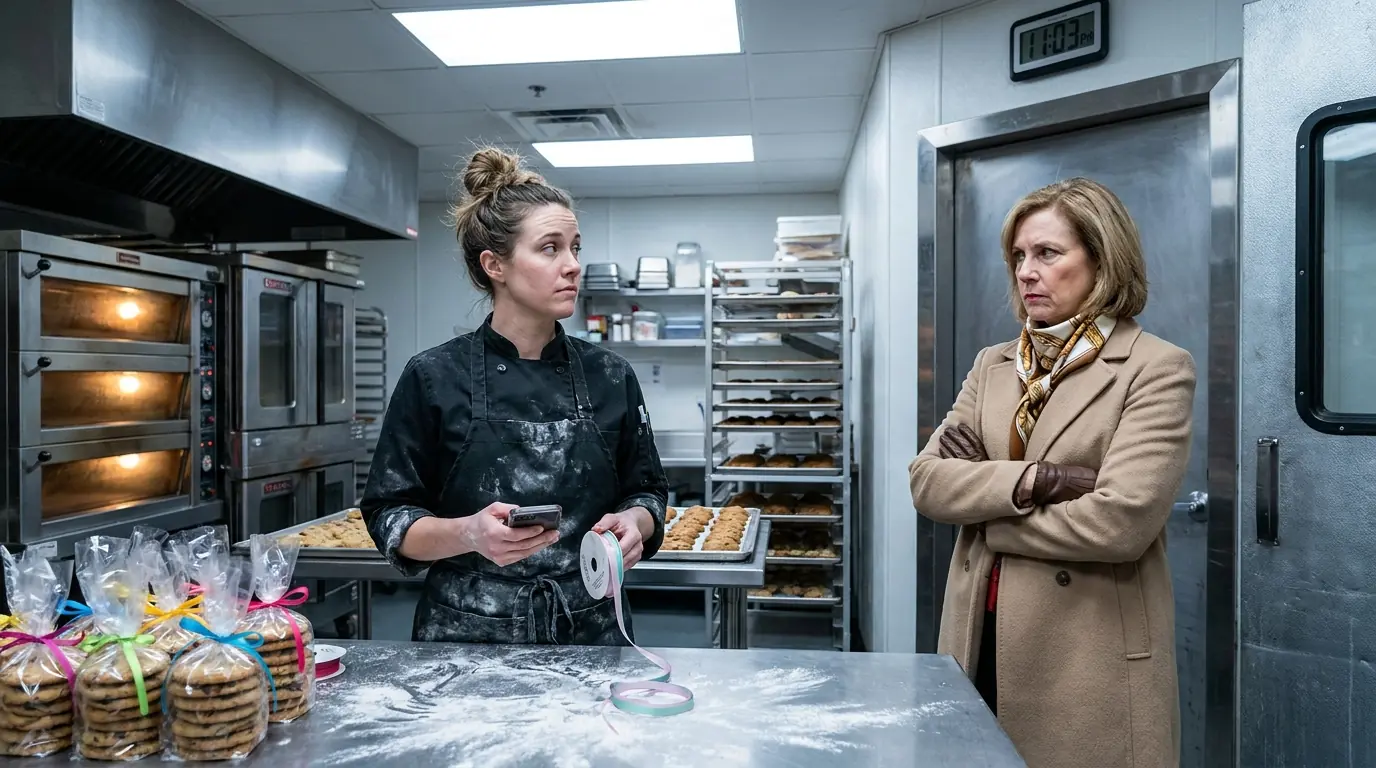
The only sound in a professional kitchen at 11:00 at night should be the hum of the refrigerator and the click of a locking door. But I was still there tying ribbons around thirty handmade cookie bags. My son Zachary was turning nine in exactly nine hours, and I had promised him everything would be perfect. No work calls, no emergencies, just us.
Then my phone lit up on the stainless steel counter. It was a text from my mother, Susan.
I canceled a party. Michelle needs you to cater her networking brunch tomorrow. It’s good exposure. Don’t be selfish.
I stared at the screen. The blue light reflected off my chef’s knife. Three seconds later, another notification popped up.
Michelle loved canceling the party.
I didn’t reply. I didn’t type out a paragraph about boundaries or promises. I didn’t call to argue. I just felt a cold, quiet switch flip in my chest.
It wasn’t anger. It was the sudden, absolute end of a very long contract. I put the phone down. I picked up my knife roll, and I started packing.
I moved with the efficiency of a line cook during a dinner rush. No wasted motion. I packed my industrial stand mixer, my collection of Japanese steel knives, and the fifty pounds of premium chocolate I had tempered for tomorrow.
I stripped the kitchen bare of every tool that made it functional. My parents owned the building, but I owned the ability to make it work.
I drove home and woke Zachary up. It was almost 1:00 in the morning.
“Hey, buddy, wake up. We’re going on a secret mission.”
He rubbed his eyes, confused but trusting. “Where?”
“To a new fortress.”
I packed his clothes and his new Lego sets into the van. I left my house key under the mat. I didn’t leave a note. Notes are for people who might be misunderstood.
I understood them perfectly.
We drove across town to the warehouse district. Larry, my old mentor, owned an industrial bakery down there. He’d given me the code to the upstairs loft years ago, telling me to use it if I ever needed a ghost kitchen.
It smelled of sourdough starter and burnt sugar. It smelled like work, but it also smelled like safety.
Zachary fell back asleep on a mattress on the floor. I sat by the window, watching the streetlights flicker, and opened my laptop. I pulled up the spreadsheet I had been keeping for three years.
I called it the family tax. Every brunch, every quick appetizer for Michelle’s friends, every holiday meal for twenty people that I shopped for, prepped, cooked, and cleaned up after. The total at the bottom of the column was $12,500.
And that was just for the last twelve months.
I wasn’t a daughter. I was a utility.
You know how you can boil a frog if you turn the heat up slowly enough? That’s what they had done to me. It started with, “Can you make a few cupcakes?” and ended with me running a full catering service for free.
I had normalized the cruelty because I thought it was the price of admission. I thought if I made myself useful enough, eventually I would be valuable. But utilities don’t get love.
They get used until they break, and then they get replaced.
I wasn’t indispensable because they loved me. I was indispensable because I was free.
I looked at Zachary sleeping. He was turning nine, and his grandmother wanted to cancel his joy for a networking opportunity.
That was the heat getting too high. That was the water boiling over.
I closed the laptop. I didn’t block their numbers yet. I wanted to see it. I wanted to see the exact moment they realized the refrigerator light was on, but nobody was home.
The morning sun hit the concrete floor of the warehouse at 7:00. It was the quietest morning I had experienced in ten years. Usually by 7:00, I would have been three hours into prep, smelling of onions and stress.
Today, I smelled coffee brewing on a hot plate and the dusty, sweet scent of flour from the bakery below.
I picked up my phone. It was dead. I plugged it in and watched the screen flicker to life. The moment it connected to the network, it vibrated so hard it almost walked off the table.
Fifty-three missed calls. Eighty-seven texts.
I scrolled through them. I was looking for one specific thing. I was looking for, “Are you okay?” or “Is Zachary safe?”
They weren’t there.
Where are you? People are arriving in an hour.
This isn’t funny.
Grace, pick up.
You are ruining my brand.
Where are the quiches?
Mom is crying.
You are selfish and jealous.
Fix this now.
I read them with a detachment that surprised me. It was like reading a script for a play I was no longer acting in. They still thought I was late. They didn’t realize I was gone.
They thought this was a delay in service, not a cancellation of the contract.
I didn’t respond. I poured a cup of coffee for myself and a glass of juice for Zachary. We sat on the floor and played a card game. I let the phone buzz against the metal table leg like a trapped insect.
Around 10:00, the tone of the messages shifted from anger to panic. The brunch had started. I logged into Instagram from a burner account I used for market research.
Michelle was live.
The video was shaky. She was standing in the dining room of my parents’ house, which she used as her studio for these events. Behind her, I saw the disaster.
Instead of my hand-rolled puff pastry tartlets and artisanal smoked salmon boards, there were plastic trays from the discount supermarket. Cubes of sweating cheddar cheese. Rubber-looking ham. A tub of generic potato salad with a lid half off.
It looked like a breakroom potluck, not a high-end networking event. Her guests, women with perfect hair and phones out, looked confused. They were filming the food, zooming in on the bright orange stickers someone had forgotten to remove from the plastic lids.
Michelle wasn’t apologizing. She wasn’t owning it. She was looking at the camera with wide, wet eyes.
Then she did the one thing that ensured I would never, ever go back.
She turned the ring light up. She put on her vulnerable face, the one she used when she wanted sponsors to pity her. She squeezed out a tear.
“I am so sorry, everyone,” she whispered into the microphone, her voice trembling perfectly. “My sister, she was supposed to be the chef today, but she’s having a mental health crisis.”
I froze. My hand tightened around my coffee mug until my knuckles turned white.
“She had a complete breakdown last night,” Michelle continued, wiping away the fake tear. “She took off with her son. We’re all so worried. She’s been unstable for a while, and honestly, we think she might be dangerous. Please, just pray for us. I’m trying to hold this event together while my family is falling apart.”
The comments started rolling in.
So brave, Michelle.
Sending prayers.
I hope she gets help.
Is the child safe?
She wasn’t just covering her tracks. She was burning my reputation to the ground to create a smokescreen for her own incompetence. In the tight-knit food industry of our city, being labeled unstable and dangerous was a professional death sentence.
No one hires a chef who might snap. No one trusts a caterer who is a flight risk. She was willing to destroy my career, my livelihood, and potentially my custody of Zachary just because she was embarrassed about serving cubed cheese.
I watched until she ended the stream. I felt the heat rising in my neck, hot and sharp. But then I looked at Zachary, who was building a tower of cards, completely safe, completely sane.
I didn’t scream. I didn’t throw the phone. I felt the temperature in my chest drop about twenty degrees.
Anger is a fire. It burns out. This wasn’t anger.
This was dry ice.
She wanted a narrative about a breakdown. Fine. I would give her a narrative, but it wouldn’t be the one she was writing.
I opened my laptop. I wasn’t a sister anymore. I wasn’t a daughter. I was a creditor.
And the bill was due.
I sat at the metal table in the loft, the glow of the laptop screen illuminating the dust motes dancing in the air. Zachary was building a fortress out of cardboard boxes in the corner, happily humming to himself.
He was safe. My reputation, however, was currently bleeding out on the internet. Michelle’s followers were eating up the tragic sister narrative. They were sending her digital hearts and prayers while she dismantled my livelihood.
I took a breath. I held it for four seconds. I let it out.
Then I opened my invoicing software.
For years, I had operated on a handshake and a guilt trip. Not anymore. I created a new client profile.
Michelle Events LLC.
I started typing.
Date of service: September 12th to August 24th.
Item one: catering services, various dates, $12,500.
Item two: rush cancellation fee, failure to provide venue access/safety, per standard contract terms, $1,500.
Item three: ingredient reimbursement, $850.
Total due: $14,850.
I didn’t send it to her personal email. I sent it to her business account, copying our parents, who I knew were silent partners in her LLC.
Next, I opened a new tab. I typed in the email address for an old friend from culinary school, Sarah, who was now a shark of a lawyer specializing in hospitality law.
Subject: Defamation / Cease and Desist.
Message: My sister is publicly claiming I am mentally unstable to cover her own health code violations. I need a letter sent today. I want a retraction, and I want damages.
I hit send. My fingers were flying now. I felt like a pianist playing a concerto of consequences.
Finally, I made the phone call that hurt the most, but was the most necessary.
I called the county health department. I knew the inspector for my district. He had given my kitchen an A rating five years running.
“Hi, Dave, it’s Grace. I’m calling to put on record that I am not the caterer of record for the event at 42 Oak Street today. I terminated the contract last night. Any food served there was not prepared by me, nor under my supervision.”
“Understood, Grace,” Dave said, his voice serious. “We had a complaint about temperature control on some potato salad anyway. We’re sending someone out.”
I hung up. I looked at the phone. It was silent now. I had turned off notifications, but I could see the outgoing messages.
This wasn’t a family dispute anymore. This was business.
Michelle wanted to play the professional victim. Fine. I would treat her like a professional liability.
I didn’t feel guilty. Guilt is for people who do something wrong. I felt the cold, hard satisfaction of a ledger finally balancing out.
I walked over to Zachary. “Hey, Fortress Commander. How about we go get some real food? I know a bakery downstairs that has the best croissants in the city.”
He grinned. “Do they have chocolate?”
“They have everything,” I said.
We walked downstairs, leaving the laptop open, the invoice sent, and the legal machinery grinding into gear.
I didn’t look back.
Three days passed in the quiet rhythm of the warehouse. I helped Larry with the morning bread bake, the repetitive motion of kneading dough soothing the jagged edges of my nerves.
My parents had tried to call, blocked numbers mostly, but the cease and desist letter Sarah sent had clearly landed. The public smearing had stopped abruptly.
Then, on Wednesday afternoon, my email pinged with a message that changed everything from a skirmish into a war.
It was from a contact at a midsized publishing house. A woman named Elena, who I had catered a launch party for two years ago.
Subject: Quick Question — The Curated Table.
Hi, Grace. I hope you’re well. I’m reviewing the final proofs for Michelle’s cookbook, The Curated Table, and I was a little confused. The manuscript notes say these are her original family recipes, but I recognized this smoked duck with cherry gastrique. Isn’t that the signature dish you made for my wedding? Just wanted to clarify credits before we go to print.
I stared at the screen. The air left my lungs.
A cookbook.
Michelle couldn’t boil water without watching a YouTube tutorial. She treated her oven like extra storage space for sweaters.
I replied immediately, “Can you send me the PDF?”
Elena sent it. I opened the file.
It was my life’s work.
There, in high-resolution glossy photos, were my recipes. My puff pastry. My forty-eight-hour bone broth. My grandmother’s secret mole sauce that I had spent six months perfecting.
She hadn’t just copied them. She had copy-pasted them from the shared family cloud drive I used to store my notes.
She hadn’t even changed the headnotes.
I developed this recipe on a rainy Tuesday when Zachary was sick.
One paragraph read: Michelle didn’t have a son named Zachary. She didn’t have a son at all.
She had stolen my memories along with my ingredients.
I scrolled to the bottom of the press release attached to the file.
Join us this Saturday for an exclusive investor gala and live cooking demonstration. Buy-in starts at $75,000. Witness the culinary genius of Michelle as she prepares a five-course tasting menu from the book live on stage.
$75,000.
She was soliciting investors for a lifestyle brand based entirely on intellectual property she had stolen from the sister she called unstable.
My first instinct was to call Elena and scream fraud, to shut it down right now. But then I looked at the date of the event.
Saturday. Three days away.
A live cooking demonstration.
The menu listed sole meunière and chocolate soufflé. These weren’t dump-and-stir recipes. These required technique, temperature control, emulsification, timing.
You couldn’t fake a soufflé. You couldn’t charm your way through a broken sauce.
If I stopped the book now, she would spin it. She would say I was jealous, that it was sabotage. She would play the victim again.
But if she stood on a stage in front of investors who had written checks for seventy-five grand and tried to cook my food, there wouldn’t be anywhere to hide.
I closed the PDF. I emailed Elena back.
Thanks for sending, Elena. I’ll handle this directly.
I didn’t tell her to stop the press. I sat back in my chair. The smell of yeast was strong in the air.
Michelle wanted to be the star. She wanted the spotlight.
I was going to let her have it.
I was going to give her the brightest, hottest spotlight she had ever seen, and I was going to watch her melt under it.
The venue for the investor gala was a converted art gallery in the city center. Industrial chic, exposed brick, and enough lighting equipment to simulate a supernova.
I arrived at 7:30. I didn’t go through the front door where the investors were sipping champagne. I went to the loading dock.
My phone buzzed. It was a text from Michelle.
Where are you? The induction burner isn’t working and the sauce broke. Mom is crying in the bathroom. I will pay you double. I will pay you triple. Please save us.
I walked into the prep kitchen. It was a scene of absolute carnage. The floor was slick with oil.
A tray of burnt puff pastry sat on a cooling rack, looking like charcoal briquettes. And there was Michelle, wearing a pristine white chef’s coat that still had the creases from the packaging, frantically whisking a bowl of gray liquid that was supposed to be a beurre blanc.
She looked up. Her mascara was running. When she saw me, her face collapsed into relief.
“Oh, thank God,” she breathed. She practically threw the whisk into the sink. “You’re here. I knew you wouldn’t do this to me. I knew you wouldn’t let me fail.”
She tried to hand me her apron.
“Fix the sauce. I have to go out and do the intro speech. Just plate the first course in ten minutes.”
She didn’t ask how I was. She didn’t apologize for the smear campaign. She just assumed that, like always, I would step in and clean up the mess because that’s what the help does.
I didn’t take the apron. I let it fall to the floor.
“No,” I said.
Michelle froze. “What?”
“I’m not here to cook, Michelle. I’m here to clarify the menu.”
I walked past her. I pushed through the swinging doors into the dining room.
The hum of conversation died down as I entered. Sixty high-net-worth individuals turned to look at me. My parents were at the head table.
My father stood up, looking furious. My mother looked like she was about to faint.
I walked straight to the lead investor, a man named Mr. Sterling, who I knew appreciated due diligence. I placed a manila folder on his table.
“Mr. Sterling,” I said, my voice calm and carrying clearly in the silent room. “Inside that folder, you will find the original creation logs for every recipe in tonight’s cookbook. You will see timestamps dating back three years, originating from my cloud drive.”
I looked back at Michelle, who was standing in the kitchen doorway, pale as a sheet.
“The person in the kitchen cannot cook this menu because she didn’t write it,” I said. “And the sauce is broken because she tried to add cold butter to hot vinegar without an emulsifier. Enjoy your evening.”
I didn’t wait for the explosion. I turned around and walked out the front door.
I heard my mother scream my name, but it sounded far away, like a noise from a television in another room.
The collapse wasn’t slow. It was instant. Mr. Sterling pulled his $75,000 before the valet even brought his car around. The other investors followed.
The publishing house canceled the book deal the next morning for breach of contract and intellectual property theft.
Two days later, my father called. I let it go to voicemail. I listened to it later, sitting on the balcony of the warehouse with a glass of cheap wine.
“You’ve destroyed us,” he said. His voice sounded old. “We put everything into Michelle’s brand. Our retirement accounts, the equity in the house, it’s all gone. I hope you’re happy.”
I sat there looking at the city skyline, and I realized something profound.
I hadn’t destroyed them. I had just stopped propping them up.
For years, I thought Michelle was the golden child, the one with the shine, the charisma, the success. I thought I was just the support beam. But looking at the wreckage of their finances, I finally understood the math.
Michelle was an empty wallet. She had the logo, the stitching, and the expensive leather. But there was no currency inside.
I was the currency.
I was the labor, the talent, and the grit.
When I removed myself, the wallet didn’t just become thin. It became worthless.
My parents hadn’t invested in a business. They had invested in a mirage. And when the wind blew the sand away, they blamed the wind instead of their own lack of vision.
My phone rang again. My mother this time.
I looked at the screen. For a second, I felt that old pull, the invisible chain that yanks you back into the line of fire because you’re afraid of being the bad guy.
It’s the survivor’s guilt, the feeling that saving yourself is an act of cruelty. But I looked over at Zachary. He was sitting on a stool frosting a cake.
It wasn’t perfect. It was lopsided and blue. But it was his.
I realized that breaking the chain didn’t make me cruel. It made me free. Holding on to the guilt was the only thing keeping us connected, and I was done being the anchor for a sinking ship.
I declined the call. Then I blocked the number.
I walked over to the counter. “Ready for the grand opening?” I asked.
Zachary grinned. “Yes, Chef.”
We opened the doors to the warehouse. I had used the last of my savings to buy tables and chairs from a restaurant liquidation. I had posted a simple menu on social media.
Real food made by the person who wrote the recipes.
We sold out in an hour.
The food critic from the city paper came. She didn’t write about drama or scandals. She wrote about the bread. She wrote that you could taste the integrity in the soup.
I served a slice of the lopsided blue cake to Zachary at the end of the night. We sat on the loading dock, eating in silence, watching the stars.
I wasn’t a daughter anymore. I wasn’t a sister.
I was Grace.
And for the first time in my life, my table was full.