What kind of family sends a broken woman to a broken man and calls it a joke?
The winter of 1888 came early to the Montana Territory, painting the mountains white and cruel. Snow draped the ridges like a burial shroud, the kind that swallows color, warmth, and hope all at once.
Twenty miles from the nearest town of Bitter Creek stood a ranch, lonely as its owner. Caleb Dwire gripped a fence post, his breath fogging the cold air, his bad leg throbbing like fire under his heavy coat.
The injury was an old enemy. Three years of pain since the rodeo accident that turned him from cowboy to cripple. At thirty-two, Caleb moved like a man twice his age.
Every limp carried the ghost of what he used to be. Once, he had been strong, proud, and quick in the saddle, the kind of man who drew cheers at rodeos and sighs from girls in Sunday bonnets. But one bad fall had taken it all.
His fiancée, Sarah Beth, had visited him once in the hospital, left her ring on the bedside table, and walked out without a word. By the time he’d learned to hobble again, she’d married the banker’s son.
The story spread like wildfire.
Poor Caleb. Good heart, but damaged goods.
Now he lived out here, half-forgotten, the crippled rancher of Bitter Creek. His house was little more than two rooms of rough logs, a stone chimney that smoked when the wind blew wrong, and windows that rattled at night.
The barn stood sturdier because animals mattered more than comfort. Fifteen cattle, a dozen chickens, two horses, and a mule named Moses, who hated everyone. That was his world.
Inside, the place was clean but bare. A bed, a stove, one chair, and silence that could crush a man if he let it.
That was why the letter had hit him so strangely when it came two weeks ago. Delivered by Tommy Morrison, the mail boy with too many freckles and not enough sense, Caleb had read the words a hundred times.
Dear Mr. Dwire,
Your request for a mail-order bride has been received and processed. We have found a suitable match. A widow woman of good character who is eager to begin a new life in the Western Territories. Mrs. Miriam Fletcher, aged thirty, will arrive by stage on November 15th. Please remit final payment of twenty dollars.
A widow.
That had caught his attention. No young woman of comfort would marry a stranger out here. Only someone desperate or hiding from something, just like him.
The whole thing had been his sister Elizabeth’s idea.
“You need a woman’s touch,” she’d written, pretending kindness while really trying to rid the family of guilt.
His brother James had called him a burden. His mother wrote less these days, her letters filled with news about grandchildren from the other siblings. He’d sent the money mostly to stop their pity.
But tonight, on the eve of her arrival, Caleb felt the kind of nerves he hadn’t known since before the accident. He stared into the cracked mirror, studying the man he’d become.
His once-dark hair was streaked with gray. Lines carved his face deep. His green eyes, Sarah Beth used to call them his best feature, looked hollow.
He shaved as best he could, combed his hair, and pulled on his cleanest shirt. The jacket was his father’s old wool one, patched but sturdy. His boots, bought before the fall, he polished until they almost shone.
When the morning came, the air bit hard and bright. Caleb hitched up the wagon, fighting through the pain that burned from knee to hip. Moses kicked at the harness, mule-headed as ever, but they set out anyway.
The road to Bitter Creek was long and brutal, frozen ruts jolting every bone. By the time the town came into view, Caleb’s hands were white from gripping the reins.
He was early. The stage wouldn’t arrive till noon. So he stopped at Doc Hartwell’s office for a dose of laudanum to dull the pain.
“Not forever,” Caleb said. “Just through today.”
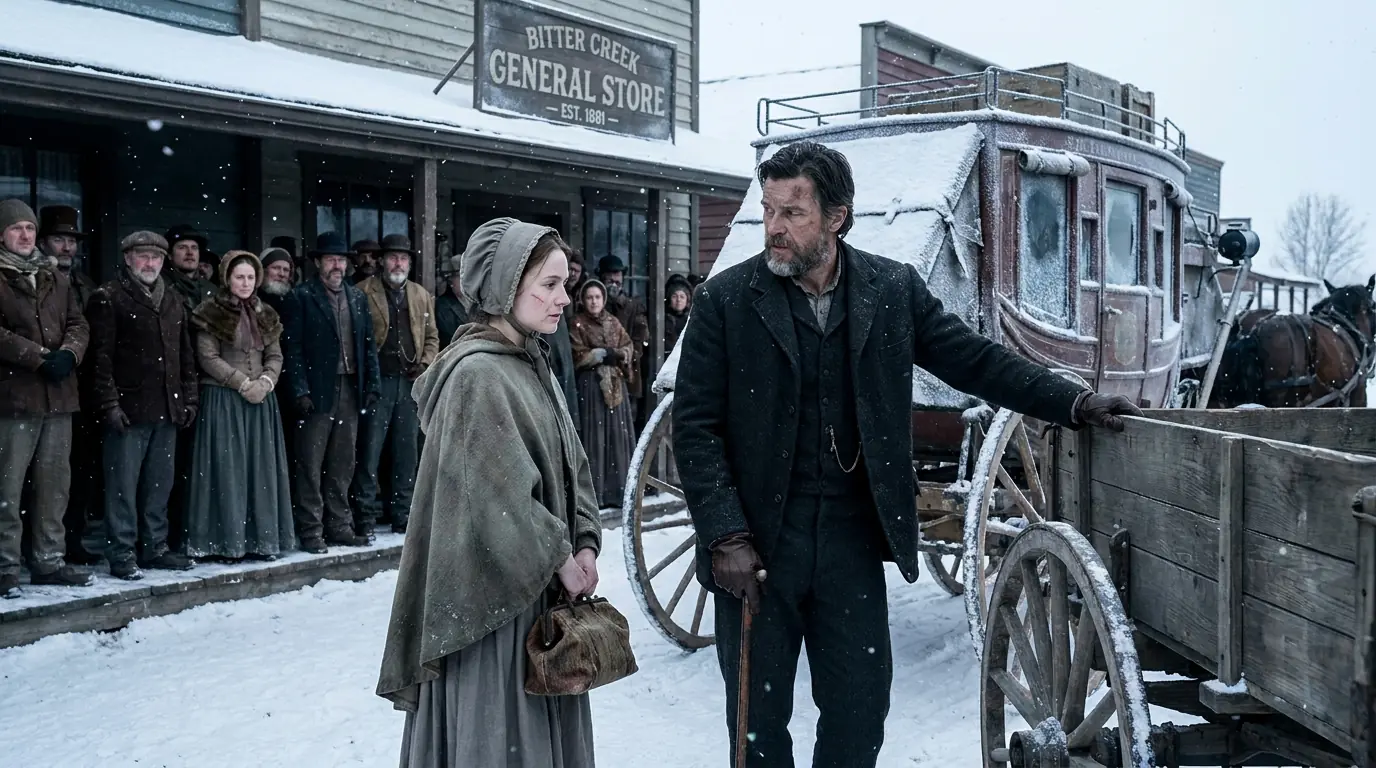
By the time the stagecoach thundered down Main Street, half the town had gathered to watch. Folks loved a show, especially when it was at someone else’s expense.
The cripple’s mail-order bride.
Everyone wanted a look.
The stage ground to a stop in a cloud of dust and cold wind. An elderly couple stepped down first, then a traveling salesman.
No one else followed.
Caleb’s chest tightened.
She hadn’t come.
Then the driver turned toward the coach door.
“Ma’am, this is your stop, ain’t it?”
A gloved hand appeared, gripping the frame. Then a woman stepped down. Slow and careful.
Her cloak was faded. Her bonnet frayed at the edges. She carried a single small carpetbag. For a moment, she didn’t move, just looked around like someone searching for courage.
Caleb took a step forward and froze.
A pale scar, faint but unmistakable, ran from her left temple down across her cheek. She turned, and her brown eyes met his, large, solemn, and full of quiet resignation.
“Mr. Dwire?” she asked softly.
He nodded, unable to speak.
Behind him, someone snickered.
“Looks like he got what he paid for.”
Miriam flinched, but she didn’t turn. She just stood there, chin high, hands trembling around her bag. Caleb’s jaw clenched.
Whatever cruel joke his family had played, he would not add to it.
“Let me take your bag,” he said.
“I can manage,” she replied gently.
The two of them, both limping, both scarred, stood in the cold street while the town whispered. Then, without another word, Caleb gestured toward his wagon.
“It’s a long ride to the ranch. We should go.”
Miriam nodded, and as she climbed into the seat beside him, he noticed she too favored one leg. The journey began in silence, wheels creaking over frozen ground.
After an hour, he spoke, his voice rough.
“There’s a blanket behind the seat if you’re cold.”
“Thank you,” she said, her movements careful, precise.
The scent of lavender drifted faintly from her cloak.
When they finally crested the ridge, Caleb pointed toward the valley below.
“That’s home.”
Miriam studied the sight. A small house, a leaning barn, nothing but emptiness around.
“It’s peaceful,” she said.
“It’s isolated,” he corrected.
“Good,” she whispered.
He looked at her then, really looked, and wondered what kind of pain made a woman call loneliness good.
By the time they reached the ranch, the light was fading. He helped her down, trying not to wince as his bad leg buckled. She steadied him without a word.
Inside, she looked around the bare room and said simply, “It’s warm. That’s enough.”
Then, with quiet purpose, she hung her cloak, rolled up her sleeves, and began to cook. Within an hour, the house smelled of salt pork and beans. She even cleaned as she worked, humming softly under her breath.
Caleb sat at the table, watching her move, small, graceful, marked by scars, but unbroken.
When she set the bowl before him, she said, “You need to eat more than I do.”
He wanted to protest, but she was already tidying up. When he finally stood to leave for the barn, she turned to him.
“Thank you,” she said quietly, “for not asking questions.”
He paused at the door.
“We all have things we’d rather not tell.”
Outside, the snow began to fall again, soft and endless. For the first time in years, when Caleb lay down in the barn beside his mule, he wasn’t completely alone.
Somewhere beyond the wall, a woman with a scar was breathing in his house. His wife now, for better or worse.
And though he didn’t know it yet, everything in his lonely world was about to change.
The next morning dawned gray and bitterly cold, the kind of morning that promised a long winter ahead. Caleb rose early, joints stiff from a night in the barn.
He could see lamplight flickering through the house window.
She was awake.
When he limped inside, the smell of coffee and frying cornmeal greeted him. Miriam stood by the stove, her hair pulled back neatly, her sleeves rolled to the elbow.
She didn’t startle when he entered, just turned slightly, her expression calm.
“I hope you don’t mind,” she said. “I thought it best to begin early. The stove smokes a little, but I’ll manage.”
“You made breakfast?” he asked, surprised.
“It seemed expected of a wife.”
Her tone was simple, without bitterness, but the word wife landed heavy between them.
They ate quietly. The food was plain but good, and it had been a long time since Caleb had shared a meal with anyone. Every so often, he’d glance up to find her eyes on him, soft but unreadable.
When she began to clear the dishes, he said, “You don’t have to do all that. I’m not used to—”
“Neither am I,” she interrupted gently. “But we’ll learn.”
That afternoon, she joined him in the barn, insisting she could help feed the stock.
“You’ll catch your death out here,” he warned.
But she smiled faintly.
“I’ve lived through worse.”
He watched her move among the animals, hesitant at first, then sure. She spoke softly to Moses, the mean-tempered mule, who usually bit at strangers.
To Caleb’s astonishment, the mule allowed her to pat his neck without fuss.
“He likes you,” Caleb said.
“Animals know kindness,” she replied. “They don’t care about scars or limps.”
Her words stung more than she meant them to.
The days began to settle into a rhythm. Miriam worked with quiet determination, cleaning, cooking, repairing what could be repaired. By the end of the first week, the house looked transformed.
Curtains made from flour sacks. The floor swept clean, shelves tidied. It still wasn’t warm. Not yet. But it felt less empty.
She spoke little of her past, and Caleb didn’t pry. But he noticed things. How she flinched when voices rose. How she never turned her left side fully toward the window light.
She carried her pain quietly, the same way he carried his.
One night, as he stacked firewood near the door, she said softly, “You don’t have to sleep in the barn, you know.”
He hesitated.
“I figured it was best for now.”
She nodded.
“For now.”
Two weeks passed before they went to town for supplies. The flour barrel was nearly empty, and Miriam had written a list in neat, careful handwriting.
“I’ll go alone,” Caleb said, not wanting her to face the town folks’ gossip.
But she shook her head.
“I’m your wife. I can stand beside you.”
The road was rough and the ride silent. As they reached Bitter Creek, Caleb warned, “They’ll talk. Ignore them.”
“I’ve heard worse than whispers,” she said, her voice steady.
Inside the mercantile, every head turned. Mrs. Pritchard, the shopkeeper, pasted on a false smile.
“Mr. Dwire, and this must be your wife.”
“Miriam Dwire,” she replied, firm but polite. “Good morning.”
Caleb saw Mrs. Pritchard’s eyes flick to the scar, then away. The whispers started as they moved through the aisles.
“Poor thing,” one woman murmured. “Desperate enough to marry him.”
Another snickered. “Matched in misery, those two.”
Miriam’s shoulders tightened, but she didn’t flinch. She picked up a sack of flour, added beans, salt, and sugar to the pile.
Her hands didn’t tremble until a group of young men near the door started laughing.
“Hey, Dwire,” one called, “that your bride? Looks like you got the short end of the deal.”
Caleb’s blood boiled. He turned, jaw tight.
“You want to say that again?”
The biggest of them smirked.
“Relax. We’re just having fun. Ain’t every day a cripple brings home a scarred woman.”
Before Caleb could move, the man took a step closer, lips curling.
“Maybe she’d rather have a real man.”
Caleb’s fist connected with the man’s jaw before he could say another word. Pain shot through his leg as he pivoted, but rage carried him forward.
He landed another punch before a boot caught his bad knee, sending him crashing down. He tasted dirt and blood.
Then came the sound of Miriam’s voice, low but sharp as a whip.
“Stop it.”
Everything froze.
She stood over him, bonnet fallen, scar in full view, eyes blazing.
“My husband is more man than any of you,” she said quietly. “And I’ll thank you to remember that.”
The men stepped back, shamed. Even the sheriff who’d appeared in the doorway looked startled by her fire.
“That’s enough,” he said. “Go on, all of you.”
Miriam knelt beside Caleb, her hand trembling as she wiped the blood from his face with a handkerchief.
“Can you stand?”
“Barely,” he grunted.
She helped him up, her strength surprising. The room had gone silent. Every eye followed them as she guided him out, head held high.
They didn’t speak until they were well out of town. The wagon wheels creaked, the wind biting at their faces.
“You didn’t have to do that,” Caleb said finally.
“Neither did you,” she replied. “But I’m grateful you did.”
“I made it worse. They’ll talk even more now.”
“Let them,” she said, eyes forward. “I’ve been called worse things.”
He looked at her then, really looked. The afternoon light caught her face, softening the scar. She wasn’t beautiful in the way he once thought beauty meant, but there was something in her strength, her quiet courage, that struck deeper.
After a long silence, he said, “I wasn’t always like this, you know. Before the accident.”
“I know,” she interrupted gently. “You don’t have to prove anything to me, Caleb.”
He blinked.
“You don’t think you deserve better?”
She turned to face him fully, eyes steady.
“My first husband was strong, healthy, and cruel. He gave me this scar.”
She paused, fingers brushing it lightly.
“You fought for me today. That’s worth more than any perfect face or steady leg.”
The words hit him harder than any punch he’d taken.
When they reached the ranch, she helped him inside, insisting he sit while she tended his cuts. Her touch was gentle, practiced. He wondered who she’d learned that from, and suspected the answer.
“There,” she said softly, dabbing the last of the blood from his temple. “You’ll be sore, but you’ll live.”
He caught her hand before she could pull away.
“Thank you,” he said quietly.
She looked at their joined hands, then at him. Slowly, she placed her other hand over his.
“We’re both still healing, Caleb. Maybe we can do it together.”
That night, he lay in bed for the first time in years. She took the barn instead, claiming he needed the rest. But through the window, he saw her lantern glow in the dark, steady and warm.
And as the snow fell outside, he realized that for the first time since his accident, he didn’t dread tomorrow. Because for the first time in a long while, someone had chosen to stand beside him.
Scars, limp, and all.
The storm hit two nights later, fierce and howling, rattling the windows and bending the few pines that guarded the valley. Caleb fought through knee-deep drifts to reach the barn, his bad leg nearly buckling with every step.
By the time he came back inside, soaked and shivering, Miriam was waiting by the fire with coffee and blankets.
“Are the cattle safe?” she asked, helping him peel off his coat.
“They’ll be fine,” he said, teeth chattering. “Barn’s tight enough.”
She guided him toward the stove with firm, capable hands.
“Sit down before you fall down.”
He obeyed, too cold and too tired to protest. Miriam knelt beside him, rubbing warmth back into his hands, her eyes full of quiet concern.
In that moment, something shifted between them. The unspoken wall they’d both been hiding behind began to crumble.
“You shouldn’t have gone out alone,” she murmured.
“I’ve been alone a long time,” he said. “Hard habit to break.”
“Then maybe it’s time you did,” she whispered.
That night, the wind roared outside while the two of them sat near the stove. Miriam read softly from her small, worn Bible. Her voice was calm, steady, the sound of peace in a world that rarely offered any.
When she finished, Caleb said, “That verse, it could have been written about you.”
She gave a faint smile.
“Hardly. I’m no one’s idea of a perfect wife.”
“You’re mine,” he said quietly.
Miriam looked up, startled. Their eyes met, and neither looked away. Slowly, cautiously, she reached out.
Their hands touched, one rough, one scarred, both trembling. The silence between them was full of things they didn’t yet know how to say.
“I’m frightened,” she admitted at last.
“So am I,” he said.
Outside, the blizzard screamed. Inside, two broken souls sat side by side, holding on to something fragile and new.
They fell asleep that way, her head resting lightly on his shoulder, his arm around her. When dawn came, the storm had passed, leaving a world blanketed in white and silence.
For the first time, Caleb woke with warmth in his chest that had nothing to do with fire.
Days turned into weeks, and the house no longer felt like exile. Miriam hummed as she worked, laughter sometimes bubbling from her lips. Caleb found himself smiling more, even joking with her on rare occasions.
When she baked her first loaf of bread, he told her it was the best he’d ever eaten, and she blushed like a girl half her age.
One evening after supper, she asked softly, “Do you ever miss it? The rodeo?”
He stared into the fire.
“Sometimes. Mostly, I miss feeling whole.”
She hesitated, then reached across the table to cover his hand with hers.
“You are whole, Caleb. Just in a different way.”
That night, she woke screaming, trapped in one of the nightmares that sometimes came to her. Caleb rushed from his bed, finding her sitting up, shaking, eyes wide with terror.
“Miriam,” he said gently, sitting beside her. “It’s all right. You’re safe.”
“I saw him,” she whispered. “My first husband. He was here. He—”
He took her trembling hands.
“He can’t hurt you anymore.”
She clung to him and, for the first time, let the tears fall freely.
“I’m so tired of being afraid,” she said.
“You’re not alone anymore,” he murmured. “Not now, not ever.”
She lifted her face to his, eyes glistening, and before he could think, before she could speak, she kissed him softly, like a question. He answered without hesitation.
It wasn’t passion that guided them. Not at first. It was need, the human kind, for warmth, for trust, for the safety of another heartbeat close by.
They lay together, clothed, just holding each other as the storm outside began again.
“I think,” she whispered against his chest, “I could learn to love you if you’re patient.”
He smiled, brushing a hand over her hair.
“Miriam, I’ve got nothing but time.”
When morning came, she was still there, sleeping peacefully beside him. For the first time in years, neither of them dreamed of pain.
Spring arrived slowly in the Montana valley, turning snow to mud and mud to green. With it came laughter and something else, too.
Miriam began to hum as she worked in the garden, one hand unconsciously resting over her belly. Caleb noticed.
“You feeling all right?”
She looked up at him, brown eyes shining with both fear and joy.
“I think we’re going to have a baby.”
For a long moment, he couldn’t speak. Then he crossed to her, dropped to his knees despite the pain in his leg, and pressed his hand gently to her stomach.
“A baby,” he whispered. “Our baby.”
Tears filled her eyes.
“I was afraid to tell you after everything.”
He silenced her with a kiss.
“Don’t be afraid. Not anymore.”
That summer, the ranch was alive with new purpose. Caleb built a cradle from pine, carving it carefully by hand. Miriam sewed tiny clothes by the firelight, her belly round beneath her apron.
The town that once mocked them now came to seek her advice. The banker’s wife sent gifts. Mrs. Pritchard apologized. Even Doc Hartwell tipped his hat to her in genuine respect.
When winter returned, it brought more than snow.
It brought life.
Their daughter came screaming into the world on a cold December night, healthy and strong. Miriam wept as she held the tiny bundle.
“What should we name her?” Caleb asked, his voice thick with emotion.
“Grace,” Miriam whispered. “Because that’s what she is.”
Grace Elizabeth Dwire.
The miracle born of two people the world had cast aside.
Months later, as the spring sun melted the last of the snow, Caleb watched his wife standing in the yard, baby Grace cradled against her chest. Her hair glowed in the light, the faint scar on her cheek soft and beautiful now, like a mark of survival.
He stepped behind her, wrapping his arms around them both.
“Remember when you called this place a curse?” she said softly.
He nodded.
“It was never a curse,” she said. “It was waiting for us.”
He smiled, resting his chin on her shoulder.
“Guess my family’s joke turned out to be the best thing that ever happened to me.”
She turned to kiss him, laughter in her eyes.
“Then let them laugh.”
And they did.
The crippled rancher and the scarred widow. Two souls the world thought unworthy. Two people who built something stronger than beauty, stronger than pride.
A home, a family, a love that healed what life had broken.
Outside, the wind swept across the prairie, carrying the scent of pine and promise. Inside, laughter echoed through the small log house, the sound of grace, of forgiveness, of everything they’d both thought they’d never have again.
Because sometimes what begins as a cruel joke becomes a miracle.