Rain had a way of clinging to London when sorrow wished to make itself known.
It settled as a thin mist over gas lamps and cobblestones, softening the city into dull shades of gray. On such an afternoon, she stood outside a dressmaker’s window, her worn shawl pulled tight around her shoulders. The cold she felt did not come from the weather. It lived deeper, in the hollow space grief had carved inside her.
Under the same awning nearby, two women lingered. They spoke softly, as though kindness guided them, yet their words carried sharp edges meant to wound. They pretended not to see her, but their eyes flicked in her direction all the same.
“Her father left nothing,” one murmured. “A gentleman in name only. Debts everywhere, no estate, no protection for his daughter.”
“And the engagement?” the other asked too casually.
“Broken, I hear, just days before the wedding.”
She knew better than to look at them. If she did, they would see the crack she worked so hard to hide. Her fingers tightened around the shawl.
The street bustled with life around her, carriages rolling across wet stone, vendors calling beneath dripping canvas. Yet the world felt small, narrowed to the sharp awareness of being seen and dismissed as already ruined.
Her father had died three months earlier. He left behind no comfort, only ledgers heavy with red ink. The estate was taken. The furniture sold.
Her name was now spoken with pity, never warmth. The man she once planned to marry had sent a letter, brief and polite.
This union is no longer feasible.
Feasible, as though love were measured by coin.
She turned away from the window and walked on, letting the rain cling to her lashes. She had nowhere to go except where pride no longer mattered.
The carriage house.
Inside, the air smelled of damp wool and horsehair. Voices murmured over posted work. Some positions were hard, others humiliating. She searched for something quiet, something that did not demand strength she no longer possessed.
One notice caught her eye.
Caretaker sought for infant at Hawthorne Hall. Discretion required. Immediate placement. Generous wage.
Hawthorne Hall. The name stirred memory. A duke’s estate. A recent tragedy whispered through drawing rooms and chapels.
A young duchess dead in childbirth. A child left motherless before his first breath had steadied. The Duke himself had not been seen since the funeral. Some said grief had hollowed him. Others claimed the house was haunted.
Ruin recognizing ruin.
The carriage ride took most of the afternoon. Rain followed her the entire way, soft and steady. Hawthorne Hall rose from the moorlands like a solemn memory.
Gray stones softened by ivy. Tall windows reflecting only clouded sky. It was not unwelcoming. It was grieving.
A butler led her through quiet halls. Portraits watched from the walls, faces heavy with history. The air smelled of beeswax and cold hearths.
No laughter lived here, only echoes.
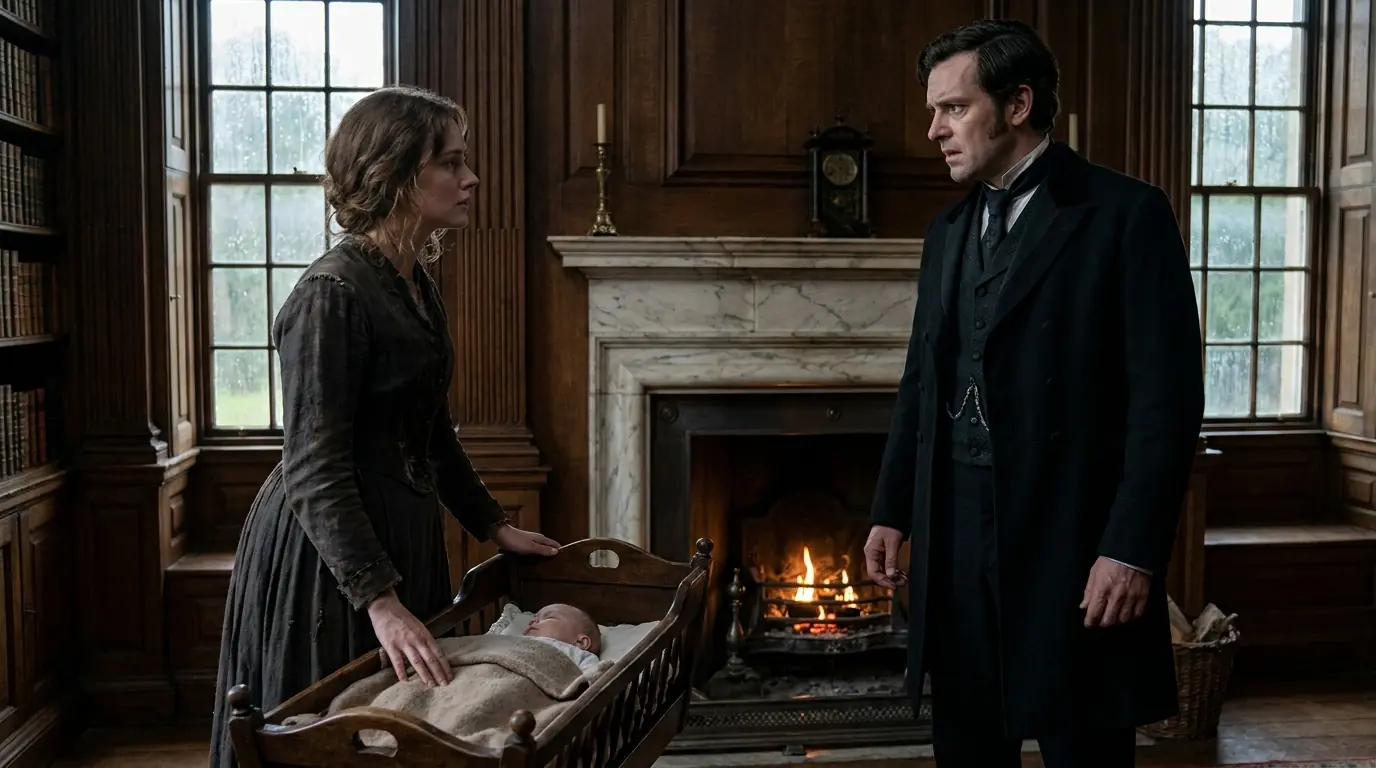
They entered a small sitting room where a carved cradle stood near the fire. Inside lay a tiny boy wrapped carefully. His cheeks were pale, his breath shallow. A nurse hovered nearby, anxious.
The child had not cried properly in days.
Then the Duke appeared. He did not announce himself. He simply stood in the doorway, tall, still.
His grief was not loud. It was carved into his posture, into the tired lines of his face. His eyes rested on the child before lifting to her.
“You arrived sooner than expected,” he said quietly.
“Yes, Your Grace.”
He studied her, not with cruelty, not with kindness. With caution.
“The child is unwell,” he said. “Not in body. The doctors insist he is strong. Yet he refuses to be held. He will not eat. He barely sleeps.”
She knelt beside the cradle. The child whimpered, frightened rather than weak. She did not think. She reached out and lifted him gently.
The change was instant.
His small fists clutched her shawl. His cry stopped. The room stilled. The nurse crossed herself.
The Duke did not move. Yet something shifted behind his eyes.
“What is your name?” he asked.
She told him.
“If you are willing,” he said, “the position is yours.”
She expected relief. Instead, she felt the weight of something fragile settling into her arms.
The days that followed were quiet. Too quiet. The house seemed to test her, revealing itself slowly.
She learned its rhythms. The soft tread of servants, the cook humming to keep loneliness away. The Duke appearing only when needed, silent and controlled.
No one spoke of the Duchess. Yet her presence lingered everywhere: in the drawn curtains, in the faint scent of lavender in the nursery, in the way the Duke sometimes stared at an empty chair.
The child changed quickly. He slept. He ate. He reached for her when she entered the room.
The house noticed. So did the servants. Small kindnesses appeared. Extra blankets. Warm bread. Gentle looks.
Then the whispers began.
They came from outside first. From a milk cart driver who glanced toward the nursery windows. From townsfolk who spoke too softly and smiled too sharply.
A young woman living in the Duke’s house. Too soon after mourning. Too close to the child.
The Duke addressed it one morning as she entered the dining room.
“You are spoken of in town,” he said.
“I suspected as much.”
He exhaled slowly. “If it troubles you, I can make arrangements.”
She shook her head. “I can remain unseen if needed.”
“No.”
The word was sharp.
“You have restored life to this house. I will not hide you as though you were shameful.”
That afternoon, she found a small carved wooden bird outside her chamber door, old, carefully cleaned. She did not ask who left it.
She knew.
The Duke said nothing. He did not need to.
By the second week, his sister arrived without warning. Silk and sharp glances, she observed everything. The child in her arms. The calm in the nursery.
“Indispensable,” the sister remarked lightly. “Indispensable can become dangerous when whispers grow loud.”
Later, her voice carried through an open doorway.
“If she remains, the family may contest the child. They will say the household is compromised.”
“I will not lose my son,” the Duke replied.
“Then you must act,” his sister said.
That evening, the Duke stood by the hearth, his hands clasped tightly behind his back.
“They mean to take him,” he said. “They claim grief has made me unfit. They will listen to whispers unless silenced.”
She understood before he spoke again.
“I ask this not for myself,” he said. “Only for him. Pretend to be my wife. For one week, long enough to prove stability.”
The words settled heavily between them. She looked at the child sleeping against her shoulder.
“One week,” he repeated.
Her heart beat hard, knowing already that one week could change everything.
Morning arrived softly at Hawthorne Hall, as though the house feared waking too loudly. Pale light slipped through tall windows, resting gently on stone floors and quiet furniture.
She rose before the bells, the child already stirring in his cradle. His small sounds were familiar now, not cries, but questions, asking the world if it was safe to greet the day.
She lifted him carefully, breathing in the warmth of him. For a moment, she forgot the weight of what she had agreed to.
Then the memory returned, steady and unavoidable.
One week. A borrowed role. A borrowed name.
The Duke was waiting in the breakfast room when she arrived. He stood by the window, hands clasped behind his back, staring out at the gray sky.
He turned when he heard her steps. For the first time since she had known him, uncertainty crossed his face.
“We should speak of how this will be done,” he said.
She nodded. The child rested calmly against her shoulder, unaware that his future had become the subject of careful planning.
“To the world, you will be my wife,” the Duke continued. “We will dine together, appear together, attend the winter assembly. The household must reflect order.”
“And privately?” she asked.
“Privately?” he hesitated. “We will remain exactly as we are, respectful, honest.”
Relief and disappointment mingled inside her, equal and confusing.
“That seems wise,” she said.
The servants were informed that morning. The announcement was made without ceremony, yet it spread through the hall like a change in weather. Some faces showed surprise, others approval.
None questioned it aloud. Titles had a way of quieting curiosity.
The seamstress arrived before noon. She measured carefully, her hands efficient, her mouth discreetly silent.
The gown chosen was modest, elegant, suitable for a duchess who did not wish to draw attention, yet could not escape it.
That evening, the Duke offered his arm as they walked through the hall. The gesture was practiced, expected. Yet when her hand rested lightly on his sleeve, she felt the tension beneath the fabric.
He was aware of her in a way he had never allowed himself to be before.
They ate together that night. The child slept nearby, his cradle drawn close.
Conversation was gentle, careful. They spoke of the household, of necessary appearances, of nothing that touched the heart too closely.
But silence has its own language.
As days passed, the act became easier and more dangerous. They learned how to stand together, how to exchange glances that appeared natural, how to share space without drawing notice.
The servants adjusted quickly, addressing her with quiet respect. The house responded as though recognizing a balance restored.
The child thrived. He laughed now, small sounds of delight that echoed through rooms long unused to joy.
The Duke watched these moments closely, his expression softened by wonder and fear. Fear that this peace could be taken away.
One evening, as rain returned to the windows, they sat in the library. The fire burned low. The child slept in the Duke’s arms, his tiny fingers curled around a finger far larger than his own.
“I was not kind to her,” the Duke said suddenly.
She looked up. “To your wife?”
“Yes. I respected her. I fulfilled my duty. But love was never part of the arrangement. When she died, I mourned the idea of what should have been more than what was.”
“You cannot force love,” she said gently.
“No,” he agreed. “But you can recognize it when it arrives.”
The words settled between them, heavy with meaning neither dared to name.
The winter assembly loomed closer. Invitations arrived. Visitors called. Each appearance was a test. Each smile measured.
She felt the weight of borrowed dignity pressing on her shoulders. At night, alone in her chamber, doubt crept in.
What would remain when the week ended? What would she become once more?
The Duke’s sister returned three days before the assembly. She watched closely, her sharp gaze missing nothing. Later, she cornered the caretaker in the corridor.
“You play your role well,” she said. “But remember, borrowed places are the most fragile.”
That night, the Duke found her standing by the nursery window, staring out into darkness.
“She doubts me,” he said quietly.
“She doubts everyone.”
“Do you doubt me?” he asked.
She turned. The question was not about the arrangement. It was about something deeper.
“I doubt myself,” she answered honestly.
He nodded as though he understood that more than any reassurance.
The night of the assembly arrived wrapped in cold and light. Hawthorne Hall gleamed as it had not in months. Carriages lined the drive. Music filled the air.
She stood at the top of the stairs, her gown pale and soft, her hands trembling despite herself.
The Duke waited below. When he looked up, something changed in his face.
Not pride, not possession. Something quieter, and far more dangerous.
They descended together. The room stilled. Eyes followed. Whispers fluttered like trapped birds.
She held her head high, every step measured. The Duke remained close, his presence steady, protective without display.
A gentleman stepped forward, his smile sharp with intent. He spoke of rumors, of her past, of questions that needed answering.
The Duke answered before she could. His voice carried across the room, calm and firm. He spoke of loyalty, of care, of the woman who had saved his son when grief had silenced the house.
The attention was unbearable. She felt heat rise. Tears threatened.
She excused herself before the music resumed.
In the corridor beyond, the air was cool and quiet. She pressed a hand to her chest, breathing through the ache.
He followed moments later.
“You should not have defended me so openly,” she said without turning.
“I could not remain silent.”
“When this ends,” she whispered, “I will bear the weight of it alone.”
He stepped closer. “Do you truly believe I asked for one week because I intended for it to end?”
Her breath caught.
“Do not offer kindness you cannot sustain.”
Before he could answer, a small cry echoed from the nursery. The sound cut through them both.
The child needed them.
And in that moment, she understood that the most dangerous part of pretending was how easily it became real, far too real.
Dawn crept over Hawthorne Hall like a cautious promise. Pale light brushed the stone walls, unsure whether it was welcome.
She had not slept. Every sound felt sharp, every thought heavy.
The child lay in his cradle beside her bed, his small chest rising and falling in peaceful rhythm. He trusted this place. He trusted her.
That trust was what broke her resolve.
She dressed quietly, moving with care, so as not to wake him. The gown she chose was plain. It belonged to the woman she had been before borrowed titles and borrowed futures.
If she was to leave, she would leave as herself.
Her hand was on the door when it opened. The Duke stood there, soaked from the rain. His coat hung heavy with water. His hair clung to his brow.
He looked as though he had been standing in the corridor all night, held upright by nothing but will.
“Do not go,” he said.
She lowered her gaze. “If I stay, they will destroy me with whispers. I will become a shadow clinging to your name. And when this ends, I will have nothing left.”
“I do not care what they say of me,” he replied.
“But I do,” she said softly. “I cannot live on kindness that is meant to expire. I cannot replace a woman you lost. I cannot belong where I have no right.”
His voice was no longer that of a duke. It was the voice of a man stripped bare by truth.
“You belong because this house breathes when you are in it. You belong because my son reaches for you. You belong because my heart has already chosen you.”
Her breath shook. She wanted to believe him more than she had ever wanted anything.
Carriage wheels thundered outside. Voices rose in the courtyard. Firm voices. Certain voices.
“They have come,” he said. “They mean to take him today.”
Fear cleared her mind in an instant. She lifted the child from his cradle and followed the Duke down the stairs without hesitation.
The entrance hall filled quickly with rigid figures. His aunt stood tall and unyielding, his uncle beside her. A solicitor held papers sealed in red.
“The household is compromised,” the aunt declared. “The child must be placed where judgment is sound.”
The Duke stepped forward. “This house is sound.”
The solicitor cleared his throat. “Grief clouds reason. The court requires proof of stability.”
She moved then, not behind him, but beside him. The child stirred, his small hand gripping her gown. Her voice was quiet but clear.
“This child is fed. He is held. He is loved. You may question appearances, but you cannot question care.”
The aunt’s eyes narrowed. “You speak boldly for one without place here.”
The words did not wound as they once might have.
“She has a place,” the Duke said. “She is the woman I choose. Not for show, not for necessity, because she is my heart.”
Silence fell heavy and complete. The solicitor looked from one to the other, then bowed.
The challenge dissolved, not in argument, but in certainty. Love spoken plainly left no room for doubt.
They left shortly after, dignity frayed but intact. When the doors closed, the house seemed to sigh.
She turned to him, tears filling her eyes.
“You love me?”
“Yes,” he said simply. “I always have.”
She stepped forward. This time, neither of them held back. Their kiss was not desperate.
It was steady.
It was a promise spoken without words.
One year later, Hawthorne Hall was alive again. Laughter filled its rooms. The child ran through halls once silent, his joy unrestrained.
In the garden, beneath climbing roses, she walked beside the Duke, now her husband, not by pretense, but by choice.
Love had not come loudly. It came in quiet moments, in shared grief, in a child’s trust.
And it endured.