It was a Friday evening, just past six, when I heard her heels on the hardwood. Kate appeared in the doorway wearing a silver dress that caught every bit of light in the kitchen. I had seen it once before in a shopping bag she tried to hide behind her coat.
“Big night?” I asked, keeping my voice even as I rinsed the dishes.
She smiled, checking her phone. “Just a mixer. Work stuff.”
“That’s the same story you used last week.”
She sighed, rolling her eyes. “You don’t trust me anymore, do you?”
Trust. That word had been hanging in our house like smoke for months. The late nights, the networking events, the phone that never left her hand. I’d asked questions before and never got real answers. Tonight, something in me stopped pretending not to notice.
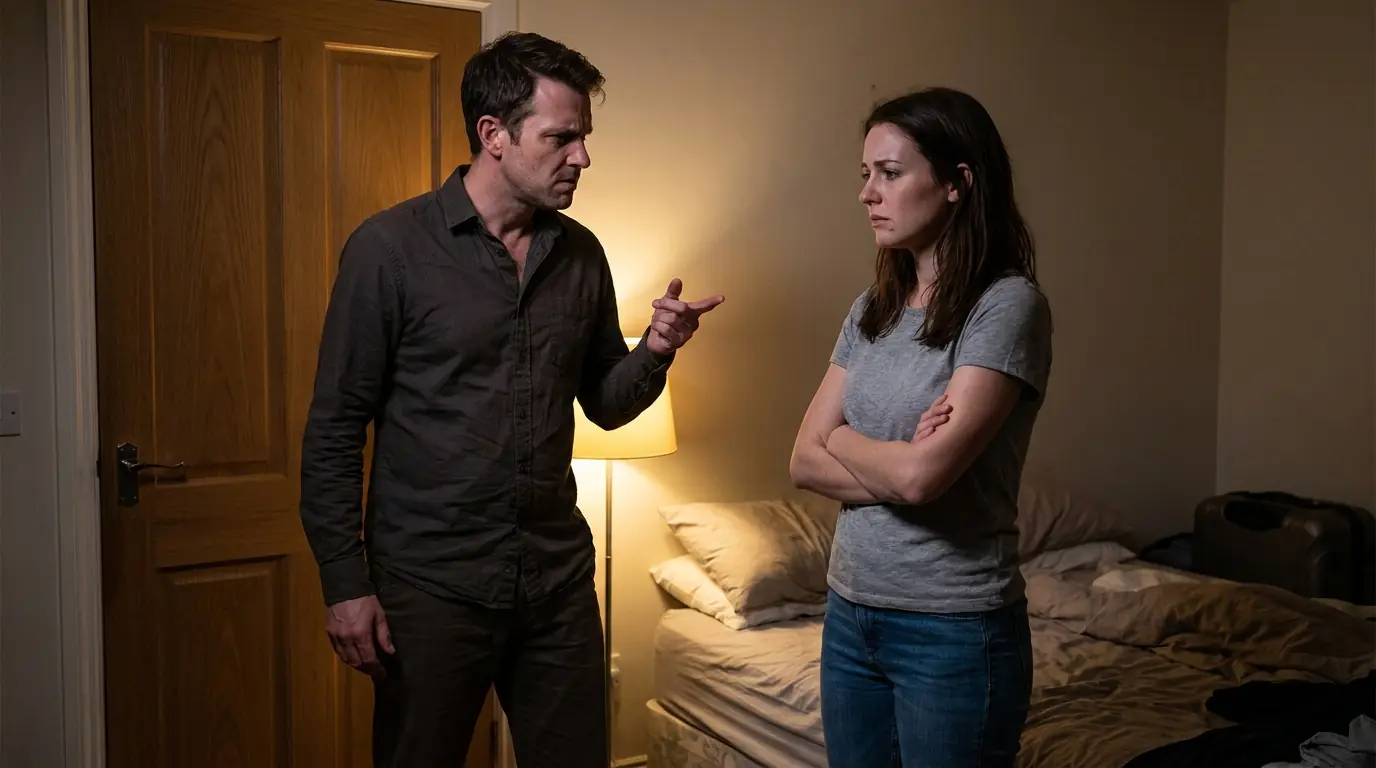
“You look nice,” I said. “But if you walk out in that dress, don’t come back.”
She froze, one earring halfway on. “Excuse me?”
I dried my hands slowly. “You heard me.”
Her laugh came sharp, too loud for the room. “You’re being ridiculous, Tyler. It’s just a dress.”
“No,” I said, meeting her eyes. “It’s a choice.”
She shook her head, grabbed her clutch, and slipped her phone inside. “You sound like my father.”
“Maybe he was right about some things.”
For a second, I saw something flicker in her expression. Not guilt exactly, but recognition. Then she straightened.
“You’ll feel stupid when I’m home by midnight.”
“Maybe,” I said. “But I won’t be waiting up.”
The house felt different the second she left. Quieter, like it was holding its breath. I turned off the faucet and stared at the empty doorway. No shouting, no slamming doors, just silence.
It was close to midnight when I heard the crunch of tires on the driveway. I muted the TV and listened. The door shut, then came the sound of her keys in the lock. I stayed where I was, sitting in the dark.
Through the hallway mirror, I caught her reflection. She was barefoot, shoes in one hand, hair a little messy.
“Too late,” I said.
She jumped, spinning toward me. “You scared me,” she whispered.
“Didn’t mean to. How was the mixer?”
“It was fine,” she said quickly, looking anywhere but at me. “You’re still up.”
I nodded toward the clock. “You said you’d be home by midnight.”
“It’s not midnight yet.”
She smiled, but it didn’t reach her eyes. I stood, walked past her, and stopped at the kitchen counter.
“Go to bed, Kate. We’ll talk in the morning.”
That quiet hit harder than yelling. She hesitated, studying my face, maybe realizing something had changed. Then she went upstairs without another word.
When the floorboards stopped creaking, I opened the laptop. Our joint credit card was still logged in. There it was, a charge at a rooftop lounge across town. Two glasses of wine, one on Trey.
The same place she once said was too expensive for just us.
I closed the laptop slowly, the decision already forming. In our bedroom, she was asleep, the silver dress folded over the chair. I picked up my bag from the closet and stuffed it with clothes, wallet, and charger. Before walking out, I looked at her once.
She looked peaceful, the kind of peace that comes from not knowing what’s about to break. I didn’t have a destination in mind, just direction away. By sunrise, I was parked outside my friend Lucas’s apartment, knocking quietly.
When he opened the door, half asleep, all I said was, “Got a couch?”
He nodded. “Rough night?”
“Yeah,” I said. “And it’s only the beginning.”
Lucas didn’t ask questions that first morning, and I was grateful for that. He handed me a mug of coffee and pointed to the couch.
“Sleep first,” he said. “Think later.”
But I didn’t sleep much. My head was too clear for that. By noon, I was sitting at his kitchen table with my laptop open, scrolling through the small digital trails Kate had left behind. A receipt here, a calendar invite there.
Nothing explosive on its own, but together they painted a story she’d never tell me herself. A charge for perfume I’d never seen. A bar tab for two in a part of town we’d never been to. Then a tagged photo I found through a mutual friend.
Kate, at a launch event, standing a little too close to a man named Adrien Cole.
I stared at that photo for a long time. He was older, dressed sharp, smiling like he’d already won. That afternoon, I called Nora Bennett, a lawyer a friend had recommended months ago when I joked about getting a divorce before turning forty.
Back then, it was a joke.
This time, it wasn’t.
She met me the same evening in her office. No small talk. I explained what I knew and what I didn’t. Nora took notes, calm and efficient.
“Don’t tell her anything yet,” she advised. “Document quietly. Stay steady. People show their real selves when they realize they’re losing control.”
When I left, I felt lighter. Not happy, not even relieved. Just steady.
That night, Kate called three times. I let the first two ring out. On the third, I answered.
“Where are you?” she asked, her voice tight.
“Somewhere quiet,” I said.
“Can we talk?”
Eventually, she went silent for a few seconds. “Tyler, you’re scaring me.”
“I’m not trying to,” I said. “You did that all on your own.”
I hung up before she could respond. Then I saved every screenshot, every receipt, and backed it all up twice. For the first time in a long while, I felt in control.
Three days passed before Kate found me. I was sitting in a cafe downtown, the kind of place where no one knew us, nursing a black coffee and pretending to read the news. She walked in wearing sunglasses.
“Tyler,” she said, voice soft. “Careful. Can we talk?”
I didn’t stand up. “You found me. Sit.”
She slid into the chair across from me, glancing around like someone expecting a camera to flash.
“I’ve been losing my mind. You just left.”
“You were gone long before I was,” I said.
Her lips tightened. “This is about the other night, isn’t it? You think I cheated?”
I didn’t answer. Instead, I pulled my phone from my pocket, opened the email, and placed it face up on the table. A confirmation from the Silverline Hotel. One night, two breakfasts, her name on the receipt.
Kate blinked at it, then shook her head fast. “It’s not what it looks like.”
“It never is.”
“It was for work,” she said, her voice rising. “We had a client dinner that ran late. Adrien offered to book a room so I didn’t have to drive home tired.”
“So he booked it in your name,” I said.
“That’s not fair.”
“It’s not supposed to be,” I replied.
She reached for my hand, but I pulled it back.
“Tyler, please don’t do this. We’ve had problems, I know, but this isn’t worth throwing everything away.”
I took a slow breath. “It’s not about the dress, Kate. It’s about what came after.”
Her eyes watered, but I didn’t flinch.
“I never wanted it to be like this,” she whispered.
“Neither did I,” I said, standing. “But here we are.”
She grabbed her purse. “So that’s it? You’re just walking away?”
I nodded once. No yelling, no scenes, just the truth catching up. I left her there, staring at the table like she expected the evidence to vanish if she stared long enough. Outside, I took a deep breath and walked toward my car. For the first time, I didn’t feel like the one being left.
Kate showed up outside my office two days later. I saw her through the glass doors, hair tied back, eyes swollen, holding her phone like a lifeline. I didn’t go out.
My coworker texted me, “Your wife’s in the lobby.”
I waited until she left.
That evening, when I pulled into Lucas’s driveway, she was there, sitting on the hood of her car. Someone from work must have told her about my location.
“Please, just five minutes,” she said as I stepped out.
“Five,” I agreed, folding my arms.
She walked closer, voice trembling. “It wasn’t what you thought. Adrien and I, we were working on a pitch. He was helping me move up at the firm.”
“Helping you how?” I asked.
She swallowed. “We had drinks after meetings, but it wasn’t... it wasn’t serious.”
I studied her face. “You wore that dress for him, didn’t you?”
Tears welled up. “No. I wore it because I felt invisible to you.”
That stung, but I didn’t react.
“So you fixed that by being seen somewhere else.”
“Tyler, I made a mistake,” she said, stepping forward. “I miss how we used to be.”
I shook my head. “You miss the version of me that didn’t know.”
She broke then, shoulders shaking, voice cracking.
“I’ll quit my job. I’ll block him. I’ll do anything.”
I wanted to believe her. But the image of that hotel receipt sat between us like a wall.
“You can’t unring a bell,” I said quietly. “We can’t go back.”
“Please,” she whispered. “Just give me a chance to make it right.”
“I gave you chances,” I said. “You spent them.”
She dropped her gaze, silent. I turned toward the house.
“Is this really the end?” she asked.
“It was the night you laughed,” I said, walking inside.
I heard her car door slam and the engine start. For a second, I thought she’d scream or cry or say something that would change it all. She didn’t.
A week after that night, Kate’s life started coming apart. Word got around her office that she and Adrien had been too close. He was married, which didn’t help her case. Within days, she was reassigned to another department, quietly removed from client meetings.
There was no satisfaction in watching someone self-destruct. Just confirmation that the truth always cashes its own check.
She called often at first, sometimes crying, sometimes furious.
“Tyler, you can’t just walk away from six years of marriage.”
“I didn’t,” I said. “You did.”
Then silence.
A few days later, she called again, her voice quieter. “I can’t face people at work.”
“Take care of yourself, Kate.”
“Please,” she whispered. “I’m sorry.”
Her mother, Sila, called next.
“Tyler, she’s broken. She barely eats. Maybe just talk to her once. She knows she messed up.”
“I don’t hate her,” I said. “But a conversation won’t rebuild what’s gone.”
Sila sighed. “You really mean to go through with it?”
“It’s already started.”
The next morning, I met with Nora and signed the divorce petition. She reviewed the documents carefully.
“You’re doing the right thing,” she said.
“I’m not sure it feels like it,” I admitted.
“It will,” she replied. “When the noise stops.”
Kate’s messages kept coming. Long apologies, promises to change, memories of good days. I read them all, then deleted them one by one.
The last text said, “I wish I could take that night back.”
I almost replied, but didn’t.
Some things don’t need closure.
At night, I slept better. No checking the clock. She had her fallout. I had my peace.
Two months later, we met again. Not at home, not at a cafe, but across a long wooden table in Nora’s office. Papers were stacked neatly between us.
Kate looked smaller somehow, thinner, her voice barely above a whisper when she said, “You really want to do this?”
“It’s already done,” I answered.
Nora explained everything calmly. Property split evenly, no alimony, separate accounts moving forward. Kate nodded at each line, but didn’t really hear it. Her hands shook as she signed.
“I never thought it would end like this,” she said quietly.
“Neither did I,” I said. “But you made sure it did.”
She swallowed hard. “If I could go back, I’d—”
“You can’t,” I cut in gently. “You laughed when I asked you not to go out that night. That was the moment you chose.”
Tears filled her eyes. “I thought you’d fight for me.”
“I did,” I said. “You just didn’t notice.”
Nora slid the final set of documents across the table. Kate signed them. The lawyer nodded, stamping the date.
“It’s official,” she said.
We both stood. Kate brushed a tear and said, “Maybe one day you’ll forgive me.”
“I already have,” I replied. “But forgiveness isn’t an invitation.”
Outside, she followed me to the parking lot.
“You’re not even angry,” she said.
I looked at her. “Anger means I still care enough to hate you. I don’t.”
She flinched, stepping back. I unlocked my car.
“Take care of yourself,” I said.
“Tyler.”
I shut the door, started the engine, and drove away before she could finish. In the rearview mirror, she stood motionless beside her car, clutching the divorce papers to her chest.
It was over. Clean, quiet, final.
I moved into a small apartment on the east side of town. One bedroom, plain walls, a balcony that overlooked nothing special. I bought a secondhand table, stocked the fridge, and slept through the night for the first time in years.
A few weeks later, a text came from Kate.
“I hope someday you can forgive me.”
I stared at it for a while, then typed back, “I already did. Forgiveness just doesn’t mean staying.”
That was the last message between us.
The divorce went through quietly. No shouting in courtrooms, no lawyers fighting over furniture, just two signatures and a stamp from the clerk. We divided everything evenly. Savings, the car, the house.
She kept the place. I kept my peace.
Over the next months, life settled into something steady. I drove to work, hit the gym, and learned to cook properly. The silence that once felt heavy now sounded clean.
I was just living.
I heard about Kate through her mother, Sila. She said Kate had changed jobs and kept mostly to herself.
“She regrets everything,” Sila told me softly.
“I know,” I said. “But sometimes regret comes too late.”
One Saturday, I drove past the restaurant where Kate and I had our first date. Couples filled the windows. For a second, I saw us there. The old version, the one before secrets and silence.
Then the light changed, and I kept driving.
Later that night, I thought about that night months ago, her standing in the doorway in that silver dress, me at the sink, telling her not to go. Back then, I thought I was drawing a line in anger. Now, I realized it was something else, a promise to myself.
Walking away hadn’t been losing.
It was the first time I finally won.