Being a cop in a small town in Minnesota probably isn’t the most exciting career there is, but it’s not bad either. It’s actually a relatively peaceful and safe line of work compared to being in law enforcement in one of the big cities like New York or L.A. There’s only around 10,000 people in the town where I live. It’s way out in the middle of nowhere, surrounded by miles of open farmland, and the only real crime that ever occurs is pretty minor stuff. The occasional rowdy rednecks getting into a fistfight at one of the three bars downtown, teenage vandals, petty theft, the odd drunk driver, a case of disorderly conduct here and there, the rare breaking and entering. That sort of thing.
The only real serious stuff I’ve ever had to deal with is a couple cases of domestic violence and assault and battery, but even that’s pretty typical, I guess, and it doesn’t happen very often. Well, that’s not entirely true. There was one case that still haunts me, but I’m getting ahead of myself.
Like I was saying, I live in a pretty peaceful little town. Boring, some would even say. The kind of rural, out-of-the-way farming community you’ve probably driven through on the highway yourself on the way to someplace more interesting without as much as a second thought or a glance back. The kind of place where nothing out of the ordinary ever happens, you’ve probably thought. And for the most part, you’d be right. But there’s one case I can’t get out of my mind. One case that still makes my blood run cold whenever I think about it. One case I can’t explain, no matter how hard I try to rationalize it to myself.
What happened to the old Garrity woman seven years ago.
I’d been a police officer for five years when it happened, in the early spring of 2014. There were only five cops on the entire town police force: me, my partner Jerry, Pete and Vance who both worked night patrol, and the police chief. Plus Karen, an older woman who was a retired librarian and worked part-time as the dispatcher. The police department was located in the town municipal building and consisted of two offices, one for the chief and one for the rest of us to share, and three jail cells in the rear. And the three of them were never all occupied at the same time.
It was an overcast, rainy afternoon in late March or early April. Me and Jerry were in our cruiser on a routine patrol around town when Karen’s voice came over the radio telling us there was a possible 10-82 in progress at the Garrity house on Turner Road. For those of you who aren’t in the know, 10-82 is police code for a burglary. We acknowledged, then changed directions, heading for the Garrity home.
I wasn’t unduly concerned about the call. I already had a pretty good idea who had made it. Eileen Garrity was an elderly widow who lived in a run-down farmhouse on the outskirts of town. She was probably around 65 or 70 years old and had lived alone since her husband had died of a stroke three years before. They had two adult children, but they both lived out of town and never visited. Since her husband’s death, she had developed something of a reputation for being eccentric, to put it nicely, or crazy, to put it not so nicely.
She was a shut-in who rarely left her home and had her groceries delivered once a week. Basically a crazy cat lady, minus the cats. The reason she was considered crazy was because she’d become pretty flaky and paranoid since being widowed and had called the police department on multiple occasions for everything from hearing intruders moving around in her attic to seeing UFOs in her cornfield. There were probably at least a dozen others too. All her calls turned out to be false alarms, of course. The burglars she claimed were hiding in her attic turned out to be a pair of raccoons that had slipped in under the roof, and the UFOs were probably just jets flying overhead from the National Guard base 50 miles west.
Me and Jerry and Pete and Vance had all visited her home before during our respective shifts. We never got frustrated with her or gave her a hard time about it, and we usually indulged her, inspecting her house and property to calm her nerves. She’d relax, thank us, we’d leave, and the process would repeat itself in a couple weeks or a couple months. Honestly, our infrequent trips to her house were probably the only real highlight of what was a rather dull and unexciting job.
When we told the chief about Mrs. Garrity’s latest emergency — Bigfoot was sneaking around her yard or there was a giant anaconda lurking in the basement — he would just shake his head sadly. When Vance and Pete were the ones who had to deal with her, they’d tell us all about her most recent ordeal when me and Jerry saw them at the end of their shifts and the start of ours. They’d usually smirk in a mean-spirited way, and Pete would twirl his finger next to his temple before they left. Jerry and I just felt sorry for the old woman. It couldn’t have been easy for a frail, nervous, lonely woman living all alone in that old crumbling house with no friends or close family.
I suspected she might be getting senile, or maybe entering the early stages of Alzheimer’s or dementia. We worried about her living there by herself, almost a mile from the nearest neighbor. If her health suddenly turned bad or she had an accident and couldn’t call for help, well, there wasn’t really much we could do about it. A couple times I looked up the numbers of her daughters and son and tried calling them about possibly placing her in an assisted living home or a mental health facility, but the one time I managed to reach her son, as I was explaining his mother’s situation to him, he interrupted me by telling me he was too busy at the moment and would call me back, then abruptly ended the call. He never did call me back. From then on they always happened to be unavailable and never answered any of the voicemail messages I left them.
So Jerry and me turned onto Turner Road and drove up to Mrs. Garrity’s house on that gray, rainy late spring day, certain that the old woman was just overreacting yet again to something relatively minor and her imagination was just playing tricks on her. She was waiting for us outside on her porch when we pulled to a stop.
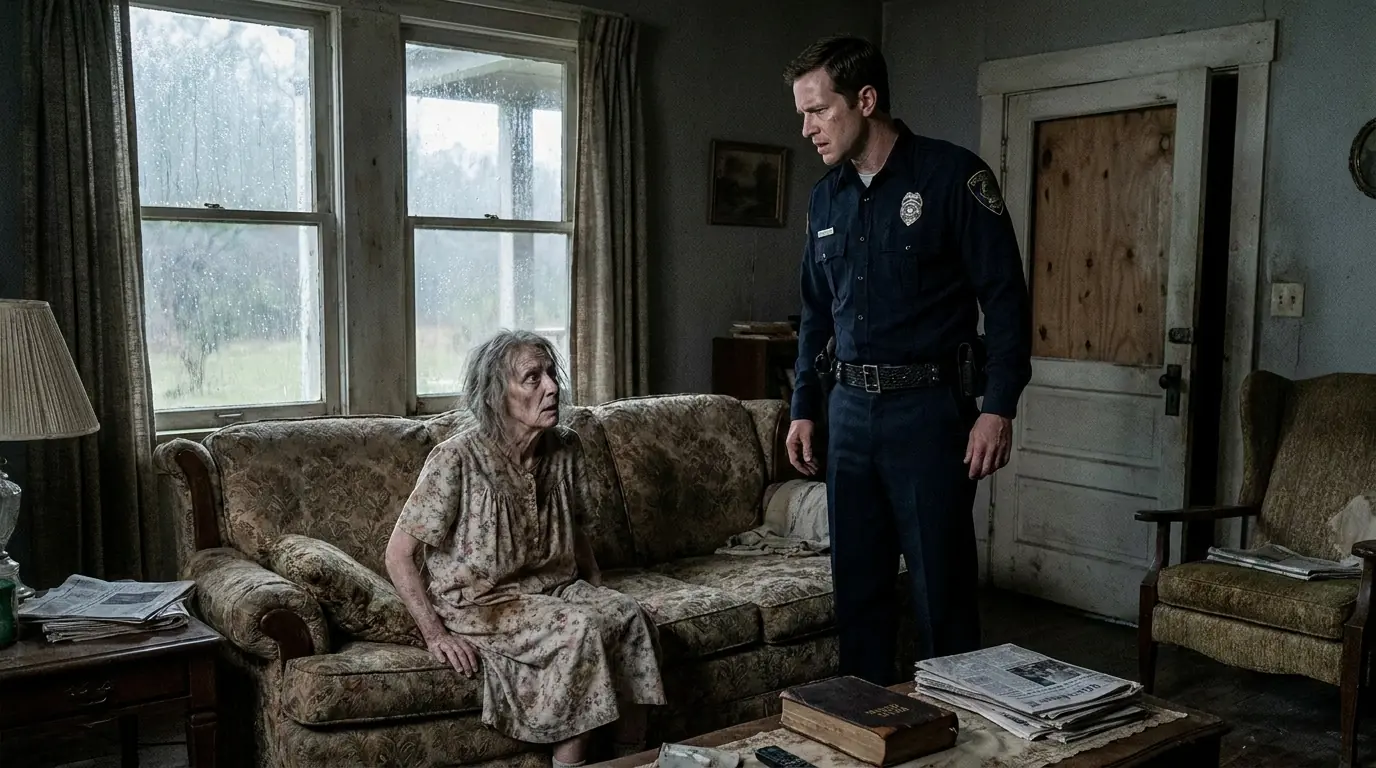
I’ll never forget how she looked. It shocked me. She’d already been a thin, frail woman the other times we’d been out there, but we hadn’t seen her in probably a couple months since her last false emergency, and she had changed drastically since then. Now she was gaunt, almost emaciated. Her cheeks were hollow and there were dark rings around her bloodshot, sunken eyes. Her gray hair was tangled and didn’t look like it had been washed in days, maybe weeks, and the dress she was wearing was wrinkled and dirty.
Her physical appearance was alarming enough, but there was also something about the way she was staring at both of us with those dark, doll-like eyes that seemed to look at us, through us, and past us all at once. It reminded me of old photos I’d seen of American soldiers in Vietnam. The blank, expressionless, shell-shocked look of someone who’d been through more horror than any ordinary person should have to endure.
Me and Jerry exchanged a shocked look, then got out and approached the old woman. “What, uh, seems to be the trouble, Mrs. Garrity?” Jerry asked her amiably, trying to keep his voice nonchalant.
“There’s something in my house,” she told us in a flat, toneless voice. She was shaking slightly, a woman on the verge of total physical and mental exhaustion. The way she phrased it — not someone, but something — made me raise my eyebrow.
“Well, you just wait here and we’ll go have a look and make sure it’s safe, okay?” I told her, trying not to sound too patronizing. I looked at Jerry and nodded. We drew our pistols and stepped past Mrs. Garrity, cautiously entering the house.
We did a routine sweep of the first floor, guns leveled, then headed upstairs. It only took about five minutes to check out the house. We’d done it so many times before we had the layout down pat, and there was no sign of any intruders or evidence of a breaking and entering. But I saw plenty of other things that disturbed me deeply.
For one thing, the place was a total mess. The house was already pretty decrepit, but Mrs. Garrity had still taken pride in how clean she kept it, and it always had been spick and span on our earlier visits. Now dirty dishes were stacked high in the kitchen sink, the counters were dirty, and trash and dirty laundry littered the floors. I also noticed that Mrs. Garrity’s pillow and blankets were lying rumpled on the couch in the living room. The surface of the coffee table in front of it was cluttered with half-drunk cups of coffee, open containers of food, a Bible, and a rosary. It looked like she’d been eating and sleeping in the living room for some time.
When we went upstairs, sure enough, the bed in Mrs. Garrity’s room was bare and the room itself looked like it had been vacant for quite a while. There was also something in the living room that really alarmed me. Leaning in one corner was an old double-barreled shotgun that had probably belonged to her late husband. Jerry picked it up, broke it open, and found two spent shells in the chamber. He took one out, sniffed it, then told me the gun had been fired very recently.
Jerry shot me a perplexed, questioning look. I shrugged, clueless and equally bewildered. Finishing with our inspection of the house, we put away our pistols and turned around to go back outside. Mrs. Garrity was standing in the room behind us, staring at us with that unnerving blank expression. Both of us almost jumped a foot in the air, startled. Neither of us had seen her enter.
Jerry regained his composure and flashed her a fake reassuring smile. “Well, we don’t see any sign of him, Mrs. Garrity. He must have slipped out the back. You’re safe now.”
She didn’t relax or appear relieved like she had the countless other times we’d humored her. Her face seemed to twitch, and some new look dawned in her eyes. It took me a moment to identify it. It was a look of pure, hopeless doom mixed with terror.
“No,” she said in that same odd, listless, flat voice. “I’m not safe. It’s still here. It’s hiding. That’s why you couldn’t find it. And after you leave, it’ll come back for me.” Then she began to quiver. She started to cry with total despair, breaking down into hysterical sobs that wracked her whole body.
Jerry and me looked at each other, concerned. We went to the old woman and comforted her as best as we could, guiding her over to the couch and sitting her down with us on either side of her, coaxing her gently back to a state of calm. After she had herself back under control, we asked her to explain what had happened.
She was quiet for a few moments, gathering her thoughts. Then she began to speak. As we listened to her story, my body temperature seemed to gradually drop, and I felt a chill. Several times I made eye contact with Jerry, and his expression was a mirror of my own: disbelief and fear.
“It started about a month ago,” she began. “That’s when I first heard the scratching at my closet door. A soft, slow, steady scratching that seemed to come from inside.” Her bedroom closet, at night. At first she’d assumed it was probably a mouse or some other small animal, except the scratching seemed to come from too high up to be the work of a mouse. Whenever she opened the closet door — always after the scratching had ceased — there had been nothing there. Several times she’d started to open the closet door while the scratching was in progress, to get to the bottom of it once and for all, but each time she’d grasped the knob she’d been overwhelmed with a sudden, irrational sense of unease and had been unable to do it. The scratching sounded too deliberate, too gentle, too deceptively harmless, as if something was trying to lure her into opening the closet door. To be safe, she’d started locking her closet door every night.
Over the next several days, the scratching had gotten louder and more intense, as if something was trying to tunnel its way through the wood. One day she opened her closet door and found claw marks on the other side. Claw marks that were six feet off the ground. Claw marks that looked like they’d been made by fingernails.
The horror had really started for Mrs. Garrity about a week after she’d first heard the scratching sounds. One night she’d awoken to a voice softly calling for her, a voice that seemed to be coming from the locked closet door. She was bewildered, even more so because she recognized that voice. It belonged to Bill, her dead husband.
Bill’s voice had pleaded for her to open the closet door, telling her that God had sent him down to take her up to heaven where they could be together again and young like they used to be, forever. At this point Jerry had looked at me wide-eyed from the other side of the couch.
“Then what happened?” I prodded her gently.
“I thought I was dreaming,” Mrs. Garrity said. “I thought it had to be a dream. Poor Bill had been gone for three years, and since I was having a dream, I didn’t see no harm in doing what he was asking me to. I got out of bed and went to the closet. I reached for the lock, but then I stopped. Something… something didn’t seem right. It was Bill’s voice, and it seemed perfectly normal, but somehow it was wrong too. The way he was talking, it wasn’t like how Bill used to talk. It was like a stranger was using Bill’s voice, trying to trick me into opening the closet door.”
That doesn’t make much sense, does it? Actually, nothing she was telling us made sense, but we just asked her to continue telling her story. Bill, or whoever or whatever was using his voice, had continued to beg her to unlock the closet. When she’d refused, the voice had changed, becoming harsh and belligerent. It had angrily demanded she open that door, and when she’d still refused, it had begun to shout at her, using profanity and making obscene threats, things Bill never would have said to her while he was alive, she said, before beginning to pound violently on the door.
The voice had begun to change, no longer sounding like her late husband’s. It had become deeper and distorted until it didn’t sound human. In terror, she’d fled her bedroom and spent the night on the couch downstairs. Eventually the pounding and the threats had stopped.
“Mrs. Garrity,” Jerry politely interrupted her at this point, “why didn’t you call us at the police station when this happened?”
She was silent for a moment, then a small, bitter smile formed on her lips. “I thought you’d think I was just imagining it. I know people in town think I’m a crazy old lady, and I’ve had you all out here so many times before for things that turned out to be nothing. I thought maybe it was all in my head, and I didn’t want to bother you about it.”
Things had escalated pretty quickly from there. The pounding and threats had continued every night. She’d been too scared to sleep in her bedroom and had started sleeping on the living room couch. Then one night, the pounding had begun not just on her bedroom closet door, but all the closet doors in the house, all at the same time, like there were people in all of them trying to get out all at once, she told us. But it was the same voice in every closet. The same horrible voice.
In fear, she nailed all the closet doors shut to keep the thing, whatever it was, from coming out to get her. Then, about two weeks ago, something even more terrifying had happened. She’d been in her bathroom and was washing her hands in the sink when she’d looked up into the mirror. Here she paused in her story.
“What did you see?” Jerry asked her.
“I saw it,” she said in a choked whimper. “I saw its face instead of my own. It was wearing a black robe with a hood, and its face… its face was just a grinning skull. A skull with horns. Its eyes were red. The eyes of the devil himself. I don’t mean I saw it standing behind me in the mirror. It was in the mirror itself.” I felt a shiver crawl up my spine. “It reached out of the mirror. It didn’t have hands, it had claws, and it tried to grab me.”
She’d thrown a bottle of lotion at the mirror, shattering the glass. Then, to be safe, she’d done the same to all the other mirrors in the house.
“How could you stay in this house with all this happening to you?” I asked her. She shrugged sadly. “I don’t have anywhere else to go, and no one will take me in.”
The nights were awful, but it was always better during the days. At least then she could get some sleep. It always stopped by morning and never happened during the day, she suddenly shuddered, “until three days ago. Then it started happening all the time, day and night. I wasn’t safe no matter what time it was.”
It all came to a head late this morning. The pounding had gradually gotten more violent and forceful until all the closet doors were rattling in their frames. Mrs. Garrity knew that even with the boards nailed over them, it was only a matter of time until that thing broke through. In desperation, she’d begun praying and reading from the Bible, which had only caused the entity in the closet to laugh at her mockingly. Finally, she’d gotten out Bill’s shotgun and fired it through the closet door.
“For a minute or so there wasn’t a sound,” she told us. “I started to think it was finally over, and then I saw those red eyes burning in the dark in the hole the shotgun had made. It chuckled, and it said one word to me.”
“What word did it say?” I asked her.
“Tonight,” she said, and began to tremble. She lowered her head into her hands and began to sob again.
Jerry and I were silent for some time, trying to absorb what she had just told us. We looked at each other, deeply troubled by her story. Neither of us actually believed it, of course, but it was obvious the poor woman was deeply disturbed. She was having some kind of nervous breakdown. Maybe her frayed grip on reality had finally snapped, or maybe it was old age taking its toll on her mind. One thing was clear: it wasn’t safe for her to be alone anymore. Especially not here. It wasn’t healthy for her. Hell, for all we knew, maybe her paranoid delusions were the result of some dangerous form of mold that had formed in the house.
Jerry and I excused ourselves for a moment, then stepped outside to talk in private. We both agreed she needed help. She needed to be institutionalized. But for now, it was best she stay somewhere else. We went back in and told Mrs. Garrity she was coming with us. She was going to spend the night in a motel room in town, and tomorrow, Jerry added, we were gonna find a priest who would come out and exercise the evil spirit that had been bothering her, getting rid of it once and for all.
She broke down again, this time crying in relief, and she hugged me and my partner, thanking us over and over again. We drove her to a cheap motel in town and checked her in. Her mental state already seemed to have improved in that short amount of time being away from that house. She smiled and told us she couldn’t wait to finally get a decent night of sleep without having to worry about that thing banging on the doors. I think mostly she was just glad she wouldn’t have to be afraid anymore of the entity she was convinced was lurking in her home.
We both smiled at her and said goodbye, getting in the cruiser and driving away. Our smiles faded as soon as we pulled away from the motel. We both drove in grim silence. We both liked old Mrs. Garrity, in spite of all the times she’d made herself a nuisance to the police department with her bogus calls and erratic behavior. We were sorry her mental state had deteriorated to such a point that she could no longer look after herself.
We told the chief her story when we got back. He sighed sadly and nodded, agreeing that she had to be committed somewhere. Tomorrow, him and me were gonna drive out and personally visit her son and daughter and explain to them what was going on, and if they still refused to do what needed to be done, the chief would see to it himself that Mrs. Garrity got the help she needed.
But we never got the chance.
The last time we ever saw Mrs. Garrity was when Jerry and I left her at the motel around 4 p.m. The next morning, I was awakened by an urgent phone call from the chief telling me to get over to the motel as soon as possible. He wouldn’t say why over the phone, but I already had a hunch that it had something to do with Mrs. Garrity. I felt an awful sense of dread as I got dressed. I wondered if maybe she’d taken her own life in that motel room.
When I arrived outside the motel, my fears were confirmed when I saw crime scene tape blocking the door to Mrs. Garrity’s room. The chief, along with Jerry and Pete and Vance, were gathered outside, along with a couple cops from the state police and a pair of detectives from the city. The chief greeted me with a grave expression as I approached.
He told me that Mrs. Garrity was gone. At first I thought he meant she was dead. Then, seeing the solemn look on my face, he clarified himself. She was literally gone.
I looked at him, confused. I saw something in his eyes I’d never seen before. Something that caused a ripple of fear in my heart. The chief was scared.
He told me he didn’t know what to make of it himself. People in the neighboring rooms had heard blood-curdling screams and sounds of violence coming from Mrs. Garrity’s room around 2 a.m., and then nothing. They’d called the police department. Pete and Vance had been the first to arrive. They’d pounded on the door, but there’d been no response, so they’d forced the door open.
When they saw what was inside, they’d called the chief himself.
“What did they find?” I asked him.
“Maybe you ought to come see for yourself,” he told me, leading me to the doorway and under the crime scene tape. He explained to me that they’d found no sign of forced entry, and that the door and windows of the motel room had all still been locked from the inside when Pete and Vance showed up.
I took a look around, feeling a shiver run through my body. There was fresh blood splattered around the room. On the walls, the floor, the bed, even the ceiling. The blood-stained bed sheets had been ripped away from the mattress, as if someone had desperately tried holding on to them as they were pulled from the bed. There were ten very thin trails of blood on the carpet leading away from the bed. Ten thin trails of blood that had been made by ten desperate, terrified fingers clawing for purchase as their owner was dragged away.
I followed the bloody finger marks across the floor, away from the bed, to where they ended at the closet. I looked at them, then I looked at the chief. He looked back at me, his face hard and impassive, but I could see fear in his eyes.
I approached the closet. The door was standing open. I stood there looking in for some time.
The closet was empty. Completely empty. There wasn’t even blood on the floor.
They never found Mrs. Garrity.
---
**Part Two**
I told you in my last post that the Garrity case was the scariest thing that ever happened to me, and that apart from that, nothing much out of the ordinary has ever happened to me in the course of a mostly uneventful and rather dull career enforcing the law in a rural, middle-of-nowhere town most of you have probably never even heard of. Well, until about a week ago, that was mostly true. Mostly. But in light of recent circumstances, I feel I have a new story I have to share with you.
But first, I have to back up a bit and tell you about something that happened about three years ago. It was a strange thing, but at the time I wrote the first story, it hardly seemed important enough to warrant mentioning. Cops get used to dealing with all kinds of weirdos. People reporting or confessing to false crimes and things of that sort. People confessing to murders they didn’t commit, etc. I’m sure police departments in the big cities have to put up with crap like that all the time, but even small-town departments get it once in a while.
It was, I believe, late June or early July of 2019. I was on the night patrol at the time. I usually worked the day, but I was filling in for Vance because he was out to get his appendix removed. Joe, a rookie we took on just the year before, was doing the day patrol with my partner Jerry.
It was an early summer evening, and I was in the office shooting the breeze with the chief and Pete, just getting ready to punch in for my shift, when a woman appeared in the police station, surprising us. I say “appeared” because afterwards, when the three of us discussed what happened, we were all in agreement that none of us had seen or heard her enter the room. It was as if one moment she wasn’t there, the next she was.
She was young, perhaps late teens or early 20s, slender, and might have been pretty, but you wouldn’t have known that looking at her in her current condition. For one thing, she was soaking wet. I mean absolutely drenched, head to foot. Her dripping hair was matted and tangled all around her face, and her dress, which I noticed looked kind of old-fashioned, was saturated. She was panting, completely out of breath, as if she’d just run a mile, and her eyes were frantic and wide with fear. Another thing I noticed was she was very pale. Unnaturally pale, I mean. Her skin looked almost bone white.
I guess we were all pretty taken aback by her appearance for a few seconds. The three of us — me, Pete, and the chief — just gaped at her in shock.
“Please,” she said. “You have to help me.”
The chief, who had been sitting at his desk working on a jigsaw puzzle, found his voice. “What seems to be the problem, ma’am?” he asked a little awkwardly.
“Someone kidnapped me. I managed to get away. I think they were gonna kill me.”
We all exchanged a sober look. Things like this didn’t happen very often in our town.
“Why don’t you have a seat and tell us all about it, ma’am?” the chief asked her politely, and gestured to an empty chair next to his desk. She sat down, trembling slightly, as if she was cold. The chief told Pete to go get a blanket for her, and Pete went to fetch one.
The chief asked the young woman if she would care for some coffee, gesturing to the pot sitting on a table across the room.
“No, thank you,” she said distantly, looking past him into space, distracted or maybe in shock.
“What’s your name, miss?” the chief asked her.
“Shirley,” the young woman said. “Shirley Anne McDougall.”
The chief took a police report form out of his desk drawer and jotted that down. Pete came back into the office carrying a blanket, which he offered to Shirley Anne McDougall. She thanked him and wrapped it gratefully around her shoulders but continued to shiver through the interview, as if it wasn’t possible for her to warm her body back up.
“How old are you, Miss McDougall?” the chief asked.
“19.”
He wrote that down.
“Where do you live?”
“Right here in town.”
“And how long have you lived here?”
“My whole life.”
At this, the chief frowned a little. He threw a questioning look at Pete, who shrugged, then at me. I shook my head. I could see what was bothering the chief. When you’ve been a cop in a small town for long enough, you get to know most of the people who live in your jurisdiction. I’d been a cop for 10 years at that point, Pete, who was older than me, had been one for close to 20, and the chief, who was older than both of us, had been one for nearly 40. And yet none of us had ever seen this woman who claimed to have lived here her whole life or heard of her before this night.
“What’s your address, Miss McDougall?” the chief asked.
“I live with my parents in their apartment above the hardware store they own. McDougall’s Hardware, on Main Street.”
That was when I knew there was something really off about this whole deal. There was no McDougall’s Hardware on Main Street. In fact, I’d never heard of anyone named McDougall ever living in the area.
The chief was looking at Shirley strangely, but he continued doing it by the book and didn’t miss a beat.
“Now, Miss McDougall — you can call me Shirley, she interrupted softly, still staring off vacantly at nothing in particular — Shirley, why don’t you tell us exactly what happened tonight?”
So she told us. And her story only got stranger and stranger.
“I was coming back home from the movies. Me and my friends had gone to see the new Martin and Lewis comedy at the Mayan.”
“Whoa,” Pete interrupted her at that point, raising his hand. “I’m sorry, you say you went to the buy-in?”
“Yes. To see Martin and Lewis. Martin and who?”
“You know, Dean Martin and Jerry Lewis. We went to see their new film, *Partners*. It just opened last week.”
Pete met eyes with me. The look on his face was a combination of confusion and bewilderment. He mouthed the words “What the hell is going on?”
Shirley just went on anyway. “I was walking back home to my parents, and I stopped at Beckman’s drugstore to get a chocolate malt first.”
Beckman’s drugstore. That rang a bell somewhere in some distant corner of my memory. I dug for it, and after a moment it came back. Beckman’s had been a pharmacy here in town when I’d been a little kid. An independent, family-run drugstore complete with an old-time soda fountain, like something you would have seen back in the 1950s. It had been owned and operated by the Beckmans for three generations until the last of them, old Clyde Beckman, had died back in the late 90s. His kids had sold the business, and now there was a CVS where it had once stood.
I felt a shiver creep up my spine.
“I was going into the store, but a man approached me outside. He was an older man, maybe in his late 40s, silver hair. He was dressed like a priest, and he had a crutch under one arm. He asked me if I could help him. He said his wallet had fallen under the seat of his car and he wanted to know if I’d help him get it out. He was very polite. He seemed harmless, and I felt sorry for him because of the crutch. You know, he led me over to his car.”
“What kind of car was it, Shirley?” the chief interrupted her.
She thought about it for a few seconds. “I think it was a Buick. Yeah, yeah it was a dark Buick. A couple years old, maybe a ’53 or ’54.”
A 1953 or ’54 Buick that, according to Shirley McDougall, was only a couple years old. What the hell was this? Was this chick on something? Was she nuts? Or just pulling some stupid prank? I searched her face, trying to detect a lie, but she seemed genuinely shaken by whatever she’d been through.
“Did you see the license plate, Shirley?” the chief asked.
“I just caught a glimpse as we were going around it. I didn’t see the numbers, but I noticed it was an out-of-state car. I think the license plate said Oklahoma.”
“Then what happened, Shirley?” the chief prodded her gently.
“I knelt down and I was feeling beneath the driver’s seat for his wallet, and then…” She paused and took a long, shaky breath, then exhaled it sharply, as if mustering her courage to recall her ordeal to herself. “Something hit me in the head. It hit me hard. It was him, the man dressed like a priest. He hit me from behind, I think with the crutch he was carrying, and then he hit me again. I was stunned. I think I might have even lost consciousness for a few moments. When I came to, he was dragging me around to the back of his car. I tried to fight him off, but he slapped me and told me to shut up or he’d kill me. He called me a…” She hesitated. “I’d rather not repeat what he said.”
“He lifted the lid of his trunk and shoved me inside, and then he slammed it shut. I was screaming at the top of my lungs and pounding against the trunk, but he’d already gotten back in and started the car, and then he was driving. I was screaming and crying, praying, begging him not to hurt me. I told him I just wanted to see my parents again, but he kept driving. I don’t know how long he drove. It was a long time, maybe an hour. But then something happened. He had an accident. I heard him shout an alarm, and then the car swerved. I could hear the tires shriek. We went off the road. The next thing I knew, the trunk was filling with cold water. We must have crashed into a lake or a pond. I was panicking, pounding, trying to force the trunk open, and then I don’t remember. It just went black for a while. The next thing I remember is splashing around at the surface of the water. I don’t know how I managed to get out. I swam to the shore and climbed back onto the road, and I just started walking back into town.”
Her story finished, Shirley fell silent. She lowered her head, shuddering. None of us knew what to say. We stood there trying to make sense of what she told us. I looked at Pete, then at the chief. The chief looked back at me, a disturbed expression on his face.
“May I use the telephone, Shirley?” she asked, looking up. “I want to call my parents to tell them I’m okay.”
“Of course, Shirley. Just give us one minute. We wanna run this guy’s description out on the radio, get an APB going so we can catch this creep,” the chief told her, standing up and gesturing for me and Pete to follow him. He led us out of the office and shut the door.
“What the hell is she talking about, chief?” Pete asked. “That Mayan theater went out of business when I was a kid, 30 years ago. There’s a liquor store there now.”
“Yes, yes, and McDougall’s hardware is long gone too,” the chief replied. “Long before your time, either of you. It burned down when I was a kid, back in ’67, I think. Maybe ’68. And the McDougalls went up in flames with it. Died in their sleep.”
Pete and me took a moment to absorb that.
“So what the hell’s her deal? Is she crazy? Or strung out? Or what?”
The chief shrugged. “Who knows? Maybe something really did happen to her tonight and the trauma caused a psychotic break. Dissociative identity disorder, whatever they call it.”
He opened the office door and motioned us back in.
Shirley McDougall, or whatever her name really was, was still sitting beside the chief’s desk. She looked up as we entered.
“Can I call my parents now?” she asked urgently. “They must be worried sick about me.”
“Shirley,” the chief said, staring at her thoughtfully, “who’s the current U.S. president?”
She blinked at him. “What?”
“Dwight Eisenhower.”
“What’s this have to do with anything?”
The chief looked at her for what seemed like a long time.
“Shirley,” he asked her softly, “do you know what year it is?”
She gave him a puzzled look. “Excuse me?”
“Do you know what year it is?”
“1956. Why are you asking me this?”
“No, Shirley,” he said gently, looking at her with compassion. “It’s not 1956. It’s 2019. 1956 was 63 years ago.”
She looked at him, confused. “2019? What are you talking about? Are you crazy?”
“Look at the calendar behind me, Shirley,” he told her, pointing at the bulletin board on the wall above him.
Looking at him suspiciously, Shirley stood and approached the calendar. She stood directly in front of it, staring for some time. Then she backed away, her eyes widening in disbelief.
“No. No, this is some sort of trick. It has to be,” she stammered, terrified and confused.
“Shirley,” the chief said, pointing at the computer on his desk, “have you ever seen one of these before?”
But Shirley ignored him. Her attention had shifted to a large map of the United States on the opposite wall. She stepped up to it, studying it intently.
“Hawaii and Alaska,” she muttered quietly to herself.
She moved to the window and looked outside at the parking lot.
“The cars,” she said, her voice rising in panic. “What’s wrong with the cars? Why do they look so different?”
We stood by the chief’s desk, just watching her, dumbfounded and not knowing how to react. Shirley turned to face us, beginning to shudder. She fell to her knees, clutching her midsection, her breath heaving in and out like she was hyperventilating.
“I… I think I’m gonna be sick,” she uttered in a low, choked voice. “Please, just show me where the ladies’ room is. I’m gonna be sick.”
Pete looked to the chief, who nodded grim-faced. Pete helped Shirley to her feet and escorted her out of the office. He looked back at us, and the chief mouthed at him, “Keep an eye on her.” Pete nodded, then they stepped through the door and out of sight.
A long, awkward moment of silence passed, with the chief sitting at his desk distractedly toying with a piece of his jigsaw puzzle and me standing there, both of us trying to wrap our heads around what had just happened. The entire encounter, from the moment the soaking wet woman had entered the police station to when Pete had taken her to use the restroom, had lasted no more than 20 minutes.
I finally broke the silence, forcing out a nervous laugh to try to lighten the mood. “Weird night, huh?” I said to the chief.
He just grunted in response, seeming preoccupied with something.
“So who should we call? The state cops or the hospital?” I asked.
He didn’t answer me. He was still lost in thought, staring intently straight ahead.
“What’s on your mind, chief?”
“Something just dawned on me a couple minutes ago. Just when Pete and her were leaving.” He looked at me, troubled. “1956 was two years before I was born, but McDougall’s hardware store was still in town until I was nine. My parents used to do business with the McDougalls. I remember something from when I was a kid, overhearing my parents talking. Something about the McDougalls having a daughter that vanished under mysterious circumstances.”
I looked at him. “Come on, chief. You’re not telling me you’re actually buying into this thing, are you?”
“It wouldn’t be the first time something strange has happened in this town,” he said, giving me a pointed look. I think you know what I’m talking about.
I didn’t answer him, but I did know what he was talking about. In my mind I saw images I cared not to remember. A blood-spattered motel room. Sheets torn from the bed. Bloody claw marks on a carpet, trailing off and stopping abruptly at an empty closet. I shuddered at the memory.
And then suddenly there was a commotion from down the hall. Pete was yelling for both of us to come quick.
“[ __ ] what now?” I muttered as we hurried out of the office.
Pete was standing down the hall, just outside the women’s restroom. He looked rattled.
“She’s gone,” he said as we got closer.
“What the hell do you mean she’s gone?” the chief demanded.
“See for yourself,” Pete answered, and pushed open the restroom door.
We looked in. All three stalls were standing with their doors open. Vacant.
The chief turned to Pete. “Well where the hell did she go? I thought you were watching her.”
“Hey, chief, I was standing right here outside the whole time, I swear it,” Pete insisted, looking anxious and scared. He muttered something to himself, something I couldn’t quite make out. I asked him to repeat it.
He looked at me. I’d never seen Pete look so frightened before in my life.
“I said she was cold when I was helping her up to go to the restroom. My hand touched her arm. It was so cold. It was like touching the skin of a corpse.”
The chief shot me a grim look, which I reciprocated, feeling a stirring of fear in the pit of my stomach. This was too much like what had happened back in ’14.
The chief and I entered the women’s room and looked around. There wasn’t much to see, and no obvious place to hide. Three empty stalls and a sink. There was a small window directly above the sink. I approached it, certain I was going to find it locked, but the latch was unfastened.
I felt a weird sense of relief at that, that this avenue of denial, this fallback position of logical explanation, hadn’t been blocked. Because otherwise…
“Chief,” I said, “window’s unlocked. Outside, quick.”
He ordered me. Me and Pete hastily followed him down the hallway to the main entrance of the municipal building. We went outside and looked around. All we saw was the front lawn of the building and Main Street beyond it, mostly deserted on this early summer evening. The window in the women’s restroom faced the left side of the building. We went in that direction, but when we turned the corner, there was nothing there. No sign of the mysterious young woman who called herself Shirley McDougall.
I looked up. The window was about 10 feet above the ground, and while small, it was not impossible for someone with a smaller build like Shirley to have squeezed through it. What I’m getting at is that it was conceivable for her to have escaped out the window, dropped to the ground below, and then disappeared into the night. The grass had been recently mowed, and it hadn’t been raining, so the ground hadn’t left any footprints we could see to determine which direction she’d gone.
We looked at that window for some time. Finally, the chief lowered his head and emitted a slightly shaky chuckle.
“She, uh, must have closed it behind her before she jumped, I guess.”
I guess so, chief,” Pete said.
“Guess so. Or lying. Or on drugs. Or who the hell knows.” But that troubled, disturbed look was still in the chief’s eyes, and I think he was trying to rationalize what had just happened as much as I was.
“Let’s go back inside,” he told me and Pete. And that’s just what we did.
It was easier for us to believe that we’d just been dealing with some deeply disturbed young woman or a flake looking for attention. Because otherwise, we would have to accept that what we’d been questioning a ghost that summer night.
The chief did report the incident to the state police, and they put out an alert for her, but nothing ever came of it, and we never saw or heard from Shirley Anne McDougall ever again.
I did some research in my free time, just out of curiosity, or so I told myself. Searching online and looking through old newspapers and town records. There really had been a young woman named Shirley Ann McDougall, the 19-year-old daughter of Wilbur and Harriet McDougall, the owners of McDougall Hardware, and she really did disappear one night back in early August of 1956, never to be seen or heard from again. But for all I knew, the crazy woman we dealt with had known about the case and incorporated the details into her delusion.
There were no pictures, if you were wondering. I looked but couldn’t find anything in the newspapers. I even tried locating any of Shirley’s surviving relatives, to no avail. It had been over 60 years, and presumably all the family photographs had been destroyed in the fire that killed her parents.
I forced it all out of my mind. I was a police officer, and there were more pressing matters to deal with. Eventually I forgot all about my strange encounter with Shirley McDougall.
Then last week, I went into the station to start my usual shift. The chief beckoned me into his office, his face pale and grave. He didn’t say anything, just pointed to the newspaper on his desk.
I picked it up and looked at the headline: “Lake Yields Dark Secret After 66 Years.”
One town over, some guy in a boat had been trying out his new fish-locating sonar and it inadvertently stumbled upon an old car at the bottom of the lake, 20 feet down. He went to the police, and they’d hoisted the car to the surface. An old, battered, rusted wreck that had once been a 1953 Buick. A set of skeletal remains belonging to a man had been found in the driver’s seat. The old Buick had an Oklahoma plate, and when the authorities ran it through the system, they discovered the vehicle was a match for a car registered to a man the FBI had been looking for back in the mid-1950s. A drifter and convicted sex offender they suspected of being a serial killer, or a “spree killer” as they called them back then, who was believed to have abducted and murdered up to 10 young women in six different states.
His last intended victim had managed to escape. She claimed a man dressed as a priest had tried to lure her into his car and then overpower her. This had happened in Iowa, one state away from Minnesota. After that, he just vanished off the FBI’s radar.
When they conducted a more detailed inspection of the wrecked Buick, they made a further gruesome discovery. A second skeleton was found in the trunk. A skeleton belonging to a young woman.