For eight days, Evelyn Parker had tried everything else.
That was the part nobody inside the executive boardroom knew.
And the reason everything that happened afterward mattered.
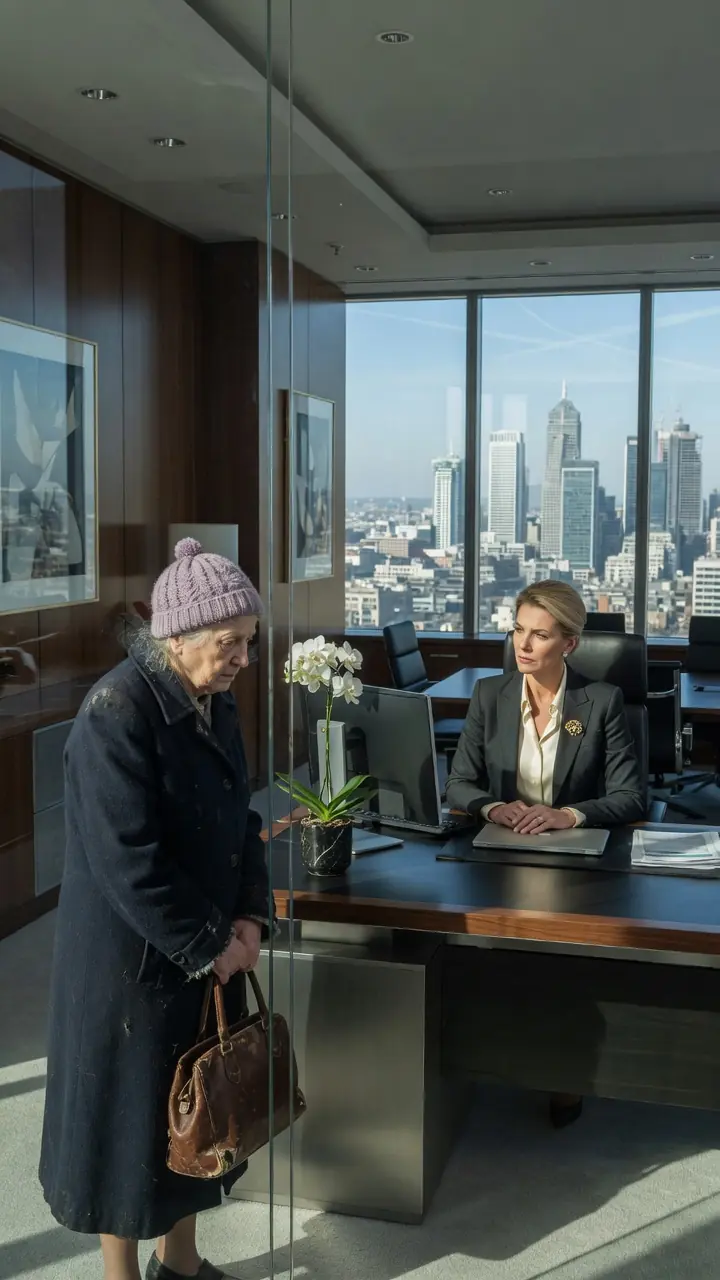
When Charlotte Whitmore looked through the glass wall of her private office and saw the elderly woman waiting outside, she almost laughed.
The woman looked harmless.
Seventy years old.
Gray hair tucked beneath a knitted hat.
A faded wool coat.
Scuffed shoes.
An old leather handbag that had clearly survived decades.
Charlotte assumed she already knew why she was there.
Another complaint.
Another exception request.
Another customer unwilling to accept reality.
She was wrong.
Eight days earlier, Evelyn had received a certified letter.
The Jefferson Avenue branch of Commonwealth Trust Bank was closing permanently.
The property had been sold as part of a large restructuring plan led by Charlotte Whitmore.
All safe-deposit boxes would be transferred to a central storage facility.
Customers had thirty days to retrieve their belongings.
Most people had already done so.
Evelyn couldn't.
Because of a mistake buried deep inside paperwork that stretched back almost forty years.
According to the bank's records, Safe-Deposit Box 317 legally belonged to her late uncle.
The problem was that her uncle had passed away decades ago.
The ownership transfer had never been fully updated.
For years nobody noticed.
Then the merger happened.
Lawyers reviewed every account.
Computers flagged every inconsistency.
And suddenly Evelyn was told she could not access the box she had visited for nearly thirty years.
Inside Box 317 wasn't cash.
There were no diamonds.
No stock certificates.
No hidden fortune.
Instead it contained the last pieces of her husband.
Robert Parker had spent forty-three years as a firefighter.
He was the kind of man who remembered every birthday.
Every anniversary.
Every promise.
When he died from cancer seven years earlier, Evelyn couldn't bring herself to throw anything away.
So she stored his journals.
His medals.
His photographs.
His retirement badge.
His handwritten letters.
There was even a small wooden box containing every birthday card he had ever given her.
Forty-seven cards.
One for every year they had been married.
The last card was unfinished.
Robert had started writing it three days before he passed away.
Evelyn had never shown it to anyone.
Not even her children.
It was the most valuable thing she owned.
And now the bank was telling her she might never see it again.
She tried everything.
She called customer service.
Five different representatives.
Five identical answers.
She wrote letters.
No response.
She hired a lawyer for a consultation.
The lawyer reviewed the documents and shook his head.
"The bank is technically correct."
She visited branch managers.
Regional managers.
Compliance officers.
Nobody could help.
Each person pointed to a different rule.
A different policy.
A different department.
After a week of failure, someone finally suggested one last possibility.
Charlotte Whitmore.
Chief Executive Officer.
The woman overseeing the restructuring.
The woman with the authority to approve exceptions.
The woman everyone described the same way.
Brilliant.
Powerful.
Uncompromising.
Three days later Evelyn found herself sitting outside Charlotte's office on the forty-first floor.
The receptionist looked uncomfortable.
Two executives walking past glanced at Evelyn and exchanged amused smiles.
One whispered:
"Wrong floor."
The other laughed.
Evelyn heard them.
She pretended not to.
Eventually the office doors opened.
Charlotte looked up from her desk.
Perfect suit.
Perfect posture.
Perfect confidence.
Forty-five years old.
The youngest CEO in company history.
Everything about her suggested success.
Everything about Evelyn suggested the opposite.
Charlotte invited her in.
Barely.
Then listened while checking emails on her laptop.
Evelyn explained the journals.
The photographs.
The medals.
The birthday cards.
The unfinished letter.
For a brief moment Charlotte looked sympathetic.
Then corporate logic returned.
"Mrs. Parker, I understand this is emotional."
The word emotional stung more than Evelyn expected.
"But procedures exist for a reason."
Charlotte folded her hands.
"If we make exceptions for one customer, we create risk for everyone."
Evelyn sat quietly.
The room fell silent.
Finally she asked:
"So that's it?"
Charlotte gave a professional smile.
"I'm afraid so."
Then she added something she immediately wished she hadn't.
"At some point we all have to let go of the past."
The words landed like a slap.
Because Charlotte thought she was discussing documents.
Evelyn was discussing her husband.
The room became very still.
For several seconds Evelyn simply looked at her.
Not angry.
Not offended.
Just disappointed.
Then she slowly opened her handbag.
"Then you won't mind if I make a call."
Charlotte almost laughed.
"Please do."
Evelyn dialed.
The phone connected almost instantly.
A warm voice answered.
"Evelyn. I've been waiting. How did it go?"
Charlotte froze.
She knew that voice.
Everyone in the state knew that voice.
Governor Abigail Monroe.
One of the most influential women in America.
Evelyn spoke calmly.
"About how we expected. Would you mind speaking with Ms. Whitmore?"
A brief pause.
Then:
"Put her on."
Charlotte accepted the phone.
The next four minutes changed everything.
Not because the governor threatened her.
She didn't.
Not once.
Instead Abigail told a story.
Forty years earlier she had been eleven years old.
Her mother had died suddenly.
Her father worked double shifts driving a delivery truck.
Most nights there wasn't enough food.
One teacher quietly noticed.
That teacher began sending groceries home.
Paying school fees.
Buying winter coats.
Helping with homework after school.
Never asking for recognition.
Never telling anyone.
That teacher was Evelyn Parker.
Abigail finished with one sentence.
"If not for her, I don't know where my life ends up."
When Charlotte handed the phone back, her hands were trembling slightly.
She stared at Evelyn.
Then at the worn handbag.
Then at the woman sitting across from her.
For years Charlotte had evaluated people instantly.
Income.
Assets.
Influence.
Potential.
She had become very good at it.
And for the first time she realized how often she was wrong.
"You never told anyone," Charlotte said quietly.
Evelyn smiled.
"It wasn't something to tell."
Charlotte looked away.
For a long moment neither woman spoke.
Then Charlotte finally admitted the truth.
"I looked at you and saw a problem."
Her voice cracked.
"A customer. A complaint. Someone standing in my way."
Evelyn remained silent.
"I never saw the person."
The room felt different now.
Smaller.
More honest.
Charlotte pressed a button on her desk.
Within minutes the bank's chief legal officer entered the room.
Followed by two senior compliance executives.
Charlotte looked directly at them.
"Open Box 317."
The attorney blinked.
"There are ownership concerns—"
"Open it."
The room went silent.
Nobody argued a second time.
An hour later Evelyn sat alone inside the secure vault room.
The metal box rested on the table.
Her hands trembled as she opened it.
Everything was there.
Robert's journals.
The photographs.
The medals.
The retirement badge.
The birthday cards.
And the unfinished letter.
Carefully she unfolded the final card.
The handwriting stopped halfway through the last sentence.
But the first line remained perfectly clear.
"If this ends up being the last birthday card I ever give you, I hope you know that loving you was the easiest thing I ever did."
Tears filled her eyes.
Across the room Charlotte quietly looked away to give her privacy.
Several minutes later Evelyn stood to leave.
She thanked the staff.
Then turned toward the door.
Before she left, Charlotte stopped her.
"I owe you an apology."
Evelyn smiled gently.
"You already gave me one."
Charlotte shook her head.
"No."
She glanced toward the vault.
"That was procedure."
Then her voice softened.
"This is personal."
For the first time in years, Charlotte felt ashamed of how many people she had dismissed simply because they didn't look important.
After Evelyn left, Charlotte made another decision.
The bank would create a permanent customer advocacy program for elderly clients facing inheritance, estate, and documentation issues.
No press release.
No advertising campaign.
No interviews.
Just help.
Real help.
Months later the program had already reunited hundreds of families with documents, photographs, military records, and keepsakes they thought were lost forever.
Because Charlotte finally understood something Evelyn had known all along.
The most valuable things people own rarely fit inside a bank account.
Sometimes they're hidden inside a small metal box.
Sometimes they're folded inside an unfinished birthday card.
And sometimes they're carried quietly for decades inside the heart of a woman everyone else almost overlooked.