A rich woman walked into a restaurant, ordered a small amount of food, ate only a few bites, paid the bill, and quickly left, barely noticing anything around her as she stepped back into her busy life. She didn’t realize that in her haste, she had left her wallet behind on the table, sitting quietly beside a half-finished plate of food that meant nothing to her but would soon mean everything to someone else. A few minutes later, a waiter came over to clean the table. He was a young man, thin, with tired eyes and worn shoes, moving through his shift with the quiet rhythm of someone used to long days and little rest. As he reached for the plates, he noticed the wallet. He paused for a second, picked it up, and immediately understood what had happened. Without checking inside, without hesitation, he turned and rushed out the door, scanning the street until he spotted the woman near her car.
“Ma’am, you forgot your wallet.”
The woman turned, surprised, her expression shifting from confusion to relief.
“Oh… thank you. I didn’t even realize.”
She took the wallet from his hand, barely noticing the urgency with which he had run after her, and gave him a polite smile before getting into her car and driving away. To her, it was a small inconvenience avoided. To him, it was simply the right thing to do. He stood there for a moment, catching his breath, then turned and walked back inside to finish his shift as if nothing had happened.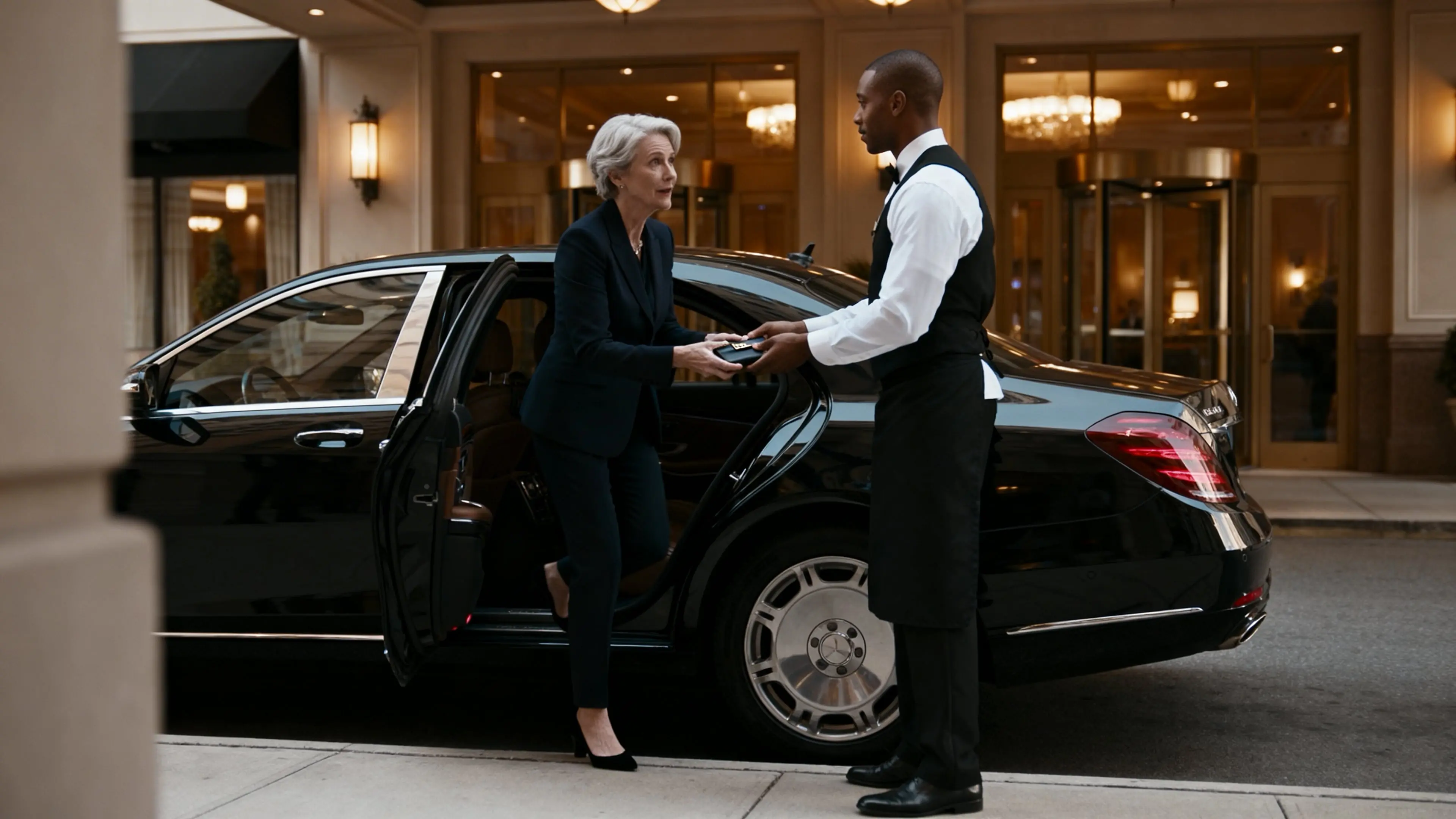
When the dinner rush slowed and the restaurant began to empty, he returned to the same table. Most of the food was still there, untouched. Plates that would soon be thrown away, wasted without a second thought. He looked at them for a moment, then quietly gathered the leftovers and packed them into a large bag. No one stopped him. No one asked why. It was something he had done before, something he would likely do again.
When his shift ended, he stepped out into the cool evening air, carrying the bag with him as he began the long walk home. The streets grew quieter the further he went, the bright lights of the restaurant fading behind him, replaced by dim streetlamps and cracked sidewalks. He walked past closed shops, empty lots, and old buildings that had long since lost their purpose.
The rich woman, sitting in her car not far from the restaurant, had hesitated before driving away. Something about the way he had run after her, the way he hadn’t even opened the wallet or looked inside, stayed with her. It was unusual. It was rare. And for reasons she couldn’t quite explain, she decided to follow him from a distance.
She drove slowly, keeping far enough back that he wouldn’t notice. At first, she told herself it was just curiosity, just a passing thought. But as the distance between the restaurant and the neighborhoods grew, curiosity turned into something else.
He finally stopped in front of an old, broken house. The paint was peeling, the windows were cracked, and the door looked like it had been repaired more times than it should have been. It was the kind of place most people would avoid without thinking twice. He opened the door and stepped inside.
The woman parked across the street and waited. Something told her to stay.
After a moment, she got out of the car and quietly moved closer, stopping near a side window. Through the glass, she could see everything.
Inside, three children were waiting. They were small, thin, their clothes worn and slightly oversized, their faces carrying the kind of quiet exhaustion that didn’t belong on children. But the moment they saw him, everything changed.
“You brought food?” one of them asked, his voice filled with hope he was trying not to show too much.
The waiter smiled, setting the bag down carefully.
“Yeah. Come here.”
The children rushed toward him, their energy suddenly alive, their eyes bright. He opened the containers one by one, laying the food out on a small table that had clearly seen better days. He divided everything evenly, making sure each child had enough before taking anything for himself.
“Slow down,” he said gently as they began eating. “There’s enough for everyone.”
They laughed, talked, and ate like it was a feast, even though it was just leftovers. The waiter sat with them, not above them, not separate from them, but among them, sharing the same food, the same moment. He didn’t rush them. He didn’t act like he was doing something special. To him, this was normal. This was necessary.
Outside, the woman stood completely still.
She had eaten only a few bites of that food. She had left it without thinking, without caring. And now she was watching it become something else entirely.
Her eyes slowly filled with tears.
For the first time in a long time, she felt something she hadn’t expected—humility. The realization that what meant nothing to her could mean everything to someone else. The realization that the man she had barely noticed had a life she couldn’t have imagined.
She returned to her car quietly and drove away, but she didn’t feel the same. Something had shifted inside her, something she couldn’t ignore.
That night, she couldn’t sleep. The image of the children eating, the way they smiled, the way the waiter cared for them, stayed with her. She thought about her own life, the comfort, the security, the distance she had placed between herself and the struggles of others. She thought about how easy it had been to overlook everything.
By morning, she had made a decision.
She spent the day making arrangements. She bought a house—not extravagant, but clean, safe, and warm. She made sure it had everything needed: beds, furniture, food, and a sense of stability that the old house could never provide. She didn’t tell anyone why. She didn’t explain her reasons. She simply acted.
That afternoon, she drove back to the old house.
When the waiter opened the door, he looked surprised to see her standing there.
“Ma’am?”
She smiled gently.
“Can you come with me? You and the kids.”
He hesitated, unsure.
“Is something wrong?”
“No,” she said softly. “I just want to show you something.”
The children gathered behind him, curious, their eyes moving between the two adults.
“Is it far?” one of them asked.
She shook her head.
“Not at all.”
They got into her car, the children sitting quietly, unsure of what to expect. The waiter remained cautious, watching carefully, not out of fear, but out of responsibility.
When they arrived at the new house, the children stepped out first. Their eyes widened as they looked around.
“Is this… real?” one of them whispered.
Inside, a large table was already set with food. Fresh, warm, more than enough.
“Go ahead,” she said gently.
They walked in slowly at first, then faster, their excitement growing with every step. They sat down, still unsure, but when they began eating, the room filled with laughter again—louder this time, freer.
The waiter stood back for a moment, taking it all in.
“Ma’am… what is this?” he asked quietly.
She walked over to him, holding something in her hand.
“This is yours now.”
She placed a key in his palm.
He looked down at it, then back at her, confusion and disbelief mixing in his expression.
“I don’t understand.”
“This house,” she said softly. “From today… it belongs to you and them.”
He shook his head immediately.
“No… I can’t take this.”
“You can,” she replied. “Because you already showed me what kind of person you are.”
His voice broke slightly.
“I didn’t do anything special.”
She looked at him, her eyes steady.
“You did everything right.”
The children ran from room to room, laughing, shouting, their voices echoing through a place that was finally theirs.
The waiter stood there, tears slowly forming in his eyes, his hand tightening around the key.
“I don’t know what to say,” he whispered.
“You don’t have to say anything,” she said. “Just keep doing what you’re already doing.”
He nodded, unable to hold back the emotion any longer.
“Thank you.”
She smiled, a quiet, genuine smile, then looked around the room once more before turning toward the door.
As she stepped outside, she realized something she hadn’t understood before.
Wealth wasn’t just about what you had.
It was about what you chose to do with it.
And sometimes, all it took to change everything… was seeing what had been right in front of you all along.