
A Simple Woman Forced to Play Violin to Mock Her, But Her Skill Leaves The Audience Speechless!
A Simple Woman Forced to Play Violin to Mock Her, But Her Skill Leaves The Audience Speechless!
The morning fog clung to San Francisco streets as Julia Hayes hurried toward the prestigious Westwood Music Academy.
Her simple gray cardigan and modest dress set her apart from the fashion-forward students crowding the sidewalk, their instrument cases emblazoned with prestigious conservatory logos.
Julia clutched her worn leather notebook filled with musical compositions, her true passion.
At 33, she'd built a modest career writing arrangements for local orchestras and small productions. Though her work was played by others, few knew her face or name. That's how she preferred it.
"Excuse me," she murmured, navigating through a group of animated violinists comparing notes about today's special event.
A visiting masterclass with Constance Wellington, the most feared critic on the West Coast.
"Can you believe she called Taylor Fischer's Carnegie performance technically perfect but soulless?" one student whispered.
"His career practically ended overnight."
Julia swallowed hard. She remembered reading that scathing review. Constance Wellington didn't just critique music. She wielded her opinion like a weapon.
Inside the building, Julia approached the reception desk.
"I'm here for the composition and performance connection seminar."
The receptionist barely glanced up.
"Room 342. You need to sign in."
As Julia scribbled her name, the woman finally looked at her.
"Are you a student or faculty?"
"Neither. I'm a composer," Julia said, shifting uncomfortably. "My publisher arranged for me to observe today."
The receptionist raised an eyebrow.
"Well, it's primarily for performing students, but since you're on the list..."
She handed Julia a visitor badge with thinly veiled skepticism.
In the elevator, Julia mentally rehearsed why she was putting herself through this.
Her publisher had been blunt.
"Your compositions are technically brilliant, Julia, but they lack something. An understanding of what performers need. You write as if you've never held an instrument."
His suggestion: observe a master class. See how musicians connect with their instruments.
What he didn't know was that Julia had held an instrument.
For 15 years, she'd poured her soul into the violin, practicing until her fingers bled and her shoulders ached. She'd been called gifted, exceptional even.
But when it came to performing for others, paralyzing anxiety took over.
After a particularly disastrous audition at Juilliard, she'd locked her violin away and turned to composition, creating music for others to bring to life.
As the elevator doors opened, Julia heard it, the unmistakable sound of a perfectly tuned E string.
Her fingers twitched involuntarily, muscle memory responding to a call she'd denied for nearly a decade.
She took a deep breath and stepped into the hallway.
Just observe. Take notes. Don't draw attention.
Little did she know, attention was exactly what she would get.
Room 342 wasn't just any classroom. It was Westwood's crown jewel, a miniature concert hall with tiered seating facing a small stage.
Julia slipped in through the back door, relieved to find several empty seats in the last row.
She settled in, notebook ready, determined to remain invisible.
The room buzzed with anticipation. Nearly 60 students, most clutching violins, filled the front rows.
Faculty members and a few recognizable faces from San Francisco's music scene occupied the middle section. Julia recognized the concertmaster of the symphony and the dean of the conservatory among them.
At precisely 10:00 a.m., the room fell silent as Constance Wellington made her entrance.
The critic moved with deliberate grace, her silver hair cut in a perfect bob, gold-rimmed spectacles perched on her nose. Her plaid blazer, undoubtedly designer, complemented her tailored slacks.
At 72, she carried herself with the authority of someone who had made and broken musical careers with the stroke of her pen.
"Good morning," she said, her voice crisp as autumn leaves. "I trust you've all prepared something worthy of my time today."
The students straightened in their seats, several visibly swallowed.
"For those who don't know my methods," Constance continued, surveying the room, "I don't believe in coddling talent. The music world isn't kind. Why should I be?"
Her eyes narrowed.
"Today, I'll select a few of you to perform. I'll critique honestly. If you can't handle that, there's the door."
No one moved. Julia sank lower in her seat.
"Now then," Constance consulted a list. "Let's begin with someone prepared."
Alexis Chen, a young woman in a tailored blue dress, rose confidently, violin already in position.
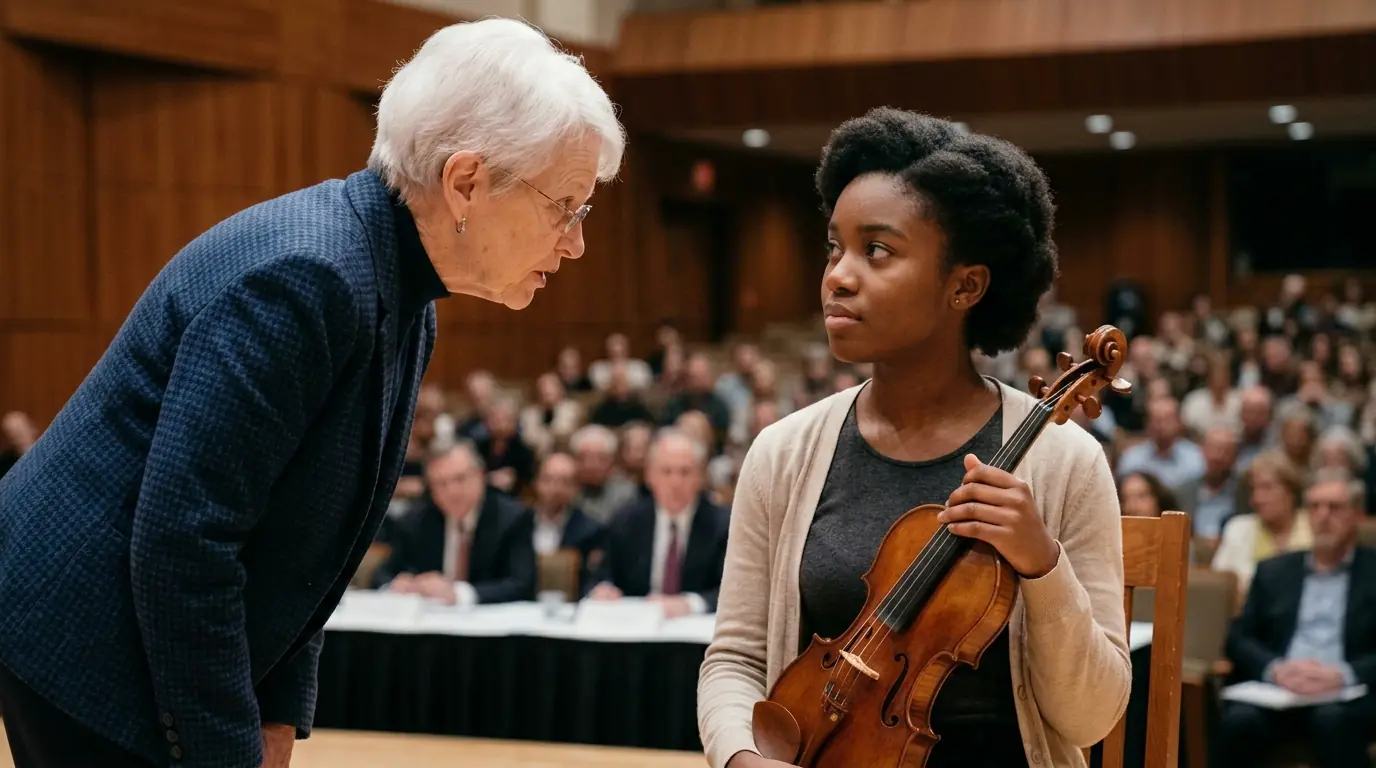
She played a technically flawless segment from a violin concerto.
When she finished, polite applause filled the room.
Constance tapped her pen against her notepad.
"Clean, precise, and utterly forgettable. You play like you're afraid of the music, Miss Chen."
The girl's smile faltered.
Two more students performed, receiving similarly cutting critiques. With each performance, the tension in the room thickened.
Julia scribbled notes, fascinated despite her discomfort. Constance was harsh, yes, but her observations were incisive.
During a brief pause, Constance scanned the room again. This time, her gaze traveled to the back rows.
Julia ducked her head, but too late. Their eyes met.
"You there," Constance called, pointing directly at Julia. "In the gray cardigan. I don't recognize you."
The room turned to stare. Julia felt her cheeks flush.
"I'm just observing," she said, her voice barely carrying across the room.
Constance's eyebrows arched.
"Everyone participates in my master class. Come down here."
Julia froze. This wasn't supposed to happen. She was here to observe, not perform.
But Constance Wellington was waiting, and 60 pairs of eyes watched expectantly.
"I'm really just here to observe," Julia repeated, her voice stronger this time.
A few students exchanged glances, surprised at anyone challenging Constance Wellington.
The critic's mouth tightened into a thin line.
"Young lady, I've been conducting master classes for 40 years. There are no passive observers in my sessions."
Her eyes narrowed.
"Unless, of course, you feel you have nothing to contribute."
A murmur rippled through the room.
Julia felt every eye upon her as she slowly stood, clutching her notebook like a shield.
"What's your name?" Constance asked as Julia reluctantly made her way down the steps.
"Julia Hayes."
"And what do you do, Miss Hayes?"
"I'm a composer," Julia said, reaching the front row. "Mainly arrangements."
"A composer?" Constance's voice carried theatrical surprise. "How interesting. Tell me, Miss Hayes, do you play any instruments?"
Julia hesitated.
"I used to."
"Used to," Constance repeated, turning to address the room. "Ladies and gentlemen, we have a composer who used to play. How does one compose without intimately understanding the instrument?"
She gestured toward a violin case on the table.
"Perhaps you'd care to demonstrate your former abilities."
Several students smirked. Julia recognized this tactic, public humiliation disguised as teaching.
She'd seen it before in elite music circles, where established figures maintained their position by tearing down newcomers.
"I don't perform anymore," Julia said quietly.
"Of course you don't." Constance's smile didn't reach her eyes. "Yet you feel qualified to write music for performers."
She opened the violin case, revealing a beautiful Stradivarius copy.
"Indulge us. Play something. Anything. Show us what informs your compositions."
Julia stared at the instrument. It had been 8 years since she had held a violin.
8 years of deliberately avoiding this exact scenario, being forced to perform under critical eyes.
"I'm sure you can manage a simple scale," Constance pressed, her tone dripping with condescension. "Even my beginner students can do that."
A tall young man in the front row laughed softly.
"Maybe she can try 'Twinkle, Twinkle, Little Star,'" he whispered to his neighbor, just loud enough for Julia to hear.
Constance lifted the violin from its case, holding it out to Julia.
"Consider this a learning opportunity, Miss Hayes. To write effectively for an instrument, one must understand its soul."
Julia knew she was being mocked. Constance had already decided she was a fraud, a mediocre composer who couldn't perform, who didn't belong in this prestigious space.
The critic had specifically chosen her to make an example.
This is what happens to impostors.
With trembling hands, Julia accepted the violin, its familiar weight simultaneously comforting and terrifying.
"The stand is there," Constance said, gesturing. "Unless you prefer to play from memory."
More chuckles from the students.
The assumption was clear. Julia couldn't possibly know anything challenging by heart.
Constance retreated to a chair, notepad ready, lips curved in anticipation of disaster.
"Whenever you're ready, Miss Hayes. A scale perhaps, or whatever simple piece you remember."
Julia positioned the violin under her chin, muscle memory taking over despite years of avoidance.
The room seemed to spin around her.
This was exactly why she'd stopped performing, the paralyzing anxiety, the judgmental stares, the certainty that one mistake would define her forever.
Her bow hovered over the strings.
She could play a simple scale as suggested and escape with minimal embarrassment.
She could hand the violin back and refuse this charade altogether.
Or she could show them who she really was.
Julia closed her eyes, shutting out the room, the stares, Constance's smug expression.
In the darkness behind her eyelids, she found her breath, found her center, and made her choice.
Time seemed to slow as Julia stood on the small stage, the violin nestled against her collarbone.
The familiar feel of the instrument brought back a flood of memories, years of practice, competitions, the joy of playing, and ultimately the fear that had silenced her.
Eight years ago, during her Juilliard audition, panic had overtaken her. Her fingers had frozen mid-performance, the music evaporating from her mind.
The judges' disappointed expressions had haunted her for years.
That day, she'd vowed never to perform again, channeling her musical gift into composition instead.
Yet, here she was, back in the spotlight.
A memory surfaced, her former teacher's words.
"Music isn't about perfection, Julia. It's about truth. Play your truth."
Her truth.
Not what Constance Wellington expected. Not what these students wanted to see.
A humiliated woman proving their assumptions right.
Julia opened her eyes, meeting Constance's satisfied smirk with newfound clarity.
The critic expected failure. She had deliberately set this up to embarrass the plain, unremarkable woman who dared enter her domain.
Julia's fingers settled on the strings, fingers that hadn't forgotten, despite years of neglect.
"We're waiting, Miss Hayes," Constance said, checking her watch. "Though perhaps we should move on if you're finding this too challenging."
More snickers from the front row.
The concertmaster shifted uncomfortably, looking as if he might intervene.
Julia took a deep breath.
She could walk away now, return to her safe, anonymous life of composing in the shadows.
Or she could reclaim something she'd lost. Not just her ability to perform, but her courage.
In that moment, Julia made her decision.
She wouldn't play a simple scale. She wouldn't match their low expectations.
She positioned her bow and played the first note, a perfect, resonant G that silenced the whispers instantly.
Then another, and another.
The opening notes of Bach's Chaconne from Partita No. 2 filled the room.
One of the most technically challenging pieces in the violin repertoire. A piece that separated true virtuosos from merely accomplished players.
Julia saw Constance's eyes widen slightly, her composure slipping for just a moment.
The critic had expected fumbling, perhaps a children's tune played with hesitation. Not this.
As Julia continued playing, the technical perfection of each note was just the foundation.
What flowed through her fingers was something more. All the emotion she'd bottled up for years, all the music she'd kept inside.
The room disappeared. The judging eyes faded away.
There was only Julia and the violin, speaking to each other after a long, painful silence.
She closed her eyes again, surrendering fully to the music, and played her truth.
Bach's Chaconne flowed from Julia's fingers as naturally as breathing.
Each note rang true. Each phrase built upon the last with architectural precision.
The piece, known as a Mount Everest for violinists, unfolded with a depth that only comes from profound understanding and mastery.
The room fell completely silent. Even the rustle of papers ceased.
Julia's body swayed slightly as she navigated the complex double stops, two notes played simultaneously with perfect intonation.
Her left hand danced across the fingerboard while her right controlled the bow with exquisite sensitivity, creating dynamics that ranged from a whisper to a commanding declaration.
In the fourth row, the concertmaster of the San Francisco Symphony leaned forward, his expression transforming from polite interest to stunned admiration.
He had performed this very piece last season after preparing for months.
Yet this unassuming woman in a gray cardigan was playing it with a fluidity he had struggled to achieve.
Constance Wellington sat motionless, her notepad forgotten in her lap.
The smug smile had vanished, replaced by an expression rarely seen on her face, genuine astonishment.
Her carefully orchestrated moment of humiliation had backfired spectacularly.
As Julia reached the piece's central section, where Bach shifts from minor to major, she infused the passage with an almost spiritual quality.
The music brightened like sunlight breaking through storm clouds, revealing new emotional terrain.
Several listeners visibly shivered at the transformation.
Julia remained immersed in her own world, eyes closed, completely connected to the instrument.
Her technique was flawless, but it was her interpretation that elevated the performance beyond mere technical brilliance.
She wasn't just playing notes on a page. She was telling a story, one of loss, rediscovery, and transcendence.
The melody soared through the room's perfect acoustics, reaching even the furthest seats with crystalline clarity.
In the back row, a young student wiped away tears. Next to her, a professor of violin technique shook his head in disbelief.
The piece's final section returned to the profound minor theme, now enriched by everything that had come before.
Julia's bow strokes became more intense, her vibrato expressing centuries of human emotion, distilled into pure sound.
As she approached the final bars, she opened her eyes, her gaze direct and clear.
Gone was the hesitant woman who had reluctantly taken the stage.
In her place stood an artist fully reclaiming her power.
The final chord resonated through the hall, lingering in the air like a question awaiting an answer.
For three heartbeats, complete silence held the room.
Then someone in the back gasped audibly, breaking the spell.
The applause began with one person, the concertmaster, who rose to his feet, clapping with unrestrained enthusiasm.
Others quickly followed, the ovation building to a thunderous level.
Students who had snickered earlier now stared open-mouthed, their hands moving automatically in applause, while their minds still processed what they had witnessed.
Through it all, Constance Wellington remained seated, her face unreadable.
For perhaps the first time in decades, the formidable critic found herself speechless.
Julia lowered the violin, her chest rising and falling with each breath.
The familiar post-performance adrenaline coursed through her veins, a sensation she'd forgotten, both terrifying and exhilarating.
As the applause continued, Julia noticed something unexpected.
Her hands weren't shaking.
The paralyzing anxiety that had once defined her relationship with performance had transformed into something else, a focused intensity that enhanced rather than inhibited her playing.
She had faced her greatest fear on a public stage under the scrutiny of one of music's harshest critics and hadn't merely survived.
She had triumphed.
Looking directly at Constance Wellington, Julia offered a small, genuine smile, not of smugness or revenge, but of gratitude.
Sometimes we need to be pushed to remember who we truly are.
The standing ovation continued for nearly a minute, an eternity in the typically reserved atmosphere of a master class.
Students who had been competing for Constance's approval now gazed at Julia with unfiltered admiration.
Faculty members exchanged meaningful glances, already thinking about recruitment opportunities.
When the applause finally subsided, an expectant hush fell over the room.
All eyes turned to Constance Wellington, waiting for her verdict.
The critic stood slowly, her composure mostly restored, save for a slight tremor in her hand as she adjusted her glasses.
She approached Julia with measured steps, her expression carefully neutral.
"Miss Hayes," she began, her voice carrying clearly through the silent room, "that was..."
She paused, seeming to search for the right words.
"That was a revelation."
Coming from Constance Wellington, a woman who had once described a Grammy-winning performance as "adequate," this was extraordinary praise.
"Where did you study?" Constance asked, genuine curiosity replacing her earlier condescension. "Curtis Institute, for a time?"
"Yes," Julia replied softly. "Before I stopped performing."
"Stopped performing?" Constance repeated, shaking her head. "A criminal waste of talent."
She turned to address the room.
"This, students, is what I've been trying to explain to you. Technical proficiency is merely the beginning. What Miss Hayes just demonstrated goes beyond technique. It's artistry in its purest form."
The concertmaster approached, extending his hand to Julia.
"That was remarkable. Are you currently affiliated with any orchestra?"
Before Julia could answer, others gathered around her, faculty members offering teaching opportunities, students asking questions about her technique, local musicians introducing themselves.
The energy in the room had completely transformed.
Through the crowd, Julia glimpsed Constance Wellington watching from a distance, her expression thoughtful.
When their eyes met, the older woman gave a slight nod.
Not quite an apology, but a clear acknowledgment.
In 20 minutes, Julia Hayes had gone from anonymous observer to the center of San Francisco's musical elite.
As the crowd gradually dispersed for a scheduled break, Constance approached Julia, who was carefully returning the violin to its case.
"You handle that instrument like it's an extension of yourself," Constance observed, her earlier hostility replaced by professional respect.
Julia closed the case gently.
"It felt like coming home."
"Why did you stop?" Constance asked directly.
"With that level of artistry, you could have—"
"Performance anxiety," Julia interrupted, surprising herself with her candor. "During my Juilliard audition, I froze completely. Couldn't play a note. After that, the mere thought of performing would trigger panic attacks."
Constance's expression softened almost imperceptibly.
"So you turned to composition."
Julia nodded.
"I never stopped loving music. I just found a different way to express it."
"Your publisher sent you here, didn't they? Martin Wallace?"
When Julia looked surprised, Constance smiled slightly.
"San Francisco's music world is rather small. Martin mentioned he had a brilliant composer who needed to reconnect with performance."
"He didn't tell me you'd be here," Julia said.
"Nor did he tell me about you," Constance replied. "Perhaps he orchestrated this little confrontation."
A moment of understanding passed between them.
"Your compositions," Constance continued, "I'd like to see them."
Julia hesitated, then handed over her worn notebook.
Constance flipped through it, her trained eyes scanning the complex arrangements. Her eyebrows rose incrementally with each page.
"You've been hiding twice," she finally said, closing the notebook. "These are exceptional."
She returned the notebook, then reached into her bag and extracted a business card.
"The San Francisco Chamber Orchestra needs a composer-in-residence. The position also requires occasional performance."
Her eyes held Julia's.
"They need someone who understands both worlds."
Julia took the card, her fingers trembling slightly.
Not from anxiety this time, but possibility.
"Think about it," Constance said. "Talent like yours shouldn't remain in the shadows."
Three months later, Julia Hayes stood center stage at the Herbst Theatre, violin in hand.
Behind her, the San Francisco Chamber Orchestra waited for her cue.
In the front row, Constance Wellington watched intently, program notes in hand.
The piece they were about to perform, "Emergence," was Julia's own composition, written during the transformative weeks following the master class.
As Julia raised her bow, she recalled the moment that had changed everything.
When a critic's attempt to humiliate her had instead freed her.
The anxiety hadn't disappeared completely. It probably never would.
But it had transformed into something manageable, even useful.
She began to play, leading the orchestra through her musical story of fear, hiding, and ultimately reclamation.
In the audience, faces showed the same expressions hers had once held, uncertainty, doubt, the fear of being truly seen.
Her music spoke directly to them.
It's never too late to become who you really are.
Have you ever hidden your talents from the world, afraid of judgment or failure?
Julia's story reminds us that sometimes our greatest gifts emerge when we're pushed beyond our comfort zones.
Remember, true talent can't stay hidden forever, and the very people who try to diminish you might be the ones who inadvertently help you shine.
Until next time, keep your hearts open and your spirits brave.
Her simple gray cardigan and modest dress set her apart from the fashion-forward students crowding the sidewalk, their instrument cases emblazoned with prestigious conservatory logos.
Julia clutched her worn leather notebook filled with musical compositions, her true passion.
At 33, she'd built a modest career writing arrangements for local orchestras and small productions. Though her work was played by others, few knew her face or name. That's how she preferred it.
"Excuse me," she murmured, navigating through a group of animated violinists comparing notes about today's special event.
A visiting masterclass with Constance Wellington, the most feared critic on the West Coast.
"Can you believe she called Taylor Fischer's Carnegie performance technically perfect but soulless?" one student whispered.
"His career practically ended overnight."
Julia swallowed hard. She remembered reading that scathing review. Constance Wellington didn't just critique music. She wielded her opinion like a weapon.
Inside the building, Julia approached the reception desk.
"I'm here for the composition and performance connection seminar."
The receptionist barely glanced up.
"Room 342. You need to sign in."
As Julia scribbled her name, the woman finally looked at her.
"Are you a student or faculty?"
"Neither. I'm a composer," Julia said, shifting uncomfortably. "My publisher arranged for me to observe today."
The receptionist raised an eyebrow.
"Well, it's primarily for performing students, but since you're on the list..."
She handed Julia a visitor badge with thinly veiled skepticism.
In the elevator, Julia mentally rehearsed why she was putting herself through this.
Her publisher had been blunt.
"Your compositions are technically brilliant, Julia, but they lack something. An understanding of what performers need. You write as if you've never held an instrument."
His suggestion: observe a master class. See how musicians connect with their instruments.
What he didn't know was that Julia had held an instrument.
For 15 years, she'd poured her soul into the violin, practicing until her fingers bled and her shoulders ached. She'd been called gifted, exceptional even.
But when it came to performing for others, paralyzing anxiety took over.
After a particularly disastrous audition at Juilliard, she'd locked her violin away and turned to composition, creating music for others to bring to life.
As the elevator doors opened, Julia heard it, the unmistakable sound of a perfectly tuned E string.
Her fingers twitched involuntarily, muscle memory responding to a call she'd denied for nearly a decade.
She took a deep breath and stepped into the hallway.
Just observe. Take notes. Don't draw attention.
Little did she know, attention was exactly what she would get.
Room 342 wasn't just any classroom. It was Westwood's crown jewel, a miniature concert hall with tiered seating facing a small stage.
Julia slipped in through the back door, relieved to find several empty seats in the last row.
She settled in, notebook ready, determined to remain invisible.
The room buzzed with anticipation. Nearly 60 students, most clutching violins, filled the front rows.
Faculty members and a few recognizable faces from San Francisco's music scene occupied the middle section. Julia recognized the concertmaster of the symphony and the dean of the conservatory among them.
At precisely 10:00 a.m., the room fell silent as Constance Wellington made her entrance.
The critic moved with deliberate grace, her silver hair cut in a perfect bob, gold-rimmed spectacles perched on her nose. Her plaid blazer, undoubtedly designer, complemented her tailored slacks.
At 72, she carried herself with the authority of someone who had made and broken musical careers with the stroke of her pen.
"Good morning," she said, her voice crisp as autumn leaves. "I trust you've all prepared something worthy of my time today."
The students straightened in their seats, several visibly swallowed.
"For those who don't know my methods," Constance continued, surveying the room, "I don't believe in coddling talent. The music world isn't kind. Why should I be?"
Her eyes narrowed.
"Today, I'll select a few of you to perform. I'll critique honestly. If you can't handle that, there's the door."
No one moved. Julia sank lower in her seat.
"Now then," Constance consulted a list. "Let's begin with someone prepared."
Alexis Chen, a young woman in a tailored blue dress, rose confidently, violin already in position.
She played a technically flawless segment from a violin concerto.
When she finished, polite applause filled the room.
Constance tapped her pen against her notepad.
"Clean, precise, and utterly forgettable. You play like you're afraid of the music, Miss Chen."
The girl's smile faltered.
Two more students performed, receiving similarly cutting critiques. With each performance, the tension in the room thickened.
Julia scribbled notes, fascinated despite her discomfort. Constance was harsh, yes, but her observations were incisive.
During a brief pause, Constance scanned the room again. This time, her gaze traveled to the back rows.
Julia ducked her head, but too late. Their eyes met.
"You there," Constance called, pointing directly at Julia. "In the gray cardigan. I don't recognize you."
The room turned to stare. Julia felt her cheeks flush.
"I'm just observing," she said, her voice barely carrying across the room.
Constance's eyebrows arched.
"Everyone participates in my master class. Come down here."
Julia froze. This wasn't supposed to happen. She was here to observe, not perform.
But Constance Wellington was waiting, and 60 pairs of eyes watched expectantly.
"I'm really just here to observe," Julia repeated, her voice stronger this time.
A few students exchanged glances, surprised at anyone challenging Constance Wellington.
The critic's mouth tightened into a thin line.
"Young lady, I've been conducting master classes for 40 years. There are no passive observers in my sessions."
Her eyes narrowed.
"Unless, of course, you feel you have nothing to contribute."
A murmur rippled through the room.
Julia felt every eye upon her as she slowly stood, clutching her notebook like a shield.
"What's your name?" Constance asked as Julia reluctantly made her way down the steps.
"Julia Hayes."
"And what do you do, Miss Hayes?"
"I'm a composer," Julia said, reaching the front row. "Mainly arrangements."
"A composer?" Constance's voice carried theatrical surprise. "How interesting. Tell me, Miss Hayes, do you play any instruments?"
Julia hesitated.
"I used to."
"Used to," Constance repeated, turning to address the room. "Ladies and gentlemen, we have a composer who used to play. How does one compose without intimately understanding the instrument?"
She gestured toward a violin case on the table.
"Perhaps you'd care to demonstrate your former abilities."
Several students smirked. Julia recognized this tactic, public humiliation disguised as teaching.
She'd seen it before in elite music circles, where established figures maintained their position by tearing down newcomers.
"I don't perform anymore," Julia said quietly.
"Of course you don't." Constance's smile didn't reach her eyes. "Yet you feel qualified to write music for performers."
She opened the violin case, revealing a beautiful Stradivarius copy.
"Indulge us. Play something. Anything. Show us what informs your compositions."
Julia stared at the instrument. It had been 8 years since she had held a violin.
8 years of deliberately avoiding this exact scenario, being forced to perform under critical eyes.
"I'm sure you can manage a simple scale," Constance pressed, her tone dripping with condescension. "Even my beginner students can do that."
A tall young man in the front row laughed softly.
"Maybe she can try 'Twinkle, Twinkle, Little Star,'" he whispered to his neighbor, just loud enough for Julia to hear.
Constance lifted the violin from its case, holding it out to Julia.
"Consider this a learning opportunity, Miss Hayes. To write effectively for an instrument, one must understand its soul."
Julia knew she was being mocked. Constance had already decided she was a fraud, a mediocre composer who couldn't perform, who didn't belong in this prestigious space.
The critic had specifically chosen her to make an example.
This is what happens to impostors.
With trembling hands, Julia accepted the violin, its familiar weight simultaneously comforting and terrifying.
"The stand is there," Constance said, gesturing. "Unless you prefer to play from memory."
More chuckles from the students.
The assumption was clear. Julia couldn't possibly know anything challenging by heart.
Constance retreated to a chair, notepad ready, lips curved in anticipation of disaster.
"Whenever you're ready, Miss Hayes. A scale perhaps, or whatever simple piece you remember."
Julia positioned the violin under her chin, muscle memory taking over despite years of avoidance.
The room seemed to spin around her.
This was exactly why she'd stopped performing, the paralyzing anxiety, the judgmental stares, the certainty that one mistake would define her forever.
Her bow hovered over the strings.
She could play a simple scale as suggested and escape with minimal embarrassment.
She could hand the violin back and refuse this charade altogether.
Or she could show them who she really was.
Julia closed her eyes, shutting out the room, the stares, Constance's smug expression.
In the darkness behind her eyelids, she found her breath, found her center, and made her choice.
Time seemed to slow as Julia stood on the small stage, the violin nestled against her collarbone.
The familiar feel of the instrument brought back a flood of memories, years of practice, competitions, the joy of playing, and ultimately the fear that had silenced her.
Eight years ago, during her Juilliard audition, panic had overtaken her. Her fingers had frozen mid-performance, the music evaporating from her mind.
The judges' disappointed expressions had haunted her for years.
That day, she'd vowed never to perform again, channeling her musical gift into composition instead.
Yet, here she was, back in the spotlight.
A memory surfaced, her former teacher's words.
"Music isn't about perfection, Julia. It's about truth. Play your truth."
Her truth.
Not what Constance Wellington expected. Not what these students wanted to see.
A humiliated woman proving their assumptions right.
Julia opened her eyes, meeting Constance's satisfied smirk with newfound clarity.
The critic expected failure. She had deliberately set this up to embarrass the plain, unremarkable woman who dared enter her domain.
Julia's fingers settled on the strings, fingers that hadn't forgotten, despite years of neglect.
"We're waiting, Miss Hayes," Constance said, checking her watch. "Though perhaps we should move on if you're finding this too challenging."
More snickers from the front row.
The concertmaster shifted uncomfortably, looking as if he might intervene.
Julia took a deep breath.
She could walk away now, return to her safe, anonymous life of composing in the shadows.
Or she could reclaim something she'd lost. Not just her ability to perform, but her courage.
In that moment, Julia made her decision.
She wouldn't play a simple scale. She wouldn't match their low expectations.
She positioned her bow and played the first note, a perfect, resonant G that silenced the whispers instantly.
Then another, and another.
The opening notes of Bach's Chaconne from Partita No. 2 filled the room.
One of the most technically challenging pieces in the violin repertoire. A piece that separated true virtuosos from merely accomplished players.
Julia saw Constance's eyes widen slightly, her composure slipping for just a moment.
The critic had expected fumbling, perhaps a children's tune played with hesitation. Not this.
As Julia continued playing, the technical perfection of each note was just the foundation.
What flowed through her fingers was something more. All the emotion she'd bottled up for years, all the music she'd kept inside.
The room disappeared. The judging eyes faded away.
There was only Julia and the violin, speaking to each other after a long, painful silence.
She closed her eyes again, surrendering fully to the music, and played her truth.
Bach's Chaconne flowed from Julia's fingers as naturally as breathing.
Each note rang true. Each phrase built upon the last with architectural precision.
The piece, known as a Mount Everest for violinists, unfolded with a depth that only comes from profound understanding and mastery.
The room fell completely silent. Even the rustle of papers ceased.
Julia's body swayed slightly as she navigated the complex double stops, two notes played simultaneously with perfect intonation.
Her left hand danced across the fingerboard while her right controlled the bow with exquisite sensitivity, creating dynamics that ranged from a whisper to a commanding declaration.
In the fourth row, the concertmaster of the San Francisco Symphony leaned forward, his expression transforming from polite interest to stunned admiration.
He had performed this very piece last season after preparing for months.
Yet this unassuming woman in a gray cardigan was playing it with a fluidity he had struggled to achieve.
Constance Wellington sat motionless, her notepad forgotten in her lap.
The smug smile had vanished, replaced by an expression rarely seen on her face, genuine astonishment.
Her carefully orchestrated moment of humiliation had backfired spectacularly.
As Julia reached the piece's central section, where Bach shifts from minor to major, she infused the passage with an almost spiritual quality.
The music brightened like sunlight breaking through storm clouds, revealing new emotional terrain.
Several listeners visibly shivered at the transformation.
Julia remained immersed in her own world, eyes closed, completely connected to the instrument.
Her technique was flawless, but it was her interpretation that elevated the performance beyond mere technical brilliance.
She wasn't just playing notes on a page. She was telling a story, one of loss, rediscovery, and transcendence.
The melody soared through the room's perfect acoustics, reaching even the furthest seats with crystalline clarity.
In the back row, a young student wiped away tears. Next to her, a professor of violin technique shook his head in disbelief.
The piece's final section returned to the profound minor theme, now enriched by everything that had come before.
Julia's bow strokes became more intense, her vibrato expressing centuries of human emotion, distilled into pure sound.
As she approached the final bars, she opened her eyes, her gaze direct and clear.
Gone was the hesitant woman who had reluctantly taken the stage.
In her place stood an artist fully reclaiming her power.
The final chord resonated through the hall, lingering in the air like a question awaiting an answer.
For three heartbeats, complete silence held the room.
Then someone in the back gasped audibly, breaking the spell.
The applause began with one person, the concertmaster, who rose to his feet, clapping with unrestrained enthusiasm.
Others quickly followed, the ovation building to a thunderous level.
Students who had snickered earlier now stared open-mouthed, their hands moving automatically in applause, while their minds still processed what they had witnessed.
Through it all, Constance Wellington remained seated, her face unreadable.
For perhaps the first time in decades, the formidable critic found herself speechless.
Julia lowered the violin, her chest rising and falling with each breath.
The familiar post-performance adrenaline coursed through her veins, a sensation she'd forgotten, both terrifying and exhilarating.
As the applause continued, Julia noticed something unexpected.
Her hands weren't shaking.
The paralyzing anxiety that had once defined her relationship with performance had transformed into something else, a focused intensity that enhanced rather than inhibited her playing.
She had faced her greatest fear on a public stage under the scrutiny of one of music's harshest critics and hadn't merely survived.
She had triumphed.
Looking directly at Constance Wellington, Julia offered a small, genuine smile, not of smugness or revenge, but of gratitude.
Sometimes we need to be pushed to remember who we truly are.
The standing ovation continued for nearly a minute, an eternity in the typically reserved atmosphere of a master class.
Students who had been competing for Constance's approval now gazed at Julia with unfiltered admiration.
Faculty members exchanged meaningful glances, already thinking about recruitment opportunities.
When the applause finally subsided, an expectant hush fell over the room.
All eyes turned to Constance Wellington, waiting for her verdict.
The critic stood slowly, her composure mostly restored, save for a slight tremor in her hand as she adjusted her glasses.
She approached Julia with measured steps, her expression carefully neutral.
"Miss Hayes," she began, her voice carrying clearly through the silent room, "that was..."
She paused, seeming to search for the right words.
"That was a revelation."
Coming from Constance Wellington, a woman who had once described a Grammy-winning performance as "adequate," this was extraordinary praise.
"Where did you study?" Constance asked, genuine curiosity replacing her earlier condescension. "Curtis Institute, for a time?"
"Yes," Julia replied softly. "Before I stopped performing."
"Stopped performing?" Constance repeated, shaking her head. "A criminal waste of talent."
She turned to address the room.
"This, students, is what I've been trying to explain to you. Technical proficiency is merely the beginning. What Miss Hayes just demonstrated goes beyond technique. It's artistry in its purest form."
The concertmaster approached, extending his hand to Julia.
"That was remarkable. Are you currently affiliated with any orchestra?"
Before Julia could answer, others gathered around her, faculty members offering teaching opportunities, students asking questions about her technique, local musicians introducing themselves.
The energy in the room had completely transformed.
Through the crowd, Julia glimpsed Constance Wellington watching from a distance, her expression thoughtful.
When their eyes met, the older woman gave a slight nod.
Not quite an apology, but a clear acknowledgment.
In 20 minutes, Julia Hayes had gone from anonymous observer to the center of San Francisco's musical elite.
As the crowd gradually dispersed for a scheduled break, Constance approached Julia, who was carefully returning the violin to its case.
"You handle that instrument like it's an extension of yourself," Constance observed, her earlier hostility replaced by professional respect.
Julia closed the case gently.
"It felt like coming home."
"Why did you stop?" Constance asked directly.
"With that level of artistry, you could have—"
"Performance anxiety," Julia interrupted, surprising herself with her candor. "During my Juilliard audition, I froze completely. Couldn't play a note. After that, the mere thought of performing would trigger panic attacks."
Constance's expression softened almost imperceptibly.
"So you turned to composition."
Julia nodded.
"I never stopped loving music. I just found a different way to express it."
"Your publisher sent you here, didn't they? Martin Wallace?"
When Julia looked surprised, Constance smiled slightly.
"San Francisco's music world is rather small. Martin mentioned he had a brilliant composer who needed to reconnect with performance."
"He didn't tell me you'd be here," Julia said.
"Nor did he tell me about you," Constance replied. "Perhaps he orchestrated this little confrontation."
A moment of understanding passed between them.
"Your compositions," Constance continued, "I'd like to see them."
Julia hesitated, then handed over her worn notebook.
Constance flipped through it, her trained eyes scanning the complex arrangements. Her eyebrows rose incrementally with each page.
"You've been hiding twice," she finally said, closing the notebook. "These are exceptional."
She returned the notebook, then reached into her bag and extracted a business card.
"The San Francisco Chamber Orchestra needs a composer-in-residence. The position also requires occasional performance."
Her eyes held Julia's.
"They need someone who understands both worlds."
Julia took the card, her fingers trembling slightly.
Not from anxiety this time, but possibility.
"Think about it," Constance said. "Talent like yours shouldn't remain in the shadows."
Three months later, Julia Hayes stood center stage at the Herbst Theatre, violin in hand.
Behind her, the San Francisco Chamber Orchestra waited for her cue.
In the front row, Constance Wellington watched intently, program notes in hand.
The piece they were about to perform, "Emergence," was Julia's own composition, written during the transformative weeks following the master class.
As Julia raised her bow, she recalled the moment that had changed everything.
When a critic's attempt to humiliate her had instead freed her.
The anxiety hadn't disappeared completely. It probably never would.
But it had transformed into something manageable, even useful.
She began to play, leading the orchestra through her musical story of fear, hiding, and ultimately reclamation.
In the audience, faces showed the same expressions hers had once held, uncertainty, doubt, the fear of being truly seen.
Her music spoke directly to them.
It's never too late to become who you really are.
Have you ever hidden your talents from the world, afraid of judgment or failure?
Julia's story reminds us that sometimes our greatest gifts emerge when we're pushed beyond our comfort zones.
Remember, true talent can't stay hidden forever, and the very people who try to diminish you might be the ones who inadvertently help you shine.
Until next time, keep your hearts open and your spirits brave.
News in the same category

An Old Woman Took In Two Freezing Dogs — The Next Morning, Police Surrounded Her House!
Cop Laughed At a Woman While She Was Jogging — Unaware Who She Is

Black Belt Asked a Black Woman to Fight as a Joke – What She Did Next Silenced the Whole Gym
Black Belt Asked a Black Woman to Fight as a Joke – What She Did Next Silenced the Whole Gym
They Sentenced a Cop to Death — But Her K9 Refused to Let the Story End That Way
They Sentenced a Cop to Death — But Her K9 Refused to Let the Story End That Way
She Was Accused of Stealing in a Luxury Boutique — Until Her Father Walked In
She Bought Breakfast for a Poor Old Woman Every Morning — One Day, the Truth Changed Everything
She Bought Breakfast for a Poor Old Woman Every Morning — One Day, the Truth Changed Everything
Black Woman Denied a Room at Her Own Hotel — 9 Minutes Later, She Fired the Entire Staff
Black Woman Denied a Room at Her Own Hotel — 9 Minutes Later, She Fired the Entire Staff

Judge Demanded She Take Off Her Medal of Honor — Until the Admiral Arrived and Silence Everyone
Judge Demanded She Take Off Her Medal of Honor — Until the Admiral Arrived and Silence Everyone
He Lied to Her Every Week Just to Keep Her Alive — But Her Final Letter Revealed She Knew All Along
She Walked In to Sell Her Family’s Last Treasure — But the Buyer Refused and Paid Her Debt Instead
The Veteran Couldn’t Pay for His Medicine — Until a Stranger Changed Everything
Poor Diner Owner Feeds a Broke Freezing Biker—Weeks Later His Life Was Never the Same
Poor Diner Owner Feeds a Broke Freezing Biker—Weeks Later His Life Was Never the Same
A WAITRESS FED A HUNGRY OLD MAN EVERY DAY — UNTIL ONE MORNING, TWO SUVS ARRIVED AND CALLED HIM “MR. WHITMORE”

Single Dad Janitor Was Asked to Teach Karate as a Joke — What He Did Next Shocked the Whole School
Single Dad Janitor Was Asked to Teach Karate as a Joke — What He Did Next Shocked the Whole School
Judge Ordered Black Woman To Stand Up — Then She Revealed She Is Paralyzed War Hero
Judge Ordered Black Woman To Stand Up — Then She Revealed She Is Paralyzed War Hero

A Waitress Helped an Old Man Every Day — One Day, 10 Black Cars Pulled Up and His Lawyers Walked In

Waitress Shelters Two Freezing Hungry Boys—Next Day, A CEO Claims Her As His Wife
Waitress Shelters Two Freezing Hungry Boys—Next Day, A CEO Claims Her As His Wife
News Post
They Mistook Him for a Janitor at a Job Fair — Until the CEO Revealed
An Old Woman Took In Two Freezing Dogs — The Next Morning, Police Surrounded Her House!
Cop Laughed At a Woman While She Was Jogging — Unaware Who She Is
Black Belt Asked a Black Woman to Fight as a Joke – What She Did Next Silenced the Whole Gym
Black Belt Asked a Black Woman to Fight as a Joke – What She Did Next Silenced the Whole Gym
They Sentenced a Cop to Death — But Her K9 Refused to Let the Story End That Way
They Sentenced a Cop to Death — But Her K9 Refused to Let the Story End That Way
She Was Accused of Stealing in a Luxury Boutique — Until Her Father Walked In
She Bought Breakfast for a Poor Old Woman Every Morning — One Day, the Truth Changed Everything
She Bought Breakfast for a Poor Old Woman Every Morning — One Day, the Truth Changed Everything
Black Woman Denied a Room at Her Own Hotel — 9 Minutes Later, She Fired the Entire Staff
Black Woman Denied a Room at Her Own Hotel — 9 Minutes Later, She Fired the Entire Staff
Judge Demanded She Take Off Her Medal of Honor — Until the Admiral Arrived and Silence Everyone
Judge Demanded She Take Off Her Medal of Honor — Until the Admiral Arrived and Silence Everyone
He Lied to Her Every Week Just to Keep Her Alive — But Her Final Letter Revealed She Knew All Along
She Walked In to Sell Her Family’s Last Treasure — But the Buyer Refused and Paid Her Debt Instead
The Veteran Couldn’t Pay for His Medicine — Until a Stranger Changed Everything

A K9 Ignored Every Command And Ran Into A Crowded Station—Seconds Later It Heard One Voice And Remembered, Proving Some Bonds Outrank Training Itself
A K9 Ignored Every Command And Ran Into A Crowded Station—Seconds Later It Heard One Voice And Remembered, Proving Some Bonds Outrank Training Itself
Poor Diner Owner Feeds a Broke Freezing Biker—Weeks Later His Life Was Never the Same
Poor Diner Owner Feeds a Broke Freezing Biker—Weeks Later His Life Was Never the Same
A WAITRESS FED A HUNGRY OLD MAN EVERY DAY — UNTIL ONE MORNING, TWO SUVS ARRIVED AND CALLED HIM “MR. WHITMORE”
Single Dad Janitor Was Asked to Teach Karate as a Joke — What He Did Next Shocked the Whole School
Single Dad Janitor Was Asked to Teach Karate as a Joke — What He Did Next Shocked the Whole School
Judge Ordered Black Woman To Stand Up — Then She Revealed She Is Paralyzed War Hero
Judge Ordered Black Woman To Stand Up — Then She Revealed She Is Paralyzed War Hero
A Waitress Helped an Old Man Every Day — One Day, 10 Black Cars Pulled Up and His Lawyers Walked In
Waitress Shelters Two Freezing Hungry Boys—Next Day, A CEO Claims Her As His Wife
Waitress Shelters Two Freezing Hungry Boys—Next Day, A CEO Claims Her As His Wife