The voice cracked through the courtroom like a gunshot.
Gage Whitmore, Bailiff 622, his badge catching the fluorescent light as he stepped toward the woman in the wheelchair.
She didn't move.
"I said stand. Everyone rises when this court is in session."
Judge Sloan Brierly's gavel hovered midair, knuckles white around the handle.
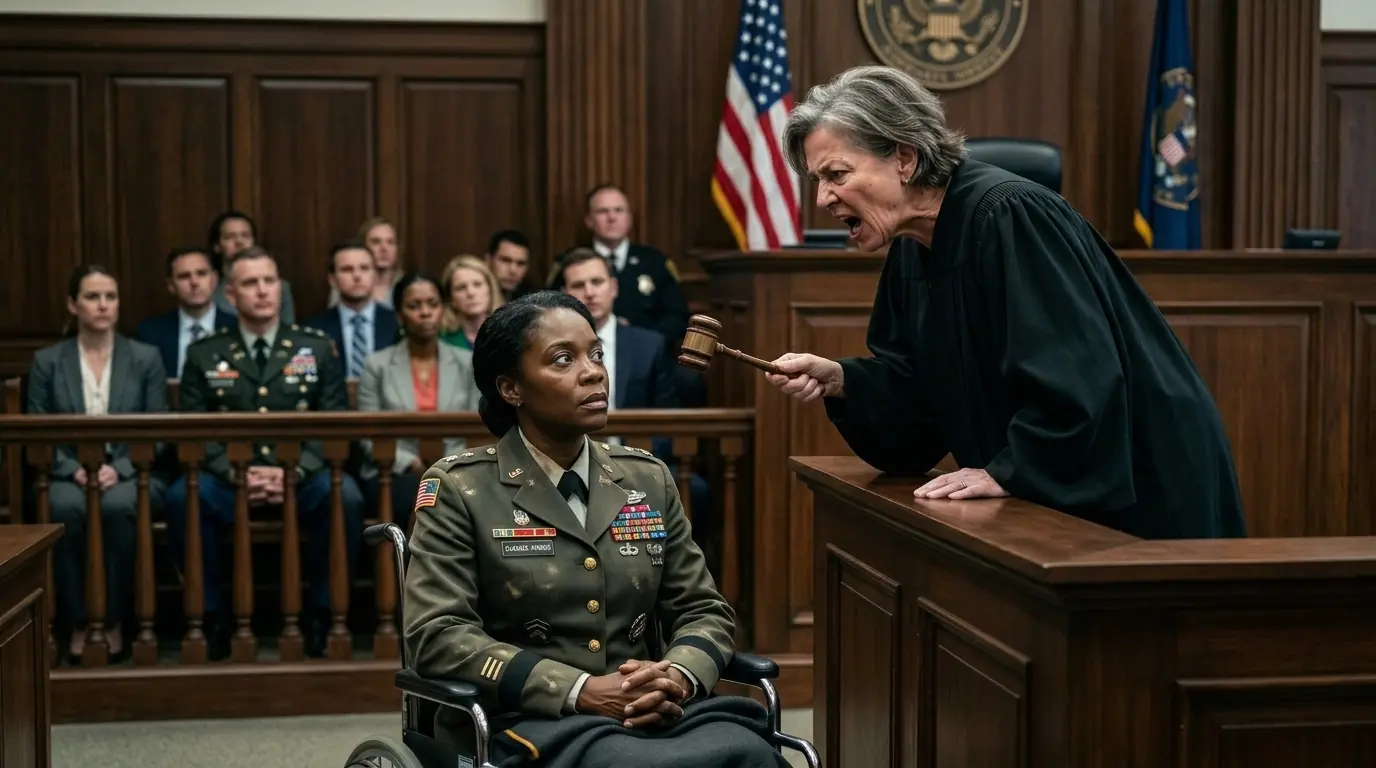
The woman's hands rested on the armrests of her titanium wheelchair.
Brown skin, cropped hair, eyes that didn't blink.
Whitmore's boot stopped 6 inches from the wheel.
"You deaf? You want a contempt charge? That what you want?"
15 people in the gallery, a Tuesday morning.
Nothing special, except the judge had just ordered a decorated army colonel to stand.
A woman paralyzed from the waist down after taking shrapnel to the spine while saving 17 soldiers in Kandahar.
And nobody in that courtroom knew it yet.
"Charleston County Court Rule 4.07," Whitmore read from the sign between the fire extinguisher and a water-stained portrait of some dead governor.
"Quote, 'All persons present shall rise when the judge enters or exits the courtroom. Failure to comply may result in a contempt citation.' End quote."
He leaned down close enough that she could smell the coffee on his breath.
"Last chance, ma'am."
Fiona Garrett looked up.
Not at the bailiff, past him, directly at Judge Brierly.
"The last time someone ordered me to stand," she said, voice flat as concrete, "I was lying in a field hospital with shrapnel in my spine."
The gavel froze.
Whitmore's mouth opened, closed, opened again.
In the back row, a woman in a gray blazer leaned forward, her pen suddenly moving across her notepad.
Marin Holloway, Charleston Post and Courier.
6 months into an investigation she thought was going nowhere, until now.
Three weeks earlier, the house on Maple Shade Lane looked like every other house on the block.
Single-story, pale blue siding, chain-link fence that had seen better decades.
What set it apart was the ramp: wooden, hand-built, angles precise, railings sanded smooth.
Someone had measured twice and cut once.
Fiona wheeled herself down that ramp at 05:47.
Not 05:45, not 05:50.
The body remembered what the mind tried to forget.
Inside, the house was spare.
Towels folded in thirds, then thirds again.
Corners aligned.
Shoes by the door, three pairs, though she only wore one.
Arranged heel to heel, toe to toe.
The photograph in the center of the shelf showed a young woman, mid-20s, laughing at something off-camera.
Maya, her daughter, gone two years now.
Beside it, a smaller frame.
A girl, seven years old, gap-toothed smile, holding a crayon drawing of a house with too many windows.
Zoe, the reason she was still fighting.
The phone rang at 06:12.
"Fiona, it's Marcus. We have a problem."
She let the silence ask the question.
"Derek's attorney filed a motion yesterday. They're arguing you're physically unfit to care for a child."
Physically unfit.
The words sat in her chest like shrapnel.
The kind that never came out.
The kind you learn to breathe around.
"When's the hearing?"
"Tuesday, 9:00 a.m. Judge Sloan Brierly presiding."
"I'll be there."
"Fiona."
Marcus Thorne hesitated.
In 3 years of working together, she'd never heard him hesitate.
"There's something else. I've heard things about Brierly. ADA complaints. Dismissed, all of them. But just be prepared."
She ended the call without saying goodbye.
Old habit.
Words cost energy.
Energy was finite.
On the shelf, Maya's photograph caught the morning light.
26 years old in that picture.
Laughing, alive.
Derek Bowen had been Maya's second husband.
The one Fiona warned her about.
The one with the temper that only showed after the wedding.
The one Maya had finally left 3 months before the accident.
Now he wanted Zoe.
Not because he loved her, Fiona knew that much.
But because Zoe came with Maya's life insurance, with the house Maya bought before the marriage, with the monthly survivor benefits that would continue until the child turned 18.
Derek Bowen saw a seven-year-old and calculated a revenue stream.
Fiona wheeled herself to the window.
The cardinals were at the birdbath, red against the gray morning.
She watched them drink, watched them fly, watched them disappear into a world that still made sense.
Then she went to prepare for war.
Tuesday, 7:45 a.m., Charleston County Family Court.
The building squatted on Broad Street like something designed to intimidate.
Concrete columns, narrow steps, a single ramp on the side, the kind that had been added as an afterthought sometime in the '90s and never updated since.
Fiona arrived 45 minutes early.
The security line had 12 people.
The accessible entrance had none, because it required a buzzer, and the buzzer required someone inside to answer, and the someone inside took 4 minutes and 37 seconds to respond.
She counted, old habit.
"Ma'am," the security officer spoke slowly, loudly, as if addressing a child or a foreigner.
"Do you have a weapon?"
"I can hear you perfectly, and no."
"Arms up, please."
"I can't raise my left arm above shoulder height. Policy requires a rotator cuff injury. VA hospital has the file. Would you like the case number?"
The officer blinked, waved her through.
The elevator to the second floor was out of service.
The sign said "Temporarily."
The tape holding it was yellowed, curled at the edges.
Fiona looked at the stairs.
14 steps.
Metal railing.
She'd done worse.
Chair folded.
Left hand gripping the rail.
Right hand pulling the chair behind her, one step at a time.
Thigh muscles burning.
Shoulders screaming.
Sweat beading on her forehead.
A man in a suit passed her going up.
Glanced, kept walking.
She reached the top in 3 minutes, 22 seconds, unfolded the chair, sat, breathed.
Field conditions, adapt and overcome.
The clerk's window was at the end of the hall.
Dorian Ehart, the nameplate said, sat behind glass that needed cleaning.
Thin face, wire-rim glasses, the kind of person who found power in paperwork.
"Name and case number."
"Fiona Garrett. Garrett versus Bowen."
"Are you the petitioner or respondent?"
"Petitioner."
He typed something, frowned, typed again.
"Ma'am, if you're requesting accommodation, I need documentation. A doctor's note, disability ID, something official."
Fiona looked at him, then at her wheelchair, then back at him.
"The chair isn't official enough?"
"Policy is policy, ma'am. Without documentation, I can't note any accommodations in the file."
She pulled out her phone, opened email, found the letter, held it up to the glass.
"Ralph H. Johnson VA Medical Center, dated 3 weeks ago. Quote, 'Patient Fiona Garrett remains permanently paralyzed due to combat-related spinal injury.' End quote."
Ehart leaned forward, squinted, didn't read.
"I'll need a physical copy for the file."
"I can email it."
"We don't accept electronic submissions for accommodation requests."
"Since when?"
"Policy."
She stared at him.
He stared back.
The kind of standoff that happened in places like this every day to people like her.
"Fine," she said. "I'll print it in the law library."
"The law library is on the third floor. Elevator's out."
She smiled. No warmth in it.
"I noticed."
The law library had a printer that jammed twice and charged 50 cents per page.
Fiona printed three copies of the VA letter, kept one, gave one to Ehart, filed one in her bag in the folder marked 'Backup', next to the other documents she'd learned to carry.
Discharge papers, Social Security disability determination, DD214.
The paperwork of being broken.
Ehart stamped her accommodation request "Approved" without reading it.
She photographed the stamp, the date, his signature.
He noticed.
"Something wrong, ma'am?"
"Just keeping records."
"That's not necessary."
"I'll decide what's necessary."
His jaw tightened.
Small victory. She'd take it.
The courtroom was down the hall, past the vending machines, past the bathrooms that weren't accessible, past a poster about justice for all that had coffee stains on the corner.
A woman stood outside the doors, tall, blonde, heels that clicked like weapons.
Laya Stratton.
Fiona recognized her from the court documents.
Derek Bowen's attorney, the one charging $400 an hour to take a child from her grandmother.
Stratton looked down, literally down, the angle calculated, and smiled.
"Mrs. Garrett, I hope you're prepared. This won't be pleasant."
"It's Ms., and I've had worse mornings."
The smile didn't waver.
"I'm sure you have."
She walked into the courtroom, heels echoing.
Fiona counted her steps.
Eight from the door to the petitioner's table.
Measured the distance, calculated the angle.
The kind of assessment that had kept her alive in places where the wrong step meant an IED, where the wrong door meant an ambush.
Old habits.
They never died.
They just found new battlefields.
Courtroom B12.
15 wooden pews, half of them empty.
American flag in the corner, slightly crooked.
Judge's bench elevated on a platform. Two steps, no ramp.
The petitioner's table had four chairs bolted to the floor.
No space for a wheelchair.
Marcus Thorne was already there.
53, gray at the temples, the kind of tired that came from too many cases and not enough wins.
He stood when Fiona entered.
"They didn't move the chairs."
"I noticed. I called ahead twice."
"I noticed that, too."
He helped her angle the wheelchair into the aisle, half-blocking the path to the exit.
Not ideal, not safe, but the only option they'd been given.
Across the aisle, Laya Stratton arranged her papers with the precision of a surgeon laying out instruments.
Derek Bowen sat beside her.
41 years old, polo shirt, the kind of tan that came from a gym with tanning beds.
He looked at Fiona the way you look at an obstacle.
Something to be removed.
"All rise."
The bailiff's voice. Whitmore.
The one with the badge and the build and the coffee breath.
Everyone stood except Fiona.
Judge Sloan Brierly entered from the side door.
58 years old, gray hair, gold-rimmed glasses, 15 years on the bench.
The kind of judge who'd seen everything and believed nothing.
She settled into her chair, adjusted her robe, looked out at the courtroom.
Her eyes stopped on Fiona.
"Ma'am in the wheelchair, did you not hear? This court requires all persons to rise."
Marcus stepped forward.
"Your honor, my client is—"
"I'm asking your client, counselor, not you."
Fiona met the judge's stare, held it.
"Your honor, I'm unable to stand. I'm paralyzed from the waist down."
3 seconds of silence, the kind that fills with judgment.
"I've seen plenty of people use wheelchairs for convenience."
Brierly's voice carried the particular contempt of someone who believed they'd earned the right to it.
"If you're capable of sitting up straight, you're capable of showing respect."
"Your honor," Marcus tried again.
"Sit down, counselor."
He sat.
Fiona pulled out her phone, found the photograph she'd taken of the ADA poster in the hallway, the one with the regulations printed in small type beneath the larger words, "Know your rights."
"Your honor, the Americans with Disabilities Act, Title 2, Section 35.130, requires public entities to make reasonable modifications for individuals with disabilities. Standing is not a reasonable expectation for a paraplegic."
Brierly's gavel came down once, hard.
"This is my courtroom, Ms. Garrett. Federal guidelines don't override judicial discretion in matters of decorum. I don't care what kind of letter you have, what kind of condition you claim. When I enter this room, everyone rises. Everyone. Are we clear?"
"I'm documenting this exchange for the record."
"You're documenting nothing. Bailiff, confiscate that phone."
Whitmore stepped forward. Hand out.
Fiona didn't move.
"The phone, ma'am, now."
"No."
The word hung in the air. Simple. Final.
Whitmore looked at the judge.
Brierly's face reddened.
"Ms. Garrett, you are this close to a contempt citation. Give the bailiff your phone or I will have you removed from this courtroom."
"On what grounds? Disruption? Disrespect? Take your pick."
Fiona lowered the phone, placed it in her lap, did not hand it over.
"Your honor, if you remove me, you remove the petitioner from a custody hearing. My granddaughter's future will be decided without representation. Is that the record you want?"
Silence.
Stratton smiled.
Small, sharp.
The smile of someone watching their opponent bleed.
Brierly's jaw worked.
Calculations behind the glasses.
Political, professional, personal.
"We'll proceed," she said finally. "But I'm watching you, Ms. Garrett. One more disruption and I will hold you in contempt. Phone stays on the table, face down. Understood?"
"Understood."
The phone went on the table, face down.
But not before Fiona pressed record.
The hearing began.
Stratton stood, smooth, polished, the kind of lawyer who practiced her opening in front of a mirror.
"Your honor, my client, Derek Bowen, is seeking full custody of his stepdaughter, Zoe Garrett Bowen. He is the only father figure the child has known since the age of three. He has a stable income, a suitable home, and a genuine desire to provide for Zoe's welfare."
She paused, looked at Fiona.
"The respondent, Ms. Garrett, is 62 years old—"
"52." Fiona's voice flat. "Excuse me?"
"I'm 52, not 62."
Stratton glanced at her notes, recovered.
"52. My apologies. The respondent is 52 years old, wheelchair-bound, and lives alone. She has no other family members who can assist with childcare. She has a fixed income from disability benefits. And frankly, your honor, her physical limitations raise serious questions about her ability to care for an active seven-year-old."
She sat.
Marcus stood, slower, heavier.
"Your honor, Fiona Garrett is Zoe's biological grandmother. She was granted temporary custody two years ago following the tragic death of her daughter, Zoe's mother. In that time, Zoe has thrived. Her school records show excellent attendance, strong grades, and positive behavioral reports. Ms. Garrett has provided a stable, loving home despite the challenges she faces."
He paused.
"Mr. Bowen, on the other hand, was subject to a restraining order filed by Zoe's mother before her death. That order alleged domestic violence. While the order expired upon Maya Garrett Bowen's passing, the underlying concerns—"
"Objection." Stratton rose. "The restraining order was never adjudicated. My client was never charged, never convicted. Counsel is attempting to prejudice the court with unsubstantiated allegations."
Brierly nodded.
"Sustained. Mr. Thorne, keep to the facts."
"Your honor, a restraining order is a fact."
"A fact that was never proven. Move on."
Marcus sat.
The kind of sitting that looked like surrender.
Fiona watched him, watched Stratton, watched the judge.
She'd seen this before.
Not in courtrooms, in briefing rooms, in tactical meetings, in the back rooms where decisions got made and soldiers got sent to die.
The power dynamics, the alliances, the signals passed between people who thought no one was watching.
Brierly and Stratton had a rhythm, a familiarity.
The way Brierly's eyes softened when Stratton spoke, the way objections were sustained without argument.
Something was wrong here.
She filed it away, kept watching.
The first witness was Wells Ransom, 54 years old, Derek Bowen's neighbor, the kind of man who wore short-sleeved dress shirts and believed they looked professional.
Stratton led him through the questions.
Softball. Rehearsed.
"Mr. Ransom, how would you describe Mr. Bowen's character?"
"Oh, Derek's great. Real stand-up guy. Always waves when he's getting the mail. Helps with the trash cans if they blow over."
"And have you ever witnessed any concerning behavior?"
"Never, not once. He's quiet, keeps to himself, good neighbor."
"Have you seen him interact with Zoe?"
"Sure. Before, you know, before the mother passed. He was great with her. Took her to the park, bought her ice cream. Real father figure."
Stratton nodded, satisfied.
"Your witness, counselor."
Marcus stood.
"Mr. Ransom. How long have you been Mr. Bowen's neighbor?"
"About 2 years now."
"So, you moved in after Maya Garrett Bowen filed the restraining order?"
"Objection. Relevance."
"Goes to the witness's knowledge, your honor."
"Overruled. Answer the question."
Ransom shifted.
"Yeah, I guess after."
"So, you never witnessed any interaction between Mr. Bowen and Maya Garrett Bowen?"
"No."
"But you never saw the behavior that led to the restraining order?"
"No, I wasn't—"
"You're testifying only to what you've seen in the last 2 years, since Mr. Bowen has been living alone. Correct?"
"I guess."
"No further questions."
Small victory, but Brierly's expression hadn't changed.
Like nothing had landed.
The morning dragged on.
More witnesses, more testimony.
Derek Bowen's coworker talking about what a great guy he was.
Derek Bowen's sister talking about how he'd always wanted children.
No one mentioned the restraining order.
No one mentioned Maya's fear.
No one mentioned the bruises Fiona had seen on her daughter's arms.
The ones Maya explained away.
The ones that kept Fiona awake at night.
At 11:30, Brierly called a recess.
"45 minutes. We'll resume at 12:15."
Fiona wheeled herself toward the door.
The aisle was narrow.
The chairs jutted into the path.
She maneuvered carefully, the way you navigate a minefield.
Ransom was ahead of her, walking slow, taking up space.
She tried to pass on the left. He shifted left.
She tried the right. He shifted right.
Coincidence? Maybe.
"Excuse me."
He turned, smiled.
The kind of smile that doesn't reach the eyes.
"Oh, sorry. Didn't see you down there."
He stepped aside, barely.
She squeezed past, her wheelchair scraping against a pew.
In the hallway, Stratton was waiting.
"Ms. Garrett, a word."
Fiona stopped.
Didn't respond. Just waited.
"I want you to know this isn't personal. I'm just doing my job."
"Your job is to take my granddaughter away from me."
"My job is to advocate for my client. Whatever is best for the child, that's for the court to decide."
"And you think Derek Bowen is what's best?"
Stratton's smile sharpened.
"I think a seven-year-old needs an active parent. Someone who can run after her at the park. Someone who can take her to soccer practice. Someone who can keep up."
She let the words land, watched Fiona's face for a reaction.
Fiona gave her nothing.
"I'll see you in there, counselor."
She wheeled past, didn't look back.
The women's restroom on the second floor had two stalls.
Neither was accessible.
The sign on the wall directed wheelchair users to the first floor.
The elevator was still out of service.
Field conditions.
Fiona pulled the wheelchair up to the mirror, looked at herself.
52 years old, gray creeping in at the temples, lines around the eyes that hadn't been there before.
Kandahar.
Before the convoy, before the world split into before and after.
She washed her hands, dried them, wheeled out.
The vending machine was down the hall.
She wanted water.
The machine took her dollar, hummed, dispensed. Nothing.
She pressed the button again. Nothing.
"You have to hit it on the side."
A man's voice.
She turned.
The cane came first.
Wooden, worn at the handle, then the man himself.
Late 60s.
Ball cap that said 'Vietnam Veteran'.
Brown skin darker than hers.
Weathered in the same way.
"Second panel near the bottom. Give it a good whack."
She hit it.
The water bottle fell.
"Thanks."
"Welcome."
He nodded at her chair.
"That a Quickie? Titanium rigid custom frame. Nice. I've got a buddy... IED outside Mosul, '06. He's got the same one. Says it's the Cadillac of chairs."
"He's not wrong."
The man looked at her, not at the chair, at her.
The way veterans looked at each other.
Recognition without introduction.
"You here for a case? Custody hearing?"
"That judge in there, Brierly?"
She nodded.
He shook his head, slow.
"Watch yourself. She's got a thing about people like us."
People like us.
People who take up space.
He walked away. Cane tapping against the tile.
She watched him go.
People who take up space.
She'd spent 23 years learning how to take up space, how to fill a room, how to command attention without raising her voice, how to make men twice her size listen when she spoke.
Now she was being told to make herself smaller.
That wasn't going to happen.
12:15.
The hearing resumed.
Stratton called her next witness.
Dr. Harold Vance, court-appointed psychologist, the kind of expert who made his living telling judges what they wanted to hear.
"Dr. Vance, you conducted an evaluation of the petitioner and respondent. Is that correct?"
"That's correct."
"And what were your findings?"
Vance adjusted his glasses, consulted his notes, the performance of expertise.
"I found that Mr. Bowen presents as a stable, emotionally available individual with appropriate parenting instincts. He expressed genuine concern for Zoe's well-being and a desire to provide her with a structured, nurturing environment."
"And Ms. Garrett?"
Vance paused.
The pause that meant bad news.
"Ms. Garrett is clearly capable in many respects. However, I noted several concerns. Her physical limitations are significant. She requires assistance with many daily activities. Her emotional affect during our interview was flat, detached. This can indicate difficulty with emotional bonding."
Fiona's hands tightened on the armrests.
Flat, detached.
The words they used for people who'd seen things, people who'd learned to put their feelings in a box and lock it shut because the alternative was drowning.
"In your professional opinion, Dr. Vance, which environment would be more beneficial for the child?"
"Objection." Marcus rose. "Calls for speculation."
"Dr. Vance is an expert witness, your honor. His opinion is precisely what he's here to provide."
Brierly nodded.
"Overruled. The witness may answer."
Vance straightened.
"In my professional opinion, a child Zoe's age requires an active, engaged parent who can meet her physical and emotional needs. While Ms. Garrett clearly loves her granddaughter, the question is whether love is sufficient when paired with significant physical limitations and emotional unavailability."
Emotional unavailability.
The words hit like shrapnel.
The kind you don't feel at first, the kind that bleeds slow.
Marcus cross-examined, asked about methodology, about sample size, about the 15 minutes Vance had actually spent with Fiona versus the hour he'd spent with Derek.
None of it mattered.
Brierly's expression said she'd already made up her mind.
Lunch recess, 1 hour.
Marcus found Fiona in the hallway staring at the 'Justice for All' poster with the coffee stains.
"That didn't go well."
She didn't respond.
"Fiona, we need to talk strategy. Vance's testimony hurt us. We need to counter."
"I need air."
She wheeled past him, found the side exit.
The ramp, the afterthought ramp, led to a small courtyard, concrete benches, dead grass, a single tree that had given up trying.
She sat in the sun, closed her eyes.
Kandahar, 2012.
The convoy, the explosion, the silence after.
She'd been three vehicles back when the IED hit.
The lead Humvee went airborne, flipped, landed on its side.
Fire, screaming, the smell of burning fuel and burning flesh.
She was the ranking medical officer.
23 years of training, thousands of hours of simulations.
None of it had prepared her for this.
She didn't remember getting out of her vehicle.
Didn't remember running toward the wreckage.
She remembered the faces, soldiers, some of them kids, 19 years old, bleeding out in the sand.
Triage, the word they used for choosing who to save.
She'd saved 17.
17 soldiers who went home to their families.
17 soldiers who were alive because she'd made decisions no one should have to make.
The 18th didn't make it.
Private First Class Carlos Mendes, 20 years old, died in her arms while she was applying pressure to a wound that wouldn't stop bleeding.
The shrapnel hit her later, when the second wave came, when she was still kneeling in the sand, still holding Carlos's hand, still telling him it was going to be okay.
Even though she knew it wasn't.
She didn't feel it at first.
That's how shrapnel works.
The body goes into shock.
The pain comes later.
The paralysis came later, too.
After the surgery, after the helicopter ride, after waking up in a hospital bed at Landstuhl and realizing she couldn't feel her legs.
Flat, detached, emotionally unavailable.
Try holding a dying boy in your arms and see how available your emotions are afterward.
"Ms. Garrett?"
The voice pulled her back.
The courtyard, the concrete, the dead tree.
A woman stood near the ramp, gray blazer, notepad.
"I'm sorry to bother you. Marin Holloway, Charleston Post and Courier."
Fiona looked at her, said nothing.
"I've been covering the courts for 6 months. Accessibility issues, ADA compliance, or lack thereof." She paused. "I saw what happened in there this morning with Judge Brierly."
"You saw a judge do her job."
"I saw a judge order a disabled woman to stand. I saw a bailiff threaten confiscation. I saw—"
"You saw what happens every day in this building to people like me."
Holloway stepped closer.
Careful, the way you approach a wounded animal.
"That's exactly what I'm investigating. Brierly has 17 complaints filed against her in the last 5 years. All dismissed, all involving disabled litigants, all with the same pattern. Demands to stand, denied accommodations, contempt threats."
Fiona's eyes sharpened.
"17."
"17 that I found. Could be more."
"Why are you telling me this?"
"Because you didn't back down. Nobody backs down in there. They can't afford to. They're too scared, too tired, too broken by the time they reach that courtroom." Holloway paused. "But you didn't flinch."
Fiona looked at her. Really looked.
"What do you want from me?"
"Nothing. Not yet."
Holloway pulled a business card from her pocket, placed it on the arm of Fiona's wheelchair.
"But if something happens in there, if Brierly crosses a line, I want you to have my number."
She walked away.
Fiona looked at the card.
Marin Holloway, Investigative Reporter, 843-555-0147.
She put it in her pocket.
The afternoon session began at 2:15.
Fiona was called to the stand.
The witness box had no ramp, no accommodation.
She had to wheel up the center aisle, angle herself sideways, position the chair beside the box while the bailiff, Whitmore, stood watching with his arms crossed.
Stratton approached, smiled.
"Ms. Garrett, thank you for joining us."
"I was subpoenaed. I didn't have a choice."
"Of course." The smile didn't waver. "Let's talk about your daily routine. You live alone. Is that correct?"
"Yes."
"And you require assistance with certain activities?"
"Some, not all."
"Can you dress yourself?"
"Yes."
"Can you cook?"
"Yes."
"Can you drive?"
"I have a modified vehicle. Hand controls."
Stratton nodded, making notes, building a case.
"Can you run?"
Marcus objected. "Relevance, your honor."
"Goes to physical capability, your honor."
Brierly nodded. "I'll allow it."
Fiona met Stratton's eyes.
"No, I cannot run. I'm paralyzed from the waist down, as you already know."
"So, if Zoe ran toward traffic, a busy street perhaps, you wouldn't be able to catch her."
"I would do what any responsible guardian does. Use my voice, use my phone, use the emergency brake on my chair, position myself strategically. I've kept soldiers alive in worse conditions than a crosswalk."
A slip.
She knew it as soon as it left her mouth.
Stratton's eyes lit up.
"Soldiers? Are you claiming military experience, Ms. Garrett?"
"I'm claiming I know how to protect people. That's all."
"That's a rather vague answer. Were you in the military?"
Marcus stood. "Objection. Beyond the scope. My client's employment history is not an issue."
"It goes to credibility, your honor. If Ms. Garrett is claiming experience. The court should know what that experience is."
Brierly leaned forward. Interested now.
"I'll allow it. The witness will answer."
Fiona hesitated.
For years, she'd kept her service private.
Not out of shame, out of habit.
Out of the knowledge that civilians didn't understand, couldn't understand.
That the moment you said war, people looked at you differently.
Some with respect, some with pity, some with fear.
She wasn't ready to be looked at.
"I served in the army. 23 years. Medical Corps."
"So, you were a nurse?"
"I was a physician, a doctor in the military."
Stratton nodded. "Impressive. And when did you leave the service?"
"I didn't leave. I was medically retired in 2012."
"Following your injury?"
"Yes."
"The injury that resulted in your paralysis."
"Yes."
Stratton paused. Let the silence build.
"Ms. Garrett, I have to ask, are you physically capable of caring for a 7-year-old child? Not emotionally. Not mentally. Physically. Can your body handle the demands of parenthood?"
Fiona looked at her, then at the judge, then at Derek Bowen, sitting at the petitioner's table with that smug expression, that certainty that he'd already won.
"I've carried soldiers through gunfire," she said. "I've performed surgery in a tent with mortars falling outside. I've held dying men in my arms and kept them alive through sheer force of will. I've done all of that from a standing position and a sitting one. My body handles what my mind demands. Always has. Always will."
The courtroom was silent.
Stratton recovered. "No further questions."
Marcus approached for redirect.
Tried to rehabilitate.
Asked about Fiona's daily capabilities, her modifications, her support systems.
None of it mattered.
Brierly had made up her mind.
Fiona could see it in the set of her jaw.
The way she looked at the wheelchair like it was evidence of failure.
The hearing recessed at 5:30 to resume tomorrow, 8:00 a.m.
8, not 9.
The change had been announced casually, almost as an afterthought, but Fiona caught the look that passed between Brierly and Stratton.
The slight nod, the understanding.
They were trying to trip her up, hoping she'd miss the earlier time, hoping they could claim she'd abandoned the case.
She wouldn't.
The hallway was empty now, most of the litigants gone, the lawyers packing up, the clerks counting the minutes until they could leave.
Fiona wheeled toward the elevator, still out of service.
She turned toward the stairs and found Wells Ransom blocking her path.
"Hey there, Ms. Garrett. Long day, huh?"
He was close.
Too close.
His body angled toward her, shoulders squared, taking up space the way men did when they wanted you to know they could.
"Excuse me."
He didn't move.
"Must be tough sitting there all day listening to people talk about you like that." He shook his head. Sympathetic. False. "I almost felt sorry for you."
"Move now."
"That's not very nice. I'm just trying to have a conversation."
She looked at him, measured the distance, the angle, the way his weight shifted to his left foot.
"One more time. Move."
He laughed. "Or what? You going to roll over my toes?"
She didn't answer, just looked.
Something in her eyes made his smile flicker just for a second.
Then he stepped aside, hands raised in mock surrender.
"Relax. I'm going."
He walked past.
His shoulder brushed the handle of her wheelchair, hard, deliberate, sending her slightly off balance.
She grabbed the armrest, steadied herself.
"Oops, clumsy me."
He kept walking, didn't look back.
Fiona watched him go, memorized the way he moved, the confidence, the cruelty.
Then she turned to the stairs.
14 steps, metal railing, 3 minutes 22 seconds.
She'd done it once. She could do it again.
The house on Maple Shade Lane was dark when she got home.
7:45 p.m.
Too late for dinner. Too early for sleep.
The in-between hours when the silence got loud.
She transferred from the car to the chair, wheeled up the ramp, unlocked the door, entered the house she'd lived in for 13 years.
The house that still had Maya's kindergarten drawings in a box in the closet.
The house where Zoe had taken her first steps.
The photograph on the shelf, Maya laughing.
The smaller frame, Zoe smiling.
Both of them depending on her to be strong.
Fiona wheeled to the kitchen, made tea, drank it, didn't taste it.
Her phone buzzed. Marcus.
"Derek's attorney filed a motion for expedited ruling. Brierly granted it. Closing arguments tomorrow. Decision by end of week."
End of week.
She had 3 days, maybe less.
3 days to prove she was capable.
3 days to fight a system that had already decided she wasn't worth the accommodation.
3 days to save her granddaughter from a man who saw her as property.
The phone buzzed again. Unknown number.
She answered.
"Ms. Garrett, this is a courtesy call from Charleston County Family Court. Your hearing tomorrow has been moved from 8:00 a.m. to 7:30 a.m. Please confirm receipt."
7:30.
"Is that a confirmation?"
"That's a confirmation."
She ended the call.
7:30. Half an hour earlier.
A voicemail at 7:45 p.m.
Less than 12 hours notice.
No written documentation.
They were trying to bury her.
She looked at the photograph of Maya.
The laughter frozen in time.
The daughter she couldn't save.
Not this time.
This time she would fight.
6:15 a.m. Charleston County Family Court.
Fiona arrived an hour and 15 minutes early.
The security guard, same one as yesterday, watched her approach.
"Back again?"
"Back again."
He waved her through without the performance.
Small mercy.
The elevator was still broken.
She did the stairs.
15 minutes earlier than yesterday.
Her arms were getting stronger, or her tolerance for pain was increasing.
Hard to tell the difference.
Courtroom B12 was unlocked, but empty.
She wheeled in, positioned herself at the petitioner's table, waited.
At 7:20, Marcus arrived out of breath.
"I just got the voicemail. 7:30. They changed it again."
"Courtesy call at 7:45 last night."
"That's not... They can't..." He stopped. Collected himself. "We'll file a motion. This is clearly prejudicial after the hearing. For now, we're here. That's what matters."
At 7:25, Stratton arrived.
Didn't bother hiding her surprise.
"Ms. Garrett, you're early."
"I was army. 0730 means 0615."
Stratton's smile faltered just for a moment.
Derek Bowen arrived at 7:28, rushed, hair still wet from the shower.
The earlier time had been meant to throw Fiona off, but clearly no one had told him.
Judge Brierly entered at 7:30 exactly.
"All rise." The bailiff's command. Whitmore again.
Everyone stood.
Fiona did not.
Brierly's eyes found her immediately.
The judgment. The contempt.
But this time something else. Uncertainty.
The woman in the wheelchair had been supposed to fail.
She'd been supposed to show up late, flustered, unprepared.
She'd been supposed to give them a reason to dismiss her case.
Instead, she was here early, waiting.
That wasn't supposed to happen.
The morning session began with witness testimony.
Marcus called Zoe's teacher.
Mrs. Helen Patterson, 22 years in education.
Sensible shoes, kind eyes.
"Mrs. Patterson, how long have you known Zoe Garrett Bowen?"
"2 years. She's been in my second and third grade classes."
"How would you describe her?"
"Zoe is bright, curious, and engaged. She loves reading. She's kind to her classmates. She's a joy to have in the classroom."
"And who brings her to school each morning?"
"Her grandmother, Ms. Garrett. She's there every morning at 7:45, never late."
"In your interactions with Ms. Garrett, have you ever had any concerns about her ability to care for Zoe?"
"Never. Ms. Garrett is attentive, loving, and completely devoted to her granddaughter. Whatever challenges she faces physically, they don't interfere with her parenting."
Stratton's cross-examination was brief, pointed.
"Mrs. Patterson, you've observed Ms. Garrett dropping Zoe off at school. Is that correct?"
"Yes."
"So, you've seen her in the mornings for what? 5 minutes, 10?"
"Perhaps 10 minutes."
"You haven't observed her at home. You haven't seen her during after-school activities. You haven't witnessed her handling an emergency."
"No, but—"
"Thank you. No further questions."
Brief, efficient, damaging.
Marcus called two more character witnesses.
A neighbor who'd seen Fiona and Zoe in the yard laughing together.
A librarian who'd watched them at storytime every Saturday for the past year.
Each time, Stratton's cross-examination followed the same pattern.
You don't really know. You haven't really seen. You can't really say.
Brierly watched it all with the satisfied expression of someone who already knew how this ended.
11:00 a.m. The bombshell.
Stratton stood.
"Your honor, the petitioner calls Dorian Ehart."
The court clerk.
The man who'd demanded documentation, who'd stamped approved without reading, who'd told Fiona the elevator was out like he was delivering good news.
He took the stand, adjusted his glasses, looked everywhere except at Fiona.
"Mr. Ehart, you're employed as a clerk in this courthouse. Is that correct?"
"Yes. 12 years."
"And in that role, you've interacted with Mrs. Garrett?"
"Yes, she came to my window yesterday morning requesting accommodations."
"Can you describe that interaction?"
Ehart shifted.
"She was difficult, combative. She questioned our policies. She took photographs of official documents without permission."
"Photographs of my stamp, the accommodation approval. She photographed it with her phone."
Stratton turned to the judge.
"Your honor, Ms. Garrett's behavior raises concerns about her temperament. A grandmother caring for a young child must be patient, reasonable, cooperative. What Mr. Ehart describes suggests—"
"Objection." Marcus rose. "This is characterization, not testimony, and the witness has obvious bias."
"What bias would that be, counselor?"
"Mr. Ehart was the clerk who changed my client's hearing time twice without proper notice. He's coordinating with opposing counsel to disadvantage the respondent."
"That's a serious accusation, Mr. Thorne."
"I have evidence." Marcus held up a printed page. "I move to introduce Exhibit D7, an email exchange between Mr. Ehart and Ms. Stratton."
The courtroom stilled.
Stratton's smile vanished.
"Your honor, that's privileged. It's a communication between a court employee and an attorney about a pending case."
"That's not privilege. That's collusion."
Brierly's face went rigid.
"Let me see the document."
Marcus approached, handed it over.
The judge read.
Her expression flickered.
Surprise, then anger, then something else. Calculation.
"Mr. Ehart, did you send this email?"
Ehart looked at Stratton.
Stratton looked at the table. No help coming.
"I may have... I don't recall the exact—"
"The email is dated yesterday, 4:47 p.m., from your official court email to Ms. Stratton's office. Subject line 'Garrett Hearing'. Shall I read it aloud for the record?"
Silence.
Brierly read, her voice flat, clinical.
"Quote, 'Moved to 8:00 a.m. per your suggestion. Short notice should create compliance issues. Let me know if you need anything else.' End quote."
The gallery erupted.
Whispers, gasps.
The bailiff called for order.
"Mr. Ehart, you used your position as a court employee to deliberately disadvantage a litigant."
"I was just... It was a scheduling convenience."
"You conspired with an attorney to sabotage the respondent's case. That's not—"
"Mr. Ehart." Brierly's voice cut like glass. "You're dismissed from this witness stand. You're also suspended from your duties pending review. Bailiff, please escort Mr. Ehart from the building."
Whitmore stepped forward.
For once, his aggression was directed at someone who deserved it.
Ehart was led out.
The door closed behind him.
In the chaos, no one noticed Fiona's expression.
She'd seen it.
The look that passed between Brierly and Stratton before the judge spoke.
The quick shake of the head.
The message received.
Ehart was being sacrificed.
A pawn thrown to the wolves to protect the king.
The conspiracy went higher than the clerk's window.
The hearing recessed for lunch. 1 hour.
Fiona sat in the courtyard.
Same bench, same dead tree, same sun indifferent to human suffering.
Marcus found her.
"We caught them. The email proves coordination. This could be grounds for mistrial."
"It proves the clerk was dirty. Nothing else."
"Fiona, this is a win. We should celebrate. Look at Brierly. Look at how she handled it."
"She knew about the emails before I walked in. She sacrificed Ehart to save herself." Fiona paused. "You think Brierly was involved?"
"I think Brierly and Stratton have dinner on Saturdays."
"That's... That would be a serious breach. Ex parte contact between a judge and counsel."
"Then find me proof."
Marcus stared at her. "How?"
Fiona looked at him. The look she used to give junior officers who questioned orders.
"You're the lawyer. Figure it out."
1:15 p.m. The session resumed.
Brierly looked rattled, her hair slightly disheveled, her reading glasses misaligned.
The Ehart revelation had damaged her.
Not fatally, but enough.
Stratton called her final witness.
Derek Bowen himself.
He took the stand with the practiced ease of a man who'd been coached.
Blue tie, sympathetic expression, the image of a concerned father.
"Mr. Bowen, why are you seeking custody of Zoe?"
"Because I love her." Simple, direct, rehearsed.
"I was there when she was born. I changed her diapers. I taught her to ride a bike. She called me daddy."
"And after Maya, Zoe's mother, passed away. What happened?"
"Ms. Garrett took her. Wouldn't let me see her. I had to fight just to get visitation."
"Why do you believe you would be the better guardian?"
Bowen looked at Fiona, held the gaze.
"Because I can give her a real childhood, not one spent watching her grandmother struggle to get out of bed. Not one where she has to be the caretaker instead of the kid. She deserves to run, to play, to have a father who can keep up with her."
The words landed.
Fiona felt them like punches.
But she'd been punched before by professionals.
Marcus rose for cross-examination.
"Mr. Bowen, you mentioned teaching Zoe to ride a bike. When was that?"
"She was five. I got her the bike for her birthday."
"So, this was before your separation from Maya."
"Yes, before the restraining order—"
Stratton objected. "Your honor, goes to timeline, your honor."
Brierly hesitated. "I'll allow it."
"Yes," Bowen said, "before the restraining order."
"Mr. Bowen, why did Maya file that restraining order?"
Bowen's expression hardened.
"It was a misunderstanding. We had an argument. Things got heated, but I never touched her."
"The order alleged domestic violence."
"Alleged, never proven. The order was granted by a judge, wasn't it?"
"Temporary order. Never went to trial because there was nothing to prove."
Marcus paused, consulted his notes.
"Mr. Bowen, do you know a man named Curtis Wilder?"
Bowen's face changed. Subtle, but visible.
"Who?"
"Curtis Wilder. He was treated at Roper Hospital emergency room on March 15th, 2021, 4 weeks after Maya's restraining order expired. The records indicate he suffered a broken nose and two fractured ribs. The records also indicate you were listed as the emergency contact."
"Curtis is my cousin. He was in a car accident."
"The hospital records say assault. Police report filed. Suspect not identified."
"That's not... You can't prove—"
"I'm not trying to prove anything, Mr. Bowen. I'm just trying to establish a pattern."
Stratton shot to her feet.
"Objection. Counsel is introducing unrelated incidents to prejudice the court."
"Unrelated?" Marcus turned. "A man with a restraining order for domestic violence whose cousin shows up beaten is seeking custody of a child. How is that unrelated?"
Brierly's gavel came down.
"Enough, both of you. Mr. Thorne, stay on topic. Ms. Stratton, sit down."
But the damage was done.
The gallery was whispering.
The court reporter was typing furiously.
And Derek Bowen was looking at Fiona like he wanted to add her to his list.
Recess, 20 minutes.
Fiona wheeled herself toward the restroom.
The hallway was empty.
Most people had gone outside for air, for cigarettes, for escape.
The hallway wasn't empty.
Derek Bowen was waiting.
"You think you're clever?" His voice low, controlled. The kind of control that comes from practice.
"You think you can dig up old garbage and make me look bad?"
Fiona stopped.
"I don't think anything, Mr. Bowen. The records speak for themselves."
He stepped closer.
"My cousin's accident is none of your business."
"Your cousin's accident ended with assault charges. The only reason they were dropped is because Curtis was too scared to testify."
Bowen's hand shot out, grabbed the arm of her wheelchair, squeezed.
"Let go."
"Or what?" His face was inches from hers now. "You going to call your lawyer? Going to file another motion?"
She didn't flinch. Didn't look away.
"I'm going to count to three and then you're going to wish you'd let go."
He laughed. "One disabled old woman threatening me. That's rich."
"One."
"You don't scare me."
"Two."
His grip tightened.
"You know what I think? I think you're all alone. No husband, no daughter, just you and that chair. And soon, no granddaughter either."
"Three."
Nothing happened.
Bowen grinned.
Then Fiona's left hand came up fast, precise, the edge of her palm striking his wrist at the exact point where the tendons crossed.
His hand spasmed, released.
She twisted the wheelchair backward, creating distance.
"I spent 23 years in the Army Medical Corps," she said, voice calm. "I know every nerve cluster, every pressure point, every weak spot in the human body. You touch me again, I'll make sure you feel every single one of them."
Bowen cradled his wrist, eyes wide.
"This isn't over."
"No," Fiona agreed. "It isn't."
She wheeled past him, didn't look back.
In her pocket, her phone was still recording.
The afternoon session continued.
"Closing arguments."
Stratton went first, polished, rehearsed, hitting every note.
"Your honor, this case is simple. A young girl needs stability. She needs an active, present parent who can meet her needs. My client, Derek Bowen, offers that. He offers a home, a future, a chance at normalcy."
She paused, looked at Fiona.
"The respondent, Ms. Garrett, is a remarkable woman. Her service to this country is commendable. Her love for her granddaughter is evident. But love is not enough. Not when you can't run after a child. Not when you can't protect her in an emergency. Not when every day is a struggle just to exist."
She turned back to the judge.
"We ask the court to grant full custody to Derek Bowen for Zoe's sake."
She sat.
Marcus rose.
"Your honor, I've been a family law attorney for 22 years. In that time, I've seen a lot of custody battles, a lot of parents fighting over children, and I've learned one thing. The best indicator of a child's future is the love they receive today."
He looked at Fiona.
"Ms. Garrett loves Zoe. Not the way you love an inheritance. Not the way you love a tax deduction. The way you love a child who is all that's left of the daughter you buried. That kind of love doesn't quit. Doesn't give up. Doesn't say, 'I can't.'"
He turned to Bowen.
"The petitioner has a restraining order in his past. He has a cousin who showed up beaten and refused to press charges. He has a pattern of behavior that this court should not ignore."
He turned to Brierly.
"And this court has a pattern of its own. Changing hearing times without notice, staff conspiring with attorneys, litigants with disabilities being told to stand or face contempt."
Brierly's face went rigid. "That's enough, counselor."
"Is it, your honor? Because my client has been fighting an uphill battle since she walked through those doors. Every accommodation was questioned. Every timeline was shortened. Every possible disadvantage was applied."
"I said enough."
"17 complaints, your honor. 17 previous litigants who faced the same treatment. All dismissed. All buried."
Brierly's gavel came down hard.
"Mr. Thorne, you are out of order. One more word and I will hold you in contempt."
Marcus held his hands up, stepped back.
"No further argument, your honor."
The courtroom was silent.
Brierly's face was red.
Stratton looked uncomfortable.
And in the back row, Marin Holloway was writing furiously.
5:30 p.m. The hearing adjourned.
Brierly had not issued a ruling.
She'd promised a decision within 48 hours and retreated to her chambers like a general to a bunker.
The courtroom emptied.
Fiona remained sitting at the petitioner's table, staring at the judge's empty chair.
Marcus approached.
"That was something."
"It was necessary."
"I might have overstepped."
"You told the truth. That's not overstepping."
He sat beside her. Tired. The years showing.
"Fiona, I have to be honest with you. Brierly is going to rule against us. Everything she's done, the schedule changes, the treatment, the way she looked at you... she's already decided."
"I know."
"So, what do we do?"
Fiona looked at him.
The same look she'd given soldiers before sending them into battle. Clear, certain, unafraid.
"We appeal. We file complaints. We make noise."
"That could take years. I've got years. Zoe might not."
The words hit because they were true.
Fiona looked at the photograph in her wallet.
Zoe, gap-toothed, holding a crayon drawing of a house with too many windows.
"Then we'd better work fast."
9:00 p.m. The house on Maple Shade Lane.
Fiona sat at the kitchen table.
Documents spread before her.
The VA letter, the accommodation request, the email Marcus had obtained, the one proving Ehart's conspiracy.
But there was more. There had to be more.
She pulled out her phone, found the recording from the afternoon.
The hallway.
Bowen's voice. "You going to call your lawyer? Going to file another motion?"
"Let go."
"Or what?"
The threat, the grab, the intimidation, evidence.
She emailed the file to Marcus. Subject line: 'Tomorrow's exhibit'.
Then she opened her browser, searched 'Laya Stratton, Attorney Charleston'.
Results loaded. LinkedIn, law firm page, bar association listing, and something else.
A photograph, a fundraiser from three years ago, Charleston Legal Aid Gala.
Laya Stratton standing beside a woman in a red dress. Both holding champagne glasses, both smiling.
The woman in the red dress was Judge Sloan Brierly.
Fiona zoomed in, read the caption.
"Attorney Laya Stratton and the Honorable Judge Sloan Brierly at the annual Charleston Legal Aid Gala, October 2022."
Three years ago, before the custody case, before any of this, they knew each other.
Fiona screenshotted the image, saved it, sent it to Marcus.
Subject line: 'Found it'.
7 a.m. The next morning, Fiona's phone rang.
Marcus.
"Where did you get this photograph?"
"The internet. Took me 20 minutes."
"This is... Fiona. This is proof of a personal relationship between the judge and opposing counsel. This is grounds for recusal. This is... This is why I told you to look."
Silence on the other end.
"Then I'm filing a motion this morning. I'm asking Brierly to recuse herself based on conflict of interest. If she refuses, I'm filing with the South Carolina Judicial Conduct Commission."
"Good."
"Fiona. Even if we get her recused, even if we get a new judge, Derek's case isn't going away. They still have testimony. They still have the evaluation."
"Then we need better evidence."
"Like what?"
She looked at the phone, the recording. Bowen's voice.
"Come by in an hour. I'll show you."
8 a.m. Marcus arrived.
Fiona played the recording.
The hallway confrontation.
Bowen's threats, his hand grabbing her wheelchair.
Marcus listened. His face went pale.
"He assaulted you. He grabbed my chair. I handled it."
"Fiona, this is battery in a courthouse during a custody hearing."
"I'm aware."
"Why didn't you call security?"
"Because security works for Brierly and Brierly works with Stratton and Stratton works for Bowen." She paused. "I needed evidence, not intervention."
Marcus stared at her, something shifting in his expression.
Not just respect, recognition.
The recognition of someone who'd underestimated her.
"You planned this. I assessed the situation. I identified the vulnerabilities. I exploited them."
She shrugged. "That's not a plan. That's just Tuesday."
"Where did you learn to think like this?"
She didn't answer. Didn't have to.
23 years, Medical Corps, Kandahar.
Some lessons never left you.
9:30 a.m. Charleston County Courthouse.
Marcus filed two motions before 10.
First, a motion for Judge Brierly's recusal based on the photograph showing her personal relationship with opposing counsel.
Second, a motion to enter the audio recording as evidence showing Derek Bowen's intimidation and assault of the respondent.
The courthouse clerk, a new one, Ehart having been suspended, stamped both without comment.
By noon, Brierly had responded.
She denied the recusal motion.
She suppressed the audio recording, and she scheduled the ruling for the following morning, 8:00 a.m.
"She's rushing it," Marcus said. "She knows she's exposed. She's trying to rule before anyone can stop her."
Fiona nodded.
"Then we stop her."
"How?"
She pulled out Marin Holloway's business card.
"I know a reporter who's been waiting for a story."
Marin answered on the second ring.
"Ms. Garrett, I was hoping you'd call."
"I have something for you."
"I'm listening."
Fiona laid it out.
The schedule changes.
The Ehart email.
The photograph of Brierly and Stratton.
The audio recording of Bowen.
The denied motions.
Marin didn't interrupt, just listened, took notes.
When Fiona finished, the reporter was quiet for a long moment.
"This is bigger than one case."
"I know."
"If I run this, it's going to blow up. Brierly, Stratton, maybe the whole county court system."
"I know."
"Are you ready for that?"
Fiona looked at the photograph of Zoe, the gap-toothed smile.
"I've been ready my whole life."
6 p.m. Charleston Post and Courier website.
The headline: EXCLUSIVE: JUDGE ACCUSED OF BIAS IN CUSTODY CASE, EVIDENCE OF COLLUSION WITH ATTORNEY.
The story ran long, detailed, damning.
17 previous complaints against Brierly, all obtained through FOIA requests Marin had filed months ago.
The Ehart email, the photograph, quotes from anonymous courthouse employees describing a culture of dismissiveness toward disabled litigants.
No mention of Fiona's military service.
She'd asked Marin to leave that out.
"Why?" Marin had asked. "It makes you sympathetic."
"It's not relevant. What's relevant is what Brierly did, what the system did. Me being a veteran doesn't change that."
By 7:00 p.m., the story had 100,000 views.
By 9:00 p.m., the South Carolina Attorney General's office had issued a statement promising to review the allegations.
By 10:00 p.m., Judge Sloan Brierly's office had "no comment."
7 a.m. The next morning.
Fiona arrived at the courthouse to find news vans in the parking lot, cameras on the steps, reporters shouting questions.
She wheeled past them, said nothing.
Inside, the hallways were crowded, staff members avoiding eye contact, attorneys whispering in corners, the air thick with the smell of desperation and damage control.
Courtroom B12 was full, every pew packed, reporters in the back.
Cameras not allowed, but notebooks everywhere.
Marcus was already at the petitioner's table.
He looked like he hadn't slept.
"The Attorney General's office filed an intervention motion this morning. They're asking Brierly to recuse voluntarily before they escalate to formal proceedings."
Fiona nodded. "And she hasn't responded."
The side door opened.
Judge Sloan Brierly entered.
She looked smaller, grayer, the 15 years on the bench suddenly showing in the lines on her face.
The bailiff's voice. "All rise."
Everyone stood except Fiona.
Brierly's eyes found her. Held.
Neither of them looked away.
The courtroom held its breath.
Judge Sloan Brierly stood at the bench, hands gripping the edge like it was the only thing keeping her upright.
Her eyes swept the gallery.
The reporters, the attorneys, the faces she didn't recognize but knew were watching, judging, waiting.
Then her eyes found Fiona.
The woman in the wheelchair, the woman who hadn't stood, the woman who had somehow brought the entire weight of the South Carolina legal system down on this courtroom in less than 48 hours.
Brierly's voice came out, strained.
"Before we proceed, I have a statement to make."
The gallery leaned forward, notebooks opened, pens ready.
"I have reviewed the motion filed by the Attorney General's office. I have considered the allegations made in the press, and I have decided..."
She paused, swallowed.
"I have decided to deny the motion for recusal. These allegations are baseless, politically motivated, and designed to undermine the integrity of this court."
Whispers erupted.
Marcus was on his feet. "Your honor, the Attorney General—"
"Sit down, Mr. Thorne."
The gavel came down hard three times.
"I am the presiding judge in this matter. I will render my decision, and no amount of media pressure or political grandstanding will change that."
She straightened, adjusted her glasses, the mask of authority sliding back into place.
"Now, in the matter of Garrett versus Bowen, custody of the minor child, Zoe Garrett Bowen, I am prepared to issue my ruling."
Fiona's hands tightened on the armrests of her wheelchair.
This was it.
"After careful consideration of the testimony presented, the evaluations conducted, and the best interests of the child, this court finds—"
The side door burst open.
A man in a gray suit strode into the courtroom.
Tall, silver hair, the kind of presence that made people stop talking and start paying attention.
Behind him, two more men in suits, younger, harder.
The look of federal agents who'd seen things and weren't impressed by state court judges.
"Your honor," the silver-haired man's voice cut through the room like a blade, "I'm David Chen, Assistant Attorney General for the state of South Carolina. I'm here to inform you that Governor Mitchell has signed an emergency order suspending these proceedings pending a formal investigation into judicial misconduct."
Brierly's face went white.
"You can't..."
"The order is effective immediately."
Chen produced a document, official seal, governor's signature.
"You are directed to step down from this case. A replacement judge will be assigned within 72 hours."
"This is my courtroom."
"Not anymore, your honor."
Chen handed the document to the bailiff.
Whitmore took it, read it.
His face went through several expressions: confusion, understanding, something that might have been relief.
He stepped forward.
"Judge Brierly, you need to come with me."
"I will not."
"Ma'am." Whitmore's voice was quiet now, almost gentle. "Please don't make this harder than it has to be."
The courtroom watched in silence as Judge Sloan Brierly—15 years on the bench, hundreds of cases, dozens of lives shaped by her decisions—was escorted from her own courtroom.
She didn't look at Fiona as she passed.
She didn't have to.
They both knew who had won this round.
The hearing was suspended.
3 hours later, Fiona sat in Marcus' office.
A cramped space on King Street, law books stacked on every surface, the smell of old coffee and older paper.
"This doesn't mean we've won," Marcus said.
He was pacing. He did that when he was thinking.
"Brierly's gone, but the case isn't dismissed. A new judge will review everything. Could go either way."
"I know."
"Derek's still in the picture. Stratton's still his lawyer. They'll regroup. Come back harder."
"I know."
"And the investigation into Brierly could take months, years. Even if she's eventually removed from the bench, that doesn't automatically give you custody."
Fiona looked at him, patient, waiting.
Marcus stopped pacing.
"You already knew all of this."
"I did."
"So why are you so calm?"
She considered the question.
The real answer was complicated.
Years of training, decades of experience, the understanding that panic never solved anything and patience was the only weapon that never ran out of ammunition.
But she gave him the simple version.
"Because we're still in the fight. Yesterday we were about to lose. Today we're not. That's progress."
Marcus sat down heavily. The chair creaked.
"You know, when you first came to me, I thought this would be a straightforward custody case. Grandmother versus stepfather. Sad but simple."
"Nothing is ever simple."
"No." He looked at her. Really looked. "Nothing with you is ever simple."
The new judge was assigned 2 days later.
Judge Raymond Pulk.
63 years old, 30 years on the bench.
A reputation for fairness that bordered on obsessive.
He'd once delayed a ruling for 6 weeks because he wanted to personally visit the home environments of both parties in a custody dispute.
Marcus called with the news.
"Pulk is good. Really good. He's got no connection to Brierly. No relationship with Stratton. Clean slate."
"When does the hearing resume?"
"Next Monday, 9:00 a.m. He wants to review all the previous testimony first. Both sides can submit additional evidence."
"Additional evidence?"
"The recording of Bowen in the hallway. Brierly suppressed it. Pulk will probably allow it."
Fiona nodded to herself. The phone felt heavy in her hand.
"There's something else I need to submit."
"What?"
She hesitated.
For 13 years, she'd kept this part of herself private, hidden.
The medals in a drawer, the photographs in a box, the memories locked away where they couldn't hurt anyone.
But this wasn't about her anymore. This was about Zoe.
"My service record."
Silence on the other end.
"Fiona, are you sure?"
"I'm sure."
"You fought so hard to keep that separate. You didn't want people to see you as..."
"I know what I didn't want. What I want now is my granddaughter. If that means opening up the whole file, then that's what it means."
Another pause.
"Then I'll submit the request to the Army records office today. Full service record, commendations, medical discharge documentation, everything."
"Everything."
She ended the call.
On the shelf, Maya's photograph caught the afternoon light, laughing, alive, gone.
"I'm doing this for her," Fiona said to the empty room. "You know that, right? I'm doing this for Zoe."
The photograph didn't answer.
But she felt somehow that Maya understood.
The weekend passed slowly.
Saturday, Fiona had her weekly video call with Zoe.
Court supervised, 30 minutes, a social worker watching from the corner of the screen.
Zoe's face appeared.
Seven years old, gap-toothed smile, the same eyes Maya had.
"Grandma!"
"Hey, baby girl. How are you?"
"I'm okay. The foster house has a cat. Her name is Mittens. She's gray and fluffy and she sleeps on my bed."
Fiona's heart clenched.
Foster house.
Temporary placement.
The words that meant her granddaughter was sleeping in a stranger's home because the system had decided that was safer than being with family.
"That sounds nice, sweetheart. You being good for the Hendersons?"
"Yes, Grandma. Mrs. Henderson makes pancakes on Saturdays. Not as good as yours, but okay."
"Nobody makes pancakes like Grandma."
"I know."
Zoe's smile flickered. Something behind the brightness.
"Grandma, when can I come home?"
The question landed like shrapnel.
"Soon, baby. I'm working on it. There are some grown-up things happening, but I'm working on it."
"Derek came to visit yesterday."
Fiona's hands tightened on the phone.
"Did he?"
"He brought me a doll, a big one with yellow hair. He said, 'When I come live with him, I can have my own room with pink walls.'"
"That was nice of him."
"I don't want pink walls. I want my room at your house. The one with the stars on the ceiling. Mommy put those stars there."
"I know, baby. I know."
The social worker made a gesture. Time.
"I have to go, sweetheart. I love you."
"Love you, too, Grandma. Tell the cardinals I said hi."
The call ended.
Fiona sat in the silence.
The empty house, the photographs, the stars on the ceiling of the room down the hall.
Glow-in-the-dark stars that Maya had put up when Zoe was four.
The two of them laughing and standing on the bed and sticking stars everywhere until the whole ceiling looked like the night sky.
She wouldn't lose this. She couldn't.
Sunday morning, the phone rang at 8.
Marin Holloway.
"Ms. Garrett, I have an update and you're not going to like it."
Fiona braced herself.
"Brierly held a press conference last night. Her attorney released a statement claiming the investigation is a witch hunt orchestrated by radical activists and enemies of law enforcement."
"That's not surprising."
"No, but this is..." Marin paused. "She's claiming you assaulted a courthouse employee. Says you struck Dorian Ehart during an altercation on the first day of the hearing."
The words didn't compute at first.
"I never touched Ehart."
"I know, but he's backing her story. Signed an affidavit. Says you attacked him when he asked for documentation."
"That's a lie."
"Of course, it's a lie. But it's a lie with a signature. And right now, it's being picked up by every conservative news outlet in the state. 'Disabled grandmother claims victimhood while attacking court staff.' That's the headline on three sites already."
Fiona closed her eyes, counted to five.
The same technique she'd used in Kandahar when the world was falling apart and she needed to think.
"They're trying to flip the narrative. They're trying to destroy your credibility before the hearing resumes. If they can paint you as violent, unstable, aggressive, the new judge might not be as sympathetic."
"Is there any surveillance footage from the clerk's window?"
"I'm checking, but courthouse cameras have a way of malfunctioning at convenient times."
"Like the footage from the hallway, the 10 minutes that went missing."
"Exactly like that."
Fiona opened her eyes.
"Then we need witnesses. Someone who saw what actually happened at that window."
"I'll work on it. In the meantime, be careful. These people are cornered. Cornered people do desperate things."
The call ended.
Fiona looked at the photograph of Maya.
"Desperate people," she said aloud. "Yeah, I know all about those."
Monday morning, 9:00 a.m. Charleston County Family Court.
The courtroom was different now.
New faces in the gallery, more reporters, a sketch artist in the corner.
Cameras still not allowed, but the public wanted images.
Judge Raymond Pulk sat at the bench.
Silver hair, wire-rimmed glasses, the patient expression of a man who'd seen everything and judged it all by the same standard.
"This court is now in session. Before we proceed with testimony, I want to address the allegations made over the weekend regarding the respondent."
Fiona sat up straighter.
"I've reviewed the affidavit submitted by Mr. Dorian Ehart. I've also reviewed the courthouse security footage from that morning."
Her heart stopped.
"The footage clearly shows Ms. Garrett approaching the clerk's window, presenting documentation, and departing without incident. There is no physical contact of any kind. Mr. Ehart's affidavit is, therefore, demonstrably false."
The gallery buzzed.
Stratton's face went pale.
"I'm referring this matter to the District Attorney for potential perjury charges. Additionally, I'm issuing a formal reprimand to Judge Brierly's office for allowing this affidavit to be submitted without basic verification."
He looked directly at Fiona.
"Ms. Garrett, I apologize on behalf of this court for the distress these false allegations have caused you. The integrity of these proceedings depends on truth, and I intend to ensure that truth prevails."
Fiona nodded once. No words needed.
"Now, let's proceed. Mr. Thorne, you may call your first witness."
Marcus stood.
"Your honor, the respondent calls Colonel Fiona Garrett."
The words hung in the air.
Colonel.
Stratton's head snapped up.
Derek Bowen leaned forward.
The reporters' pens moved faster.
Marcus had submitted the service record on Friday.
The judge had reviewed it, but this was the first time the title had been spoken aloud in this courtroom.
Fiona wheeled herself to the witness area.
The same awkward positioning as before.
No ramp, no accommodation.
But she'd done it before. She'd do it again.
"Ms. Garrett," Marcus began. "Please state your full name and occupation for the record."
"Fiona Elaine Garrett, retired."
"Retired from what?"
"The United States Army Medical Corps."
"And what was your rank at retirement, Colonel?"
The word landed like a stone in still water, ripples spreading.
Marcus picked up a document.
"Your honor, I'd like to enter into evidence Exhibit R1, the official service record of Colonel Fiona Garrett, obtained from the National Personnel Record Center."
"Admitted."
Marcus read aloud.
Slow, clear, every word a hammer.
"Service record, United States Army. Name: Fiona Elaine Garrett. Rank at retirement: Colonel, O-6. Branch: Medical Corps. Total years of service: 23 years, 4 months."
He turned the page.
"Deployments: Operation Iraqi Freedom, 2004 to 2006, stationed at Camp Victory, Baghdad. Operation Enduring Freedom, 2009 to 2012, stationed at Forward Operating Base Chapman, Kandahar Province, Afghanistan."
Another page.
"Commendations: Bronze Star with Valor, Purple Heart, Army Commendation Medal with Oak Leaf Cluster, Meritorious Service Medal, Combat Medical Badge."
The gallery was silent.
The sketch artist's pencil had stopped moving.
"Combat injury." Marcus' voice softened. "March 14th, 2012. Kandahar Province. Colonel Garrett's medical convoy was ambushed by insurgent forces approximately 15 km from Forward Operating Base Chapman. The lead vehicle was destroyed by an improvised explosive device."
"Colonel Garrett, serving as the ranking medical officer, immediately moved to evacuate wounded personnel despite ongoing small arms fire."
He looked at Fiona.
"During the evacuation, Colonel Garrett personally carried four soldiers to safety, directed triage for 11 others, and performed emergency surgery on two critical patients in the field. In total, 17 soldiers survived the ambush due to her actions."
He paused.
"While treating the final wounded soldier, Colonel Garrett was struck by shrapnel from a secondary explosion. The shrapnel severed her spinal cord at the L1 vertebra, resulting in permanent paralysis from the waist down."
The courtroom was absolutely still.
"Colonel Garrett completed the evacuation of all surviving soldiers before allowing treatment for her own injuries. She was subsequently awarded the Bronze Star with Valor for her actions that day."
Marcus set down the document.
"Your honor, the woman seeking custody of her granddaughter is not merely a disabled grandmother. She is a decorated combat veteran who sacrificed her ability to walk in service to this country. She has demonstrated leadership, courage, and selflessness under the most extreme conditions imaginable."
He turned to Stratton.
"Your witness."
Stratton didn't stand immediately.
She shuffled papers, consulted notes. Buying time, recalculating.
When she finally rose, her voice was measured. Careful.
"Colonel Garrett, thank you for your service."
Fiona said nothing.
"I'd like to focus on the present, if we may. You were injured in 2012. That's 13 years ago. Can you describe your current physical capabilities?"
"I'm paralyzed from the waist down. I use a wheelchair for mobility. My upper body strength is unimpaired."
"Can you run?"
"No."
"Can you walk?"
"No."
"Can you climb stairs?"
"With difficulty. I require handrails and significant upper body effort."
Stratton nodded. Building something.
"Colonel, you've described significant physical limitations. How do you propose to care for an active seven-year-old child who may run, climb, and require rapid physical response?"
"The same way I cared for 200 soldiers in a combat zone. By planning, by preparation, by using the resources available to me."
"Resources?"
"I have a modified vehicle with hand controls. I have a home with wheelchair accessibility. I have a network of support—neighbors, fellow veterans, community members who have offered assistance. I have 23 years of training in emergency response, triage, and crisis management."
Fiona leaned forward slightly.
"And I have something else, something you can't measure with a physical evaluation or quantify in a report. I have love. Not the theoretical kind. Not the conditional kind. The kind that gets up at 5:00 to make breakfast. The kind that reads the same story 14 times because a child loves it. The kind that doesn't give up. Ever."
Stratton's expression flickered.
"Colonel, I'm not questioning your love."
"Then stop questioning my capability. I've done more from this chair than most people do on two legs. If you think paralysis means weakness, you haven't been paying attention."
Stratton regrouped. Tried a different angle.
"Colonel, let's discuss the incident in the hallway with Mr. Bowen."
"Objection." Marcus rose. "That incident was recorded. The recording was suppressed by Judge Brierly, but should be admitted under the new proceedings."
Judge Pulk nodded. "I've reviewed the recording. I'm admitting it as Exhibit R2. Ms. Stratton, you may proceed, but the court will rely on the actual evidence rather than characterizations."
Stratton's jaw tightened. "Very well. Colonel Garrett, in the recording, you can be heard threatening my client. You said, and I quote, 'I'll make sure you feel every single one of them.' Were you threatening violence against Mr. Bowen?"
Fiona's voice remained steady.
"Mr. Bowen grabbed my wheelchair. He invaded my space. He made threatening statements about taking my granddaughter. I responded with a warning that if he touched me again, I would defend myself. That's not a threat. That's a statement of fact."
"You admit to striking him."
"I used a pressure point technique to release his grip on my chair. It caused no injury. It was proportional self-defense."
"You're trained in combat techniques."
"I'm trained in anatomy. I'm a physician. I know how the human body works."
Stratton tried again.
"Isn't it true that your reaction demonstrates a volatile temperament, a quick resort to physical response?"
"Isn't it true that your client assaulted a disabled woman in a courthouse hallway, and that the only reason he's not facing charges is because the previous judge suppressed the evidence?"
"Objection."
"Sustained." Judge Pulk's voice was calm. "Colonel Garrett, please answer only the questions asked."
Fiona nodded. "My apologies, your honor."
But the point had been made.
The gallery had heard it.
The reporters had written it.
Stratton sat down without asking another question.
The morning session continued.
Marcus called additional witnesses.
The teacher again.
A VA psychologist who'd worked with Fiona for 3 years.
A fellow veteran who testified to her character, her resilience, her fitness as a guardian.
Each testimony built the same picture.
A woman of extraordinary capability, determination, and love.
A woman who had sacrificed her body for her country and was now fighting with the same intensity for her granddaughter.
Judge Pulk listened, took notes, asked clarifying questions.
At noon, he called a recess.
"We'll resume at 1:30. At that time, I'll hear closing arguments. I expect to issue a ruling by end of day."
The hallway was crowded.
Reporters, attorneys, spectators, everyone wanting a piece of the story.
Fiona wheeled herself toward the accessible exit.
The one that actually worked now.
Someone had fixed the buzzer system since the story broke.
Small victories.
A man stepped into her path.
Derek Bowen.
"You think you've won?"
His voice was low, controlled, but something in his eyes was cracking.
"You think because you've got medals and a sob story, the judge is going to hand her over?"
"Step aside, Mr. Bowen."
"She's my daughter. Mine. I raised her. I changed her diapers. I taught her to walk. And you? You're just the grandmother, the broken grandmother who can't even stand up."
Fiona looked at him.
Saw the desperation beneath the anger, the fear beneath the bravado.
"You didn't teach her to walk," she said quietly. "Maya did. You were passed out on the couch. I was there. I saw it."
His face contorted. "You don't know..."
"I know everything, Derek. I know about the nights Maya called me crying. I know about the bruises she hid. I know about the restraining order she was too scared to enforce. I know you never loved Zoe. You loved what she represented. Control, money, a way to keep hurting Maya even after she escaped."
His hand came up fast, too fast.
The slap caught her across the cheek.
She didn't flinch, didn't look away, just let the sound echo through the hallway.
Heads turned, phones raised, cameras clicking.
Bowen realized what he'd done.
"I... I didn't..."
"You just assaulted a disabled woman in a courthouse hallway again, but this time..." Fiona's voice was ice. "...there are witnesses."
A courthouse security guard was already moving toward them.
"Sir, step away from the wheelchair."
"I didn't mean..."
"Sir, step away."
Bowen backed up, hands raised.
The cornered animal, finally realizing it was trapped.
The guard positioned himself between them.
"Ma'am, are you okay? Do you need medical attention?"
"I'm fine, but I'd like to file a report."
"Of course. Follow me."
As she wheeled away, Fiona allowed herself one glance back.
Derek Bowen stood frozen in the hallway.
Stratton was rushing toward him, phone already out, damage control mode engaged.
But it was too late.
The hallway was full of phones, full of witnesses, full of evidence.
This time, there was no suppressing the truth.
1:30 p.m. Courtroom B12.
The atmosphere had shifted.
Judge Pulk sat at the bench, his expression harder than before.
Something had happened during the recess. Word traveled fast in courthouses.
"Before we proceed with closing arguments, I need to address an incident that occurred during the lunch break."
Bowen, seated at the petitioner's table, went pale.
"It has been reported to this court that Mr. Bowen physically struck the respondent, Ms. Garrett, in the courthouse hallway. Multiple witnesses have provided statements. Security footage is being reviewed."
Stratton rose. "Your honor, my client is under tremendous stress. This custody battle has taken a toll on—"
"Ms. Stratton, your client struck a disabled woman in public. I don't care about his stress. I care about his judgment."
Pulk turned to Bowen.
"Mr. Bowen, are you aware that assaulting someone in a courthouse is a felony in South Carolina? That you could face up to 5 years in prison?"
Bowen couldn't speak. His mouth moved, but nothing came out.
"I'm ordering a continuance of the assault matter for separate proceedings. For the purposes of this custody hearing, however, I've seen enough."
He picked up a document.
"In the matter of Garrett versus Bowen, custody of the minor child, Zoe Garrett Bowen, this court makes the following findings."
The courtroom held its breath.
"First, the petitioner, Derek Bowen, has demonstrated a pattern of violent behavior. The restraining order filed by the child's mother, while expired, speaks to a history of domestic abuse. The assault on Ms. Garrett today confirms that pattern continues."
"Second, the respondent, Colonel Fiona Garrett, has demonstrated extraordinary character, capability, and commitment. Her military service speaks to her dedication. Her testimony speaks to her love. Her conduct throughout these proceedings speaks to her fitness as a guardian."
"Third, it is the finding of this court that the best interests of the child, Zoe Garrett Bowen, are served by placement with her maternal grandmother."
Fiona's hands gripped the armrests.
"I am granting full custody of the minor child, Zoe Garrett Bowen, to the respondent, Fiona Garrett. The petitioner's request is denied."
The gavel fell.
The courtroom erupted.
Fiona didn't hear it.
Didn't see the reporters rushing for the doors.
Didn't notice Marcus grabbing her hand.
Didn't register Stratton's stunned expression or Bowen's collapse into his chair.
She was thinking about stars.
Glow-in-the-dark stars on a ceiling, placed there by a mother who loved her daughter, waiting for that daughter to come home.
The chaos continued for an hour.
Reporters wanted statements. Marcus gave them.
Pulk had additional orders.
Bowen was remanded into custody pending assault charges.
Stratton filed an immediate appeal which everyone knew would fail.
Through it all, Fiona sat quietly waiting, processing.
Finally, Marcus found her in the hallway.
"We won. We won this round, Fiona. We won the case. Full custody. No visitation for Bowen pending his criminal trial. This is everything we wanted."
She looked at him. "It's a start."
He didn't understand. Couldn't.
23 years in the army had taught her that victories were temporary, that enemies regrouped, that the fight was never truly over.
But for now, for today, it was enough.
"When can I see her?"
"The social worker is arranging transfer. Tomorrow morning, you can bring her home."
Home.
Fiona closed her eyes.
"Thank you, Marcus, for everything."
"Thank you for trusting me, and for being the most stubborn, brilliant, terrifying client I've ever had."
She almost smiled. "I'll take that as a compliment."
"You should."
7:00 p.m. The house on Maple Shade Lane.
Fiona sat in the living room looking at the photographs.
Maya laughing. Zoe smiling.
Tomorrow, one of them would be here.
Alive, present, home.
The other would never come back.
She let herself cry.
Not for long, not dramatically.
Just a few minutes of grief released like pressure from a valve.
For Maya, for the years she'd lost, for the years she'd never get.
Then she dried her eyes, wheeled to the kitchen, and started preparing for tomorrow.
The room needed to be cleaned.
The sheets needed to be changed.
The refrigerator needed to be stocked with things a 7-year-old would eat.
She worked until midnight, until her arms ached and her back screamed and her body demanded rest.
Then she wheeled to Maya's old room.
The stars glowed faintly on the ceiling.
Green points of light scattered like constellations.
"Zoe's room now. She's coming home," Fiona said to the empty room. "I promised you I'd protect her, and I did."
The stars didn't answer, but in the silence, she felt something.
Not peace, not yet, but the possibility of peace.
Somewhere ahead, waiting.
The next morning, 9:00 a.m., the Henderson Foster Home.
Fiona arrived early. Of course.
The social worker, a young woman named Patricia Odum, met her at the door.
"Ms. Garrett, Zoe's been asking about you since she woke up. She's very excited."
"So am I."
Patricia led her inside.
A modest house, clean, comfortable.
The Hendersons were good people.
Fiona had no complaint against them.
They'd taken care of Zoe when the system said she couldn't.
But the system had been wrong.
Zoe came running before they reached the living room.
"Grandma!"
She launched herself at the wheelchair, arms around Fiona's neck, holding on like she'd never let go.
"Hey, baby girl. Hey."
"You came. You really came."
"I told you I would, didn't I?"
Zoe pulled back, looked at her grandmother with those serious eyes. Maya's eyes.
"Derek hit you. I saw it on the phone. Mrs. Henderson tried to hide it, but I saw."
Fiona felt the chill run through her.
"You saw that?"
"Is he going to jail?"
"Yes, sweetheart. He is."
Zoe nodded. 7 years old.
Processing things no 7-year-old should have to process.
"Good. He hit mommy too, before I remember."
Fiona pulled her close again.
"He's never going to hit anyone again. Not you, not me, not anyone. I promise."
"Okay, Grandma."
Just like that.
The trust of a child who had been let down before, but was willing to try again.
Fiona held her for a long moment.
Then she looked at Patricia.
"We're ready to go home."
The house on Maple Shade Lane had never felt more alive.
Zoe ran through every room, touching everything.
Remembering the couch where she'd watched cartoons.
The kitchen where grandma made pancakes.
The backyard where the cardinals came to drink.
"The bird bath is still there!"
"Of course it is."
"And the ramp. You fixed the ramp."
"I made it smoother, easier to use."
Zoe stopped running, turned to look at her grandmother.
"Grandma, can I see my room?"
Fiona's heart caught. "Of course, baby. Go ahead."
Zoe walked down the hall, slow now, careful.
She pushed open the door to Maya's old room, her room now, and stepped inside.
For a long moment, she just stood there.
Then, "The stars."
Her voice was small, fragile.
"Mommy put these stars here. I remember."
Fiona wheeled herself to the doorway.
"She did, when you were four. She stood on the bed and I stood on the bed, too. And we stuck them everywhere."
"Everywhere."
Zoe reached up, touched one of the stars, her fingers tracing the plastic shape.
"I miss her, Grandma."
"I know, baby. I miss her, too."
"Is she... Is she still here somewhere?"
Fiona considered the question, thought about truth, thought about hope, thought about what a seven-year-old needed to hear.
"She's here," she said finally. "In the stars she put on your ceiling, in the pancakes I make with her recipe. In the way you laugh, you laugh just like her. She's here, Zoe. She'll always be here."
Zoe turned, crossed the room, climbed into her grandmother's lap.
They sat together looking at the stars.
"I love you, Grandma."
"I love you too, baby girl, more than you know."
3 weeks later, the headlines had moved on.
The reporters had found new stories.
The courthouse had returned to its normal rhythm of small tragedies and smaller victories.
But the investigation continued.
Fiona sat at her kitchen table reading the official letter that had arrived that morning.
South Carolina Judicial Conduct Commission. Case number 2025-JC-0847.
"Preliminary finding: Sufficient evidence exists to proceed with formal investigation into former Judge Sloan Brierly for violations of the South Carolina Code of Judicial Conduct, Canon 2, Rule 2.2 (Impartiality and Fairness), Canon 2, Rule 2.9 (Ex Parte Communications), and Canon 3, Rule 3.1 (Extrajudicial Activities). Judge Brierly is suspended with pay pending the outcome of this investigation. Estimated timeline for resolution: 9 to 12 months. Additionally, the commission has referred related matters to the South Carolina State Bar for potential disciplinary action against attorney Laya Stratton."
Fiona set down the letter.
Suspended with pay. 9 to 12 months. Related matters.
Not justice, not yet.
But movement, momentum, the slow grinding of a system that protected its own until it couldn't anymore.
She picked up her phone, called Marin Holloway.
"I got the letter."
"I know. I have a source at the commission. They're taking this seriously."
"Suspended with pay isn't exactly accountability."
"It's a start, and there's more coming." Marin paused. "The DOJ Civil Rights Division opened a preliminary inquiry yesterday, not just into Brierly, into the entire Charleston County court system. ADA compliance, disability discrimination, pattern and practice."
Fiona let that sink in. "How many others?"
"What do you mean?"
"You said there were 17 complaints against Brierly. How many of those people are still fighting?"
Marin was quiet for a moment.
"Not many. Most gave up, settled, moved on."
"Can you get me their contact information?"
"Why?"
Fiona looked at the photograph on the shelf. Maya laughing. Zoe smiling.
"Because this fight isn't over. And I'm not the only one who deserves to win."
Later that afternoon, another letter arrived.
This one was different.
No official seal, no return address, just a plain white envelope with her name typed on the front.
She opened it carefully.
Inside, a single sheet of paper, printed text.
"Ms. Garrett, you should know that Brierly isn't the only one. There's a list. Cases and years. If you want it, reply to this email within 48 hours."
"A Friend" at the bottom, an email address, a proton mail account. Untraceable.
Fiona stared at the letter for a long time.
A list. More cases, more victims.
Someone inside the system wanted to help or wanted to use her or both.
She set the letter aside, didn't respond. Not yet.
But she didn't throw it away either.
That evening, Marin called again.
"I've been looking into the missing security footage, the 10 minutes from the hallway on day one. The courthouse IT department says it was a technical malfunction. The footage was automatically deleted when the server rebooted."
"Convenient."
"Very. But here's the thing. I talked to a former IT employee off the record. He says the server doesn't auto-delete. Someone would have had to manually remove those files."
"Who has access?"
"Three people. The IT director, the chief bailiff, and..." Marin paused. "Judge Brierly."
Fiona let that settle. "So she deleted evidence."
"Probably. But proving it is another matter. The original files are gone. The backup server was corrupted, also conveniently, unless someone has a copy somewhere."
"What about the body cameras? The bailiffs wear them."
"Whitmore's camera was malfunctioning that day."
"Surprise, surprise."
Fiona thought about Whitmore.
The way he'd looked at her in that courtroom.
The way he'd threatened her.
The way he'd escorted Brierly out at the end.
He was following orders probably.
But orders from whom? Brierly? Someone else?
"You think there's someone above Brierly?"
"I think a county judge doesn't usually have this much protection. The way evidence keeps disappearing, the way people keep conveniently forgetting... that's not one person, that's a system."
Fiona looked at the anonymous letter on her table.
"Maybe someone inside the system is ready to talk."
"Maybe. Be careful, Fiona. People who expose systems don't always end up okay."
"I've been to Kandahar. I know what dangerous looks like."
Bedtime.
Zoe was already in her pajamas, teeth brushed, face washed.
The nighttime ritual was becoming familiar again. Story, song, lights out.
"Grandma, can you leave the door open so I can see the hallway light?"
"Of course, baby."
"And can you check under the bed just in case?"
Fiona smiled, wheeled herself to the bed, made a show of looking underneath.
"All clear. No monsters."
"What about the closet?"
"Also clear."
Zoe settled into her pillows, the glow-in-the-dark stars beginning to shine as the room darkened.
"Grandma, what happened to the bad people from the court?"
Fiona considered how to answer.
"Some of them are in trouble. They did wrong things and now they have to face the consequences."
"Are they going to jail?"
"Some of them might. The one who hit me, Derek, he's definitely going to face charges. The judge who wasn't fair. She might lose her job."
"What about the lady lawyer? The mean one?"
"She's in trouble, too. People are looking at what she did."
Zoe was quiet for a moment.
"Good. I hope they all get in trouble."
"Why is that, baby?"
"Because they were mean to you and you're the nicest person I know next to mommy."
Fiona reached out, stroked Zoe's hair.
"Thank you, sweetheart. That means a lot."
"Grandma, I'm glad I'm home."
"Me, too, baby. Me, too."
Later that night, after Zoe was asleep, Fiona sat at her computer.
The anonymous email address glowed on the screen.
"A Friend."
She typed a response.
"I'm interested in the list. What do you want in return?"
She hesitated, then added, "And how do I know I can trust you?"
She hit send.
The response came 3 hours later.
"You don't know you can trust me. That's the point. But ask yourself, who benefits if this list stays hidden? Not you, not the other victims, only the people who made the list in the first place."
Attached: one sample, a case from 2019.
Victor Mendes, Hispanic man, wheelchair, lost custody of his son after Brierly ruled him physically incapable.
His son is still with a foster family.
He hasn't seen him in 3 years.
"There are more, many more. The question is, what are you going to do about it?"
Fiona opened the attachment.
Court documents, testimony, a pattern she recognized.
Victor Mendes had been destroyed by the same system that tried to destroy her.
But she'd had resources, connections, a reporter investigating, a lawyer who believed her.
Victor had had none of that.
She saved the document, started composing an email to Marin Holloway.
Subject: 'New evidence: I need your help. Again.'
One month later, the Charleston Post and Courier ran a front page story.
Headline: PATTERN OF BIAS: HOW CHARLESTON FAMILY COURT FAILED DISABLED PARENTS FOR A DECADE.
The story named names, cited cases, showed the pattern.
Brierly, Ehart, Stratton.
A web of collusion stretching back years.
Victor Mendes was quoted. So were three other parents.
All wheelchair users. All had lost custody under suspicious circumstances.
The DOJ investigation expanded.
The governor called for a special session on disability rights in the court system.
And somewhere in Washington, a Senate subcommittee added Charleston County to its list of jurisdictions to review.
Fiona read the story at the kitchen table.
Zoe was at school. The house was quiet.
The cardinals were at the birdbath.
The phone rang.
"Ms. Garrett, this is David Chen from the Attorney General's office."
"Mr. Chen, how can I help you?"
"I wanted to let you know the formal charges against Judge Brierly were filed this morning. Judicial misconduct, evidence tampering, civil rights violations."
"What's the timeline?"
"Trial won't be for another year at least. These things move slowly."
"I'm aware."
"But we're moving. That's what matters."
Fiona thought about that.
"What about the others? The people on the list."
"We're reviewing every case. Some may be reopened. Some it may be too late. The children have aged out. The families have moved on."
"Victor Mendes."
A pause. "His case is being expedited. His son is 14 now. If we can reunite them before he turns 18..."
"Do it. Whatever it takes."
"We're trying, Ms. Garrett. Thanks to you, we're finally trying."
That afternoon, Fiona wheeled herself to the mailbox.
Inside, bills, flyers, and one more envelope.
This one had a return address: Washington, DC, Department of Justice.
"Dear Ms. Garrett, the Department of Justice, Civil Rights Division, acknowledges receipt of your complaint regarding disability discrimination in Charleston County family court proceedings. Based on our preliminary review, we have opened a formal investigation into potential violations of Title 2 of the Americans with Disabilities Act, 42 USC section 12132, and section 504 of the Rehabilitation Act, 29 USC section 794. You may be contacted for additional information as our investigation proceeds. We appreciate your courage in bringing these matters to our attention."
17 others.
That's what the first DOJ letter had said. 17 complaints.
Now there was a formal investigation. Real accountability.
The slow wheels of justice finally turning.
Not fast enough. Never fast enough. But turning.
Evening.
Zoe was home from school.
They sat together on the couch watching a movie about a princess who rescued herself. Zoe's choice.
"Grandma?"
"Yeah, baby."
"Are you a hero?"
The question caught Fiona off guard. "Why do you ask?"
"At school today, we had to talk about heroes and I talked about you. I said you were in the army and you saved people and you're in a wheelchair, but you still fight the bad guys."
Fiona felt the tightness in her chest. "What did your teacher say?"
"She said that sounded very brave. She asked if you could come talk to the class sometime. Maybe if you want me to."
Zoe snuggled closer. "I want you to. I want everyone to know my grandma is a hero."
Fiona put her arm around her granddaughter. "I'm not a hero, baby. I'm just someone who doesn't give up."
"Isn't that what heroes do?"
Fiona thought about that.
About Kandahar. About the convoy.
About the 17 soldiers she'd saved and the one she couldn't.
About Maya.
About the daughter she'd lost and the granddaughter she'd fought to keep.
About courtrooms and judges and systems that tried to break people, and the people who refused to be broken.
"Yeah," she said finally. "I guess it is."
9:00 p.m.
Zoe was asleep. Fiona sat at the kitchen table.
The day's mail spread before her.
The DOJ letter, the news articles, the anonymous correspondence that kept coming.
More names, more cases, more evidence of a system that had failed so many.
Her phone buzzed. Text message. Unknown number.
She opened it.
"We know who you're talking to. We know what you're planning. This isn't over. You got lucky once. Don't expect to get lucky again."
She stared at the screen.
Then she did something she hadn't done in years.
She smiled.
They were scared.
Whoever they were, the people behind the system, the ones who'd protected Brierly, the ones who'd made the list... they were scared of her.
Good.
She typed a response.
"I'm not lucky. I'm prepared, and I'm just getting started."
She hit send.
Then she turned off the phone, wheeled herself to the window and looked out at the darkness.
The cardinals would be back in the morning.
The sun would rise.
Zoe would wake up and ask for pancakes.
Life would go on. And so would the fight.
One year later.
The Charleston County courthouse had been renamed.
The old sign, with its faded letters and chipped paint, had been replaced with something new, something brighter.
Inside, things had changed, too.
Every courtroom had accessible seating.
Every hallway had working elevators.
Every clerk's window had a policy stating in clear language that disability accommodations were available upon request and could not be denied without documented cause.
Judge Sloan Brierly had been removed from the bench.
Her trial for judicial misconduct had resulted in a conviction, 5 years probation, permanent loss of license, a reputation destroyed.
Laya Stratton had been disbarred.
Dorian Ehart had pled guilty to perjury and obstruction, 18 months in federal prison.
And Derek Bowen was serving 4 years for assault.
His parole hearing wouldn't come for another 2 years.
The system hadn't been transformed. Systems never were. Not overnight, not completely.
But it had been cracked, exposed, forced to acknowledge what it had done and begin the long, slow process of doing better.
Fiona sat in the courtroom gallery watching.
Today was Victor Mendes's day.
He was in a wheelchair, too. Spinal cord injury, car accident 15 years ago.
His son, now 15 himself, sat beside him.
They hadn't seen each other in 4 years until last month.
The judge, a new judge appointed specifically to handle the reopened cases, issued the ruling.
"In light of the evidence presented, this court finds that the original custody determination was fundamentally flawed and influenced by discriminatory attitudes toward the petitioner's disability. The custody order is hereby vacated. Mr. Mendes is granted full custody of his son, effective immediately."
Victor wept.
His son, Carlos, named after someone Fiona had never been able to save, held his father's hand.
In the gallery, Fiona watched.
This was what it looked like.
Justice, not perfect, not complete, but real.
She'd spent a year fighting for this.
Making calls, connecting victims, gathering evidence.
Working with Marin, with the DOJ, with anyone who would listen.
And now, finally, it was working.
Victor's case wasn't the only one.
12 others had been reopened.
Eight had resulted in changed custody arrangements.
Four were still pending, and the investigation continued.
New names emerging, new patterns revealed.
The system was learning that it couldn't hide anymore.
After the hearing, Victor found Fiona in the hallway.
"Ms. Garrett, I don't know how to thank you."
"You don't need to."
"I was ready to give up. 4 years without my son. I thought... I thought I'd never see him again."
"I know the feeling."
Victor looked at her, saw something he recognized.
"You were in the Army Medical Corps. 23 years."
"I was Marines. Two tours. That's how I ended up in this chair."
"Then you know you don't give up. No matter what."
He nodded, slow understanding. "Semper Fi."
"Semper Fi."
They shook hands, soldier to soldier, survivor to survivor.
Then Victor wheeled away, his son walking beside him.
Finally together.
Fiona watched them go.
Marin appeared at her elbow.
"That's 12 families reunited because of you."
"Because of a lot of people, but you started it. You refused to back down."
Fiona shrugged. "I didn't do anything special. I just did what needed to be done."
"Most people don't. Most people can't. That's what makes it special."
Fiona considered that.
"There are still cases pending, still names on that list."
"I know. We'll keep working."
"I know we will."
She looked around the hallway.
The accessible entrances, the working elevators, the signs that acknowledged rights instead of denying them.
Small changes, incremental progress, but progress nonetheless.
3:00 p.m. The house on Maple Shade Lane.
Zoe was home from school.
Third grade now, growing so fast, Fiona could barely keep up.
"Grandma, I got an A on my history test."
"That's wonderful, baby. What was it about?"
"The civil rights movement. We learned about Rosa Parks and Martin Luther King and the marches and everything."
"And what did you learn?"
Zoe thought about it.
"I learned that sometimes you have to fight for what's right. Even when it's hard, even when people tell you to sit down and be quiet."
Fiona smiled. "That's a good lesson."
"Mrs. Patterson said that change starts with one person refusing to accept things the way they are. She said that's what heroes do."
"Mrs. Patterson is a smart woman."
Zoe looked at her grandmother.
"I told her about you, about the court case, about how you fought the bad judge."
"What did she say?"
"She said she remembered reading about it. She said you were brave."
"I was just doing what needed to be done."
"That's what Rosa Parks said, too."
Fiona laughed. Actual laughter. It felt strange. Good.
"Come on, baby. Let's make dinner, and you can tell me more about Rosa Parks."
That night, after Zoe was asleep, Fiona sat on the porch.
The stars were out. Real stars, not plastic ones glowing on a ceiling.
Her phone buzzed. Email notification from Anonymous.
Subject: 'Thank you'.
"You don't know me, but I was on the list. Case number 23. I lost my daughter in 2017. Today, because of the investigation you helped start, my case was reopened. The social worker called me this afternoon. They're going to let me see her again. She's 11 now. I missed four years of her life, but I'm going to be there for the rest of it. Thank you. Thank you for not giving up. Thank you for fighting when I couldn't. - A Mother."
Fiona read the email twice.
Then she looked up at the stars.
17 complaints when she started.
Now more than 30 cases reopened.
12 families reunited.
Countless others still in progress.
She thought about Carlos Mendes, the soldier who'd died in her arms in Kandahar, the one she couldn't save.
She couldn't bring him back.
Couldn't undo that loss.
Couldn't erase the guilt that still woke her some nights.
But she could save others.
That was what she'd learned in 23 years of service.
You couldn't save everyone. You couldn't fix everything.
But you could try. You could fight.
You could refuse to accept things the way they were.
And sometimes... sometimes that was enough.
The next morning, sunrise, 05:47.
Fiona wheeled herself down the ramp.
The cardinals were at the birdbath, red against the gray dawn.
In the house behind her, Zoe was still sleeping, safe, loved, home.
The fight wasn't over.
There were still cases pending, still names on the list, still a system that resisted change even as it was forced to confront its failures.
But progress was happening.
Slow, incremental, real.
And Fiona would be there for every step.
Not because she was a hero.
Not because she was special.
Because she was a soldier, because she was a mother, because she was a grandmother.
Because she didn't give up, ever.
The end.
Epilogue.
18 months after the initial custody ruling, the South Carolina legislature passed the Maya Garrett Act, named in honor of Fiona's daughter, requiring all family courts in the state to provide full ADA compliance, including accessible seating, reasonable accommodation procedures, and mandatory disability awareness training for all judicial staff.
The law was not a perfect solution. Laws never are, but it was a start.
Victor Mendes and his son Carlos are doing well.
Victor coaches Carlos's wheelchair basketball team.
They never miss a game.
Judge Raymond Pulk was appointed to oversee the court reform initiative.
He still delays rulings when he thinks he needs more information. Nobody minds.
Marin Holloway won a state journalism award for her coverage of the courthouse scandal.
She's working on a book.
Derek Bowen filed for early parole. It was denied.
And Fiona Garrett still rises every morning at 5:47.
The cardinals still come to the birdbath.
The stars still glow on Zoe's ceiling.
Some things change, some things don't.
That's how it works. That's how it's always worked.
This story isn't just about one woman in a wheelchair fighting a corrupt judge.
It's about every person who's ever been told they're not enough, not strong enough, not capable enough, not worthy enough.
Colonel Fiona Garrett lost the use of her legs saving 17 soldiers in Afghanistan.
But she never lost the one thing that matters most: the refusal to quit.
The system told her she couldn't care for her granddaughter.
The judge told her to stand when she physically couldn't.
The lawyer mocked her limitations.
The bailiff threatened her with contempt.
And she sat there, calm, unbroken, documenting everything.
Because real strength isn't about standing up.
It's about standing your ground.
The lesson here is simple but powerful.
Your limitations don't define you. Your response to them does.
Fiona didn't have working legs.
But she had a working mind, an unbreakable will, and the patience to let her enemies destroy themselves.
She didn't win because she was lucky.
She won because she was prepared.
Because she documented.
Because she refused to be intimidated.
Because she understood that systems protect themselves until someone forces them into the light.
If you're fighting a battle right now against a broken system, against people who underestimate you, against circumstances that seem impossible, remember Fiona.
Document everything.
Stay calm, play the long game, and never, ever give up.
And remember, the fight isn't over until you decide it is.