There are lies you tell to protect yourself.
And then there are lies you tell… because telling the truth would take something away from someone else.
The kind of thing you don’t get to give back.
I lied to her every Thursday for five months.
Not because I wanted to.
Not because it was easy.
But because it was the only way she would let me help her… and still walk away with her dignity intact.
My name is Sam.
I work for a third-party courier service—one of those companies that promises speed, efficiency, and convenience, but quietly strips everything human out of the process.
To the customer, you’re a blinking icon on a screen.
To the company, you’re a number tied to performance metrics.
Delivery time.
Accuracy.
Customer rating.
You scan, you drop, you disappear.
Five stars if you’re lucky.
A warning email if you’re not.
No one asks who you are.
No one cares.
And honestly… after a while, you stop caring too.
Until someone breaks the pattern.
Mrs. Adler did that.
She lived at the edge of my delivery zone, out past the main roads, where the asphalt gave way to gravel and the houses looked like they were holding their breath against time. Her place was a faded clapboard cottage with a porch that leaned just slightly and a yard that had probably once been full of flowers, now buried under winter frost.
Every Thursday at exactly 11:00 AM, her order would appear on my route.
Always the same.
A carton of generic eggs.
A tin of coffee.
And a bag of specialized senior kibble for a dog named Barnaby.
I knew his name because she told me on my second delivery.
Barnaby was a Great Dane—massive, even in old age—but softened by time. His muzzle had turned completely white, and his movements carried that slow, careful rhythm of a body that had done its work and was now asking for gentleness.
He didn’t bark.
Didn’t jump.
He just stood beside her, steady and quiet, like a guardian who had aged into companionship.
If Mrs. Adler was the mind of that house…
Barnaby was its heartbeat.
Mrs. Adler herself was in her late seventies, maybe older.
The kind of woman who carried herself like the world had rules—and she intended to follow them, whether anyone else did or not.
Her posture was straight.
Her voice was measured.
Her eyes… sharp.
Not unkind.
Just aware.
She wasn’t fragile.
Not in the way people assume older folks are.
She was something else.
Self-contained.
Independent in a way that felt almost… defiant.
She never used the tipping feature on the app.
Not once.
Instead, she would meet me on the porch every Thursday, no matter the weather, press three folded dollar bills into my hand, and say the same thing every time:
“For the tires. Watch the curves.”
Like we were both part of some old system no one else remembered.
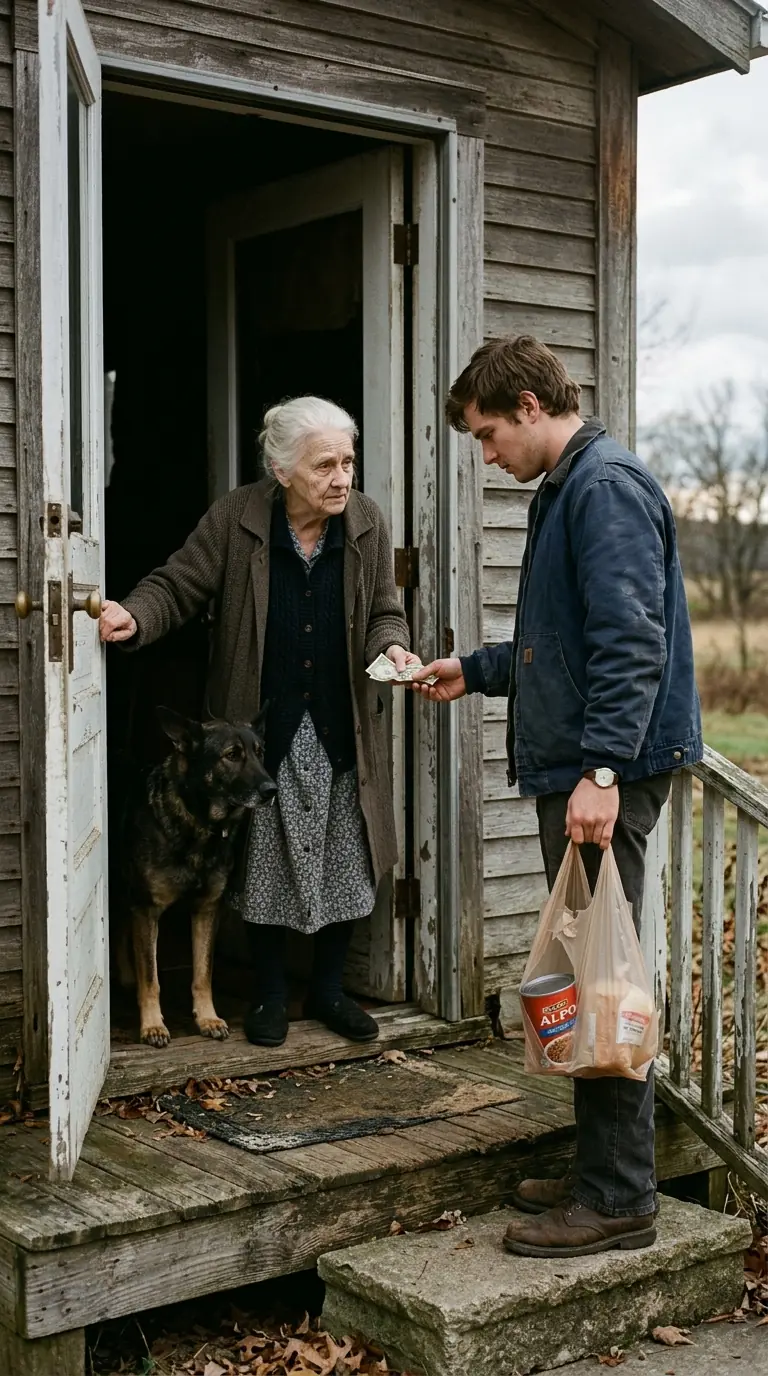
It wasn’t charity.
It wasn’t gratitude.
It was an exchange.
Professional.
Respectful.
She wasn’t a project.
And I wasn’t a hero.
I was just the man with the van.
And that was exactly how she wanted it.
Then winter came.
Not just cold.
Heavy.
The kind of winter that doesn’t just sit outside—it pushes its way into everything.
The economy was already slipping.
You could feel it in small ways at first.
Gas creeping up.
Groceries shrinking in size but not price.
Utility bills that made you pause a little longer before opening them.
I started picking up extra shifts.
Double routes.
Weekend runs.
Trying to stay ahead of my own numbers.
Trying not to think about the noise my van had started making when I turned the ignition.
The alternator was going.
I knew it.
Just didn’t have the money to fix it yet.
That Thursday, her order came through.
I glanced at it without thinking.
Then looked again.
Something was wrong.
1 Bag Senior Kibble.
That was it.
No eggs.
No coffee.
Just the dog food.
I sat there for a second, staring at the screen longer than I should have.
Because when something changes in a pattern that consistent…
It’s not random.
It means something.
I picked up the order anyway and drove out to the valley.
The road felt longer that day.
Or maybe I just noticed it more.
When I pulled up, the house looked the same.
But it didn’t feel the same.
You can tell, sometimes.
Even before anything happens.
She opened the door slowly.
And the first thing I noticed wasn’t her.
It was the air behind her.
Cold.
Not winter cold.
Inside cold.
The kind of cold that doesn’t belong in a lived-in house.
She was wearing a heavy trench coat indoors.
That told me everything I needed to know.
Her face looked thinner.
Her skin… almost translucent.
Like something had been slowly taken from her over time.
But her posture?
Still straight.
Still composed.
She stepped forward and handed me the three dollars like she always did.
Steady.
Controlled.
Like nothing had changed.
“For the tires,” she said.
My throat tightened slightly.
“Just the dog food today, ma’am?” I asked.
Neutral.
Professional.
Like I hadn’t already noticed.
“I’m fasting this week,” she replied.
Simple.
Quick.
Too quick.
“Barnaby needs his strength.”
I nodded.
But I saw it.
On the small table behind her.
An empty pill bottle.
Lying on its side.
Not hidden.
Just… there.
And suddenly the math became clear.
Heat.
Medicine.
Food.
She was choosing.
And she wasn’t choosing herself.
She took the bag.
Gave Barnaby a small nod.
Closed the door.
And just like that…
The moment was over.
But it didn’t leave.
I drove away.
But I couldn’t stop thinking about that house.
About the cold air.
About the coat.
About the way she said “fasting” like it was a decision, not a necessity.
And I knew something else too.
I couldn’t help her.
Not directly.
If I handed her money, she’d refuse.
If I added items and told her the truth, she’d return them.
If I called someone…
She’d panic.
People like her don’t fear hardship.
They fear losing control.
Losing independence.
Being seen as a problem.
And in her mind…
That was worse than being cold.
So I did the only thing I could think of.
Something small.
Something quiet.
Something that would let her accept help…
Without ever having to admit she needed it.
The following Thursday…
I became the system error.
The following Thursday, I changed nothing on the system.
I didn’t touch the route.
Didn’t alter the ticket.
Didn’t flag anything in dispatch.
On paper, everything was exactly as it should be.
But in real life…
It wasn’t.
I got to the store early that morning.
Picked up her usual order—just the senior kibble.
Then I walked a second lap.
Quietly.
Carefully.
Like I was doing something I didn’t want anyone to notice.
I added eggs.
Milk.
Bread.
A small cut of steak.
Some fresh vegetables that looked like they hadn’t been sitting under fluorescent lights for too long.
And a tin of tea—because I remembered she never rushed her words, and people who don’t rush… usually don’t rush their mornings either.
I paid for everything myself.
Didn’t think too hard about it.
Didn’t look at the total longer than necessary.
Just folded the receipt, tucked it into my glove compartment, and packed everything into her delivery.
By the time I got to her house…
It looked like an accident.
A system mistake.
A glitch.
She opened the door.
Same coat.
Same posture.
Same quiet strength holding everything together.
I handed her the bags.
She frowned immediately.
“This isn’t mine.”
Her voice wasn’t angry.
Just certain.
“There’s been a mistake.”
I let out a frustrated sigh, like I’d been dealing with this all morning.
“Yeah… system’s been acting up,” I said, shaking my head. “It’s over-ordering inventory to random stops. Dispatch is trying to clear out a backlog.”
She narrowed her eyes.
“I’m not paying for excess.”
“You don’t have to,” I replied quickly. “It’s flagged as unrecoverable loss. If I take it back, I’ve gotta log it and they’ll just throw it out.”
That part wasn’t entirely a lie.
Big companies waste more than they admit.
I checked my watch, adding a little urgency.
“Honestly, you’d be doing me a favor keeping it. Saves me paperwork.”
She hesitated.
Looked at the bags.
Then at Barnaby.
He stepped forward, nudging her hand gently, like he understood more than he should.
For a moment…
I saw it.
That internal fight.
Pride.
Versus survival.
And then—
She exhaled.
“Poor management,” she muttered.
“That’s what’s ruining everything.”
“Yes, ma’am,” I said.
And just like that…
She accepted it.
Not as help.
Not as charity.
But as a correction.
A flaw in a system she didn’t trust anyway.
Something she could tolerate.
Something she could justify.
That’s how it started.
And that’s how it stayed.
Every Thursday, the “glitch” evolved.
Sometimes it sent extra groceries.
Sometimes it sent better ones.
Once, it “accidentally” included a thermal blanket.
Another time, vitamins.
Even a small space heater.
Each time, I played the part.
Complaining about dispatch.
Blaming software.
Rolling my eyes at corporate incompetence.
And every time—
She played her part too.
Shaking her head.
Criticizing the system.
Accepting the items as a necessary inconvenience.
We never spoke about what was really happening.
Not once.
Because the truth would have ruined it.
The truth would have turned it into something she couldn’t accept.
So we stayed in the lie.
Together.
Week after week.
And slowly…
Something changed.
Not in the orders.
Not in the routine.
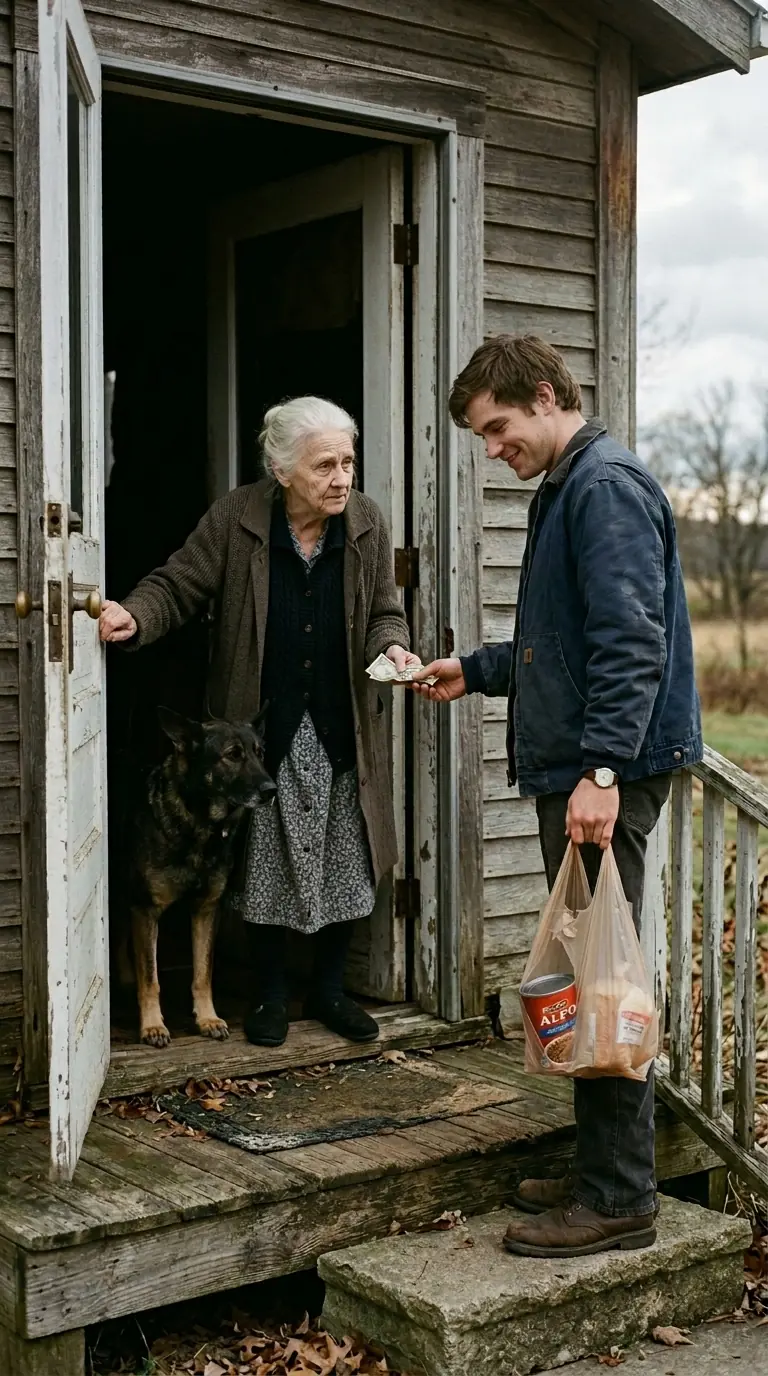
But in the space between us.
She started talking more.
Not much.
But enough.
A comment about the weather.
A story about Barnaby when he was younger.
A passing remark about how things used to be.
Nothing deep.
Nothing personal.
But more than before.
And I realized something I hadn’t expected.
I wasn’t just delivering groceries anymore.
I was delivering…
Time.
Warmth.
A few extra days where she didn’t have to choose.
And in return—
She gave me something too.
Not money.
Not gratitude.
Something quieter.
Recognition.
She still handed me the three dollars every week.
“For the tires,” she’d say.
Like always.
Like nothing had changed.
And I always took it.
Because refusing it…
Would have broken the balance.
And the balance mattered.
More than anything.
Five months passed like that.
Cold days.
Short conversations.
Heavy bags.
Small lies.
Until one Thursday…
Everything stopped.
No notification.
No order.
No ping.
I checked the app twice.
Then a third time.
Nothing.
I told myself it was a delay.
A system issue.
Ironically.
I waited an hour.
Then two.
Still nothing.
And something in my chest…
Didn’t sit right.
So I got in the van.
And drove out there anyway.
The road felt different that day.
Quieter.
The house came into view.
And I knew before I even parked.
The porch was empty.
No footprints.
No movement.
No Barnaby at the door.
Just a lockbox hanging from the handle.
And a “For Sale” sign planted in the frozen ground.
I stood there for a long moment.
Not moving.
Not thinking.
Just… standing.
A neighbor came out from across the street.
Older man.
Slow steps.
“She passed,” he said simply.
“Four days ago.”
The words didn’t land all at once.
“Peacefully,” he added.
“In her chair.”
I nodded.
Didn’t trust my voice.
“Her nephew came,” he continued. “From the city. Took the dog.”
Barnaby.
Gone too.
Just like that.
I thanked him.
Walked back to my van.
Sat there longer than I should have.
Hands on the wheel.
Not starting the engine.
Because something about it didn’t feel right.
Not because I had lost someone I knew deeply.
I didn’t.
Not really.
I didn’t know her birthday.
Didn’t know her past.
Didn’t even know her first name for months.
But still…
There was something there.
Something that had existed in that quiet space between us.
And now—
It was gone.
I went home.
Sat in my apartment.
And for the first time in a long time…
I felt it.
That weight.
That strange kind of grief you don’t feel entitled to.
Because on paper…
You weren’t anything to each other.
Just a courier.
Just a customer.
Just another stop on a route.
But life doesn’t always follow paper.
Yesterday…
A letter arrived.
Registered mail.
Formal.
Unexpected.
From a local attorney.
Inside was an envelope.
And a note.
“To the System Error Driver,” it read.
My hands went still.
“She asked us to find you,” it continued. “She didn’t know your name, but she knew your route. Your face.”
I opened the envelope.
Inside—
Cash.
A stack of bills.
More than I had seen in one place in a long time.
Nearly three thousand dollars.
And underneath it—
A bundle of folded papers.
I opened them slowly.
And felt something catch in my chest.
Receipts.
Every single one.
Every Thursday.
Every item I had paid for.
She had found them.
Kept them.
Saved them.
All of them.
Clipped to the stack…
Was a note.
Handwritten.
Careful.
Elegant, but slightly unsteady.
I sat down before I read it.
Because something told me…
This mattered.
Dear Young Man,
I am aged, not oblivious.
I am well aware that a ribeye steak does not cost zero dollars.
I let out a breath I didn’t realize I was holding.
I know the computer was working perfectly fine.
I know you paid for these things.
And I know why you lied.
My vision blurred slightly.
You understood something most people do not.
You understood that I would rather go without than be seen as needing.
So you gave me something far more valuable than food.
You gave me a way to accept it… without losing myself.
I had to stop for a second.
Just… breathe.
You allowed me to believe I was helping you.
That I was solving a problem.
Instead of being one.
That line stayed with me.
You remind me of my brother.
He was a man who believed that kindness did not need witnesses.
Only intention.
Please accept this.
Fix your van.
And know this—
You did not just help me survive.
You made my final winter… warm.
And full.
— Mrs. Adler
I sat there for a long time.
The letter in my hands.
The receipts in my lap.
The weight of it all settling in slowly.
Not heavy.
Not crushing.
Just… real.
We live in a world that tries to reduce everything.
To numbers.
To ratings.
To efficiency.
To what can be tracked, measured, optimized.
But some things…
Don’t fit into that system.
Some things happen quietly.
Between two people.
Without recognition.
Without reward.
Without anyone else ever knowing.
And sometimes…
That’s where the most important things live.
Because kindness isn’t just about giving.
It’s about how you give.
It’s about understanding what the other person needs…
Not just to survive—
But to remain whole.
And sometimes…
The greatest thing you can offer someone…
Is not just a helping hand.
But a way to take it…
Without having to lower their head.