The rain reached Halstead Avenue just before midnight.
It came down in hard silver sheets, turning the road into a black river and making every streetlight look blurred behind the storm. Cars crawled through the water with their headlights low and tired, each one dragging ripples along the curb.
Caleb Moore drove his old blue Honda with both hands locked around the wheel.
He was twenty-six years old, but that night he felt twice that. His shoulders hurt from crawling under factory machines all day, and his knees ached from mopping office floors after his shift ended. In the back seat, his five-year-old daughter, Ava, slept curled against her car seat with a small stuffed rabbit tucked beneath one arm.
She still had glitter glue on her sleeve from preschool.
Caleb glanced at her through the rearview mirror, and guilt tightened in his chest.
Ava had spent another evening in the corner of a janitor’s break room while he cleaned offices across town. She had colored quietly until she fell asleep on two stacked chairs pushed together like a little bed. She never complained much, but that made it worse.
Children who learn too early how to be quiet can make a parent feel like he has failed without saying a word.
“Almost home, peanut,” Caleb whispered.
Ava’s mouth moved in her sleep, but she did not wake.
Caleb worked maintenance at Whitaker Motors, a powerful automotive company that filled its lobby with chrome, glass, and photographs of expensive cars. He knew every broken pipe, every jammed loading door, every elevator that groaned before it stalled. He kept the building alive for people who walked past him like tools fixed themselves.
At night, he cleaned office suites downtown.
Not because he wanted two jobs.
Because being a single father at twenty-six did not leave much room for want.
Ava’s daycare payment was late. The rent was behind. Her winter coat was too small, but she loved the purple buttons, so Caleb kept telling himself he had another week before he absolutely had to replace it.
A man could be exhausted later.
His child needed breakfast now.
That morning, Vivian Hart had humiliated him in front of the operations team.
Vivian Hart was the CEO of Whitaker Motors. She was forty-three, elegant, severe, and famous for walking into a room and making everyone remember their posture. Her suits were always perfect. Her hair was always smooth. Her voice rarely rose because she had learned long ago that powerful people did not need to shout.
Caleb had arrived seven minutes late to a maintenance briefing because Ava’s preschool called before dawn.
Her teacher had a family emergency, and parents had been asked to drop children later than usual. Caleb had spent half an hour trying to find someone to watch Ava, then drove across town with her half-asleep in the back seat, apologizing to a child who did not understand why adults were always rushing.
When he finally walked into the briefing, Vivian stopped mid-sentence.
Everyone turned.
Caleb stood there in his damp work jacket, holding his cap in both hands.
“I’m sorry, ma’am,” he said. “My daughter’s school—”
Vivian looked at her watch.
“Mr. Moore, your childcare issues cannot keep becoming company delays.”
Childcare issues.
That was what she called Ava.
Caleb felt his face burn.
He wanted to say that his daughter was not an issue. She was five years old. She liked pancakes shaped like bears, hated thunder, and still asked if her mother could see her drawings from heaven. She was not a delay. She was his whole life.
But men like Caleb did not correct women like Vivian Hart in front of managers.
Not when a paycheck stood between his child and an eviction notice.
So he lowered his eyes.
“Yes, ma’am.”
Then he spent the rest of the day fixing machines inside her company.
By midnight, he had almost convinced himself to swallow it.
Then he saw the hazard lights.
They blinked weakly near the corner of Halstead and Ninth, red light bleeding through the rain. A black luxury sedan sat crooked beside the curb, one tire lifted onto the sidewalk. The driver’s door hung open, letting rain pour into the leather interior.
At first, Caleb thought the driver had already walked away.
Then he saw her.
A woman stood beside the car, one hand braced against the roof, the other reaching blindly toward the open door. Her pale blouse was soaked through. Her dark hair clung to her face. She swayed on high heels that slid dangerously against the wet curb.
Caleb slowed.
For one tired second, he almost drove past.
Not because he was cruel.
Because he had been useful to everyone all day, and sometimes kindness feels impossible when there is almost nothing left inside you.
Then the woman stepped backward into the road.
Headlights swept around the corner.
A delivery truck came fast through the rain.
“Daddy?” Ava mumbled from the back seat.
But Caleb was already out of the car.
Rain hit him hard as he ran. The truck horn blasted, tearing through the night. Caleb grabbed the woman’s arm and pulled her backward just as the truck roared past, close enough that the wind shoved both of them against the side of her sedan.
The woman fell into him.
Her fingers clutched his shirt.
“Easy,” Caleb said, holding her steady. “You’re okay. You’re out of the road.”
She smelled like rain, expensive perfume, and whiskey.
Her breathing came in shallow bursts. Her phone lay cracked near the gutter. One heel had twisted beneath her ankle. Mascara ran down one side of her face, making her look strangely young and lost.
Caleb pushed wet hair away from her cheek.
Then he froze.
“Ms. Hart?”
Vivian Hart stared up at him.
There was no recognition in her eyes.
For a moment, the storm seemed to pull back from everything but the two of them. This was the woman who had made him feel small that morning. The woman who could end his job with one sentence. The woman who treated schedules like they mattered more than the people trying to survive them.
Now she was trembling in his arms, drunk, shaken, and seconds away from being killed.
“My car,” she whispered. “I can’t… I couldn’t…”
Caleb looked inside the sedan.
The keys were still in the ignition.
“You can’t drive,” he said.
“I’m fine.”
“No, ma’am. You’re not.”
Her eyes narrowed, but they could not focus.
“Who are you?”
He swallowed.
“Caleb Moore. Maintenance. Whitaker Motors.”
His name did not reach her.
Behind him, Ava pushed herself up in her car seat and blinked into the rain.
“Daddy? Is the lady hurt?”
“Stay in the car, Ava.”
“Is that your boss?”
Caleb looked at Vivian, then back at his daughter.
“Yes.”
“The lady who made you sad this morning?”
The question hurt because children noticed what adults tried to hide.
Caleb took a breath.
“Tonight, she’s just somebody who needs help.”
Ava went quiet.
Caleb knew how dangerous this moment could become.
He was a young maintenance worker with a sleeping child in an old car. Vivian was a wealthy CEO, drunk and confused on a dark street after midnight. If she remembered the wrong pieces, if shame turned into anger, if someone asked why he had taken her home instead of calling someone else, his life could be ruined before breakfast.
But he could not leave her there.
Not in the storm.
Not in the road.
Not after watching death pass inches from her shoulder.
He helped Vivian into the passenger seat of his Honda and wrapped his worn denim jacket around her shoulders. Ava hugged her rabbit and watched quietly as rainwater dripped from Vivian’s hair onto the cracked upholstery.
Caleb used Vivian’s face to unlock her phone and found her address in the emergency contact section.
Her house was across town, in a neighborhood behind iron gates and tall hedges. The kind of place where the lawns looked too perfect to be touched by children, and the streets had no sidewalks because no one there needed to walk anywhere.
The drive took nearly half an hour.
Vivian drifted in and out of awareness. Once, she whispered, “Dad, please.” Another time, she pressed her hand to her chest and said, “I didn’t mean it,” so softly Caleb barely heard her.
He understood then that whiskey was not the whole story.
Something older was hurting her.
Something the rain had loosened.
At the gate, he found a remote clipped inside her purse and drove up a long stone driveway. The house at the top was enormous, all glass and pale stone, with dark windows staring out at the storm.
“Ms. Hart,” Caleb said gently. “We’re here.”
She opened her eyes halfway.
“Don’t let them see me.”
“Who?”
She did not answer.
He helped her up the slick front steps. She slipped once, and he caught her before her knee struck the stone. Behind them, Ava stayed in the car, watching with her stuffed rabbit pressed beneath her chin.
Inside, the house was beautiful in a lonely way.
Marble floors. Tall ceilings. Expensive paintings. A chandelier hanging above the foyer like frozen rain. Everything looked arranged, polished, untouched.
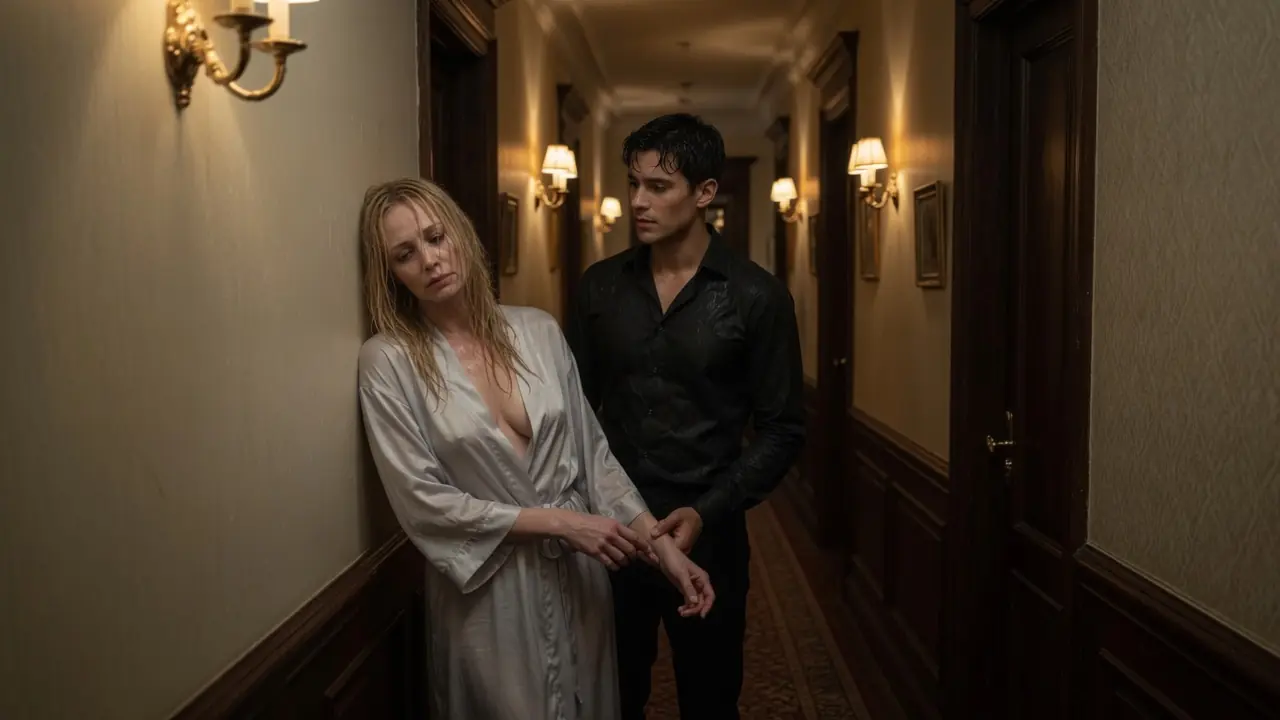
Caleb guided Vivian to a sofa in the living room and pulled a folded blanket over her.
She caught his wrist before he could step away.
“You shouldn’t have stopped,” she murmured.
He looked down at her hand.
“I couldn’t drive past.”
Her eyes opened slightly.
“I was cruel to you.”
Caleb said nothing.
Vivian swallowed.
“I know I was.”
That was the first honest thing she had said to him all day.
He found water in the kitchen, placed a glass beside her, plugged in her phone, and made sure the front door locked behind him. Before leaving, he wrote a note on a small pad near the lamp.
You are home. Your car is on Halstead and Ninth. Your keys are on the table. Caleb Moore.
He looked at the note for a moment.
Then he stepped back into the rain.
Ava was still awake when he returned to the car.
“Is she going to be okay?”
“I think so.”
“Are you going to get in trouble?”
Caleb started the engine.
“I don’t know.”
He barely slept.
After getting home, he carried Ava inside, changed her into pajamas, and made sure the little night-light beside her bed was on. Then he sat on the couch in their small apartment, listening to the rain tapping the window, imagining all the ways the morning could destroy him.
What if Vivian remembered only his hands on her arms?
What if she hated that he had seen her weak?
What if she decided to fire him so the night could disappear?
People with power often protect pride before truth.
By morning, Caleb’s stomach was tight with dread.
He packed Ava’s lunch, brushed her hair into two uneven ponytails, and walked her to preschool beneath a gray sky. She hugged him at the classroom door and looked up with sleepy seriousness.
“You did good, Daddy.”
He tried to smile.
“I hope that matters.”
“It does.”
The certainty in her voice nearly undid him.
Whitaker Motors felt different when Caleb arrived.
The lobby still shone with glass, chrome, and quiet wealth. Employees crossed the floor carrying coffee and tablets. Most days, nobody noticed Caleb unless something broke.
That morning, people noticed.
Whispers followed him as he walked toward maintenance.
He set down his tool bag and tried to breathe normally.
Then the executive elevator opened.
Vivian Hart stepped out.
Cream suit. Perfect hair. Clear eyes. Professional mask restored.
At first glance, she looked exactly like the woman everyone feared.
But Caleb saw the difference.
The faint shadows beneath her eyes. The stiffness in her ankle. The way she held his folded note in one hand as if it were not just paper.
Her gaze found him immediately.
“Mr. Moore.”
The lobby went quiet.
Caleb’s chest tightened.
“Yes, ma’am?”
“My office. Please.”
That last word moved through the lobby like something nobody knew how to interpret.
Please.
Vivian Hart did not usually say please to maintenance workers.
Caleb followed her into the elevator. Neither of them spoke as the numbers climbed. He watched each floor light up and felt as if he were being carried toward a verdict.
Her office was high above the city, all glass walls and cold leather furniture, with the factory complex stretching below like a model.
She closed the door.
Then lowered the blinds.
For several seconds, she stood with her back to him.
Caleb remained near the entrance, unsure whether he should sit, speak, or apologize for helping someone who had not asked him to.
Finally, Vivian turned.
The mask cracked.
Only a little.
“You helped me last night.”
“Yes.”
“You pulled me out of traffic.”
“Yes.”
“You drove me home.”
“Yes, ma’am.”
She looked down at the note.
“I remember headlights. Rain. Your jacket. Your daughter asking if I was hurt.”
Caleb stayed quiet.
“I remember enough,” she said.
He did not know if that was a warning or mercy.
Vivian sat slowly behind her desk.
For the first time since Caleb had known her, she looked less like a CEO and more like a woman who had woken up beside the truth and could not make it leave.
“I owe you an apology.”
“For last night?”
“For yesterday morning,” she said. “For calling your daughter a childcare issue. For speaking to you as if your life outside this building was an inconvenience to my calendar.”
Caleb looked away.
He had expected a threat.
Maybe denial.
Maybe a quiet instruction never to mention the night again.
He had not expected this.
“You were having a hard day,” he said.
“No,” Vivian replied. “Do not give me a softer version of myself. I was wrong before the hard day began.”
That silenced him.
She opened a folder on her desk.
“I reviewed your file this morning.”
Caleb stiffened.
“I see.”
“You are twenty-six. You work full-time in facilities. You clean offices three nights a week. You are raising your daughter alone. You submitted two schedule-change requests this year because of preschool coverage.”
His jaw tightened.
“Both denied.”
“Yes,” Vivian said. “Both denied.”
He said nothing.
Her shame became visible in her face.
“I did not know.”
Caleb gave a tired little smile.
“People usually don’t.”
“That is not an excuse,” she said. “It is the problem.”
Rain tapped faintly against the windows.
Vivian looked toward the gray sky.
“Yesterday was the anniversary of my father’s death.”
Caleb’s expression softened.
“I’m sorry.”
“He built Whitaker Motors from a repair shop with three employees. He believed a company should never become too large to see the people sweeping its floors.” She swallowed. “The last conversation I had with him was an argument. He told me I was turning the company into a place where people were afraid to be human. I told him sentimentality was why he never became as successful as he should have been.”
Her voice thinned.
“Two days later, he died.”
Caleb did not interrupt.
Some pain does not need advice.
It needs a room quiet enough to come out.
“I went to a foundation dinner last night,” Vivian continued. “They honored his name. Everyone talked about legacy, values, family. I smiled through speeches and drank until I could not hear myself think.” She looked at Caleb. “Then I nearly died in the rain, becoming exactly the kind of person he warned me not to be.”
Caleb remembered the truck horn.
The impact of her body against his arms.
The fear in Ava’s voice from the back seat.
“You’re alive,” he said.
“Because you stopped.”
“Because I was there.”
“No,” Vivian said. “Because you chose to care after I gave you every reason not to.”
That sentence sat between them.
Neither of them knew what to do with it.
At noon, Caleb was called into Human Resources.
The HR director explained that his schedule would be adjusted immediately, his pay would be reviewed, his denied requests would be reopened, and the company would provide childcare support while Ava’s preschool schedule remained unstable.
Caleb sat very still.
“I didn’t ask for any of this.”
The HR director looked at him carefully.
“This is not a favor, Mr. Moore. It is a correction.”
Correction.
The word followed him all afternoon.
Not charity.
Not pity.
Correction.
By the time he returned to the maintenance department, people had already heard enough to start guessing. Managers who had never learned his name suddenly called him Mr. Moore. An executive who used to walk past him without looking now stepped aside in the hallway.
Respect arriving late always sounds a little false.
When Caleb picked Ava up, she came running with a drawing of a rainbow and a crooked blue car.
“Did she fire you?”
“No.”
“Did she say sorry?”
Caleb paused.
“Yes.”
Ava studied him.
“Did that fix it?”
He opened the car door.
“Not all of it.”
“That’s okay,” she said. “When I spill juice, sorry doesn’t clean the floor. I still have to wipe it.”
Caleb laughed softly.
“Smart girl.”
“I know.”
Over the next few weeks, Vivian Hart began noticing the company she owned.
Not in a magical, overnight way.
People do not become better just because one storm scares them.
But she started looking.
She noticed the receptionist covering two desks because no one wanted to hire relief staff. She noticed the warehouse worker who limped through his shift because unpaid time off would cost him rent. She noticed the night cleaners, the cafeteria workers, the security guards, the people who kept Whitaker running while the executives spoke about performance.
And she noticed Caleb.
Not because he sought her out.
Because he did not.
He accepted the schedule correction because Ava needed stability. He thanked HR. Then he returned to fixing what broke.
He did not become grateful in a way that made Vivian comfortable.
He did not act like she had rescued him.
That unsettled her.
It also made her respect him more.
One Saturday afternoon, Vivian appeared at the small garage where Caleb worked extra weekend hours repairing old cars.
He was under the hood of a faded Ford pickup when he heard careful steps on the concrete. He looked up and saw her standing near the entrance in jeans, a white blouse, and sunglasses pushed into her hair.
Even dressed casually, she looked like someone who had never wondered whether her debit card would decline.
“You lost?” Caleb asked.
She almost smiled.
“I came to see if I could help.”
“With an engine?”
“I run an automotive company.”
“That is not the same thing.”
This time, she smiled for real.
“Fair.”
Ava stepped out of the little office, holding a juice box with both hands.
“Ms. Hart?”
Vivian looked down.
“Hello, Ava.”
“Are you here to check if Daddy is working?”
Caleb coughed.
Vivian laughed softly.
“No. I’m here to be useful, if your father lets me.”
Ava considered this.
“You can sort bolts. Daddy hates sorting bolts.”
“I do,” Caleb muttered.
Vivian rolled up her sleeves.
“Then bolts it is.”
At first, Caleb thought she came because guilt needed a place to stand.
But guilt usually leaves when forgiveness does not come quickly.
Vivian did not.
She came by on Saturdays when she could. She brought coffee. She helped Ava build a cardboard city for school. She sat on an overturned bucket while Caleb explained why an engine was misfiring, and though she understood manufacturing more than repair, she listened like the difference mattered.
One rainy evening, while Ava colored in the office, Vivian sat near the workbench with a paper cup warming her hands.
“My father would have liked you,” she said.
Caleb wiped grease from his fingers.
“I’m not sure I’m the kind of person CEOs like.”
“My father did not like most CEOs.”
“Then he had good judgment.”
Vivian smiled faintly.
“He built Whitaker because he wanted people like his father to have steady work. I inherited the company and forgot to see the people inside it.”
Caleb looked at her.
“You didn’t forget.”
She waited.
“You stopped looking.”
The words hurt.
He saw it.
But Vivian did not defend herself.
“That is worse,” she said quietly.
“Maybe. But it can be changed.”
Her eyes lifted.
“You believe that?”
Caleb looked through the office window at Ava bent over her coloring book.
“I have to. I’m raising a kid.”
That answer stayed with her.
Two weeks later, Vivian stood in front of the entire company in the main assembly hall.
The Whitaker Motors logo hung behind her. Hundreds of employees filled the floor. Caleb stood near the back in his work shirt, with Ava beside him because preschool was closed for a staff training day.
Vivian stepped to the microphone.
Her suit was navy and perfect.
Her voice was not cold anymore.
“Today, Whitaker Motors is launching the Family Bridge Initiative,” she said. “It will provide emergency childcare, flexible scheduling, transportation support, counseling, and family crisis assistance for hourly and salaried employees alike.”
Whispers moved through the crowd.
“For too long,” she continued, “we have treated personal hardship as if it stops at the front door. We have praised dedication while ignoring the cost of that dedication. We have rewarded people for hiding pain instead of helping them carry it.”
Caleb lowered his eyes.
Ava slipped her hand into his.
Vivian did not say his name.
He was grateful.
“I was reminded recently,” she said, and her voice caught just once, “that kindness is not weakness. Sometimes kindness is the only reason a person survives long enough to change.”
The applause began slowly.
Then it grew.
Then it filled the hall.
Afterward, employees lined up at HR tables. A warehouse worker cried when he learned his mother’s medical appointments would no longer cost him his job. A receptionist hugged a supervisor. A mechanic who had been with Whitaker for twenty-four years shook Caleb’s hand and said, “Whatever happened, kid, thank you.”
Kid.
The word should have bothered him.
It did not.
For once, it sounded like affection instead of dismissal.
Caleb drove home that night feeling both hopeful and afraid.
The program was real.
It mattered.
But Vivian mattered too.
That was the danger.
She was no longer only the CEO who had humiliated him. She was a woman trying, awkwardly and sincerely, to become better because he had seen her at her lowest and still acted with decency.
That kind of bond is difficult to name.
It is not exactly romance at first.
It begins as gratitude.
Then respect.
Then trust.
And trust can become dangerous when two lonely people stand near it too long.
Caleb tried to keep distance.
He was twenty-six.
She was forty-three.
She owned the company where he worked.
She lived behind gates.
He counted grocery coupons.
The world would have opinions.
The world always did.
But Ava had fewer concerns.
She cared that Ms. Hart remembered her favorite cookie. She cared that Ms. Hart came to the science fair and clapped too loudly when her cardboard volcano foamed. She cared that Ms. Hart listened when she talked about her mother without changing the subject.
Vivian never tried to replace anyone.
That mattered.
One afternoon, an offer came.
A repair company in Knoxville wanted Caleb as an operations supervisor. Better pay. Predictable hours. Full benefits. No night cleaning. Enough stability to move Ava into a better apartment and maybe stop choosing which bill could wait.
It was everything he had needed for years.
It also meant leaving.
Caleb kept the offer letter in his glove compartment for three days.
On the fourth evening, Vivian came to the garage after closing. The sun was low, turning the windows gold, and Ava was in the office watching cartoons on an old tablet. Vivian looked at Caleb once and knew.
“You got the job,” she said.
“I haven’t accepted.”
“You should.”
He stared at her.
“That’s not what I expected you to say.”
“I know.”
“I thought you’d try to convince me to stay.”
“I want to.”
“Then why aren’t you?”
Vivian stepped closer, but stopped before the space between them became careless.
“Because wanting you near me and having the right to ask are not the same thing.”
The honesty in that sentence made Caleb look away.
“It would be good for Ava.”
“Yes.”
“And for me.”
“Yes.”
Her eyes shimmered.
“You changed my life, Caleb. I will not repay that by asking you to make yours smaller.”
He looked at her.
“You don’t owe me your life.”
“No,” she said. “But I owe you the truth.”
“What truth?”
“That I do not want you to go.”
The words stayed in the garage between the smell of oil and rain.
For a moment, Caleb forgot the age difference, the money, the company, the gossip, all the reasons why the feeling in his chest should be folded away and never spoken of.
Then Ava appeared in the doorway.
“Are we moving?”
Caleb turned.
“Maybe.”
“Will Ms. Hart be lonely?”
Vivian wiped under one eye quickly.
“A little.”
Ava walked to her and wrapped both arms around her waist.
Vivian froze.
Then she held the little girl carefully, like someone had handed her something breakable and sacred.
Caleb watched them and understood something he had been trying not to see.
Vivian had power.
But she had not had tenderness.
Not the kind that stayed after the applause ended.
The next morning, Caleb accepted the job.
During the next two weeks, Vivian did not try to change his mind. She helped arrange the transition benefits through Family Bridge. She wrote a recommendation letter so strong the Knoxville company called Caleb to ask if the CEO herself had really written it.
She never used generosity as a chain.
That mattered more than she knew.
On Caleb’s last night in town, rain fell again.
Not like the storm that had nearly killed her.
This rain was softer, tapping gently on the garage roof and darkening the pavement outside.
Vivian came by holding the old umbrella Caleb had used to walk her from his car to her door that night. The fabric was faded, and one rib was bent.
Caleb looked at it.
“You kept that?”
“Yes.”
“Why?”
“It reminds me that someone covered me when I had given him every reason to leave me in the rain.”
He shook his head.
“That’s not how kindness works.”
“I know that now.”
She stepped closer.
“Promise me something.”
“What?”
“Do not stop being the man who stops.”
His throat tightened.
“I’m not always that man.”
“You were when it mattered.”
He looked at her, at the woman who had once made him feel invisible and now stood before him with nothing guarded.
“Take care of yourself, Vivian.”
It was the first time he used her first name without correcting himself.
She smiled through tears.
“You too, Caleb.”
The next morning, Caleb drove away with Ava in the back seat.
As they passed the garage, Vivian stood beneath the old umbrella. Ava pressed both hands to the window and waved until the street curved and the garage disappeared.
Caleb did not look back.
He was afraid if he did, he might stop.
Months passed.
Knoxville was quieter. The new job was steady. Ava made friends, joined a little art club, and stopped falling asleep in break rooms. Caleb came home before dinner most nights, still tired, but not hollowed out.
For the first time in years, he had enough energy to ask about Ava’s day and listen to every answer.
Still, rain made him think of Vivian.
Then one afternoon, a letter arrived.
The envelope carried the Whitaker Motors logo, but the handwriting was hers.
Caleb opened it at the kitchen table while Ava colored beside him.
Inside was a photograph of Vivian standing with employees beneath a new sign.
The Moore Fund.
Caleb stared at it.
Beneath the photo, Vivian had written:
You did not only save me from a truck. You saved me from becoming someone my father would not recognize. The Moore Fund now supports emergency childcare, transportation, counseling, and education grants for young parents and working families across every Whitaker location. Thank you for stopping.
Caleb read the note twice.
Then a third time.
Ava leaned against his arm.
“Is that Ms. Hart?”
“Yes.”
“She named it after us?”
“After what happened.”
Ava studied the picture.
“No,” she said seriously. “After you being good.”
Caleb laughed softly, but his eyes burned.
He placed the photograph on the refrigerator beside Ava’s drawing of three people under an umbrella beside a blue car.
Across the top, in crooked letters, she had written:
Kindness is still kindness when someone did not earn it.
Years later, Ava would remember the storm.
Not because her father saved a CEO.
Not because a company changed.
Not because a fund carried their name.
She would remember watching her young, exhausted father step into the rain for a woman who had been cruel to him that morning.
She would remember asking if the lady was his mean boss.
And she would remember what he said.
Tonight, she’s just somebody who needs help.
That became the lesson she carried.
Power can stumble into the street.
Pride can shake beneath headlights.
Loneliness can live inside a mansion.
And sometimes the person who saves you is the person you failed to see when he was standing right in front of you.
Vivian learned that in the rain.
Caleb had known it long before her.