By half past eleven, Miss Eliza Hartwell’s trunk was already strapped behind the carriage.
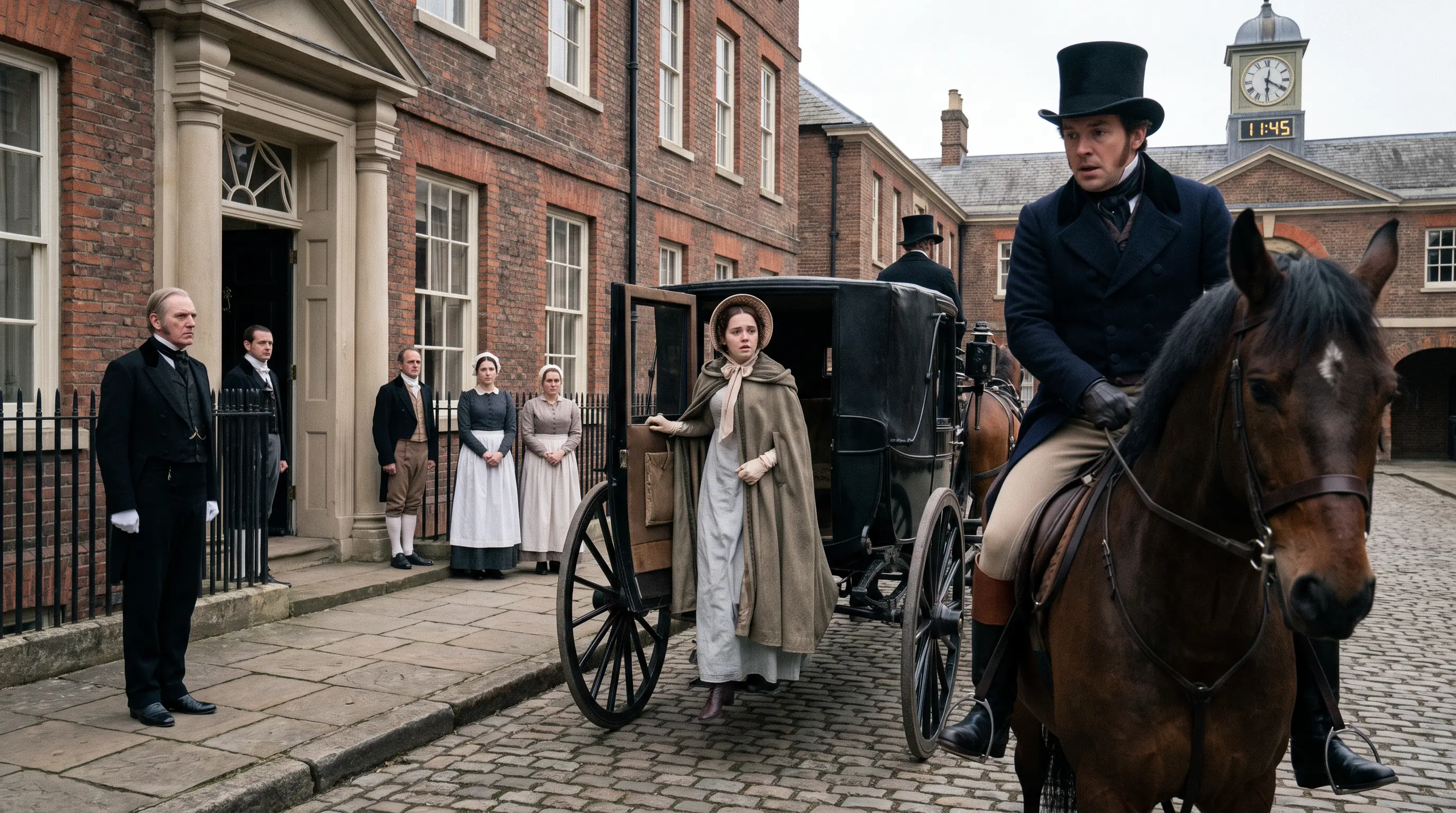
By quarter to twelve, Mrs. Wren had removed Eliza’s name from the household book.
And at eleven fifty-three, Eliza stood on the stone steps of Number Fourteen Cavendish Row with both hands folded over her gloves, trying not to look as though she had nowhere in London to go.
The morning was unusually mild for October. Pale sunlight filtered through yellowing plane trees, touching the white stucco fronts of the neighboring houses and catching on the brass fittings of the hired carriage waiting at the curb. Footmen crossed the pavement. A milk cart rattled at the far end of the street. Two ladies in pale walking dresses passed beneath parasols and glanced toward Eliza with exactly the degree of curiosity polite society permitted itself before noon.
Eliza kept her chin lifted.
That was important.
People forgave poverty more readily than humiliation if one wore it neatly.
Behind her, the green front door remained open.
Mrs. Wren stood just inside.
The housekeeper had served the Vale family for thirty-one years and had perfected the expression of a woman who could deliver cruelty while persuading herself she was merely obeying hierarchy.
“You understand that I had no choice, miss.”
Eliza did not turn.
“Yes.”
“Her Grace’s instructions were quite explicit.”
“I heard them the first time.”
Mrs. Wren sighed.
“I only mean that your departure is not a judgment from the household.”
Eliza looked back then.
“No?”
The housekeeper’s mouth tightened.
Eliza continued.
“My room has been cleared.”
“My letters have been packed.”
“The carriage has been ordered.”
“And I have been instructed not to return unless summoned.”
She gave the smallest smile.
“I would hate to mistake any of that for judgment.”
Mrs. Wren colored.
“I did what I was told.”
“I know.”
That was the difficulty.
Everyone had done what they were told.
For six weeks.
The butler who stopped delivering letters directly and began placing them in a silver tray outside the dowager duchess’s morning room.
The footman who quietly told Eliza the duke had written twice, then denied saying it when questioned.
Mrs. Wren, who began entering Eliza’s chamber without knocking after Lady Vale announced that “temporary residents ought not develop territorial habits.”
And Eliza herself.
Especially Eliza.
She had stayed because Lord Julian Vale had asked her to.
That fact now embarrassed her more than anything.
Julian had not asked her to become his mistress.
Nor his secret.
Nor some foolish woman waiting in a London townhouse while he decided whether affection could survive the inconvenience of rank.
He had asked her to remain as companion to his younger sister, Lady Beatrice, while Beatrice recovered from an illness that left her weak through the summer.
The position was respectable.
The salary generous.
The arrangement practical.
At least at first.
Then Beatrice recovered.
Eliza stayed.
And society noticed.
A gentleman did not visit his sister’s companion three evenings in one week merely to discuss poetry.
A duke did not abandon a political dinner to sit beside a feverish companion when she caught influenza.
He did not send violets from Richmond in August without his mother asking questions.
He certainly did not stand alone with that companion in the library and say, in a voice too steady to be impulsive:
“When I return from Yorkshire, I intend to ask you something that will make my mother furious.”
Eliza had looked at him.
“What?”
Julian smiled.
“If I tell you now, I shall spend three weeks imagining your answer instead of attending to my tenants.”
“You already imagine answers to questions you have not asked.”
“Yes.”
“It is exhausting.”
“So I have been told.”
“By whom?”
“You.”
He had laughed.
Then become serious.
“Stay until I return.”
Eliza had.
That was twenty-three days ago.
His letters stopped after the fifth day.
Then the dowager duchess arrived from Bath.
And now Eliza’s carriage waited.
Mrs. Wren cleared her throat.
“The driver says he cannot remain much longer.”
Eliza glanced toward the carriage.
“I have already paid him for an hour.”
“Yes.”
“Then he can remain another seven minutes.”
Mrs. Wren blinked.
“Why seven?”
“Because Lady Vale said I was to be gone before noon.”
The housekeeper looked toward the clock in the hall.
Eliza continued.
“If I have been granted a deadline, I intend to use all of it.”
For the first time, something like admiration appeared in Mrs. Wren’s face.
Then it vanished.
“Where will you go?”
Eliza looked toward the street.
“Mrs. Bellamy’s.”
That was only partly true.
Clara Bellamy, a widowed cousin of Eliza’s mother, lived in Bloomsbury and would certainly offer Eliza a sofa.
For perhaps three nights.
Maybe a week.
After that, Eliza would need work.