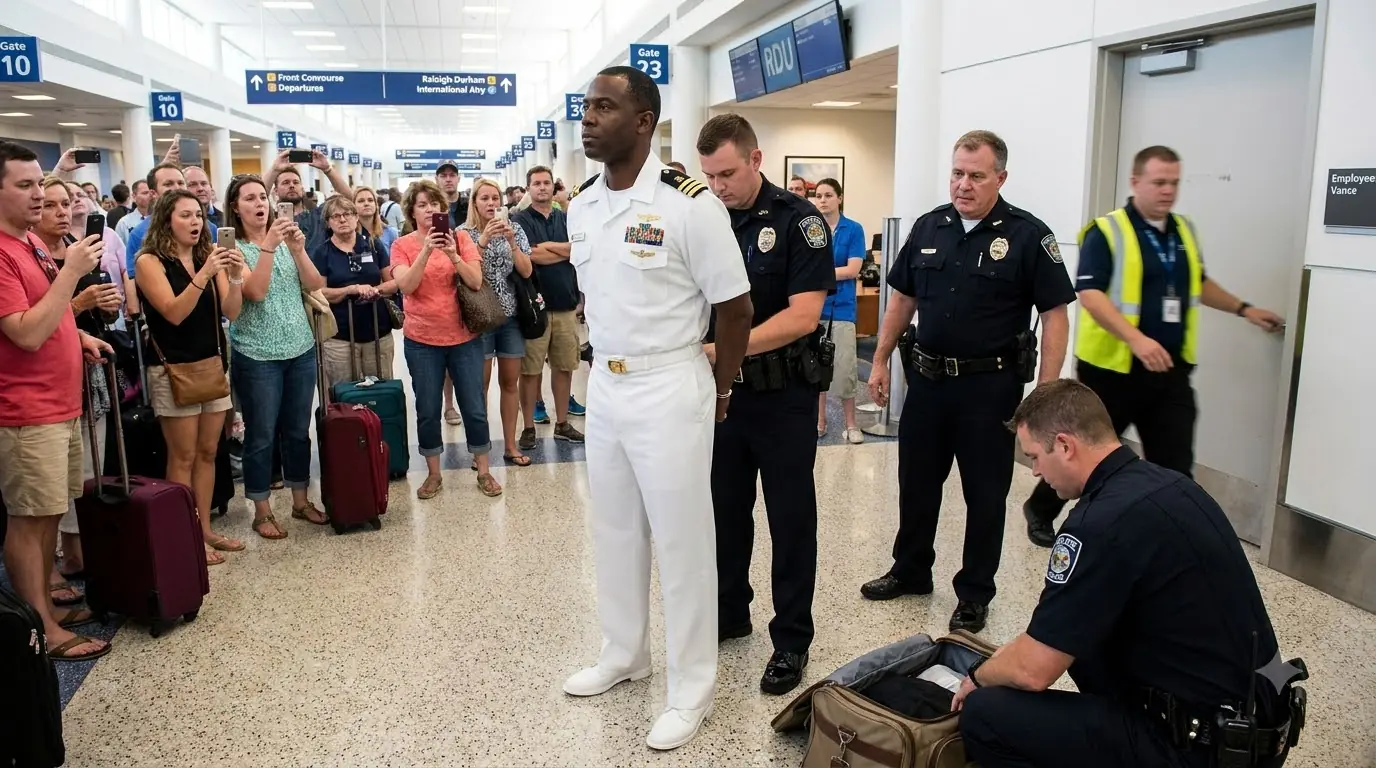
Nine minutes before Commander Malcolm Hayes found himself standing handcuffed in the middle of Raleigh-Durham International Airport, the morning had felt ordinary.
That was the part he would remember later.
The smell of coffee.
The distant announcement of a delayed flight to Chicago.
A toddler dragging a stuffed dinosaur behind his mother.
A businessman arguing quietly into a headset.
The polished terminal floor reflecting white daylight from enormous windows.
Nothing had warned Malcolm that within minutes strangers would be filming him while an airport police officer emptied his travel bag across the carpet.
At forty-seven, Malcolm had spent more than twenty years learning not to confuse calm with safety.
He had served in places where alarms meant exactly what they sounded like and other places where danger entered wearing an identification badge.
He had learned that the first useful question in any crisis was not, Who looks powerful?
It was, What does the evidence actually say?
That morning, the evidence said he was exactly who he claimed to be.
Commander Malcolm Hayes.
United States Navy.
Valid travel orders.
Official identification.
A secured, locked service weapon properly declared for transport.
Nothing hidden.
Nothing improvised.
Nothing unusual for someone traveling under his orders.
He stepped away from a coffee stand with his black travel bag over one shoulder and had walked perhaps twenty feet when a uniformed airport police officer moved directly into his path.
“Sir.”
Malcolm stopped.
The officer was white, broad through the shoulders, perhaps forty-five. His name tag read COLLINS.
A younger officer approached from Malcolm’s left.
ROWE.
Rowe looked maybe twenty-eight.
Nervous, Malcolm thought.
Not frightened.
Alert.
Officer Brent Collins kept one hand close to his belt.
“We received a report concerning an armed man matching your description.”
Around them, traffic continued for three or four seconds.
Then people began slowing.
Malcolm felt their attention before he saw their faces.
He did not reach for anything.
“My identification is inside my jacket,” he said. “I am going to open it slowly.”
Collins watched.
Malcolm revealed his military identification.
Then his travel orders.
“My service weapon is locked inside the declared case in my bag. The declaration paperwork is attached to the case.”
Rowe glanced at Collins.
Malcolm continued.
“Verify the documents before you open anything.”
Collins pointed toward the floor.
“Set the bag down.”
Malcolm did.
The terminal had become quieter.
Not silent.
Airports never became completely silent.
But the space around Malcolm began acquiring that strange vacuum that forms when strangers realize something uncomfortable is happening and nobody knows whether watching makes them a witness or a participant.
Rowe knelt beside the bag.
He did not open it immediately.
Good, Malcolm thought.
The younger officer located the transparent sleeve containing the declaration.
He examined the numbers.
Looked at Malcolm’s orders.
Checked identification.
Then looked at Collins.
“The paperwork matches.”
Three words.
Simple.
Those words should have ended it.
Malcolm expected Collins to verify the transport procedure, perhaps ask one or two additional questions, then let him continue.
Instead Collins stared past him.
Someone was approaching.
The man wore an airport police supervisor’s uniform.
Fifty.
Fit.
Short brown hair.
Face controlled too carefully.
Malcolm knew him.
That recognition happened slowly enough to feel unreal.
Not from Raleigh.
Not from any airport.
Norfolk.
A closed security review eight months earlier.
Daniel Mercer had attended as a civilian security liaison representing a private contractor with airport and logistics relationships.
Malcolm remembered him because Mercer had challenged nearly every request for vendor-access records.
Not angrily.
Professionally.
Always with an administrative reason.
Wrong form.
Wrong department.
Privacy restrictions.
Incomplete authorization.
Data unavailable.
Nothing openly suspicious.
Just delay after delay.
Malcolm looked at him now.
Mercer did not show recognition.
That was the first thing that truly frightened Malcolm.
Collins spoke.
“Supervisor Mercer.”
Mercer looked at the bag.
“What do we have?”
“Armed subject.”
Rowe immediately corrected him.
“Declared weapon, sir. His paperwork matches.”
Mercer barely glanced at Rowe.
“Open everything.”
Malcolm looked directly at him.
“You attended the Norfolk security review.”
Mercer’s eyes met his.
For a fraction of a second, recognition was there.
Then gone.
“Never heard of it.”
Malcolm felt something inside him settle.
Not panic.
Understanding.
Mercer had not simply failed to remember.
He had answered too quickly.
“You were there,” Malcolm said.
Mercer’s expression hardened.
“You’re not here to question us.”
“My identification is valid.”
No response.
“Your officer confirmed my declaration.”
Mercer looked at Collins.
“Cuff him.”
Rowe turned.
“Sir?”
“Cuff him.”
Malcolm did not resist.
That mattered.
He knew cameras were already recording.
Airport cameras.
Body cameras.
Passenger phones.
If anyone later tried to change the story, the sequence had to remain clean.
He placed his hands where instructed.
Cold metal closed around his wrists.
A woman standing beside the departure board lifted her phone higher.
Another traveler did the same.
A Black mother with a teenage son stopped several yards away.
Her hand rested on the boy’s shoulder.
Malcolm saw her expression.
Anger mixed with helplessness.
He hated that expression.
Not because it was directed toward him.
Because he had seen it before.
The look of someone watching authority behave badly while wondering whether intervention would only make things worse.
Collins opened the travel bag.
Folded shirts came out first.
Then toiletries.
A second uniform cover.
A secure document pouch.
Malcolm watched each item land on the carpet.
Mercer stood over the scene.
Rowe kept the declaration in his hand.
That detail mattered.
A TSA manager arrived.
“What is happening?”
Mercer answered before anyone else could.
“Aggressive armed subject refused instructions.”
Malcolm turned his head toward him.
Aggressive.
He had raised his voice zero times.
Refused.
He had complied with every physical instruction.
Armed.
The weapon remained locked and declared.
Three facts had been replaced with three accusations.
Malcolm looked at the TSA manager.
“Ask Officer Rowe whether my declaration is valid.”
She looked uncertain.
Mercer interrupted.
“Do not interfere with an active police matter.”
Several passengers raised their phones higher.
The TSA manager noticed.
“Everyone needs to stop recording.”
Nobody moved.
A woman near the departure board said:
“I’m standing in a public terminal.”
The TSA manager flushed.
Malcolm looked toward each phone long enough to memorize where the witnesses stood.
Not because he wanted humiliation preserved.
Because he wanted chronology preserved.
The locked case before Collins touched it.
Rowe verifying the declaration.
Mercer arriving afterward.
The handcuffs ordered after verification.
In any environment where authority could rewrite memory, sequence mattered.
Mercer looked down at Malcolm.
“Stay quiet.”
Malcolm remained standing.
“You described me as aggressive.”
Mercer’s jaw tightened.
“Stop talking.”
“Name the person who reported that aggression.”
“You don’t question us.”
“Then record that you refuse to identify the source.”
Something flashed across Mercer’s face.
Fear.