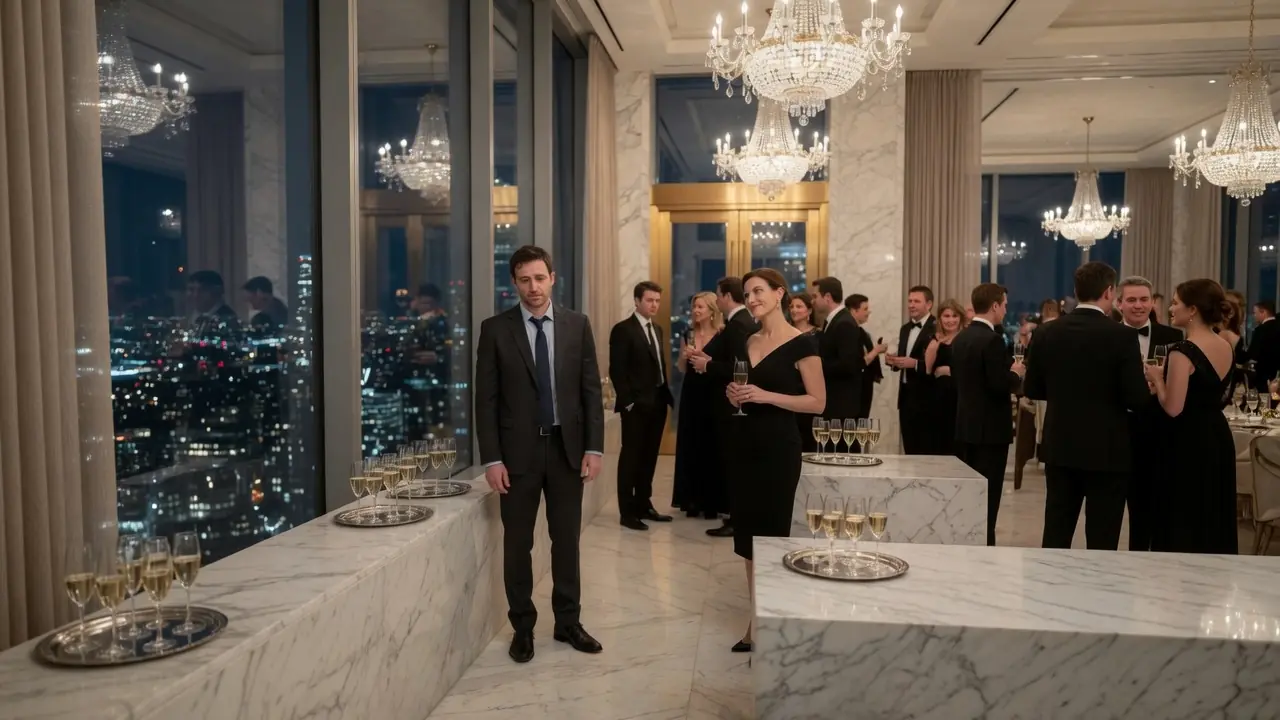
I stood alone at the investment gala in Manhattan, where each glass of wine cost more than my weekly grocery bill. When my ex-wife glanced around and saw no one beside me, she smiled with pity. “No one loves you,” she said loudly enough for those around us to hear. I didn’t argue. I didn’t defend myself. I just stood there, silent. And at that exact moment, the grand doors behind us opened. The most powerful woman in the room walked in and took my hand.
The elevator to the penthouse took forty-three seconds. I counted every one. Outside, Manhattan stretched in a grid of lights, each window representing lives I’d never touch, dreams I’d never share, wealth I’d never accumulate. Inside this glass box climbing toward the sky, I tugged at my suit jacket. The fabric felt stiff, the tie too tight. Nothing fit quite right because nothing here was mine.
My name is Daniel Morrison. I’m thirty-four years old. I work as a project coordinator at a midsized architectural firm in Brooklyn. I have a seven-year-old daughter named Lily who colors outside the lines, asks questions I can’t always answer, and believes wholeheartedly that dragons are probably real somewhere. And tonight, I absolutely did not belong here.
“You made it,” Ryan said when I stepped into the reception area. He clapped my shoulder with the easy confidence of someone who attended these events every month, who networked without thinking, who belonged in spaces like this. Ryan and I went to college together back when we both ate ramen three meals a day and dreamed small, practical dreams. He went into venture capital. I went into fatherhood.
“Barely,” I said.
The penthouse sprawled before us, all marble floors and floor-to-ceiling windows that showed off Manhattan like a trophy. Waiters moved like shadows, offering champagne and hors d’oeuvres I couldn’t pronounce. Men in custom suits discussed market positions and acquisition strategies. Women in designer dresses laughed at jokes that weren’t funny but came from people who mattered. Everyone belonged except me.
“Daniel, relax,” Ryan said, sensing my discomfort. “These people aren’t that different from us.”
I looked at a woman wearing what was probably a year of my salary on her wrist alone. “Right,” I said.
Ryan introduced me to a few people. I shook hands, made small talk, forgot names immediately. The conversations followed a predictable pattern. What do you do? Where do you work? Who do you know? When they learned I wasn’t an investor, wasn’t a founder, wasn’t anyone important or connected, their eyes would drift politely, professionally, but drift nonetheless, seeking more valuable connections elsewhere.
I found a corner near the windows, watched the city below, and checked my phone. A text from Mrs. Chen, my neighbor who watched Lily tonight. Everything okay? Lily already asleep. Sweet dreams. I should have stayed home.
I saw her before she saw me. Victoria stood near the bar, laughing at something a silver-haired man said. She wore a burgundy dress that probably cost more than my monthly rent. Her hair fell in perfect waves. Diamond earrings caught the light. She looked successful, confident, completely in her element.
My ex-wife. We met ten years ago at a coffee shop near NYU. She was studying business. I was finishing architecture. We were young and stupid and thought love was enough. It wasn’t. Victoria wanted a corner office. I wanted a home with a yard. She talked about climbing ladders. I talked about building foundations.
When Lily was born, the cracks became canyons. Victoria couldn’t stop working. Wouldn’t stop. Client dinners ran late. Business trips extended. Lily’s first steps happened without her. Her first words, too.
“I’m building something,” Victoria would say.
“We already built something,” I’d reply, looking at our daughter.
The divorce was efficient, professional, very Victoria. She didn’t fight for custody. Said her career required flexibility, said I was the better parent for a young child, said it like she was delegating a project. Lily lived with me. Victoria visited twice a month, scheduled like board meetings. We hadn’t spoken in three months, not since Lily’s birthday, when Victoria arrived an hour late with an expensive gift and a distracted smile.
Now here she was in her world, looking like she’d never been anywhere else. I turned toward the window. Maybe she wouldn’t notice me.
“Daniel.”
I turned back. Victoria stood three feet away, champagne glass in hand, eyebrows raised in genuine surprise.
“Hi, Victoria.”
“What are you doing here?” Not unkind. Just curious, the way you’d ask why someone showed up to the wrong meeting.
“Ryan invited me,” I said.
“Ryan Chen from college?”
“That’s the one.”
She glanced around, scanning the crowd with the efficiency of someone cataloging assets. “Are you here with anyone?”
The question landed softly, innocently. But I heard what lay beneath it. “No,” I said. “Just me.”
Victoria’s expression shifted. Not dramatically. Just a flicker of something. Pity maybe, or vindication. “Still alone then,” she said.
Around us, conversations continued. Laughter bubbled. Glasses clinked. But I felt the subtle attention of people nearby, those who could hear but pretended not to.
“I have Lily,” I said quietly.
“That’s not what I meant.” Victoria took a sip of champagne. “I mean romantically. You’re always alone at these things.”
“I don’t usually attend these things.”
“Exactly my point.” She set her glass on a passing waiter’s tray. “Daniel, you’re a good father. No one questions that. But you’ve let yourself become invisible. When was the last time you actually dated someone?”
I didn’t answer.
“You can’t hide behind parenthood forever,” she continued. “Lily needs to see you happy. Needs to see you as a complete person, not just a caregiver.”
“Everything all right?” he asked Victoria.
“Fine,” she said. “Just catching up with my ex-husband.”
The man’s eyes swept over me. My off-the-rack suit, my scuffed shoes, my empty hands with no wedding ring, no champagne, no companion.
“Ah,” he said. Then to Victoria, “The Hendersons want to talk about the merger.”
“Of course.” Victoria turned back to me. “It was good seeing you, Daniel. Give Lily my love.”
She started to walk away, then stopped and turned back.
“You know what your problem is?” she said, loud enough that the conversations around us actually paused. “You’ve made yourself so small, so forgettable. You dedicate everything to Lily, but what example are you setting? That love means sacrifice? That being a good parent means having no life of your own?”
I stood there and said nothing.
“No one loves you, Daniel,” Victoria said, not angry, almost sad. “Not because you’re unlovable, but because you don’t let anyone close enough to try.”
The words hung in the air. People stared. Victoria’s companion touched her elbow gently.
“We should.”
“I’m just being honest,” Victoria said. “Someone needs to tell him.”
I could have responded. Could have told her about the life I’d built, the home I’d made, the daughter who smiled every morning because she felt safe and loved. But I didn’t. I just stood there in my ill-fitting suit, proving her point.
Victoria walked away. The conversations around me resumed, but softer now, careful. People who witnessed public humiliation always got uncomfortable, like they’d seen something they shouldn’t have.
I felt Ryan appear beside me. “Daniel, I’m so sorry. I didn’t know she’d be here.”
“It’s fine,” I said.
“It’s not fine. She had no right.”
“Ryan, it’s fine.”
Inside, I wasn’t fine. Inside, I wanted to shout that I packed Lily’s lunch every morning with notes she couldn’t read yet but saved anyway. That I knew all her friends’ names, her favorite books, the exact way she liked her toast. That I showed up to every school event, every doctor’s appointment, every moment that mattered.
I wanted to say that love wasn’t about grand gestures or public displays. That the truest love happened in quiet moments, in bedtime stories and scraped knees and tears dried with patience. But I didn’t say any of that because Victoria wouldn’t understand. These people wouldn’t understand. And more importantly, I didn’t need them to.
The man who’d been with Victoria, her new boyfriend probably, kept glancing back at me, whispered something to her. She laughed. I felt the familiar weight of invisibility settle over me like a coat. This was a mistake. I should leave. Make an excuse about the babysitter, about work tomorrow, about anything.
I pulled out my phone to call a car. And that’s when the room changed. The shift was subtle at first. Conversations didn’t stop, but they recalibrated. People near the entrance turned, straightened, adjusted ties, and smoothed dresses.
I looked up. The grand double doors at the penthouse entrance opened, and Isabella Hart walked in. She didn’t rush. Didn’t make an entrance in the theatrical sense. She simply arrived.
Isabella wore a navy dress, elegant but understated. No visible jewelry except small pearl earrings. Her dark hair pulled back in a simple twist. She could have been anyone except for the way the room responded to her presence. Conversations paused mid-sentence. The host materialized from nowhere, hand extended, smile wide.
“Miss Hart, we’re honored.”
She shook his hand briefly. “Thank you for the invitation.”
Her eyes swept the room. Not searching, assessing. And then they found me. Isabella’s expression softened. She crossed the room with purpose, people parting without realizing they were doing it. She walked straight to me and took my hand.
“I’m sorry I’m late,” she said quietly.
The room didn’t gasp. Nothing that dramatic. But the silence that followed felt heavier than any sound. Ryan stared. Victoria stared. Everyone stared.
“You made it,” I said, managing to keep my voice steady.
“Of course.” Isabella squeezed my hand. “Shall we?”
We moved toward the windows, away from the crowd. Behind us, the whispers started.
“That’s Isabella Hart.”
“The Isabella Hart?”
“She’s worth billions.”
“I didn’t know she was seeing anyone.”
“Who is he?”
Victoria appeared in my peripheral vision, champagne glass forgotten, face pale. I didn’t look at her.
“You really didn’t have to come,” I said quietly.
Isabella smiled. “I wanted to. Besides, you mentioned your friend Ryan would be here.”
“The venture capitalist?”
“That’s him over there, still looking shocked. You didn’t tell him about me?”
“I didn’t tell anyone about you.”
She studied my face. “Because you thought they wouldn’t believe you?”
“Because it’s nobody’s business.”
Isabella’s smile widened. “There’s that integrity I love.”
We’d met three months ago at a coffee shop in Brooklyn. Not the trendy kind with exposed brick and artisanal pour-overs, the old kind with worn counters and regulars who knew each other’s orders. Mario’s Coffee, run by the same family for forty years.
I was there early on a Saturday, laptop open, reviewing blueprints for a community center renovation while Lily had a playdate. The project wasn’t glamorous, but it was mine. Isabella sat at the next table reading a physical newspaper like it was 1995. The Wall Street Journal arts section.
The coffee shop filled up. Every table occupied except the empty chair at mine.
“Is this seat taken?” she’d asked.
“All yours.”
We didn’t talk at first, just coexisted in comfortable silence. Two people who appreciated quiet Saturday mornings. Then Lily’s playdate ended early. Mrs. Chen brought her to the coffee shop. The other child had a fever. Lily climbed into my lap, chocolate milk mustache and all.
“This is my dad,” she announced to Isabella.
“I gathered,” Isabella said, eyes warm.
“He builds buildings.”
“Designs them,” I corrected.
“That sounds important,” Isabella said to Lily, completely serious.
“It is. He made a library with big windows so you can see the trees when you read.”
“What a gift to a community. Do you use it?”
“Every Tuesday they have story time.”
Most people heard architect and assumed skyscrapers, big money, celebrity designers. Isabella asked about the library, about community spaces, about how design could serve neighborhoods. She asked Lily about her favorite books, asked me what it was like to see people use spaces I’d helped create. She got it. The whole point of what I did.
She didn’t mention her own career until our third meeting, and only when I asked directly.
“I invest in companies,” she said simply.
I learned later, much later, that meant a multibillion-dollar equity firm, that she’d been featured in Forbes and Fortune, that her decisions moved markets. But when we were together, she was just Isabella, the woman who remembered Lily’s favorite color, who asked about my day before discussing her own, who laughed at my terrible puns, who confessed she’d built an empire but sometimes wondered what she’d sacrificed to do it.
Now, standing in this penthouse with all these people staring, I realized how different our worlds looked from the outside.
“They’re going to ask questions,” Isabella said.
“Let them.”
“Your ex-wife is coming over.”
“I see her.”
Victoria approached, her companion trailing behind. Her expression carefully neutral, but I saw the calculation in her eyes.
“Daniel,” she said. “You didn’t mention you were seeing someone.”
“You didn’t ask.”
Victoria extended her hand to Isabella. “Victoria Morrison, Daniel’s ex-wife.”
Isabella shook it briefly. “Isabella Hart.”
Recognition flashed across Victoria’s face. Then her professional smile locked into place. “Miss Hart, it’s an honor. I’ve followed your work for years. Your fund’s performance is remarkable.”
“Thank you.”
“I actually run a consulting firm, Morrison Strategic Solutions. We specialize in helping mid-cap companies optimize their operations. If you ever need—”
“I have a full team,” Isabella said politely.
Victoria nodded, smile unwavering. “Of course. Perhaps just for lunch sometime. I’d love to pick your brain about market trends.”
“I don’t do networking lunches.”
The rejection was gentle but absolute. Victoria’s companion cleared his throat.
“We should probably circulate.”
“Actually,” Isabella said, her voice still quiet but somehow commanding attention. “I’m curious about something, Victoria. Earlier, you said something to Daniel about no one loving him.”
Victoria’s face flushed.
“Were you?”
The question hung there. People nearby stopped pretending not to listen. Victoria straightened.
“Daniel and I have a complicated history. As his ex-wife, I sometimes feel obligated to be honest with him, even when it’s difficult.”
“Honest,” Isabella repeated. “Is that what you call public humiliation?”
“I wasn’t trying to humiliate anyone. I was pointing out that Daniel isolates himself. That he uses Lily as an excuse not to engage with life fully.”
“And you know this how?”
“I know Daniel. We were married for five years.”
“Were,” Isabella said. “Past tense.”
Victoria’s jaw tightened. “Miss Hart, with all due respect, you don’t know our history.”
“I know Daniel,” Isabella said simply. “Present tense. I know he wakes up at 5:30 every morning to make his daughter breakfast before work. I know he turns down overtime that would pay better because it would mean less time with her. I know he volunteers at her school library every Thursday because the district cut funding for a full-time librarian.”
Victoria blinked. “I didn’t know about the library.”
“No, you wouldn’t.”
Silence.
“I also know,” Isabella continued, her voice never rising, never hardening, “that when we met, he didn’t mention he knew Ryan Chen. Didn’t drop names or try to impress me. The first time I asked him to dinner, he said no because it was a school night and Lily needed help with her project. The second time he said yes, but only after confirming his neighbor could watch her, and only for two hours maximum.”
Victoria opened her mouth, closed it.
“So when you say no one loves him,” Isabella said, “I have to wonder who exactly you’re speaking for, because it’s certainly not me.”
I’d never heard Isabella speak like this. Not angry. She wasn’t capable of pettiness. But clear, definitive, the same voice she probably used in boardrooms when she shut down bad ideas.
“I apologize,” Victoria said stiffly. “I clearly misread the situation.”
“You misread Daniel,” Isabella corrected. “You saw him standing alone and assumed he was lonely, that his life was empty, that his choices were mistakes.”
“I just meant—”
“I know what you meant.”
Victoria looked at me. “Daniel, I’m sorry. Truly. I was out of line.”
I nodded, didn’t say anything.
She turned back to Isabella. “Miss Hart, I hope there are no hard feelings. Perhaps we could start over.”
“No, thank you.”
“I beg your pardon.”
“I don’t work with people who disrespect others,” Isabella said. “And I don’t pretend that can be erased with an apology at a cocktail party.”
Victoria’s face went white. “I see.”
“I hope you do.”
Victoria’s companion touched her elbow. “We really should.”
“Yes,” Victoria said. “We should.”
They walked away. The crowd around us dispersed slowly, conversations resuming with a nervous energy. Ryan appeared, looking dazed.
“Daniel, what the hell?”
“Ryan, meet Isabella,” I said. “Isabella, this is Ryan Chen.”
“The venture capitalist,” Isabella said, shaking his hand. “Daniel speaks highly of you.”
“He’s never mentioned you at all,” Ryan said, then caught himself.
“It’s fine,” Isabella said, amused.
“You’re Isabella Hart.”
“So people keep saying.”
Ryan looked at me. “How did you—when did you—”
“Coffee shop,” I said. “Three months ago. A coffee shop in Brooklyn.”
Ryan laughed. The sound was slightly hysterical. “Of course. Of course you’d meet a billionaire in a Brooklyn coffee shop.”
We stayed at the party another hour. It was different now. People approached carefully, respectfully, asked about my work with genuine interest, laughed at my jokes like they were actually funny. I hated it. Isabella noticed.
“You want to leave?”
“Is it that obvious?”
“Only to me.”
We made our excuses. Ryan hugged me, whispering, “You have to tell me everything.” The host thanked us for coming, though his gratitude was directed entirely at Isabella.
At the elevator, Victoria appeared. “Daniel, wait.”
I turned. She stood alone, her companion nowhere in sight. Her earlier confidence had cracked, showing something more desperate underneath.
“Can we talk just for a minute?”
“Victoria—”
“Please.”
Isabella touched my arm. “I’ll wait in the elevator.”
The doors closed behind her. Victoria and I stood in the marble hallway, the party sounds muffled behind us.
“I really am sorry,” she said. “What I said was cruel and untrue.”
“Okay.”
“I was surprised to see you. Surprised you were alone. I assumed.”
“I know what you assumed.”
She twisted her hands together. “The truth is, I’ve been thinking about Lily. About spending more time with her.”
“You can visit whenever you want. You know that.”
“I mean more than visits. Maybe adjusting our arrangement.”
I went very still. “What are you suggesting?”
“I’m in a better place now, professionally, personally. My new boyfriend, Marcus, he’s wonderful with children. We could give Lily opportunities. Travel, private schools, connections. Daniel, just listen.”
“No, Victoria. Lily stays with me.”
“I’m not trying to take her away. I’m suggesting we share custody more equally. Every other week perhaps. It would be good for her to see both of us living full, successful lives.”
I understood then this wasn’t about Lily. This was about Isabella, about what access to me might mean, what doors might open, what opportunities might arise.
“You don’t want more time with Lily,” I said quietly. “You want proximity to my girlfriend.”
Victoria’s face flushed. “That’s not—”
“It is. And the answer is no.”
“Daniel, be reasonable. I’m her mother.”
“You signed papers giving me primary custody. You chose your career over parenting. I don’t judge you for that choice, but you don’t get to unmake it because it’s suddenly inconvenient.”
“I’m not trying to be difficult. I genuinely think this could benefit everyone.”
“Everyone except Lily.”
“You’re being selfish.”
I almost laughed. “That’s rich coming from you.”
“I made mistakes. I know that. But I’m trying to do better. Can’t you give me credit for that?”
“I’ll give you credit when you make changes for Lily, not for networking opportunities.”
The elevator doors opened. Isabella stepped out.
“Everything all right?” she asked.
“We’re done,” I said.
Victoria looked at Isabella. “Miss Hart, perhaps you could help Daniel see reason.”
“I don’t involve myself in custody matters,” Isabella said coolly. “But I will say this. I’ve seen Daniel with his daughter. I’ve seen the home he’s built, the life he’s created. If you think that’s something you can buy your way into, you understand neither Daniel nor parenthood.”
“I wasn’t trying to buy anything.”
“Weren’t you?”
Victoria’s mouth opened. Closed.
“Good night, Victoria,” I said.
We got in the elevator. As the doors closed, I saw Victoria standing in the hallway, finally alone. Finally understanding what she’d lost.
In the car, Isabella took my hand. “Are you okay?”
“I think so. She’ll probably try again.”
“I know.”
“And if she does, I’ll handle it.”
Isabella nodded. We rode in silence for a while, watching the city lights blur past.
“Can I ask you something?” I said.
“Always.”
“Why did you come tonight? You hate these events.”
“I do.”
“So why?”
She smiled. “You texted me earlier, said you felt out of place, like you didn’t belong. And I thought about how you must feel in these spaces, these rooms full of people who measure worth in dollars and connections. How lonely that must be, even in a crowd.”
“You came because I felt lonely.”
“I came because you matter to me, and I wanted you to know that regardless of who was watching.”
I squeezed her hand.
“Also,” she added, “I wanted to meet the ex-wife who was so foolish as to let you go. She’s exactly what I expected. Ambitious, intelligent, completely blind to what actually matters.”
“She wasn’t always like that.”
“Maybe not, but she is now. And that’s her loss, not yours.”
We stopped at a red light. Through the window, I could see a father and daughter crossing the street, her hand in his, both of them laughing about something.
“I need to tell Lily about us,” I said.
“About you?”
“I was wondering when you’d get around to that.”
“I wanted to be sure. She’s been through a lot with the divorce. I didn’t want to introduce someone who might not stay.”
“And now?”
“Now I’m sure.”
Isabella leaned her head on my shoulder. “Good, because I’ve been dying to meet her properly. Not just coffee shop encounters.”
“She’ll interrogate you.”
“I expect nothing less.”
“She’ll ask impossible questions.”
“I look forward to it.”
“She’ll want to know your favorite color, your favorite food, your thoughts on unicorns.”
“Purple, pasta, and they’re highly underrated.”
I laughed. Really laughed for the first time all night. “When did you prepare those answers?”
“I’ve been ready for three months, Daniel. I’m just waiting for you to catch up.”
Saturday morning. Pancakes on the griddle, the batter bubbling perfectly. Sun through the kitchen window, warming the worn linoleum floor. Lily at the table coloring a picture of what she claimed was a dragon but looked more like a purple blob with wings and what might have been teeth or possibly flowers.
“Dad?”
“Yeah, sweetheart.”
“Why did you get dressed up last night?”
“I went to a party with Uncle Ryan.”
“Was it fun?”
“Parts of it.”
She added more purple to her dragon, tongue stuck out in concentration. “Did you see Mom there?”
I flipped a pancake. “I did.”
“Was she nice?”
Such a simple question. Such a complicated answer. Seven-year-olds saw the world in binaries. Nice or mean. Happy or sad. Good or bad.
“She was Mom,” I said.
Lily nodded, apparently satisfied with this non-answer answer.
“Lily, I want to talk to you about something.”
She looked up, crayon paused midstroke.
“You know my friend Isabella from the coffee shop, the nice lady who likes books?”
“That’s her.”
“Well, she and I have been spending time together, getting to know each other better.”
“Like how?”
“Like we have dinner sometimes, go for walks, talk about our days.”
Lily’s eyes widened with understanding. “Is she your girlfriend?”
“Would that be okay with you?”
She thought about it seriously, considering the question with the gravity it deserved. “Does she make you happy?”
“Very happy.”
“Does she like me?”
“She thinks you’re amazing.”
“Okay, then.”
Lily returned to her dragon.
“Can she come over for pancakes?”
I laughed. “Maybe next time.”
“Does Mom know?”
“She does now.”
“Is she mad?”
“I don’t know. Maybe.”
“Oh.”
Lily added wings to her dragon. “Dad.”
“Yeah?”
“I’m glad you’re not alone anymore.”
My throat tightened. “I was never alone, sweetheart. I had you.”
“I know. But now you have someone just for you. That’s good. Everyone needs that.”
Out of the mouths of babes.
The doorbell rang.
“I’ll get it!” Lily jumped up, dragon forgotten.
“Wait. I didn’t order—”
She opened the door. Isabella stood there holding a bag of fresh blueberries and wearing jeans and a simple T-shirt. Not the billionaire from last night. Just Isabella.
“I hope it’s okay,” she said. “I wanted to properly ask if I could join for pancakes.”
Lily looked at me. I nodded.
“Purple or yellow?” Lily asked seriously.
“I’m sorry?”
“Dragons. Are they better purple or yellow?”
Isabella crouched down to Lily’s level. “Definitely purple. Yellow dragons are overrated.”
“That’s what I think.”
They walked to the table together, Lily chattering about dragons, unicorns, and her latest library book. I stood at the griddle flipping pancakes, listening to my daughter and my girlfriend discuss the relative merits of mythical creatures.
Victoria was wrong. I hadn’t made myself small. I’d made a life that mattered. I hadn’t become invisible. I’d become present for the moments that counted. And I wasn’t alone. I’d never been alone. I had Lily. I had this small apartment with its worn furniture and morning light. I had neighbors who checked in and friends who showed up.
And now I had Isabella. Not because she was wealthy or powerful, but because she saw me. The real me. The father, the architect, the quiet man in the corner who measured success in bedtime stories and blueberry pancakes.
“Dad, Isabella says she knows the librarian at the public library downtown. The big one.”
“Is that so?”
“She says they have a whole room just for rare books. Can we go?”
I looked at Isabella. She smiled.
“Absolutely,” I said.
Later, after breakfast, after Lily showed Isabella every drawing she’d made in the last month, after they’d built an elaborate fort out of couch cushions, Isabella and I stood on the small balcony while Lily napped. The balcony was barely big enough for two people, just a narrow strip of concrete with a wobbly railing. Nothing like the penthouse terraces Isabella probably had access to. Nothing special at all, but the afternoon sun was warm and we were together.
“Thank you,” I said. “For last night, for this morning, for all of it.”
“You don’t need to thank me for showing up, Daniel.”
“You didn’t have to confront Victoria like that.”
“Yes, I did. No one gets to speak to you that way, especially not someone who had you and gave you up.”
I pulled her close.
The words surprised us both. We hadn’t said them yet. Hadn’t named what this was.
Isabella turned in my arms. “Say that again.”
“I love you.”
“I love you too, Daniel Morrison. I have for weeks.”
“Why didn’t you say anything?”
“Because you needed to get there yourself. Needed to believe you deserved it.”
I kissed her then, there on that tiny balcony in Brooklyn, with my daughter sleeping inside and the afternoon stretching before us.
“I’m just thinking about Victoria’s face when she realizes this is real,” Isabella said.
“I am happy. Terrifyingly happy.”
“Why terrifying?”
“Because now I have something to lose.”
“That’s where you’re wrong. Love isn’t something you lose by having it. Victoria lost you the moment she decided her career mattered more. She lost you to her own choices.”
We stood there in silence, high above Brooklyn, with the city stretching around us and a future unfolding that I hadn’t dared to imagine. Silence, I’d learned, wasn’t weakness. Sometimes it was wisdom. Sometimes it was strength. Sometimes it was simply knowing that the truest things didn’t need defending.
And sometimes, if you stayed quiet long enough, if you focused on being present instead of impressive, the right person came along and saw you. Really saw you.
Behind us, I heard Lily stir.
“Dad, where are you?”
“Right here, sweetheart.”
“Is Isabella still here?”
“I’m here,” Isabella called back.
“Good. Don’t leave. We still have to decide about unicorns.”
Isabella laughed. “I wouldn’t dream of it.”
We went inside together, hand in hand, ready to debate the nature of unicorns with a seven-year-old who took such matters seriously. And for the first time in a very long time, I realized I was exactly where I belonged. Not at fancy parties in Manhattan. Not anywhere requiring me to be someone I wasn’t.
But here, in this small apartment with crayon drawings on the fridge and a daughter who believed in dragons. Here, with a woman who loved me, not despite my choices, but because of them. Here, where I’d built a life that mattered, where silence had been wisdom, not weakness. Here, where family wasn’t something you inherited or lost in divorce. It was something you chose every day.
And I chose this. All of it. Forever.