The wind howling down from the Big Horn Mountains did not just carry the cold. It carried a bitterness that settled deep in the marrow of anyone foolish enough to remain in the high country past November. In the settlement of Granite Peak, the snow was already drifting against the rough-hewn timber of the storefronts, turning the muddy thoroughfare into a frozen, chaotic sculpture of rutted wagon tracks and horse manure.
Sarah Miller pulled her woolen shawl tighter around her shoulders, though the fabric was worn thin and offered little defense against the Wyoming winter. The bundle in her arms shifted, a small, muffled whimper escaping from the layers of flannel. She patted the blanket rhythmically, a desperate, soothing motion that had become second nature over the last four months.
“Hush now, Samuel,” she whispered into the wind. “We are almost done.”
She stood before the heavy oak door of the mercantile, taking a moment to steel herself. Her reflection in the glass was a ghost of the woman she had been six months ago. Her cheekbones were too sharp, her eyes shadowed with a fatigue that sleep could no longer cure, and her hands were chapped raw from scrubbing other people’s floors.
She pushed the door open, the bell overhead jangling with a cheerful dissonance that felt like a mockery. The warmth inside hit her like a physical blow, smelling of coffee beans, leather, and sawdust. Mr. Henderson, the proprietor, was behind the counter, tallying figures in a ledger. He looked up, his face tightening almost imperceptibly when he saw her.
“Good morning, Mrs. Miller,” he said. His tone was polite, but final.
“Mr. Henderson,” Sarah began, her voice steady despite the trembling in her legs. “I brought the mending you asked for, the shirts and the canvas trousers.”
She placed a neatly folded stack of heavy cloth on the counter. She had stayed up until two in the morning, working by the dim light of a single tallow candle, stitching through tough denim until her fingers bled. Henderson did not reach for them.
“Sarah,” he said, using her first name with a familiarity she detested. “I told you last week, I cannot extend any more credit. The account is frozen until the outstanding balance is cleared.”
“I am not asking for credit,” she said. “I am asking for payment for the work I have done. These stitches are double reinforced.”
Henderson sighed, leaning back. He was a man who prided himself on being a pillar of the community, which mostly meant he knew exactly whom he could afford to squeeze.
“I will credit the value of the work against your husband’s debt,” he said. “That brings the total down by two dollars. You still owe $43.50 for the supplies John took on promise before the accident.”
Sarah felt the blood drain from her face.
“John never took that much. We lived simply. He bought flour, ammunition, and salt. That ledger is wrong.”
“It is signed by him,” Henderson said, tapping the book. “Look here.”
“I have seen it,” Sarah snapped, a flash of anger cutting through her exhaustion. “I have seen the mark that does not look like his hand. John is dead, Mr. Henderson. He died crushing his ribs in a logging break that should have been secured by the company. And now you want to starve his widow and son for a debt that grew three times in size the day he was buried.”
Henderson’s face hardened. He leaned forward.
“You watch your tone. You are a woman alone with a child in a territory that has no patience for beggars. If Silas Thorne hears you are calling his ledgers false, you will have more to worry about than the price of flour.”
The name hung in the air like smoke.
Silas Thorne, the man who owned the timber rights, the freight lines, and effectively the law in Granite Peak.
“Please,” Sarah whispered, the fight draining out of her as Samuel stirred again against her chest. “Just a sack of cornmeal and milk. I am losing my milk, Mr. Henderson. I cannot feed him if I do not eat.”
Henderson looked away, unable to meet her gaze.
“I have my orders, Mrs. Miller. No credit.”
Sarah stood there for a long moment, the humiliation burning hot in her chest. She took the clothes back.
“If you will not pay, you will not have the work.”
She turned and walked out, the bell jingling behind her, stepping back into the biting cold. She had no food in the small shack she rented at the edge of town. The landlord had been by yesterday, demanding rent. Everywhere she turned, the walls were closing in, built by invisible hands that seemed determined to crush her.
She walked toward the livery stables, hoping to find work mending horse blankets. But as she passed the saloon, three men stepped out onto the boardwalk. They were rough men, company enforcers who worked for Thorne.
“Well, look at that,” one of them said, spitting a stream of tobacco juice into the snow. “The widow Miller still walking high and mighty.”
Sarah kept her eyes forward, clutching Samuel tighter.
“You know,” the man called out, stepping into her path. “The boss says the auction is coming up on Saturday. Since you cannot pay your debts, the court is going to settle them for you.”
Sarah stopped. “What are you talking about?”
“Debt recovery,” the man grinned, revealing yellowed teeth. “Under the territorial statutes for destitute widows, if you cannot pay, the town auctions your labor contract to the highest bidder to satisfy the creditors. It is all legal-like.”
“That is slavery,” Sarah said, her voice shaking.
“No, ma’am,” the man laughed. “It is justice.”
She pushed past them, her heart hammering against her ribs like a trapped bird. She practically ran the rest of the way to her shack, bolting the flimsy door behind her.
She collapsed onto the narrow cot, the only piece of furniture left, and wept. She wept until Samuel began to cry, and then she forced herself to stop, unbuttoning her dress to offer him what little sustenance she had left.
The cabin was freezing. She had burned the last of the kindling that morning. As the baby nursed, his small hand gripping her finger, Sarah looked at the cracks in the wall where the wind whistled through.
They were going to sell her.
She had heard whispers of it happening to others, immigrant women, girls from the reservation who had no tribe to claim them. But she was a white woman, a citizen.
“John,” she whispered into the empty room. “What have they done to us?”
John had been a good man, strong and vocal. He had argued with the foreman about safety lines on the timber ridge. Two days later, a log rolled when it should have been staked. They brought him home on a wagon, broken and blue.
The foreman said it was a tragic accident. Sarah knew it was murder.
And now the same men who killed him were coming to consume what was left of his family.
Three days later, the summons came. It was not a request. The sheriff, a man named Cobb, who had long ago sold his badge to Silas Thorne, knocked on her door at sunrise.
“Time to go, Sarah,” Cobb said, not unkindly, but with the weary detachment of a man just doing a job. “The judge is sitting at the town hall.”
“I am not going,” Sarah said, holding Samuel.
“You don’t have a choice,” Cobb said. “If I have to drag you, I will. And if you fight, the county takes the boy as a ward to the territory.”
That threat froze her blood.
She put on her best dress, a gray calico that was frayed at the hem, and wrapped Samuel in every blanket they owned. She walked with her head high, flanked by the sheriff, marching toward the center of town like a condemned prisoner walking to the gallows.
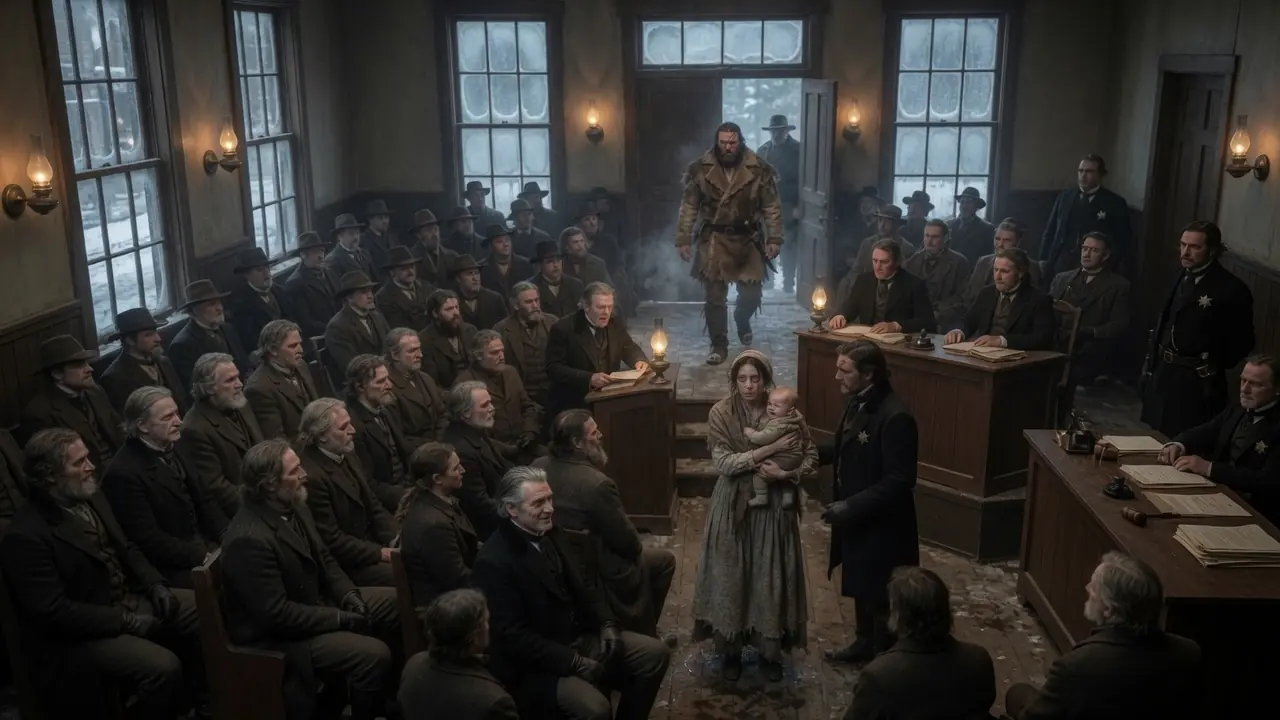
The town hall was a large, drafty building that doubled as a church on Sundays. Today, it felt like neither. It smelled of wet wool, unwashed bodies, and stale tobacco.
The benches were filled with men, miners, trappers, laborers, and the wealthy elite of Granite Peak. In the front row sat Silas Thorne, a man with a face like a hawk and eyes that counted coins before they saw people.
Sarah was led to the front near a raised platform. To her horror, she saw she was not alone. Two other women were there. One was a young Irish girl weeping openly. The other was an older woman, stoic and hard, likely a laundress who had fallen behind on rent.
The judge, a man with a red nose and shaking hands, banged a gavel.
“Order,” he croaked. “We are here to settle the accounts of the indigent and the indebted.”
The proceedings were swift and brutal. The Irish girl was up first. Her debt was read aloud: $20. A saloon keeper bought her contract for six months of kitchen labor for $25. She was led away, sobbing.
Then it was Sarah’s turn.
“Sarah Miller,” the judge read, “widow of John Miller, outstanding debts to the Thorne Mercantile, the Granite Peak Land Company, and Doctor Evans. Total debt: $112.”
A murmur went through the room. It was a fortune. No one could pay that off with scrubbing floors.
“Mrs. Miller has no assets,” the judge continued. “Therefore, her labor contract is up for auction. The term is indefinite until the debt is satisfied with interest.”
Sarah stepped onto the platform. The floorboards creaked. The room went silent. She could feel the eyes of 50 men crawling over her. They were not looking at her hands, wondering how well she could sew. They were looking at her waist, her face, the curve of her neck.
She felt naked despite the layers of wool.
Samuel, disturbed by the noise and the tension, began to wail. His cry was thin and hungry.
“Make the brat quiet!” someone shouted from the back.
Sarah rocked him, desperate. “Shh. Samuel, please.”
He would not stop. He was hungry. The stress had delayed her milk, and he was frantic.
“Judge,” Silas Thorne stood up. His voice was smooth, like oil over gravel. “We cannot have this racket. It disrupts the proceedings. Perhaps the mother should attend to the child so we can see what we are bidding on.”
There was cruel laughter in the room.
Sarah looked at the judge. “Please, may I step down?”
“No,” the judge said, looking at Thorne for approval. “Just quiet him. Woman, do what you must.”
Sarah looked at the sea of faces. She had no bottle. She had no choice. Her face burned with a heat that had nothing to do with the wood stove in the corner.
Trembling, her hands shaking so hard she fumbled with the buttons, she undid the top of her bodice. She turned slightly away, trying to shield herself with the shawl, but the angle of the platform left her exposed to half the room.
She brought Samuel to her breast. As he latched on, the room fell into a heavier, darker silence. It was not a respectful silence. It was a predatory one.
She stood there, a mother feeding her child, turned into a spectacle for a room full of men who saw her only as a commodity. Tears, hot and stinging, pricked her eyes, but she refused to let them fall.
She fixed her gaze on a knot in the pine wall, willing herself to turn to stone.
I am a statue, she told herself. I am not here. I am far away.
“One hundred and twelve dollars,” the auctioneer called out. “Do I hear an opening bid of 50?”
“Fifty!” a voice shouted.
It was the owner of the brothel at the edge of town.
Sarah flinched.
“Sixty,” Silas Thorne said calmly. “I need a housekeeper.”
The bidding continued, slow and taunting. They were discussing her as if she were a brood mare.
“Eighty,” the brothel owner shouted.
“Ninety,” Thorne countered.
Then Thorne raised a hand.
“However,” he said, his voice carrying to the back of the room. “I am bidding on the woman. The child is a hindrance. He will eat into the profits of her labor. I propose the debt be split. The county orphanage can take the boy. It will make the mother more focused.”
Sarah’s head snapped up. She broke her stare with the wall.
“No,” she screamed.
The judge looked at Thorne. “It is a reasonable request. The child is a ward of the state if the mother cannot support him.”
“You cannot take him,” Sarah cried, clutching Samuel so tight he unlatched and began to scream again. “I will not let you.”
“Order.” The judge banged the gavel.
“Separating them increases the value of the contract,” Thorne said coldly. “I will pay $100 for the woman alone.”
The sheriff stepped forward, reaching for Sarah’s arm.
“Hand him over, Mrs. Miller. It is for the best.”
“No!”
“Do not touch him.”
The room was in chaos. Men were laughing, shouting for the sheriff to take the kid. Thorne looked smug, victorious. He had broken her husband, and now he was breaking her.
“Two hundred.”
The voice was not loud, but it cut through the noise like a rifle shot. It came from the very back of the room, from the shadows near the heavy double doors.
The room quieted, heads turning.
Leaning against the door frame was a man who looked like he had been carved out of the mountain itself. He was tall, his shoulders broad under a coat made of heavy buffalo hide. His hair was long, tied back with a leather thong, and a beard covered the lower half of his face, but it could not hide the jagged scar that ran from his temple to his jaw. He wore buckskins stained with grease and pine pitch, and a heavy Bowie knife hung at his belt.
It was Elias Vance, the tracker, the mountain man.
The townspeople whispered about him, that he had lived with the wolves, that he had killed a man in Colorado with his bare hands, that he worshiped pagan gods in the deep timber. He came to town only to trade pelts, speaking to no one, his eyes always scanning the horizon.
The auctioneer blinked. “Did you say $200, Mr. Vance?”
“For the pair,” Elias said.
He pushed off the wall and walked down the center aisle. The crowd parted instinctively, the smell of wood smoke and old blood following him. He did not look at the men. He looked only at Sarah, his eyes dark and unreadable.
Thorne sneered. “This is a debt auction, Vance, not a charity ward. You do not have that kind of money.”
Elias stopped at the foot of the platform. He reached into a pouch at his belt and upended it onto the clerk’s table.
Gold dust and nuggets spilled out, along with a roll of thick, high-quality beaver pelts that thudded heavily against the wood.
“Weigh it,” Elias said.
The clerk scrambled to the scale. He piled the gold on. His eyes widened.
“It is over 200, Your Honor. Nearer to 300 in raw weight.”
Thorne’s face turned purple.
“This is preposterous. The man is a savage. He lives in a hovel three days’ ride from civilization. It is not a suitable environment for a white woman and a child.”
“Is a brothel suitable?” Elias asked. His voice was a low rumble, like distant thunder. “Or your house, Thorne, where debts seem to grow while men die?”
Thorne bristled. “I bid 250.”
“Three hundred,” Elias said instantly.
The room gasped. Three hundred dollars could build a house. It could buy a herd of cattle.
Thorne hesitated. He was a businessman. The woman was a prize, a way to punish John Miller even in death. But she was not worth $300.
“You are a fool,” Thorne spat. “She is scrawny and weak.”
Elias ignored him. He looked at the judge.
“Sold.”
The judge looked at the gold, then at Thorne, then at the size of the knife on Elias’s belt.
“Sold.” The judge banged the gavel. “To Elias Vance. Three hundred dollars.”
The silence that followed was heavy.
Elias stepped onto the platform. He did not smile. He did not look triumphant. He looked grim. He took off his heavy buffalo coat.
“Cover yourself,” he said to Sarah.
Sarah was frozen, her heart racing so fast she thought she might faint. She fumbled to button her dress, her fingers numb. Elias gently placed the heavy coat over her shoulders. It weighed 20 pounds, smelling of earth and animal musk, but it was instantly, incredibly warm.
“Can you walk?” he asked.
She nodded, though she wasn’t sure.
“Come then,” he said.
He turned to the crowd.
“If any man follows us,” Elias said, his voice pitching to reach every corner of the room, “if any man thinks to question this sale or come looking for a refund, I will leave him for the crows.”
He placed a hand on the small of her back, not grabbing, just guiding, and steered her off the platform.
“Wait,” the sheriff said, stepping forward. “You need to sign the papers. The contract.”
“There is no contract,” Elias said without stopping. “I bought the debt. The debt is paid.”
He led her down the aisle. The men stared, some with jealousy, some with disgust.
Rumors were already starting. Why would a mountain hermit pay a fortune for a widow? What depravities did he have in mind that required such a price? Sarah heard the whispers.
Bought her just like a heifer. Savage takes a bride.
She felt a wave of nausea. She had been saved from Thorne, yes, but for what?
She looked up at the man beside her. His profile was hard, his jaw set. He was a stranger. A dangerous stranger. And he now owned her.
They pushed out into the cold air. The wind had picked up, snow swirling violently. Tied to the rail was a massive roan horse and a sturdy pack mule loaded with supplies.
Elias lifted Sarah effortlessly, placing her onto the roan saddle. He handed Samuel up to her.
“Wrap him inside the coat,” he commanded. “The wind will freeze his lungs in ten minutes if you don’t.”
“What about you?” she asked, her voice raspy. “You gave me your coat.”
“I have walked through worse in my shirtsleeves,” he said.
He untied the animals. He did not mount. He took the reins of her horse and began to walk, leading them toward the north road, toward the mountains that loomed like black teeth against the gray sky.
“Where are we going?” Sarah asked, panic finally finding its voice.
“Away from here,” Elias said.
“But where? You cannot just take me into the wilderness. I have a baby.”
Elias did not look back. “If you stay here, Thorne will find a way to have you arrested by morning, or the sheriff will decide the boy needs a guardian after all. The only safety is distance.”
He set a brutal pace. Sarah clutched the pommel of the saddle with one hand and Samuel with the other. The town of Granite Peak faded into the whiteout behind them. The sounds of civilization, the church bell, the blacksmith’s hammer, were swallowed by the wind.
They walked for hours. The terrain shifted from the muddy tracks of the mining district to the pristine, untouched snow of the foothills. The trees grew thicker, towering pines that blocked out the fading light. The cold was a physical weight.
Sarah’s feet were numb in her thin boots, but the buffalo coat kept her core and the baby warm. She watched the man walking ahead. He moved with a strange grace for someone so large, placing his feet carefully, his head constantly turning to scan the trees.
He had paid $300 for her.
“Why?” she called out over the wind. “Is it true?”
He stopped, turning to look at her. His beard was frosted with ice.
“Is what true?”
“That you bought me? Am I your property now?”
Elias looked at her for a long time, his eyes the color of slate, unreadable and distant.
“You are no one’s property, Mrs. Miller.”
“Then why?”
“Because,” he said, turning back to the trail and pulling the horse forward. “I saw a mother nursing her child, and I saw a room full of men who wanted to tear that apart.”
He paused, his back to her.
“And because no one separates a mother,” he added, his voice almost lost in the wind.
He trudged on.
Sarah sat in the saddle, the snow gathering on her shoulders. She was terrified. She was exhausted. She was in the hands of a man who was little more than a legend of the high country.
But as she looked down at Samuel, sleeping soundly in the warmth of the stranger’s coat, she felt a spark of something that wasn’t quite hope, but was no longer despair.
She looked at the knife on Elias’s hip. She looked at the wilderness closing in around them.
I will run, she promised herself. The first chance I get when the weather breaks, I will take the baby and run.
But for now, as the darkness of the forest swallowed them whole, she let the mountain man lead her into the winter night.
The storm was coming, and survival was the only law that mattered.
The cabin was not so much a building as it was a hollowed-out extension of the mountain itself. Tucked into a fold of granite beneath a hanging ridge of spruce, it remained invisible until one was standing less than ten yards from the door. The logs were thick, hand-hewn ponderosa pine, chinked with river clay and moss that had frozen solid.
Elias Vance halted the roan horse and turned to look at Sarah. She sat shivering in the saddle, clutching Samuel beneath the massive buffalo coat. Her face was pale, her lips tinged with blue despite the layers he had given her.
They had been riding for two days, climbing steadily away from the timberline into the high, thin air of the Absaroka Range.
“We are here,” Elias said, his voice rough from disuse.
He reached up and lifted her down. Her legs buckled as they hit the snow, the muscles cramped from hours of riding. Elias caught her by the elbow, steadying her without pulling her closer than necessary.
“Inside,” he commanded. “I will see to the animals.”
Sarah stumbled toward the door. It was heavy, swinging on leather hinges, and opened into a single room that smelled of cured tobacco, dry sage, and ancient wood smoke. It was dark, lit only by the gray light filtering through a scrap of oilskin stretched over the single window.
She saw a stone hearth, a rough table, a few shelves lined with tin canisters, and a bed frame in the corner piled high with furs. She stood in the center of the room, clutching her son, her heart hammering a frantic rhythm against her ribs.
This was it. This was the moment the transaction was completed. He had brought her to the middle of nowhere, where no sheriff or neighbor could hear her scream.
The door creaked open behind her. Elias entered, carrying the saddlebags and a heavy armload of firewood. He kicked the door shut against the wind. He did not look at her.
He went straight to the hearth, kneeling to arrange the kindling with practiced, efficient hands. Within minutes, a fire was roaring, casting dancing orange shadows against the log walls. He stood up, brushing the bark dust from his hands.
“There is dried meat in the tin on the shelf,” he said, pointing. “And coffee. The spring is out back, but I will fetch the water until you have your strength back.”
Sarah did not move. She watched him, her eyes wide and weary.
“Where do you want me?” she asked, her voice barely a whisper.
Elias frowned, confused. “Excuse me?”
“To sleep,” she said, hugging Samuel tighter. “Where do you want me?”
Elias looked at the bed in the corner, then at the floor, and finally at her face. The realization of what she was asking, and what she expected, darkened his expression. A muscle feathered in his jaw.
He pointed to the bed. “You sleep there. The boy needs the warmth.”
“And you?” Sarah asked.
“I will take the floor by the fire,” Elias said.
Sarah blinked. “But you paid $300.”
Elias turned away, grabbing a blackened kettle to fill with snow for melting. He moved with a sudden, sharp aggression that made her flinch, but his anger was not directed at her.
“I paid $300 to keep a pack of wolves from tearing you apart,” he said, his back to her. “I did not buy a wife, Mrs. Miller. And I certainly did not buy a whore. You are safe here. As long as you are under this roof, no one will touch you, not even me.”
He walked out the door to pack snow into the kettle, leaving her standing in the sudden, stunning silence of the room.
Sarah sank onto the edge of the bed. The furs were soft, likely bear and elk, deeper and warmer than any blanket she had ever owned. She laid Samuel down, unwrapping him from the cocoon. He was pink and warm, blissfully unaware of the terror that had defined his mother’s last 48 hours.
She sat there staring at the closed door. She wanted to believe him. God, she wanted to believe him. But the world had taught her that men did not give things away. Kindness always had a ledger attached to it.
She reached into her pocket and touched the small, sharp sewing scissors she had managed to keep hidden. If he tried anything, she would not make it easy.
The first week passed in a blur of survival and tension. The cabin was a fortress against the winter, but the cold was a constant prowling beast waiting for the fire to die down. Life here was stripped to its bones.
There was no commerce, no society, only the immediate demands of the body. Wood had to be chopped. Water had to be hauled. The chamber pot had to be emptied. And above all, the baby had to be fed.
Sarah found that her milk was struggling to return. The stress and lack of food in town had nearly dried her up. Elias seemed to understand this without being told. He began making a thick stew of rabbit and root vegetables, forcing her to eat three bowls a day.
“Eat,” he would say, pushing the bowl across the rough table. “The boy is drinking thin air if you do not.”
He kept his word. He slept on a pile of blankets near the door, his rifle always within arm’s reach. He gave her privacy when she nursed, turning his back or stepping outside to check the weather.
He never touched her. If they passed each other in the small space, he would shrink back, making himself smaller to avoid brushing against her skirt.
Yet Sarah remained on guard. She watched him through lowered lashes as she mended his torn shirts. She saw how he moved quietly, deliberately. He was a man of immense physical capability.
She watched him split logs with a single fluid swing of the axe, the wood flying apart with a violence that made her shudder. He could snap her neck with one hand. The fact that he didn’t only made the waiting worse.
One afternoon, a storm blew in from the north, burying the cabin in four feet of snow. The wind shrieked like a banshee, rattling the heavy door on its hinges. The temperature plummeted, even with the fire roaring.
Sarah could see her breath in the room. Samuel was fussy, crying with a thin, irritated wail that grated on the nerves. Sarah paced the floor, rocking him.
“Shh, Samuel. Please, quiet now.”
Elias was sitting by the fire, whittling a new trigger mechanism for a trap. He stopped, the knife hovering over the wood.
“Is he sick?” he asked.
“No,” Sarah said, defensive. “He is just cold. And maybe, maybe he senses the storm.”
Elias stood up. He walked over to the corner of the room where a pile of old, soft deerskins lay. He picked one up and began to cut it into strips with his knife.
“What are you doing?” Sarah asked.
“Making the draft stop,” he said.
He went to the window where the wind was whistling through a hairline crack in the frame. He used the tip of his knife to jam the leather strips into the gap, sealing it tight. Then he went to the door and hung a heavy bearskin over it, nailing it into the header.
The difference was immediate. The whistling stopped. The room held the heat.
“Give him to me,” Elias said, holding out his hands.
Sarah recoiled, clutching Samuel.
“No.”
“You are exhausted, Sarah,” Elias said.
He used her name for the first time in days.
“You are gripping him so tight. You are scaring him. Let me hold him while you drink some water.”
Sarah looked at his hands, large, scarred, stained with walnut juice and gun oil. Then she looked at his eyes. There was no malice there, only a tired sort of patience.
Slowly, she held the baby out.
Elias took the infant. His hands engulfed the child’s small body. He did not hold him awkwardly, as many men did, like a sack of grain. He cradled the head, supporting the neck, and tucked the bundle into the crook of his arm against his chest.
He began to walk the small perimeter of the room, humming a low, vibrating tune that had no words. Samuel, sensing the deep rumble of the man’s chest and the solid warmth, stopped crying almost instantly. His eyes blinked open, staring up at the beard that hung above him.
Sarah watched, stunned. She sank onto the bench, her legs trembling.
“You have done this before,” she said softly.
Elias stopped pacing. His back was to her. He looked down at the baby in his arms, his thumb brushing the soft curve of Samuel’s cheek.
“I had a son,” he said.
His voice was so low she almost missed it.
“What happened to him?” Sarah asked, the question slipping out before she could check herself.
Elias stared into the fire.
“It was the winter of ’68 in the Dakota Territory. Smallpox came through the trade forts. It took my wife, Mary, in two days. The boy, Jacob, he lasted a week.”
He turned to look at her. The grief in his eyes was not fresh. It was ancient, a canyon carved by a river that had long since dried up. But it was deep.
“I was out trapping when the fever started,” he said. “When I came back, the fire was out.”
Sarah put a hand to her mouth. “I am so sorry.”
Elias looked back at Samuel.
“He was about this size. Maybe a little bigger.”
He walked over and gently placed the sleeping baby back into Sarah’s arms.
“That is why I live out here, Mrs. Miller,” he said, his tone hardening again, closing the door on the moment of vulnerability. “The towns have nothing for me but disease and noise. And that is why I will not let a child be taken from his mother while I have breath in my lungs.”
He put his coat on and went outside into the blizzard, leaving Sarah alone with the realization that the monster she feared was just a man broken by the same cruel world that was trying to break her.
The thaw came two weeks later, turning the snow into a heavy, wet slush that made travel difficult but not impossible. With the change in weather came a change in the air, a tension that Sarah felt before she saw it.
Elias became restless. He spent hours on the ridge above the cabin, scanning the valley with a brass telescope. He checked his rifles every night, cleaning and oiling them until the metal gleamed.
“What is it?” Sarah asked one evening as he sharpened his knife for the third time.
“Tracks,” Elias said.
“What kind of tracks?”
“Shod horses,” he said. “Three of them. They were on the lower ridge yesterday. Today they are closer to the creek.”
“Who are they?”
Elias looked at her. “Thorne does not like to lose, Sarah. He considers you stolen property, and he considers me a thief. He has sent men to recover his investment.”
Panic, cold and sharp, spiked in Sarah’s chest.
“Will they find the cabin?”
“Eventually,” Elias said. “This valley is hidden, but if they have a good tracker, they will find the smoke or the path to the spring.”
He stood up.
“Pack everything. We leave at first light.”
“Where do we go?”
“Deeper,” he said. “There is a cave system up near the timberline behind the waterfall on Granite Creek. They cannot ride horses there. We will have to climb.”
The next morning, they abandoned the safety of the cabin. Elias loaded the mule with only the essentials: blankets, ammunition, dried food, and the heavy buffalo coat. He doused the fire and scattered the ashes, covering their tracks as best he could.
The climb was brutal. The snow was knee-deep in places, wet and heavy. Sarah carried Samuel in a sling Elias had fashioned from a blanket, strapped tight to her chest. She struggled for breath in the thin air, her boots slipping on the icy rocks.
Elias moved ahead, breaking the trail. Every few hundred yards, he would stop and offer her a hand, pulling her up the steep inclines. His grip was iron-hard, but he never rushed her.
“Rest,” he would say, watching her chest heave. “Breathe through your nose. It warms the air.”
By midday, they reached a narrow ledge that skirted the side of a gray cliff. Below them, a drop of 500 feet fell away into a canyon of jagged pine tops.
“Do not look down,” Elias instructed. “Look at my back. Step where I step.”
Sarah pressed herself against the rock wall. She was terrified of heights, but the fear of the men behind them was greater. She moved inch by inch.
Suddenly, a gunshot echoed through the valley. It was distant, a flat crack that rolled off the stone walls.
Elias froze. He dropped to a crouch, pulling Sarah down with him.
“They are closer than I thought,” he whispered.
He pointed down into the valley. Through the trees, Sarah could see three small figures on horseback, navigating the snow-choked trail they had just left.
“They found the cabin,” Elias said. “They are firing to flush us out or to signal.”
He looked at Sarah.
“We have to move faster. Can you do it?”
“I have to,” Sarah said, her jaw setting.
They scrambled up the final stretch of the cliff. The rocks cut Sarah’s hands and her legs burned with lactic acid. Samuel began to whimper, jostled by the movement.
“Hush, baby. Hush,” Sarah panted.
They reached the mouth of the cave just as the sun began to dip behind the peaks. It was a shallow recess behind a curtain of ice where a frozen waterfall hung suspended in time. It was cold, damp, and smelled of wet stone, but it was defensible.
Elias unloaded the mule quickly, pushing the animal into a deeper alcove. He set up a small perimeter of rocks and laid out his rifle.
“Stay back,” he told her. “If they come up that trail, I will see them long before they see us.”
Night fell, bringing a darkness so absolute it felt heavy. They dared not light a fire. The glow would be visible for miles. They sat huddled together at the back of the cave, wrapped in the buffalo coat and every blanket they had.
The cold was biting, a physical pain that gnawed at their extremities. Sarah shivered violently, her teeth chattering. Samuel was warm against her skin, sleeping, but she felt her own core temperature dropping.
Elias, sitting a few feet away, keeping watch, heard her teeth clicking. He moved toward her in the dark.
“You are freezing,” he said.
“I am fine,” Sarah stammered.
“You are not,” he said. “Hypothermia will kill you faster than a bullet.”
He hesitated for a moment, the silence stretching. Then he moved next to her.
“Open the coat,” he said quietly.
Sarah stiffened. “What?”
“Body heat, Mrs. Miller. It is the only way.”
She hesitated, the old fear flaring up, but the cold was agonizing. Slowly, she opened the heavy buffalo robe.
Elias slid in beside her. He did not face her. He sat with his back against the stone wall, pulling her back against his chest. He wrapped the coat around both of them, enclosing Sarah, Samuel, and himself in a single cocoon of fur and warmth.
His body was a furnace. The heat radiating from him was shocking. Sarah felt herself relaxing involuntarily, her frozen muscles unspooling in the presence of his strength.
He was stiff at first, holding his arms carefully away from her, as if afraid to make contact. But as the wind howled outside the cave, he settled. One of his arms came around her to hold the coat closed, his hand resting near her shoulder but not touching it.
They sat like that for a long time, the only sound the breathing of the baby and the wind.
“Why do they hate you?” Sarah asked into the dark.
Her head was resting near his shoulder.
“Because I do not need them,” Elias said.
His voice rumbled against her back.
“Men like Thorne, they need everyone to need them. They need you to owe them money. They need you to be afraid of their laws. When a man walks away and says, ‘I will live by my own laws,’ it insults them. It scares them.”
He paused.
“And because I look like this. The scar, the way I live. It is easier to call me a monster than to admit I am just a man who wants to be left alone.”
“They call me ruined,” Sarah whispered. “Because of the auction, because I am here with you. They say I am a fallen woman.”
Elias’s arm tightened slightly around the coat.
“You fell nowhere, Sarah,” he said fiercely. “You were pushed. There is a difference.”
He shifted slightly, and his cheek brushed against her hair.
“Do not let them name you,” he said. “You are the woman who stood in front of 50 men and fought for her child. That is the only name that matters.”
Sarah felt a lump rise in her throat. Tears pricked her eyes, hot and sudden. For months, she had been treated like trash, like a problem to be solved or a body to be used. This man, this stranger who smelled of pine resin and gunpowder, was the first person to speak to her with honor.
“Thank you,” she whispered.
She felt him exhale, a long, slow breath.
“Sleep,” he said. “I will watch.”
She did not think she could sleep, not with the danger below and the strange intimacy of his body against hers. But the warmth was narcotic. She felt safe for the first time since John died. She felt entirely, completely safe.
She leaned back against him, letting her head rest on his chest. She felt his heart beating slow, steady, and strong.
“Good night, Elias,” she said.
“Good night, Sarah.”
In the darkness of the cave, high above the world that wanted to destroy them, the distance between them closed. It was not a romantic embrace. Not yet. It was something deeper. It was the pact of survival.
It was the acknowledgment that out here in the savage dark, they were the only light the other had. As Sarah drifted off, she felt Elias’s hand move. He did not grope her. He simply shifted his hand to rest over hers where she clutched the baby.
A large, rough hand covering her small, cold one. A shield.
He did not pull away, and neither did she.
The descent from the high country was a journey through the thawing bones of winter. The snow line receded as they moved south, replaced by the slick, churning mud of the foothills. The air grew heavier, smelling of wet pine needles and earth that was waking up after a long freeze.
Elias Vance rode the roan horse, his rifle resting easily across his saddle horn. Sarah walked beside the mule for a spell to stretch her legs, Samuel strapped to her chest in the sling. They moved in a silence that had changed texture. It was no longer the fearful silence of strangers, but the companionable, alert silence of partners moving through hostile territory.
They were heading for Silver Creek, a settlement three days’ ride from Granite Peak. It was a larger town, the county seat, where a federal circuit judge was rumored to be sitting for the spring session. Elias believed that if they could present the case there, away from the immediate stranglehold of Silas Thorne, they might find a lawman who honored the statutes written in books rather than the ones bought with gold dust.
But to get to the judge, they had to enter the world again.
As the buildings of Silver Creek came into view, a sprawl of clapboard and brick rising from the valley floor, Sarah felt a physical tightening in her stomach. She reached up and checked the shawl covering her hair and the baby’s face. She was wearing the buckskins Elias had fashioned for her to replace her ruined dress, but she had scrubbed them clean in the river that morning.
She wanted to look like a woman of dignity, not a fugitive.
“Stay close to the stirrup,” Elias said low, his eyes scanning the rooftops and the alleyways. “We are here for supplies and the judge. We do not stop for conversation.”
They rode onto the main thoroughfare. It was midday, and the street was busy with wagons, miners, and townspeople going about their business. The noise was an assault after the stillness of the mountains: the clang of a blacksmith’s hammer, the shouting of drivers, the barking of dogs.
As they moved through the crowd, the bubble of activity around them seemed to burst and fall silent. Heads turned. Conversations halted mid-sentence.
It began with the stares. Men on the boardwalk stopped chewing their tobacco to gawk at the giant mountain man on the warhorse. And then their eyes slid to the woman walking beside him. They took in her rough clothing, the baby strapped to her chest, and the fact that she was traveling with a man who looked like a savage.
Sarah kept her chin high, fixing her eyes on the back of the roan horse, but she could hear them.
The whispers hissed through the air like steam escaping a valve.
“Look at that,” a woman whispered loudly from a group gathered outside a milliner’s shop. “That is the one. The one from the auction up north. Shameful.”
Another voice agreed. “Walking with him like a squaw. I heard he bought her for $300.”
A man’s voice chuckled, coarse and low.
“Reckon he is getting his money’s worth.”
Sarah stumbled slightly, her face burning. The words felt like stones thrown against her skin. Ruined. Bought. Whore.
She clutched Samuel’s small back through the blanket, her knuckles white. She wanted to scream at them that she was a mother, a widow, a woman who had survived a winter that would kill them all. But she knew her voice would not matter to them. She was a morality tale, a cautionary story of what happens to women who fall off the edge of the world.
Elias stopped the horse in front of a general store. He dismounted, his boots hitting the mud with a heavy thud. He tied the reins to the rail and turned to the crowd.
He said nothing. He simply looked at them. His gaze was flat and cold, sweeping over the men who had been chuckling. Under the weight of his stare, the laughter died out. Men looked at their boots or suddenly remembered urgent business elsewhere.
“Wait here,” Elias said to Sarah, his voice gentle, only for her. “I will get the grain and the ammunition.”
“I want to come in,” Sarah said. “I need to buy cloth for diapers.”
Elias hesitated, looking at the storefront, then nodded.
They entered the store. The bell jangled. The interior was dim and smelled of spices and dry goods. There were two other women at the counter inspecting a bolt of calico. They were dressed in fine wool, their hair pinned up in neat, civilized coils.
As Sarah approached the counter, the women turned. Their eyes widened. They looked Sarah up and down, taking in the buckskins and the travel-worn shawl. Then, with a synchronized movement of utter disdain, they gathered their skirts and stepped away, pressing themselves against the far shelves as if Sarah were carrying a plague. One of them pulled a handkerchief to her nose.
The shopkeeper, a balding man with wire-rimmed spectacles, looked from the women to Sarah. He cleared his throat.
“We are closed,” he said.
Sarah blinked. “The door was open. The sign says open.”
“We are out of stock,” the man said, his eyes darting to Elias, who was looming by the barrel of axe handles.
“I see the cloth right there behind you,” Sarah said, her voice trembling with a mixture of humiliation and anger. “I have money.”
“We do not serve your kind here,” the shopkeeper said, finding his courage. “This is a respectable establishment. We do not cater to camp followers.”
The air in the room seemed to vanish.
Elias took a step forward, the floorboards creaking under his weight.
“She is a customer,” Elias rumbled. “Sell her the cloth.”
“I have the right to refuse service,” the shopkeeper squeaked, backing up.
Elias reached for his belt, not for a weapon, but the motion alone made the women gasp and clutch each other.
“Elias,” Sarah said sharply.
She put a hand on his arm. His muscles were rock hard, vibrating with tension. She looked up at him.
“No,” she said. “Do not give them the satisfaction. We will go elsewhere.”
She turned and walked out, her head high, though her vision was blurred with hot tears. She would not let them see her cry. She would die before she let them see her cry.
They walked further down the street, leading the horses. The rejection stung worse than the frostbite. The frostbite was honest. Nature did not hate her. It was simply indifferent.
This was hatred. This was a society punishing her for the crime of being victimized.
They reached the edge of town near a small whitewashed house with a picket fence that had seen better days. An older woman was in the yard hanging laundry on a line. She was broad-shouldered, wearing a faded apron, her gray hair pulled back in a severe bun.
She watched them approach. Sarah braced herself for another sneer, another turned back.
The woman stopped pinning a sheet and looked at Sarah. She looked at the baby. Then she looked at the mountain man.
“You look like you have walked a long way,” the woman said.
Her voice was dry like rustling leaves, but not unkind.
“We have,” Elias said, stopping.
The woman walked to the fence. She looked at Sarah’s face, seeing the exhaustion in the red rims of her eyes.
“I am Martha Higgins,” the woman said. “My husband was the sheriff here for 20 years before he passed. I know a fugitive when I see one, and I know a woman in trouble when I see one. You two look like both.”
“We are not fugitives,” Sarah said, though she felt like one. “We are seeking the judge.”
“Judge Halloway is fishing down at the creek,” Martha said. “He will not be back until sundown.”
She opened the gate.
“Come inside. I have fresh bread, and I suspect that baby needs changing on something other than a saddlebag.”
Sarah hesitated, looking at Elias. He gave a barely perceptible nod.
“Thank you,” Sarah whispered.
Inside, the house was small, but scrubbed clean. Martha Higgins bustled about, setting a kettle on the stove and cutting thick slices of bread. She did not ask prying questions. She simply provided.
She gave Sarah a basin of warm water and a clean flannel cloth for Samuel. It was such a small thing, warm water and a kind word, but it nearly undid Sarah. She sat in the rocking chair, cleaning her son, feeling the tension in her shoulders dissolve just enough to breathe.
“You are the one from Granite Peak, aren’t you?” Martha asked, handing Elias a mug of black coffee. “The news travels on the freight wagons. They say a mountain man stole a woman from the auction block.”
“I did not steal her,” Elias said quietly. “I paid.”
Martha sat down opposite them. “I know you did. And I know Silas Thorne. My husband arrested him twice for fraud in the sixties, but the charges never stuck. Witnesses have a habit of disappearing around that man.”
She looked at Sarah. “They say your husband owed a debt.”
“One hundred and twelve dollars,” Sarah said. “They said he signed for it, but John never borrowed money. He was afraid of debt.”
Martha snorted. “One hundred and twelve dollars. That is a specific number. It is exactly the cost of a filing fee and survey for a mining claim on the upper ridge.”
Sarah froze. “What?”
Martha leaned forward. “My nephew works in the land office in Cheyenne. He was here last week. He told me the Thorne Company just filed a claim on a parcel of land north of Granite Peak. Said they acquired the rights from a defaulter. The geology report said there was a coal seam thick enough to power the trains for 50 years.”
Sarah’s hands began to shake.
“John found coal,” she whispered. “Two days before he died, he came home with black dust on his boots. He said our luck was about to change. He said he was going to file a claim.”
Elias set his mug down. The sound was loud in the quiet kitchen.
“He did not die in an accident,” Elias said. His voice was a low growl. “He found the coal. Thorne found out. Thorne had him killed, forged the debt to seize the assets, and then auctioned you to clear the loose ends.”
The room spun around Sarah. It was not just exploitation. It was a conspiracy. They had murdered her husband for rocks in the ground, and then they had tried to sell her to cover the paper trail.
“He was murdered,” Sarah said, the realization settling in her gut like cold lead. “They killed him, and then they made me stand on that stage.”
She looked at Martha.
“Is the auction legal?”
Martha shook her head. “There is no law in this territory that allows a human being to be sold for debt. It is something Thorne and his crooked judge made up to scare the ignorant and the poor. It is kidnapping, plain and simple.”
Sarah looked at Elias. “You knew?”
“I suspected,” Elias said. “Wolves do not hunt for sport. They hunt for hunger. Thorne was too hungry for it to be just about a grocery bill.”
Martha stood up.
“If you go to Judge Halloway, you need proof.”
“Thorne has the papers. He has the sheriff. I do not have papers,” Sarah said. “I have nothing.”
“You have yourself,” Martha said sternly. “You are the witness. You are the proof of the crime. But you have to be willing to stand up in front of a town that has already decided what you are.”
They left Martha’s house as the sun began to set, painting the sky in bruises of purple and red. They did not stay in town. It was too dangerous. They made camp by the river a mile downstream, hidden by a grove of cottonwoods.
Elias built a small fire, keeping the flames low. Sarah sat on a log, staring into the embers. The rage was rising in her, hot and suffocating.
Elias sat across from her, cleaning his rifle. The rhythmic snick-snick of the cloth rod was the only sound.
“We can keep going,” Elias said suddenly.
Sarah looked up. “What?”
“We do not have to see the judge,” he said. “We can go south to New Mexico or California. Thorne’s reach does not go that far. You can start over. No one will know your name.”
“Is that what you want?” Sarah asked.
“It does not matter what I want,” Elias said. “I am used to running. I am used to being the thing people point at. But you, Sarah, you saw them today. The way they looked at you. If we fight this, it will get worse. They will drag your name through the mud. They will call you every name in the book.”
“Let them,” Sarah said.
She stood up, pacing the small circle of firelight.
“For months, I thought I was unlucky. I thought the world was just hard. But it wasn’t luck. It was a man. A man who decided my husband’s life was worth less than a coal seam. A man who decided my son should be an orphan so he could have a thicker wallet.”
She stopped and looked at Elias.
“If we run, Thorne wins. He keeps the land. He keeps the money. And he keeps doing it to other women.”
Elias watched her. The firelight caught the sharp angles of her face. She was no longer the terrified creature shivering on the auction block. She was hardening like iron in a forge.
“I am not running, Elias,” she said. “I am going to see that judge, and I am going to make Silas Thorne pay for every minute I stood on that stage.”
Elias nodded slowly.
“Then we fight.”
Later that night, the bravado faded. The darkness of the river bottom felt vast and lonely. Samuel was asleep in his basket. Sarah sat wrapped in her blanket, the events of the day playing over and over in her mind, the women in the store, the shopkeeper’s sneer.
We do not serve your kind.
She let out a small, choked sob.
Elias was there in an instant. He did not hover. He simply sat down on the log beside her, close enough that she could feel his warmth, but not touching.
Sarah wiped her eyes furiously.
“I’m sorry. I said I would be strong.”
“You do not have to be stone to be strong,” Elias said quietly.
“It is the shame, Elias,” she whispered, her voice breaking. “I feel dirty. When those women looked at me, I felt like I was back on that platform with my dress open, with those men bidding. I can still feel their eyes on me. It makes me want to crawl out of my skin.”
She turned to him, her eyes searching his face in the dim light.
“You were there. You saw me. Do you see what they see? A ruined thing?”
Elias turned to face her fully. The scar on his face was stark in the shadows, a map of his own survival.
“I see a woman who kept her child alive when the world wanted him dead,” he said. “I see a woman who walked through a blizzard without complaining.”
He leaned in slightly, his voice dropping to a rough whisper.
“When I saw you on that stage, Sarah, I did not see shame. I saw the only holy thing left in that town.”
The air between them seemed to charge, the crackle of the fire fading into the background. Sarah looked at him, really looked at him. For weeks he had been her protector, her guard dog. But now she saw the man, the loneliness in his eyes that matched her own, the gentleness that lived inside his massive, scarred hands.
He had risked everything for her. He had spent his gold, ruined his reputation, and put his life on the line, asking for nothing in return. Trust was no longer a gamble. It was a certainty.
Without thinking, she reached out, her fingers rough from the cold, and touched the side of his face. She traced the line of his beard, the edge of the scar near his temple.
Elias went perfectly still. He stopped breathing. He looked at her with a mixture of terror and longing that broke her heart.
“Thank you,” she whispered.
She leaned forward. It was a slow movement, giving him a thousand chances to pull away.
He did not pull away.
She pressed her lips to his.
It was not a kiss of passion, not in the way the dime novels wrote it. It was tentative, tasting of smoke and tears. It was a question asked and answered.
His lips were chapped, his beard rough against her skin, but he was incredibly warm.
For a heartbeat, Elias responded. He leaned into her, his hand coming up to hover near her waist, his touch ghostly light. A sound, half groan, half sigh, escaped his throat.
Then, gently, he pulled back.
He did not pull away far. Just an inch. His forehead rested against hers. His eyes were closed.
“Sarah,” he breathed.
“I wanted to,” she whispered. “I wanted to.”
“I know,” he said. His voice was ragged. “And God knows I wanted you to.”
He opened his eyes. They were dark, intense.
“But not like this,” he said. “Not while you are hunted, not while you are afraid. I will not be another man who takes something from you because you have nowhere else to go.”
“It is not payment, Elias,” she said fiercely.
“I know,” he repeated. “But you are vulnerable. And I am the man who bought you. Until you are free, truly free, with your own name cleared and your own life back, I cannot touch you. It would not be right.”
He took her hand, the one that had touched his face, and pressed a kiss into her palm. It was a gesture of such reverence it made her tremble more than the kiss on the lips had.
“When this is over,” he said, looking into her eyes. “When you are standing on your own two feet, ask me again.”
Sarah nodded, tears slipping down her cheeks. But they were not tears of shame this time.
“Okay,” she whispered. “When it is over.”
Elias squeezed her hand once, then released it. He stood up and moved back to his side of the fire, picking up his rifle to resume his watch.
Sarah lay back on her blankets. She watched his silhouette against the stars. The physical distance between them had returned, but the emotional chasm was gone. They were no longer just survivors clinging to the same raft.
They were a promise waiting to be kept.
She closed her eyes, the memory of his lips on hers anchoring her against the fear of tomorrow.
She was not ruined. She was loved.
And for that, she would fight the whole world.
The ambush did not happen with a shout or a dramatic confrontation. It happened with a quiet click of a hammer being cocked in the dense underbrush.
Elias heard it. His instincts, honed by a decade of sleeping with one eye open in wolf country, registered the metallic sound before his conscious mind could name it. He did not hesitate. He did not ask questions.
He swung his rifle around, shouting a single word to Sarah.
“Down.”
Sarah threw herself off the mule, clutching Samuel to her chest, landing hard in the mud just as the air where her head had been was split by the crack of a rifle shot.
The morning peace of the trail shattered. Gun smoke bloomed from the treeline, white puffs against the gray drizzle. Elias returned fire, working the lever of his Winchester with a speed that blurred the motion.
He was not aiming to kill, Sarah realized with a jolt of terror, but to suppress. He was buying them seconds.
“Get into the trees!” Elias roared, his voice competing with the chaotic echoes of gunfire. “Sarah, move!”
She scrambled on her hands and knees, the mud sucking at her palms. The mule, panicked by the noise, reared and bolted down the trail, carrying their food and their tent with it.
Sarah didn’t look back. She clutched the baby, shielding his head with her arm, and threw herself behind the thick trunk of a fallen oak. Bullets chewed into the wood above her head, sending splinters raining down into her hair.
Samuel began to scream, a high, piercing sound that cut through the violence.
“Give it up, Vance!” a voice shouted from the ridge. “We have a warrant.”
It was the sheriff from Granite Peak, or at least a deputy who sounded like him.
“You are wanted for kidnapping and horse theft,” the voice bellowed. “Send the woman out and we will go easy on you.”
Elias slid in beside her, breathing hard. Blood trickled from a shallow graze on his cheek, mingling with the rain that had started to fall.
“Are you hit?” he demanded, his eyes scanning her frantically.
“No,” Sarah gasped. “Samuel is scared, but we are whole.”
“They are flanking us,” Elias said, reloading his rifle with trembling but efficient fingers. “There are at least six of them. They do not want to arrest me, Sarah. They want to bury me here and drag you back to Thorne.”
He looked at the steep slope behind them. It was a tangle of blackberry thorns, slick rocks, and dense fog that rolled off the river bottom.
“We have to go up,” he said. “Into the fog. They cannot track us if they cannot see us.”
“But the mule,” Sarah started.
“Leave it,” Elias said harshly. “We travel light or we die.”
He grabbed her arm, hauling her up.
“Run.”
The next three hours were a blur of agony and adrenaline. They climbed straight up the side of the ridge, slipping on wet leaves, tearing their clothes on brambles that hooked into their skin like claws. The freezing rain intensified, turning the ground into a slide of slush and mud.
Sarah fell. She fell constantly. Each time, she twisted her body in midair to land on her shoulder or her hip, protecting the infant strapped to her chest. Her knees were bruised, her palm sliced open by sharp shale. But she did not stop.
She could hear the men behind them: shouts, the crashing of heavy boots, the occasional blind fire into the mist.
Elias was a force of nature. He moved behind her, covering their tracks, lifting her over ledges she could not reach, practically carrying her when her legs refused to work. But he did not treat her like baggage. He treated her like a soldier.
“Quiet,” he would hiss. “Watch your footing. Breathe.”
They crested the ridge and descended into a rocky ravine that cut through the landscape like a wound. The fog here was soup-thick, reducing the world to five feet of visibility.
“We have to cross the creek,” Elias whispered.
The water was swollen with melt and rain, rushing white and angry over black rocks. It was freezing, melted snow from the high peaks.
“If we go in there, we freeze,” Sarah whispered, her teeth chattering so hard she could barely speak.
“If we stay here, they catch us,” Elias said. “The water hides the trail. It is the only way.”
He took the baby from her.
“I will carry him high. You hold my belt. Do not let go.”
They stepped into the water.
The cold was a physical shock, driving the air from Sarah’s lungs. It swirled around her waist, heavy and powerful, trying to drag her downstream. She gripped Elias’s leather belt with both hands, using his massive frame as an anchor against the current.
They waded upstream for a mile, walking in the river to leave no footprints. Sarah’s legs went numb. She could no longer feel her feet. She focused entirely on the back of Elias’s coat. On the way he held Samuel high above his head, dry and safe, while he took the brunt of the freezing current.
Finally, Elias turned toward the bank. He hauled himself out, then reached down and pulled Sarah up. She collapsed onto the mossy stones, shaking violently.
Hypothermia was setting in. She knew the signs, the lethargy, the desire to just close her eyes.
“Get up,” Elias said.
He did not offer comfort. He offered a command.
“Sarah, get up. We have two miles to the shelter. If you stop now, you’ll kill the boy.”
That worked. The mention of Samuel sparked a reserve of strength Sarah did not know she possessed. She forced her frozen limbs to move. She stood up.
“I am moving,” she stammered. “I am moving.”
They walked until the sun went down, though the gray sky offered little light to begin with. Just as Sarah felt her consciousness beginning to fray at the edges, the smell of wood smoke cut through the rain. Not the acrid smoke of a campfire, but the rich, established smell of a hearth.
Elias led her through a narrow fissure in the rocks that opened up into a hidden box canyon. There, nestled against the cliff wall, were three cabins built of stone and timber, their roofs covered in sod so they blended perfectly into the landscape.
Dogs barked, lean, wolf-like curs that rushed out but did not attack. A door opened. A tall man with dark skin and long braided hair stepped out holding a lantern. He was followed by a woman with features that spoke of both French and Cree ancestry.
“Elias,” the man called out.
“Thomas,” Elias croaked. “We need help.”
The couple rushed forward. They did not ask for names. They did not ask why there was a white woman half dead from cold or a baby screaming in hunger. They simply saw the need.
They were ushered into the main cabin. It was warm, incredibly warm. Rugs woven from colorful wool covered the floor. The woman, whose name was Marie, took Samuel immediately, beginning to unwrap his wet outer layers, clucking softly in a language Sarah did not recognize.
Thomas helped Elias strip off his soaked buckskins, while Marie guided Sarah to a chair by the fire, wrapping her in a heavy quilt.
“Drink,” Thomas said, pressing a tin cup of bitter, hot herbal tea into Sarah’s hands. “It will stop the shaking.”
“Who are you?” Sarah asked, her voice slurring.
“We are the people who live where the map ends,” Thomas said gently.
They were a community of what the territory called mongrels, mixed-race families, freed slaves, and Indigenous people who had refused the reservations. They lived in the cracks of the world, hidden from the census takers and the sheriffs who saw their existence as a disorder.
For three days, Sarah did not leave the bed. The fever took her, a result of the exposure and the stress. She drifted in and out of dreams where the auctioneer was laughing, where the river was turning into snakes, where Silas Thorne was holding Samuel over a cliff.
But every time she woke, screaming or sobbing, someone was there. Sometimes it was Marie pressing a cool cloth to her head. Sometimes it was Thomas adding wood to the fire. But mostly it was Elias.
He sat in the chair by the bed, his presence a dark, solid anchor in the swirling chaos of her fever. He cleaned his gun. He whittled. He fed Samuel from a bottle Marie had found, using goat’s milk sweetened with honey.
When the fever finally broke on the fourth morning, Sarah woke to find the cabin quiet. Sunlight, weak but real, streamed through the window. She sat up, weak but clear-headed.
Elias was asleep in the chair, his head tipped back, his mouth slightly open. He looked exhausted. Dark circles bruised the skin under his eyes, and his beard was unkempt.
Sarah watched him for a long time. She saw the lines of worry etched into his forehead. Even in sleep, she realized with a sudden, piercing clarity that he had not just saved her life, he was sustaining it, pouring his own vitality into hers.
She swung her legs out of bed. Her muscles protested, but she stood. She walked over to the cradle Thomas had carved, where Samuel was sleeping. He looked fat and happy.
Elias stirred. His eyes snapped open, instantly alert.
“You are up,” he said, sitting up straight.
“I am,” Sarah said. “How long?”
“Four days,” he said. “We thought, we were worried.”
Sarah looked at him. “You stayed.”
“I said I would not leave you,” he said simply.
The recovery at the settlement changed everything. The dynamic of the refugee and the savior began to dissolve, replaced by something harder, more equal. As her strength returned, Sarah realized that her ignorance was a liability. She could not rely on Elias to be her shield forever.
If the ambush had gone differently, if Elias had been shot, she and Samuel would have been helpless.
“Teach me,” she said one morning, finding Elias by the corral where he was chopping wood.
“Teach you what?”
“To shoot,” she said. “To track, to do what you do.”
Elias rested the axe on the stump. “Sarah, you do not need to learn the trade of killing. That is why I’m here.”
“And if you are dead?” she asked bluntly. “If that bullet last week had been three inches to the right, what happens to Samuel? Then do I wait for the wolves, or do I wait for the sheriff to drag us back?”
Elias looked at her, his expression tightening. He hated the thought of her hardening. He wanted to preserve some softness in her, some part of her that the frontier hadn’t calloused over.
“Please, Elias,” she said. “I am done being a passenger in my own life.”
He sighed, a long release of breath, and nodded.
“Get your coat.”
They went to a ridge a mile from the settlement. Elias set up tin cans on a log 50 yards away. He handed her the Winchester. It was heavy, smelling of oil and steel.
“It kicks,” he warned. “Pull it tight into your shoulder. If you hold it loose, it will bruise you. If you hold it tight, it becomes part of you.”
The first shot went wild, the recoil slamming into her shoulder so hard she nearly dropped the weapon. Tears of pain sprang to her eyes.
Again, Elias said.
She fired until her shoulder was black and blue, until her ears rang, until she could hit the can three times out of five.
Over the next two weeks, the lessons expanded. He taught her how to read the ground, how to tell the difference between a deer track and a man’s boot print, how to see the disturbed grass that meant someone had passed through hours ago. He taught her how to dress a rabbit, how to find dry wood in a rainstorm, how to listen to the silence of the woods to hear when it was broken.
Sarah absorbed it all with a hunger that bordered on desperation. She cut her hair shorter, to her shoulders, so it wouldn’t catch in the brush. She wore trousers Marie had sewn for her. She walked with a different stride, heavier, more grounded. She was becoming a creature of the wild, not by choice, but by necessity.
But as Sarah grew stronger, Elias grew more distant. He spent long hours patrolling the perimeter of the canyon. He stopped eating with her and the other families in the communal hall, preferring to eat alone by the fire in their small guest cabin.
One evening, Sarah found him sitting on a rock overlooking the valley. The sun was setting, casting long, bloody shadows across the snowcapped peaks.
“You are avoiding me,” she said, standing behind him.
“I am keeping watch,” he said without turning.
“There are sentries posted, Elias. You are avoiding me.”
He turned then. His face was tormented.
“I am thinking about leaving,” he said.
The words hit her like a physical blow.
“What?”
“Thomas has a cousin in Oregon,” Elias said, speaking quickly, as if he had rehearsed the speech. “A fruit orchard. It is civilized, safe. I can give you the rest of the gold. You and Samuel can take the wagon train west. You can change your name. You can have a life.”
“And you?” Sarah asked, her voice rising.
“I will stay here. I will draw them out. If I make enough noise, Thorne’s men will follow me. They will forget about you.”
“You are trying to be a martyr,” Sarah said, stepping closer. “You think if you die leading them away, you have done your job. You think that is what love is.”
Elias stood up, towering over her.
“Love? Sarah, look at me. I am a savage. I have nothing to give you but a life on the run. I have dragged you through freezing rivers and gunfights. I am the reason you are hunted. If I stay with you, I will get you killed.”
He was shaking. The stoic mountain man was cracking open, revealing the terrified boy inside who believed he destroyed everything he touched.
“I look at you,” he whispered, his voice cracking. “And I see everything I ever wanted. And that is why I have to go. Because everything I love dies. My wife, my son. I will not add you to the graveyard.”
Sarah did not back down. She closed the distance between them, grabbing the lapels of his heavy coat.
“You arrogant fool,” she hissed.
Elias blinked, stunned.
“You think you get to decide?” she demanded. “You think you get to decide what is safe for me? You think safety is just breathing air and eating food?”
She shook him, though he was an immovable object.
“I was safe in Granite Peak, Elias. I had a roof. I had food. And I was standing on a box with my breast out for strange men to bid on. That was safety without dignity, and it was a prison.”
She let go of his coat and poked him hard in the chest.
“I would rather freeze in a cave with you than live in a palace with anyone else, because you see me. You treat me like a human being. You taught me how to shoot. You carried my son through a river.”
She softened her voice, her eyes locking onto his.
“You are not the danger, Elias. You are the shelter. Do not dare try to send me away to save me. I have saved myself, and now I am choosing.”
“Choosing what?” Elias whispered, the fight draining out of him.
“You,” she said. “I am choosing you.”
The wind whistled through the canyon, carrying the scent of pine and coming snow. Elias looked at her, his defenses shattered by her ferocity.
He raised a hand, his fingers trembling, and cupped her face. His thumb brushed the bruise on her cheek where a branch had whipped her during the escape.
“I am afraid,” he confessed. “I am terrified.”
“So am I,” Sarah said. “But I am not running anymore. Not from Thorne. And not from this.”
She leaned into his hand, closing her eyes. The connection between them hummed, a tension that had been building for months. It was not the desperate, adrenaline-fueled kiss of the cave. It was a slow, deliberate coming together.
Elias lowered his forehead to hers. He wrapped his arms around her, pulling her against the solid wall of his chest. He held her as if she were made of glass, yet with a desperation that said he was the one who might break.
“I don’t know how to be what you need,” he whispered into her hair.
“You already are,” she answered.
They stood there as the stars came out, two scarred people in a vast, indifferent wilderness, forging a pact. There was no lustful tearing of clothes. The air was too cold, the danger too near, the trauma too fresh for that.
Instead, there was a profound, aching intimacy. He kissed her forehead, her eyelids, the corner of her mouth. He held her hands, warming them in his own. It was a courtship of survival, a romance of small touches that claimed possession not of the body, but of the soul.
Later that night, back in the cabin, after Samuel was asleep, they sat by the fire. The map of the territory was spread out on the rug between them. Elias traced a line with his finger.
“If we go to Oregon,” he started.
“No,” Sarah interrupted.
She reached out and placed her hand over his, stopping his finger. She moved his hand back to the center of the map.
“Back to Granite Peak. We are not going to Oregon,” she said. “We are going back.”
Elias looked at her, his eyes widening. “Sarah, that is suicide.”
“No,” she said. “It is justice. We have the truth. We know about the coal. We know about the murder.”
“Thorne owns the law there,” Elias reminded her.
“He owns the sheriff,” Sarah corrected. “He does not own the truth, and he does not own me.”
She leaned forward, her face illuminated by the firelight. She looked dangerous. She looked beautiful.
“We go back, Elias. We find the evidence. We find the men who killed John. And we burn Thorne’s empire to the ground. For John, for Samuel, and for us.”
Elias looked at the map, then at the rifle leaning against the wall, and finally at the woman who had transformed from a widow into a warrior. A slow, grim smile touched his lips, the first genuine smile she had seen in weeks.
He turned his hand over, intertwining his fingers with hers.
“We go back,” he agreed.
He pulled his knife from his belt and stabbed it into the map, right through the dot labeled Granite Peak.
“But this time,” he said, his voice dropping to a low, lethal rumble, “we do not go as prey. We go as hunters.”
Sarah squeezed his hand.
“No one separates a mother,” she whispered, echoing the vow he had made on the auction block.
“And no one,” Elias added, touching her face, “takes what is mine.”
The plan was set. They would rest for two more days, gather supplies from Thomas and Marie, and then they would turn the horses north into the storm, into the teeth of the enemy. But this time, they would not be running away.
They would be riding home to take it back.
The return to Granite Peak was not done under the cover of darkness, as a fugitive might move, but in the gray, steel-hard light of early morning. The town was waking up to the sound of wagon wheels churning through the half-frozen mud of Main Street.
Elias sat on the buckboard of a borrowed wagon, the reins loose in his hands. Sarah sat beside him. She was no longer wearing the tattered dress of the auction block. She wore the buckskin trousers and coat, cleaned and mended, with a heavy woolen shawl draped over one shoulder.
Her hair was braided back, exposing a face that had lost the softness of grief and gained the sharp, angular resilience of survival. Across her lap lay the Winchester rifle she had learned to use in the high country.
They rode past the saloon, past the mercantile where Mr. Henderson had denied her credit, and past the livery stable. People stopped. The blacksmith let his hammer rest. A woman shaking out a rug on a balcony froze.
They recognized the mountain man. And they recognized the woman, but they did not recognize the look in her eyes.
They pulled up in front of the town hall. It was the same building where months ago Sarah had been sold. Today, a circuit court session was in progress. Judge Halloway, a federal appointee known for his sour stomach and strict adherence to procedure, had arrived two days prior.
Elias set the brake. He looked at Sarah.
“Are you ready?” he asked.
Sarah looked at the building. The memories of that stage, the heat, the shame, the smell of unwashed men threatened to rise up and choke her. She swallowed them down. She checked the pouch at her belt where the evidence lay.
“I am ready,” she said.
She handed Samuel to Elias. He tucked the baby into the crook of his left arm, his right hand resting near the heavy Colt revolver on his hip. They walked up the steps together, not as captor and captive, but as an alliance.
The door swung open. The hall was packed. A land dispute was being argued, but the murmuring died instantly as the pair entered. The silence that swept the room was heavy, suffocating.
Silas Thorne sat in the front row, looking bored. When he turned and saw them, his boredom evaporated. His face went slack, then tightened into a mask of fury.
Sheriff Cobb jumped to his feet.
“You!” Cobb shouted, his hand going to his gun. “Elias Vance, you’re under arrest for kidnapping and theft.”
“Hold!”
A voice boomed from the bench. Judge Halloway peered over his spectacles. He was a man who resembled a bulldog with jowls that shook when he spoke.
“What is the meaning of this interruption?”
“Your Honor,” Cobb said, advancing down the aisle. “That man is a fugitive. He abducted this woman, Sarah Miller, from a lawful debt auction four months ago. He stole a horse and fled justice.”
Elias did not move. He did not reach for his weapon. He stood like a stone pillar in the center of the aisle.
“I stole nothing,” Elias said.
His voice was calm, carrying to the back of the room without effort.
“I paid $300 in gold, and the woman is not a captive. She stands here of her own will.”
Thorne stood up, smoothing his silk vest.
“Your Honor,” Thorne said smoothly. “The man is a savage. He clearly has the woman under duress. Look at her, dressed like a squaw, armed. She has been dragged through the wilderness until she broke. I demand you remand her to custody and arrest him immediately.”
Sarah stepped forward. She moved away from Elias, creating a deliberate space between them to show she was not being held. She walked until she was ten feet from the judge’s bench.
“I am not broken, Mr. Thorne,” Sarah said.
Her voice shook slightly, but it was clear.
“And I am not under duress. I am here to report a murder.”
The room gasped.
Thorne’s eyes narrowed to slits.
“Murder?” Thorne scoffed. “The poor woman is delirious. Her husband died in a tragic logging accident. We all know this. The grief has unhinged her.”
Sarah reached into her pouch. She pulled out a small leather-bound book. It was battered, stained with coal dust and dried blood.
“This is the shift foreman’s ledger,” Sarah said, holding it up. “We took it last night from the company office while your clerk was sleeping off his whiskey.”
She turned to the crowd, finding the faces of the men who had watched her on the auction block.
“My husband, John Miller, did not die from a falling tree,” she declared. “He died because he found this.”
She reached into her pocket and pulled out a jagged lump of black rock. She slammed it down on the prosecutor’s table.
“Coal,” she said. “Anthracite. High-grade. He found a seam on the north ridge two days before he died. He wrote it down in his journal.”
She opened the book, her fingers steady.
“And this ledger shows that Silas Thorne filed a claim on that exact ridge 12 hours after John’s body was brought down. And it shows a payment of $50 to Pete Saylor, the foreman, for special services on the day of the accident.”
Thorne’s face turned a violent shade of red.
“This is absurd. That ledger is stolen property. It is a forgery. Sheriff, arrest them.”
Sheriff Cobb drew his gun.
“Put your hands up, Vance.”
“I would not do that.”
A voice drawled from the back of the room.
The heavy double doors at the rear creaked open again. A man stepped out of the shadows. He wore a long duster coat and a wide-brimmed hat. On his chest, a silver star caught the light.
It was U.S. Marshal Caleb Grant, a man whose reputation for fairness was matched only by his reputation for being quick on the draw. He had been traveling with Judge Halloway, observing the proceedings from the gallery, unseen until now.
Marshal Grant walked down the aisle, his spurs jingling softly. He stopped beside Elias, nodding once to the mountain man.
“I have been reading the territorial statutes, sheriff,” Grant said. “And I cannot find the one that allows you to sell a nursing mother to pay a mercantile bill. In fact, under the 13th Amendment, that looks a hell of a lot like slavery.”
He looked at the judge.
“Your Honor, I suggest we hear the lady out. If half of what she says is true, I will be needing a lot of jail cells.”
Judge Halloway leaned back, his eyes hard.
“Sheriff, lower your weapon. Mrs. Miller, take the stand.”
Sarah walked to the witness chair. She sat down, clutching the arms of the chair. She looked out at the sea of faces. She saw the shopkeeper who had refused her service. She saw the women who had called her ruined.
Thorne stepped forward to cross-examine her, bypassing the local prosecutor. He knew he was fighting for his life.
“Mrs. Miller,” Thorne began, his voice dripping with faux sympathy. “We understand you have had a hard time, but let us be honest. You have been living alone in the woods with this man for months. You sleep in his bed?”
“I sleep in a bed,” Sarah said. “He sleeps on the floor.”
Thorne smiled a greasy, knowing smile.
“Come now. A healthy young woman, a savage mountain man. Are we to believe he paid a fortune in gold just out of the kindness of his heart? Or did he buy himself a concubine? And now you will say whatever he tells you to say to keep him from the gallows.”
The townspeople murmured. The seeds of prejudice were deep. It was easier to believe she was a fallen woman than to believe she was a hero.
Sarah looked Thorne in the eye.
“You want to talk about shame, Mr. Thorne?” she asked quietly.
She stood up.
“You made me stand on that stage,” she said, pointing to the platform where the judge sat. “You made me unbutton my dress. You made me feed my son while men bet on my body like I was a heifer at a fair.”
Her voice rose, gaining power.
“You tried to take my baby. You tried to sell him to an orphanage so you could get a better price for my labor. And this man,” she pointed to Elias, who stood silently by the rail, holding Samuel, “this man, who you call a savage, gave every penny he owned to keep a mother and child together. He never asked for a thing. He never touched me. He carried us through snowstorms. He went hungry so my son could eat.”
She looked at the women in the front row.
“You call me ruined?” she asked them. “I am not ruined. I survived. I am the woman who walked out of the hell you built and came back to burn it down.”
The courtroom was deadly silent. The shame that Thorne tried to cast on her had been reflected back, magnified a thousand times onto the town itself. Men looked at their boots. The women looked pale.
“We have a witness,” Sarah said.
She looked at the back door.
“Marshal.”
Marshal Grant opened the door and pulled a man into the room. It was Pete Saylor, the foreman. He was handcuffed and looked like he had been weeping.
“We found Mr. Saylor trying to catch the morning stage to Denver,” Grant said. “He had a very interesting story to tell about a loosened chain on a log pile.”
Thorne’s composure shattered. He looked around the room, seeing the mood shift. The townspeople were no longer a mob he could control. They were a jury he had lost.
“This is a conspiracy,” Thorne shouted. “Saylor is a drunk.”
Saylor looked up, his face gray.
“He told me to do it,” Saylor whispered. “He said John Miller was a troublemaker. He said the coal was worth millions. He said if I didn’t do it, I’d be next.”
The judge banged his gavel.
“Silas Thorne. You are remanded to the custody of the U.S. Marshal pending a grand jury indictment for murder and fraud.”
Thorne looked at the sheriff.
“Do something, you fool. I pay your salary.”
Cobb looked at the marshal, then at Elias, and finally at the angry faces of the miners in the crowd, who were realizing just how disposable they were to the company.
Cobb took a step back, holstering his gun.
“I reckon the county pays my salary, Mr. Thorne,” Cobb said.
Thorne’s eyes darted around the room. He was a cornered rat.
Suddenly, he lunged.
He didn’t lunge for the door. He lunged for Sarah. He grabbed her by the hair, pulling her out of the witness box, hauling a small derringer pistol from his vest pocket. He pressed the cold barrel to her temple.
“Back!” Thorne screamed. “Back or I scatter her brains.”
The room erupted in chaos. Women screamed. Men ducked. Marshal Grant drew his weapon, but he couldn’t fire. Sarah was used as a human shield.
“Open the door,” Thorne yelled, dragging Sarah backward toward the side exit. “I am walking out of here, and she is coming with me.”
Sarah clawed at his arm, but his grip was hysterical and strong. She looked across the room.
Elias had not moved. He stood perfectly still, Samuel tucked safely in his left arm, but his right hand was hovering over the Colt on his hip. His eyes were locked on Thorne’s face. The world narrowed down to a single geometric line between the mountain man and the tyrant.
“Let her go, Thorne,” Elias said.
His voice was not a shout. It was a statement of fact.
“You stay back, savage,” Thorne shrieked. “I will kill her.”
“You might,” Elias said. “But you will be dead before she hits the floor.”
Thorne hesitated.
In that split second of hesitation, Sarah acted.
She didn’t wait to be saved. She stomped her boot heel down onto Thorne’s instep with all the force of a woman who had climbed the Rockies. Thorne howled in pain, his grip loosening just a fraction.
Sarah threw her elbow back, slamming it into his ribs, and dropped to the floor.
Thorne’s gun wavered.
Elias moved.
It was not the reckless violence of a gunslinger. It was the precise, controlled motion of a predator. He drew the Colt. He did not fan the hammer. He fired one shot.
The roar of the heavy-caliber pistol was deafening in the enclosed space. Thorne’s derringer spun out of his hand, shattered by the bullet that had struck the metal frame.
Thorne screamed, clutching his numb, bleeding hand, and collapsed to his knees. Marshal Grant was on him in a second, pistol whipping him to the ground and clamping irons on his wrists.
Sarah scrambled away, breathing hard. The room was frozen, the smell of gunpowder sharp in the air.
Elias holstered his gun. He walked forward, stepping past the groaning Thorne. He did not kick the man. He did not spit on him.
He walked straight to Sarah. He offered her a hand.
“Are you hurt?” he asked.
Sarah looked at the hand, the hand that had just fired a bullet inches from her head. It was steady.
“No,” she said, taking it. “I am not hurt.”
Elias pulled her to her feet. He handed Samuel to her. The baby, miraculously, had slept through the gunshot, rocked by the motion of Elias’s body.
The townspeople watched. They expected the mountain man to roar in triumph. They expected him to claim the woman.
Instead, Elias stepped back. He turned to the marshal.
“He is yours,” Elias said.
Marshal Grant hauled Thorne to his feet.
“Silas Thorne, you are under arrest for the murder of John Miller, for kidnapping, and for assault.”
The judge banged his gavel, though it was hardly necessary.
“The court is adjourned.”
The crowd began to disperse, but slowly. They filed past Elias and Sarah. This time there were no jeers. A few men tipped their hats. The shopkeeper, who had turned them away, looked at the floor, his face burning with shame.
Martha Higgins pushed through the crowd. She walked up to Sarah and hugged her fierce and hard.
“You did it,” Martha whispered. “You did it.”
Sarah looked over Martha’s shoulder at Elias. He was standing near the door, looking at the open sky. He looked uncomfortable with the attention, like a wolf trapped in a parlor.
He had done what he promised. He had protected her, and now the danger was over.
Later that afternoon, the town began the slow process of correcting itself. The land office was seized by the marshal. The ledgers were confiscated. The sheriff was suspended pending an investigation.
Sarah stood on the porch of the boarding house where the judge had arranged a room for her. The sun was setting, casting a golden light over the town that had been her prison and was now finally just a town.
Elias was by his horse, tightening the cinch.
Sarah walked down the steps.
“Where are you going?” she asked.
“The horse needs water,” he said, not looking at her. “And I do not belong in a boarding house.”
“Elias, are you leaving?”
Elias stopped. He looked at her. The vulnerability was back in his eyes, masked by his stoicism.
“You are free, Mrs. Miller,” he said. “Thorne is gone. The judge has voided the auction. You have the coal claim. You are a wealthy woman now. You can hire a dozen men to protect you. You do not need a savage anymore.”
Sarah walked up to him. She reached out and took the reins from his hand.
“Stop calling him that,” she said.
“Calling who what?”
“Stop calling yourself a savage,” she said firmly. “And stop deciding what I need.”
She tied the reins back to the rail.
“You told me once that you stay in the mountains because everything you love dies,” she said.
Elias flinched. “Sarah.”
“Well, look at me, Elias,” she demanded. “I am not dead. Samuel is not dead. We are alive because of you.”
She stepped closer, invading his personal space, ignoring the people walking by on the street.
“You protected us without owning us,” she said. “You gave me my life back. Do not ask me to live it without you.”
Elias looked down at her. He looked at the baby in her arms and then at her face. The walls he had built around his heart for ten years, the walls of grief and isolation, were crumbling.
He had fought an army for her. Fighting her love was a battle he knew he would lose.
“I do not know how to live in a town, Sarah,” he said quietly. “I do not know how to be this.”
“We will figure it out,” she said. “We can build a cabin on the claim. Or we can go back to the valley. I do not care where we are as long as we are us.”
She reached up and touched his face, her thumb tracing the scar.
“You bought a debt, Elias. But you earned a family.”
Elias let out a breath he seemed to have been holding since the auction. He raised his hand and covered hers, pressing it to his cheek. He closed his eyes, and for the first time, the perpetual vigilance left his shoulders.
“I am not leaving,” he whispered.
“Good,” Sarah said.
She took his arm.
“Now come inside. Martha is making stew, and Samuel needs his father figure to hold him while I eat.”
Elias looked at the boarding house, then at the woman who had saved him just as surely as he had saved her. A slow smile spread across his face, transforming his features.
“Yes, ma’am,” he said.
They walked up the steps together, the mountain man and the widow, leaving the dust of the street behind them. The town watched them go, no longer with judgment, but with a quiet, grudging respect.
They were no longer a scandal. They were a legend in the making.
And as the door closed behind them, the sun dipped below the horizon, ending the long winter and promising a spring that belonged entirely to them.
The silence that followed the verdict was heavier than the noise of the trial. The town of Granite Peak, so recently a cauldron of shouting men and gavel strikes, had settled into a weary, watchful quiet.
For Sarah Miller, the victory did not feel like a trumpet blast. It felt like the sudden cessation of a storm wind that leaves the world ringing and strange.
She sat in the small parlor of the boarding house, her hands resting in her lap. They were clean hands now, no longer stained with the mud of the high country or the grease of a wagon axle, but they trembled.
She looked at the teacup on the table. The porcelain was delicate, painted with blue violets. It seemed impossibly fragile. She felt that if she touched it, she might shatter it. Or perhaps she herself would shatter.
The door opened softly.
Elias Vance entered. He had bathed and trimmed his beard, though he had refused the barber’s offer to shave it off entirely. He wore a clean shirt of gray flannel and fresh trousers, but he moved with the same contained energy he had carried in the wild.
He looked too large for the room. The floral wallpaper and the lace curtains seemed to shrink away from him. He stood by the door, his hat in his hands.
“The marshal has finished the paperwork,” Elias said. His voice was low, careful. “The deed to the ridge is in your name. The frozen assets from the Thorne Company have been released to you.”
Sarah nodded. “Thank you.”
“You are a wealthy woman, Sarah,” he said.
“It is blood money,” she replied, looking out the window where the street below was busy with commerce. “It is the price of John’s life.”
“It is justice,” Elias corrected. “It will secure Samuel’s future. He will never have to work a dangerous line. He will never have to stand on a block.”
Sarah turned to look at him. Elias was standing on the threshold, not fully entering the room. He looked like a man prepared to leave. The saddlebags she had seen near the door were packed.
“Where are you going?” she asked, the old panic flaring in her chest before she could suppress it.
Elias looked at his boots.
“The snow is melting in the high passes. The beaver will be moving.”
“You are going back to the trapline?”
“I am a mountain man, Sarah. That is what I do.”
Sarah stood up. The trembling in her hands stopped.
“We talked about this,” she said. “On the porch. You said you would stay.”
“I said I would stay until you were safe,” Elias said. “You are safe now. You have the law on your side. You have money. You have the respect of the town, or at least their fear, which serves the same purpose.”
He looked up, meeting her gaze with eyes that were full of pain.
“Sarah, look at me. I am a savage to these people. I am the man who lives in a cave. If I stay, if I stay and try to be part of your life here, I will only drag you down. They will tolerate you because you are the widow who won. But if you keep the mountain man in your parlor, they will whisper. They will say you are tainted.”
“I do not care what they say,” Sarah said fiercely.
“You should,” Elias countered. “You have a son to raise in this society. He needs a mother who is respected, not a mother who is living in sin with a drifter.”
“Living in sin?” Sarah repeated the words, tasting the bitterness of them. “Is that what you think we are?”
Elias stepped forward, his restraint cracking.
“I think I am a man who has spent ten years talking to trees and ghosts,” he said. “I think I am rough and scarred and have blood on my hands. And I think you are a woman who deserves a gentle life. You deserve a man who can take you to church without the congregation staring. A man who knows how to hold a teacup, not a Bowie knife.”
He reached out, almost touching her, but stopped his hand in the air.
“I was the shelter for the storm, Sarah. The storm is over. You do not need the shelter anymore. You need the sun.”
Sarah looked at him, this giant, terrified man who was trying to break his own heart to save her reputation. She saw the love in his sacrifice. But she also saw the lie in it.
She walked across the room and closed the door, shutting out the boarding house, the town, and the world.
“Sit down, Elias,” she said.
He hesitated, then sat on the edge of the stiff velvet sofa. He looked like a bear caught in a trap. Sarah did not sit. She paced the rug.
“You think you are saving me by leaving?” she said. “You think you are giving me a chance at a normal life?”
“It is the right thing to do,” he murmured.
“Is it?” Sarah asked.
She stopped and faced him.
“Let me tell you about the normal life I had before you, Elias. My normal life was a husband who worked himself to death because the company squeezed us for every cent. My normal life was neighbors who turned their backs when I couldn’t pay the rent. My normal life was a town that watched a woman be sold like cattle and did nothing but bid.”
She took a breath, her voice trembling with emotion.
“I have seen civilization. I have seen the men in suits who follow the law, and I would rather have the man in buckskins who follows his conscience.”
She sat down beside him on the sofa, close enough that their knees touched.
“You say you are a temporary shelter,” she said softly. “But you are wrong. You are the foundation. When I was out there in the snow, when I was terrified and cold, you did not just keep me warm. You gave me back my dignity. You treated me like a person when the world treated me like a thing.”
She reached out and took his large, calloused hand in hers.
“I am not choosing you because I am desperate,” she said, her voice firm. “I am not choosing you because I need a guard dog. I am choosing you because I know who you are. I know you are the man who sings to my son when he cries. I know you are the man who held me in a cave and asked for nothing.”
She squeezed his hand.
“If you leave, Elias, you are not sparing me a burden. You are taking away the only thing that makes this victory matter.”
Elias stared at their joined hands. He was trembling. The walls of his self-imposed exile, built brick by brick over a decade of grief, were shaking.
“I am afraid,” he whispered. “I am afraid I will fail you. I do not know how to be a husband. I do not know how to be a father.”
Sarah smiled, a genuine, tear-filled smile.
“Neither do I,” she said. “I am making it up as I go. We will learn together.”
Elias looked at her then. He saw the resolve in her eyes. He saw that she was not a damsel to be saved, but a partner offering a contract.
“Okay,” he breathed. “Okay.”
The next morning, they faced the town. It would have been easier to sneak away to the ridge, to disappear into the land, and hide from the prying eyes. But Sarah refused. She wanted to walk down Main Street. She wanted to show Granite Peak that she was not hiding.
They walked out of the boarding house at ten in the morning. Sarah wore a new dress of blue calico, simple but well-made. Elias wore his clean flannel and a new canvas coat, his hair tied back neatly. He carried Samuel in one arm, the baby looking around with bright, curious eyes.
They walked to the general store. The bell jangled as they entered. The conversation inside stopped. Mr. Henderson was behind the counter. Two local ranch wives were inspecting fabric.
Sarah walked straight to the counter. Elias stood beside her, a solid, undeniable presence.
“Good morning, Mr. Henderson,” Sarah said.
Henderson looked at her, then at Elias, then at the baby. He swallowed hard. The shame of their last encounter hung in the air between them.
“Good morning, Mrs. Miller,” he said, his voice tight.
“I would like to open an account,” Sarah said clearly. “And I would like to pay the balance of John Miller’s debt. Not the fraudulent debt Thorne created. The real one. The two dollars for the flour.”
She placed two silver dollars on the counter.
Henderson looked at the coins. He looked at Sarah’s face. He saw no malice there, only a calm expectation of fairness.
He picked up the coins. He opened his ledger. He wrote in it, his pen scratching loudly in the silence.
“Account paid in full,” he said.
He looked up. His eyes met Elias’s. Elias nodded, a small, barely perceptible dip of his chin.
“Mr. Vance,” Henderson said, clearing his throat. “We have some new trapping gear in the back. High-grade steel, if you’re interested.”
It was a small thing, a sales pitch, but in the language of the frontier, it was a peace treaty. It was an acknowledgment that Elias was a customer, a citizen, a man who belonged on this side of the counter.
“I might take a look,” Elias said. “Thank you.”
As they turned to leave, one of the ranch wives stepped forward. She was an older woman with a face weathered by the wind. She held out a small knitted cap.
“For the boy,” she said gruffly. “The winters can be hard on the ridge.”
Sarah took the cap. “Thank you.”
“It is a good color for him,” the woman said. “Matches his eyes.”
They walked out into the sunlight. It was not a parade. There were no cheers, but the stares were different now. They were no longer looks of disgust or pity. They were looks of curiosity, of measurement.
The town was recalibrating. They were seeing a family where they had expected to see a tragedy.
They did not stay in town. The noise and the closeness of the buildings still made Elias twitch, and Sarah found the memories of the streets too sharp.
They moved to the north ridge, to the land John had claimed. It was a beautiful, harsh stretch of country, dominated by pine forests and the jutting gray rock where the coal seam lay hidden. They did not start mining immediately. That would come later, with hired crews and contracts.
First, they built a home.
It was hard work, brutal work. For two months they lived in a canvas tent while they felled trees and dragged stones. But it was a different kind of labor than the desperate survival of the winter. This was labor with a promise attached.
Elias worked from dawn until dusk. He seemed to pour all his nervous energy, all his lingering guilt, into the wood. He hewed the logs until they fit together so tightly a knife blade could not pass between them. He built a stone chimney that drew the smoke perfectly. He built a cradle for Samuel that was sturdy enough to hold a bear cub.
Sarah worked beside him. She mixed the clay for chinking. She planted a garden in the rocky soil, coaxing turnips and potatoes from the earth. She learned to cook over an open fire with the spices she had bought in town.
And in the evenings, when the work was done, they sat on the porch of the half-finished cabin and watched the sun go down over the valley.
They talked. They talked about everything and nothing. Elias told her about the migration patterns of the elk, about the names of the stars, about the time he wrestled a mule in Santa Fe. Sarah told him about her childhood in Ohio, about the books she used to read, about the way John used to laugh when he lost at cards.
They were building a language of their own, a shared history to replace the trauma that had brought them together.
The intimacy came slowly, like the thaw of the river. For the first month, they slept separately: Sarah in the bed, Elias on a pallet near the hearth. He was still careful, still terrified of presuming, still waiting for her to realize she had made a mistake.
But Sarah did not realize a mistake. She realized a hunger.
It happened on a night in late August. The cabin was finished. The roof was tight against the summer rain that drummed on the shingles. The fire was low, casting a warm golden glow over the room. Samuel was asleep in his cradle.
Sarah sat on the edge of the bed, brushing her hair. Elias was checking the latch on the door, a habit he could not break.
“Elias,” she said.
He turned. “Yes?”
“Come here.”
He walked over to her. He stood by the bed, his hands hanging at his sides. She put the brush down. She looked at his hands, those hands that had built this house, that had fired the shot that saved her, that had carried her son.
“You are still sleeping on the floor,” she said.
“I am comfortable there,” he said.
“I am not,” she said. “It is cold in this bed alone.”
Elias went still. He looked at her face, searching for any sign of obligation or fear. He found only an open, honest invitation.
“Sarah,” he said, his voice raspy. “You know, you know I am not a gentle man. I am rough. I have scars.”
“I know,” she said.
She reached out and took his hand. She pulled him gently.
“I do not want a gentle man, Elias. I want you.”
He sank down onto the edge of the bed. He looked at her with a reverence that made her breath catch. He reached up and touched her cheek, his fingers trembling slightly.
“May I?” he whispered.
“Yes,” she said.
He kissed her.
It was not like the kiss in the cave, nor the kiss by the fire in the settlement. This was a kiss of arrival. It was deep and slow, tasting of rain and wood smoke.
When he lay down beside her, he did not take. He waited. He let her guide him. He let her set the pace. He treated her body not as a territory to be conquered, but as a sanctuary to be entered with bare feet and a bowed head.
And for Sarah, the act was a reclamation. In the darkness, in the arms of the man who had bought her freedom, she took back the ownership of her own skin. She was not a victim. She was a woman desiring and desired.
The ghosts of the auction block, of the leering eyes and the crude bids, dissolved in the heat of his touch, replaced by the heavy, grounding weight of love.
The next morning, the sun broke clear and bright. Sarah woke to find the bed empty, but the smell of coffee filled the room. She dressed and went out to the porch.
Elias was there sitting on the step. Samuel was on his knee. Elias was holding the baby’s small hand in his own large one, pointing out toward the treeline.
“You see that?” Elias was murmuring to the child. “That is a hawk. He sees everything. You have to be like him. Watch the sky.”
Sarah leaned against the door frame, watching them. The two men in her life, one at the beginning of his journey, one finding a new path in the middle of his.
She reached into her pocket. Her fingers brushed the small, cold metal of a ring. It was John’s wedding band. She had carried it with her through the snow, through the trial, through the building of the house.
She walked out into the yard toward the large pine tree that marked the edge of the clearing. She knelt down at the base of the tree. The earth was soft. She dug a small hole. She placed the ring inside.
“Goodbye, John,” she whispered. “Thank you. Thank you for the coal. Thank you for the boy.”
She covered the ring with dirt. She patted it down.
It was not a forgetting. It was a placing. She was laying the past to rest in the soil of the future. She would always love him. But she could not live with a ghost. She had to live with the living.
She stood up and brushed the dirt from her knees. She turned back to the cabin.
Elias had seen her. He did not ask what she was doing. He knew. He simply watched her walk back to him, his eyes steady and warm.
“Breakfast is ready,” he said.
“What did you make?” she asked, sitting down beside him on the step.
“Cornbread,” he said. “And venison.”
Samuel gurgled and reached for Sarah. She took him, settling him in her lap.
“We need to go into town next week,” Sarah said.
“Why?” Elias asked, instantly guarded.
“We need to register the birth,” she said. “He needs a last name.”
Elias looked at the baby.
“His name is Miller,” Elias said.
“His name is Samuel,” Sarah said. “But I was thinking for the last name.”
She looked at Elias.
“Vance has a good ring to it.”
Elias stared at her. The air seemed to leave his lungs.
“Sarah. You cannot mean that. The boy needs a clean name.”
“He needs a father,” Sarah said. “He needs the man who saved him. And so do I.”
She reached out and took Elias’s hand.
“Marry me, Elias. Let us make it right. Let us make it legal. Let the whole town see.”
Elias looked at the valley spreading out before them. He looked at the smoke rising from the chimney of the house he had built. He looked at the woman who had seen the man beneath the monster.
He squeezed her hand.
“I will have to get a new suit,” he said gruffly.
Sarah laughed. It was a bright, clear sound that echoed off the mountains.
“Yes,” she said. “You will.”
The wedding was small. It was held in the white church in Granite Peak. Martha Higgins stood as the witness. Marshal Grant, who was passing through on his circuit, attended as well.
There were whispers. Of course, there would always be whispers. Some people said she had married the savage for protection. Some said he had married her for the coal money.
But as Elias and Sarah walked out of the church doors, blinking in the sunlight, none of that mattered. They stood on the steps, a family. Elias carried Samuel, who was now wearing a small buckskin jacket his father had made. Sarah held Elias’s arm, her head held high.
They looked out at the town, then past it, toward the mountains that rose purple and majestic in the distance. The wind blew down from the peaks, cold and clean, carrying the scent of pine and coming snow.
It was a harsh land. It was a land that could kill you with cold or with greed or with indifference. It was a land where a woman could be sold for a debt and a man could be hunted for a crime he didn’t commit.
But it was also a land where you could rebuild, where you could carve a life out of the rock, where love, if it was strong enough, could survive the winter.
Elias looked down at his wife.
“Ready to go home?” he asked.
Sarah looked at the wagon, then at the road leading north. Back to their ridge, back to their cabin, back to the life they had chosen.
“I am ready,” she said.
He helped her into the wagon. He climbed up beside her. He took the reins.
“No one separates a mother,” he said softly.
A quiet echo of the vow that had started it all.
“And no one,” Sarah added, leaning her head on his shoulder, “separates us.”
Elias snapped the reins. The wagon lurched forward, rolling out of town, leaving the shadows of the past behind them, heading toward the high country, where the air was thin and the light was clear, and where they belonged together until the mountains crumbled to dust.