Brad Doyle ripped the check clean in half and threw it in Loretta Banks's face.
"Fake checks don't fool me, sweetheart," he sneered, loud enough for the whole lobby to hear.
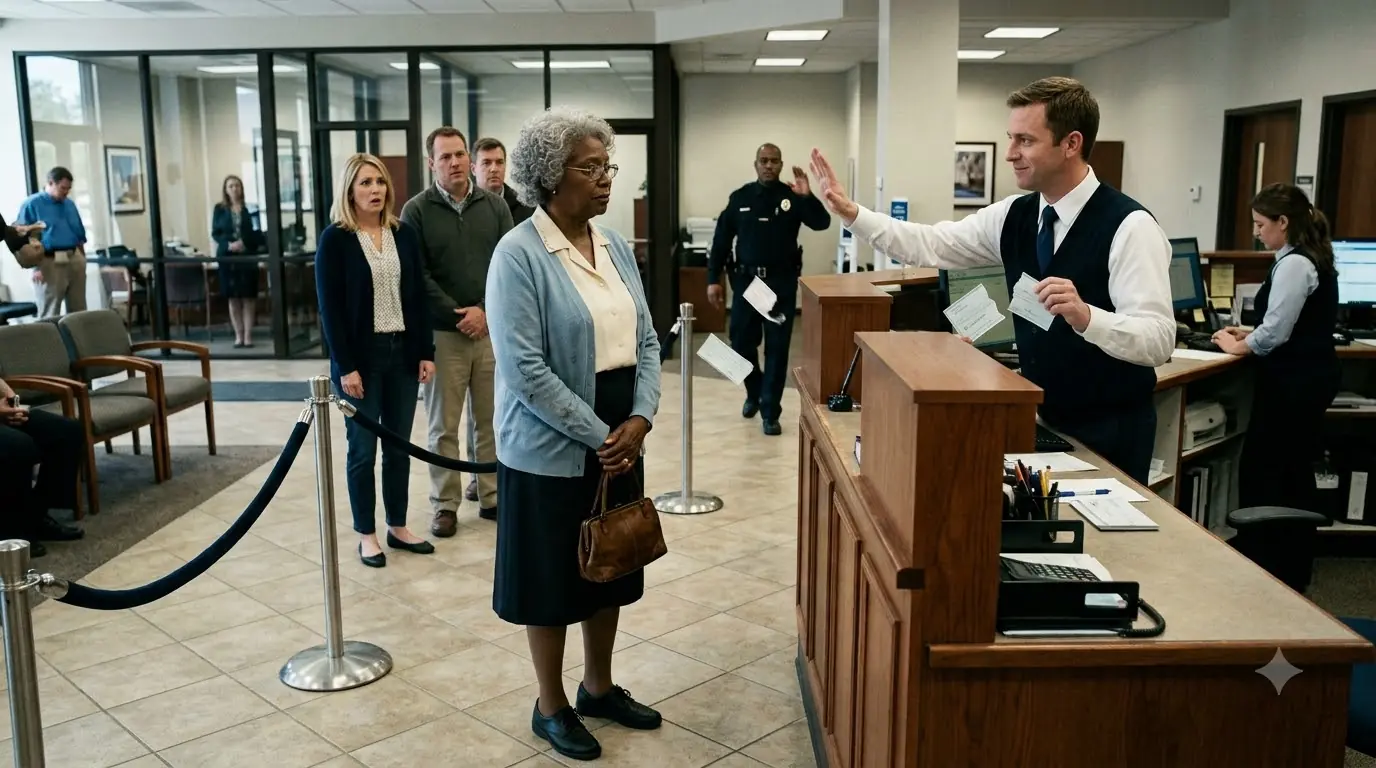
"That check came from your own bank," Loretta said quietly, not moving. "Sure it did." "Officer, I've got a live one here," Brad called out, laughing.
"Fake checks don't fool me, sweetheart," he sneered, loud enough for the whole lobby to hear.
"That check came from your own bank," Loretta said quietly, not moving. "Sure it did." "Officer, I've got a live one here," Brad called out, laughing.
He had no idea what he'd just started. Three white customers walked past him, cashed instantly, no questions asked. Loretta sat in a cracked plastic chair by the door, hands folded, waiting for the police he'd summoned on her. "You people always got a story," Brad muttered, arms crossed, smirking at his coworker. Loretta didn't answer.
She didn't need to. Somewhere across town, a phone she still hadn't dialed sat waiting anyway. Brad thought this ended with her walking out empty-handed. He was about to learn how badly he'd misjudged exactly who was sitting in that chair. Loretta Banks woke at 6, same as she had for 40 years, teaching or not, she made coffee in the chipped world's best teacher mug her third graders gave her the year she retired and carried it out to the porch to water three pots of geraniums that refused to die no matter how cold the Dayton winters got.
The house was small, paid off years ago, but the roof had started leaking above the back bedroom two winters back. She'd patched it herself with tarps and a ladder her neighbor Frank insisted on holding steady because at 67, falling off a roof wasn't a risk worth taking twice. Still, every hard rain sent her up to check the buckets, listening for the drip that meant the tarp had shifted again. She lived alone. Her husband had been gone 11 years now, and her daughter Simone lived 2 hours away in Columbus, calling every Sunday evening like clockwork.
Loretta never asked for money. She'd raised Simone on a teacher's salary and pure stubbornness, and old habits didn't bend just because her daughter had grown into someone capable. Money was tight, but manageable. Social Security covered the essentials.
The rest she stretched, clipping coupons, buying generic, skipping the hair salon for a box dye she did herself in the bathroom mirror. She wasn't ashamed of any of it. 31 years in a classroom had taught her that dignity wasn't about what you had. It was about how you carried what you didn't.
Twice a week, she volunteered at the elementary school two streets over, helping first graders sound out words they'd stumble over for the rest of their lives if nobody caught it early. The younger teachers called her Miss Loretta out of habit the same way her own students had decades before. She liked that. It meant something hadn't ended, just changed shape. On Tuesdays, she did her errands.
The pharmacy, the grocery store, sometimes the library if a new mystery novel had come in. Simple days, quiet days, the kind she'd earned after three decades of grading papers by lamplight. Nobody who saw her reading glasses pushed up into gray curls, cardigan buttoned wrong by one hole, cart with exactly the same six items every week would have guessed there was anything unusual about Loretta Banks at all. That was exactly how she preferred it.
Loretta had one rule she never said out loud, not even to Simone. She'd carried it since the year she started teaching, back when a parent had once stormed into her classroom, accusing her of favoritism toward the white students, loud enough that the principal came running. Loretta could have called her own father then, a man who'd sat on the county school board for a decade. She didn't. She stayed after class, pulled out her grade book, and showed the parent the numbers herself, page by page, until the accusation had nowhere left to stand.
That was the day the rule took root. You didn't reach for the people behind you until you had already done everything a person with no one behind them could do. Not because family didn't matter, because dignity mattered more. And dignity meant standing on your own evidence before you ever stood on someone else's name.
She'd kept that rule through every hard year since. Through her husband's illness, through raising Simone alone on a salary that never quite stretched far enough, through the quiet, grinding indignities that came with being a Black woman in rooms that assumed the worst of her first and asked questions second. She'd learned to document everything. Save every receipt. Write down every name, every time, every word said to her that shouldn't have been said.
Not for revenge, for proof in case proof was ever needed. Simone knew about the rule, mostly. She'd grown up watching her mother handle indignities with a composure that looked like patience, but was really preparation. "You never ask me for help until you've already tried everything else," Simone had said once, half joking, half frustrated, during a rare argument in her 20s.
Loretta had only nodded. "That's how you'll know it's serious," she'd told her. "Not because I'm angry, because I'm out of road."