The document was not long.
It was a single sheet of foolscap, the ink a faded brown, the signature at its foot a spidery mark belonging to a man of business Theodora Lamont had never met.
Yet it held the entire shape of her future and that of her son.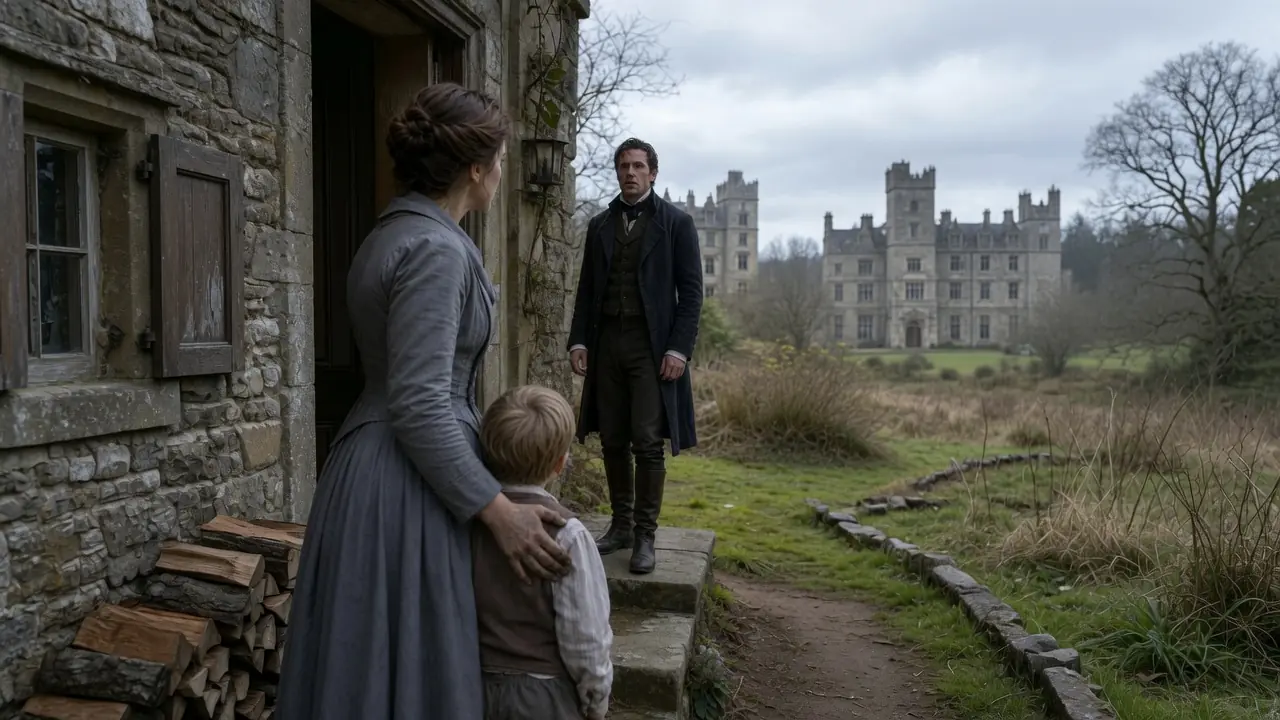
The words were plain, couched in the dry language of the law: lease of tenancy for the Dower House on the estate of Holmbridge, Yorkshire, granted to Mrs. Theodora Lamont, widow, for the term of her natural life or until the majority of the heir.
The heir.
A boy cousin somewhere in the south who would one day inherit the vast, empty holdings of the Wendhurst family. For the current Duke of Vaughn was dead, reported killed in a skirmish in the dusty heat of India eight years ago. A second son, who had inherited the title for less than a year, before his own death notice followed that of his elder brother.
Theodora folded the paper. The crisp crackle of it was unnaturally loud in the small borrowed room in York.
Beside her, her son Leo, not quite six years old, looked up from his careful arrangement of tin soldiers.
“Is that our new house, Mama?” he asked, his voice clear and untroubled.
“It is, my love,” Theodora said, her own voice steady.
She smoothed his fair hair, a shade lighter than her own sensible brown.
“A house in the country with a garden.”
A garden, a roof, a place to be that was not dependent on the dwindling charity of her late husband’s relations.
Her husband, a gentle country clergyman, had left her little more than his good name and their son. It was a distant connection, a kindness from her mother’s girlhood friendship with the late Dowager Duchess, that had secured this—a lifeline from a ghost.
The Dower House had stood empty for a decade. The estate trustees, managing the property for a distant heir, were content to have it occupied and kept from falling into ruin, even by a widow of no particular consequence.
Of course, they did not know.
No one knew that the name Wendhurst was a wound Theodora carried, far older and deeper than her widowhood. No one knew that Silas Wendhurst, the second son, the captain, believed dead, the man who had briefly and shockingly been the Duke of Vaughn, was the true ghost that haunted her.
Not the kind clergyman she had married, but the fierce, green-eyed soldier she had loved, and who had abandoned her without a word ten years before.
She had mourned him twice.
Once for his love, which had vanished overnight, and again for his life, which had ended across the world.
This tenancy was a strange, cruel sort of homecoming. To live on the land that should have been his. To raise another man’s son in the shadow of his ancestral home.
But she was a practical woman.
Grief was a luxury, and she had a child to raise.
She would take this gift, this strange postscript to a long-closed chapter of her life, and she would make it a home.
She had no other choice.
Holmbridge did not welcome them.
It stood indifferent, a great mass of gray stone under a vast, pale Yorkshire sky. The main house was a monument to absence. Its windows were shuttered like closed eyelids, a film of grime and neglect dulling its grandeur.
The gardens were a riot of weeds. The formal lines of boxwood hedges blurred into shaggy, undisciplined mounds. The place was breathing, but only just, a shallow, sleeping breath.
The Dower House was a smaller echo of the main building, set a quarter mile away, shielded by a stand of ancient oaks.
It was handsome in its proportions, but it wore the same air of abandonment. Damp bloomed in the corners of the drawing room, and the dust lay so thick on the furniture left behind that it seemed a shroud.
“It is very big,” Leo said, his small voice lost in the echoing hall. “And very quiet.”
“We shall make it less quiet,” Theodora promised, untying the ribbons of her bonnet.
Her own heart felt heavy, a stone in her chest. Every line of the house, every view of the park, was a reminder of him, of the man he was, and the man he might have become.
She set to work.
It was what she did. It was how she had survived her husband’s long illness, how she had survived the condescending pity of his family, how she had survived everything.
Work was a balm. Competence was a prayer.
She hired two girls from the village, and with their help she began the slow reclamation.
Windows were thrown open to the sharp, clean air. Floors were scrubbed with lye soap and vinegar. The scent of beeswax and lavender began to chase away the smell of dust and decay.
She had a small but secure income from her jointure, enough for necessities. She spent it with care, her account book a testament to her precise, orderly mind.
She discovered the still room, its shelves lined with empty stoppered bottles, a ghost of herbal scents still clinging to the air—bergamot, chamomile, rose.
Here she felt a sense of purpose. She had learned the art of simples and remedies from her own mother, an apothecary’s daughter.
Soon, the shelves began to fill again with infusions and tinctures from the herbs she found growing wild in the neglected kitchen garden.
Her hands, sorting leaves and crushing petals, were never idle. This was a language she understood—the quiet, steady work of healing.
Leo, after a few days of hushed exploration, claimed the estate as his kingdom. He was a solemn, observant child, and he seemed untroubled by the silence.
He spent his days mapping the woods, collecting pebbles from the river that bordered the property, and talking to the few elderly servants who remained like barnacles attached to the great empty house.
There was a housekeeper, Mrs. Gable, a woman as gray and unyielding as the local stone, and a handful of grooms and gardeners who did the bare minimum to keep the wilderness at bay.
They spoke of the late Duke with a kind of hushed reverence, the elder brother who had died in a riding accident.
And they spoke of Mr. Silas, the younger one, the soldier. They remembered him as a boy.
Wild, they said.
All fire and air, a world away from the solemn weight of the title he had so briefly held.
One afternoon, a month after their arrival, Theodora was in the Dower House garden, her hands deep in the soil, wrestling with a stubborn knot of brambles, when Leo came running toward her.
His face was alight with a rare, bright excitement.
“Mama, there is a man. A visitor. He’s asking for the Duke.”
Theodora sat back on her heels, pushing a stray strand of hair from her forehead with the back of a muddy glove.
“A visitor?”
The estate’s man of business came once a quarter, but he was not due for months.
“Did he give his name, Leo?”
“No. He’s very tall and he has a dark coat. He looks tired.”
A petitioner, perhaps, or someone lost.
“Where is he?”
“At the front door. I told him the Duke was not here.”
A child’s literal truth.
The Duke, Jervis Wendhurst, Silas’s cousin and heir presumptive, lived in London and had never, to anyone’s knowledge, set foot on the estate.
She would have to direct the man to the estate office in the village.
Brushing the dirt from her practical gray skirts, she walked around the side of the house.
A man stood on the front step, his back to her, gazing out at the shuttered facade of Holmbridge.
He was, as Leo had said, very tall. He wore a heavy wool greatcoat despite the mildness of the day, the collar turned up. It was the coat of a man who had been traveling a long time.
As she approached, he seemed to sense her presence and turned.
The world stopped.
It was not possible.
It was a trick of the light, a phantom conjured by her own foolish, grieving heart. But the light did not change, and the phantom did not fade.
The face was thinner, honed by years and hardships she could not imagine. The sun and wind of a foreign climate had weathered the skin, carving fine lines around the eyes.
But the eyes themselves were the same, a clear, sharp green, the color of moss in deep woods, and they were fixed on her with an expression of such cold, blank shock that it stole the breath from her lungs.
“Silas,” she whispered.
The name was a ghost on her lips.
He did not smile. His face remained a mask of stone. His gaze flickered from her face down to the small boy who now stood half hidden behind her skirts.
A muscle tightened in his jaw.
“So,” Silas Wendhurst, the Duke of Vaughn, the man believed dead for eight years, said, his voice a low rasp rough with disuse. “It is true, then.”
He looked at her, at the Dower House, at the child, and in his eyes Theodora saw not the joy of a miraculous return, but the flat, dead confirmation of an old and bitter judgment.
Silas felt the ground shift beneath his feet.
For a decade, he had carried the image of her betrayal like a shard of glass in his heart, a sharp, defining pain. He had built his life around it.
The recklessness that had earned him a reputation in the army, the cold distance he had maintained from all others, the weary acceptance of the news of his brother’s death, and then the final crushing weight of the dukedom—it was all built on the foundation of that one moment, the moment his world had ended in a shadowed London garden.
He had believed her false. He had seen the proof with his own eyes: the swift, secret embrace, the murmur of her laughter.
He had turned and walked away, and he had never looked back.
He had taken the King’s shilling and a posting to the farthest, most dangerous corner of the empire, seeking a clean death. Death, it turned out, was not so easily found.
A skirmish. A head wound. A long fever in a field hospital where records were lost and names forgotten.
He had spent two years as a man with no past, his memory a tattered ruin. Then, slowly, it had returned.
The name. The rank. The wound of her betrayal.
By the time he was well enough to be repatriated, the official report of his death had long since been filed.
He had let it stand.
What was there to come back to? The brother who was now Duke would have his own life, and she would have hers.
It was a lawyer’s letter, finding him by chance in Kolkata, that had dragged him back. News of his brother’s fatal accident. He was the Duke of Vaughn, a title he had never wanted, a responsibility he had spent his life fleeing.
Duty, cold and heavy, had compelled him home.
The journey had been a long, gray purgatory. He had imagined returning to Holmbridge, to the silence and the ghosts.
He had not, in all his darkest imaginings, pictured this.
Her.
Theodora.
Standing in the doorway of the Dower House.
Her face was the same, yet different. The youthful softness was gone, replaced by a quiet, steady gravity. She was still beautiful, but it was the stark, fined-down beauty of a landscape after a storm.
And beside her, the boy.
Fair-haired.
The living, breathing proof of the life she had made after she had broken his.
Her whispered “Silas” had struck him like a physical blow, and then his own words, cold and cruel.
“So it is true, then.”
True that she had not waited. True that she had moved on, married, borne a child.
Why the sight of it should feel like a fresh wound, he did not understand. It was what he had known, but knowing and seeing were two different things.
He saw the color drain from her face, the light in her eyes extinguish.
She drew the boy closer, a protective gesture that shut him out completely.
“You were reported dead,” she said, her voice barely audible.
“The report was in error,” he stated, the words flat and lifeless.
A silence stretched between them, thick with the weight of ten lost years, a decade of misunderstanding, of grief, of lives lived apart.
He should feel triumphant. He was alive. He was the Duke. He was master of all he surveyed.
Instead, he felt like a trespasser in his own life.
The little boy, her son, peeked out from behind her skirts. He looked at Silas with wide, curious eyes, untouched by the adult currents of pain and shock that swirled around him.
“Are you the Duke, then?” the child asked.
Silas looked down at the boy. He saw Theodora’s chin, her steady gaze reflected in the child’s face.
He could not bring himself to answer. He simply gave a stiff, formal nod.
Theodora recovered herself first. Her training as a companion, her years of managing difficult situations, rose to the surface.
Her posture straightened. The shock receded from her face, replaced by a mask of cool, distant courtesy.
“Your Grace,” she said, and the formal address was a wall erected between them. “The house is not prepared. The staff… they believe you gone.”
“I can see that,” he said, his gaze sweeping over the shuttered windows of the great house.
It looked as dead as he was supposed to be.
“Mrs. Gable is in the kitchens. I will inform her. She will see to airing a room for you.”
She was all competence now, all cool efficiency. The woman who had whispered his name was gone. In her place was a capable stranger managing an unexpected crisis.
He wanted to call her back.
To say what?
To demand an explanation for a decade-old betrayal? To rage at the injustice of it all? But the words would not come. He was frozen in place by a grief so old it had become a part of his bones.
He watched her walk away, her back straight, the little boy’s hand held firmly in hers.
She did not look back.
He was alone on the steps of a house he no longer recognized.
A ghost returned to a world that had moved on without him.
The Duke of Vaughn had come home, and he had never felt more lost.
The news of the Duke’s return spread through Holmbridge, not like wildfire, but like a slow, seeping flood.
It started in the kitchens with Mrs. Gable’s stunned silence, followed by a flurry of disbelieving activity. It moved to the stables, where the old grooms whispered and stared toward the great house.
By evening, the entire village was humming with it.
The dead duke had walked back into his own life.
Jervis Wendhurst, the cousin who had for a few years seen himself as the next Duke of Vaughn, was summoned from London by a curt note from the estate solicitor.
He arrived three days later, his face a mask of practiced astonishment and delight that did not quite reach his eyes.
“Silas, my dear cousin, a miracle!” he exclaimed, grasping Silas’s hand in the grand, dusty entrance hall. “We had all given you up for lost. To have you back—it is an answer to a prayer.”
Silas received the greeting with a cold nod. He looked at his cousin, at the expensive cut of his coat, the fashionable nonchalance of his posture.
This was the man who had stood to gain everything by his death.
And this was the man who had been his friend, his confidant in the days before he had left England.
“Jervis,” Silas said, his voice flat. “I require the estate books, and a full accounting of all expenditures made in my absence.”
The warmth in Jervis’s expression flickered.
“Of course. Of course, everything is in order. The trustees have been most diligent.” He cleared his throat. “You will find the estate somewhat at rest. We saw no sense in great expense, with the heir being a minor and so far away.”
“I am the heir,” Silas said, the words tasting like ash in his mouth.
He took up residence in the main house, a solitary ghost in a sea of dusty sheets and unopened rooms.
He worked from dawn until long past dusk in the library, the one room he ordered to be thoroughly cleaned. He submerged himself in the details of his inheritance: tenant rolls, crop yields, investment ledgers.
The land was neglected. The finances were disordered.
It was a ruin, and it was his.
The work was a shield, a bulwark against the past that was now his present.
He saw Theodora only at a distance, a glimpse of her in the garden, the sound of her son’s laughter carrying on the wind. She kept to the Dower House, a quiet, self-contained world.
She made no demands. She sent no messages.
She was simply there, a constant, silent reminder of all he had lost and all he had misunderstood.
His nights were the worst.
In the suffocating silence of the great empty house, the memories had room to breathe.
Not just of India, of the fever and the fighting, but of London.
Of the time before.
London, 1814.
He was Captain Silas Wendhurst, second son of a Duke, a man with a fine name and no fortune. His uniform was his living, his sword his only inheritance. He was handsome, reckless, and utterly without prospects.
And he was in love.
Theodora Neville was a companion to a wealthy dowager, a young woman of good family but no dowry. She was intelligent and serene, with a quiet wit that lay hidden beneath a placid surface.
From the first moment he had seen her across a crowded ballroom, he had been lost.
Their courtship was a thing of stolen moments.
A walk in the park under the guise of escorting the dowager’s pug. A whispered conversation behind a potted palm. A shared book of poetry with passages marked for each other to find.
They existed in a world of codes and glances, their love a secret garden in the midst of London’s bustling, transactional society.
He knew it was impossible.
He had nothing to offer her. His father, the old Duke, was a stern, unyielding man who expected his sons to marry for land and advantage.
Theodora, for all her grace and intelligence, was a nobody in the eyes of the world.
“We could go to America,” he had whispered to her one evening in the shadowed corner of a music room, the sound of a string quartet covering their words. “I could sell my commission. We could buy a farm. I would learn to work the land for you.”
She had looked at him, her eyes shining in the candlelight.
“I would live in a cottage with you, Silas, or a tent. It does not matter, as long as we are together.”
They made a plan, a desperate, foolish, romantic plan.
He would arrange for a special license. They would meet at dawn at a small church in Cheapside. They would be married, and then they would face the world together.
His cousin Jervis, the only one he trusted with his secret, promised to help.
Jervis, who had always been his friend, his shadow.
The day before they were to elope, Jervis came to him, his face a picture of distress.
“I have heard something, Silas. A rumor about Miss Neville.”
“What rumor?” Silas demanded, his heart turning to ice.
“That she… that she has another. A wealthier suitor. That her affections are not solely yours.”
“It’s a lie,” Silas snarled. “Who told you this?”
“I cannot say, but I fear… I fear you are being played for a fool.” Jervis looked pained. “Go to the Hartwoods’ garden party tonight. Her dowager is attending. Go, but do not announce yourself. Just watch, for your own peace of mind.”
He had gone, his heart pounding with a sick, cold dread.
He had slipped into the gardens through a side gate, keeping to the shadows of the yew hedge, and he had seen her.
She was standing by the ornamental fountain with a man he vaguely recognized, a wealthy young baronet.
The man was speaking to her in low tones, his expression intense. Then he had reached for her, pulling her into a swift, shadowed embrace.
Silas had heard the faint sound of her laughter, a light, carefree sound that had shattered his world.
He had not stayed to see more.
He had turned and walked away, the image burned into his mind.
Betrayal.
It was so simple, so absolute.
Jervis’s words, the laughter, the embrace—it all fit together into a perfect, damning picture.
He did not go to the church at dawn.
Instead, he went to Horse Guards and took the first available posting that would put an ocean between him and England.
He did not write to her.
What was there to say?
He had seen the truth. He had left her to the life she had clearly chosen, a life of wealth and ease with her baronet.
He had never imagined she would end up a country clergyman’s widow, living in a Dower House on his own estate.
The pieces did not fit.
The past was a labyrinth, and Silas was lost in it.
He drove himself and the small staff he had begun to assemble with a relentless energy. He rode the estate from dawn until dusk, his face grim, his eyes missing nothing.
He noted the fallen fences, the silted-up drainage ditches, the tenants’ cottages in desperate need of repair. The neglect was a physical manifestation of his own absence, a reproach in stone and soil.
He avoided the Dower House as if it were plague-ridden, but he was always aware of it.
Aware of her.
One afternoon, he was returning from a long ride when he saw her son Leo by the riverbank.
The boy was trying to sail a small boat made of bark and a leaf, but it kept catching in the current and spinning in circles. He was frowning with intense concentration, his small brow furrowed.
Silas reined in his horse, watching from the cover of the trees.
He should ride on. The boy was nothing to him. He was a symbol of the life she had built without him.
But he stayed, an unwilling observer.
The boat finally capsized and was swept away. The boy’s shoulders slumped. He did not cry, but a look of profound, weary disappointment settled on his small face.
It was an expression too old for a child, and it was an expression Silas recognized.
He had seen it in the mirror.
On impulse, Silas dismounted. He walked toward the boy, his own movements stiff.
Leo looked up, startled, his eyes wide. He did not seem afraid, only surprised.
“The current is too strong here,” Silas said, his voice rusty. He had not spoken to anyone all day. “You need a calmer stretch. Or a better keel.”
He crouched down, ignoring the protest of a knee that had never fully healed from a long-ago wound. He picked up a flat stone.
“You need weight,” he explained, his fingers surprisingly clumsy as he demonstrated how a stone could be wedged into a piece of bark to keep it steady.
Leo watched, his expression solemn.
“My father made me a boat once. It had a real cloth sail.”
The words were a simple statement of fact, but they landed like a punch.
My father.
The clergyman. The man who had taken his place.
“Did he?” Silas said, his voice devoid of expression.
He stood up abruptly.
“You should not be so close to the water alone.”
He turned and walked back to his horse, leaving the boy staring after him, the flat stone still in his hand.
He mounted and rode toward the main house, the brief, fragile connection shattered.
He had been a fool to approach him. The boy was a part of her world, not his. A world he had been locked out of for ten years.
But as he rode away, he could not shake the image of the child’s solemn, disappointed face.
It was a face that understood loss.
Theodora knew something had shifted.
Leo spoke of the Duke, of Mr. Silas, as he had heard the old grooms call him. He reported their brief encounter by the river with a child’s simple accuracy.
“He showed me how to make my boat stay up,” he said. “He said I need weight.”
She felt a tremor of something she could not name.
Silas, who had looked at her with such cold fury, had stopped to speak to her son.
It was a small thing, a crack in the wall of ice he had built around himself.
She watched him from a distance. She saw the relentless way he worked, the long hours he spent in the saddle or shut away in the library. She saw the exhaustion etched on his face, the tension in his shoulders.
He was a man at war, not with a foreign enemy, but with his own estate, his own past.
Her late husband had been a kind man, a gentle scholar. His love had been a quiet, peaceful harbor after the storm of losing Silas.
She had been grateful for that peace. She had been a good wife to him, and she mourned him sincerely.
But the love she had felt for Silas had been a different thing entirely.
It had been a fire, a thing of fierce, elemental power.
Seeing him again, even this cold, wounded version of him, had stirred the embers she thought long dead.
But she was not the girl she had been.
She would not plead or weep. Her pride was a different thing now, forged in hardship, not in youthful passion.
She had a son. She had a life, however small and quiet. She would not have it overturned by a ghost who looked at her as if she were a criminal.
One evening, Jervis Wendhurst paid a call to the Dower House.
It was the first time she had seen him since Silas’s return. He was all smooth charm and solicitous concern.
“My dear Mrs. Lamont,” he began, accepting the cup of tea she offered. “I can only imagine how unsettling this must all be for you.”
“His Grace’s return is a blessing for the estate,” she said, her tone neutral.
“Of course, of course. A true miracle.” He took a sip of tea, his eyes darting around her small, tidy drawing room. “I confess I worry for him. He seems changed. So grim, so driven, not the Silas we once knew.”
“Ten years is a long time,” Theodora observed, “especially the years he has lived.”
“Indeed.” Jervis leaned forward, his voice dropping to a confidential murmur. “And to return and find circumstances altered. To find you here. It must be a shock.”
He let the words hang in the air.
Theodora met his gaze directly.
“My circumstances are a matter of public record, Mr. Wendhurst. I am a widow raising my son. His Grace the Duke has been kind enough to honor the lease granted by his trustees.”
Jervis gave a thin smile.
“He was always a man of honor, if a bit impulsive, prone to jumping to conclusions.” He sighed, a theatrical sound. “I remember how devastated he was when you… when you chose to end your understanding. He never truly recovered. It was what drove him to take that dreadful posting.”
Theodora’s hand, holding her teacup, was perfectly steady.
“There was no understanding to end, Mr. Wendhurst. Captain Wendhurst made his own choices. He left London without a word of explanation.”
“Did he?” Jervis looked surprised. “How strange. He was under the impression… Well, it is all in the past, is it not? A sad business. I’m only glad you have found some peace here.”
He finished his tea and took his leave, leaving a trail of silken insinuation behind him.
Theodora stood by the window, watching him walk back toward the main house.
He was under the impression.
What impression?
That she had been the one to break it off?
But that was impossible.
Silas had simply vanished.
A cold seed of doubt began to sprout in her mind. Jervis’s words, meant to sound sympathetic, had felt wrong, calculated. He had been painting a picture, a version of the past where she was the faithless one and Silas the wounded victim.
It was the same judgment she had seen in Silas’s own eyes.
She went to a small writing desk and unlocked a drawer. Inside was a small lacquered box.
She opened it.
There were only a few things inside: her late husband’s wedding ring, a lock of Leo’s baby hair, and a small folded piece of paper.
It was a note written in a bold masculine hand.
My dearest Theodora, at dawn. All is arranged.
Forever yours,
Silas.
It was the last thing she had ever received from him.
She had gone to the church at dawn, her heart singing. She had waited for two hours, a small, hopeful figure in the gray morning light.
He had never come.
She had believed his courage had failed him, that his sense of duty to his family had won out over his love for her.
Then, weeks later, she heard he had taken a commission in India.
It was a brutal, public severing.
Now Jervis was suggesting that Silas believed she had been the one to end it.
It made no sense.
Unless someone had wanted it to make no sense.
She thought back to that last day in London, the Hartwoods’ garden party. She had been there with her employer.
She remembered speaking to the young baronet, a cousin of the Hartwoods whom she barely knew. He had been ridiculously effusive, full of florid compliments.
He had cornered her by the fountain, and she had been trying to politely extricate herself.
Had he touched her arm? Perhaps.
She could not recall an embrace.
She remembered laughing. Not with him, but at some absurdly over-the-top pronouncement he had made.
Could that have been what Silas saw?
A meaningless, trivial moment twisted into something else.
And who would have twisted it?
Who knew their plans? Who had been there advising him, sympathizing with him?
Jervis.
The seed of doubt began to grow, sending out cold, searching roots.
Jervis, who had been his closest friend. Jervis, who stood to inherit if Silas, the second son, was out of the way.
But Silas had not been the heir then. His brother was alive and well.
It did not add up, unless the goal was simpler. Not to gain a fortune, but simply to separate them. To remove the unsuitable companion from the life of a duke’s son.
Theodora closed the box.
She felt a quiet, cold anger begin to burn within her.
For ten years, she had carried the pain of his abandonment.
For eight of those years, she had carried the grief of his death.
Now he was back, looking at her with the eyes of a hanging judge, and she was beginning to suspect that they were both victims of a lie, a cruel, carefully constructed lie.
And she would not rest until she knew the truth.
The reclamation of the walled garden became Theodora’s sanctuary.
It was a place of ordered work, of bringing life back to a neglected space. She found the old espaliered fruit trees choked with ivy, the rose bushes a tangle of thorns.
Methodically, she began to prune, to weed, to dig. Her hands were often sore, her back aching, but her mind was clear.
One afternoon, as she was carefully tying a rambling rose back to the crumbling brick wall, she heard the crunch of boots on the gravel path behind her.
She did not need to turn.
She knew the weight of that footstep.
“You are ruining your hands,” Silas said.
It was not a question.
She finished tying the knot before she turned to face him. She held up her hands, stained with earth, a long scratch on one forearm.
“They are capable hands, Your Grace. They are not afraid of work.”
He stood a few feet away, his tall frame blocking the afternoon sun. He looked as though he had not slept in days. His green eyes were shadowed, his face taut with a strain that never seemed to leave him.
“Why are you here?” he asked, the question abrupt. “At Holmbridge?”
“I needed a home for my son. Your family’s trustees were kind.”
“Kind?” he repeated the word flatly. “And your husband’s family? Were they not kind?”
The question was a deliberate cruelty, a testing of a wound.
The old Theodora would have flinched. The woman she was now simply met his gaze.
“My husband was a good man, Your Grace. His family did what they felt was their duty. Their resources were limited. I prefer to be independent.”
“Independent?” he said again, as if tasting a foreign word.
His gaze was fixed on her face, searching, probing.
“You seem to have made a habit of it.”
The anger she had been nursing for days, cool and controlled, finally found its voice.
“And you, Your Grace, what habits have you made? Leaving without a word, perhaps. Judging from a distance. Allowing others to tell you what to believe.”
The shot landed.
A flicker of something—shock, anger—crossed his face.
“I saw what I saw.”
“Did you?” She stepped closer, her voice low and intense. “Tell me, then. Tell me what you saw that was worth ten years of silence.”
He was the one who flinched, taking a half step back.
The Duke of Vaughn, the master of Holmbridge, retreating from a widow in a dusty gardening apron.
“It is in the past,” he said, his voice tight.
“The past is standing in this garden with us now,” she countered. “It is in every shuttered window of that house. You brought it back with you. So tell me.”
He was silent for a long moment, the muscle in his jaw working.
When he finally spoke, his voice was raw.
“I saw you in the Hartwoods’ garden. With him.”
“With whom?” she demanded.
“Lord Albright.”
“A man I spoke to for five minutes. A fool whose name I could barely remember a day later.”
“You were in his arms. You were laughing.”
Theodora stared at him, the sheer, breathtaking absurdity of it stealing her breath.
An embrace she could not remember.
A laugh that meant nothing.
That was the foundation of all this ruin.
“There was no embrace,” she said, her voice shaking with a cold fury. “There was a man paying clumsy compliments and me trying to escape him. If he touched my arm, I do not recall it. If I laughed, it was at him, not with him. That is the great betrayal you have carried with you all these years. A shadow. A misunderstanding.”
He looked away from her, toward the high garden wall, as if he could not bear the sight of her face.
“It seemed clear at the time.”
“Did it, or did someone make it seem clear? Someone who knew you were to meet me the next morning. Someone who knew how to poison your mind against me.”
He turned back, his eyes narrowed.
“What are you suggesting?”
“I am suggesting you were a fool,” she said, the words sharp and clear. “And that I have paid the price for your foolishness for a decade. I mourned you, Silas. I grieved for you. I accepted that you had cast me aside, and then I grieved for your death. I built a life from the ashes you left me. And you return and look at me—at my son—as if we are a stain on your honor.”
She stopped, her chest heaving.
She had said too much. She had broken her own rules of control and restraint.
He stood as if turned to stone, his face pale beneath its tan. The anger in his eyes was gone, replaced by a dawning, horrified confusion.
It was as if he was seeing the past, not through the dark glass of his own pain, but through her eyes for the very first time.
“I did not pity you when I heard you had returned,” she said, her voice softer now, weary. “I know what it is to be wounded. I looked at you and I saw the cost of the years you have lost. I saw the man you are beneath the title and the bitterness. That is not pity. Pity is for the helpless, and you are not that. It is sight. To see another person clearly. I granted you that. You have never, not once, granted it to me.”
She turned away from him, picking up her gardening shears.
Her hands were trembling. She began to snip at a dead rose branch, the rhythmic click, click, click of the blades the only sound in the sudden ringing silence.
She felt his eyes on her back, but she did not turn.
She had said all she could say.
The next move, if there was to be one, was his.
After a moment that stretched into an eternity, she heard his footsteps on the gravel, walking away, back toward the great silent house, back to his ghosts.
But she knew, with a certainty that settled deep in her bones, that a new ghost now walked with him.
The ghost of a doubt.
The possibility that the story he had told himself for ten years was a lie.
The conversation in the garden changed nothing.
And it changed everything.
On the surface, Silas’s routine remained the same—the long days, the solitary evenings. But inside the fortress of his solitude, a breach had been made.
Theodora’s words echoed in his mind.
Did someone make it seem clear?
He began to re-examine the memory that had been the cornerstone of his bitterness.
He had trusted Jervis implicitly, his charming, easygoing cousin who had always been at his side, full of advice and sympathy.
It was Jervis who had first planted the seed of doubt.
It was Jervis who had urged him to go to the garden party.
It was Jervis who had been there afterward to clap him on the shoulder and agree that some women were not worth the pain.
“You’re better off without her, Silas. She’d have broken your heart sooner or later.”
At the time, it had felt like friendship, like loyalty.
Now, viewed through the lens of Theodora’s fierce, clear-eyed anger, it seemed manipulative.
Why?
What motive could Jervis have had?
Back then, Silas had been a mere captain. His brother Arthur was the heir, healthy, robust, and newly married. Jervis had been a distant third in the line of succession.
Separating Silas from a penniless companion would bring him no closer to the title.
Unless the motive was not about the title.
Unless it was simpler.
Pride. Family pride.
The Wendhursts did not marry companions.
Perhaps Jervis had seen it as his duty to save Silas from a foolish romantic mistake, a misguided act of protection that had spiraled into a decade of ruin.
It was plausible.
It was human.
And it was devastating.
He began to watch his cousin.
He noticed things he had been too consumed by his own misery to see before. The way Jervis’s eyes slid away under a direct question about estate finances. The slight, almost imperceptible tension in his shoulders when Silas entered a room.
The way he spoke of Theodora, a constant, subtle campaign of faint praise and veiled criticism.
“A capable woman, to be sure, though perhaps a bit hard. The years have not been kind to her, I suppose.”
The pieces began to fall into place, forming a picture that made him feel sick with a cold, slow-burning rage.
A rage directed not only at his cousin, but at himself, at his own blind, arrogant pride.
He had been so certain of her guilt, so wrapped in his own righteous pain, that he had never once stopped to question what he saw. He had not given her the chance to speak. He had condemned and executed her in his own mind, and the sentence had been a lifetime.
His interactions with the world outside the estate were few and far between. But he forced himself to engage.
He met with tenants. He spoke with the vicar. He listened and he learned.
He learned of Mrs. Lamont, the clergyman’s wife, who had been a tireless support to her ailing husband. He learned of her skill with herbs, of the remedies she quietly provided to villagers who could not afford a physician. He learned of her quiet dignity, her uncomplaining strength.
The woman they described was not the flighty, faithless girl from his poisoned memories.
She was the woman in the garden with dirt on her hands and truth in her eyes.
The chasm between the woman he was discovering and the woman he thought he knew grew wider with each passing day.
And in that chasm lay ten lost years.
One day, he found Leo in the library.
The boy had slipped in on a forbidden adventure and was staring up at the towering shelves of books, his face a mask of awe.
“It’s bigger than a church,” Leo whispered, as if to himself.
Silas, who had entered silently, stood watching him from the doorway.
He should have been angry. This was his sanctuary.
But he felt no anger, only a strange, hollow ache.
“Do you like to read?” Silas asked.
Leo jumped, startled.
“My father taught me my letters,” he said, his voice small. “We read the Bible and a book about birds.”
“There are many books about birds in here,” Silas said, walking slowly into the room.
He pulled a heavy leather-bound volume from a lower shelf. It was filled with magnificent hand-colored plates. He opened it on the large library table.
“This one is from America.”
Leo crept closer, his eyes wide. He reached out a small, hesitant finger and gently touched the vibrant image of a blue jay.
“He’s very bright.”
“Yes.”
They stood in silence for a time, turning the pages together. Silas found himself pointing out the different birds, telling Leo their names, stories he had read long ago.
The boy was a rapt audience. He asked questions, simple, direct questions.
“Why is his beak so sharp?”
“Does he fly very far?”
It was the longest conversation Silas had held in weeks.
It was easy.
There were no shadows between them, no history of pain, just a man and a boy and a book of birds.
When it was time for Leo to go, he looked up at Silas, his expression serious.
“My mother says you are sad because you lost a great deal of time.”
Silas froze, his hand resting on the book.
“Did she?”
“Yes. She said it is like losing a chapter from the middle of a book. You can read the end, but you will never know exactly what you missed.”
The simple, borrowed metaphor struck Silas with the force of a physical blow. He looked down at the boy, at his clear, untroubled eyes, and felt a sudden, desperate longing.
A longing not just for the lost years, but for the possibility of a future, a future in which he might be worthy of the quiet, profound wisdom of the woman who had just explained his own soul to him through the mouth of her son.
“Your mother,” Silas said, his voice rough, “is a very wise woman.”
He knew then what he had to do.
He could not get the years back. He could not unbreak what was broken.
But he could uncover the truth.
Not for revenge, not even for justice, but for her, so that she would know that he finally, finally saw her.
The next day, he sent a quiet message to a man in the village—an old groom named Hobbes, who had been a stable boy at Holmbridge when Silas was a youth, a man who saw everything and said little.
He asked the man to come to the great house. He had some questions about the past, about a certain day in London long ago, about who came and went, and who paid for services rendered in secret.
It was time to excavate the ruin.
Theodora felt the subtle shift in the estate’s atmosphere.
The Duke was still a remote figure, but there was a new purpose in his actions.
He was asking questions.
He spoke to old Mrs. Gable for an hour in her parlor. He spent a morning with the head gardener, a man who had been at Holmbridge for fifty years. He was, it seemed, piecing together a history, not of the land, but of the people.
She did her own quiet work.
She wrote a letter to a cousin in London, asking a delicate question. Did she, by any chance, recall Lord Albright, the man who had briefly been talked of in the season of 1814?
The reply came a week later.
Albright? That dreadful man. He was a notorious gambler, fled to the continent to escape his debts not a week after the Hartwoods’ party. Last I heard, he died of a fever in Naples years ago.
Fled the country a week after the supposed embrace.
It was another piece that did not fit the narrative of a wealthy suitor.
He had not been a suitor. He had been a desperate man, and desperate men could be bought.
The final piece of the puzzle arrived not in a letter, but in the form of a small, elderly man with shoulders bowed from a lifetime of labor.
She saw him from her garden, walking up the main drive to the great house. She recognized him as Hobbes, one of the old grooms.
He was with the Duke in the library for over an hour.
When he left, his face was grave. He tipped his hat to her as he passed the Dower House, a gesture of respect he had never made before.
That evening, a footman delivered a note to her.
It was written on the Duke’s heavy cream stationery. The handwriting was a stark black slash.
Mrs. Lamont,
I request your presence in the library of the main house this evening at nine o’clock. I have also requested the attendance of Mr. Jervis Wendhurst.
Vaughn.
The formal signature. The cold, correct phrasing.
But underneath it, Theodora felt the tremor of an earthquake.
The reckoning was at hand.
She dressed with care, not in her usual widow’s gray, but in a simple gown of deep blue muslin. It was a color she had not worn in years. It was a color Silas had once told her matched her eyes.
She arranged her hair simply, her hands steady.
She was not a girl going to a ball.
She was a woman going to claim her past.
At nine o’clock precisely, she walked up the steps of the great house.
The front doors were open. The hall was lit, not just by a single candle, but by several branches of them, casting a warm, living light.
It felt as though the house was finally waking up.
The library door was ajar. She pushed it open and stepped inside.
A fire burned in the grate, chasing the chill from the room. Silas stood near the mantelpiece, one hand resting upon it.
He was not looking at the door, but into the flames. He was dressed in a severe, perfectly cut black coat and dark breeches. He looked every inch the Duke, but his stillness was that of a soldier waiting for a battle to begin.
Jervis Wendhurst was already there, seated in one of the large leather armchairs. He looked ill at ease, a faint sheen of sweat on his upper lip despite the coolness of the room.
He rose as Theodora entered, his smile too quick, too bright.
“Mrs. Lamont, an unexpected pleasure. I confess I am at a loss. A mysterious midnight summons from our grim cousin. It is all very dramatic.”
Theodora did not smile.
She inclined her head.
“Mr. Wendhurst.”
She walked further into the room, taking a seat in a chair opposite Jervis. She placed her hands in her lap and waited.
Silas turned from the fire. He looked first at Jervis, then at her. His face was a mask, his green eyes unreadable.
But when his gaze met hers, she saw a flicker of something in their depths.
An apology.
A plea.
A terrible shared sorrow.
“Thank you both for coming,” Silas began, his voice low and even. “I have been back at Holmbridge for two months. In that time, I have been reviewing the past, not just the estate’s ledgers, but my own.”
He paused, his eyes fixed on his cousin.
“Jervis, ten years ago in London, you came to me with a story, a rumor about Miss Neville’s infidelity.”
Jervis shifted in his seat.
“Silas, my dear fellow, must we rake over these ancient coals? It was a painful business for all concerned. Best left buried.”
“I think not,” Silas said, his voice dangerously soft. “You told me to go to the Hartwoods’ garden party. You told me to watch. What you did not tell me was that you had paid Lord Albright fifty pounds to stage a scene for my benefit.”
The color drained from Jervis’s face.
He looked utterly, completely stunned.
“What? That is… that is an outrageous accusation. Preposterous.”
“Is it?” Silas took a step forward. “I have a sworn statement from a groom who worked at the Hartwood stables. He remembers you, Jervis. He remembers you meeting Albright in the mews behind the house just before the party. He remembers the exchange of money. He thought you were paying off a gambling debt, but you were not paying a debt. You were buying a performance.”
Jervis stared at Silas, his mouth slightly agape.
He looked from Silas’s cold, implacable face to Theodora’s quiet, watchful one. He seemed to shrink in his chair.
“It was a lie,” Silas continued, his voice resonating with a decade of suppressed pain. “You manufactured a betrayal to separate us. You played on my pride, my jealousy. You coached me in my grief. And you let me go to the other side of the world, believing a lie you had crafted.”
Jervis finally found his voice, a greedy, defensive whine.
“I was trying to protect you. She was not our kind. A penniless companion. She would have ruined you, tied you down. I did it for you, Silas. For the family.”
“You did it for yourself,” Silas cut in, his voice like the crack of a whip. “You have always been afraid, Jervis. Afraid of being poor, of being a nobody. You saw me throwing my life away on a foolish love, and you could not bear it. But it was my life to throw away.”
Theodora listened, her heart aching, not with triumph, but with a profound, soul-deep sadness.
Jervis’s motive had not been grand or villainous. It had been small and petty and pathetic.
It had been fear.
“I never thought… I never thought you would be reported dead,” Jervis whispered, his face crumbling. “I swear it, Silas. I only meant to separate you, to make you see reason. When we heard you were gone, I was horrified. I lived with that.”
“Did you?” Silas said, his voice weary. “Did you live with it when you began to position yourself as my heir? When you borrowed against the estate’s future income? When you stood to gain a title and a fortune from the consequences of your lie?”
Jervis flinched as if struck.
He had no answer.
He buried his face in his hands, his shoulders shaking. The carefully constructed facade of the charming man-about-town had shattered, revealing the weak, frightened man beneath.
It was not satisfying to watch.
It was merely sad.
Silas looked at his broken cousin for a long moment.
Then he turned to Theodora.
The room was silent, save for the crackle of the fire and Jervis’s muffled sobs.
The truth was out, a shabby, pathetic truth that had cost them ten years of their lives.
Silas walked toward her. He did not stop until he was standing before her chair. He did not reach for her. He simply stood, his hands hanging at his sides, his face stripped of all its masks.
The anger was gone. The coldness was gone.
All that was left was a vast, hollow landscape of regret.
“Theodora,” he said.
Her name.
Just her name.
It was a question, an apology, a confession. It held everything he could not say.
She looked up at him, at this man she had loved, mourned, and hated. This stranger who was more familiar to her than anyone on earth.
She saw the boy he had been and the wounded man he had become. She saw the fool who had thrown her away and the Duke who had painstakingly uncovered the truth to lay it at her feet.
“I know,” she said softly.
It was all the absolution he was going to get.
It was all he deserved.
He did not ask for forgiveness.
The crime was too large. The cost too high for such a simple transaction.
In the days that followed the confrontation in the library, a quiet, profound shift occurred at Holmbridge.
Jervis was gone by morning.
There was no public scandal, no legal retribution. Silas’s justice was as silent and absolute as his grief. His cousin was exiled, sent to the continent with a small, unforgiving allowance, stripped of his expectations and his place in the family.
He simply ceased to be.
The life of the estate began to stir.
Silas hired more staff, brought in architects to see to the house and land agents to advise on the farms. The sounds of hammers and saws replaced the oppressive silence.
Holmbridge was slowly, painstakingly being brought back to life.
But between the main house and the Dower House, a different kind of silence fell.
A silence of uncertainty.
The truth was out, but what was to be done with it?
The past had been a wall between them.
Now, it was a chasm.
Silas came to her a week later.
He did not send a note. He appeared at her door in the late afternoon as the sun was casting long shadows across the lawn.
He looked tired, but the taut, angry lines around his eyes had softened.
“Walk with me,” he said.
It was not a request, but a quiet plea.
She took a light shawl and went with him.
They did not walk toward the reviving splendor of the main house, but took a small overgrown path that led down to the river. They walked for a long time without speaking, the only sound the murmur of the water and the call of a distant bird.
“I have thought of a hundred things to say to you,” he began at last, his eyes on the far bank. “Apologies. Explanations. Excuses. None of them are adequate.”
“No,” she agreed softly.
“I was a boy,” he said, “arrogant and proud and so certain I was right. I built a fortress out of my own pain, and I locked myself inside it for ten years. I never once thought to question the foundations.”
He finally turned to look at her.
“I cannot give you back those years, Theodora. For you, for me, for your husband, for your son. They’re gone.”
“I know,” she said.
“He was a good man, your husband.”
“He was a very kind man,” she answered honestly. “He gave me a home when I had none. He gave me Leo. I was a good wife to him.”
Silas nodded, accepting it.
There was no jealousy in his face, only a quiet sorrow.
“Leo is a fine boy. He has your steadiness.”
They were silent again.
The chasm between them was filled with ghosts—the boy Silas had been, the girl she had been, the kind clergyman, the ten years of silence.
“I have instructed my solicitor,” Silas said, his voice formal, businesslike, “to make a settlement on you and Leo. A generous one. You will be independent. You can live wherever you choose—London, Bath, or here if you wish. The Dower House is yours for as long as you want it.”
He was offering her everything.
Everything except himself.
He was giving her a cage of her own, gilded with his guilt.
Theodora stopped walking. She turned to face him fully, the evening breeze catching at her shawl.
“I am not looking for a transaction, Silas.”
For the first time since that terrible day in London, she used his given name. It felt both strange and utterly natural on her tongue.
He looked at her, his expression confused.
“I don’t understand.”
“You are offering me a pension. Reparations for a decade of foolish pride. I do not want it.”
“Then what do you want?” he asked, his voice raw with a pain he could no longer hide. “What can I possibly give you?”
She saw him then.
Truly saw him.
Not as the Duke of Vaughn, master of Holmbridge, but as Silas Wendhurst, a man hollowed out by his own mistakes. A man who believed himself so broken he was beyond repair. A man who thought the only thing he had left to offer was money.
And in that moment, her choice was made.
It was not a grand romantic gesture. It was a quiet, steady decision born of sight.
Not pity.
“I am here,” she said, her voice clear and strong in the quiet evening air. “The world believes you were dead. In a way, you were. The world believed I was a contented widow. In a way, I was. We are both ghosts, you and I. Perhaps it is time we learned to live again.”
He stared at her, his green eyes wide with dawning, incredulous hope.
“Theodora…”
“I will not be your pensioner, Silas,” she said firmly. “Living on the estate as a monument to your guilt. That is not alive. If you would have me, I will stay. But as your wife. As your duchess.”
She took a breath, the words a leap of faith into the vast, unknown chasm between them.
“The choice was never yours to make alone. Not then and not now. This is my choice, and I am making it.”
He did not move.
He simply looked at her, the setting sun catching the unshed tears in his eyes.
He had returned from the dead to find his life in ruins. And now, in the midst of that ruin, this quiet, strong, incredible woman was offering him not forgiveness, but a future.
A second chance he had never dreamed he would have, and knew he did not deserve.
Slowly, as if afraid she might vanish, he reached out and took her hand. His fingers were cool, but his grip was firm.
It was not the hand of the passionate boy she had known, but of the man who had fought his way back.
“Yes,” he said, his voice thick with emotion. “Yes.”
Two years later, the gardens of Holmbridge were a symphony of color.
Roses, pruned and tended, climbed the old brick walls, their scent heavy in the summer air. The lawns were green and manicured, and the great house itself seemed to have taken a deep, contented breath, its windows clean and shining, open to the sunlight.
From the terrace, Theodora, Duchess of Vaughn, watched her son Leo chase a butterfly across the grass.
He was eight years old now, sturdy and confident, his laughter a bright, welcome sound that the old stones of the house seemed to drink in.
The library door opened, and Silas came out to join her.
He moved with an easy grace that had been absent when he first returned. The perpetual tension in his shoulders had eased.
The years in India had left their mark—a slight limp that was more pronounced in damp weather, a network of fine lines around his eyes—but his face was no longer a mask of grief. It was the face of a man at peace in his own home.
He came to stand beside her, his arm resting lightly around her waist.
They stood in comfortable silence, watching their son.
“He will need a pony soon,” Silas remarked.
“He will terrorize the stables,” Theodora replied, a smile in her voice.
“Hobbes can manage him.”
Their life was a quiet one. They had not returned to the whirl of London society. Their world was here at Holmbridge.
They had built a new life, not on the ashes of the old one, but alongside it.
The ghosts were still there. They always would be.
Later that evening, Theodora found Silas in the gallery, standing before a portrait of his elder brother, Arthur.
It was something he did often, a quiet communion with the man whose death had so altered the course of his life. The weight of the title, the one he had never wanted, was a burden he still carried.
It was part of the story that could not be rewritten.
She came to stand beside him, her hand finding his.
He did not startle. He simply laced his fingers through hers, his thumb stroking the back of her hand.
“I often wonder,” he said quietly, his gaze on his brother’s painted face, “what he would think of all this.”
“He would be glad the house is full of life again,” Theodora said. “He would be happy for you.”
Silas was silent for a moment.
Then he turned from the portrait to look at her in the dim light of the gallery. His eyes were full of a deep, unwavering love.
It was not the fire of their youth, but something stronger, more enduring.
A love that had been tested by time and sorrow, and had survived. It was a love that did not seek to erase the scars, but to accommodate them.
He raised her hand to his lips.
“Ten lost years,” he murmured against her skin. “And a lifetime to make up for them.”
It was not a perfect story.
There was a chapter missing from the middle of the book, just as Leo had said. A chapter of pain and misunderstanding that could never be reclaimed.
But they had the rest of the book.
And together, they would write the ending.
The great house was quiet around them, breathing in the cool night air.
The past was settled.
The future was waiting.