At 10:18 on a rainy Tuesday night, Hannah Walker stood barefoot on the cold tile floor of Miller’s Coin Laundry with her four-year-old son asleep across two plastic chairs and her last five dollars trapped inside a broken washing machine.
She did not cry.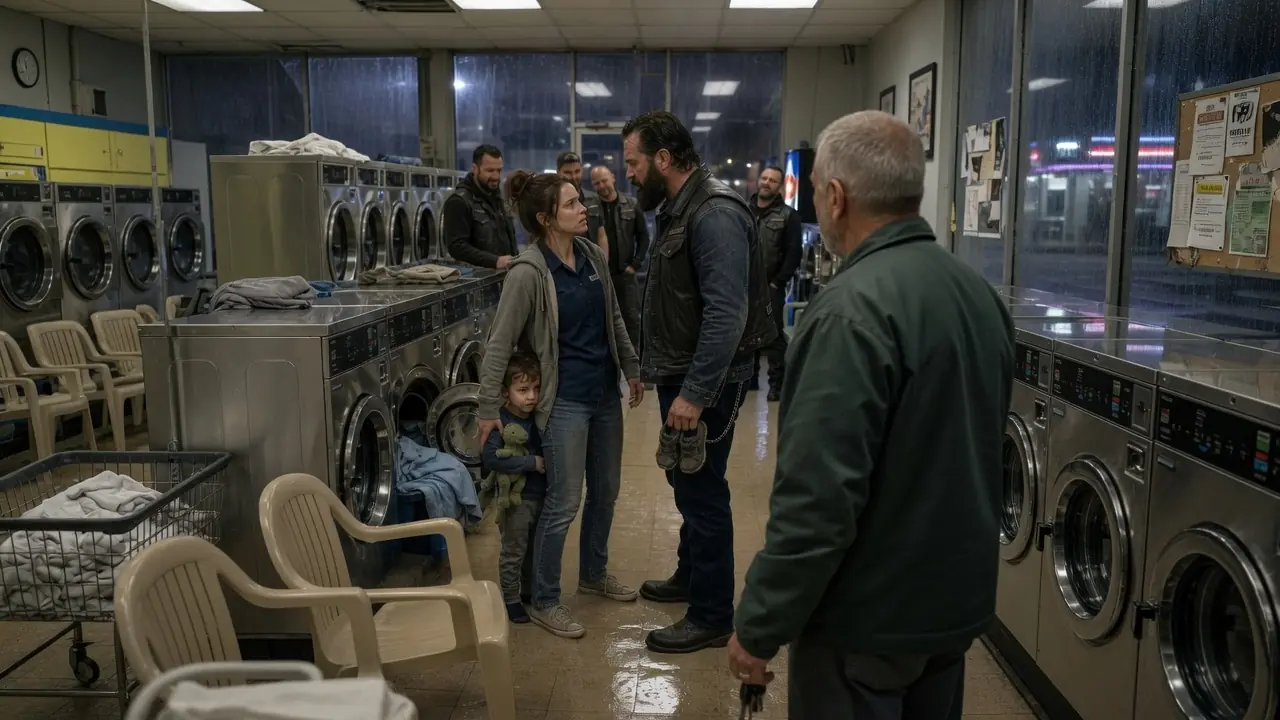
Not yet.
She had learned to delay crying the same way she delayed everything else. Dinner could wait until Ethan fell asleep. Her own laundry could wait until the uniforms were clean. Sleep could wait until the early shift ended. Fear could wait until there was no one left to take care of.
So Hannah stood in front of machine number six, one hand pressed against the scratched metal lid, and stared through the cloudy glass at the water sitting still around her son’s tiny dinosaur pajamas.
The machine had stopped mid-cycle.
The timer showed eighteen minutes remaining.
The lid was locked.
Her quarters were gone.
And inside the washer were the only clean clothes Ethan had for daycare the next morning.
Hannah closed her eyes and breathed in slowly.
The laundromat smelled of detergent, wet cotton, old dryers, and rainwater tracked in from the parking lot. Fluorescent lights buzzed overhead. A soda machine hummed near the back wall, its bright red glow reflecting off the damp floor. Outside, the street was nearly empty. The small town of Harrow Creek, Arkansas, folded itself up early on weeknights. By ten, the diner was closed, the barber shop was dark, and even the gas station across the road had only one tired clerk behind the counter.
Miller’s Coin Laundry stayed open until midnight because people who worked two jobs did not always have the luxury of washing clothes at reasonable hours.
Hannah was one of those people.
At twenty-seven, she looked younger when she was tired and older when she was scared. Her brown hair was pulled into a loose bun, strands falling around her face. She wore faded jeans, an old gray hoodie, and the blue work shirt from the grocery store where she stocked shelves from six in the morning until two in the afternoon. Her hands were red from soap and cold water because the sink in her apartment had backed up again, and the landlord had not answered three calls.
On the plastic chairs behind her, Ethan shifted in his sleep.
He was small for his age, with soft brown curls and a round cheek pressed against his folded jacket. One hand clutched a green toy dinosaur with a missing tail. His sneakers sat beneath the chair because Hannah had taken them off after he complained they were wet.
The sight of him made her throat tighten.
She turned back to the machine.
“Come on,” she whispered. “Please.”
She pressed the start button again.
Nothing.
She tapped the coin return.
Nothing.
She looked toward the office window near the entrance. The sign taped to the glass read, “Attendant on duty until 9 p.m. For emergencies call number below.”
The number had been written in fading marker.
Hannah had called it twice.
No answer.
At the far end of the laundromat, a man with a mop bucket moved slowly between the dryer rows. His name was Earl Mason, though most people in town called him Mr. Earl. He was the night janitor, not the attendant. He came after nine to clean lint traps, mop the floor, empty trash cans, and make sure nobody slept behind the dryers.
He was in his late sixties, thin but straight-backed, with silver hair trimmed close and deep lines around his mouth. He wore dark work pants, rubber-soled shoes, and a faded green jacket with the laundromat logo stitched over the pocket. He had a quiet way of moving that made him easy to overlook.
Hannah did not overlook him.
She had seen him give a homeless man clean socks one winter night. She had seen him leave a roll of quarters beside a washer for a woman who thought no one noticed she was counting pennies. She had seen him pretend to inspect a dryer for ten minutes so a teenage girl could wait safely for her ride.
Mr. Earl looked over now.
“Machine still stuck?” he asked.
Hannah nodded. “It took the money, filled up, then stopped.”
He leaned the mop against the wall and walked toward her. “Number six has been acting stubborn.”
“I really need those clothes.”
“I know.”
He crouched slowly, opened the lower panel with a key from his belt, and studied the wires inside. He did not rush. He never rushed. His hands moved carefully, like each old machine deserved patience even when it did not deserve respect.
Hannah glanced at Ethan. “I’m sorry. I know it’s not your job.”
Mr. Earl looked up. “A thing needing doing does not always care whose job it is.”
She almost smiled. “That sounds like something my grandmother would say.”
“Your grandmother sounds sensible.”
“She was.”
He adjusted something inside the machine. It clicked once, then fell silent again.
His mouth tightened. “Control board may be dead.”
Hannah’s chest sank.
“Can you open it?”
“Not without draining it.”
“How long will that take?”
“Depends on whether the drain hose wants to behave.”
She looked at Ethan’s pajamas floating in the still water. “Of course it doesn’t.”
Mr. Earl stood with a small grunt. “I’ll get my tools.”
Hannah folded her arms against the cold. “Thank you.”
He paused. “You and the boy need to get home tonight?”
She nodded. “I have work at six. He has daycare at seven.”
“Car?”
“The starter’s bad. My neighbor dropped us off.”
Mr. Earl’s eyes moved toward the rain streaking the front windows. “You got a ride back?”
Hannah hesitated.
That was enough answer.
He nodded once, not making her explain.
“I’ll call my niece when we get your laundry loose. She runs the late taxi sometimes.”
“I can’t afford a taxi.”
“I didn’t mention money.”
Hannah looked away quickly.
Kindness was dangerous when she was tired. It made the walls inside her soften, and she needed those walls to hold until she got home.
Before she could answer, a low rumble rolled down the street.
At first, Hannah thought it was thunder.
Then it grew closer.
Deeper.
Rougher.
Mr. Earl turned toward the front windows.
Across the road, the gas station lights flickered over the wet pavement. Headlights appeared beyond them, one after another, bright circles cutting through the rain. The rumble split into separate engines.
Motorcycles.
Hannah felt her stomach tighten before she knew why.
Six bikes came around the corner and pulled into the laundromat parking lot as if they owned it. Their tires hissed through shallow puddles. Chrome flashed beneath the buzzing sign. The riders revved once, twice, then killed the engines one by one.
The silence afterward felt heavy.
Hannah looked at Ethan. He was still asleep.
“Just customers,” she told herself.
But Mr. Earl did not look convinced.
The riders climbed off their bikes. They wore leather vests over denim jackets and dark shirts, boots shining wet from the rain. Patches covered their backs, showing a coiled rattlesnake around a wrench. The words beneath the patch read, “Iron Serpents.”
The tallest rider stood in front.
He had a thick black beard, broad shoulders, and eyes that seemed amused before anything funny had happened. His vest hung open over a white shirt stained at the collar. Silver chains swung from his belt, and a name patch on his chest read: Knox.
Hannah knew the type.
Not because he was a biker. She had met plenty of good riders. Quiet ones. Polite ones. Men and women who washed road dust from jeans, folded their clothes, and thanked the person behind the counter.
No, she knew Knox’s type because he looked through the glass and smiled when he saw only a tired woman, a sleeping child, and an old janitor inside.
The door opened.
The bell gave a weak metallic ring.
Rain air rushed into the laundromat.
The men came in laughing, shaking water from their jackets onto the clean floor. Boots struck tile. One slapped the side of the soda machine. Another whistled low when he saw Hannah standing near machine six.
“Well, well,” Knox said. “Place ain’t empty after all.”
Hannah turned back to the washer and pretended not to hear.
Mr. Earl walked to his mop bucket, lifted the mop, and began drying the water they had tracked in.
“Evening,” he said. “Washers on the left. Dryers on the right. Quarters in the machine by the office.”
Knox looked him over. “You the boss?”
“No.”
“Then why are you talking?”
Mr. Earl kept mopping. “Because I’m the one who has to clean up after you.”
One of the bikers laughed. He was younger than the others, maybe twenty-five, with a shaved head and a tattoo curling up his neck.
Knox smiled, but his eyes cooled. “Careful, old man.”
Mr. Earl did not answer.
The bikers spread into the laundromat.
Two went toward the vending machines. One opened a dryer that was not his and looked inside, then slammed it shut. Another leaned against the folding table and began picking at the edge of a lost sock someone had left behind.
Knox walked toward Hannah.
She kept her eyes on the washer.
“Machine trouble?” he asked.
She said nothing.
He stopped beside her, too close.
“I asked you a question.”
Hannah forced herself to look at him. “It’s broken.”
Knox looked at the machine, then at the waterlogged clothes inside. “That’s a shame.”
“It is.”
“You always this friendly?”
“I’m tired.”
He looked over her shoulder at Ethan sleeping on the chairs. “That yours?”
Hannah’s body stiffened. “Yes.”
“Cute kid.”
She did not like the way he said it.
“Thank you.”
Knox leaned one hand on the broken washer. “Little late for a kid to be out.”
Hannah picked up the laundry basket from the floor and placed it between them, creating a small barrier. “We’re almost done.”
“Doesn’t look done.”
“It will be.”
One of the other bikers came closer. “Boss, look at this.”
He pointed at Ethan’s dinosaur, half tucked under his arm.
Knox chuckled. “Kid brought a lizard.”
“It’s a dinosaur,” Hannah said before she could stop herself.
The biker grinned. “Oh, she speaks.”
Knox looked pleased. “Dinosaur, huh?”
He stepped away from Hannah and moved toward Ethan.
Hannah immediately stepped into his path.
“Don’t wake him.”
Knox stopped and looked down at her.
The room shifted.
The other bikers noticed. Their laughter softened into attention.
“What did you say?” Knox asked.
Her heartbeat pounded in her throat. “Please don’t wake him. He has daycare early.”
Knox’s smile widened. “Please don’t wake him.”
He repeated it in a higher voice, mocking her.
One of the bikers laughed.
Hannah felt heat rise in her face, but she did not move.
Mr. Earl stopped mopping.
Knox tilted his head. “You got a husband coming?”
“No.”
“Boyfriend?”
“No.”
“Figures.”
Hannah’s jaw tightened.
He leaned closer. “Women like you always got that look.”
“What look?”
“Like the world owes you help.”
The words hit too close to old bruises.
She thought of the apartment sink, the broken car, the daycare bill, the grocery manager cutting her hours then asking why she looked stressed, the landlord saying single moms always had emergencies.
“The world owes my son sleep,” she said. “That’s all I’m asking for.”
For a second, Knox looked almost surprised.
Then his face hardened.
“Your son is sleeping in a laundromat at ten-thirty at night,” he said. “Maybe don’t lecture me about what he’s owed.”
Hannah felt the sentence like a slap.
One of the bikers made a low sound. “Damn.”
Knox had found the place to press.
Her shame.
Hannah looked at Ethan, still sleeping, his mouth slightly open, his cheek red from the plastic chair.
She already felt guilty every minute of every day. Guilty that he spent mornings at daycare and evenings in grocery carts while she clipped coupons. Guilty that he knew how to sleep under fluorescent lights. Guilty that his shoes had been bought from the church donation bin. Guilty that sometimes she was too tired to read the same bedtime book twice.
Knox had not created that guilt.
He had only dragged it into the room and laughed at it.
Hannah swallowed hard. “Leave us alone.”
The younger biker with the neck tattoo walked behind Ethan’s chairs and looked down at him. “Little man’s out cold.”
Hannah turned sharply. “Step away from him.”
The young biker raised both hands, grinning. “Relax.”
Knox’s voice lowered. “You don’t give orders here.”
“Neither do you.”
She regretted it instantly.
The words escaped from a place beyond caution. A place exhaustion had worn raw.
Knox’s smile disappeared.
Mr. Earl took one step forward.
“Hannah,” he said softly.
Knox looked at him. “You know her?”
“She washes here every Tuesday.”
“A regular.” Knox looked back at Hannah. “That makes you important?”
“No,” she said.
“Good. Then you can wait.”
“For what?”
He tapped machine six. “We need a washer.”
Hannah stared at him. “There are empty washers.”
“I want this one.”
“It’s broken.”
“I’ll decide that.”
“My son’s clothes are inside.”
Knox looked through the glass. “Then take them out.”
“I can’t. It’s locked.”
“Sounds like a you problem.”
He turned to the young biker. “Crow, unplug it.”
Mr. Earl’s voice cut through the room.
“Don’t touch that machine.”
Everyone turned.
Mr. Earl stood near the mop bucket, shoulders squared, one hand resting lightly on the handle.
Knox laughed. “Janitor found his spine.”
Mr. Earl looked at Hannah, then at Ethan, then back at Knox. “That machine has water in it. You unplug it wrong, it can short. You force the lid, you can flood the floor. The child’s clothes stay inside until I drain it.”
Crow, the young biker, smirked. “You going to stop me?”
“Yes.”
The room went quiet.
Hannah stared at Mr. Earl.
He was old. Thin. Wearing rubber-soled shoes and a faded jacket. He held a mop, not a weapon. But his voice had changed. Not louder. Deeper somehow. Solid.
Knox noticed too.
He walked toward him slowly. “You got a hero problem?”
“No.”
“No?”
“No,” Mr. Earl said. “I got a cleaning problem. Men like you always leave messes.”
Crow laughed before Knox turned and silenced him with a look.
Knox stepped close to Mr. Earl. “You don’t know men like me.”
Mr. Earl looked up at him. “I knew men like you before you knew how to start an engine.”
Knox’s eyes narrowed.
For a moment, Hannah saw something pass across the bikers’ faces. Not fear exactly. Recognition of a line being approached.
Then Ethan woke up.
He stirred on the chairs, rubbed one eye, and sat up halfway.
“Mommy?”
Hannah immediately turned. “I’m here, baby.”
Ethan looked around at the strange men, the wet floor, Mr. Earl standing still, his mother’s tense face.
His lower lip trembled. “Are we going home?”
“Soon.”
Knox turned toward the child.
“Hey, little dinosaur boy.”
Ethan grabbed his toy and pressed it to his chest.
Hannah moved to him.
Knox was faster.
Not by grabbing her. Not by touching the boy.
He simply reached down and picked up Ethan’s tiny sneakers from beneath the chair.
Hannah froze.
“Put those down,” she said.
Knox examined one shoe. “These are rough.”
Ethan’s eyes widened. “Those are mine.”
“Yeah? You run fast in these?”
Ethan looked at his mother.
Hannah held out her hand. “Give me my son’s shoes.”
Knox lifted them higher.
The bikers laughed.
Ethan began to cry.
Not loudly at first. Just a frightened little sound that cut through Hannah’s chest sharper than any insult.
She stepped forward. “Please. He’s scared.”
Knox smiled. “Then maybe you should teach him not to be.”
“He’s four.”
“World doesn’t care.”
The words were casual.
That made them worse.
Mr. Earl moved.
He walked past Knox, past the broken machine, and stopped beside Ethan. He crouched slowly, his knees cracking, and looked the little boy in the eye.
“Ethan,” he said gently, “remember what I told you about the lint dragon?”
Ethan sniffled. “He lives in the dryer.”
“That’s right. And what scares him away?”
Ethan wiped his nose with his sleeve. “The green dinosaur.”
“That’s the one. Hold him tight.”
Ethan clutched the toy.
Knox watched this with a mocking smile. “Sweet.”
Mr. Earl stood and faced him.
“Shoes,” he said.
Knox tossed one shoe lightly into the air and caught it. “Ask nice.”
Hannah felt something inside her crack.
“Please,” she whispered.
Knox looked at her. “Louder.”
“Please give him his shoes.”
“Say you’re sorry for running your mouth.”
Mr. Earl’s eyes sharpened. “Don’t.”
Hannah looked at Ethan, then at the shoe in Knox’s hand.
“I’m sorry,” she said.
Knox grinned.
“For what?”
“For running my mouth.”
The bikers laughed again.
Hannah’s face burned so hot she thought she might be sick.
Ethan cried harder. “Mommy.”
Knox dropped the shoes at her feet.
“There,” he said. “See? Manners work.”
Hannah bent to pick them up, but her hands were shaking so badly one shoe slipped from her fingers.
Crow clapped once. “Good girl.”
Mr. Earl turned his head slowly toward Crow.
The young biker’s grin faded.
Hannah put the shoes on Ethan with trembling hands. She tied the laces, though they were wet and stiff, and whispered, “It’s okay, baby. It’s okay.”
But it was not okay.
Everybody in the room knew it.
The other two customers had left quietly through the side door when the bikers first came in. The laundromat now held only Hannah, Ethan, Mr. Earl, and the Iron Serpents.
Knox walked back to machine six.
“Open it,” he said.
Mr. Earl straightened. “No.”
Knox slapped the top of the washer.
Ethan flinched.
Hannah stood. “Stop.”
Knox looked at her. “You still talking?”
Mr. Earl reached into his jacket pocket.
Every biker tensed.
But he did not pull out a weapon.
He pulled out a ring of keys.
Then he walked to the front door.
Knox frowned. “Where you going?”
Mr. Earl locked the door.
The click was small.
In the silent laundromat, it sounded enormous.
Crow laughed nervously. “Old man locked us in?”
Mr. Earl turned the sign from OPEN to CLOSED.
Then he pulled a cord near the office window.
Metal shutters began lowering over the front glass with a grinding rattle.
Hannah stared.
She had never seen the shutters used before.
Knox stepped forward. “What the hell are you doing?”
Mr. Earl looked at him calmly. “Closing early.”
“Open that door.”
“No.”
The last shutter locked into place.
The laundromat changed instantly.
The outside world vanished behind metal slats. The rain became a muffled whisper. Fluorescent lights buzzed overhead, suddenly too bright, too exposed. The bikers no longer looked like men entering a public place.
They looked like men trapped inside the mess they had made.
Knox’s face darkened. “You think that’s smart?”
“No,” Mr. Earl said. “I think it’s necessary.”
He walked to the office window, reached beneath the counter, and pressed a red button.
A silent alarm light blinked once.
Then again.
Knox saw it.
So did everyone else.
Crow cursed. “Boss.”
Knox pointed at Mr. Earl. “You just made a mistake.”
Mr. Earl took off his green laundromat jacket and folded it over the back of a chair.
Beneath it, he wore a plain black T-shirt.
On his left forearm was a tattoo faded by age but still visible.
A shield.
Two crossed tools.
And the words: HARBOR CREW.
The Iron Serpents went quiet.
Knox stared at the tattoo.
For the first time all night, his confidence faltered.
“You were Harbor Crew?” he asked.
Mr. Earl did not answer.
Crow looked confused. “What’s Harbor Crew?”
One of the older bikers near the dryer row answered in a low voice. “Not a club you mess with.”
Mr. Earl rolled his sleeves down slowly, not to hide the tattoo, but as if the point had already been made.
“I was a lot of things,” he said. “Tonight I’m the man cleaning this floor.”
Knox recovered quickly, but the edge in his voice had changed. “That crew died twenty years ago.”
“No,” Mr. Earl said. “It got old.”
Something heavy settled over the room.
Hannah did not understand the history. She did not know the Harbor Crew or why the tattoo made hardened men suddenly measure their words. But she understood one thing clearly.
Mr. Earl was not just a janitor.
Knox looked toward the door. “Open it.”
“The sheriff has a key.”
“You called the sheriff?”
“I called people who know what you are.”
The older biker shifted. “Knox, this ain’t worth it.”
Knox snapped, “Shut up.”
But his eyes kept moving to the tattoo.
Mr. Earl walked to the broken machine and picked up the screwdriver he had left on top.
Hannah stiffened.
He did not raise it.
He simply handed it to her.
“Hold this for me.”
She took it, confused.
Then he crouched at machine six again and began disconnecting the drain line.
Knox stared. “You fixing laundry right now?”
“Yes.”
“You’re insane.”
“No,” Mr. Earl said. “Her child needs clothes in the morning.”
The sentence changed the room in a way threats had not.
Hannah felt tears sting her eyes.
Not because everything was safe.
Because someone had remembered the simple truth beneath all the fear.
Her son needed clothes in the morning.
Mr. Earl worked steadily. Water began draining into a bucket. He adjusted the hose, tightened a clamp, and ignored the bikers with a discipline that felt more powerful than rage.
The Iron Serpents watched.
Knox grew angrier with each second because he had lost the center of the room. His cruelty had turned into background noise. The old janitor was solving the actual problem, and that made Knox seem smaller than any insult could have.
Ethan sniffled and leaned against Hannah’s leg.
“Mommy,” he whispered, “is Mr. Earl a superhero?”
Hannah looked at the old man kneeling by the washer, silver hair under fluorescent light, one hand steady on a drain hose, surrounded by men who suddenly looked unsure.
She touched Ethan’s curls.
“Something like that.”
Mr. Earl looked over his shoulder. “No capes in the laundromat.”
Ethan gave a tiny, broken laugh.
That laugh made Knox move.
He stepped toward Ethan, face twisted with irritation. “Kid thinks this is funny?”
Hannah pulled Ethan behind her.
Before Knox came closer, Mr. Earl stood.
“Enough.”
The word cracked through the laundromat.
Knox stopped.
Mr. Earl’s voice stayed low, but every syllable landed hard.
“You scared the mother. You scared the child. You made her apologize for protecting him. You took his shoes. You tried to use hunger, tiredness, and poverty like handles to pull her down. Now you will stand there and keep your mouth closed until the sheriff arrives.”
Crow tried to laugh. “Or what?”
Mr. Earl turned toward him.
“Or you can explain to every rider still alive who remembers Harbor Crew why six men wearing patches decided to terrorize a woman and a sleeping child in a coin laundry.”
Crow’s smile died.
Knox clenched his fists. “You got no authority.”
Mr. Earl looked toward the metal shutters. “Then leave.”
Nobody moved.
Because they could not.
Because he had locked the door.
Because the sheriff had been called.
Because outside the laundromat, headlights were now cutting across the shutter seams.
Hannah heard vehicles pulling into the lot.
One.
Then another.
Then many.
The bikers heard them too.
Knox turned toward the front.
Through the thin gaps in the shutters, red and blue lights flickered across the tile.
Then came another sound.
Motorcycle engines.
Not six.
More.
A lot more.
They did not roar aggressively. They arrived in steady lines, engines settling into place outside like a wall forming around the building.
Crow whispered, “Who is that?”
Mr. Earl picked up the mop and rested both hands on the handle.
“Old men,” he said.
Knox’s face went pale with fury. “You called Harbor Crew?”
“I called friends.”
The front door rattled.
A woman’s voice came from outside. “Earl Mason, open up for the sheriff.”
Mr. Earl unlocked the door.
The moment it opened, Sheriff Dana Whitcomb stepped inside, rain shining on her tan uniform, one hand resting near her belt. She was in her early fifties, with sharp eyes and the tired authority of someone who had spent decades dealing with men who thought volume was power.
Behind her came two deputies.
Behind them, visible through the open doorway, stood nearly twenty older riders in rain jackets and plain leather, men and women with gray hair, hard hands, and calm faces. Some wore old Harbor Crew patches. Some wore no patches at all. They stood beside their motorcycles without speaking.
Knox saw them.
His jaw tightened.
Sheriff Whitcomb looked first at Hannah and Ethan.
“You hurt?”
Hannah shook her head. “No.”
“Child?”
“He’s scared.”
The sheriff’s expression hardened. “I can see that.”
She turned toward Knox. “Hands where I can see them.”
Knox lifted both hands slowly. “This is ridiculous.”
“What is?”
“We came in to do laundry.”
Mr. Earl spoke from beside machine six. “They came in to intimidate her. Took the child’s shoes. Forced her to apologize. Tried to interfere with her laundry. Refused to leave when told.”
Sheriff Whitcomb looked at Hannah. “Is that true?”
Hannah’s mouth felt dry.
Knox stared at her.
For a second, the old fear came back.
Rent. Work. Daycare. Being known as trouble. Having people say she overreacted. Having men like Knox remember her face.
Then Ethan’s small hand slipped into hers.
She looked down at her son.
He was watching her with frightened eyes.
Hannah took a breath.
“Yes,” she said.
The word shook, but it stood.
“Yes, it’s true.”
Sheriff Whitcomb nodded. “Good.”
Knox scoffed. “Good?”
“Good that she said it out loud.” The sheriff looked at him. “You’re used to people staying quiet.”
One of the older Harbor Crew riders stepped inside then. She was a tall woman with silver hair braided down her back and an old leather vest over a raincoat. Her face was lined, but her eyes were bright and fierce.
She looked at Mr. Earl. “You all right?”
He nodded. “I’m fine, Louise.”
Her gaze moved to Hannah and Ethan, and her expression softened. “Ma’am.”
Hannah nodded back, uncertain.
Louise turned to Knox.
“Do you know what that patch on your back means?” she asked.
Knox’s lip curled. “I know what mine means.”
“No,” Louise said. “You know what you use it for. That is different.”
Sheriff Whitcomb pointed to the folding tables. “All six of you. Hands on the tables. Now.”
The Iron Serpents hesitated.
Then the older biker among them, the one who had recognized Harbor Crew, walked to the table first and placed his hands flat.
“Do it,” he muttered to the others.
Crow looked at Knox.
Knox did not move.
Sheriff Whitcomb’s voice sharpened. “Mr. Knox.”
He finally turned and put his hands on the folding table.
The deputies moved in, separating them one by one. IDs were taken. Pockets emptied. Questions asked. The sheriff listened as Hannah gave her statement, then Mr. Earl, then the older biker who admitted quietly that Knox had been “running hot” all week and looking for someone to push around.
While the officers worked, Louise approached Hannah.
“You need to sit down,” she said.
“I’m okay.”
“No, honey. You’re upright. That’s not the same.”
Hannah almost laughed, but it came out as a shaky breath.
Louise crouched in front of Ethan.
“And who are you?”
Ethan hid behind Hannah’s leg.
“This is Ethan,” Hannah said.
Louise smiled gently. “Ethan, my name is Louise. I ride a motorcycle, but I do not steal shoes.”
Ethan looked at her cautiously. “You know Mr. Earl?”
“For forty years.”
“Is he a superhero?”
Louise glanced at Earl, who was pretending not to listen while reconnecting the washer hose.
“He used to think so,” she said.
Mr. Earl grunted. “Still no capes.”
This time, Ethan smiled.
Small.
But real.
Hannah covered her mouth for a second.
The relief hit suddenly, so hard her knees weakened. She sank onto the plastic chair beside her son and pressed one hand to her face.
“I’m sorry,” she whispered.
Louise sat beside her. “For what?”
“I don’t know.”
“That usually means someone made you feel ashamed when you had nothing to be ashamed of.”
Hannah’s shoulders shook.
“I apologized to him,” she said. “I told him I was sorry just to get my son’s shoes back.”
Louise’s face softened with fury. “You did what a mother had to do.”
“It felt weak.”
“No,” Louise said. “Weak was six men scaring a child because they could. You were surviving. Don’t confuse the two.”
Hannah looked at Ethan.
He was watching Mr. Earl drain the machine, still holding his dinosaur.
The washer clicked.
The lid unlocked.
Mr. Earl opened it and lifted out the soaked dinosaur pajamas, blue daycare shirt, little socks, and Hannah’s work uniform.
“They’ll need a spin cycle in another machine,” he said. “Then dryer.”
Hannah wiped her eyes. “I don’t have more quarters.”
Before Mr. Earl could answer, Louise stood and turned toward the open door.
“Quarters,” she called.
Outside, the old riders began reaching into pockets.
Coins appeared in hands.
One rider brought a coffee can from his motorcycle saddlebag. Another handed over a roll of quarters still wrapped in paper. Someone placed bills on the folding table. Within minutes, the table held enough money to wash clothes for weeks.
Hannah stared. “No. I can’t take that.”
Louise looked at her. “Can your boy wear wet pajamas to daycare?”
“No, but-”
“No buts. The laundry is tonight’s problem. Pride can make an appointment for tomorrow.”
Mr. Earl poured quarters into a clean plastic cup and set it beside machine eight.
“Machine eight works,” he said.
Hannah stood slowly and moved the clothes.
Her hands still shook, but now from relief.
The Iron Serpents were escorted outside one by one. Crow kept his head down. The older biker paused near Hannah.
“I should’ve stopped it,” he said quietly.
Knox, handcuffed near the door, snapped, “Shut your mouth.”
The older biker ignored him.
He looked at Ethan. “I’m sorry about your shoes, little man.”
Ethan gripped Hannah’s hand tighter.
Hannah did not answer.
She did not owe him forgiveness in the same room where he had failed to act.
The sheriff guided him outside.
Knox was last.
At the door, he turned toward Hannah. There was still anger in his face, but it had nowhere to go now. The room was full of people who saw him clearly.
“You made this bigger than it needed to be,” he said.
Hannah’s heart hammered.
But she lifted her chin.
“No,” she said. “You did.”
Sheriff Whitcomb pushed him gently but firmly through the door.
The bell rang as he left.
The laundromat became quiet again.
Not empty.
Quiet.
Safe enough to hear the washer begin spinning.
Safe enough to hear Ethan yawn.
Safe enough for Hannah to sit down and realize she had been holding her breath for almost an hour.
Mr. Earl returned to mopping the floor as if this were just another night.
Louise watched him with fond irritation. “Earl, sit down.”
“Floor’s wet.”
“It’s a laundromat. The floor has survived worse.”
He ignored her.
Hannah looked at the cup of quarters, then at the riders outside, then at Mr. Earl.
“Why did they come?” she asked.
He kept mopping. “Because I called.”
“But why would they come for me?”
Mr. Earl paused.
Then he leaned the mop against the wall and sat across from her, slowly, like the answer deserved stillness.
“They did not come because they knew you,” he said. “They came because they knew what was happening to you.”
Hannah swallowed.
“I don’t understand.”
Mr. Earl looked toward the front door, where Louise was speaking with the sheriff.
“Years ago, before I cleaned floors and fixed stubborn washers, I rode with Harbor Crew. We were not saints. Don’t let anyone polish the past too much. We were loud, proud, sometimes foolish. But we had a rule that mattered.”
“What rule?”
“If strength walks into a room, fear should leave it, not grow.”
Hannah looked down at Ethan, whose head now rested against her arm.
“The Iron Serpents made fear grow,” Mr. Earl continued. “That is why they were wrong.”
She looked at his tattoo. “Were you their leader?”
“No.”
Louise, overhearing from the doorway, snorted. “Liar.”
Mr. Earl gave her a tired look.
She pointed at him. “He was president for eleven years.”
Hannah’s eyes widened.
Mr. Earl sighed. “Titles are mostly paperwork with louder jackets.”
Louise came closer. “He built half the roadside rescue network in this county. If a woman’s car broke down, Harbor Crew showed up. If a kid’s bicycle got stolen, they found it. If someone was stranded in a storm, they rode out.”
Mr. Earl looked uncomfortable. “We also played cards badly and argued too much.”
Louise ignored that. “Then his wife got sick. He stepped away. The club got older. Some moved. Some passed. But when Earl calls, people still answer.”
Hannah stared at him.
“You locked the door,” she said.
“I did.”
“Were you scared?”
“Yes.”
The answer surprised her.
Mr. Earl did not say it like an apology.
He said it like a fact.
“I thought people like you didn’t get scared.”
“People like me get scared all the time. We just learn not to hand fear the steering wheel.”
Ethan lifted his head sleepily. “Can fear drive?”
Mr. Earl smiled faintly. “Not legally.”
Ethan considered that, then nodded as if it made sense.
Hannah laughed for real then, short and wet-eyed.
The washer finished spinning at 11:26.
The dryer took forty-two minutes.
During that time, Louise bought Ethan a grape soda from the vending machine, then looked guilty when Hannah raised an eyebrow and added a bag of pretzels “for balance.” Sheriff Whitcomb returned after loading Knox and Crow into separate cars and told Hannah the charges would include harassment, disorderly conduct, intimidation, and interfering with a child’s necessary belongings.
Hannah did not know if anything serious would come of it.
But she knew it had been named.
That mattered.
The old riders waited outside until the dryer buzzed.
Not crowding her.
Not making a performance.
Just waiting.
When Hannah folded Ethan’s warm pajamas, she pressed them to her face for one brief second. They smelled like detergent and heat and normal life returning.
Mr. Earl pretended not to see.
At midnight, Louise drove Hannah and Ethan home in an old blue pickup while two Harbor Crew riders followed behind on motorcycles.
Hannah almost refused the escort.
Then she remembered Knox’s face.
She accepted.
Her apartment complex sat behind a closed hardware store, in a row of tired brick buildings with peeling white railings and porch lights that worked only when they felt like it. Louise carried the laundry basket upstairs despite Hannah’s protests. Mr. Earl followed in his own truck, carrying Ethan, who had fallen asleep again with his dinosaur tucked under his chin.
At the apartment door, Hannah fumbled with the key.
The lock stuck, as always.
Mr. Earl noticed.
“Lock’s bad,” he said.
“It works.”
“It argues.”
“Everything I own argues.”
Louise smiled. “Then tomorrow we teach it manners.”
Hannah turned. “No. You’ve already done enough.”
Mr. Earl looked at her with that calm, stubborn expression she was beginning to recognize.
“Tomorrow,” he said, “I fix the lock.”
She wanted to say no.
She wanted to protect the thin border between help and debt.
But Ethan was asleep against his shoulder, safe and warm, and the image of Knox holding her son’s shoes flashed through her mind.
A working lock was not pride.
It was safety.
“All right,” she said softly.
“Good.”
The next morning, Hannah woke to sunlight through thin curtains and Ethan standing beside her bed in his clean dinosaur pajamas.
“Mommy,” he whispered.
She opened her eyes. “What is it?”
“Mr. Earl fixed the washer?”
“Yes.”
“And the dinosaur scared the lint dragon?”
“Yes.”
“And the bad motorcycle men can’t come in?”
She sat up slowly and pulled him close.
“No,” she said. “They can’t come in.”
He rested his head against her chest. “Because we have a lock?”
She closed her eyes.
“Because we have people.”
By noon, Mr. Earl arrived with a new deadbolt, a toolbox, and Louise, who carried groceries and claimed they were “extra from the church pantry” even though Hannah suspected she had bought half of them fresh. By three, the lock was fixed. By five, Mr. Earl had looked at Hannah’s broken car in the parking lot and announced the starter needed replacing.
By six, two old Harbor Crew riders had arrived with tools.
By seven, the car started.
Hannah stood in the parking lot with her hands over her mouth.
“I can’t pay for this,” she said.
Louise shut the hood. “Nobody asked today.”
“I need people to stop saying that.”
Mr. Earl wiped his hands on a rag. “Then stop saying things that make us need to say it.”
She almost laughed, but tears came instead.
“I don’t know how to accept this.”
“Most people don’t,” he said. “Practice.”
The story of the laundromat spread through Harrow Creek faster than Hannah wanted.
At the grocery store, people looked at her differently. Some with pity. Some with respect. Some with curiosity that made her skin crawl. Her manager, who had always acted as if scheduling her around daycare was a personal insult, called her into the office and said he had heard “there was an incident.”
Hannah braced herself.
Then he cleared his throat and said, “If you ever need to leave early because of your son, tell me. We’ll work it out.”
She stared at him.
He looked embarrassed. “My wife saw the post from Sheriff Whitcomb. Said I should stop being an ass.”
Hannah did not know what to say.
So she said, “Your wife sounds smart.”
“She is.”
Things did not become easy.
Bills still came. Ethan still got colds. The apartment still had thin walls and old pipes. Hannah still woke sometimes at night hearing Knox’s voice telling her to apologize. She still hated the memory of bending for her son’s shoes while men laughed.
But the memory changed shape.
At first, it was only humiliation.
Then it began to include Mr. Earl locking the door.
Louise calling her strong.
The riders emptying their pockets for quarters.
The sheriff saying the words out loud.
Ethan asking if fear could drive.
The apartment lock clicking smoothly for the first time.
One month later, Hannah returned to Miller’s Coin Laundry on a Tuesday night.
She almost changed her mind three times in the parking lot.
Ethan was with her, wide awake this time, carrying his dinosaur and wearing shoes that Louise had found through a school donation closet. Hannah carried two baskets. Her car waited outside, repaired and reliable enough for short trips.
When she entered, the bell rang.
Mr. Earl was mopping near the dryers.
He looked up. “Evening.”
Ethan ran to him. “Mr. Earl! The lint dragon came back?”
“Every Tuesday,” Mr. Earl said seriously. “Very persistent.”
Hannah smiled despite the tightness in her chest.
Machine six was still there.
A repair sign hung on it.
Machine eight was open.
She loaded clothes slowly. Her hands shook when the motorcycles passed outside on the road, but they did not stop. She breathed through it. Ethan fed quarters into the machine and clapped when it started.
Halfway through the wash, a young woman entered with a baby on her hip and a basket balanced against her side. She looked exhausted in the way Hannah recognized instantly.
Her eyes went to the quarter machine.
Then to the prices.
Then to the baby.
Hannah saw her count money twice.
The woman turned to leave.
Hannah stood before she could think too hard.
“Machine eight takes a little less time,” she said.
The woman paused. “I only have enough for wash. Not dry.”
Hannah reached into her hoodie pocket.
Inside was the cup of quarters Louise had given her, now half full because Hannah had refused to spend them all.
She held it out.
The woman immediately shook her head. “No, I’m not asking.”
“I know,” Hannah said.
The words felt familiar.
Mr. Earl looked over from the mop bucket.
Hannah smiled softly.
“That’s why I’m calling it laundry.”
The woman stared at her for a long moment.
Then, slowly, she took two quarters.
“Thank you,” she whispered.
Hannah nodded. “I’m Hannah.”
“Marisol.”
The baby grabbed one of Hannah’s fingers and held on.
Ethan came over with his dinosaur. “This scares the lint dragon.”
Marisol blinked.
Then laughed.
The sound warmed the cold tile room.
Mr. Earl went back to mopping, but Hannah saw him smile.
A year later, machine six had been replaced.
The new machine worked perfectly, though Ethan remained suspicious of it because, as he told everyone, “that spot used to be cursed.”
Miller’s Coin Laundry changed too.
Not dramatically.
There were no grand renovations, no television crews, no miracle ending that erased every hard thing. But the front door had a better lock. The silent alarm was serviced monthly. A sign hung near the entrance.
Respect everyone inside or leave.
Beneath it, in smaller letters, someone had taped a handwritten note.
Strength is shelter.
Nobody signed it.
Everyone knew who wrote it.
On Tuesday nights, a few older riders sometimes parked outside for coffee from the gas station and conversation with Mr. Earl. They did not crowd the laundromat. They did not roar engines. They sat on their bikes or folding chairs and waved politely when people came and went. If a woman needed help carrying baskets, they asked first. If a car would not start, they fixed it. If a child stared nervously at their motorcycles, Louise gave a careful smile and said, “Only if your mom says it’s okay.”
Ethan stopped fearing the sound of motorcycles entirely by summer.
Hannah took longer.
Healing often asks more patience from adults than children.
But one warm evening, as the sun turned the laundromat windows gold and the dryers spun behind her, Hannah stood outside with a laundry basket on her hip and watched Ethan sit on Louise’s parked motorcycle, helmet too big for his head, laughing while Mr. Earl held the handlebars steady.
For a moment, the old fear rose.
Then it passed.
Not gone forever.
But no longer driving.
Mr. Earl came to stand beside her.
“You all right?” he asked.
Hannah looked at her son, at Louise, at the laundromat door, at machine eight humming inside.
“I think so.”
“That is not a small thing.”
“No,” she said. “It isn’t.”
He nodded.
Across the lot, Ethan shouted, “Mommy! Look! I’m riding!”
Louise quickly corrected him. “Sitting. You are sitting.”
Hannah laughed.
Mr. Earl’s eyes softened.
“You know,” he said, “that night, when I locked the door, I was not sure what would happen.”
Hannah looked at him. “You seemed sure.”
“Seeming is cheaper than being.”
“Were you afraid they’d hurt you?”
“Yes.”
“Then why do it?”
He watched Ethan pretending to steer the motorcycle.
“Because that man had your son’s shoes,” he said.
The simple answer brought tears to Hannah’s eyes even a year later.
Mr. Earl cleared his throat. “Also, I had just mopped. They were tracking mud everywhere.”
She laughed through the tears.
The laundromat bell rang behind them as Marisol came out with her baby, now toddling unsteadily beside her. Hannah took one of her baskets without asking, and Marisol let her.
That was another kind of progress.
Learning to accept the hand before your arms gave out.
As the sky darkened, Hannah loaded clean clothes into her car. Ethan climbed into his seat, still talking about motorcycles and lint dragons. Louise promised him a ride someday when he was “at least thirty,” which Ethan loudly declared unfair.
Before leaving, Hannah looked back at Miller’s Coin Laundry.
The building was still plain. Still old. Still buzzing with fluorescent light and stubborn machines. But to her, it no longer looked like the place where she had been humiliated.
It looked like the place where the door had locked against cruelty.
The place where an old janitor became a wall.
The place where strangers emptied their pockets so a child could have clean pajamas.
The place where she learned that rescue did not always arrive with sirens first.
Sometimes it arrived with a mop in one hand, keys on a belt, old friends in the rain, and enough quarters to keep going.
Hannah started the car.
The engine turned over smoothly.
Ethan hugged his dinosaur in the back seat.
“Mommy?”
“Yes, baby?”
“Mr. Earl says strong people are umbrellas.”
Hannah smiled. “Did he?”
“He said they keep rain off smaller people.”
She looked through the windshield at Mr. Earl locking the laundromat door for the night while Louise waited beside her motorcycle.
“That sounds like him.”
“Are you an umbrella?”
The question surprised her.
For a long time, Hannah had thought of herself only as tired. As behind. As barely enough. As a woman trying to keep her son fed, dressed, safe, and loved while the world kept breaking machines in front of her.
But she thought of Marisol taking quarters from her hand.
She thought of Ethan sleeping warm in clean pajamas.
She thought of herself saying yes to help and no to shame.
Maybe strength was not never needing shelter.
Maybe strength was learning how to become it after someone had sheltered you.
Hannah looked at her son in the rearview mirror.
“I’m learning,” she said.
Ethan nodded seriously, as if that was good enough.
And it was.
She pulled out of the parking lot and drove home beneath the soft evening sky, leaving the laundromat glowing behind her.
Inside, the dryers kept turning.
Outside, the old riders waited until her taillights disappeared safely down the road.
Not because she was weak.
Because people were never meant to face cruelty alone.
And because on that rainy Tuesday night, when bikers tried to make a young mother feel small, the quiet man with the mop remembered an old rule the cruel men had forgotten.
Strength is shelter.
And shelter, once given, can change the whole road home.