"A waitress doing math? That's rich."
Richard Sterling laughed, looking at Ivonne as though she were a joke. He crumpled the paper with the equation and threw it against her chest.
"Pick it up. That's what people like you are here for, right?"
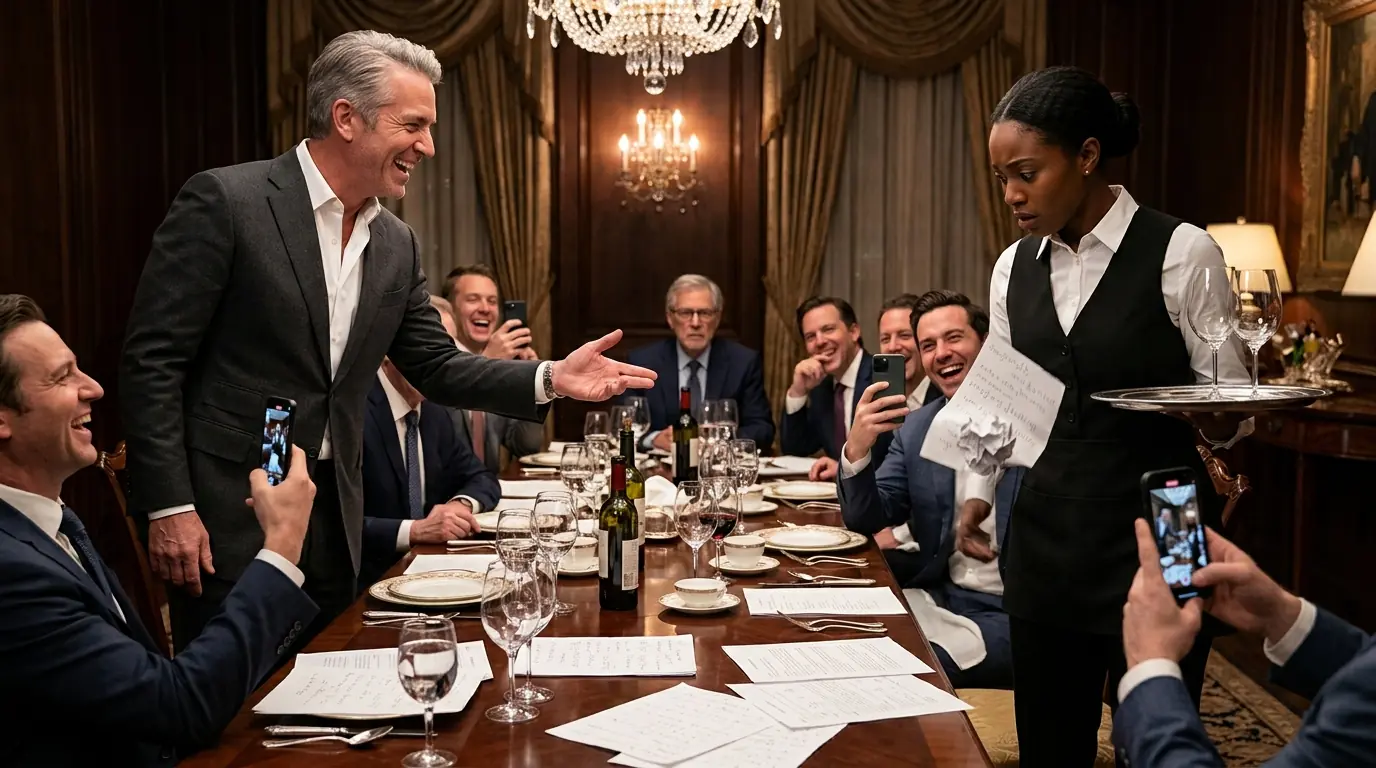
His eight guests laughed, several of them holding up phones and recording a young woman being belittled for their entertainment. Ivonne bent down and picked up the crumpled paper with shaking hands.
Sterling grinned. "I'll pay three million dollars if you can even read that. But you didn't finish high school, did you?"
"She probably thinks algebra is a pasta dish," someone said, and the table erupted again.
Then Ivonne looked at the equation. Her hands stopped shaking. She lifted her eyes to Sterling and opened her mouth.
Three hours earlier, Ivonne Brooks had pushed through the staff entrance of the Crystal Room at 6:30 p.m., just as she had every night for the past eight months. Eight months of being invisible.
The Crystal Room did not advertise because it did not need to. Its annual membership cost $50,000, and its waiting list included Fortune 500 CEOs, senators, hedge-fund managers, and founders whose names moved markets. This was where billionaires closed deals over thousand-dollar steaks, where power ate dinner, and where Ivonne served drinks and stayed quiet.
She showed her ID to security and headed toward the staff locker room while Vivaldi played softly through the hallway speakers. The music was classy, expensive, and somehow suffocating.
Locker 23. She spun the combination and opened the metal door.
Inside, folded carefully against the back wall, was a torn envelope from Cambridge University. She had kept the acceptance letter even though reading it hurt. PhD program. Pure mathematics. Number theory.
She used to look at it every day. Now she tried not to.
Beside it was a photograph of her younger brother Tommy grinning from a hospital bed three months after surgery, both thumbs raised, alive. The surgery had cost $183,000. It had saved his life and changed hers.
Ivonne closed her eyes and breathed. She was 28 years old. She had been six months away from becoming Dr. Ivonne Brooks, six months from defending a dissertation in one of the best mathematics programs in the world, when Tommy collapsed during a pickup basketball game.
The diagnosis was a rare autoimmune disorder. The recommended treatment was experimental and not covered by insurance. It was the kind of medical emergency that did not wait for a payment plan or academic calendar.
Cambridge paid her roughly $28,000 a year, a respectable graduate stipend and useless in a crisis of that size. Ivonne had made the choice in less than an hour.
Family first. Always.
The Crystal Room paid $45 an hour plus tips. Working doubles, she could earn close to $70,000 a year. In two years, if nothing else went wrong, Tommy's bills would be gone.
Maybe then she could return to Cambridge. Maybe.
But every month she spent away made Cambridge feel more distant, and the equations that had once filled her days began to feel like ghosts.
"Brooks, you're on Sterling tonight."
Ivonne jumped. Her manager, Dennis, stood in the locker-room doorway holding a clipboard.
"Private dining room. Eight guests. Very high-profile."
"Understood."
Dennis lowered his voice. "Ivonne, listen to me. Richard Sterling is difficult. He likes games. Challenges. Last month he made a busboy recite the Constitution for laughs. The month before that, he made a server solve a Rubik's Cube while balancing drinks."
Ivonne's stomach tightened.
"If he starts anything, stay professional. Don't engage. Don't react. Let him have his fun and move on."
Stay invisible. That was the rule. That was survival.
"Got it."
Dennis left. Ivonne turned back to her locker.
Tucked behind her uniform was a worn black notebook filled with equations. Her equations. Problems she worked on during breaks, in bathroom stalls, in the storage room when no one was looking. Even though she served champagne for a living now, her brain had never stopped working.
Modified Riemann-type variants. Elliptic-curve applications. Prime-distribution patterns. The beautiful, elegant world of pure mathematics, where arguments either held or they did not, where status could not make a false proof true.
She ran her fingers over the cover, then closed the locker.
Two minutes until her shift.
Ivonne smoothed her black uniform, checked her reflection, picked up her serving tray, and headed toward the private dining rooms.
The hallway outside Sterling's suite buzzed with confident voices. Ivonne could hear fragments through the door.
"I'm telling you, my R&D team has been stuck on this for over a year. Best PhDs money can buy. Still can't crack it. Ten million in costs and we're nowhere."
Ivonne's hand froze on the door handle.
R&D team. PhDs. Can't crack it.
She knew that language. It had once been her language.
She shook it off. Not her world anymore.
She knocked once and entered.
Eight men in custom suits sat around a table covered in crystal and fine china. Their wealth was the kind that did not need to announce itself. Richard Sterling sat at the head, silver-haired, mid-50s, his shirt open at the collar and his posture relaxed with the confidence of a man rarely told no.
Ivonne moved silently around the table, setting down the first course: seared scallops, microgreens, and gold leaf. The men barely looked at her.
She was furniture.
Sterling continued talking. "The problem combines number theory with cryptographic systems. It's the bottleneck in our new encryption platform. Solve that, and we're looking at a fifty-billion-dollar market."
A younger founder laughed. "So your company's future depends on a math problem nobody can solve?"
"Not nobody. Not yet." Sterling grinned. "I'm offering ten million dollars to whoever cracks it. Stanford's mathematics department is working on it. MIT consulted. Nothing."
Ivonne's hand trembled slightly as she set down the last plate.
Number theory. Cryptographic systems.
That was her dissertation field.
She steadied her breathing and backed toward the door.
"Will there be anything else, Mr. Sterling?"
He did not look at her. "We're fine."
She left, closed the door behind her, and leaned against the hallway wall.
Number theory and cryptography. The exact framework she had spent years developing at Cambridge. The work that should have made her Dr. Brooks.
Richard Sterling was sitting ten feet away throwing millions of dollars at a problem she might actually understand.
Might.
Ivonne pushed herself away from the wall. It did not matter. That was not her life anymore. She was a waitress. She served food, collected tips, paid bills. She did not solve billion-dollar problems.
She returned to the kitchen and picked up the second course.
When she entered again, the energy in the room had shifted. Sterling had papers spread across the table, dense with mathematical notation.
"This is it," he said to his guests. "This is the equation eating my budget alive. Eighteen months. Best team money can buy. Nothing."
Ivonne set down plates of duck confit. She tried not to look at the papers.
She failed.
From three feet away, she saw the structure and notation, the beautiful and terrible complexity of it, and her heart seemed to stop.
She knew this problem.
Not something similar. Not something close.
This exact framework combined a modified Collatz-type conjecture with elliptic-curve theory and a prime-distribution overlay. It was a variant of her thesis research, the work she had presented at Cambridge before she left.
She could solve it.
Sterling looked up and noticed her frozen in place. His eyes narrowed, then brightened with something cruel.
"Wait," he said slowly, smiling. "I just had the best idea."
Ivonne's stomach dropped.
The eight men turned toward her.
Sterling stood, papers in hand, smiling like someone who had discovered a new toy.
"This young lady has been listening to us discuss the most complex mathematical problem my company has ever faced." He gestured toward Ivonne as if she were part of the room's décor. "What's your name again?"
Her throat went dry. "Ivonne, sir."
"Ivonne. Beautiful name." His smile did not reach his eyes. "Tell me something. You've been serving us all night, hearing us talk about equations and algorithms. Do you understand any of it?"
Every instinct screamed at her to lie. Say no. Smile. Escape.
But she looked at the papers in his hand and the equation she recognized.
"Some, sir."
The table erupted in laughter.
"Some," Sterling repeated, savoring the word. "She understands some of it. Fascinating."
He walked toward her.
"Did you go to college, Ivonne?"