"You're nothing but a mistake your daddy made with a dead woman."
Monica shoves the young black boy against the church hallway wall. Her white gown drags across the floor.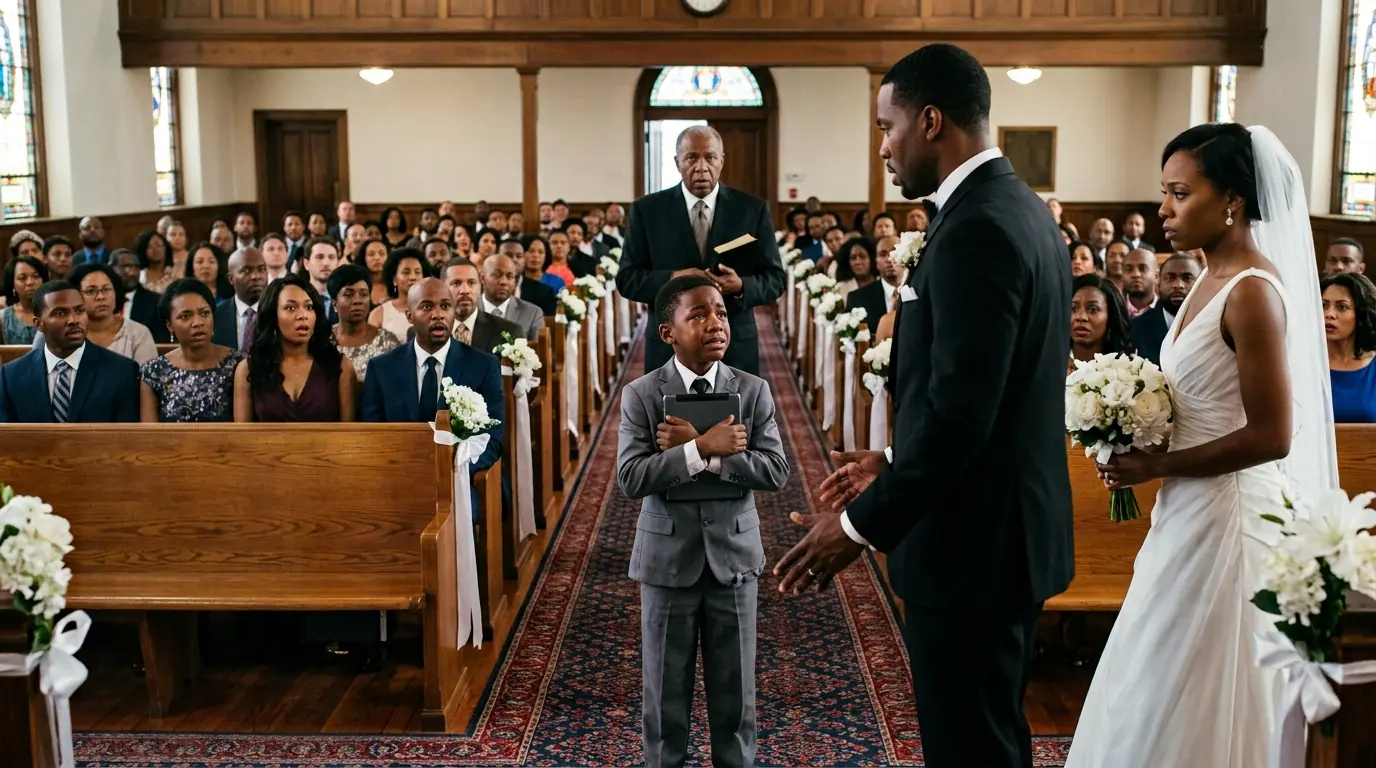
"I'm sorry, ma'am. I just—"
"Shut your mouth." Manicured nails dig into black skin. "30 minutes from now, your daddy belongs to me. His money, his house, everything your dead mother left behind. Mine."
10-year-old Will trembles. "Yes, ma'am."
"Once that ring is on my finger, you're gone. Boarding school, far away." Her lips brush his ear. "Your mama raised you weak. No wonder she's rotting underground."
Tears roll down the boy's face. He says nothing.
Monica smiles, walks toward the altar. Will stands alone, shaking.
Then his jaw tightens. His hand slides under his jacket.
30 minutes later, this black boy runs into his dad's wedding screaming, "Don't marry her!" What he showed next made his dad call 911.
The house on Maple Street sits in South DeKalb County, Georgia, where the suburbs fade into stretches of pine forest and red Georgia clay. Red brick walls, white wooden shutters, a magnolia tree in the front yard that blooms every April without fail, filling the air with sweetness.
Wesley Davis's grandfather bought this house in 1968. He was one of the first black men to own property on this street back when real estate agents still steered colored families away from certain neighborhoods, back when banks found reasons to deny loans to people who looked like him. He paid cash, $12,000, saved over 20 years of working two jobs. He didn't trust banks, didn't trust loans, didn't trust any system that could take back what a black man had earned with his own hands.
Three generations of Davis men have grown up within these walls. Wesley's father learned to walk on these hardwood floors. Wesley learned to ride a bicycle on this cracked sidewalk, his daddy running alongside him, hand on the seat. He kissed his wife Carolyn for the first time under the magnolia tree junior year of high school. Their son William—Will, everyone calls him—took his first steps on the same floors his great-grandfather laid by hand, board by board, in the hot summer of 1969.
18 months ago, those same floors held the weight of grief. Carolyn Davis lay in a hospital bed at Grady Memorial, room 414. The cancer had started in her lungs, spread to her bones, then everywhere else. Her hand felt like dry paper in Will's small brown fingers. The machines beeped their steady rhythm. The fluorescent lights hummed overhead.
"Take care of daddy for me, baby." Her voice barely rose above the mechanical sounds keeping her alive. "He's going to need you. Promise me."
Will nodded. He was 8 years old. He didn't cry. Not then. Not at the funeral 3 days later. Not when they lowered her casket into Georgia clay while the choir sang Precious Lord. He made a promise. And promises were sacred things.
After the burial, the house on Maple Street went quiet. Wesley stopped cooking the recipes Carolyn had taught him. Stopped laughing at the sitcoms they used to watch together. Stopped being the father Will remembered. Dinner became pizza boxes eaten in silence, the television filling the space where conversation used to live. Will did his homework alone at the kitchen table where his mother used to help him with fractions, her patient voice guiding him through each problem.
Eight months ago, Wesley started attending a grief support group at Ebenezer Baptist Church. The Davis family has worshiped there for 40 years. Baptisms, weddings, funerals—all the milestones of black southern life marked within those brick walls.
Monica Turner sat in the corner of the fellowship hall that first Tuesday night. Simple black dress, modest gold jewelry. Her eyes glistened when she spoke about losing her husband two years prior. She understood Wesley's pain. She said she knew what it meant to watch your whole world collapse and somehow keep breathing.
Wesley started talking to Monica after meetings. Coffee became dinners. Dinners became weekends. She laughed at his jokes. Really laughed. Head tilted back, hand resting on his arm.
Monica moved in 4 months later. She rearranged the kitchen cabinets. She replaced the old curtains Carolyn had sewn by hand. She put Carolyn's photograph in the hallway closet.
"Too painful for you to see everyday, baby," she told Wesley.
Will noticed things. Monica claimed she was an orphan: no parents, no siblings, nobody to invite to any wedding. She never mentioned her life before 2018. Her phone rang at odd hours. Wesley started complaining of stomach pains. Monica made him fresh lemonade every morning. "My grandmother's recipe. Drink up, baby."
Everything felt like healing until Will noticed what no one else did.
2:14 in the morning. The house sleeps.
Will wakes with his throat dry, tongue thick against the roof of his mouth. He slides out of bed and pads downstairs in bare feet, avoiding the third step from the bottom—the one that always creaks, the one his mother used to skip too when she came down for water in the middle of the night.
The hardwood is cool against his soles. The kitchen light is off, but a voice floats through the darkness: low, careful, secret.
Monica on the phone.
Will freezes at the bottom of the stairs. He presses his back flat against the wall, holds his breath until his lungs burn, makes himself small and invisible.
"Yes, this is Rachel."
Monica's voice sounds different. The warmth is gone. The honey sweetness has curdled into something hard and cold.
"The policy is still active, right? Good. Good." A pause. He hears her fingernails tap against the granite counter. Tap, tap, tap. "Don't worry, it'll be soon."
Will's heart slams against his ribs so hard he's certain she can hear it.
Rachel. Her name is Monica. Monica Rachel Turner, she told them once when filling out some form, but she never uses Rachel. Never introduces herself that way. Never.