In expensive neighborhoods where sidewalks are spotless and cars park themselves without being told. Silence isn't absence, it's curation. The jewelry store on the corner of 18th and Northbridge didn't try to impress. No signage, no music, no slogans. The glass door was so thick it seemed to erase itself.
Only those who'd been inside before knew where to press. Celeste Vaughn stood in front of it at 10:01 a.m. She paused just long enough to see herself reflected, not to fix her hair, but to confirm she was still herself, even as she was about to enter a space that refused to say her name. She exhaled softly, then placed her hand on the cold handle. Inside, the lights were already on.
The space felt freshly wiped. Everything was cleaned so thoroughly that it could erase a person's presence if they didn't leave sound behind. At 10:02 a.m., the door parted, and Celeste stepped inside without asking permission. It was quiet enough to tilt the room off its axis. Celeste Vaughn entered the store at 10:02 a.m.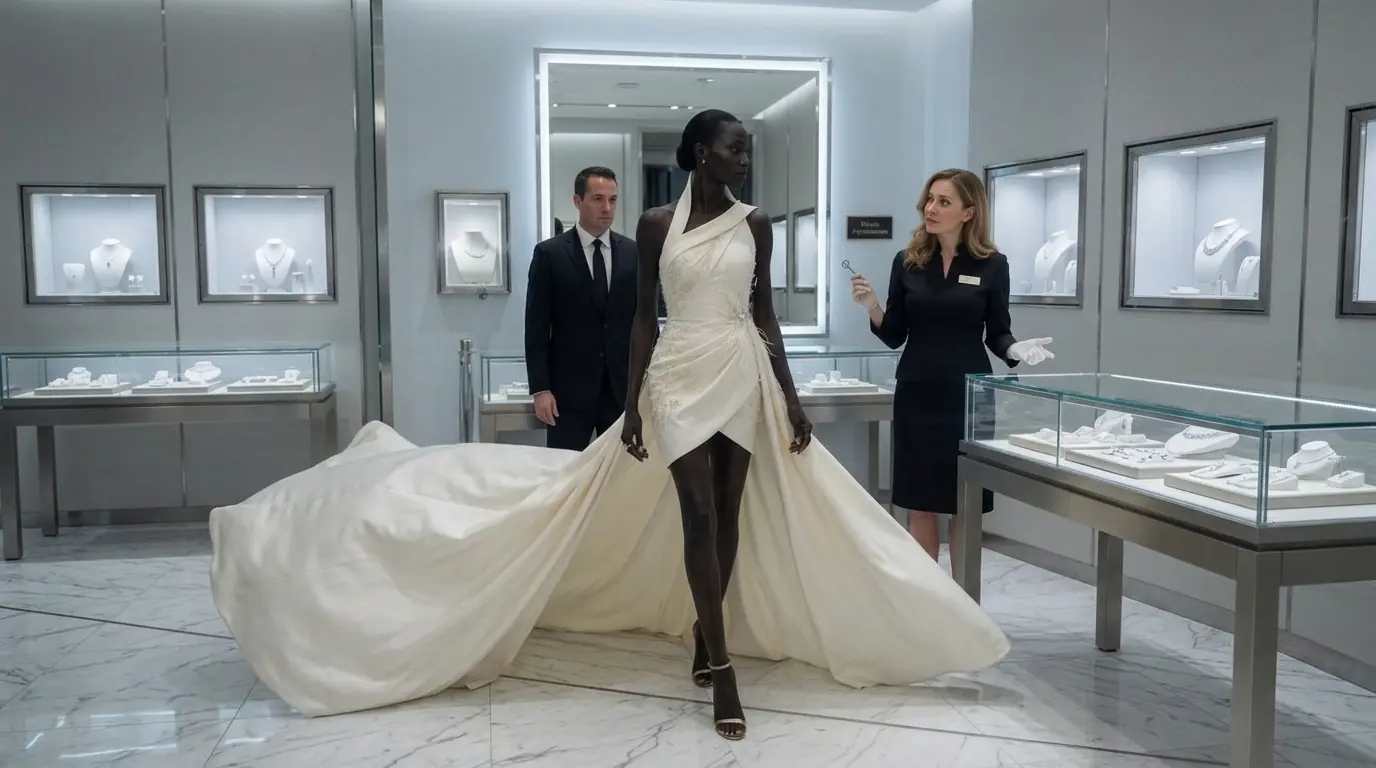
She was neither late nor early, just precise enough for her presence to interrupt everything people assumed was orderly. The glass doors slid open, exhaling the sterile scent of air conditioning and over-sanitized surfaces. It was a cold smell—not the chill of winter, but the chill of places where randomness has no invitation. Her heels struck the floor. Click—a clean, decisive sound, a single note—but it echoed across the pristine white space like a wrinkle in freshly changed bed sheets.
The marbled tiles shone so brightly they mirrored the hem of her dress, drifting like soft waves in a frozen painting. She wore a beige silk dress, the kind most assume only flatters white skin. On Celeste, it didn't merely fit. It challenged. Not out of place, just too natural to be accepted.
Her hair was tied in a low bun, exposing her neck, smooth, straight, and bare like a space waiting to be colored in. The overhead lights spilled across her nape with a cold, indifferent glow. But when they touched her skin, the light recoiled, altered, as if reconsidering itself. To the left of the entrance, a security guard in a black suit and gray tie leaned against the wall with the posture of someone too familiar with being surplus. He looked up at the sound of her heels.
A glance, then a retreat, then a return. Not entirely intrusive, not quite admiring, more like desire. Restrained by social position, she didn't look back, but she knew. Her posture shifted: chin raised, spine lengthened—a reflex born not of pride, but of necessity. At the center of the store was a U-shaped glass counter diamonds laid out like tiny blocks of ice, waiting to be exchanged for six-figure sums.
White women often entered the space with wedding rings already in place. Celeste wore none, but she wore presence, an accessory that came without a price tag. Behind the counter, a white woman wiped the glass with a gray microfiber cloth. Her movements were slow, steady, precise, as if trying to erase some invisible smudge that had just dared appear. Clara Wittman's small name tag was affixed just above a fading coral lipstick stain.
Clara looked up and saw Celeste. A breath caught for a beat. Not shock—she had seen Black women before. Not fear—there were cameras and a guard. Just discomfort, the kind born when someone crosses a line without asking.
Clara smiled, a trained smile soft at the lips, rigid in the eyes. Good morning. May I help you with something? Celeste didn't answer immediately. She took a few more steps, slow, firm, as if each one denied the unspoken assumption.
I did not come here to ask permission to exist. Her hand brushed her neck a small gesture, almost instinctive. But Clara noticed that space where a silver necklace should have hung bare, but not empty. Celeste's scent wood and bitter orange leaked into the cold air, shifting the room's temperature half a degree. No one could accuse her of anything.
But something had changed. Clara frowned slightly. Was it the smell or the posture? Straight, grounded, unapologetic. She glanced down at Celeste's shoes, heels not new, but clean and shaped.
Her dress was elegant enough but not showy. Hair, no visible sign of salon work. No designer bag, no jewelry, no clues—nothing clear. And that alone was a threat. Celeste stopped three steps from the counter.
Her gaze made a slow circuit from the gemstones to the ceiling lights, then landed squarely on Clara's face. " Can I help you?" Clara repeated, voice slightly tighter. Celeste looked down at a necklace in the case. Fine chain, heavy clasp, feminine enough to seduce, sharp enough to cut.
Her shoulders straightened. It was as if a gust of wind had nudged the store off its axis. Celeste didn't look up. Her fingers hovered above the glass. Soft as if testing water before deciding whether to enter.
Silence isn't absence. In places like this, it's a way to see who will yield first. This one. I'd like to see it. Her voice was soft, unclear whether it was a request or a command.
Clara Wittman unlocked the glass case with a small key attached to a pale gray ribbon. Her hand didn't tremble, but she held the key a bit too tightly. " Of course," she said. Clara picked up the necklace with a small wooden clamp, handling it more like a specimen in a lab than a piece meant for a customer. " This is our new Aurora model: 18-karat natural diamond, sourced from Canada."
She spoke like a machine, each word trained and filed through a "Communicating with High-End Clients" course. Celeste Vaughn reached out to take it, but Clara stepped back half a pace. Ma'am, if you'd like, I can put it on for you. The sentence was spoken gently, but the backward motion made it feel like a velvet covered barricade. Celeste smiled.
No teeth, just the tilt of a lip. A river that appeared still but ran backward underneath. She turned around. All right, I'll let you put it on. Clara stepped forward, gloved fingers brushing against the warmth of Celeste's neck.
The skin was warm, smooth like the surface of living metal, and that was precisely what made Clara uneasy. She clasped the hook with excessive care, as if the necklace might discolor if placed on the wrong skin. Celeste stood still. Her eyes caught the mirror across from her. It wasn't a large mirror, just wide enough to catch her collar bone, neck, and the necklace.
But in that narrow frame, she could see everything Clara was thinking without a single word spoken. " Looks lovely," Clara offered, adjusting her tone. " Jewelry really suits that kind of warm skin tone." Celeste turned around slowly. " You think I have a warm skin tone?"
Her voice was smooth like Italian leather, but cool like marble. Clara hesitated a beat too long. " I mean, your skin is quite unique. That caramel-golden tone is rare among people like me." Celeste tilted her head.
A silence followed, as long as the echo of a dropped clock no one dares pick up. " I'm sorry if my words were misunderstood," Clara replied, but her voice had already dropped an octave. Celeste didn't answer. She looked back into the mirror. The necklace rested perfectly on her collarbone, as if it had always belonged there.
But the mirror didn't just reflect jewelry. It reflected the struggle for control. Who wanted to steer the conversation? Who wanted to reclaim the balance? Clara tried to reset the rhythm.
Do you have a special occasion today? Birthday anniversary. We have a more exclusive collection in the back if you'd like. Celeste turned fully toward her. " No occasion."
She touched the necklace lightly. " I'm not buying this for a reason. I'm buying it because it's beautiful and because I can." Clara smiled, but her cheeks didn't lift.
Of course. I just want to make sure I show you something appropriate. " Appropriate," Celeste repeated. Tell me, which collection do you think is appropriate for me? The question wasn't loud, but it lingered like a small bell ringing in an empty cathedral.
Clara looked around, searching for an escape. No other customers, no music playing, just mirrors, lights, and a truth so bright it outlined every vein on her face. Celeste unclasped the necklace. May I see the back collection? Clara stiffened.
That collection is limited edition, ma'am. Usually reserved for clients with prior appointments or long-term purchase history. Celeste placed the necklace on the counter. The light struck the glass in such a way it looked wrinkled like skin about to be cut. You were about to ask if I have financial proof, weren't you?
Her voice dropped a tone, the kind of tone that knocked softly before forcing the door open. Clara swallowed hard. Of course not. I didn't mean Celeste looked her straight in the eye. Don't worry.
I'm used to being doubted before I'm served. She smiled again. But the funny thing is, even with all these cameras in your store, people always forget that their gaze gets recorded, too. Some mirrors reflect faces, some reflect intentions, and some people, like Celeste Vaughn, are both. Clara smiled, but her cheeks didn't move.
The smile stayed in place as if strapped to her evenly white teeth. " Let me check the system for a moment. The back-room collections are usually presented during private appointments to long-term clients." She tilted her head slightly in a gesture meant to signal empathy, but her eyes still scanned not Celeste's collar or clothing this time, but the blank space where information should be, as if searching for an invisible profile. Celeste didn't nod, didn't protest.
She just looked, not a sharp look, but one you couldn't slip away from. Clara stepped back and turned to a small computer behind the counter. Her fingers typed quickly, but her eyes never left the screen as if she were waiting for the data to confirm the assumption her mind had already made. " Have you made purchases at any of our branches before? I can look up your account."
Celeste leaned in, resting her elbow on the edge of the glass. No need to check. Her voice was soft, but it echoed like a spoon striking the bottom of a porcelain cup. I've never bought anything here. Clara's hands paused.
The smile withdrew half a millimeter. " Well, then I'm sorry. Some of our collections are only available for verified account holders. But I'd be happy to show you the classic line. It's 15% off today."
Classic on sale. Each word dropped like water from a leaky pipe. Slow, insistent, impossible to ignore. Celeste closed her eyes for a second, opened them.
She wasn't angry. Anger was a privilege people like her couldn't afford to wear inside places like this. She looked past Clara toward the back where a small door stood shut. No signage, just a silent camera in the upper corner of the ceiling. That door wasn't locked with a key.
It was locked by belief. Belief held by people like Clara that no one like Celeste would ever come knocking. You say you're sorry, Celeste began. But I don't think what you're sorry about is the lack of an account. She tapped the glass counter lightly.
I think you're sorry that I walked in unannounced, that I left no trace ahead, that I wore nothing your eye could file away safely. Clara stood straighter. " No, you've misunderstood. We don't discriminate here. Our policies apply equally to all customers."
All Celeste repeated. The word hung in the air like a coin spinning on a countertop, still upright, undecided. Clara glanced at the security guard standing to the left. He remained silent, hands now clasped in front of his waist, a gesture learned in training.
Stay quiet when the customer is female, but stand ready if things seem unusual. Celeste looked directly into Clara's eyes. Do you really believe discrimination only exists in words? Clara didn't respond.
Her eyes blinked rapidly for the first time. A small sign, but truer than any corporate apology. Celeste placed her hand on the necklace still lying on the counter, unchosen, unclaimed, but clearly aware. " This piece—it is beautiful," she said, almost in a whisper. " Yes, absolutely."
Clara nodded quickly. " It's one of our newest designs. Delicate, feminine, and perfect for—" "For whom?" Celeste cut in.
Clara swallowed. The question didn't need an answer. Celeste smiled for the first time. A real smile. Not because she was amused, but because this scene had become so familiar.
It was almost comedic. Some things don't sit inside glass cases, and some cuts don't bleed, they echo. The door chime rang a small ding, just loud enough to register, just soft enough not to disrupt the purity encased in glass and light. Celeste Vaughn didn't turn around. She didn't need to.
She knew that chime, the kind engineered to sound only for those worth noting, not for those merely interrupting the system. The woman who entered carried the sound of hard heels measured even precise to the half second. Each step declared without language I belong here. Champagne colored wool coat. A loosely knotted Hermes scarf.
Platinum blonde hair smoothed back. Light didn't reflect off her. It obeyed her. She didn't look around. She didn't hesitate.
She moved as if the space had been measured and laid out to her specifications. No scanning glance like the one Celeste had drawn when she entered. She didn't need to. Behind the counter, Clara came to life as if a switch had been flipped. Her facial muscles relaxed, her lips opened into a silver metal smile, polished, symmetrical, certified.
Mrs. Blackstone, I was just talking about you yesterday. Her voice gained rhythm, emphasis like jazz notes hitting their proper chord. Clara, you never forget, said Mrs. Blackstone, her voice of velvet soaked in waxed warmth. " Anything new today?" " Yes, I've saved something just for you.
I didn't even display it. Baguette-cut diamonds. Platinum, 18-carat, limited edition—it arrived two days ago." She bent down to open the case swiftly, effortlessly, as if she had never hesitated to do the same with the Black woman standing three steps away. Celeste remained silent.
Her hand rested on the glass, not from fatigue, but because the cold beneath her palm felt familiar, transparent, rigid, unfeeling. Mrs. Blackstone leaned over and lifted the ring with two fingers. She didn't try it on, didn't ask the price. She only needed to feel the weight of ownership in her palm. " How much?" "
$47,000," Clara replied like she was quoting the cost of afternoon tea. " Mm. Send it to the usual address. You still have my size, don't you? Of course.
I've kept your record since last year. Still a 5.5. Correct?" " That's right." Clara bowed slightly, scribbling notes.
Mrs. Blackstone turned noticed Celeste for the first time, but her gaze paused only a fraction of a second. No surprise, no curiosity, no greeting, just the trained glance of someone taught to scan, but not stop unless the face is familiar enough to echo their own. " Anyone else in the store?" " Just one guest browsing," Clara answered without glancing in Celeste's direction. The word guest floated in the air like a misused variable visible on paper, but uninvited in the context.
Celeste didn't react. She simply stood. Stood like a rest note in a symphony playing the wrong song. She was not a character in this conversation. She was the air edited out.
Clara turned again, her gaze brushing Celeste's face like light against stone, aware of the presence, but unwilling to stop. Celeste lifted an eyebrow. Subtly, no accusation, no suggestion, just a question asked without a sound. Clara dodged the look by lowering her head to sign the order form. The fountain pen spun slightly off center in her grip.
Her hand trembled, not enough for a customer to notice, but just enough her conscience to tilt the script. " Will it be delivered this afternoon?" Mrs. Blackstone asked. " Yes, I'll personally call the courier." Celeste looked down at the necklace still in the display case before her.
It remained there like evidence in a dialogue no one had logged. No one had spoken to her. No one had asked her to leave. No one had done anything wrong. And that was the most wrong thing of all.
In some places, you don't need a sign that says, "We discriminate." They use speed of service and selective gaze sharper than any spoken word. The door closed behind Mrs. Blackstone with a hush so thin it felt like undusted air. The room remained cool. The lights still white, but something had dropped out of the atmosphere, a missing breath, like background music fading without warning.
Clara stood motionless behind the counter, holding a receipt, but offering it to no one. In front of her, Celeste still stood silent, unmoving. She hadn't said much all morning, but her presence had cracked the room open like a hairline fracture across glass, the kind no one notices until it's already halfway through. It took Clara 13 full seconds to remember Celeste was still there. And in a luxury store, 13 seconds was all it took to reveal who was prioritized and who was simply an interruption.
Clara stepped out from behind the counter, adjusting her slightly askew name tag. The smile returned not out of sincerity, but survival. It was a reflex trained to activate even when the heart wasn't aligned. " Are you still here?" she asked. It wasn't really a question.
More of a polite cloak for discomfort. I'm sorry I didn't assist you more earlier, she continued. She's a longtime client. I had to move quickly. Celeste turned her head.
Her eyes met Clara's not sharp, not accusing. But enough to let Clara know she was being watched, not forgiven. " Would you like to see anything else?" Clara asked, voice lower now. " I could show you our elegant line very fitting for your style."
Celeste didn't answer right away. Instead, she looked down at the glass case where the necklace still lay, silent as a witness too aware to speak. She reached for it, lifted it gently, let it catch the light. Teardrop cut, precise, cold, like the chapters of history this society prefers not to revisit.
Clara inched closer. Her hand fidgeted with the silk scarf around her neck, a small gesture, but it betrayed the unease that hadn't found a place to hide yet. " Would you like to try it on again? I can assist," she offered. Celeste placed the necklace back down carefully, exactly where it had been.
Then she spoke, just one line: "I don't need to try on something to know it was never made for me." The sentence fell like a judge's gavel on a courtroom desk. Not loud, not final, but unmistakably decisive. Clara opened her mouth, ready to say something, an explanation, a correction. But there were no words fit for this moment.
No training manual prepared her for the feeling of being seen through every layer of curated politeness. Celeste stood tall, turned slowly. No backward glance, no rush. Her heels tapped against marble like a countdown to something unspoken yet universally heard. She reached the door, paused.
Her hand rested for a moment on the stainless steel handle, cold, round, and smooth, much like the world that had greeted her for years. Not sharp, not direct, but polished and refusing. Then she pushed. The bell rang for the third time that morning. And for the first time, the entire room truly fell silent.
Not every customer leaves a store with a shopping bag. Some, like Celeste Vaughn, leave carrying the truth of place worked so hard to soften out of sight. The door closed behind Celeste with a sound so soft it might as well not have existed. But she heard it, not with her ears, with a bodily reflex honed over dozens. Hundreds of exits through doors never designed to welcome her.
Her spine straightened slightly as the street wind touched her skin, a reminder, welcome back to reality, where at least people don't pretend to smile while excluding you. Her heels struck the pavement with a gentle even rhythm. Her footsteps merged into the city's soundscape, a distant car horn, the wind brushing tree trunks, a half-finished phone call in French from the cafe across the street. Everything went on as if she hadn't carried anything out of the store. But she knew some things don't go in bags, yet weigh just as much as memory.
The black SUV was parked at the end of the block. She unlocked it remotely. The lights blinked twice, silently, confirming, "Still here." Still waiting, not like the rest of the world. She stepped in, closed the door, and in that instant, the sealed cabin created a vacuum.
Not silence, but a kind of pressure the weight of things never said, never acknowledged, but always present like dust in an air vent. Celeste didn't start the engine immediately. She sat still, one hand on the wheel, index finger tapping lightly on the leather wrap. Her eyes stared through the windshield, but her focus drifted as if her vision were swimming across layers of time. A store in Atlanta, 2009: She had worn a borrowed blazer from her cousin, walked in to buy a leather wallet for her father.
The clerk followed her across four aisles, saying nothing, but the footsteps made intentional noise. Then came the question, "Are you looking for something within your range?" That sentence swept away all previous pleasantries like a broom across a showroom floor. She didn't respond. She had walked out as if she lacked reason to remain.
She used to think, "Once I succeed, it'll be different." Black card in her wallet, luxury car outside, English enunciated to perfection. But today, Clara Wittman had proved otherwise: sometimes prejudice doesn't check your bank account. It sees straight through you and finds what it's been trained to fear. Celeste tilted her head, leaned back into the seat.
Her neck touched the cold leather, a sensation both familiar and strange, like an embrace from a family member you're no longer sure still loves you. A child ran past the hood of her car. Black boy, about eight, in a red hoodie, dragging a backpack half his size. His mother, white, blonde, thin, wearing dusty shoes, laughed with him. A genuine laugh unobserved.
Celeste watched them like someone who had just glimpsed a map to a place she was never invited to. She wasn't envious, just reminded that maybe she too might have had a childhood like that if history hadn't misspelled her name. She adjusted the rear view mirror. Light angled across her eyes, but the pupils seemed stained with a different hue, the shade of prolonged awareness. No one called, no one texted, no one asked, "Are you okay?"
Because this world had grown used to letting people like her rebalance themselves after every deliberate nudge. Celeste started the engine. The hum rose evenly. She drove off the block as if nothing had happened. But in the rear view mirror, Clara's face remained not as a reflection, but as a residue of emotional memory, the measuring gaze, the sugar wrapped phrases, the elegant rejection.
Some doors appear to open, but only those who've been pushed out know where the hinge really is. Clara Wittman stood behind the counter, hands clasped in front of her stomach. Not because she was cold, but because she didn't know where else to put them after a situation not listed in the training manual. She'd been doing this job for 8 years. Six of them at this flagship store, where every pane of glass was wiped on schedule, where every greeting followed a softened script.
Here, everything was clean, organized, predictable, white. Mrs. Blackstone had left. The ring had been purchased. Delivery arranged within 24 hours. Nothing went wrong.
No complaints, no yelling, no scene. And yet Clara remained frozen as if she just made a mistake that had no name. She looked up at the security camera upper right corner of the ceiling, aimed precisely at the front counter. The tiny LED was still red. The feed was still rolling.
But Clara knew something had been recorded today that the camera would never catch. She began to wipe the glass. A habit, something to reclaim a sense of control. Spray bottle, microfiber cloth, circular motion, even pressure. Her hand stopped when she saw it.
A faint fingerprint, possibly Celeste's right at the spot where the necklace had been. It wasn't clear, but it was real. Light so light, as if the one who had touched it knew they weren't allowed to linger. Clara froze, cloth still in hand. She didn't wipe it away.
She just stared. She didn't do anything. Didn't shout. Didn't accuse. Didn't demand a manager.
She only left one sentence drifting like wind across the tight bun of Clara's hair. I don't need to try on something to know it wasn't made for me. A sentence with no blame, no attack. A sentence Clara still couldn't bring herself to admit was directed at her, but it stayed lodged in her throat like a crumb that refused to swallow. Clara wanted to believe she wasn't biased.
She had black friends. She had once supported Black Lives Matter that month, that year, when the whole company changed its profile photo to a black square. She had cried watching Selma. She had said, "Ma'am," to black customers, even though she never remembered their names. She had said, "I'm just following protocol."
As if protocol weren't a crack polished over with polite language. She walked into the staff break room. She brewed coffee. Her hand trembled slightly as she poured water into the machine. She sat down, opened her phone, typed.
Unconscious bias in customer service, not to learn, but to look for ways to forgive herself. She scrolled articles, videos, infographics. None of them said, "If you've ever quietly withheld service from someone who did nothing wrong, who does that make you?" No quiz could measure the part of Clara that had been touched this morning. The part that believed politeness could cover any void.
Not all who discriminate hate you. Some are just afraid that you exist without asking permission. Celeste Vaughn parked her car outside the St. James and Meridian Tower, a financial firm founded in 1911, an old name with a periodically refreshed facade where floor tiles might change. But the foundation never did. She had been here dozens of times.
As a strategic consultant, a role with influence, but always on the periphery of decision-making. She wasn't a shareholder, not a director. She was a respected woman of color, a label the press used when they wanted to seem colorblind. She entered the elevator with her scuffed badge card, stone-blue blazer, and silk-gray tie pulled taut. No bold makeup, low bun, eyes shadowed with the cool sheen of someone who had learned that softness is the first thing crushed in a boardroom.
23rd floor. The hallway glared with LED lights, harsh and clinical. Black leather chairs, dark wood flooring, a coffee machine that never stopped. Everything here was designed to feel decisive, transparent, clean, and exclusive. She opened the conference room door.
Inside, 11 people were already seated. Eight men, three women, eight white, three nearly white. She was the only one without European lineage, and the only one whose name hadn't been called. " Great, we're all here," the assistant announced, voice crisp. " In attendance, Mr. Langford, Miss Jenkins, Mr. Price, Mr. Yates, Miss Koulson."
The list continued. At the very end, as an afterthought, came, "And Miss Celeste Vaughn, strategic adviser." The assistant's voice hesitated half a beat at her name. She recognized that pause.
It was the kind reserved for names not born of their legacy. Celeste nodded slightly, sitting at the far-left seat near the projector. She always chose that spot close enough not to be forgotten, far enough not to be called on first. The presentation began.
PowerPoint slides fired like bullets: market forecasts, charts, logistics costs, personnel projections. She listened, took notes, waited for the moment. When the CFO got to Southeast Asia shipping costs, Celeste raised her hand. " Excuse me," she said, voice level. " Does that figure account for the new customs law changes in Indonesia?"
Heads turned, a salt and pepper-haired man frowned. Another executive raised an eyebrow. A young woman smirked like Celeste had asked something naive. " Ah, we haven't updated for that yet," the CFO replied. " We're not sure how significant the impact will be."
Celeste nodded. " In my view, at least an 8% increase. If we don't adjust this quarter, next quarter, we'll need to cut personnel to cover the loss. Silence. Three seconds.
Four. Then the chief executive laughed lightly. Very pragmatic. Thank you, Miss Vaughn. She didn't smile back.
She hadn't come to impress. She'd come to reveal blind spots. Afterward, her slide deck opened. No graphics, just one line of title. The financial ecosystem after the age of humanitarian risk.
A topic no one wanted to touch and everyone needed to hear. She spoke slowly, word by word. No drama, no fire, just data, evidence, and a quiet warning that profit cannot outrun ethics forever. That even the greatest financial systems collapse not from war, not from crisis, but from the cost of corroded trust left unpaid. The room held still.
One person coughed, another smoothed their phone screen. A third nodded along without listening. No objections, no questions. She was used to it. Her best words always reappeared later, quoted in internal reports, newsletters.
But inside the room, they were just air. The meeting ended. Hands shook, and polite goodbyes followed. See you next week. Celeste packed up her laptop, buttoned her cuff.
She looked down at the polished mahogany table. Nothing wrong, no one wrong, no one right either. Just the sense that she'd walked through a white field left footprints, but made no sound. In the elevator mirror, her face was clear, high cheekbones, deep set eyes, hair neatly tied. The reflection showed polish, but not what was missing.
Acknowledgement. Presence alone doesn't make you belong, especially in rooms that already decided who counts as air and who deserves the light. The cafe sat tucked in the corner where 42nd Street met Vine Avenue. Not fancy, not flashy, just quiet enough to sit alone without being disturbed. Celeste stopped by after the meeting.
She wasn't hungry. She wasn't thirsty, but she needed to pause the way someone might place a hand over their chest just to make sure they're still breathing. She chose a table by the window, pulled out the chair, sat back straight, purse on the right, a familiar ritual. A choreography of self-defense sharpened in her 20s. Walking alone into white public spaces, she ordered a single espresso, no sugar.
The server was young, dyed ash gray hair, a nose ring, tapping her order into an iPad. No suspicion, no warmth, no smile. She looked outside. The intersection churned with movement, people chasing time. A white woman pulled off her mask mid yawn.
A man in a charcoal suit hustled past, gripping a laptop. A small boy lugged a backpack twice his size. The world moved. Colors distributed evenly. But Celeste still felt like the one misaligned pixel in the picture.
Three people entered. Two men, one woman. Loud laughter. They scanned the room. One of them spotted Celeste.
They paused, then redirected to another table. No words, but the motion was enough to make her sit half an inch straighter. Her espresso arrived, no greeting, no smile, just the gentle clink of cup against wood. She nodded as thanks. The server walked away briskly, as if she'd left no imprint in his field of vision.
She took a small sip. The coffee was bitter, faintly burnt, strong, but it did nothing to ease the acrid tightness in her throat from earlier that morning. At the next table, a young couple discussed their vacation. Iceland, the northern lights, cheap airfare deals. Their voices were bright, unburdened.
Celeste had once had conversations like that back when she lived in Portland. Before she understood that freedom of speech wasn't built for people like her, at least not in the house of innocence. An older woman walked past her table, her eyes swept across Celeste just one second, then dropped to her purse, then moved faster. Celeste wasn't insulted, wasn't cursed at, wasn't asked to leave. But all those things that didn't happen, she would remember them.
There are places where they don't push you out. They just make you feel like you should go. Celeste took another sip, then checked her phone. No new texts, no urgent emails, just a notification from her investment app. Your portfolio is up 2.3%.
She smirked. Success didn't bleach her skin. Money didn't mute the algorithm inside every trained gaze. She stood up, left the espresso unfinished. The chair hardly moved, but the outline of her presence lingered on the seat, in the waiter's glance, in the tension that still clung to the air around her table.
Outside, she took a long breath, not to cleanse, to confirm. I'm still here. I'm still alive. And I'm still the only one in the frame no one wants to name. Not all wounds need a voice.
Some cuts speak loudest by simply existing. Late afternoon. Sunlight stretched thin like a damp towel. Quietly folded by the invisible hand of the city. The sun didn't set.
It retreated. As if it knew there was nothing left today worth witnessing. Celeste Vaughn stood at the edge of the underground parking lot where fluorescent light bounced off concrete floors painted the faded green of old hospitals. The air smelled of AC dust and recycled metal, a place no one lingered, but just long enough to feel like you were still moving, even if only between levels beneath the surface. She pressed the elevator button.
The round light glowed a muted red like the last amber of a cigarette. No one finished. In her mind, the morning meetings replayed every glance, every nod, every shoulder tap disguised as collaboration. She remembered the boardroom lights, the faux attentive faces, and the CFO's gentle table tap announcing, "Everything's under control. The elevator arrived.
The doors opened with a soft ping, a manufactured friendliness, like a greeting programmed for everyone and meant for no one. Inside stood a young Black boy, 11, maybe 12, dark gray hoodie, sagging backpack, worn-down high-tops. He stood by the mirrored wall, hands in his pockets, eyes not on her, but not avoiding either. Celeste nodded slightly. He didn't respond, but the air in the elevator shifted.
Not colder, not warmer, just more honest. The elevator began to move. Each floor passed with a soft click. Tick, tick. Like a small sound in the chest of someone still uncertain.
No music, no safety message, just silence engineered to keep you upright without questions, without speech, without thought. Celeste glanced at him. Tight curls, shoulders not yet broad, eyes the color of damp earth after rain. He looked down at his shoes, then flicked a glance at her. Quick, but not dismissive, as if he were asking something language couldn't hold.
Have you made it past this place? Really made it out? Or are you just circling the lit floors of a basement? No one escapes. She didn't answer, didn't smile, didn't furrow her brow.
She just breathed like someone who survived a fire and still smells smoke every morning. The doors opened. B2—darker, colder, a place frozen at the temperature forgotten decades. She stepped out first. He followed.
There were no words, but the sound of their steps didn't echo; it only whispered like wind brushing through coat seams. Celeste found her car, opened the door, sat down. She looked into the rearview mirror. The boy was gone, but his presence lingered a black dot moving through a white maze, leaving no footprints, but asking all the right questions. She turned the key.
The engine came alive. GPS lit up. Destination home. But she knew sometimes home was just the place where no one says your name correctly. She looked back once more.
She didn't see the boy, but saw herself at 12 years old, hoodie zipped, backpack heavy, standing in a silent elevator next to an adult who said nothing. Back then, she had thought, "One day I won't see this anymore." And now, 30 years later, she still did—still standing in elevators, still wearing coats, still waiting for doors to open. And she understood. There are places where you no longer get stopped because you've already learned how to stop before anyone has the chance to raise their hand.