"Hey, mop boy. Move your ass. You're stinking up my lobby."
Bradley Thornton shoved past Fletcher Davis and wrinkled his nose. "Smells like a dumpster in here. That you, janitor?"
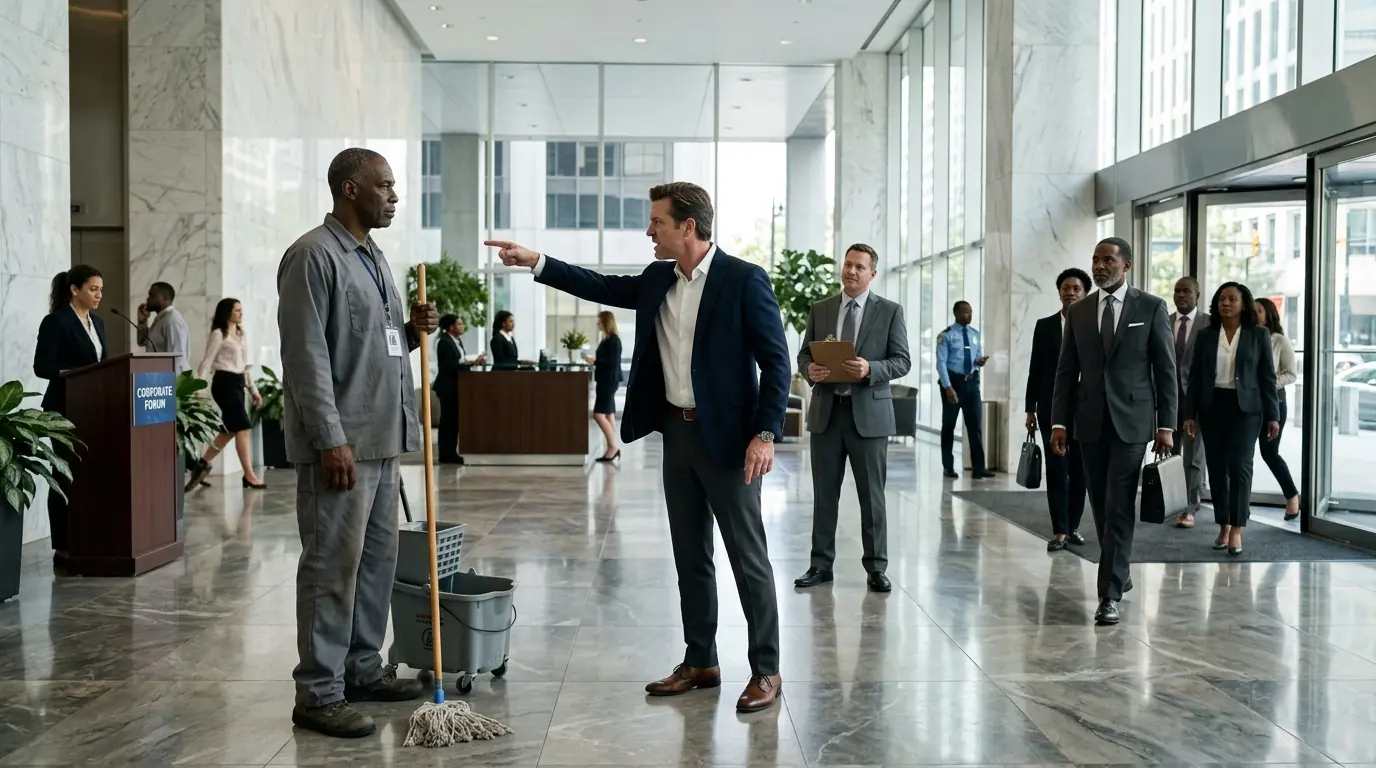
Fletcher kept mopping, silent, eyes down.
"Look at me when I'm talking to you, dog." Bradley snapped his fingers an inch from Fletcher's face.
Craig Ellsworth strolled over, laughing. "Where'd they dig this one up? Smells like he slept on the street."
"Probably did." Bradley kicked the mop bucket hard enough to send dirty water across Fletcher's gray uniform. "Clean it up, trash. That's all you're good for."
Fletcher's knuckles went white around the mop handle. His jaw locked, but he kept working. Not one word.
The man they had just called trash was not who they thought he was. Not even close.
Three weeks earlier, Fletcher Davis had been sitting in a corner office on the forty-second floor of Pinnacle Industries headquarters in downtown Atlanta. Floor-to-ceiling windows opened onto a skyline that seemed to stretch beneath him like proof of everything he had built. In many ways, it was.
Pinnacle Industries was worth $14 billion. Real estate, technology, infrastructure, logistics. Fletcher had built it from nothing, beginning as a kid from public housing in Savannah, Georgia, who earned an engineering scholarship, slept in his car for two years, and turned a one-room logistics startup into a Fortune 500 empire.
The wall behind his desk told the public version of the story. Magazine covers from Forbes, Bloomberg, and Black Enterprise. Awards from the Chamber of Commerce, the Urban League, and three different governors. A framed photograph showed him shaking hands at the White House.
That morning, none of it mattered. On his desk sat a forty-six-page report containing anonymous complaints from janitorial and maintenance staff across Pinnacle properties. Racial harassment. Verbal abuse. Wage theft. Hostile working conditions.
Some complaints were three years old. Every one had been buried by middle management. Not one had ever reached Fletcher's office.
He read every page twice. His coffee went cold. His assistant knocked three times, but Fletcher did not answer.
One property kept appearing in the report: Pinnacle Tower, the company's flagship property in Atlanta's Buckhead district. Forty stories of glass and steel, home to technology firms, law offices, and Pinnacle's own regional operations. It was supposed to be the crown jewel of his empire.
The man running it was Bradley Thornton, regional property manager, twelve years on the job, and a man who had never once met Fletcher face-to-face.
Fletcher closed the report, picked up his phone, and called Raymond Cole, his chief legal counsel.
"Ray, I need you to do something for me," Fletcher said. "And I need you to keep it between us."
That same week, Fletcher walked into a small apartment across town with no driver and no security detail. Raymond had arranged for a discreet consultant to help him construct a simple cover identity. Fletch. No last name needed. A janitorial resume with work histories at two cleaning companies that no longer existed. Nothing fancy and nothing that invited questions.
Fletcher applied through the third-party cleaning contractor that serviced Pinnacle Tower, not Pinnacle Industries directly. That distinction was part of the problem. Pinnacle Tower did not employ its own janitors. The entire custodial workforce had been outsourced because it was cheaper, which also meant fewer benefits, weaker HR protections, and almost no direct accountability.
The people who cleaned the building every day were not even considered Pinnacle employees.
Fletcher was hired in two days. There was no real interview and almost no background check. The contractor simply needed another person with a mop.
His first shift began at 5:45 a.m. through a service entrance on the side of the building. No marble lobby and no glass doors, only a gray metal door beside the loading dock, peeling paint, and a security camera with a cracked lens hanging above it.
He carried a brown lunch bag and wore a gray uniform two sizes too big. A plastic name tag clipped to his chest read FLETCH.
The hallway inside smelled of bleach and wet concrete. Fluorescent lights buzzed overhead, one of them flickering in a rhythm that would become unbearable by noon. The break room was in the basement, with no windows and no air conditioning. A vending machine ate quarters. Plastic chairs had cracked seats. The microwave was crusted with leftovers from the previous week.
This was the world beneath the marble.
A woman was already there, in her mid-fifties, with a warm face and tired eyes. She looked up from her coffee and smiled.
"You the new one? I'm Denise. Denise Holloway. Twenty-two years in this building."
Fletcher shook her hand. "Fletch. First day."
Denise showed him the supply closets, the service elevators, the floors to avoid before 9:00 a.m., and the way to refill soap dispensers without disturbing office tenants. Then she stopped, looked him directly in the eyes, and lowered her voice.
"Listen to me. Keep your head down. Don't make eye contact with management. And whatever Mr. Thornton says to you, whatever he calls you, just say, 'Yes, sir,' and keep moving. You understand?"
Fletcher stared at her. "Does he talk to everybody like that?"
Denise did not answer. She picked up her cleaning cart and pushed it toward the elevator.
Over her shoulder, she said, "You'll find out soon enough."
Fletcher stood alone in the basement break room with the fluorescent lights buzzing over him and the smell of bleach burning his nostrils. The plastic name tag on his chest said Fletch. This was his building, his company, his name on the deed, the contracts, and the letterhead in every office above him.
And his own workers had been trained to be invisible.
On day three, Fletcher was on his knees scrubbing a baseboard in the twelfth-floor executive lounge. The carpet smelled of expensive perfume and old money. Soft jazz played through hidden speakers. Floor-to-ceiling windows looked out over Buckhead, rooftop pools, and German cars moving through tree-lined streets.
This was where top tenants drank espresso and closed deals.
Fletcher heard Bradley Thornton before he saw him. Leather soles struck marble tile with deliberate clicks, the sound of someone who wanted everyone nearby to know he was coming.
Bradley entered with two white office tenants, laughing about a golf trip. His cologne reached Fletcher from ten feet away, sharp and heavy. Bradley stopped mid-sentence when he saw him.
"The hell? They send you up here?" His voice filled the room. "I told them I don't want you people on this floor before noon."
Fletcher kept scrubbing. "I was told to finish this floor by ten, sir."
"You were told?" Bradley stepped closer. "Who told you? Because I run this floor. I run this building. And I'm telling you, you don't belong up here."
One tenant shifted uncomfortably. The other, Owen Hargrove, looked at Fletcher and then looked away without speaking.
Bradley crouched until he was near Fletcher's eye level. His breath smelled of bourbon and breath mints. He pointed a finger toward Fletcher's chest.
"Let me explain something to you, janitor. The people on this floor pay more rent in one month than you'll see in your entire life. You think they want to look at you while they're having their morning coffee? You think they want to smell you?"
Fletcher tightened his grip on the scrub brush. His pulse beat hard at his temples, but his face stayed still.
"I'll finish up and move to the next floor, sir."