The rain had been falling for almost two hours by the time Evelyn Carter made the decision that would change everything. Not the slow, polite kind of rain that makes people reach for an umbrella. The cold sideways kind that stings when it hits your face. The kind that makes the road slick and the world feel smaller than it already is. The kind of rain that makes you feel like God himself is trying to push you somewhere.
Evelyn didn't care about the rain. She hadn't cared about much of anything comfortable in six days. Six days of sleeping in her car, six days of eating crackers and water from gas stations, paying cash, never using her phone, never stopping anywhere long enough for anyone to notice her. 6 days of checking her rear view mirror so many times that the back of her neck had a permanent ache. 6 days of carrying something so dangerous inside her coat that she'd started to feel like the weight of it might crack her ribs.
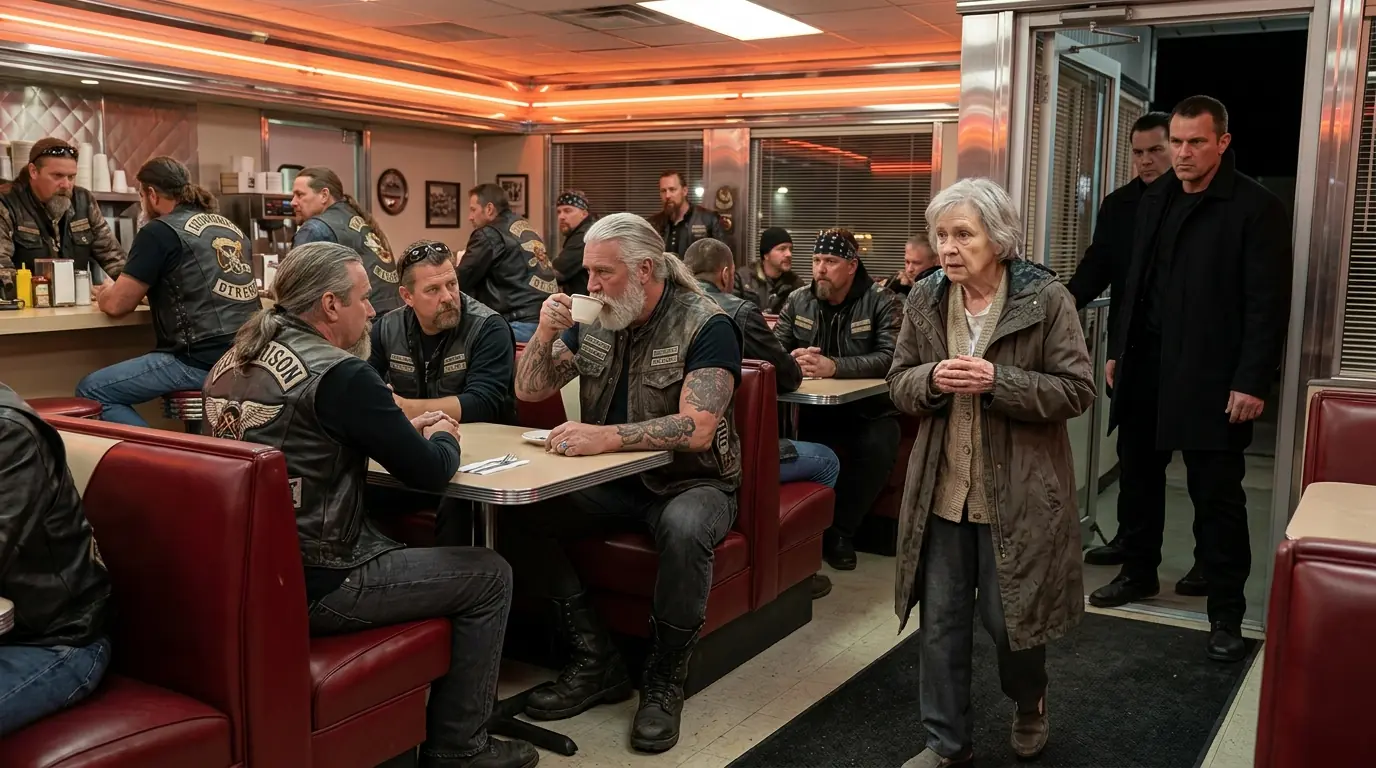
She was 72 years old. She had a bad hip from a fall three winters ago. She had a heart that skipped a beat now and then in the way her doctor said wasn't serious but wasn't nothing either. She had reading glasses she'd lost somewhere outside of Billings and hadn't been able to replace. She had arthritis in both hands that got so bad some morning she couldn't open a jar.
Supposed to be running. She was supposed to be home. She was supposed to be in her kitchen making the chicken soup she made every Sunday. The one with the wide egg noodles and too much dill. The one her grandson Nathan said was the only soup in the world worth eating.
She was supposed to be watching her evening programs, calling her neighbor Bernice to gossip about the new family on the block, falling asleep in her recliner with the television still on. She was not supposed to be standing in a parking lot in a town she'd never been to. In a state where she knew nobody, with two men behind her and nowhere left to go, she had stopped at the diner because she was dizzy. That was the honest truth. Not because she had a plan, not because something in her gut told her this was the right move.
She had stopped because her vision had started going gray at the edges somewhere around mile marker 47. And she knew from the one time she'd fainted in her garden back in 2019, that gray edges meant she needed to sit down and eat something real. Before she collapsed on the asphalt, she'd pulled in. She'd turned off the engine. She'd reached for her purse, and that's when she saw them in the mirror.
The black sedan, the same one she'd spotted twice in the last 100 miles. Now, at the far end of the lot, was engine still running. Two men sitting inside, not moving, not getting outs, just watching, just waiting. Her hand had gone still on her purse strap. She'd done what Nathan told her to do if she was ever sure she was being followed.
She hadn't gone inside. She hadn't used her card. She'd sat very still and thought very carefully and told herself to breathe. Just breathe. Just think.
And then the passenger door of the sedan had opened. And then the driver's door had opened. And Evelyn Carter had exactly 4 seconds to make the most important decision of her life. She got out of the car. She didn't run.
Running drew attention. Nathan had told her that. Walk like you know where you're going. Even when you don't. Walk like the ground belongs to you.
She'd practiced it in her head a hundred times over the past six days. Head up, eyes forward. She walked toward the diner entrance and then she saw them. She had heard motorcycles when she first pulled into the lot. She'd registered them the way you register background noise, the rumble of engines, the pop and settle machines cooling down, the low murmur of men talking.
She hadn't looked directly at them. She'd been too focused on the sedan. But now cutting across the parking lot with two men behind her and the diner entrance still 30 ft away. She looked eight of them big men not just tall wide. The kind of men who took up space simply by existing in it.
Leather jackets with patches she couldn't read. Boots that had seen serious miles. Had arms so covered in tattoos that even in the dim light of a rainy evening, she could see the ink from 20 ft away. Another one had a scar that ran from his left ear to the corner of his mouth. Another was laughing at something with his head thrown back.
The kind of laugh that came from the belly and filled up all the space around it. Hell's Angels. She knew the name. Everybody in her generation knew the name. You grew up knowing that name.
The way you grew up knowing to stay out of certain neighborhoods at certain hours. The way you knew certain doors you didn't knock on. Certain situations you cross the street to avoid. Every instinct. She had 72 years of instincts, a lifetime of careful living, trusting the rules, and respecting the warnings, and doing what sensible people did.
Every single one of those instincts said, "Earned, not them. Anyone but them. " And then one of the men behind her said low and calm and much closer than she expected, "Don't make this difficult. " And something shifted inside her, "Not bravery. " She would tell you honestly, it was not bravery. It was something older and more animal than bravery. It was the same thing that makes a rabbit run directly into a thicket of thorns because the open field behind it is worse. It was the calculus of desperation.
The math that your body does when your brain is too frightened to think clearly. She calculated behind her men who knew her name. Men who had been following her for 6 days. Men who did not want her who wanted what she was carrying. Men who had, she was almost certain now, done something to her grandson to keep him from being the one carrying it instead.
Ahead of her strangers, big, loud, leather jacketed strangers with a reputation that made most people cross the street. She chose the strangers, she moved fast, faster than her hip- liked, faster than was dignified. She cut left away from the diner entrance straight toward the cluster of motorcycles and she grabbed the nearest leather sleeve she could reach with both hands. Grabbed it the way you grab a railing. When you feel yourself falling, grabbed it with the full weight of desperation and she looked up.
The man attached to the sleeve was enormous. 6'3, maybe 6'4, broad through the chest and shoulders in a way that made him look like something carved rather than grown. Gray hair pulled back, a beard that had some age in it, eyes that were in that first second completely unreadable. Colbear Harrison looked down at the small, soaking wet, trembling woman who had just latched onto his arm like a drowning person latches onto a life preserver. He did not pull away.
He did not say anything. She was. He just looked at her and for one brief breathless moment, the whole parking lot actually did go quiet. The conversations dropped. The laughter faded.
Even the rain seemed to ease up as if the world itself was holding its breath to see what happened next. "I hide here," she whispered. The words were so small, so stripped of everything except what they were raw, honest need, the kind that bypasses every social filter a person has because there's simply no time for filters anymore. Cole looked at her face. He saw the circles under her eyes that come from days without real sleep.
He saw the way her hands were shaking, not the mild tremble of colder age, but the deeper whole body vibration of sustained fear. He saw the way she was holding herself. Her weight shifted slightly forwards, knees slightly bent like she was ready to bolt if she had to. He saw the wet clothes that had been wet for a while. He saw the set of her jaw frightened.
Yes, absolutely frightened. But underneath the fear, something harder, something that had made decisions, he looked past her. Two men in expensive coats 20 ft back and closing. Not shouting, just walking with the particular kind of purpose that said they expected no obstacle. Faces were calm in the way that faces are calm when they believe they have already won.
Cole had known men who wore that kind of calm. He had not liked any of them. He shifted his weight, moved his arm so that instead of the woman grabbing his sleeve was behind her, not touching her but present a wall and he stepped forward step just one. But it was the right step at the right moment and the two men stopped walking behind Cole without a word being said, without a signal being given, without anything except the particular awareness that exists between men who have spent years reading situations quickly. The other seven hell's angels shifted.
Subtle movements. A foot planted differently. A body turned a certain way. Face closed. Nobody raised a voice.
Nobody made a threat. Nobody said anything at all. They didn't have to. The two men in expensive coats stopped at about 15 ft. The taller one spoke.
His voice had the particular smoothness of someone who had spent a lot of time convincing people of things. We apologize for the interruption. This woman is a patient. She has dementia. She wandered from a care facility about 40 mi up the road here to take her back safely.