Whose bright idea was it to let this stranger into my wedding? Vivian slammed her champagne glass down. The stem snapped. 500 heads turned.
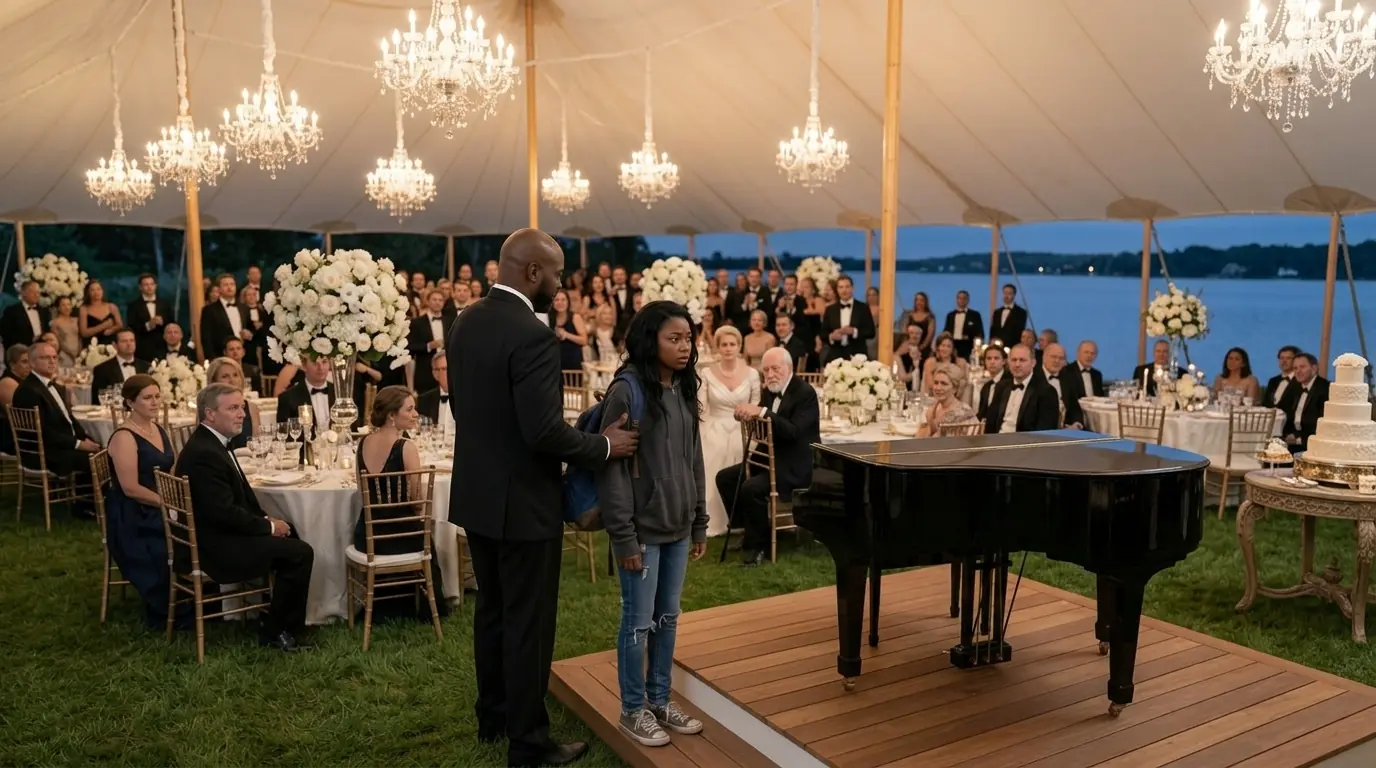
A woman by the string quartet laughed loud, ugly. The girl didn't move. She just looked at the Steinway the way a starving person looks at bread. Her voice was small, steady.
Can I play it for food? One song, please. I'll leave after. The laughter came like a wave.
She doesn't belong here. Go back where you came from. Beatrice didn't stand. She raised one finger and the wedding planner leaned in.
Have this girl removed. Burn whatever she touches. Wait, let her play. Free entertainment.
Someone film this. A man howled. Phones went up. Farah Gray' fingers closed around something at her wrist.
A small, silver treble clef. The last thing her mother ever gave her. 3 hours before that moment, Farah Gray was walking. The gravel road along the Long Island shoreline burned through the thin canvas of her sneakers.
She had been walking for nearly 6 hours. The strap of a scuffed blue backpack cutting into her collarbone. Inside the pack, a leather notebook, a half-empty water bottle, and a folded map she had picked up at a Greyhound station in Queens two nights ago. Nothing else.
Not since the last shelter closed its intake at 8:00 the previous morning. She was heading for a small Baptist chapel outside Oyster Bay that a woman on the ferry had mentioned. "They serve dinner till 6:00 on Saturdays," the woman had said without looking at her. "Sometimes clothes." Farah had smiled and nodded and hadn't spoken.
Talking cost energy she did not have. By the time the chapel came into view, its stained-glass windows were dark. A padlock hung from the side door. A hand-lettered sign in the window read in Sharpie, "Back Monday, 9:00 a.m.
Blessings." Farah stood on the empty sidewalk for a long moment. She did not cry. She had stopped crying about 11 months ago somewhere on a subway platform in the Bronx and the habit had never come back. Instead, she opened the front pouch of her backpack and touched a small silver charm shaped like a treble clef.
She had touched it maybe 2,000 times in the past year. And each time her mother's voice came back to her. "Play it for someone who deserves to hear it, baby." She turned around and started walking back down the road. Ms.
Coretta's Parlor had smelled like lemon oil and pipe tobacco. Farah remembered the piano before she remembered the woman. A scarred upright Yamaha wedged between two bookshelves, the ivory of middle C worn concave by 90 years of thumbs. She had been six.
Her mother, Delilah, had knelt beside her and whispered, "Baby, this lady is going to teach you music free. Just listen and don't touch anything unless she tells you to." Miss Coretta had been 83 then, a woman built out of sharp elbows and hymnbook wisdom. She had looked at the small girl for a long moment. "Sit her down at the bench, Miss Gray.
Let's see." Farah had climbed on. Her feet did not touch the pedals. She had never played a piano in her life. Miss Coretta played a single note, G above middle C, and asked, "Can you sing that back to me, child?" Farah had sung it perfectly.
Miss Coretta played three more notes. Farah sang each back, the pitch dead center. Miss Coretta played a chord next, then another. Farah named each note in each chord out loud, one after the other, and by the sixth chord, Miss Coretta had put her old hands over her face and cried very quietly.
"Miss Gray, do you have any idea what your child is?" Delilah, who worked the night shift at Harlem Hospital in a cracked pair of nursing shoes, and who had walked her daughter 40 blocks to this parlor because there was no money for the subway, said, "I know she loves music, ma'am." Miss Coretta had wiped her eyes on her sleeve. "She is going to change something. I do not know what yet, but she is." For the next 8 years, 3 days a week, Farah studied piano. Ms.
Coretta did not charge them. Farah brought her progress, Bach at 6, Chopin at 9, Debussy at 10. By the time she was 12, Ms. Coretta had stopped teaching her and had started listening.
Delilah found the lump the summer Farah turned 14. By October, the doctors were using the words stage four and pancreas in the same sentence. By January, Delilah had lost 40 lb and could no longer stand at the stove. Farah stopped going to school and stayed home to bathe her mother, count out pills, and hold the plastic basin under her chin.