"Can I Play It for Food?" Wedding Guests Laughed at Homeless Black Girl — Minutes Later All in Tears

"Can I Play It for Food?" Wedding Guests Laughed at Homeless Black Girl — Minutes Later All in Tears
Reader Theme:
Font Size:
24px

Whose bright idea was it to let this stranger into my wedding? Vivian slammed her champagne glass down. The stem snapped. 500 heads turned.
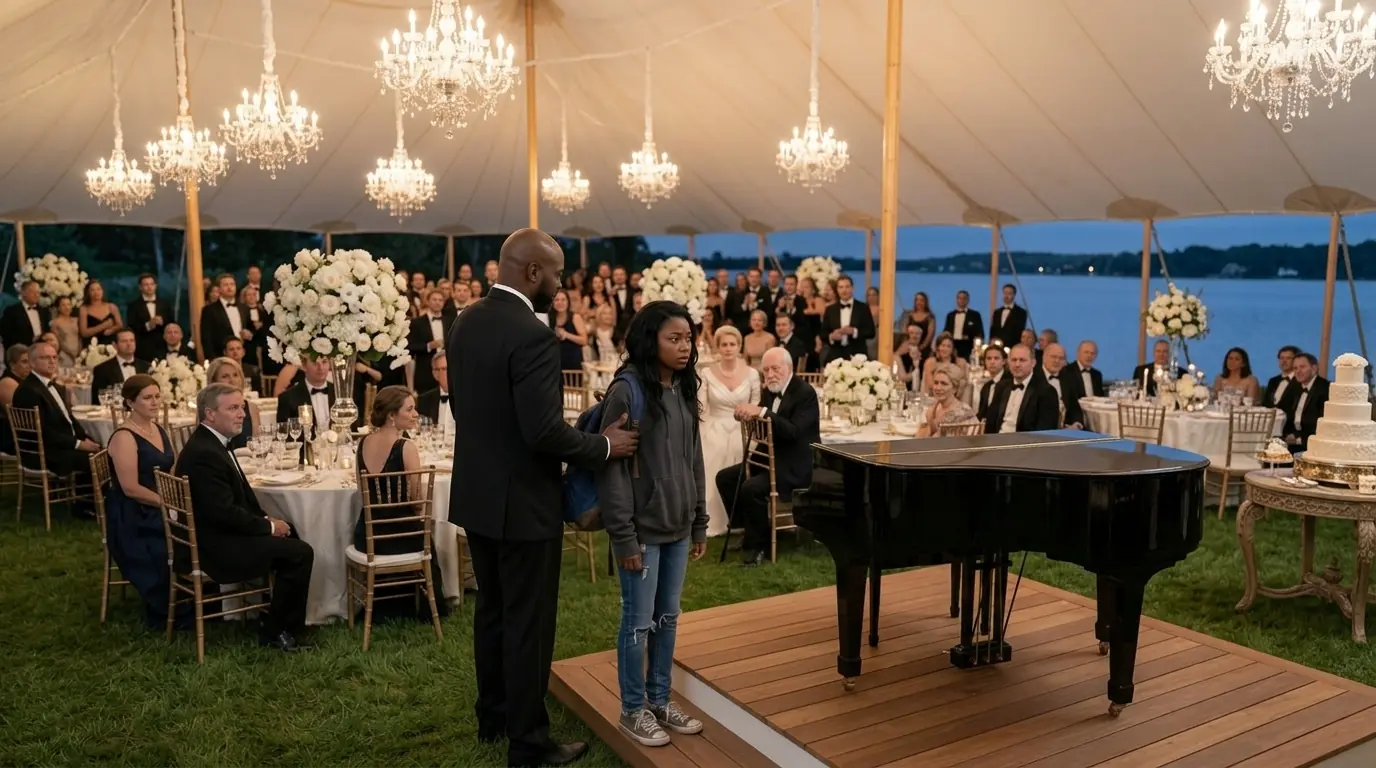


A woman by the string quartet laughed loud, ugly. The girl didn't move. She just looked at the Steinway the way a starving person looks at bread. Her voice was small, steady.

Can I play it for food? One song, please. I'll leave after. The laughter came like a wave.

She doesn't belong here. Go back where you came from. Beatrice didn't stand. She raised one finger and the wedding planner leaned in.

Have this girl removed. Burn whatever she touches. Wait, let her play. Free entertainment.

Someone film this. A man howled. Phones went up. Farah Gray' fingers closed around something at her wrist.

A small, silver treble clef. The last thing her mother ever gave her. 3 hours before that moment, Farah Gray was walking. The gravel road along the Long Island shoreline burned through the thin canvas of her sneakers.

She had been walking for nearly 6 hours. The strap of a scuffed blue backpack cutting into her collarbone. Inside the pack, a leather notebook, a half-empty water bottle, and a folded map she had picked up at a Greyhound station in Queens two nights ago. Nothing else.

Not since the last shelter closed its intake at 8:00 the previous morning. She was heading for a small Baptist chapel outside Oyster Bay that a woman on the ferry had mentioned. "They serve dinner till 6:00 on Saturdays," the woman had said without looking at her. "Sometimes clothes." Farah had smiled and nodded and hadn't spoken.

Talking cost energy she did not have. By the time the chapel came into view, its stained-glass windows were dark. A padlock hung from the side door. A hand-lettered sign in the window read in Sharpie, "Back Monday, 9:00 a.m.

Blessings." Farah stood on the empty sidewalk for a long moment. She did not cry. She had stopped crying about 11 months ago somewhere on a subway platform in the Bronx and the habit had never come back. Instead, she opened the front pouch of her backpack and touched a small silver charm shaped like a treble clef.

She had touched it maybe 2,000 times in the past year. And each time her mother's voice came back to her. "Play it for someone who deserves to hear it, baby." She turned around and started walking back down the road. Ms.

Coretta's Parlor had smelled like lemon oil and pipe tobacco. Farah remembered the piano before she remembered the woman. A scarred upright Yamaha wedged between two bookshelves, the ivory of middle C worn concave by 90 years of thumbs. She had been six.

Her mother, Delilah, had knelt beside her and whispered, "Baby, this lady is going to teach you music free. Just listen and don't touch anything unless she tells you to." Miss Coretta had been 83 then, a woman built out of sharp elbows and hymnbook wisdom. She had looked at the small girl for a long moment. "Sit her down at the bench, Miss Gray.

Let's see." Farah had climbed on. Her feet did not touch the pedals. She had never played a piano in her life. Miss Coretta played a single note, G above middle C, and asked, "Can you sing that back to me, child?" Farah had sung it perfectly.

Miss Coretta played three more notes. Farah sang each back, the pitch dead center. Miss Coretta played a chord next, then another. Farah named each note in each chord out loud, one after the other, and by the sixth chord, Miss Coretta had put her old hands over her face and cried very quietly.

"Miss Gray, do you have any idea what your child is?" Delilah, who worked the night shift at Harlem Hospital in a cracked pair of nursing shoes, and who had walked her daughter 40 blocks to this parlor because there was no money for the subway, said, "I know she loves music, ma'am." Miss Coretta had wiped her eyes on her sleeve. "She is going to change something. I do not know what yet, but she is." For the next 8 years, 3 days a week, Farah studied piano. Ms.

Coretta did not charge them. Farah brought her progress, Bach at 6, Chopin at 9, Debussy at 10. By the time she was 12, Ms. Coretta had stopped teaching her and had started listening.

Delilah found the lump the summer Farah turned 14. By October, the doctors were using the words stage four and pancreas in the same sentence. By January, Delilah had lost 40 lb and could no longer stand at the stove. Farah stopped going to school and stayed home to bathe her mother, count out pills, and hold the plastic basin under her chin.

Ms. Coretta died in February. A stroke in her sleep, mercifully quick. And there was no one else.

On a Tuesday morning in early April, Delilah patted the mattress beside her and asked her daughter to come sit down. She held out a leather notebook, brown and soft with age. Inside were pages and pages of hand-drawn staves in her mother's crooked handwriting. One melody written over and over across years, revised and re-revised in different colored inks.

On the last page, a completed score. No title. "Baby, I wrote this for you," Delilah said. Her voice was a thin wind.

"I've been writing it my whole life. I did not know how it ended until last month." She squeezed Farah's hand with what strength she had left. "Play it for someone who deserves to hear it. Not for money, not for fame, not for the ones who can afford it, for someone who deserves it.

Promise me." Farah had promised. Three weeks later, Delilah was gone. The state took Farah at 15. The first foster home lasted 4 months.

The second one lasted 11 days. She left after the foster father shattered her mother's notebook against the wall for making noise on his piano at night. Farah walked out with the notebook taped back together, the silver treble clef charm her mother had bought her for her 12th birthday, and one change of clothes. She had been sleeping on shelter cots and metro station benches for almost 2 years.

She was walking back up the coast road toward the ferry station when the smell hit her. Grilled corn, butter, something with rosemary, something with lemon. The kind of smell that reached inside a starving stomach and folded it in half. Farah's mouth flooded with saliva before her mind understood what she was smelling.

Her feet had already turned toward the source. A wrought-iron gate. Behind it, through a hedge of white hydrangeas, a lawn stretched down toward the sound like a green cathedral. She caught glimpses of white linen, glass chandeliers hanging from a canvas tent, tuxedos and gowns moving across the grass in a slow current of wealth.

A string quartet was playing something soft. And on a raised wooden platform at the far end of the lawn, half turned toward the last of the late afternoon sun, was a piano. Even from this distance, she knew it. The proportions, the angle of the lid, the stubborn old length of it.

A concert grand, 9 ft easy. And it had the coloring only one thing had, a Steinway Model D. The kind that got wheeled onto Carnegie Hall stage and made a whole city hold its breath. Farah stood at the gate and could not breathe.

She had not touched a piano since her mother died. 22 months. She had not sat down at a bench. She had not felt keys under her fingertips.

Sometimes, she practiced in her head, running scales on her knee, imagining Bach. But real ivory under real hands, sending real sound into real air, she had lost that the day she left the last foster home. And she had not let herself want it back. The wind changed.

The smell of the food came again. Farah looked at the sky. The sun was low. The chapel was closed.

She had eaten a granola bar and half an apple in the past 48 hours. She reached up very carefully and pushed the small service gate. It swung open. The Whitmore estate was 38 acres of manicured lawn and old family money wedged between Cove Neck Road and a private inlet where a 50-ft yacht was moored behind a pair of Corinthian boathouse columns.

The main house had been built in 1889 by a railroad baron and inherited through six weddings and four scandals by the current mistress of the property, Beatrice Whitmore. Beatrice had spent 11 months planning her youngest daughter's wedding the way a general plans an invasion. $200,000 in white hydrangeas flown in from a greenhouse outside Amsterdam. A string quartet borrowed from the New York Philharmonic. A 12-course tasting menu designed by a chef who did not as a rule cater weddings.

And at the center of it all, on a raised cedar platform under a tent of ivory silk, the piece the whole spread had been engineered around, the family Steinway Model D built in 1932, played at Rosalind Whitmore's own debutante ball 90 years earlier. Wheeled outside for the first time in three decades because Beatrice wanted the photographs to show that this family owned time itself. Vivian Whitmore came down the wide veranda steps a half hour before the ceremony began, and every camera in the tent turned toward her at once. She had trained for this.

From the age of 12, she had practiced her wedding smile in a mirror in her grandmother's dressing room. Mouth corners raised 15 degrees, chin lowered by five, eyes soft in the way that human eyes always registered as breeding. Her gown trailed 9 ft of cathedral train behind her. Around her throat, a diamond riviere that had belonged to her great-great-grandmother, valued somewhere in eight figures.

Around her wrist, a Cartier her fiance had given her the morning of the engagement, which she was already planning to sell after the honeymoon. She glided across the lawn to her mother's table, kissed the air beside Beatrice's cheek, and said, without looking at her, "Where is the videographer for the piano moment?" "He is right there, darling," Beatrice said, "in position at the platform. Two additional cameras on the terrace. The live stream goes to Vogue's private feed in 8 minutes." Beatrice Whitmore did not stand to greet her daughter.

She did not stand to greet anyone. At 55, she had made a private study of stillness, the way the truly powerful let other people come to them. A triple strand of Mikimoto pearls trailed almost to her waist. Her wine glass was cradled between the tips of her thumb and index finger, and her thumb never made contact with the crystal.

Her mother had taught her that. This was how Whitmore women held their wine, their tempers, and their staff. Priscilla Vandermeer materialized at Vivian's elbow like a well-dressed shadow. She was the most expensive wedding coordinator on the Eastern Seaboard, and the reason for the price was on full display.

A single earpiece, a slim tablet in a leather sleeve, and a habit of tilting her head half an inch and murmuring into her collar to make an entire lawn full of florists, sommeliers, and lighting technicians rearrange themselves without any of the guests noticing. She had a smile that she pointed at guests, and a voice that she pointed at staff, and the two things did not touch. "String quartet moves to Pachelbel in 4 minutes," Priscilla murmured. "Pianist arrives at the platform in nine.

The photographer will fire on the first three chords. Vivian, when Nathaniel steps to the altar, I need your left shoulder angled toward the west camera by 6 degrees, not 5." Vivian turned 6 degrees. Priscilla did not need to check. She could feel it.

At the second table from the front, on the aisle side, an older man was watching all of this without a word. He was slight and stooped a little at the shoulders, but he sat with the straight back of someone who had spent a career on concert stages and had never quite learned how to slouch. His hair had gone entirely white. His beard was trimmed close, the way it had been in every professional photograph anyone had ever taken of him for 40 years.

Beside him in a wheelchair sat a woman even older than he was, his contemporary and tonight his hostess, the last surviving matriarch of the Whitmore line, 82-year-old Rosalind Whitmore, who had been born in this house, who had been a debutante on this lawn, and who was here at her granddaughter's wedding because her son had asked her and refused because the last 20 years of her life had taught her the difference between blood and family. Rosalind looked at the Steinway on the raised platform for a long time. Then, she looked at her old friend beside her and said very quietly, "Edmund, that is Mother's piano." "I know," Edmund Ashcroft said. "I recognize the tuning.

Nobody has played it in 31 years. They're going to play something dreadful on it tonight, aren't they?" Rosalind smiled faintly. "Almost certainly." Edmund Ashcroft closed his hand very gently around the head of his ebony cane and said nothing else. He had been the executive director of the Juilliard School for 20 years, chair of its endowment board for another 11, and had, in a quiet six-decade career, personally identified and mentored 11 of the greatest classical pianists alive.

He did not, on principle, attend weddings. He was here because his grandson had asked him. He was, at that moment, the single most dangerous man on the property, and he did not yet know why. The service gate swung shut behind Farah with a soft metallic tick that no one heard.

She had meant to hug the hedge line and slip around to the back of the tent where the caterers might slide her a paper plate through the service door. She had done this before. Country clubs, hotel loading docks, banquet halls in Queens. She knew how to make herself invisible against a service wall.

But the hedges had been designed to be beautiful, not to be navigated. The path curved the wrong way. It emptied her, without warning, out from behind a wall of white peonies and directly onto the outer edge of the lawn, 10 yards from the raised platform in front of every guest. The nearest string player saw her first.

The violinist's bow slid off the strings mid-phrase. The cellist stopped a beat later. Then the second violin. Then the viola.

The quartet's careful Pachelbel unraveled into silence, and 500 wealthy heads swiveled toward the small figure standing at the edge of the peonies in a scuffed hoodie and torn jeans. One hand still clutching the strap of a blue backpack. For four full seconds, no one spoke. Farah did not move.

She was cataloging exits with the reflexes of someone who had spent two years being asked to leave places she had not been asked to enter. Then a champagne glass hit a table hard enough to crack. "Whose bright idea was it to let this stranger into my wedding?" Vivian Whitmore was on her feet. The broken flute still in her hand.

Champagne was seeping into the linen tablecloth around her. Her voice climbed half an octave. "Someone answer me. Whose idea was this?" A woman at a nearby table laughed.

Not a delicate social laugh, but a hard, ugly one. The sort of laugh people used when they wanted to be part of the cruelty they were witnessing. Two other guests joined her. Someone whispered, "Oh my god," with real relish.

A little girl in a pale blue dress pointed openly at Farah's shoes and said, "Mommy, why does she look like that?" Bradley Holloway, the head of the estate's private security, was already moving. He was a former college wrestler in a black suit, and he crossed the lawn in five long strides. He stopped one arm's length from Farah, one hand hovering near her elbow. She flinched, but did not step back.

At the mother-of-the-bride table, Beatrice Whitmore had not risen. She lifted her wine glass to her lips, sipped once, and set it back down. Then she raised one finger, one, and the wedding planner leaned in at the exact angle a courtier bows to a queen. Beatrice said quietly, so that only the microphone Priscilla Vandermeer could pick it up, but everyone within 20 ft could hear it anyway.

"Have this girl removed. Now. Burn whatever she touches, and find out which one of the staff let her in and terminate them before the cake is cut." Priscilla nodded once and murmured into her collar. Bradley's hand closed around Farah's upper arm.

He was gentle in a way that scared her more than roughness would have. The same careful grip he used on drunk guests. He turned her toward the service path she had come from. She let him.

She had been here before. She knew how to leave. But she did not leave. Because as Bradley turned her, her eyes swept one last time across the raised platform, and she saw the piano.

She stopped walking. Bradley pulled. She did not move. She had planted her small weight against him the way a rooted thing plants itself against a wind.

He pulled harder. She said very quietly, without looking at him, "I can play that." Bradley blinked. "Ma'am, you need to come with me." "I can play it for food. One song, please, and then I'll leave." She said it loud enough this time for the front tables to hear.

The laughter came like a wave. Real laughter. Ugly laughter. The kind of laughter that came out of 500 throats when they realized they had been given permission to enjoy someone's humiliation.

"Play it, you." Vivian's voice was pure venom now. All pretense of a smile gone. "Sweetheart, that piano is older than your entire bloodline. It is worth more than every family you ever came from put together.

Get your hands away from it before I have you charged with attempted theft." "She reeks," a man shouted from three tables over. "Crawl back to whatever alley you came from," another voice. "Not on the piano. She'll break it just by breathing on it." "Wait.

Let her play," a voice roared from the back. A heavy-set man in a tuxedo, red-faced with champagne, standing up on his chair for a better view. "Free entertainment. Someone film this.

I want this on my story tonight." A ripple ran through the crowd. Phones went up like a field of black flowers. A hundred red recording dots blinked to life. Vivian's mouth twisted.

Priscilla was murmuring into her collar in a panic. "No, we cannot let this happen on camera. The live stream. Ma'am, please." But the crowd had already decided.

The crowd wanted the show. Vivian recovered. Vivian always recovered. She smoothed the curl of hair from her forehead, arranged her face into a pantomime of gracious hospitality, and swept an open hand toward the Steinway.

"By all means," she said, sweet as poison. "Give the girl her 15 seconds. Let's watch her make a fool of herself before we throw her out with the compost." Farah looked at Bradley. Bradley looked at his boss.

His boss, Priscilla, looked at Beatrice. Beatrice looked at the guests, at the phones, at the ruin already being written across her flawless livestream, and did the only thing a woman of her breeding could do. She smiled. Bradley released Farah's arm.

And then, from the second table on the aisle side, an old man stood up. Edmund Ashcroft did not raise his voice. He did not have to. He tapped the head of his ebony cane once against the floorboards, and the sound carried across the tent like a gavel.

"Let the girl play." He looked directly at Beatrice Whitmore. "And leave her the hell alone while she does it." For a long moment, nobody moved. Beatrice Whitmore opened her mouth to say something to Edmund Ashcroft and then closed it again. There were in the whole of the Eastern Seaboard perhaps four people whose opinions Beatrice actually feared.

And one of them had just spoken. She looked at her daughter. Vivian looked at her. Neither of them said a thing.

From her wheelchair, Rosalind Whitmore laid a spotted hand over Edmund's very gently and nodded her assent. The rules of the evening had, in the space of 2 seconds, been rewritten. Priscilla Vandermeer, whose entire professional talent lay in reading a room, understood this before anyone else. She murmured into her collar and the string quartet lowered their instruments in unison.

The videographer swung his camera off the bride and onto the girl in the hoodie. The live stream, which had been panning slowly across the champagne fountain, cut abruptly to a wide shot of the platform. 500 iPhones followed. Farah did not know any of that.

Farah was looking at the piano. She took the first step toward it, a small step, testing the way a person tests thin ice. And the raised cedar platform did not fall away under her. She took the second step.

A grain of gravel had lodged in the sole of her sneaker at the ferry station this morning and she felt it press into the arch of her foot as she climbed the three low stairs to the stage. She was aware of the sound of 500 people not breathing. The Steinway waited. She stopped in front of it and put her fingertips on the polished wood of the closed fallboard.

It was cool. It was cooler than her own skin, which was flushed hot from adrenaline. She had not touched an instrument in 22 months. Her hand shook and then it steadied.

The way her mother's had steadied when she had picked up a needle to give herself her own morphine. Farah lifted the fallboard. The keys underneath were the color of ancient ivory, the yellow of centuries, the yellow of teeth in an old family portrait, the yellow of things that had been touched by more hands than any one person could count. Her breath left her all at once.

She sat down on the bench. She adjusted at once. A small, deliberate scoot forward. She placed her feet on the pedals.

She reached under her sleeve and touched the small silver treble clef against the pulse in her wrist. Somewhere behind her, someone whispered, "This is going to be painful to watch." Farah closed her eyes. She listened to her own breath. She listened past it for a voice she had not heard in almost 2 years.

"Play it for someone who deserves to hear it." She opened her eyes and rested her hands on the keys. And in front of 500 people who 4 minutes earlier had called her unwelcome, Farah Gray began to play. The first note came up out of the Steinway like moonlight rising off water. It was a single B flat held for a heartbeat and then released.

And it was so achingly precisely in tune that the guest at the closest table actually flinched. A second note followed. A third. And then the shape of the phrase revealed itself, and every classically trained ear in that tent, of which there were by the standards of a Long Island wedding, more than a few, understood at exactly the same instant what the girl in the torn hoodie had just started to play.

Clair de Lune, Debussy, Suite Bergamasque, third movement. One of the most abused pieces in the entire piano repertoire. The piece that every 12-year-old with 2 years of lessons tries to play, and that fewer than 100 living pianists play the way it was actually meant to be played, which is to say, slowly, with breath between the notes, as if the whole world were pausing to listen. Farah played it slowly.

She played it with breath between the notes. She played it as if the whole world were pausing to listen. Which, on the raised cedar platform, under the ivory tent, on the lawn of the Whitmore estate, on a Saturday evening in early June, the whole world abruptly was. The laughter died first.

It did not fade gradually. It cut. One second, a red-faced man in the back was still laughing into his phone. The next second, his mouth was open, and his eyes had gone strange, and he did not know why.

A woman near the champagne fountain set her glass down without noticing. A little girl in a pale blue dress, the same one who had 4 minutes ago pointed at Farah's shoes, took one step closer to the platform, then another, until her mother caught her by the wrist. Vivian Whitmore, standing beside her mother's chair, with her mouth open in a shape that had begun as a smirk, did not close it for the entire 6 minutes of the first piece. At the second table on the aisle, Edmund Ashcroft slowly lowered himself back into his seat.

His hand on the head of his ebony cane tightened until the tendons on the back of it stood up. Beside him in the wheelchair, Rosalind Whitmore's spotted hand had gone to her throat. Her mouth was slightly open. She was breathing in a way that suggested she was trying very hard to breathe quietly.

"Edmund," she whispered without moving her lips. "Edmund." "I know," Edmund whispered back. "I hear it. Just listen.

Just listen. Don't say anything yet." The piece moved into its middle passage, the swelling arpeggios, the moment where every amateur pianist pushes and every real pianist floats. And Farah floated. Her left hand rocked underneath in a way that was almost impossible to see.

Her right hand moved as if she were reaching not for keys, but for something specific in the air above the keys. The tent had gone so quiet that the wind in the peonies became audible for the first time all evening. When she reached the final passage, the long descending line, the notes falling like the last leaves of an autumn no one wanted to end, a woman at the third table began quietly to cry. She was not alone.

By the time Farah lifted her hands from the keys, four other women were crying. Two men had turned their faces away from the platform because they did not want to be seen. Vivian had not moved. Farah did not stop.

She did not lift her hands off the keyboard. She did not pause between pieces. She let the last note of the Debussy hang, breathed out through her nose, and then, with no warning and no transition, her left hand crashed down on a chord in C sharp minor that hit the tent like a bell in a cathedral. An audible gasp went through the guests.

Someone at the front row muttered, "Oh, no." Because a certain number of them, though not most, knew what she had just started. Rachmaninoff, Prelude in C sharp minor, Opus 3, number two. Played since 1892 by every serious concert pianist as either a signature encore or a cautionary tale. Because the piece is unforgiving in the way that dark water is unforgiving, calm on the surface, and it will drown you underneath if you do not know exactly what you are doing.

Farah knew exactly what she was doing. The chords began stately, ominous, the tolling of a slow bell over a Russian winter. She held them without rushing. She leaned her whole slight body forward into the low notes, into the register where the Steinway's oldest strings vibrated deep in the wooden bones of the platform, and every guest at the front tables felt those vibrations come up through the floor.

Then, the middle section broke open. The middle section of the Rachmaninoff Prelude is a whirlwind, a torrent of 32nd notes, hands crossing both wrists, blurring the passage that most professional pianists rehearse for months and still botch. Farah did not botch it. She tore into it the way water tears into a broken dam.

A strand of hair fell across her forehead. She did not brush it away. She played through it, into the piece, and the piece met her. In the wheelchair, Rosalind Whitmore's spotted hand tightened on Edmund's forearm hard enough to leave marks under the fabric.

"Edmund," she whispered, and her voice had gone very small. "Edmund. That fingering. In the middle passage.

That is" "I know," Edmund whispered. "That is the exact voicing Horowitz used in 1968." "I know." "In the RCA recording. She is playing the Horowitz voicing." "I know, Rosalind. I have been waiting to hear it again since he died." Rosalind Whitmore, 82 years old, former concert pianist, matriarch of the Whitmore line, put both her hands over her mouth and began to shake.

Beatrice Whitmore, at her own table, was no longer breathing normally. Her lipstick mouth was open. Her wine glass held for four decades between the tips of her thumb and index finger had slipped a quarter inch. Champagne was sliding down over her diamond riviere and staining her collar.

She did not know. Nobody at her table dared tell her. Vivian, the bride, the reason for the whole spectacle, was crying. She did not know she was crying.

She was still standing beside her mother's chair, her wedding gown catching the low sun, her hands still limp at her sides. She was crying the way people cry in dreams, silently, from the eyes only, without any of the muscles of the face moving. She did not understand what was happening to her. Nathaniel Sinclair, her groom, the young lawyer who had been standing at the altar under the flower arch, waiting for the ceremony to resume, had turned all the way around now to look at the platform.

He was crying, too. He did not know it, either. He looked over at his wife-to-be, saw her wet face, and did not recognize her. Farah, on the bench, was inside the piece.

She had in her whole life played Rachmaninoff perhaps 30 times, all of them in Miss Coretta's parsonage on the beaten Yamaha upright, all of them for an audience of one very old woman. 22 months of hunger and asphalt had done nothing to touch her hands. Her hands remembered. Her hands had waited.

Her hands were at this moment doing what her hands had been born to do. The final passage of the Rachmaninoff came upon her, the crashing return of the opening bell theme. Hands wide apart, both extremes of the keyboard, the sound of a whole ancient cathedral peeling at once. And Farah brought her small body up out of the bench for the last chord, drove both hands down into it with the whole weight of every night she had slept on a metro bench, and let it ring.

The chord hung. The chord held. Nobody in 500 people breathed. The silence after was so long that the wind again became audible.

Three full seconds. Four. Five. Nobody dared vote first on how to respond.

Then at the second table on the aisle, Edmund Ashcroft slowly lowered his forehead into his open palm and did not lift it back up. And Farah, without pause, did not stop. She did not turn to face the applause that had not yet come. She did not smile or bow or acknowledge the tent.

She simply lifted her right hand to the middle register, dropped her left onto a bass note that no one in the tent recognized because no one in the tent had ever heard it before, and began to play the third piece. This one had no name. It was not in any repertoire. It was not on any recording.

It was in fact the reason her mother had died believing that her life had not been wasted. It began with three simple ascending notes. D, F sharp, A, the way a nursery rhyme might begin, or the way a mother's voice might begin in the dark room of a small child too sick to sleep. Then it broke open into something that had no genre, that lived in the space between a lullaby and a hymn and a farewell letter.

It was slow. It had almost nothing to it. It was the smallest and most private piece Farah had ever played and she had never played it for anyone in her life until this evening. She was playing it now.

Rosalind Whitmore, in her wheelchair, whispered to Edmund, "I don't know this piece. Edmund, do you know this piece? I don't know this piece." Edmund did not answer. Edmund was crying.

He had not cried at a piece of music in 14 years. The little girl in the pale blue dress, whose mother had caught her by the wrist 10 minutes before, had escaped her mother's grip and was standing 3 feet from the platform now, looking up at the girl on the bench with an expression that adults spend their entire lives forgetting how to make. Farah played the piece all the way through. It lasted 3 minutes and 20 seconds.

She did not open her eyes for any of them. Her mother was in the room with her at the bedside, humming this melody in a voice that had already begun to fail. When she reached the last chord, a simple, resolved D major, the kindest chord in the whole of Western music, she held it. She let it fade.

She let it fade the whole way. And when the last thread of sound had finally left the Steinway, she let her hands rest, palms down on the keyboard. And she opened her eyes. For eight full seconds, nothing happened in the tent.

And then the little girl in the pale blue dress, the one who had asked her mother why the strange lady looked like that, began to clap. She was 6 years old. Her small hands could not make much noise. But she was the first.

And once she started, the entire lawn of the Whitmore estate, all 500 guests, the caterers, the string quartet, the security team, the mother of the bride with champagne down her collar, the wedding planner with a dead microphone in her hand, the little bridesmaids in matching dresses, the groom, the grandmother in the wheelchair with her hands over her mouth, all 500 of them rose to their feet and did not stop clapping for 3 minutes and 11 seconds. Edmund Ashcroft was the first to move. He set the head of his ebony cane against the floorboards. He pushed himself up from his chair with a slow deliberation of a very old man who was about to do something he has been waiting his whole life to do.

He tapped once hard on the boards. Nobody heard it over the applause. He tapped again. Priscilla Vandermeer, who was standing beside the platform staring at her tablet as though it were on fire, looked up.

He held out his hand for the microphone she was carrying. She gave it to him without a word. Edmund walked slowly across the lawn, across the grass, up the three low stairs to the raised cedar platform. He did not look at Beatrice.

He did not look at Vivian. He walked straight to the bench where Farah was sitting and he stopped an arm's length from her. The applause had begun to falter from confusion. 500 people had no idea what was about to happen.

They lowered their hands slowly. Edmund looked down at the girl on the bench. He was smiling. "Young lady," he said, "what is your name?" Farah looked up.

Her cheeks were wet. She had not noticed that they were wet. She swallowed. "Farah, sir." "Farah Gray." "Farah.

That third piece, who wrote it?" "My mother, sir." She had to say it twice because the first time no sound came out. "My mother wrote it before she died." Edmund closed his eyes for one full second. When he opened them, he turned around, brought the microphone up to his mouth, and faced the 500 guests on the lawn. His voice, amplified across the tent, did not sound like the voice of an old man.

It sounded like the voice of a man who had once, in another life, filled a lecture hall at the Peabody Institute without a microphone at all. "My name," he said, "is Edmund Ashcroft. For 20 years, I was the executive director of the Juilliard School. For 11 years after that, I chaired the school's endowment board.

I still hold that chair. In 60 years of listening to pianists, students, competitors, guest artists, the very best professionals in the world, I have heard three human beings play Rachmaninoff's Opus 3, No. 2, the way it was intended to be played." He paused. Nobody in the tent moved.

"Vladimir Horowitz, Martha Argerich, and the girl on this bench behind me, who 7 minutes ago at this wedding was called unwelcome, was treated as less than human, was told to go back where she came from, and was told not to touch the piano." The tent was again absolutely silent. In the back, near the champagne fountain, one of the guests had begun very quietly to lower his phone. Edmund turned deliberately to face the mother of the bride's table. He did not lift the microphone away from his mouth.

"Beatrice, Vivian, I want to be clear with both of you, and I want the cameras to be clear as well. I am at present the chair of an endowment board that has on record accepted seven separate donations from your family across the last three decades. I would like you both to explain publicly to the Juilliard Board of Trustees and to the 98,000 people currently watching your daughter's livestream, why we should ever accept another dollar from a family that treats a musician of this caliber like garbage in front of 500 witnesses." Beatrice Whitmore rose to her feet. Champagne slid down the front of her diamond riviera.

She did not seem to know it was happening. Her voice, when she found it, was very small. "Edmund? Please, she just walked in.

We did not know the security." "She asked for food, Beatrice. You offered her humiliation. The video was already on Instagram before she played the first note. It has been screen recorded by my count at least 84 separate times in the last 11 minutes." He turned back to Farah on the bench.

His voice softened. "Farah, would you stand up, please? Just for a moment." Farah stood. Vivian Whitmore, the bride, the reason for this whole spectacle, the queen of a coronation that was in the space of 90 seconds being publicly disassembled, walked slowly across the lawn toward the platform in her 9-ft cathedral train.

She reached the stairs. She climbed them one at a time. Mascara was running black down both her cheeks. She reached Farah.

She looked at her. And she dropped very slowly to both her knees on the cedar boards. "I am so sorry," Vivian said. Her voice broke on the second word.

"I am so sorry. I am so sorry. I am so sorry." Farah looked at her for a long moment. Then she looked out across the tent, across the 500 people whose phones were still trained on her.

And she said in a voice that was small and calm and did not shake at all, "I was just hungry." The tent went completely still. Edmund Ashcroft did not wait for the tent to recover. He lifted the microphone again and in a voice that was suddenly no longer the voice of a prosecutor but of a father said, "Farah, on behalf of the Juilliard School and its endowment board, subject to formal ratification next Wednesday, which I promise you is a formality, I would like to offer you a full four-year scholarship. Tuition, room, board, books, a stipend, a private mentor of your choosing, and for what it is worth to you at this moment, my personal sponsorship of your admission." He looked at her.

"The papers can be signed on Monday. Tonight, you need a plate of food, a warm bed, and someone who is not going to lay a finger on you." Farah did not know how to answer. She had not eaten a full meal in three days. Her knees, without warning, decided to buckle.

Edmund caught her by the elbow with the practiced quickness of a man who had spent his life catching gifted young people at their moments of collapse. From the wheelchair at the edge of the platform, Rosalind Whitmore lifted her voice for the first time all evening. "Bring her to me, Edmund. Please.

Bring her here." Edmund walked Farah down the three low stairs and across the lawn to Rosalind's chair. Rosalind took both of Farah's hands in her own. The hands that had 10 minutes earlier been called too dirty to touch a piano now cradled by hands worth eight figures in inherited jewelry. Rosalind held them for a long moment.

Her ancient thumbs pressed against the calluses on Farah's fingertips. The calluses of a pianist who had never stopped practicing even when there was no piano left to practice on. "Child," she said. "I was a concert pianist once.

Before I married into money and let the money teach me to forget what mattered." Her voice was steady. She had been rehearsing what she was about to say for perhaps 90 seconds and perhaps 82 years. "Do not let anyone in this family come near you again. Do you hear me?

Not my daughter-in-law, not my granddaughter, nobody in that tent." She lifted her chin toward the platform. "But you come near me. There is a guest cottage on the west side of this property. It has a Bosendorfer upright and a working kitchen and a bed that has not been slept in for 17 years.

It is yours tonight. It is yours next week. It is yours for as long as you need it. And I would like, if you will let me, to teach you Chopin the way my mother taught me before I run out of time." She let go of Farah's hands.

She pulled a small handkerchief from her sleeve, silk, monogrammed RW in fading blue thread, and pressed it into Farah's palm. "This was my mother's. She would want you to have it." Nathaniel Sinclair, the groom, stepped forward next. He was carrying a linen napkin folded around something warm and heavy.

Bread. A piece of the salmon course. Three slices of the Wagyu. A peach from the fruit tower.

He knelt down beside Rosalind's chair and offered it to Farah with both hands. "For your walk," he said quietly. "Except you don't have to walk anywhere tonight. My grandmother meant what she said.

She never doesn't." He glanced once and only once at his bride on the platform. "You are welcome here for as long as you want to stay. Nobody in this family is going to bother you again." The video of Farah playing Rachmaninoff hit Instagram before she finished eating. It hit YouTube by 10:00 p.m.

By midnight, it had 4 million views. By noon the next day, it had 40 million. Within a week, the Juilliard admissions office had received 12,000 emails from strangers demanding that the school make good on Edmund Ashcroft's public promise. Three weeks after the wedding, Farah played the opening set at a Carnegie Hall charity gala arranged for her by phone from Rosalind's guest cottage.

Three months later, Universal Music Classical signed her to a five-record deal. Six months after that, Farah's Lullaby, the piece her mother had written on her deathbed, formally titled by Farah in the studio, sat at number one on the Billboard Classical chart for six consecutive weeks. For Vivian and Beatrice Whitmore, the six months after the wedding were by contrast unkind. Vivian lost three of her four major bridal fashion sponsorships within 11 days.

The honeymoon to Positano was postponed, then quietly canceled. Nathaniel filed for annulment 96 days after the ceremony. His lawyer cited irreconcilable differences of moral character. He never publicly explained further.

The video had explained for him. He used the annulment settlement to establish in his grandmother Rosalind's name and Farah's mother's name the Delilah Gray Scholarship Fund at the Juilliard School, a permanent endowed fund for musically gifted children from housing-insecure families. Its first cohort of six students entered Juilliard the following autumn. All six of them met Farah at their orientation.

All six of them cried. Beatrice Whitmore stepped down from three charitable boards before Christmas. She sold the estate the following spring. Rosalind kept the guest cottage.

One year later, on a Wednesday evening in early June, Farah Gray walked out onto the stage of Carnegie Hall. The dress was a simple dark navy silk cut just below the knee. Her hair had been washed and braided that morning by Rosalind's own hairdresser, who was 91 years old and had done Rosalind's hair for the same Carnegie Hall stage 60 years earlier. Woven into the braid at the crown of Farah's head was a single small stephanotis blossom.

The same white wedding flower that had 1 year ago, on a Long Island lawn, been arranged by the hundreds in vases she had not considered clean enough to walk past. The house was full. Every seat sold, every seat occupied. In the front row on the aisle, Edmund Ashcroft, ebony cane resting across his knees.

Beside him, Rosalind Whitmore in her wheelchair in a plum evening jacket that had been in the back of her closet since 1974. There was no member of the Whitmore-Sinclair extended family in the hall. Farah walked to the Steinway at center stage. She sat down on the bench.

She placed her feet on the pedals. She reached under her left cuff and touched once a small silver treble clef against the pulse in her wrist. Then she did something that she had never done before in a performance. She lifted the small microphone that had been placed on the edge of the stage and she spoke.

"Good evening," she said. The hall went absolutely quiet. "The last piece on tonight's program is called Farah's Lullaby. It was written by my mother, Delilah Gray, on a hospice bed in Harlem 6 weeks before she died.

She spent her whole life on a night nurse's salary in the city of New York. She never sat in a hall like this one. She never played a piano like this one. She was, in the eyes of the world she lived in, nobody at all." She paused.

"She used to tell me, when I was little, 'Play it for someone who deserves to hear it.' For a long time, I thought that meant somebody important. Somebody rich. Somebody who knew things about music. I don't think that anymore." She looked out into the 2,800 faces in front of her.

"Maybe everybody deserves to hear it. Because kindness isn't something you owe rich people. It's something you owe hungry people." She set the microphone back down. She placed her hands on the keys.

She began to play. At the front of the hall, Rosalind Whitmore reached across the armrest and quietly took Edmund Ashcroft's hand. Neither of them looked at each other. Neither of them needed to.

The camera, at that moment, faded slowly out on the girl at the piano and on the small silver treble clef flashing once, very softly, at her wrist.

News in the same category

News Post