"Good evening. Um..."
"Get your filthy hand away from me."
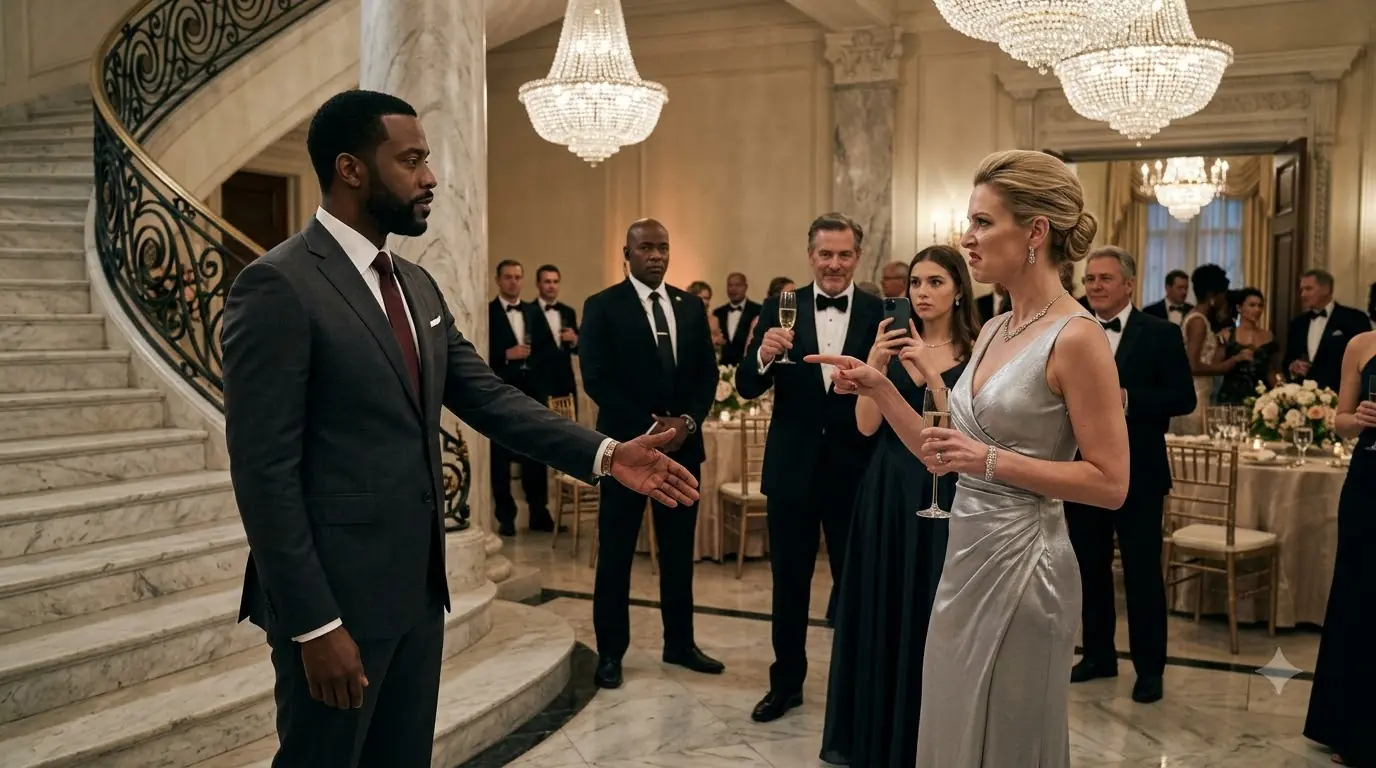
"Ma'am, I was just..."
"Don't touch me. I can smell you from here. Whatever gutter you crawled out of, crawl back."
"I was invited to this gala."
"Invited? Look at your skin. Look at this room. You're disgusting. You're nothing. Security, drag this animal out before he stains the carpet."
"I have every right to be here."
"Rights?" She stepped closer, her lip curling. "You have no rights here. You have no name. You're invisible."
The ballroom watched. No one moved. Phones rose. Someone laughed. The Black man lowered his outstretched hand. He did not leave.
She would ignore that hand two more times. The last time would destroy her career, her reputation, and everything she had ever built.
Malcolm Hayes grew up in a two-bedroom apartment in East Baltimore, where the radiator worked only in April and the roaches paid no rent. His mother cleaned offices at night. His father drove a delivery truck until his back gave out. Neither of them finished high school, and neither of them complained.
Malcolm did not inherit money. He inherited silence, the kind that watches, listens, and waits. He earned a scholarship to Howard University, graduated top of his class, and turned down three law school offers to start a small investment firm out of a rented closet in downtown D.C. with $1,100 and a borrowed laptop. The first year, he lost every client. The second year, he lost sleep.
The third year, he landed a deal that turned a failing grocery chain into a regional powerhouse. By 42, Malcolm Hayes was the chairman of Apex Global Holdings, a multinational investment group with a portfolio spanning real estate, energy, and technology across 14 countries. Forbes had profiled him twice. Bloomberg had called him the quietest shark in American finance.
He never did interviews. He never raised his voice. He believed that power did not need volume.
Three weeks before the gala, Apex had completed the acquisition of Sinclair Weston Group, a mid-tier consulting and events firm with a strong East Coast client base but declining numbers. The deal was worth $420 million. Malcolm had studied the company for six months before making the offer. He knew its revenue streams, its client retention rates, and its internal culture reports.
He also knew its CEO, Victoria Sinclair, 38 years old, born into the Sinclair family. Old money, old connections, old habits. Her grandfather had founded the company. Her father had expanded it.
She had inherited it the way some people inherit eye color, without effort, without understanding, and without gratitude. Under her leadership, three senior executives of color had quietly resigned within 18 months. Two formal complaints of racial discrimination had been filed and buried. Victoria's response to both had been the same: they weren't the right fit.
Malcolm had read those complaints. He remembered every word. When the acquisition closed, the board asked Malcolm how he wanted to announce his role to Sinclair Weston staff and clients. He said he would do it himself, in person, at the annual charity gala.
The Meridian Grand Hotel sat on Connecticut Avenue like a cathedral of old money. White marble columns framed the entrance. Crystal chandeliers hung from ceilings painted with Renaissance reproductions that nobody ever looked at. The ballroom could hold 800.
Tonight, it held 712 guests: hedge fund managers, senators, spouses, tech founders, and the kind of people who measured kindness in tax deductions. Waiters in white gloves carried trays of champagne that cost more per glass than Malcolm's mother had earned per shift. A string quartet played Debussy near the south windows. The air smelled of orchids, aged cologne, and self-importance.
Victoria Sinclair stood at the center of the room in a silver gown that caught every light in the building. She moved through conversations like a woman who had never been interrupted. Her laugh was loud and practiced. Her handshake was firm, but only for certain people.
She touched shoulders, kissed cheeks, remembered first names. She was the host. She was the star. She owned this room the way her family had always owned rooms.
Her assistant, Garrett Cole, followed three steps behind. Garrett was 29, eager, and terrified of Victoria in the specific way that small dogs are terrified of thunder. He carried a tablet with the guest list, the seating chart, and Victoria's schedule down to the minute.
At 7:14 p.m., the main doors opened. Malcolm Hayes walked in alone. No entourage, no assistant, no name tag. He wore a simple charcoal suit, a white shirt, a deep burgundy silk tie, and shoes that were clean but not designer.
He looked like a man who had come to observe, not to perform. Victoria noticed him from across the room. She registered his face for exactly one second. Then she turned back to her circle and said something that made everyone laugh.
Malcolm adjusted his cuff. He crossed the ballroom floor and extended his hand.