The first mistake Officer Henry Kerr made was assuming the house was ordinary. The second was kicking in the door. It is a quiet suburban street with a trim lawn, beige siding, and a brass plaque beside the entrance that most people would never read twice. Inside, Jake Mills stands at the window, breathing steady, eyes locked on the officer outside. He is not afraid. He is calculating.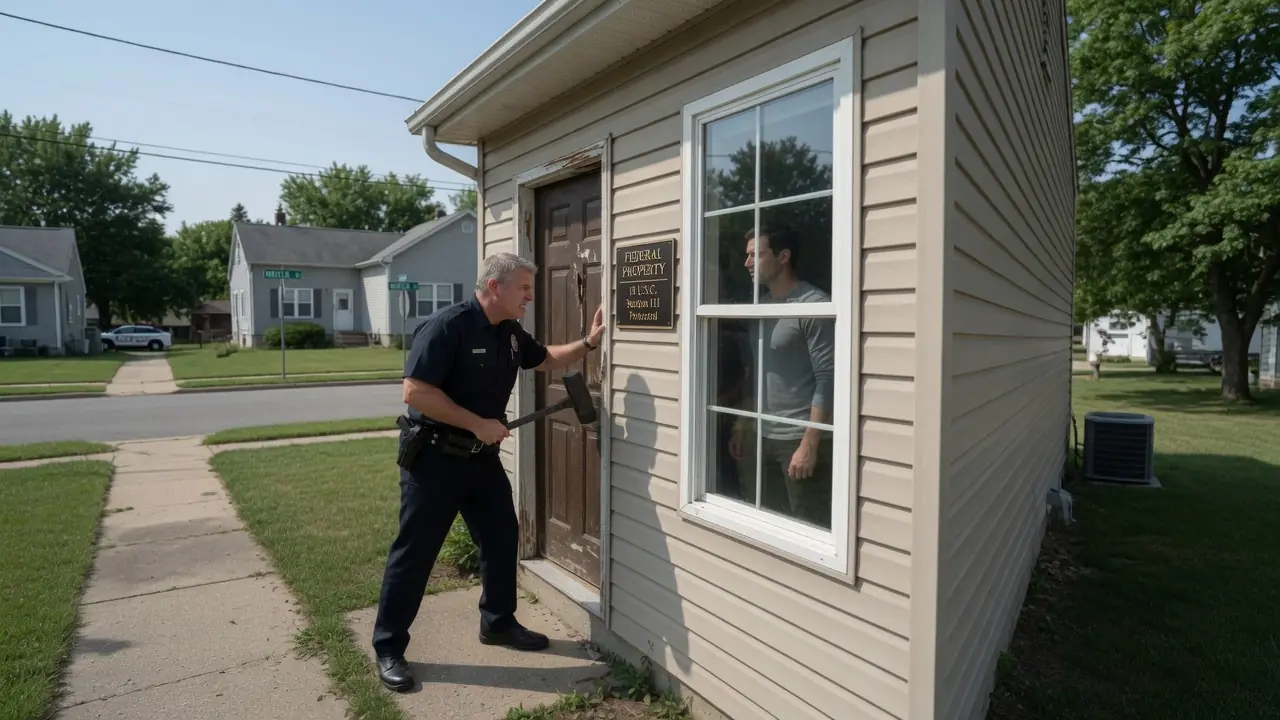
Kerr shouts another command and wedges metal into the doorframe. He thinks he is about to uncover something illegal. He is right, just not in the way he thinks, because the man inside is not hiding from the law. He is the law, just not Kerr’s version of it. And the moment the door splinters, a silent alert activates, one that does not call local backup. It calls Washington. In less than five minutes, this quiet street will belong to people Kerr does not outrank. This is not a break-in. It is a career-ending misunderstanding.
The house on Mercer Lane looked like every other house on the block. That was the point. Jake Mills stood at the kitchen counter, hands wrapped around a mug of black coffee that had gone cold twenty minutes ago. He had not touched it since. His eyes moved in a slow, practiced sweep from window to door to monitor and back to window. The kind of rhythm that did not come from training manuals. It came from years of standing in rooms that looked safe but were not.
The safe house had been active for eleven days. Eleven days of controlled silence, of grocery runs timed to avoid patterns, of blinds adjusted to the exact angle that allowed outward visibility without inviting it back. The neighbors, if they noticed anything at all, saw a quiet man who kept to himself. Maybe a remote worker, maybe recently divorced. People filled in the blanks with whatever made them comfortable. Jake let them.
His official designation was Protective Intelligence Officer, GS-13, assigned to the Federal Witness Security Support Division, a unit most people in law enforcement had never heard of, which was exactly how the division preferred it. His job was not to chase criminals. It was not to make arrests or build cases or testify in courtrooms. His job was simpler and more absolute than any of that: keep the asset alive until extraction.
The asset was a fifty-one-year-old accountant named Raymond Voss, currently occupying the reinforced basement two floors below Jake’s feet. Voss had spent fourteen years managing financial records for a mid-Atlantic organized crime network before deciding quietly and with great personal risk that he no longer wanted to. His testimony was the centerpiece of a federal prosecution that had taken six years to build. Three previous witnesses had disappeared before trial. Voss was not going to be the fourth.
Jake had been briefed on the case in a windowless room at a field office he was not allowed to name. He had read the threat assessment twice, memorized the extraction protocol, and asked exactly two questions before accepting the assignment. He was not the type to ask more than he needed. The house itself was a masterpiece of institutional deception. From the street it was indistinguishable from the beige vinyl-sided homes flanking it on either side. The same modest porch, the same trim lawn maintained by a contractor who believed he was working for a property management company.
Inside, the walls held more than drywall. Encrypted communication relays ran behind the baseboards. Motion sensors covered every entry point. A silent alert system, hardwired and not wireless, sat dormant beneath the front threshold, waiting. There was a brass plaque beside the front door. Small and understated, the kind of thing a person’s eyes slid past without registering. It bore a federal designation code and a single line of fine print that carried the legal weight of a loaded weapon. Jake had read it the first morning. He had not needed to read it again.
He set the cold coffee down and moved to the front window, staying to the left of the frame the way he always did. He was visible enough to monitor the street yet angled enough to avoid silhouetting himself against the interior light. Mercer Lane was quiet. A woman walked a terrier past the hydrant on the corner. A teenager on a bicycle cut across the intersection without stopping. Two houses down, someone was mowing a lawn, the mechanical drone of it steady and unremarkable. Normal. Jake had learned not to trust normal.
He turned from the window and moved back through the kitchen, his footsteps deliberate and quiet on the hardwood floor. Below him he could hear the faint sound of a television. Voss was watching the news again, the volume low the way Jake had asked him to keep it. The man was frightened. He had every right to be. But he was cooperating, and that was what mattered. Jake refilled the mug, this time with water, and stood at the counter again. Window, door, monitor, window. Outside, Mercer Lane stayed quiet. For now.
Henry Kerr had been a cop for fourteen years, and for the last three of them he had been angry about it. Not the job itself. He still believed in the job, or told himself he did, which was not quite the same thing. What he was angry about was the ceiling. The invisible, infuriating ceiling that seemed to exist specifically for men like him. Men who showed up. Men who put in the hours. Men who did not smile the right way in the right rooms or shake the right hands at the right retirement dinners.
Sergeant Kerr. That was what it should have said on his collar by now. Maybe Lieutenant. Instead it still said Officer, the same rank it had been since year one. And every morning he pinned that badge on, he felt the word like a splinter he could not reach. The promotion board had passed him over twice. The first time his supervisor cited interpersonal concerns, a phrase so deliberately vague it told him everything and nothing. The second time there was no explanation at all, just a name on a list that was not his. A younger guy, less experienced. The kind of guy who knew how to make the brass feel comfortable.
Kerr had stopped trying to make anyone feel comfortable a long time ago. He was forty-one years old, broad through the shoulders, with a jaw that looked like it had been set in concrete and eyes that moved fast and assumed faster. His record had commendations in it. Three use-of-force incidents reviewed and cleared, two civilian complaints dismissed, one departmental reprimand for failure to de-escalate that he still referred to as a misunderstanding when anyone brought it up. His clearance rate was above average. His temperament was not.
He was parked on the east end of Mercer Lane when the call came through. A disturbance complaint, origin unclear, logged by dispatch as a possible domestic or suspicious activity at a residential address mid-block. The details were thin. A neighbor had reported unusual activity and a man watching from the window. That was it. No description of a weapon, no raised voices, no specific threat. Thin enough that most officers would have treated it as a low-priority welfare check. Kerr treated it like a lead.
He pulled the cruiser to the curb two houses down, killed the engine, and sat for a moment, studying the address. Beige siding, small porch, blinds angled down. Nothing visibly wrong. Nothing visibly right, either. He had been doing this long enough to know that quiet was not the same as innocent. Quiet was sometimes just careful. He climbed out of the vehicle and adjusted his belt, eyes already moving across the property line. The lawn was too neat, the porch too bare. No shoes by the door, no potted plants, no mail visible in the box. It had the sterile quality of a space being maintained rather than lived in.
Kerr filed that away without fully articulating it, the way experienced officers sometimes processed details before their conscious mind caught up. He was halfway up the front walk when he saw the man standing at the window. Left side of the frame, partially obscured by the angle of the blinds, but visible, watching. Not the casual glance of someone checking who had pulled up outside. A steady, deliberate observation. The kind of look that came from someone who had been watching before Kerr even got out of the car.
Kerr stopped walking. The man did not move. Something tightened in Kerr’s chest. Not fear exactly, but the particular alertness that years of street work had wired into him. He told himself it was instinct. He told himself the man’s stillness was suspicious. He told himself a lot of things in the three seconds they held eye contact through the glass. What he did not tell himself was to slow down.
He moved to the porch and knocked hard, the flat of his fist against the doorframe the way he always knocked. Not a request. A statement. Police. Open up. Nothing. He knocked again, harder. Sir, I need you to open this door. I am responding to a disturbance call. Open the door now. The blinds shifted slightly. The man was still there, still watching, still not moving toward the door. Kerr’s jaw tightened. He had seen this before, or thought he had. The hesitation. The calculation behind the eyes. The deliberate non-compliance that some people mistook for a right.
He reached for his radio with one hand and let the other drop to his belt. He was not leaving without answers, and if the door did not open in the next sixty seconds he was going to stop asking. Jake heard the knock and did not move toward the door. He had already clocked the cruiser two houses down, noted the make, the positioning, the single occupant who sat too long before getting out. Patrol officers on routine welfare checks did not sit. They pulled up, walked up, knocked, and moved on. This one had studied the house first. That told Jake something about the man before he had even seen his face.
Now he stood at the window and watched Officer Kerr on the porch, reading him the way he had been trained to read people in high-pressure environments. The tight jaw. The hand that dropped instinctively toward the belt. The knock that was not a knock so much as an announcement of intent. Jake had encountered men like this before. Not bad men necessarily, but dangerous ones. Men whose authority had become so fused with their identity that any resistance to one felt like an attack on the other.
He stepped back from the window and pulled out his credentials. The laminated federal ID. The designation card. The emergency contact protocol card with the field office number printed in bold at the bottom. He held them in his left hand and moved toward the door, stopping two feet short of it. Officer, his voice was calm, pitched to carry through the door without aggression. I hear you. I am not ignoring you. I need you to listen carefully to what I am about to tell you.
A pause from the other side. Open this door. I will cooperate fully, Jake said, keeping his tone even. But I need to inform you that this is a federally designated property currently under active protective operation. I am a federal officer. Before this door opens, I need confirmation that you have a warrant or I need your supervising officer on the line. That is not defiance. That is protocol.
The silence that followed lasted about two seconds. Then Kerr’s voice came back harder than before. I do not need a warrant for a disturbance call. Open the door or I will open it. Jake closed his eyes briefly, not from fear, from the particular exhaustion of watching a situation move toward a cliff in slow motion while the person driving showed no interest in the brakes.
Officer, I am asking you to contact your dispatch and request a jurisdiction check on this address before you take any further action. That one call will clarify everything. It will take less than two minutes. You have got ten seconds. Jake pressed his credentials flat against the inside of the door’s narrow side window, the small pane of frosted glass beside the frame. He angled the Federal ID so the badge seal was visible, the photograph facing out. I am showing you my credentials right now through the side glass. Federal protective intelligence. Look at what I am showing you before you make a decision you cannot walk back.
He heard movement on the porch, a shift of weight, a pause that lasted just long enough for him to think for one moment that the man outside was actually looking. Then Kerr’s voice returned, and whatever hesitation had existed in that pause was gone. That could be anything. Fake IDs exist. You have got five seconds.
Jake straightened. He kept his breathing steady and kept his hands visible. He kept his voice at the same controlled register it had been since the first knock. He was not going to shout. He was not going to threaten. He was not going to give this man a single thing he could point to later as justification. Officer Kerr, he had read the name tag through the window. Using it was deliberate, a reminder that this was a conversation between two specific people with specific consequences attached to their names. I am asking you one more time. Call your dispatch. Request a federal jurisdiction check on this address. Do that one thing and this ends without incident for either of us.
Another silence. Longer this time. Jake stood perfectly still, credentials in hand, listening to the quality of the quiet on the other side of the door. He had been in enough standoffs, formal and informal, to know the difference between a man reconsidering and a man preparing. The difference was subtle: a shift in breathing, a change in the weight of the silence. What he heard was not reconsideration. He heard the metallic scrape of something being wedged into the doorframe.
Jake took one step back, exhaled slowly, and reached for the emergency trigger panel mounted flush against the interior wall. A matte black rectangle no larger than a light switch that most people would never notice. His thumb hovered over it. The door began to give. The door came in fast. One hard shove after the pry bar did its work, and the frame gave with a sound like a gunshot. Wood splitting. Brass hardware skittering across the entryway tile. The door swinging wide and slamming against the interior wall hard enough to leave a mark.
Kerr came in behind it, one hand on his weapon, eyes sweeping the room with the aggressive efficiency of a man who had already decided what he was walking into. Jake did not move. He was standing four feet back from the threshold, hands raised to shoulder height, credentials still visible in his left hand, body angled slightly sideways. A posture that communicated both compliance and training. He had not retreated to the back of the house. He had not reached for anything. He was exactly where a man with nothing to hide and everything to protect would stand.
His thumb had already pressed the trigger panel. He had done it in the half second before the frame splintered. A single clean depression of the button. No more dramatic than switching off a light. There was no sound, no flashing indicator, no confirmation tone. The system was not designed for theater. It was designed for certainty. Somewhere beneath the walls of this house, a hardwired signal had already traveled through a dedicated encrypted line to a federal operations center forty miles away, where a duty officer was now reading an alert that contained this address, this asset designation, and a single status code that meant one thing. Breach confirmed. Respond immediately.
Kerr did not know any of that. He stood in the doorway, chest heaving slightly from the exertion, eyes locked on Jake with the focused intensity of a man who had convinced himself he was right. His hand rested on his holster but had not drawn. Not yet. Do not move, he said. Hands where I can see them. They are already up, Jake said quietly. Get on the ground. Jake did not move. I am a federal officer. My credentials are in my left hand. I am not getting on the ground. I am not a threat to you. But I need you to understand what you have just done.
From below, from the basement, came a sound. A sharp, muffled crash. Something knocked over. Then rapid footsteps, the kind that came from a man moving in panic rather than purpose. Raymond Voss had heard the door come in. Eleven days of controlled tension had just found its breaking point, and whatever composure the man had been holding together had apparently shattered along with the doorframe.
Jake kept his eyes on Kerr and kept his voice level. There is a protected individual in this building. He is not a threat. He is a federal witness under active protection. If he is harmed or if his identity is compromised because of what is happening right now, that becomes your responsibility. Kerr’s eyes moved to the floor, tracking the sound from below. Something shifted in his expression. Not doubt exactly, but a flicker of something that had not been there on the porch. A hairline crack in the certainty. It closed almost immediately.
Who else is in the house? I have told you everything you are cleared to know at this moment, Jake said. The rest requires authorization you do not currently have. Kerr took two steps forward, hand tightening on the holster. That is not how this works. It is exactly how this works, Jake’s voice did not rise, did not harden. It stayed at the same measured register it had been since the first knock because he understood something Kerr did not. That the situation was already resolved. Not by anything Jake needed to do. By what had already been done. The alert was sent. The response was in motion. Every second that passed now was simply time filling the gap between the trigger and the consequence.
Jake did not need to win this argument. He just needed to keep Kerr from doing something that added a second charge to the first. Below, the footsteps had stopped. Voss had either found a corner or found his nerve. Either way, the silence from the basement was better than the panic. Kerr moved further into the room, eyes sweeping the walls, the monitors, the communication equipment that no private residence had any business containing. Jake watched him take it in. The encrypted relay panel. The hardwired alert system. The federal asset tags on the equipment cases stacked near the far wall. Watched him start to understand that something was wrong with his version of events. Not enough to stop him, but enough to plant the first seed of it.
Outside, Mercer Lane was still quiet. It had about four minutes left to stay that way. Jake lowered his hands slowly, deliberately, in the way that communicated control rather than submission. He held the credentials out at arm’s length. Not thrust forward aggressively. Not dangled passively. But extended with the quiet authority of a man who had done this before and understood exactly what the documents in his hand represented. The federal ID. The designation card. The laminated authorization sheet bearing two department seals and a classification marker that most local law enforcement would never encounter in an entire career.
Look at what I am showing you, Jake said. Take your time. Read it. Kerr glanced at the ID the way a man glances at something he has already decided is irrelevant. A flicker of the eyes. A dismissive tilt of the chin. He did not reach for it. He did not lean in. He did not give it the three seconds it would have taken to change the entire trajectory of the next hour of his life. I have seen fake federal IDs before, he said. Have you seen that seal before? Jake kept his voice neutral. That is not a design you can pull off a template. Call it in. Read the designation number on the bottom right corner into your dispatch radio and wait for the response. That is all I am asking.
Kerr’s jaw tightened. You do not get to tell me what to do in an active investigation. This is not your investigation, Jake said it without heat, without edge, as a simple statement of fact. This property falls outside your jurisdiction. It has since the federal designation was filed. Whatever call brought you here, whatever you think you walked into, you are standing inside a classified federal operation. And every decision you make from this point forward is being made inside that context, whether you acknowledge it or not.
Something moved behind Kerr’s eyes. Not belief, not yet, but the first uncomfortable awareness that the ground beneath his certainty was not as solid as it had felt on the porch. He covered it the way men like him always covered uncertainty: with escalation. He unsnapped his holster. I am going to need you to get on the ground. Last time I am asking. Jake looked at the holster, looked back at Kerr’s face, ran a rapid internal calculation. Threat level. Response timeline. Voss’s status below. The distance between himself and the nearest hard cover. He had been in rooms with drawn weapons before. He had been in rooms with men far more dangerous than Henry Kerr. What he felt was not fear. It was the specific focused clarity that came from training intersecting with a live situation.
He did not get on the ground. Unsapping that holster is a mistake, Jake said quietly. Not because of me. Because of who has already been notified and how they are going to interpret the scene when they arrive. You want to be the officer who responded to a call and asked questions or the officer who drew on a federal agent inside a classified safe house. Those are two very different reports. Kerr took another step forward. On the ground now.
Forty miles away in a federal operations center that existed on no public directory, a duty officer named Reyes had already escalated the alert to priority status. The breach code from Mercer Lane had come in clean. Hardwired signal, no interference, timestamp confirmed. She had cross-referenced the asset designation, pulled the active operation file, and had a supervisor on the line in under ninety seconds. The supervisor had made two calls. The first was to a tactical response coordinator. The second was to the special agent in charge of the inter-agency task force that owned the Voss operation. Both calls lasted less than a minute. Both ended the same way. Move now.
In a staging area twelve minutes from Mercer Lane, three unmarked vehicles that had been on standby rotation since the operation went active were already running. The tactical team inside them did not need a briefing. They had read the operation file on day one. They knew the address, the asset, the layout, the protocol. They knew what a breach code meant and what their response to it looked like. They were already moving.
Back inside the house, Kerr had closed the distance to eight feet, hand now wrapped around the grip of his weapon though it remained holstered. His breathing had changed. Faster. Shallower. The rhythm of a man running on adrenaline and ego in equal measure. Jake stood his ground and said nothing more. There was nothing left to say that would reach this man in time. The argument was over. What was coming next was not an argument.
Outside, at the far end of Mercer Lane, a black SUV turned slowly onto the street and cut its headlights. The first SUV stopped at the north end of Mercer Lane without a sound. No sirens. No lights. No radio chatter bleeding into the open air. The vehicle simply arrived the way federal response always arrived when the situation was serious enough. Quietly. Completely. And with the kind of coordinated precision that made local law enforcement look like it was still learning the alphabet.
Two more vehicles came in from the south end simultaneously, spacing themselves with the practiced geometry of a team that had run this drill enough times that it no longer felt like a drill. Six doors opened. Eight personnel deployed. They moved without urgency and without hesitation, which was somehow more unsettling than either. Urgency could be read as panic. Hesitation could be read as uncertainty. What these people projected was neither. It was the flat absolute competence of individuals who had already assessed the situation from the staging area and arrived with the outcome already determined in their minds.
They wore tactical vests over plain clothes. No visible department markings. Weapons holstered but accessible. Two of them moved immediately to the neighboring properties, positioning at angles that covered the side approaches to the safe house. Two more took the rear. The remaining four established a perimeter at the front, sealing the porch approach with the quiet efficiency of people closing a door. Mercer Lane was no longer a public street. It had become a federal envelope, and everything inside it now operated under a different set of rules.
Inside the house, Jake heard them before he saw them. Not footsteps. The team was too disciplined for that. What he heard was the particular quality of silence that descended when trained personnel locked down a perimeter. The ambient noise of the street, the distant lawn mower, the occasional passing car simply stopped registering. The world outside the windows had changed its texture. He allowed himself one slow breath.
Kerr heard something too. He had been mid-sentence, another command, another demand for compliance, when his own words seemed to lose their momentum. His eyes cut to the front window. Through the angled blinds, the shape of the first SUV was visible at the end of the block. Then the second. Then the movement of figures along the property line that did not match anything a routine backup call produced. He stopped talking.
Jake watched him process it. He watched the sequence move across the man’s face in real time. Confusion first. Then a reaching for explanation. Then the moment the explanation failed to arrive and something colder moved in to replace it. Kerr was experienced enough to recognize a tactical deployment. He had seen SWAT setups before. He knew what coordinated perimeter coverage looked like. What he did not have a framework for was the scale of it, the speed of it, the complete absence of any communication with his own department.
No one had called him. No sergeant had radioed to ask what was happening on Mercer Lane. No dispatch had flagged an incoming federal response. The operation around him had materialized without touching his chain of command at all, which meant it existed in an entirely separate chain. One that had not felt the need to notify him because notifying him was not part of the protocol. He was not a colleague in this situation. He was the situation.
What is this? Kerr said. It came out flat. Not quite a question. Jake did not answer immediately. He moved to the window, staying to the left of the frame out of long habit, and looked out at the street. He could see two of the tactical personnel from this angle, still positioned, watching the house with the patient attention of people who were in no hurry because hurry was no longer necessary.
This, Jake said, is what a federal response to a safe house breach looks like. Kerr’s hand had moved away from his holster without him appearing to notice. A small thing. Significant. The body sometimes understood the shift in power before the mind was willing to accept it. He looked at the equipment on the walls again. The relay panels. The hardwired systems. The asset cases. He looked at Jake. Really looked, maybe for the first time since he had come through the door, and something in the architecture of his certainty began to show its cracks.
I responded to a call, he said. The words had a different quality now. Less declaration, more construction. The early framing of a defense. I know, Jake said. He said it without satisfaction, without edge. The way you acknowledged a fact that did not change anything. Outside, a fourth vehicle had positioned itself at the intersection. The block was sealed, and Henry Kerr was standing in the middle of it.
Kerr’s radio crackled. His own dispatch, finally catching up to what was happening on Mercer Lane, came through in broken fragments. A supervisor’s voice asking for a status update. The tone already carrying the particular strain of someone who had just received a phone call they were not expecting. Kerr did not answer it. He stood in the middle of the room with the radio on his hip and let it crackle into silence, his eyes moving between Jake and the window with the restless energy of a man whose options were visibly narrowing but who had not yet accepted the narrowing.
This is a setup, he said. Someone is setting me up. Jake said nothing. I responded to a legitimate call. I identified suspicious activity. I made entry based on probable cause. Henry. Jake used the first name deliberately. The same way he had used the last name on the porch. Not to diminish. To ground. To pull the man back from the abstract into the specific personal reality of where he was standing. Stop building the argument. There is no one in this room to convince.
Kerr’s eyes snapped to him. Do not tell me what to do. I am telling you what I see. I see a man who made a series of decisions that brought him to this room. And I see him trying to reframe those decisions in real time because the room looks different than he expected. That is understandable. But the people outside that door are not interested in the reframe. They are interested in the breach.
Something ignited behind Kerr’s eyes. The particular fury of a man who recognized the truth in what he was hearing and hated the person saying it for that exact reason. His chest expanded. His shoulders came up. Fourteen years of frustration and passed-over promotions and civilian complaints dismissed and departmental reprimands filed. All of it compressed into this moment. This room. This federal officer standing four feet away, telling him with quiet certainty that he had made a catastrophic mistake.
You do not know anything about me, Kerr said. I know enough, Jake said. And none of it matters right now. Kerr took a step forward, then another. His hand came up from his side. Not reaching for the holster. Not yet. But moving toward it with the slow, pressurized momentum of a man who had run out of words and was reaching for the only language he had left.
The front window exploded with red. Not glass. Light. Four distinct laser points appeared on Kerr’s chest simultaneously. Perfectly spaced. Perfectly steady. The kind of grouping that did not happen by accident and was not meant to be subtle. They sat center mass on his tactical vest and did not waver, did not drift, did not blink. They simply existed with the absolute patience of people who had been trained to hold a sight picture indefinitely and who felt nothing about doing so.
Kerr froze. His hand stopped moving. The radio on his hip crackled again and went unanswered again, and the sound of it was almost absurd against the silence that had descended over everything else. Outside, nothing moved. The tactical personnel on the perimeter had not shifted position, had not raised their voices, had not announced themselves with the theatrical commands of a standard law enforcement operation. They had simply acquired the target and made their presence known in the only language that required no interpretation. Four red dots. Center mass. Do not.
Jake stood completely still and watched the transformation happen in real time. It was not dramatic. It was not the collapse of a villain in a story where the villain knew they were one. It was quieter and more human than that. The slow physical deflation of a man whose body finally received the message his mind had been refusing. Kerr’s shoulders dropped a fraction of an inch. His jaw unclenched by degrees. His hand, still hovering near the holster, completed its movement but downward, away, fingers spreading open at his side.
He looked at the laser dots on his chest. He looked at Jake. Tell them to stand down, he said. His voice had changed completely. The command structure was gone. What remained was something raw and smaller. They will stand down when you give them a reason to, Jake said. Both hands visible. Step back from the holster. Do not reach for anything. A long moment passed. Then Henry Kerr raised both hands. It was a simple gesture. Practiced even. He had given this instruction to other people hundreds of times over fourteen years. He knew exactly what it meant to comply. He had just never expected to be the one doing it.
The laser dots stayed on his chest. Steady. Patient. Absolute. The climax was not an explosion. It was four points of red light and one man finally running out of road. She came through the door the way the whole operation had arrived. Quietly and with complete authority. Special Agent Diana Reyes was not what Kerr would have pictured if he had had time to picture anything. Mid-forties. Medium height. Dark hair pulled back with the functional indifference of someone who had stopped thinking about it years ago. She wore a plain jacket over a tactical vest, a federal credentials case already open in her hand, and the expression of a person who had been called away from something important to deal with something avoidable.
She did not raise her voice when she entered. She did not have to. The room reorganized itself around her presence the way rooms did when the person with the most authority walked in. Two personnel followed her inside and positioned themselves without being directed, and the laser dots on Kerr’s chest disappeared. He was no longer a threat requiring active suppression. He was a problem requiring processing, which was a different category entirely and somehow less dignified.
Reyes looked at Jake first. A single glance that carried an entire conversation. Status. Asset condition. Threat assessment. Current situation. Jake gave her a small nod. She returned it and turned to Kerr. She looked at him for a moment without speaking. Not for effect. She was reading him the same way Jake had been reading him since the porch. Cataloging. Assessing. Filing. Then she held up her credentials and gave him the time to look at them that he had not given Jake.
Special Agent Diana Reyes, Federal Inter-Agency Task Force, Witness Security Division. I am the case agent on the operation you just walked into. She closed the credentials case and put it away. I am going to explain what this is. I would recommend you listen carefully because what I tell you in the next few minutes is going to determine the shape of the rest of your career. What is left of it. Kerr said nothing. His hands were still partially raised, a posture he had not fully abandoned even after the laser dots disappeared. He looked diminished in a way that had nothing to do with physical size. The room had simply stopped belonging to him, and his body knew it.
Reyes moved to the center of the room and spoke with the flat, precise cadence of someone delivering a briefing rather than a confrontation. This property, she told him, had been federally designated as a protected safe house asset fourteen months ago under an inter-agency witness security protocol. The designation was filed with the Department of Justice, registered with the relevant federal district, and flagged in the National Law Enforcement Database under a restricted access code that any officer could have queried before making entry. The brass plaque beside the front door bore a federal designation number that, had it been run through any standard law enforcement database, would have returned a federal jurisdiction flag and an immediate instruction to contact the task force duty line before proceeding. None of that had happened.
The man currently in the basement, she continued, was a protected federal witness whose testimony was central to an active prosecution involving organized financial crime. His identity, his location, and his existence in this house were classified at a level that Kerr did not have clearance to access. The fact that Kerr now knew this address, had physically entered the property, and had potentially been observed doing so by anyone on the street, meant that the safe house was compromised. The witness would need to be moved tonight rather than in seventy-two hours. The extraction timeline had been accelerated. The operation had been disrupted by a noise complaint. By a door that did not need to be opened.
Reyes let that sit for a moment before she continued. The charges, she said, were being reviewed by the task force legal counsel in real time. Unlawful entry into a federally designated property. Interference with a federal protective operation. Obstruction of a classified witness security program. Each carried federal weight. Each would be pursued. The question of whether additional charges applied, including the moment Kerr’s hand had moved toward his holster in the presence of a federal officer, was still being assessed.
Kerr’s face had gone through several changes during this. The defensive architecture he had been constructing since the moment the SUVs appeared had not survived contact with the specifics. Each sentence Reyes delivered removed another load-bearing wall. By the time she finished, what remained on his face was not anger or defiance or the bruised pride of a man passed over for promotion. It was the pale, stripped expression of someone finally understanding the full weight of what they had done.
He opened his mouth once. Closed it. Reyes watched him with the patient, clinical attention of someone who had seen this moment before and felt nothing particular about seeing it again. Do you have any questions, she said, that are not about how to undo this? He did not answer because they both already knew there was no answer to that one.
The police chief arrived twenty-three minutes after the perimeter was established. His name was Gerald Okafor and he came alone, which told Jake everything about how the phone call from the task force had gone. No department vehicles flanking him. No public affairs officer. No union representative trailing at a careful distance. Just Okafor in a dark overcoat, stepping out of an unmarked sedan with the measured composure of a man who had spent the drive over deciding exactly how he was going to carry himself through the next hour.
He was let through the perimeter without ceremony. One of the tactical personnel walked him to the door and stepped aside. Okafor paused at the threshold, looked at the splintered doorframe, and said nothing. He stepped over the debris and into the house. He looked at Reyes first, then at Jake, then at Kerr. Whatever he saw in Kerr’s face confirmed what the phone call had already told him. Reyes gave him a brief professional acknowledgement and stepped back, ceding the immediate space without ceding authority. This part, she understood, belonged to Okafor. Not because the department had jurisdiction here. It did not, not anymore. But because there was a human dimension to what came next that federal procedure did not cover and did not need to. Some things required a chain of command to close itself.
Okafor crossed the room and stood in front of Kerr. He did not raise his voice. He did not deliver a speech. He was not a man who performed his authority, which was perhaps why he had it in a way Kerr never had. He simply looked at his officer for a long moment with the expression of a man absorbing a disappointment he could not entirely say he had not seen coming.
Henry, he said quietly. Kerr’s jaw worked. For a moment it seemed like he might try again. Might reach for the argument he had been assembling and dismantling all evening. Might find some version of events that still left him standing on solid ground. The habit of self-justification ran deep in men like him. It had been the operating system for fourteen years. But Okafor’s eyes did not give him anywhere to go with it.
Your badge, Okafor said. And your weapon. The room was very quiet. Kerr reached up with his right hand and unclipped the badge from his chest. He held it for just a moment. Not dramatically. Not with any visible ceremony. But with the brief, involuntary pause of a man holding something he had carried so long it had become part of his physical sense of himself. Then he placed it in Okafor’s open hand.
The weapon came next. He unholstered it with practiced mechanical efficiency, cleared it, and handed it over grip first. His face had settled into something flat and unreadable. The expression of a man who had moved past the stages of grief that involved feeling and arrived at the one that involved simply enduring. Okafor took both items and held them without looking at them. I will be in contact with your attorney, he said. Then quieter, almost to himself as much as to Kerr. You had options tonight. At every point you had options.
He did not wait for a response. He turned, exchanged a brief word with Reyes, and walked back out through the broken doorway into the night as two federal personnel moved to Kerr’s sides without being asked. Not rough. Not theatrical. They simply positioned themselves in the way that made the next step clear. And Kerr, who had run out of resistance somewhere between the laser dots and the charges, walked with them toward the door without being told twice. He did not look at Jake on the way out.
Jake watched him go. Below, the sound of careful movement indicated that Reyes’s team had made contact with Voss and begun the extraction protocol. The accelerated timeline was already in motion. A different vehicle. A different route. A different safe house that Kerr would never know the address of. The operation had been disrupted but not destroyed. The testimony would still be given. The prosecution would still proceed. The thing Kerr had stumbled into trying to unravel had survived him, which was the point of building it the way they had.
Jake stood in the middle of the room and listened to the house settle around him. The monitors still glowed. The equipment still hummed. The brass plaque beside the broken door still said exactly what it had always said in the same small print that no one had bothered to read. Outside, the federal vehicles began to quietly withdraw. No sirens on the way out. No announcement. Just the gradual return of an ordinary street to its ordinary silence. And somewhere in the back of a federal vehicle moving through it, a man who had mistaken a door for an opportunity finally understanding what he had actually broken.
Henry Kerr walked into that house believing he was the most powerful person on the street. He walked out in federal custody. No headlines. No press conference. No dramatic courtroom moment. Just a badge on a table. A weapon surrendered grip first. And a career that ended the same way it had always operated: without enough patience to ask the right questions before it was too late.
Jake Mills never raised his voice. Never drew a weapon. Never needed to. Because discipline, in the end, is its own kind of power. And the law, the real law, the kind that does not need to announce itself, was always going to win this one. Raymond Voss was extracted safely that night. His testimony was delivered. The prosecution moved forward. Mercer Lane went quiet again by morning. And somewhere in a federal processing facility, while Henry Kerr sat with the full weight of one impulsive decision, one door he should never have touched, he had nothing left to do but count the cost.