The cardboard box was still flat under the conference table when Mara Voss told the single father across from her that he would never walk away from his job. She said it in front of four senior executives with the calm certainty of someone who had spent years watching people choose money over pride. But instead of arguing, Rafe Calder looked at her for a long second, reached under the table, pulled out that unused box, and began folding the bottom flaps together. That was the moment Mara stopped speaking. three hours earlier, Rafe had been sitting in his pickup truck in a parking garage beneath downtown Seattle eating a peanut butter sandwich over the steering wheel so he wouldn't drop crumbs on his work shirt.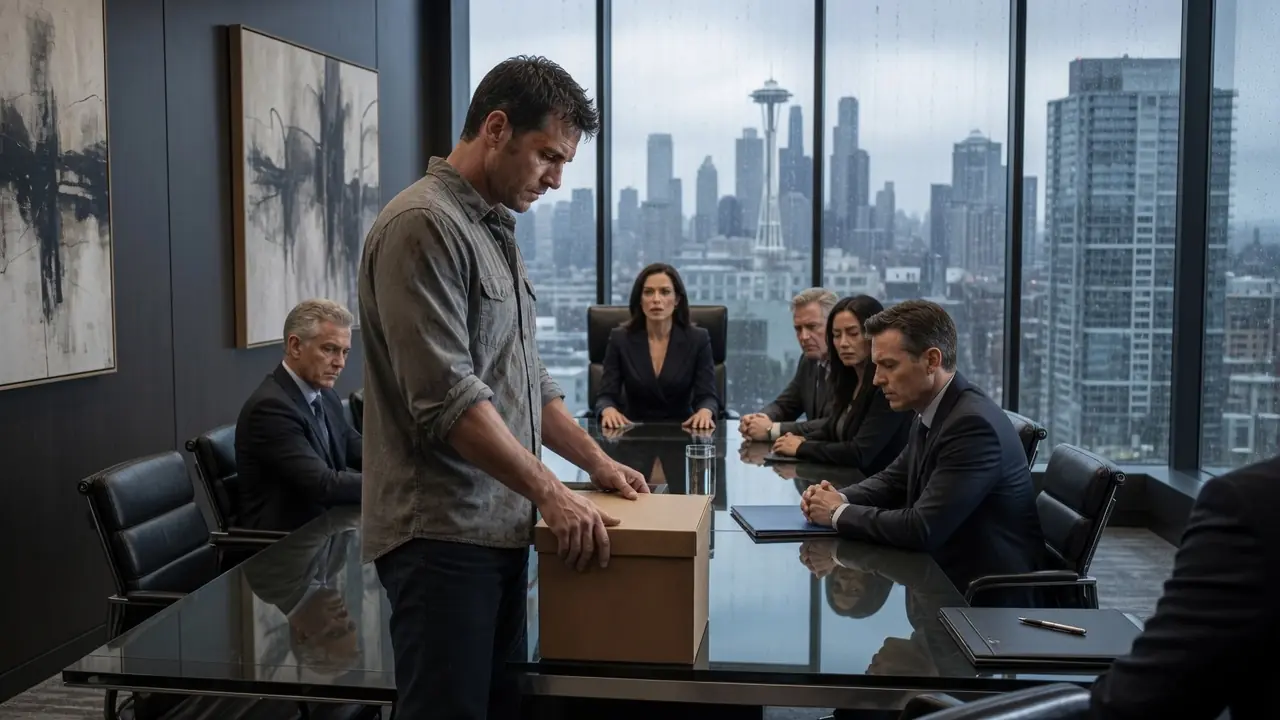
It was raining, which surprised nobody in Seattle, though this particular rain had been falling since before sunrise and had turned the concrete ramp slick and black. Rafe had parked on level P4 because employees at Calderon Systems were not allowed to use the spaces closer to the elevators. Those were reserved for clients, executives, and people whose names appeared on glass office doors. Rafe's name appeared nowhere. He was 38, broad-shouldered, usually tired, and worked as a facilities operations supervisor in a 42-story office tower owned by Voss Meridian Group.
His job title sounded better than the reality. Most days he dealt with broken access cards, leaking pipes, jammed loading docks, angry department heads, and employees who somehow believed a thermostat could be adjusted separately for every desk. He had been there six years. He was also raising his 9-year-old daughter, Tessa, alone. Every weekday morning began at 5:40.
Rafe made coffee, burned toast more often than he admitted, checked Tessa's backpack for unsigned school papers, and reminded her to brush the back teeth because she had developed a suspicious habit of brushing only the ones visible when she smiled. At 7:05, he dropped her at the before-school program. By 7:45, he was usually inside the tower checking overnight maintenance reports. His life was not tragic. He hated when people treated it that way.
It was simply tight. It was tight on time, tight on money, and tight on sleep. Tessa's mother, Corinne, had died four years earlier after a short illness that left behind hospital bills, a closet full of clothes. Rafe took almost a year to sort, and a little girl who still sometimes asked questions at bedtime because nighttime made old memories louder. Rafe earned enough to keep them steady if nothing unusual happened.
He chose the cheaper one. Then he put back the Parmesan. That was the kind of math his life had become. Which was why Mara Voss believed she understood him. At 43, Mara was the founder and majority owner of Voss Meridian Group, a logistics and commercial property company valued in the billions.
She was not flashy in the usual way. She drove a dark gray sedan, wore almost no visible designer logos, and disliked long lunches. Her reputation came from something else, mara noticed weakness. She could sit through a two-hour meeting, say very little, and remember exactly who had avoided a difficult question. She had built her company from a small freight routing business started in a rented office near Tacoma.
She understood debt, exhaustion, and risk because she had lived through all three. But success had changed one thing in her. She had stopped believing people when they said money was not the most important thing. That morning, Mara arrived at headquarters irritated before she even removed her coat. A major insurance audit had uncovered repeated safety documentation failures in three buildings.
The reports were not catastrophic, but they were serious enough to delay a refinancing package worth millions. Two senior managers immediately blamed the facilities teams. Rafe's name appeared in an email chain. At 9:20, he was called upstairs. The executive floor always made him uncomfortable.
The carpet was too quiet. The coffee was free, but served in cups so small he needed three of them. Even the trash cans looked expensive. Mara sat at the head of the conference table with four executives. Beside her was Preston Vale, the regional operations director, a polished man who had once sent Rafe a six-paragraph email because a lobby plant had been moved without approval.
Preston presented the problem neatly. There were missing inspection signatures, delayed repair logs, and incomplete vendor records. Then he suggested that Rafe's team had failed to follow procedure. Rafe listened without interrupting. He had learned that interrupting people with higher salaries rarely made them hear better.
When Preston finished, Rafe placed a worn blue folder on the table. Inside were copies of emails, work orders, and requests he had sent over the previous five months. He had repeatedly warned management that the building was understaffed. Two maintenance positions had remained vacant because Preston had frozen hiring to meet quarterly cost targets. A fire door contractor had been replaced with a cheaper vendor despite Rafe's objections.
Weekend inspections had been assigned to one technician covering three properties. The failures were real. But so were the reasons. Mara read several pages. Her expression barely changed.
Preston shifted in his chair and said the folder did not excuse incomplete records, rafe agreed. That seemed to irritate everyone more than an argument would have. He explained that his team had made mistakes because they were rushing, he included himself. Two weeks earlier, he had signed off on a generator inspection nearly 24 hours late because he had spent that evening at urgent care with Tessa after she fell during soccer practice. He did not mention that part in the meeting.
He simply said the late signature was his responsibility. Mara finally asked why he had not escalated the staffing problem directly to her office. Rafe looked around the room. Because, he explained, people at his level did not simply email billionaire owners when a regional director ignored them. There was a chain of command.
Breaking it could get a person labeled difficult, disloyal, or not a team player. The room became uncomfortable. Preston called that explanation cynical, rafe said nothing. Mara closed the folder. She should have ended the meeting there and investigated.
Instead, she made a mistake that would bother her for years. She took Rafe's calmness personally. Perhaps it was the bad morning. Perhaps it was the refinancing pressure. Perhaps it was because he had exposed a management failure without raising his voice, and she felt, for one ugly moment, that he was challenging her authority in her own conference room.
She told him that every employee believed his problems were unique, rafe's jaw tightened, mara continued. She said the company paid him well, provided health insurance, and had kept him employed through market pressure. If the conditions were truly as unreasonable as he claimed, he was free to leave. Rafe looked at her. One of the executives stared down at his notebook.
Then Mara said the sentence. She told him he wouldn't quit. Not with a child depending on him, not with bills. Not with the salary and benefits he needed. Her tone was controlled, almost casual.
"You need this job too much. " The silence afterward was different. Rafe did not look angry. That would have been easier, he looked disappointed. Then he noticed several flattened cardboard archive boxes stacked beneath a side table.
They had been left there after legal records were moved the previous week. He stood, took one, and began folding it. Mara watched his hands press the cardboard tabs into place. "What are you doing, " she asked, "Packing. " That was all.
He left the conference room and took the elevator to the 26th floor. For the first minute after he was gone, nobody spoke. Preston eventually said Rafe was being emotional. Mara turned toward him. Something about the word bothered her.
She opened the blue folder again. This time, she read it slowly. Downstairs, Rafe placed the box on his desk. His belongings looked embarrassingly small once he started gathering them. There was a stainless steel coffee mug, two screwdrivers he had brought from home, a framed photograph of.
Tessa missing her front tooth, a tiny ceramic frog she had made in second grade, three protein bars, and a phone charger with electrical tape wrapped around the cord, people began noticing. His assistant, Noreen Pike, stood beside his desk and asked if this was some kind of joke. Rafe shook his head, he felt sick. That was the truth nobody in the conference room could see. He was not making a brave, cinematic decision.
He was calculating rent in his head. He was thinking about dental payments. He was wondering whether his old pickup would survive long enough for him to take temporary work outside the city. His hands were actually trembling when he unplugged his desk lamp. But underneath the fear was something harder.
For months, he had watched his technician skip lunches. He had watched a 61-year-old electrician named Gus work a double shift because there was nobody else available. He had taken calls during Tessa's school play and once missed her entire Saturday soccer game because a loading dock sensor failed. He had accepted all of it because he needed the paycheck. Then Mara had looked directly at that need and used it as a leash.
Rafe could survive being tired. He could not teach his daughter that fear was the same thing as loyalty. Upstairs, Mara was still reading. The emails were worse than she first realized. Rafe had warned Preston repeatedly.
One message mentioned a technician working 13 consecutive days. Another requested emergency authorization to replace a failing pressure valve. Preston had denied the request, then approved decorative lobby renovations that same week. Mara asked her finance chief to pull staffing records. The numbers arrived quickly.
Preston had received a substantial performance bonus for reducing operating costs. Mara felt a cold heaviness in her stomach. She had designed that bonus structure, not Preston, her. She had rewarded managers for lowering costs and then acted surprised when they squeezed the people beneath them. Mara left the conference room.
By the time she reached the 26th floor, half the facilities department knew what had happened. Rafe was placing the ceramic frog into his box. Mara stopped several feet from his desk. People pretended not to watch. She could have ordered him into a private office.
She could have protected herself from embarrassment. Instead, she stood where everyone could see her. She told Rafe she had read the full file, he kept packing. She said she had been wrong. His hand stopped for a moment, then continued.
Mara was not used to apologies that failed to produce immediate relief. In her world, people often accepted whatever version of regret powerful people offered them, rafe did not. He told her quietly that the problem was bigger than one meeting, mara knew that. She asked him not to resign yet. He looked at the photograph of Tessa in the box, then at Mara.
For one uncomfortable second, she saw exactly what she had done. She had assumed his responsibilities made him weak. In reality, those responsibilities were the reason he had tolerated so much for so long. Rafe did not unpack. He handed in his badge that afternoon.
At 3:35, he drove away from the garage with the cardboard box strapped into the passenger seat because the bottom felt loose. Halfway home, he pulled into a gas station and sat there for 12 minutes. Then he called his older sister and admitted what he had done. She was silent for so long that Rafe checked whether the call had dropped. Finally, she asked if he had enough money for next month, he said probably.
It was not a convincing answer. That evening, Tessa found the box beside the kitchen table. Rafe tried to explain without making Mara sound cruel or himself sound heroic. He said he had left because work had become unhealthy and because sometimes adults waited too long to admit something was wrong. Tessa listened while eating cereal for dinner.
Then she asked the question he feared. "Are we going to lose the apartment? " Rafe told her he would do everything he could to prevent that. He did not promise more. The next weeks were difficult.
He applied for 14 jobs. Three companies never replied. Two offered salaries far below what he had earned. He picked up temporary maintenance work at a community theater and repaired a bakery's walk-in refrigerator for cash. He also started sleeping better.
He did not sleep perfectly, but he slept better. Meanwhile, Mara made changes that cost her company real money. Preston was dismissed after an internal review confirmed he had concealed staffing risks and altered reporting summaries. But Mara did not pretend firing one man solved everything. She removed the cost-cutting bonus formula she had approved.
She authorized the vacant maintenance positions. She met with frontline teams without their directors present. Those meetings were uncomfortable. People told her things she did not enjoy hearing, she listened anyway. Six weeks after Rafe quit, Mara called him.
He almost ignored the number. She did not offer him his old job, that mattered. Instead, she told him the company was creating an independent building safety and workforce operations unit. The role would report outside regional management and would have authority to stop work when staffing or maintenance conditions became unsafe. She wanted him to help design it.
Rafe asked about the salary. Mara gave him the number. It was higher than before, but not absurdly so. Then he asked the question she had not expected. "Will the technicians be allowed to report problems without retaliation?
" Mara said yes. Rafe told her he wanted it in writing. For the first time during the call, Mara laughed. Not because it was funny, but because she respected the answer. He returned two weeks later.
There was no grand welcome. No applause in the lobby. Most employees were too busy working. Noreen hugged him near the elevators and immediately complained that nobody had fixed the terrible coffee machine since he left. Gus handed him a stack of inspection reports.
Rafe placed the ceramic frog on his new desk. The cardboard box stayed in the trunk of his pickup for months. Life did not become perfect. Tessa still needed braces. The truck transmission finally failed in November.
Rafe and Mara still disagreed, sometimes sharply. Once, he sent her a three-line email telling her a new executive policy was written by someone who has never carried a toolbox, and Mara stared at it for 10 minutes before admitting he was right. But the company became a little better. Not because a billionaire saved a single father. And not because a single father taught a billionaire some magical lesson in one afternoon.
It became better because one person finally refused to keep pretending, and another person, after causing harm, chose not to defend her pride. A year later, Mara visited the 26th floor and noticed the old photograph of Tessa beside Rafe's computer. Next to it sat the crooked ceramic frog. She asked if he still had the box, rafe said yes. It was in his garage now, filled with old extension cords and Christmas lights, mara smiled.
Then she admitted something she had never told him. The moment he started folding that box, she had been certain he was bluffing. Rafe looked at her and said, "So was I. " That answer stayed with her. Because courage is often described as certainty, when in ordinary life it is usually nothing like that.
Sometimes courage is a frightened father driving home with no job, wondering how he will pay rent. Sometimes accountability is a powerful woman reading the same folder twice and finally seeing what she missed the first time. Rafe never framed his resignation letter. Mara never gave speeches about the day he quit.
They both understood that real change rarely arrives with perfect words or dramatic music. It begins in smaller ways with listening before judging, admitting when power has made you careless, and refusing to use someone's fear against them. And sometimes, the quietest lesson is this: kindness is not keeping people dependent on you and calling it generosity. It is giving them enough dignity to stand, enough honesty to choose, and enough room to walk away if they must.