The chains hit the front axle of the midnight blue Chevrolet with a sound that carried all the way down Sycamore Ridge Drive—a cold, scraping, metallic drag that seemed too loud for a Saturday morning in a neighborhood this quiet, this manicured, this certain of its own order.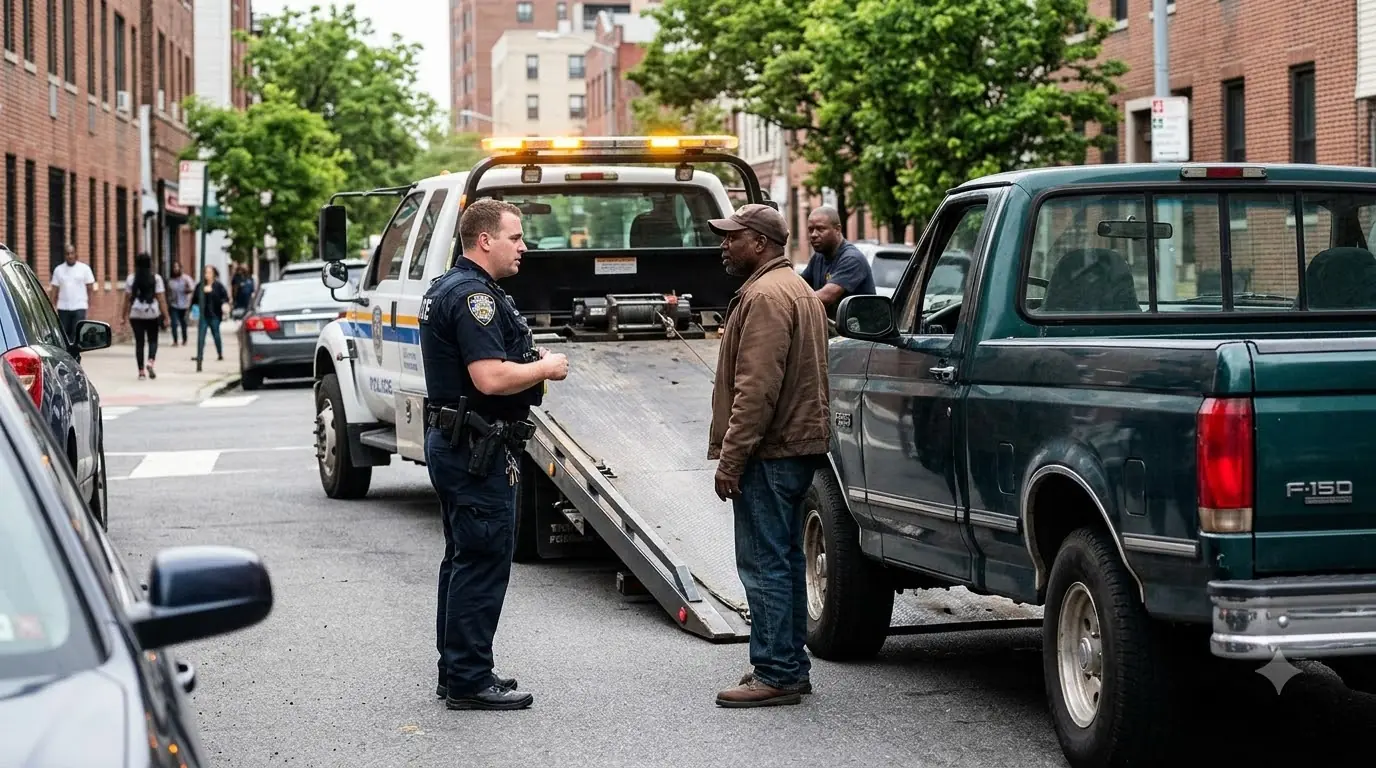
A Black man in his late 50s stood on the curb and watched it happen without moving, without raising his voice, without stepping forward a single inch toward the truck that had belonged to his father, and now belonged to him, and was at this moment being prepared for removal by a tow truck driver who kept glancing over his shoulder as if he already knew something was wrong. The man's hands were at his sides, loose and still, the paint-flecked work gloves he had been wearing tucked into the front pocket of his jeans. His face was the face of a man who had made a decision and was waiting for the world to catch up with it.
He could have stopped all of this in three seconds.
The credential case was in the glove compartment of the C20, eight feet from where he stood—a heavy leather fold worn smooth at the corners from years of use, containing a federal identification card and a gold shield that would have ended this encounter the moment it caught the light. Three seconds. A few words. And the officer standing at the edge of the driveway, with his chest puffed and his hand resting on his utility belt, would have stumbled backward through every excuse he had ever rehearsed.
He did not move toward the truck.
He had been watching men like this officer for 31 years: watching them from the bench, reading their reports, hearing their testimony, parsing the particular grammar of their justifications. And he knew, with the certainty that comes from that much accumulated attention, that this officer had done this before. Last month, or last week, or last Tuesday, to someone who did not have a federal shield in a glove compartment; to someone who lost the impound fee they could not replace, or spent a night in holding on a charge that dissolved in the morning, or simply stood exactly where this man was standing now and had no recourse at all.
That person deserved the same outcome as a federal judge.
Which meant the officer needed to finish the act completely, all the way to the end, on the record, with witnesses, with the radio still transmitting before anything else happened.
The chains tightened against the axle. The tow truck driver adjusted his grip on the winch controls and did not quite meet anyone's eyes. The officer crossed his arms and let a small, satisfied expression settle into his face.
Thomas Everett stood on the curb in his father's neighborhood—which was not his father's neighborhood at all, but that was the point—and waited for the rope to run out.
The morning had started the way Saturday mornings were supposed to start, which was to say it had started slowly and without urgency, with the kind of quiet that a man in Thomas Everett's position learned to treat as a finite and precious resource. He had been up at 5:30, not because anything required it, but because 31 years of federal court schedules had rewired his body's relationship with darkness, and sleeping past 6:00 felt like a kind of negligence he could not fully shake, even on the days when no one needed him to be anywhere.
He made coffee in the kitchen of his house on the west side of the city—the house he had lived in for 22 years, a solid brick colonial that his wife Eleanor had chosen, and that he had come to love in the particular way you love things that were chosen for you by someone with better instincts than your own. And he stood at the window while it brewed and looked out at the yard, where the oak tree his daughter had climbed as a child was losing the last of its October leaves in a slow, unhurried cascade.
Eleanor had been gone for six years. The oak tree was doing fine.
By 6:15, he was at the Home Depot on Fairfield Avenue, loading the bed of the 1971 Chevrolet C20 with the supplies Dara's contractor would need Monday morning: six boxes of specialty mortar, two bundles of steel anchor hardware, a pair of heavy load-bearing brackets rated for commercial signage. He worked with the economical efficiency of a man who has loaded truck beds before, who knows how weight distributes, who checks the tie-downs twice without being told to.
The C20 was midnight blue, a color so dark it read as black in shadow and revealed its true depth only in direct light, when the paint seemed to hold the sky inside it. The restoration had taken 11 years, not because the work was constant, but because it was deliberate; because the man doing it had not been in any hurry, and had believed that a thing done correctly was worth more than a thing done quickly, and that patience was not the same as procrastination, and that some projects were not really projects at all, but were instead ongoing conversations with someone who was no longer alive to answer.
That man was Raymond Everett, Thomas's father, who had spent 40 years repairing other people's vehicles in a shop on the south side of the city, and had driven a succession of second-hand cars his entire life because the money that might have gone towards something better always found a more urgent destination: school fees, rent, clutches, the particular emergencies that organize themselves around working-class families with reliable frequency. Raymond had worked three jobs when Thomas was in law school. He had not complained about this—not once, not in Thomas's hearing—because complaining about a thing you chose was not in Raymond's vocabulary. He had chosen to send his son to law school the way you choose to plant a tree, with the full understanding that you might not sit in its shade yourself.
Raymond found the C20 in a salvage yard in 1987, paid $300 for it, towed it home on a borrowed trailer, and spent the next 11 years of Saturdays in the garage bringing it back to something that worked, and then to something that was beautiful, and then to something that was both. He drove it for eight years after the restoration was finished—not every day, only on Saturdays, only when the weather permitted, only with the windows down. And when he died at 72, the truck passed to Thomas along with a set of wrenches, a box of maintenance records written in Raymond's careful block handwriting, and the understanding that some inheritances were not about money.