On May 22, 2022, Pastor Michael Jennings of Vision of Abundant Life Ministries in Sylacauga, Alabama, was watering flowers at his out-of-town neighbors' home in Childersburg, Alabama, when Officer Chris Smith, Officer Jay Gable, and Sergeant Jeremy Brooks of the Childersburg Police Department responded to a 911 call. Another neighbor, Amber Roberson, had reported that a younger Black man and a gold SUV she did not recognize were at the house while the owners were away. Officer Smith parked his vehicle and approached Pastor Jennings before either of the other officers arrived.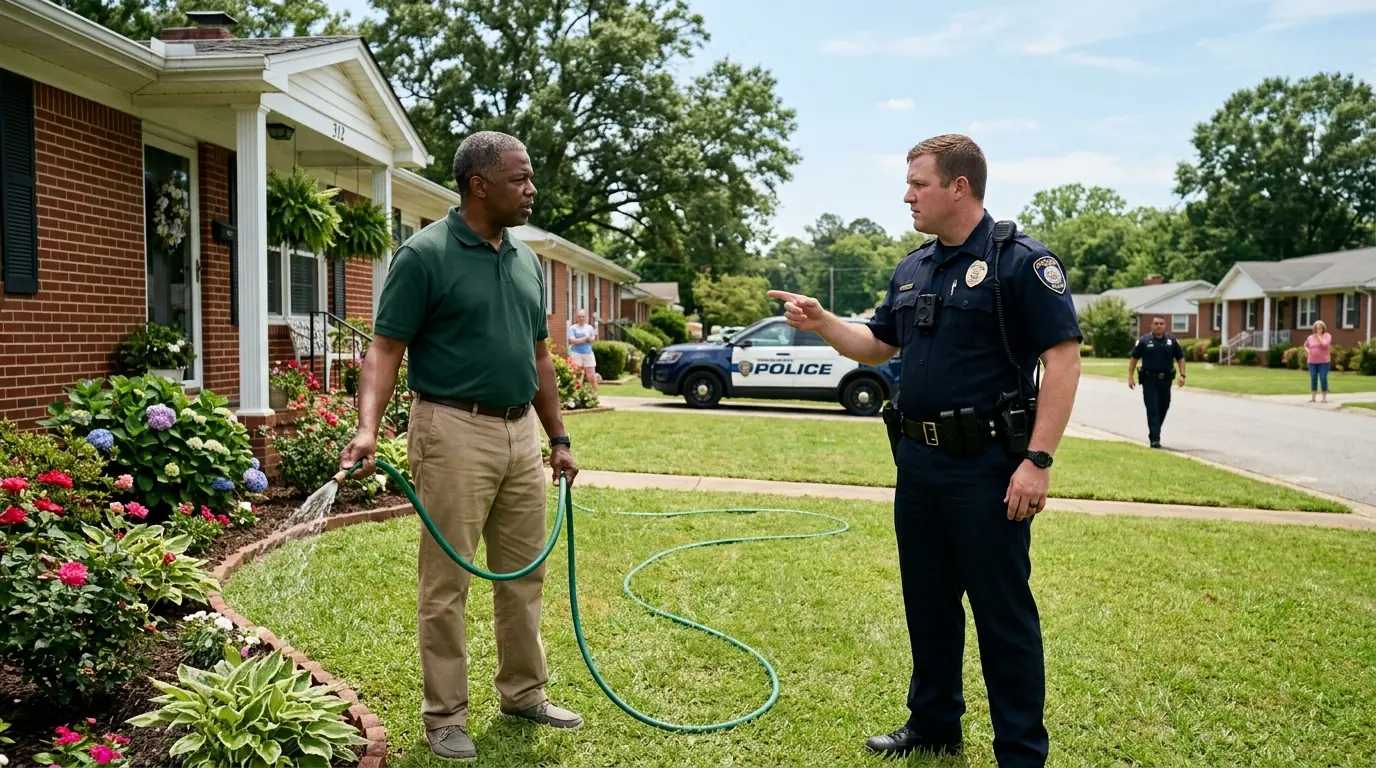
"What are you doing here, man?" Officer Smith asked.
"Watering flowers," Jennings replied.
Smith asked whether the vehicle in the driveway belonged to him. Jennings said it did not and explained that it belonged to the neighbors. Smith asked whether Jennings lived there.
"No, I don't live here. I'm supposed to be here. I'm Pastor Jennings. I live across the street. I'm looking out for their house while they're gone."
Smith acknowledged the explanation, then asked whether Jennings had identification.
"No, man. I'm not going to give you any ID," Jennings said.
"Why not?"
Smith told him there had been a report of a suspicious person. Jennings responded that he had once been a police officer in Goodwater and again emphasized that he lived across the street and was simply taking care of his neighbors' property.
"Don't do this to me," Jennings said. "I'm not showing you anything. If you want to lock me up, lock me up and see what happens."
As the encounter escalated, the officers repeatedly told Jennings to stop moving around and talk to them. One officer warned that he could face an obstruction charge if he kept walking away. Jennings told them to do whatever they felt they had to do.
Officer Gable then became more forceful, insisting that because the officers had received a call about Jennings, he was required to identify himself. Jennings disagreed.
"You have a call on you, right? You have to identify yourself to me," Gable said.
"No, I don't," Jennings replied.
Jennings repeatedly tried to return the conversation to the same point: he had already told them who he was, where he lived in relation to the property, and why he was there. He asked who had called. The officers did not give him a meaningful answer beyond saying that they were responding to a suspicious-person complaint. When one officer told him to come back and talk, Jennings responded that he did not want to argue and again said that if they believed they had grounds to arrest him, they should do what they were going to do.
"I live right across the street," Jennings said. "I told you I'm a pastor."
The officers continued telling him to stop walking and stay where they wanted him. One warned, "You're going to catch an obstruction charge if you keep walking around." Jennings answered, "You can do whatever you want. Do it." The exchange was tense, but the central factual explanation never changed: he was watering flowers for neighbors who were away.
At one point the officers tried to characterize the issue as Jennings refusing to identify himself at all. Jennings pushed back, reminding them that he had already said, "I'm Pastor Jennings," and told them he lived across the street. The disagreement was no longer about whether he had spoken to police. It was about whether he could be compelled to produce a physical identification card merely because officers had received a call.
That assertion became one of the central legal issues in the encounter. Officers cannot arrest a person merely for refusing to provide physical identification unless the circumstances satisfy the legal requirements for detention and the applicable state law requires the person to identify themselves under those circumstances. Alabama's stop-and-identify statute, Section 15-5-30 of the Alabama Code, provides that an officer may stop a person abroad in a public place whom the officer reasonably suspects is committing, has committed, or is about to commit a felony or other public offense. Under those circumstances, the officer may demand the person's name, address, and an explanation of their actions.
Although Jennings was standing on private property when police approached him, that fact alone does not necessarily mean he was outside a "public place" for purposes of the statute. In the 1983 case Schultz v. State, the Alabama Court of Criminal Appeals considered a vehicle in an open cotton field on private property to be in a public place for purposes of Section 15-5-30 because the vehicle's headlights and movement were plainly visible from the public roadway from which deputies observed it. Applying that logic, a court could conclude that Jennings was in a public place for purposes of the statute because he was close to the street and plainly visible from the roadway.
However, even if the location satisfied that part of the statute, officers still needed reasonable suspicion that Jennings was committing, had committed, or was about to commit a felony or other public offense before they could lawfully detain him under Section 15-5-30. And even if that standard had been satisfied, the statute authorized officers to demand his name, address, and an explanation of his actions. It did not authorize a demand that he physically hand over an identification card.
Jennings had already provided substantial identifying information within the first moments of the encounter. He said he was Pastor Jennings, explained that he lived across the street, and stated that he was watching the house and watering the flowers while the owners were away. Although he had not initially given his first name or recited an exact street address, the officers did not simply ask him to complete that information. Instead, they repeatedly demanded physical identification.
As more officers arrived, the situation became increasingly tense. Smith explained to the others that he had seen the gold SUV and found Jennings outside. He said Jennings told him the SUV belonged to the neighbors and that Jennings lived nearby. Meanwhile, Amber Roberson, the neighbor who had called police, came into the conversation.
She was asked whether she knew Jennings.
"Yeah," she said, indicating that he lived nearby.
The officers asked whether he might have permission to be at the property watering flowers.
"He may, because they are friends," she said. She explained that the homeowner had gone out of town and that Jennings might indeed be watering the flowers. "It could be completely normal."
Roberson also made clear that she was the person who had initiated the call and seemed increasingly concerned that an innocent situation had escalated. She explained that she had seen the gold SUV and Jennings outside but had not initially recognized him. Once she came closer and understood who was involved, she told officers that Jennings did in fact live nearby and that he was friends with the people who owned the house. She described the possibility that he was watering their flowers as entirely normal.
The officers then tried to identify the homeowners. Roberson referred to Roy Marlowe, the owner of the vehicle, and Connie, his wife. Jennings explained that he knew them and had dealt with them for years.
"That's who lives here," Jennings said. "I call him Roy, and I call his wife Connie. I've been dealing with them for seven years that I've been living here. I've got to keep their flowers watered while they're gone."
The body-camera conversation reflected a striking shift. The person who had called police was now confirming the very explanation Jennings had given from the beginning. Nevertheless, the officers continued framing the problem as his failure to comply with their demand for physical identification rather than asking whether the original basis for suspicion still existed.
One officer told Jennings that the entire encounter could have ended quickly if he had simply handed over identification at the start. Jennings responded that he had identified himself verbally and that officers were treating the production of a document as though it were automatically required. The officers continued to insist that because a call had been made, they were entitled to verify anyone involved.
Even with the neighbor corroborating the innocent explanation, an officer continued insisting that Jennings should have provided identification immediately.
"Anytime the police come out and they say we want to identify you, you have to identify yourself because there's reasonable suspicion," the officer told him.
Jennings rejected that explanation and said the officers were wrong about the law.
Officer Smith again claimed that they had reasonable suspicion but did not identify a specific crime that they reasonably suspected Jennings of committing. That distinction matters. In United States v. Sokolow, the United States Supreme Court explained that reasonable suspicion is evaluated based on the totality of the circumstances rather than a rigid checklist. And in Navarette v. California, the Supreme Court explained that information supplied by another person, including a 911 caller, can in appropriate circumstances create reasonable suspicion even when the officer did not personally observe the underlying conduct.
But Navarette also makes clear that a 911 call is not automatically sufficient. Even a reliable tip must indicate facts that create reasonable suspicion that criminal activity may be afoot. The mere existence of a call does not itself transform otherwise innocent conduct into suspected criminal conduct.
Depending on the circumstances, a report of an unknown person at another person's property could create reasonable suspicion of crimes such as trespass. Alabama Code Section 13A-7-4 provides that a person commits criminal trespass in the third degree when the person knowingly enters or remains unlawfully in or upon premises. Section 13A-7-1 explains that a person enters or remains unlawfully when they are not licensed, invited, or privileged to be there, and defines premises to include buildings and real property. Alabama Code Section 13A-11-32 separately addresses criminal surveillance while trespassing in a private place.
However, Officer Smith's own observations quickly became important. He approached and saw a man openly watering flowers. Jennings immediately explained that he lived across the street, that the property belonged to friends who were away, and that he was taking care of the house for them. The neighbor who had called police then confirmed that Jennings lived nearby and that the homeowners were his friends, making the innocent explanation even stronger.
Reasonable suspicion does not require officers to eliminate every possible innocent explanation before conducting a brief investigative stop. Still, the circumstances supporting suspicion can dissipate as officers obtain new information. Here, the visible act of watering flowers, Jennings's immediate explanation, and Roberson's confirmation all weighed heavily against the theory that he was unlawfully on the property.
The encounter nevertheless continued. Jennings accused the officers of racial profiling. The officers denied that characterization and tried to move the conversation back to what they called a routine identification process. Jennings continued saying that they had no lawful reason to run him through government databases simply because a neighbor had called about a person she did not recognize.
The body-camera footage also captured the officers discussing how much identifying information they wanted. Jennings gave his name and date of birth, but when the conversation moved toward his Social Security number, he refused. He objected specifically to being "run" through the system without a legitimate reason.
At some point, the officers sought more identifying information and discussed obtaining his Social Security number.
"You need to give me your Social Security," an officer said.
Jennings refused, saying he was not going to allow them to run him through the system for no reason.
After Jennings had already been restrained, the officers began talking among themselves about what offense might fit the situation. The discussion did not sound like officers articulating a crime they had identified before the arrest. Instead, it sounded like a search for a charge that could justify an arrest already made.
One officer suggested disorderly conduct. Another rejected that direction and moved toward obstruction of governmental operations. They discussed using the lowest available bond or fine level so they would not be "overcharging" him. One officer even remarked that Jennings seemed like a reasonable person, underscoring the disconnect between that assessment and the decision to take him to jail.
The officers then began discussing what offense they could charge him with. One suggested disorderly conduct. Another moved toward obstruction of governmental operations.
"What's the charge?" one asked.
"Obstruction. I'll just do obstruction of governmental operations," came the response.
This discussion occurred after Jennings had already been placed under arrest, and it raised another major legal issue. Alabama Code Section 13A-11-7 defines disorderly conduct through specific conduct. A person must act with the intent to cause public inconvenience, annoyance, or alarm, or recklessly create a risk of it, and then engage in conduct described by the statute. Those categories include fighting or violent, tumultuous, or threatening behavior; making unreasonable noise; using abusive or obscene language or making an obscene gesture in a public place; disturbing a lawful assembly or meeting without lawful authority; obstructing vehicular or pedestrian traffic or a transportation facility; or congregating with others in a public place and refusing a lawful order to disperse.
Nothing shown in the encounter remotely resembled most of those categories. Jennings was argumentative at points, but disagreement with officers does not itself satisfy the elements of disorderly conduct. He did not fight, threaten anyone, block traffic, disrupt an assembly, or refuse a dispersal order. That helps explain why the officers moved away from disorderly conduct and toward obstruction.
Alabama Code Section 13A-10-2 provides that a person commits obstructing governmental operations if, by means of intimidation, physical force or interference, or another independently unlawful act, the person intentionally obstructs, impairs, or hinders the administration of law or another governmental function, or intentionally prevents a public servant from performing a governmental function.
The phrase "governmental function" is crucial because Alabama law defines it as an activity that a public servant is legally authorized to undertake on behalf of government. In Kleinschnitz v. Phares, a 2013 decision from the United States District Court for the Middle District of Alabama, the court explained that a public servant must be legally authorized to undertake the action in question before interference with that action can constitute obstruction. In other words, the obstruction statute does not transform resistance to an unauthorized government action into obstruction merely because the person taking that action is a public servant.
Accordingly, if a court concluded that the officers lacked reasonable suspicion to detain Jennings, then the officers' effort to compel identification could not itself become the lawful governmental function needed to support an obstruction charge. There was an additional problem: Jennings had not actually refused to identify himself in the ordinary sense. He had told the officers he was Pastor Jennings, said he lived across the street, later provided his name and date of birth, and explained exactly why he was on the property. What he refused to do was produce physical identification and provide a Social Security number.
Because Section 13A-10-2 requires obstruction by intimidation, physical force or interference, or some other independently unlawful act, simply declining to provide physical identification when the law did not require it would not by itself satisfy that element. Even if officers had possessed reasonable suspicion for a temporary detention, the statute they repeatedly referenced did not automatically require Jennings to hand over an identification card or a Social Security number.
The body-camera discussion after the arrest further illustrated the officers' misunderstanding. One officer said the entire situation could have been avoided if Jennings had simply handed over identification. Another acknowledged that Jennings had eventually identified himself but continued to justify the arrest by saying he had walked away during the investigation.
The officers also spoke as though the fact that they were "investigating a call" created its own independent power to compel identity. That reasoning blurred the distinction between a consensual encounter, an investigative detention, and an arrest. Police are free to approach a person and ask questions without suspicion, and a person is generally free to decline during a consensual encounter. To convert the encounter into a detention, officers need the constitutional justification required for that seizure. To make an arrest, they need probable cause for an offense.
The significance of Jennings walking around the yard therefore depended on whether he was already lawfully detained. If the officers lacked reasonable suspicion at the point they ordered him to remain, his decision to continue moving around would not automatically create lawful authority that did not exist before. The source's analysis treated the officers' repeated attempt to use his noncompliance as the justification for the very detention he was resisting as circular reasoning.
At another point, officers spoke with Roberson and explained that Jennings would be taken to the Childersburg Police Department, processed on a charge related to obstruction of their investigation, taken to jail, and then could bond out. Roberson asked questions and indicated that the situation appeared to be a mistake, but the officers responded that Jennings had already been arrested. One officer said that once they had made the arrest, they could not simply undo it on the scene.
The conversation was notable because it occurred after Roberson had essentially validated Jennings's explanation. She knew the homeowners. She knew Jennings. She said the owners were away and that Jennings might be watering their flowers for them. Even then, the officers' attention remained on his refusal to produce the particular form of identification they wanted rather than on whether there was still any suspected crime to investigate.
They repeatedly characterized their presence as an investigation of a call rather than an investigation of a specific crime.
"We're not investigating a crime. We're investigating a call, and we have a right to identify anybody involved," an officer said.
That statement captures the core legal problem. Police may investigate calls, speak to witnesses, and conduct consensual encounters without reasonable suspicion. But a 911 call alone does not automatically create authority to detain every person connected to it. The constitutional question becomes whether the facts known to the officers created an objective, particularized reason to suspect criminal activity.
The officers also said that once they had arrested Jennings, they could not simply "un-arrest" him even if the neighbor's explanation showed that the situation was a mistake. One officer explained the situation to Roberson in procedural terms: Jennings would go to the Childersburg Police Department, an arrest report would be processed, he would be taken to jail on the obstruction charge, and he could bond out quickly. The administrative path had become more concrete than the criminal suspicion that was supposed to justify it.
That position did not resolve the legality of the initial arrest. Whether the officers had authority to arrest Jennings depended on what facts and legal justification existed at the time the arrest occurred, not on the administrative inconvenience of reversing the decision afterward.
Before leaving the scene, the officers continued explaining their theory to Roberson and to one another. They said they had arrived because someone reported a suspicious person and vehicle, that they had a right to determine who was involved, and that Jennings had made the situation harder by refusing the kind of identification they demanded. They repeatedly returned to the idea that the arrest could have been avoided if he had simply handed over a document at the beginning.
Roberson, however, had already supplied the missing context. The vehicle belonged to the homeowners. Jennings lived across the street. He had known the family for years. The homeowners were away, and watering their flowers was consistent with the relationship she knew them to have. The original suspicion was therefore no longer being evaluated in isolation; it had been tested against on-scene information, much of which pointed toward innocent conduct.
One of the officers nevertheless summarized the situation by saying they were not investigating a crime but were investigating a call. The source highlighted that statement because it exposed the core confusion. Officers certainly have authority to respond to and investigate a call, but constitutional authority to detain or arrest a person still depends on the legal standards governing seizures. The existence of a call does not erase those standards.
Jennings also remained consistent about what he was refusing. He did not conceal his identity and disappear into silence. He identified himself as Pastor Jennings, said where he lived relative to the house, described his relationship to the property owners, and later provided his name and date of birth. What he objected to was the officers' insistence that he surrender physical identification and a Social Security number when, in his view, they had no lawful basis to demand either.
Immediately after the incident, Jennings was taken to jail and charged with obstructing governmental operations. A few days later, on June 2, 2022, Childersburg Police Chief Richard B. McClelland issued a statement announcing that he had asked for the charge to be dropped. McClelland stated that he had reviewed the 911 call and body-camera footage and interviewed Officer Smith, Officer Gable, and Sergeant Brooks. As a result of that review, he recommended that the municipal judge dismiss the warrant with prejudice, and the charge against Michael Jennings was dismissed.
The source also noted that Chief McClelland resigned on August 11, 2022, several months after his involvement in a single-vehicle traffic accident. According to the crash report referenced in the original analysis, there was a strong odor of an alcoholic beverage inside the vehicle, and the investigation had been referred to the Alabama Attorney General's Office. That information was presented in the source as separate background concerning the chief and was not part of the legal basis for Jennings's arrest.
At the time the original episode was written, Jennings was represented by counsel and was preparing to file a federal lawsuit in the Northern District of Alabama, but the source stated that no lawsuit had yet been filed as of that writing. The later status of any litigation is outside the scope of this cleaned transcript.
The analysis ultimately gave the Childersburg officers an F for arresting Jennings when the source concluded he had committed no crime, for demanding physical identification when the law did not require it, and for maintaining a hostile and aggressive demeanor throughout the interaction. The grade also reflected the officers' repeated insistence that a 911 call itself created sufficient reasonable suspicion, even though the governing legal framework requires consideration of the particular facts suggesting criminal activity.
The source emphasized that reasonable suspicion is not a magic phrase officers can invoke after the fact. It is an objective standard that must arise from specific, articulable facts viewed under the totality of the circumstances. A caller's report can contribute to that analysis, but the reliability and content of the report matter, and so does everything the officer learns after arriving. If the officer's own observations and reliable information gathered on scene undermine the suspected criminal explanation, those developments matter too.
The criticism also focused on the distinction between identifying oneself and producing identification. Section 15-5-30 refers to a person's name, address, and explanation of actions. The officers repeatedly treated that statute as though it gave them a blanket right to demand a physical ID card and Social Security number from anyone named or described in a call. The source concluded that this was an expansive and legally inaccurate understanding of their authority. The criticism focused particularly on what the source described as fundamental misunderstandings of reasonable suspicion, the authority to identify a person, and the information an individual can be compelled to provide during an investigation.
Throughout the encounter, the officers repeatedly claimed that receiving a 911 call gave them authority to detain and identify Jennings. They told him he was required to provide physical identification and even sought his Social Security number. The source's legal analysis rejected that interpretation, emphasizing that reasonable suspicion requires more than the mere fact that someone made a call and that Alabama's stop-and-identify statute does not give officers unlimited authority to demand documents from a person who has not been shown to be involved in criminal activity.
The source strongly urged the officers to study and understand the constitutional limitations on their authority. It criticized not only the final arrest decision but the reasoning heard throughout the footage: the assumption that a call creates reasonable suspicion by itself, the conflation of a verbal identity with a requirement to produce an identification card, and the effort to turn resistance to those demands into an obstruction offense. The analysis emphasized that constitutional policing requires officers to identify the offense they reasonably suspect, explain how the known facts relate to it, and adjust their assessment when new information undermines the original suspicion.
It gave Jennings an A+ for remaining relatively calm, explaining from the beginning that he was Pastor Jennings and lived across the street, refusing to provide physical identification when he believed the law did not require it, and continuing to defend his position despite the threat and reality of arrest. His tone became frustrated and confrontational at points, but the source viewed that frustration in the context of an encounter where he had immediately supplied an innocent explanation and watched it repeatedly dismissed.
The source also credited him for pursuing civil legal remedies after the criminal charge was dropped. The dismissal eliminated the pending obstruction case, but it did not by itself answer whether the arrest violated his constitutional rights. That distinction was why the prospect of a federal civil action remained significant in the original analysis.
When Officer Smith first approached, Jennings immediately gave an explanation for his presence: he was watering the flowers for friends who were out of town. The neighbor who made the call later confirmed the relationship and said his presence could be completely normal. What began as a suspicious-person call therefore became a dispute not over what Jennings was doing, but over whether officers could compel him to prove his identity by producing documents after the innocent explanation had already been made clear.
That distinction is the central issue running through the entire encounter: police may investigate suspicious circumstances, but investigative authority has constitutional and statutory limits. A person's refusal to surrender more information than the law requires does not automatically create the crime needed to justify an arrest, and an officer's decision to continue escalating does not retroactively supply the reasonable suspicion or probable cause that was missing at the beginning.