"Life imprisonment. No parole. No appeal." "Your Honor, please. I didn't do this." "Be quiet." Judge Harrison Cole slammed his gavel, his lips curling into a grin. "People like you are all the same. Lying, stealing, wasting my court's time."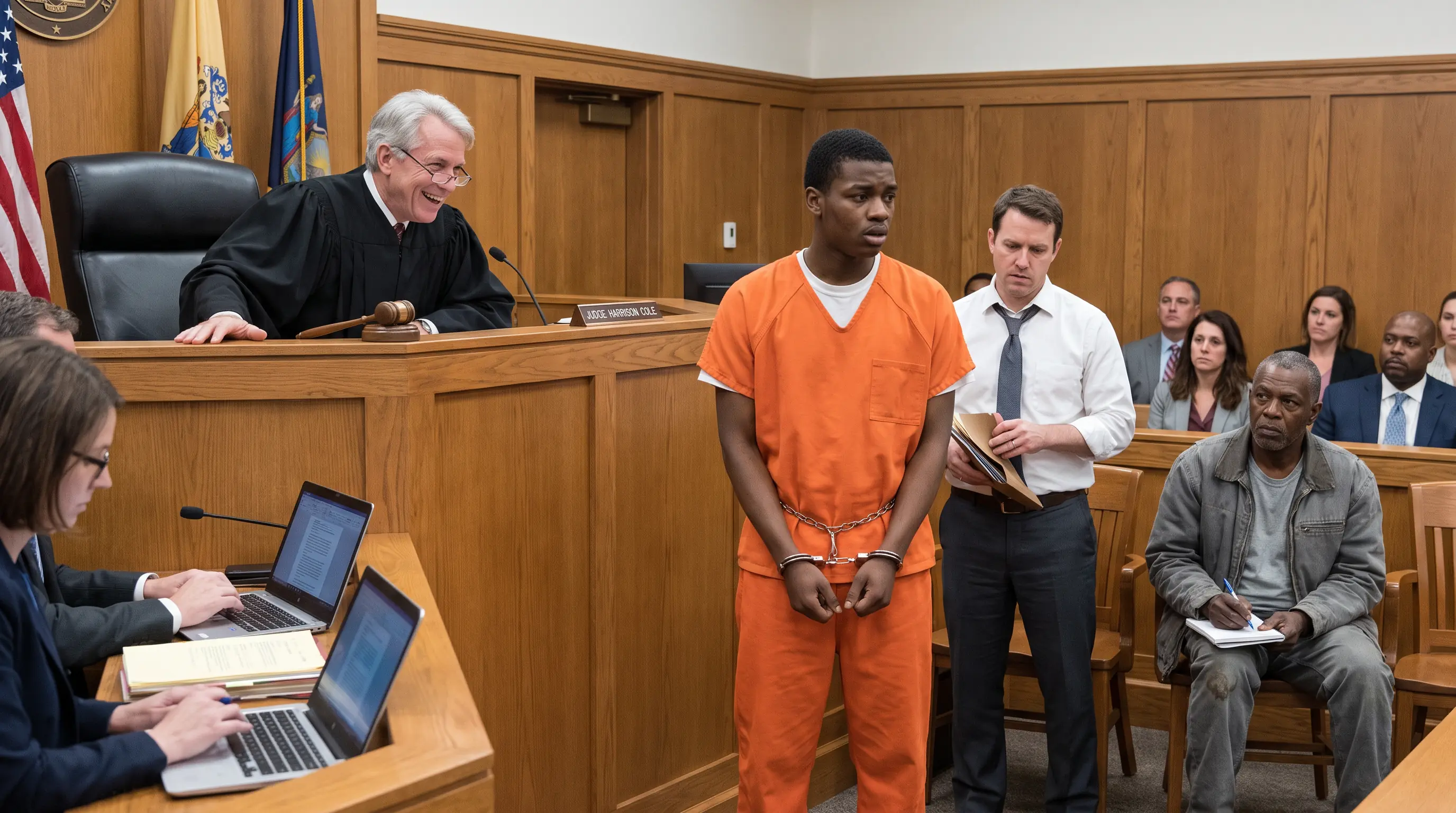
Wesley Adams stood in chains. He was 19, trembling but silent. "Look at you standing there like you deserve mercy. You disgust me." The gallery froze. A reporter stopped typing. Cole laughed openly and shamelessly, the sound bouncing off the oak walls as though it belonged there. "Someone like you doesn't deserve a second."
But in the last row, a man in a worn gray jacket slowly closed his notebook. His jaw locked, and his eyes fixed on the judge like a blade. Not a single soul in that courtroom knew what was coming next. Three weeks earlier, a pharmacy on the corner of Elm and 14th had been robbed at gunpoint. The thief wore a black hoodie. He was tall. He was Black. That was the description: three details and nothing more. No face, no name, no fingerprints. Just a hoodie, a height, and a skin color. Detective Neil Granger caught the case. He had 22 years on the force and a clearance rate he protected like a second pension. Within 48 hours, he made an arrest: Wesley Adams, a freshman engineering student at Penfield State, picked up three blocks from the pharmacy while walking home from the campus library.
Wesley had no weapon, no stolen goods, no mask. He was wearing a black hoodie. That was enough. Now, inside Courtroom 7 of the Camden County Superior Court, the State of New Jersey was presenting its case. The fluorescent lights hummed overhead. The wooden benches creaked under the weight of two dozen spectators, most of them strangers, a few reporters, and one sketch artist whose charcoal pencil never stopped moving. Prosecutor Brenda Marsh stood at the lectern, her voice measured and her posture stiff. She addressed the jury like a professor reading from a textbook: dry, factual, deliberately unemotional.
"On the night of September 14th," Marsh began, "at approximately 9:32 p.m., an armed individual entered Bennett's Pharmacy on Elm Street. He demanded cash and controlled substances. He brandished a firearm. He fled on foot, heading east." She clicked a remote. A grainy surveillance image filled the screen: a figure in a black hoodie, face obscured by shadow, standing at the pharmacy counter. The timestamp read 9:32 p.m. The image was so blurred that the person could have been anyone. "The suspect was described as a Black male, approximately six feet tall, wearing a dark hooded sweatshirt," Marsh continued. "Three blocks east of the pharmacy at approximately 9:51 p.m., officers located the defendant, matching that description." She paused and let the silence work. Three jurors leaned forward. Two others glanced at Wesley. One looked away.
"The defendant had no alibi that could be independently verified at the time of arrest. He was the only individual in the area matching the suspect's description. The State maintains that the evidence, taken together, establishes guilt beyond a reasonable doubt." In the front row of the gallery, a woman clutched a rosary. A man beside her stared at the floor. Wesley sat at the defense table, his wrists still red from the cuffs they had removed minutes ago. His public defender, Derek Sutton, shuffled papers without looking up. His tie was loosened. His briefcase sat open, spilling folders that looked like they had been assembled in a hurry, because they had been. Sutton had been assigned the case 72 hours ago. He had met Wesley once for 11 minutes in a holding cell that smelled like bleach.
Detective Granger took the stand next. He unbuttoned his jacket, adjusted the microphone, and settled in like a man who had done this a hundred times. His badge caught the overhead light. His answers came quickly, rehearsed and polished from years of courtroom repetition. "I responded to the dispatch call at approximately 9:35," Granger said. "A witness at the scene described the suspect as a tall Black male in a black hoodie fleeing eastbound on Elm. I established a perimeter. At 9:51, I observed the defendant walking southbound on Camden Avenue, three blocks from the pharmacy." "And what drew your attention to him?" Marsh asked.
"He matched the description. Black male, approximately six-one, black hooded sweatshirt." "Did you observe anything else?" "He appeared nervous. He was walking quickly." Wesley's jaw tightened. He had been walking quickly because it was late and cold and he had a thermodynamics exam in the morning. The nervous part was Granger's invention, a word officers learned to attach to anyone they needed a reason to stop.
The arrest report was four paragraphs. Wesley's life was reduced to a description that could have matched thousands of men in New Jersey. Judge Harrison Cole sat above it all, his reading glasses perched on the tip of his nose and his silver hair combed back in precise lines. He watched the proceedings with the half-interested expression of a man reviewing restaurant receipts, but every now and then his gaze drifted to Wesley, and when it did, something shifted in his face: a slight curl of the lip, a narrowing of the eyes. It was subtle, practiced, the kind of contempt that hides behind procedure. When Derek Sutton rose to cross-examine Granger, Cole leaned forward. "Mr. Sutton," he said before the lawyer could speak, "let's keep this efficient. The court's calendar is full."
Sutton blinked. "Your Honor, I have substantive questions regarding the identification process." "Then ask them quickly." Sutton turned to Granger. "Detective, how many Black males between five-ten and six-two were within a ten-block radius of the pharmacy that night?" Granger hesitated. "I couldn't say."
"You couldn't say because you didn't check. You saw a Black man in a hoodie and you stopped looking." "Objection," Marsh said. "Argumentative." "Sustained," Cole said immediately. "Move on, Mr. Sutton." Sutton tried again. "Detective, the surveillance footage. Does it show the suspect's face?"
"No." "Does it show any distinguishing features? Tattoos, scars, birthmarks?" "The resolution wasn't sufficient, so no." "And yet you're certain my client is the individual in that footage."
"He matched the general description and was found in the vicinity." "Walking on a public street. That's your case." Cole's gavel came down hard. The sound cracked through the room like a gunshot. "Mr. Sutton, I've warned you. One more grandstanding question and I'll hold you in contempt."
A murmur rippled through the gallery. Sutton swallowed. He looked at Wesley. Wesley looked back at him with the expression of someone who already understood what was happening: this courtroom had made up its mind before he ever walked through the door. In the back row, the man in the gray jacket had not moved. He sat perfectly still, a small leather notebook open on his knee. His pen moved in short, precise strokes. He wrote down the time Cole sustained the objection. He wrote down the exact words Cole used to threaten Sutton. He noted the surveillance image: no face, no features, no positive identification.
He underlined one phrase twice: "People like you are all the same." Cole had said it openly from the bench without hesitation. The man in the back row had heard words like that his entire career. He had spent 30 years making sure they carried consequences. The morning session ended at 11:45. The jury filed out. Wesley was led back to the holding room in handcuffs. Sutton gathered his files with shaking hands. Marsh packed her briefcase with the calm precision of someone who believed the verdict was already written. And in the last row, the man in the gray jacket closed his notebook, slipped it into his breast pocket, and remained seated. He did not leave for lunch. He did not check his phone. He sat and waited.
Because Raymond Adams had not come to Camden County to eat. He had come to watch, to document, to see with his own eyes whether the system he had sworn to protect would protect his son. So far, it had not. The afternoon session began at 1:15. Wesley was brought back through the side door. His orange jumpsuit was creased where he had been sitting on a metal bench in the holding room for 90 minutes. He had not eaten. The sandwich they offered him sat untouched on a paper plate because his stomach had been in knots since six that morning. Derek Sutton called his only witness, Wesley Adams.
Wesley stood. The chain between his ankles clinked against the floor as he shuffled to the witness stand. He placed his left hand on the Bible and raised his right. His fingers trembled, but his voice did not. "I swear to tell the truth, the whole truth, and nothing but the truth." "State your full name for the record," Sutton said. "Wesley James Adams."
"How old are you?" "Nineteen." "Where were you on the night of September 14th between nine and ten p.m.?" Wesley took a breath. "I was at the Penfield State Library, third floor, engineering section. I was studying for a thermodynamics exam scheduled for the next morning."
"What time did you leave the library?" "Around 9:20, maybe 9:25. I packed up my notes, put my laptop in my bag, and walked out the main entrance. Then I walked south on Camden Avenue toward my dorm. It's about a 15-minute walk. I had my earbuds in. I was listening to a lecture recording, Professor Whitman's review session on heat transfer equations." Sutton nodded. "Did you pass by Bennett's Pharmacy at any point?" "No, sir. The pharmacy is on Elm Street. My route doesn't cross Elm. I was three blocks east on Camden when the officer stopped me."
"What happened when they stopped you?" Wesley's hands gripped the edge of the witness stand. His knuckles went pale. "Two patrol cars pulled up. Four officers got out. They told me to put my hands on my head. I did. They told me to get on my knees. I did. They searched my bag. They found my laptop, my textbook, my calculator, and a granola bar. They asked me where I was coming from. I told them the library. They asked me if I had been on Elm Street. I said no. They put me in handcuffs anyway." His voice cracked on the last word. He paused, swallowed, then continued.
"They said I matched the description of a robbery suspect. I told them I didn't rob anyone. I told them I was a student. I showed them my student ID. It was in my back pocket. They didn't look at it. They put me in the back of the car." In the jury box, a woman in her 50s pressed her lips together. A young man in the second row shifted in his seat, but their faces were difficult to read, trained by weeks of testimony to remain neutral even when neutrality felt like cruelty. Marsh rose for cross-examination. She kept her distance, standing behind the lectern, arms folded. "Mr. Adams, you say you were at the library until approximately 9:20."
"Yes." "Did anyone see you leave?" "I don't know. It was late. The third floor was mostly empty." "So no one can confirm you were there at that exact time."
Wesley paused. "The library has a card-swipe system. My student ID would have logged when I entered and exited the building." A flicker of something crossed Marsh's face. She moved on quickly. "You say your route home doesn't cross Elm Street." "It doesn't."
"But Camden Avenue is three blocks east of Elm. A person could easily walk from Elm to Camden in under 10 minutes." "A person could. I didn't." Cole's pen tapped against the bench. He looked at Wesley the way a man looks at a clock he is tired of watching. "Mr. Adams," Cole interrupted, leaning into his microphone, "are you asking this court to believe that you just happened to be three blocks from a crime scene wearing the same kind of clothing as the suspect at the exact right time purely by coincidence?"
Sutton stood immediately. "Your Honor, the witness is under cross-examination by the prosecution. The bench does not typically—" "I'm aware of courtroom procedure, Mr. Sutton. Sit down." Wesley looked up at the judge. For a moment, something passed between them. Not words, but understanding. Wesley saw it in Cole's eyes. The decision had already been made. This testimony was theater. The verdict had been written before the gavel ever opened the session. But Wesley answered anyway. "Yes, Your Honor. That is exactly what I'm asking this court to believe. Because it's the truth."
Cole smiled. It was not a kind smile. It was the smile of a man holding all the cards and enjoying the view. "We'll see," Cole said. "We'll see." Sutton tried to recover. He introduced Wesley's library card-swipe records: entry at 6:14 p.m., exit at 9:22 p.m. He presented a receipt from the campus bookstore dated that afternoon showing Wesley had purchased a thermodynamics study guide at 4:45. "Your Honor," Sutton said, "these records establish a clear timeline that places my client on campus until 9:22, 10 minutes before the robbery occurred three blocks away."
Cole barely glanced at the documents. "Card swipes can be faked. Receipts can be borrowed. The court notes the evidence but finds it insufficient to establish an alibi." Sutton's mouth opened, then closed. He looked at the jury. Some of them were frowning now. One woman shook her head almost imperceptibly, but no one spoke. No one objected. The system moved forward the way it always did, on rails that had been laid long before Wesley Adams ever stepped into this courtroom. In the back row, Raymond Adams had stopped writing. His notebook lay closed on his knee, his right hand pressed flat against the bench beside him, fingers rigid as though holding himself in place. His left hand was in his jacket pocket, wrapped around a phone that had been recording since the morning session began.
He had built a career on believing the system could be reformed from within, that good laws and good people could outweigh the bad ones, that patience and process would eventually deliver justice. Watching his son's testimony be dismissed with a wave of a judge's hand, Raymond Adams was not sure he believed that anymore. But he stayed. He stayed because leaving would mean giving up. And Raymond Adams did not give up on his son. Not when Wesley's mother died. Not when the job pulled him to Washington. Not now. He uncapped his pen and wrote one final line in his notebook. Phase two. Tonight.
Wesley Adams grew up in a two-bedroom apartment on the third floor of a walk-up in Trenton. His mother, Denise, was a nurse at St. Francis Medical Center. She worked double shifts four days a week and still managed to sit at the kitchen table every night checking Wesley's homework with a red pen she kept behind her ear. She died when Wesley was 15. Pancreatic cancer. Diagnosed in March, gone by August. Five months. That was all the time the disease gave them. Wesley remembered the last thing she said to him. Not the words. Those had blurred with time. But the way her hand felt in his: thin, dry, her fingers barely closing around his palm. She squeezed once. That was it.
After her death, Wesley's father became a voice on the phone. Raymond Adams had already been climbing the ranks of the Department of Justice for years. Federal prosecutor, then deputy attorney general, then the appointment that changed everything. When the president nominated him as the 78th attorney general of the United States, Raymond stood at a podium in Washington and said the words the country needed to hear. But the person he wanted to hear them most was sitting in a dorm room in New Jersey, watching on a cracked laptop screen. They talked every night at 9:15, like clockwork. Raymond would call from his office, his car, sometimes from the hallway outside a Senate hearing. The conversations were short, 10 minutes, sometimes five, but they never missed one.
Wesley would tell him about classes. Raymond would ask about grades, meals, sleep. The ordinary questions of a father who carried the extraordinary weight of knowing he had chosen the country over his son's daily life. Wesley never blamed him, not once. He understood duty the way children of soldiers understand deployment. You do not resent the absence. You learn to carry it. The night before the trial's final day, Raymond sat alone in a rented sedan parked two blocks from the Camden County Courthouse. The engine was off. The windows were fogged. A manila folder lay open on the passenger seat, thick as a phone book.
Inside that folder was 10 years of Judge Harrison Cole's career, distilled into data. Raymond had requested the file three months ago, long before Wesley's arrest, as part of a broader federal review of sentencing disparities in the Third Circuit. Cole's name had appeared on a watch list compiled by the DOJ's Civil Rights Division. The numbers were staggering. In Cole's courtroom, Black defendants received sentences averaging 41% longer than white defendants convicted of the same crimes. His conviction rate for Black defendants was 94%. For white defendants, it was 68%. Three of his cases had been overturned on appeal, with appellate judges citing clear indicators of racial animus in their opinions.
But the file contained more than statistics. Raymond's team had obtained internal emails, messages Cole had sent to fellow judges on a private server. In one, Cole referred to a Black attorney as "that affirmative-action circus act." In another, he wrote about a sentencing decision, "Another one off the streets. You're welcome, Camden." Raymond closed the folder. He pressed his forehead against the steering wheel. This was not how he had wanted it to happen. The investigation into Cole was supposed to be methodical: grand jury, subpoenas, sealed indictments, the machinery of federal justice grinding slowly but carefully.
Then Wesley was arrested, and the machinery became personal. Raymond had made a decision that night, one that would either define his legacy or destroy it. He would attend the trial in person, not as the attorney general, not with a security detail or a press briefing or a formal federal intervention. He would go alone in plain clothes. He would sit in the back row and watch. If the system worked, if Cole followed the law, if the evidence was weighed fairly, if his son received the justice that every citizen was promised, then Raymond would let the federal investigation proceed on its own timeline. But if the system failed, if Cole did what the data predicted he would do, then Raymond would stand up, and the full weight of the United States Department of Justice would land on Harrison Cole's bench like a hammer on glass.
He picked up his phone and dialed a number. It rang once. "It's Adams. Have the team on standby. Camden County Courthouse tomorrow morning." He hung up, leaned back, and closed his eyes. Tomorrow he would find out if the system deserved his faith or his fury.
The next morning, Courtroom 7 filled early. Word had spread, not through headlines, but through the courthouse hallways, the way bad news always travels. Clerks whispered to bailiffs. Bailiffs whispered to reporters. By 8:45, every bench in the gallery was full. A line of spectators who could not find seats stood against the back wall, arms folded, waiting. Derek Sutton arrived with a new folder. He had spent the previous night at his office until two in the morning, making phone calls he should have made a week ago. His hands were steadier now. His tie was straight. Something had shifted in him overnight. Not confidence exactly, but resolve. The kind that comes when you realize you are the only thing standing between a 19-year-old and a cage.
"Your Honor," Sutton began, "the defense requests permission to present additional evidence pertaining to the defendant's alibi." Cole's eyebrows rose. "Additional evidence? Mr. Sutton, we are in the final stage of this trial. You've had weeks to prepare." "The evidence was available, Your Honor, but its significance was not fully appreciated until the prosecution rested. I believe it is material and exculpatory." Cole leaned back, his fingers drumming the bench. "Make it quick."
Sutton stood and addressed the jury. "Ladies and gentlemen, I'd like to direct your attention to the Penfield State University Library system. The library uses electronic card readers at every entrance and exit. Each swipe is logged with a timestamp and a unique student identification number." He held up a printed document. "This is the official log from the Penfield State Library for the night of September 14th. At 6:14 p.m., Wesley Adams swiped his student ID to enter the building. At 9:22 p.m., he swiped again to exit. The robbery at Bennett's Pharmacy occurred at 9:32 p.m., 10 minutes after Wesley left a building located 1.4 miles from the crime scene."
He paused and let the math settle over the jury. 1.4 miles in 10 minutes on foot at night, to a location that was not on Wesley's route home. The timeline did not work. It had never worked. Marsh stood. "Objection. Card swipes prove that a card was used, not that the defendant was the one using it." "Sustained," Cole said. "The jury will consider the limitations of electronic records."
Sutton pressed forward. "The defense also presents the campus bookstore receipt from 4:45 p.m. on September 14th, showing the defendant purchased a thermodynamics study guide. The cashier, Margaret Hollis, has provided a sworn affidavit confirming she recognized the defendant as a regular customer." Cole waved his hand dismissively. "Noted. Anything else, Mr. Sutton?" Sutton took a breath. This was the moment he had been building toward. "Your Honor, the defense calls Gloria Bennett to the stand."
A murmur swept through the gallery. Gloria Bennett, the owner of Bennett's Pharmacy, was the victim of the robbery herself. She had not been on any witness list. She had not been subpoenaed by the prosecution. She had called Sutton's office at nine the previous night after seeing a news segment about the trial on local television. She told the receptionist she could not sleep. She told her she had information the court needed to hear. Gloria was 63 years old. She walked to the witness stand with a cane in her right hand and a manila envelope in her left. Her gray hair was pulled back in a tight bun. Her glasses sat low on her nose.
She looked like someone's grandmother because she was. Four grandchildren, all of them living within 10 miles of the pharmacy she had owned for 31 years. "Mrs. Bennett," Sutton said, "you were present during the robbery on September 14th." "I was behind the counter, five feet from the man who robbed me." "Can you describe the individual who committed the robbery?"
Gloria adjusted her glasses. "He was tall, maybe six-three, six-four, bigger than that young man sitting over there." She pointed at Wesley. "Much bigger. Broader shoulders, heavier build. And he had a tattoo on the left side of his neck. A snake coiled around something, maybe a cross. I couldn't see all of it because of the hoodie, but I saw enough. You don't forget a man that close when there's a gun between you." "Did you share this description with the police?"
"I tried. The detective who came to my store, Detective Granger, took a statement, but he seemed more interested in telling me what happened than hearing what I saw. I told him the man was taller than six-one. I told him about the tattoo. He wrote it down, but when I saw the arrest report later, none of that was in there. Not one word about the tattoo. Not one word about the height difference." Another murmur from the gallery. Marsh shifted in her chair. A juror in the front row looked directly at Granger, who was sitting in the second row of the gallery. Granger did not look back. "Mrs. Bennett, do you see the person who robbed your pharmacy in this courtroom today?" Gloria looked at Wesley. She looked at him for a long time, the way a woman who had stared down the barrel of a gun would look, with precision and without fear.
Then she shook her head. "No. That boy did not rob my store." The courtroom erupted. Three jurors leaned forward simultaneously. A reporter in the second row began typing furiously. The sketch artist's pencil snapped. A woman in the gallery whispered, "Oh my God." Cole slammed his gavel. "Order! Order in this court!"
He turned to Gloria. His voice was ice. "Mrs. Bennett, are you aware that providing false testimony in a court of law is a felony?" Gloria did not flinch. "I've owned that pharmacy for 31 years, Your Honor. I raised four children on what that store earned. I watched a man point a gun at my face from five feet away. I know what he looked like. And he did not look like that boy." Cole's jaw tightened. "The court will weigh your testimony accordingly."
"I'm not finished," Gloria said. Cole blinked. Witnesses did not tell Judge Harrison Cole they were not finished. Gloria opened the manila envelope. Inside was a printed photograph, a still frame from a security camera she had installed herself, one that the police had never requested. It showed the robber from behind exiting the pharmacy. The image was clearer than the prosecution's footage, and on the left side of the man's neck, visible above the collar of his hoodie, was a dark tattoo. A snake, coiled and unmistakable.
"I pulled this from my own camera," Gloria said. "The one above the back door. The police only took footage from the front. They never asked about the second camera. I called them twice to tell them. Nobody called me back." Sutton took the photograph and presented it to the jury. The image circulated from hand to hand. Every juror stared at it. Every juror saw the tattoo. Every juror looked at Wesley's neck: clean, unmarked, smooth as the day he was born. Marsh stood again. "Your Honor, this evidence was not disclosed during discovery. The defense cannot introduce—" "Mrs. Bennett is not a defense witness in the traditional sense," Sutton interrupted. "She is the victim. She contacted my office voluntarily, and the photograph she provided was available to the prosecution had they conducted a thorough investigation of the crime scene."
Cole's face had changed. The amusement was gone. The contempt was gone. What remained was something colder: the look of a man who realizes the floor beneath him is starting to crack. "The court will take a 15-minute recess," Cole said. His voice was flat, controlled, but his hand shook as he reached for the gavel. In the back row, Raymond Adams uncapped his pen. He drew a single check mark in his notebook. The floor was cracking, and Raymond knew exactly where the fault line ran.
The recess lasted exactly 15 minutes. When Cole returned to the bench, his face was a mask. Whatever had shaken him in those final moments before the break had been buried, smoothed over, packed down, sealed behind 30 years of practiced composure. He adjusted his microphone, straightened his robe, and looked out at the courtroom with the expression of a man who had decided that nothing, not a photograph, not a victim's testimony, not the growing unease of 12 jurors, would alter the outcome he had already chosen.
"Court is back in session," Cole said. "I have reviewed the defense's additional evidence and find it insufficient to alter the court's assessment. Mrs. Bennett's testimony, while noted, does not constitute a positive identification of an alternative suspect. The photograph is of uncertain provenance and has not been authenticated by forensic analysis." Sutton rose. "Your Honor, with respect, the photograph clearly shows—" "Sit down, Mr. Sutton." Cole turned to Wesley. The grin returned, slower this time, tighter and deliberate.
"The defendant will rise for sentencing." Wesley stood. His legs were shaking. His hands were clasped in front of him, fingers interlocked so tightly that his knuckles had gone white. He looked at Sutton. Sutton looked at the floor. "Wesley Adams," Cole said, savoring each syllable. "This court finds you guilty of armed robbery in the first degree. The sentence is life imprisonment. No possibility of parole." He paused and let the words settle like stones dropped into still water.
"No appeal will be entertained by this court. Let this serve as a reminder," he leaned forward, his voice dropping to something almost intimate, almost friendly, "that actions have consequences, even for people who think they can talk their way out of anything." Wesley's knees buckled. He caught himself on the edge of the defense table. A sound escaped him, not a word, not a cry, something between the two. The sound a person makes when the future they imagined is ripped away in a single sentence. Cole laughed again. The same laugh from the first day, full and open, bouncing off the walls of Courtroom 7 as though the room itself had been built to amplify it. And then a voice spoke from the back of the room.
"Your Honor." It was calm and measured, the kind of voice that did not need volume to command attention, the kind of voice that had addressed the Supreme Court, the Senate Judiciary Committee, and the President of the United States. Cole squinted toward the gallery. "This court does not recognize any speaker from the gallery. Sit down or you will be removed." The man did not sit down. He stepped into the center aisle and walked forward. His gray jacket was plain. His shoes were scuffed. He carried no briefcase, no badge on his chest, no visible sign of authority.
He looked like any other spectator, a concerned citizen perhaps, or a retired teacher who had wandered into the wrong courtroom. He stopped 10 feet from the bench. He reached into his jacket pocket and produced a leather credential case. He opened it and held it up, not toward Cole, but toward the court reporter, the jury, the gallery, and the cameras that had begun to roll. "My name is Raymond Adams," he said. "I am the Attorney General of the United States." The courtroom went silent. Not the polite silence of attentive listeners, the absolute silence of 40 people who had simultaneously stopped breathing.
"And that young man you just sentenced to life in prison," Raymond continued, his voice steady as bedrock, "is my son." Cole's gavel slipped from his fingers. It hit the bench with a dull thud and rolled to the edge. He did not pick it up. His mouth opened, closed, then opened again. No sound came out. Raymond did not raise his voice. He did not need to. "I have sat in this courtroom for two days. I have watched you dismiss evidence, intimidate defense counsel, and deliver a sentence that would be unconscionable for any defendant, let alone an innocent one. I have documented every procedural violation, every biased remark, and every instance of judicial misconduct."
He lowered the credential case. "As of this moment, the Federal Bureau of Investigation has been authorized to open a formal investigation into your conduct, your sentencing record, and your fitness to serve on the bench." Two men in dark suits entered through the rear door of the courtroom. They did not speak. They did not need to. The letters on their jackets said everything. FBI.
For 30 seconds, no one in Courtroom 7 moved. The two FBI agents stood at the rear doors like sentinels. The court reporter's fingers hovered above her keys. The sketch artist had stopped drawing. Even the fluorescent lights seemed to hum louder in the silence, as if the building itself was holding its breath. Cole found his voice first. It came out cracked, stripped of the authority he had worn like armor for three decades. "This is completely out of order. You have no jurisdiction in my courtroom. I am a sitting judge of the State of New Jersey and I will not be intimidated by—"
"Judge Cole," Raymond said. He did not raise his voice. He did not step closer. "I am not here to intimidate you. I am here to present facts." Raymond turned to the court reporter. "I'd like the following entered into the record." He reached into his jacket and produced a folded document, a single sheet of paper that had been sitting in his breast pocket for two days next to the notebook, waiting for this exact moment.
"Over the past 10 years, Judge Harrison Cole has presided over 412 felony cases involving Black defendants. Of those, 387 resulted in convictions. That is a conviction rate of 94%." He let the number hang in the air. "During the same period, Judge Cole presided over 291 felony cases involving white defendants. Of those, 198 resulted in convictions. That is a conviction rate of 68%." Marsh sat frozen. Her pen had stopped moving three sentences ago.
"Black defendants in Judge Cole's courtroom received sentences averaging 41% longer than white defendants convicted of identical charges. In 23 cases, Judge Cole imposed the maximum sentence for Black defendants where white defendants with comparable criminal histories received probation or reduced charges." A juror in the back row covered her mouth. Another shook his head slowly, the way people do when they are not surprised but are still sickened. "Three of Judge Cole's convictions have been overturned on appeal. In each case, the appellate court cited, and I quote, 'clear indicators of racial animus in sentencing.' Those opinions are public record. Anyone in this room can read them."
Cole slammed his palm on the bench. "Enough. This is a state court. Federal statistics do not—" "I'm not finished, Judge Cole." The room went still again. Raymond's voice had not changed in pitch or volume, but the weight of it, the quiet, immovable certainty, filled the courtroom the way pressure fills a sealed room. "In addition to the statistical evidence, the Department of Justice has obtained internal communications from Judge Cole's private email account. In one message dated March of last year, Judge Cole referred to a Black attorney appearing before his bench as 'that affirmative-action circus act.'"
A gasp came from the gallery. Cole's face drained of color. "In another message sent after sentencing a 21-year-old Black man to 15 years for a nonviolent drug offense, Judge Cole wrote to a colleague, 'Another one off the streets. You're welcome, Camden.'" The court reporter's fingers flew. Every word was going into the record now. Every syllable, every pause. "Your Honor," Marsh said, standing slowly, her voice uncertain for the first time in the entire trial. "The prosecution was not aware of—"
"The prosecution was not aware," Raymond said, turning to face her, "because the prosecution did not look. The same way Detective Granger did not look at the second camera. The same way this court did not look at the card-swipe records. The same way no one in this system looked at my son, really looked at him, and saw anything other than a description." Marsh sat down. She did not speak again. Raymond turned back to Cole. The judge's hands were flat on the bench. His fingers were trembling. The gavel still lay on its side where it had rolled minutes ago.
"Judge Cole, as of nine this morning, the FBI's Public Integrity Section has opened a formal investigation into your judicial conduct. You will be served with a subpoena before the end of this day. Your financial records, communication logs, and case files have been placed under federal preservation order." Cole said nothing. His mouth was a thin line. His eyes were fixed on the desk in front of him, as though if he stared hard enough, the wood might swallow him whole. Raymond stepped back. He had said what he came to say. Now the system would do the rest. Within two hours of Raymond Adams's revelation, the machinery of federal justice began to move. Cole was escorted from the bench by the two FBI agents. He did not resist. He did not speak.
He walked between them with his robe still on and his reading glasses still perched on his nose, looking like a man sleepwalking through a nightmare he could not wake from. The bailiff held the door open. Cole passed through it without looking back. The door closed behind him with a sound that echoed through the courtroom like the period at the end of a very long sentence. Derek Sutton filed an emergency motion to vacate Wesley's conviction. The motion was submitted electronically at 11:42 a.m. By 12:15, it had been received by the Third Circuit's emergency review panel. By one, Judge Eleanor Whitfield, a 20-year veteran of the federal appellate bench, had been assigned to hear the case.
The hearing convened at three p.m. in the same courtroom. The gallery was now standing room only. Four television cameras lined the back wall. Reporters from six national outlets filled the press section. The story had broken online during the lunch hour, and it was spreading the way stories like this always spread: fast, furious, and with a hunger that no amount of detail could satisfy. Judge Whitfield was 61 years old. She wore no jewelry. Her voice carried the quiet precision of someone who had spent decades weighing words before releasing them.
"This court has been convened on an emergency basis to review the conviction and sentencing of Wesley James Adams," Whitfield said. "I have reviewed the trial transcript, the defense's supplementary evidence, the testimony of Gloria Bennett, and the photographic evidence submitted from the pharmacy's secondary surveillance system." She looked at Marsh. "Does the prosecution wish to present any argument in opposition to the motion to vacate?" Marsh stood. She looked tired. Not the tiredness of a long day, the tiredness of someone who had spent the last three hours rereading a case file and realizing, page by page, that the foundation she had built her argument on was made of sand. "The prosecution does not oppose the motion, Your Honor."
A murmur rippled through the gallery. Sutton closed his eyes for a moment. Wesley sat motionless at the defense table, staring at his hands. Whitfield nodded. "The court will now review the evidence." She proceeded methodically: the library card-swipe records, entry at 6:14, exit at 9:22; the bookstore receipt; Margaret Hollis's affidavit; Gloria Bennett's testimony; the second surveillance photograph showing a suspect taller than Wesley with a visible neck tattoo; the arrest report that omitted key details from the victim's own statement.
"The surveillance image presented by the prosecution," Whitfield said, "shows an unidentifiable figure. No facial features. No distinguishing marks. The defense's photograph, captured from a secondary camera at the scene, shows a suspect with physical characteristics inconsistent with the defendant, specifically a significantly larger build and a visible tattoo on the left side of the neck." She paused. "The defendant has no tattoos." She turned to the section of the transcript where Cole had dismissed the card-swipe records. She read his words aloud.
"Card swipes can be faked. Receipts can be borrowed." "This court finds no evidentiary basis for that assertion," Whitfield said. "The records were authenticated by the university's IT department. There is no indication of tampering." She set the transcript down. "Additionally, this court has been made aware of a pending federal investigation into Judge Harrison Cole's sentencing practices. While this court makes no findings regarding that investigation, the statistical and documentary evidence presented by the attorney general raises serious questions about the impartiality of the presiding judge in this case."
Whitfield folded her hands. "Based on the totality of the evidence, the insufficiency of the prosecution's identification, the exculpatory testimony of the victim herself, the photographic evidence of an alternative suspect, and the documented timeline establishing the defendant's presence at a location inconsistent with participation in the crime, this court vacates the conviction of Wesley James Adams." She looked at Wesley. "Mr. Adams, you are free to go."
Wesley did not move, not immediately. He sat at the defense table, his hands still flat on the wooden surface, as though he did not trust the words. As though, after everything, the arrest, the trial, the gavel, the laughter, the chains, he needed a moment to believe that the system had finally, after failing him at every turn, done something right. Then Sutton touched his shoulder and Wesley broke. The tears came silently at first. Then his shoulders shook. Then a sound escaped him, raw and unguarded, the kind of sound that cannot be rehearsed or faked. The sound of a 19-year-old who had been told his life was over and had just been told it was not. Raymond Adams walked down the center aisle. He did not hurry. He moved with the same measured stride he had used when he entered the courtroom two days earlier.
But when he reached the defense table, the composure cracked. He wrapped his arms around his son and held him the way he had not held anyone since the night Denise died. Neither of them spoke. They did not need to. The gallery erupted. Applause, shouts, the sound of people releasing a breath they had been holding for two days. Camera shutters fired like rain on a tin roof. A reporter wiped her eyes with the back of her hand, and Judge Whitfield, alone on the bench, allowed herself a small nod before gathering her papers. Justice, for once, had arrived on time.
Six months later, Judge Harrison Cole stood in a federal courtroom, not behind the bench, but in front of it. He was convicted on 14 counts of civil rights violations, judicial misconduct, and obstruction of justice. The sentencing judge, a man Cole had once shared a golf cart with at a judicial conference, gave him 12 years in federal prison, with no parole for the first eight. Cole did not laugh that day. He did not smile. He stood in a navy suit with no robe and no gavel. For the first time in 30 years, he had nothing to hide behind. Detective Neil Granger was suspended pending an internal affairs investigation. Within three months, he resigned. His pension was reduced. His clearance rate, the number he had protected like a second life, was reviewed, and 11 of his cases were flagged for inadequate investigation.
Six of those cases involved Black defendants who had been convicted on evidence as thin as Wesley's. The ripple effect of Cole's downfall reached further than anyone had predicted. Seventeen of his past convictions were reopened by the Third Circuit's review panel. Nine of those defendants, men and women who had spent years behind bars, were exonerated and released. Some of them had served five years. One had served 11. They walked out of prison into a world that had moved on without them, carrying nothing but the clothes the state gave them and the knowledge that the system had stolen years it could never return. Wesley Adams went back to Penfield State. He finished his thermodynamics exam three weeks late. He passed.
But something had changed in him. The engineering textbooks stayed on his shelf. The lecture recordings went unplayed. Instead, Wesley spent his evenings in the law library, a building he had never entered before the trial. He read case law the way he used to read circuit diagrams, with focus, precision, and the quiet intensity of someone building something that mattered. By the following semester, he had changed his major to pre-law. He founded the Adams Justice Initiative, a student-run organization providing free legal resources to young people facing wrongful charges in Camden County. Within its first year, the initiative had assisted 43 cases. Twelve of those resulted in charges being dropped before trial.
Raymond Adams testified before the Senate Judiciary Committee. He presented a comprehensive proposal for federal oversight of state-level sentencing disparities. The bill, informally called the Adams Act, was introduced the following session. It did not pass on the first vote, but it started a conversation that had needed starting for a very long time. On a Tuesday morning in March, Wesley stood on the steps of the Department of Justice in Washington, D.C. He looked up at the words carved into the stone above the entrance. Equal justice under law.
He had read those words before. Everyone had. But standing there after everything, they felt different, heavier, like a promise the country had not yet kept, but was still worth fighting for.