Everyone laughed at the desperate ranch girl for collecting broken horseshoes. You lost your wits, kid. That ain't no gold. Until they stepped inside her dusty barn, and the magnificent secret inside silenced them forever.
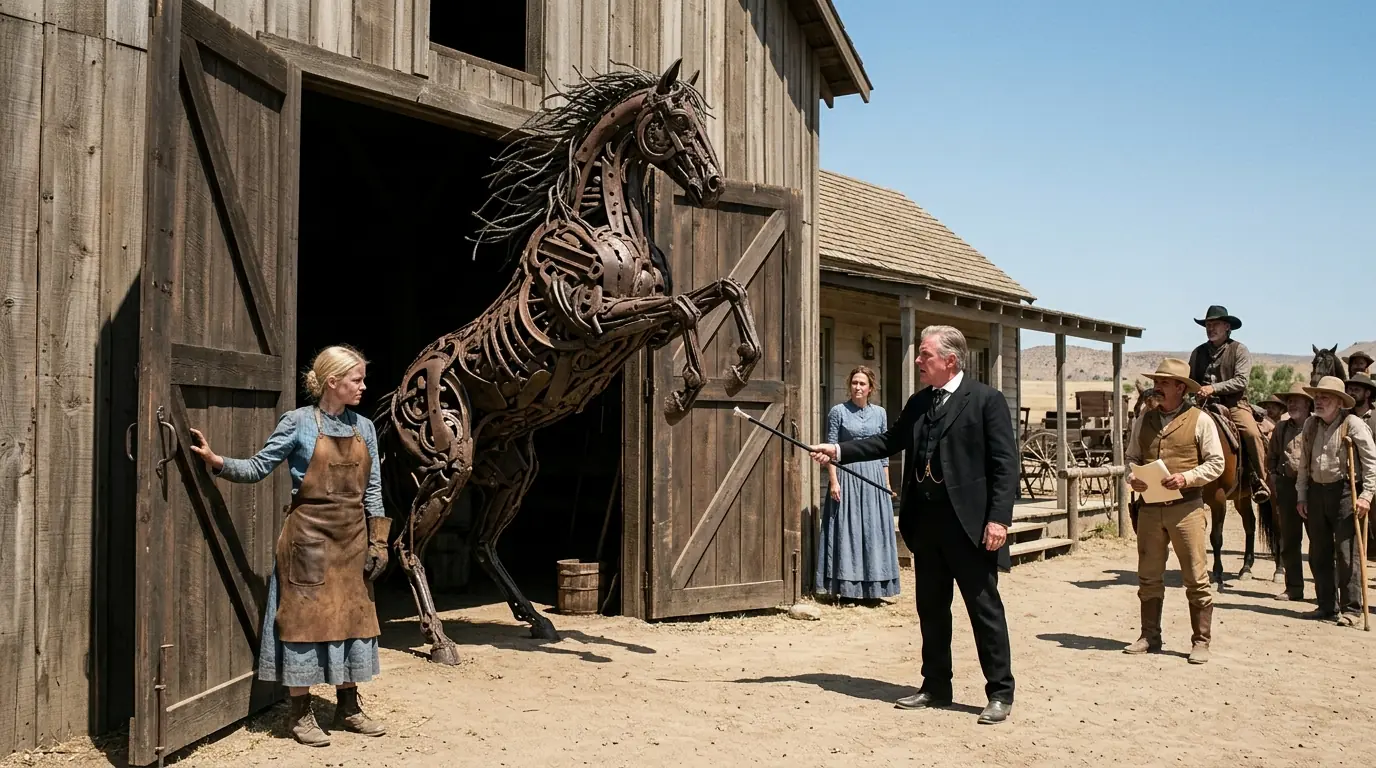
In the untamed stretches of the American West, 14-year-old Hattie was becoming a local joke. Wrapped in her grandfather's heavy leather apron, she relentlessly loaded heavy, rusted horseshoes into her wagon until her hands bled. Look at the ranch girl. Her mother is losing the ranch, and she's collecting broken horseshoes.
The men muttered, watching her haul away worthless scrap while her mother, Cora, sat on the porch of their fading ranch. They pointed. They chuckled. They saw a desperate girl clinging to junk.
They had no idea she was preparing for a quiet war. But the town's laughter was about to end. Soon, those same arrogant men would step inside her weather-beaten barn, and what she had forged from their broken trash would leave them absolutely speechless. The dust had not yet settled from the banker's buggy when Hattie picked up her first rusted horseshoe.
The iron was bent and completely useless to any rider. Yet, to a young girl carrying a debt she could never pay, it felt exactly like salvation. Hattie stood near the wooden gate of her family's fading ranch. She was 14 years old.
Her pale blonde hair was tied back tightly with a frayed piece of twine, keeping it away from a face smudged with soot and dirt. She watched the black carriage disappear down the long, dry road toward town. On the porch, her mother, Cora, sat on a wooden rocking chair. She was not rocking.
Cora stared at a single sheet of paper in her hands. It was a foreclosure notice. Mr. Amos Vance held the deed to their land.
The debt was immense. Since Hattie's father had passed from a sudden fever two winters ago, the cattle had thinned. The crops had dried up in the fierce summer heat. Now, they owed Mr.
Vance $300. In those days, out in the untamed stretches of the American West, $300 might as well have been a mountain of gold. "We have 3 months, Hattie." Cora whispered.
Her voice was thin and tired. "3 months before he takes the house." Hattie did not cry. She possessed a quiet strength, a stillness that unsettled most folks.
She simply nodded, her blue eyes fixed on the heavy iron horseshoe resting in her palm. It had fallen from one of Mr. Vance's prize carriage horses. The metal was warped, the nails sheared off.
Most people saw trash. Hattie saw raw material. She closed her hand around the warm iron and walked toward the barn. The old barn leaned slightly against the western wind.
Its red paint had been blasted away by years of sandstorms and harsh winters. To the rest of the county, it was an eyesore. To Hattie, it was a sanctuary. Inside, the air was cool and smelled of dry hay, old leather, and rusted iron.
In the far corner sat a massive, scarred anvil. Beside it rested a heavy iron forge, a pair of leather bellows, and a wooden rack holding several heavy hammers. These tools had belonged to her grandfather, Silas. He had been a blacksmith and a veteran of the long, terrible war.
Before his heart finally gave out a year ago, he had spent his final days in this barn. He had propped himself up in a wooden chair, teaching the young Hattie how to judge the heat of a fire by its color. He taught her how to strike metal without breaking her own wrist. He passed on the fading knowledge of a true iron worker.
Hattie placed the broken horseshoe on the anvil. Her grandfather had left her nothing but tools and an old leather apron, but she intended to use them.
Every Saturday, Cora and Hattie took their old wagon into town for supplies. Town was a noisy, dusty place filled with miners, cattlemen, and merchants. While Cora carefully counted pennies at the dry goods store, Hattie walked to the edge of town. She always visited the local smithy.
The town blacksmith was a large, loud man named Hiram. He was missing two fingers on his left hand and had a laugh that echoed down the street. Hiram made his living shoeing horses, fixing wagon axles, and repairing plow blades. He had no time for useless scrap.
Every week, he tossed broken horseshoes, bent nails, cracked iron brackets, and rusted wagon rims into a growing pile behind his shop. "Mr. Hiram?" Hattie asked, standing near the forge.
The heat made her face flush. Hiram looked down, wiping his brow with a dirty rag. "What is it, little Hattie? Your mother need a wheel fixed?"
"No, sir," she said politely. "I was wondering what you plan to do with that scrap iron behind the shop." Hiram barked a laugh. "Do with it?
Nothing. It's useless. Going to pay a man to haul it to the ravine next month." "Could I have it?"
Hiram paused. He looked at the slight, blond girl in her faded cotton dress. "You want my garbage? What for?"
"To practice," Hattie said simply. Hiram shook his head. He looked amused. "Practice?
Little girl, iron work is for men with shoulders as wide as a barn door, not for young ladies. But if you want to haul my trash away for free, you go right ahead." Hattie loaded the heavy iron into her wagon piece by piece. It took her an hour.
Her hands bled. Her back ached. But she did not stop. Soon, the townsfolk noticed.
A few men lounging outside the saloon pointed and chuckled. "Look at the ranch girl," one cattleman joked, spitting tobacco into the dust. "Her mother is losing the ranch, and she's collecting broken horseshoes. Thinks she's going to build a new house out of rust.
Must have lost her wits when her daddy died," another muttered. Everyone laughed when Hattie collected the scrap. They saw a poor, desperate girl clinging to junk. Hattie never argued.
She never looked down. She simply held the reins of her mule and drove the wagon back home. She unloaded the twisted metal behind her barn. She sorted it carefully.
Horseshoes in one pile, wagon rims in another, square nails in a small wooden bucket. Without anyone knowing, the 14-year-old girl was preparing for a quiet war.
That evening, the plains grew cold. Hattie wrapped herself in her grandfather's heavy leather apron. It draped down to her shins. She lit the forge.