Cecilia Voss had been selling bread since she was nine years old. Not because she wanted to, because her father's hands shook too badly to hold a knife. Her younger brother needed medicine every month, and the landlord didn't care about any of that. He cared about rent. Every morning, she rose before the village did.
She lit the oven, mixed the dough, and carried the basket through muddy streets while other girls her age were still sleeping. She never complained. Complaining cost energy she didn't have. The village of Aldenmore knew her face the way they knew the cobblestones. Always there, always underfoot, never truly noticed.
She was the baker's daughter, the quiet one, the one who smiled too politely when the merchant wives spoke over her head at market. She had learned early. People like her were not meant to take up space. Her father, Edmund, had once been a respected craftsman. Then the fever came.
It stole his steadiness, his clients, and eventually his pride. He sat by the window now, watching the street, apologizing with his eyes. Every time Cecilia walked in tired, she could see the apology in his eyes. "You shouldn't have to carry this," he told her once. She had kissed his forehead and said nothing.
Because what was there to say? She carried it. That was simply the truth. Her brother Thomas was 12 and clever. Dangerously clever, the kind of boy who asked questions that embarrassed adults.
She adored him. She worked for him. Every coin she saved went toward keeping him in school, keeping him fed, keeping that brightness in his eyes alive a little longer. She had no savings beyond that, no suitors, no prospects. What she had was a basket, an early alarm, and the particular exhaustion of someone who has never once been rescued.
The other girls in Aldenmore married merchants' sons or farmers with decent land. They whispered about Cecilia sometimes. Not cruelly, just practically the way people discuss a stray cat that refuses to leave the street. Such a shame, they said. She's pretty enough, but what man wants that burden?
Cecilia heard them. She straightened her spine and sold more bread. There was one small pleasure she allowed herself. Every evening after deliveries she walked past the old Ashcroft estate at the edge of the village. Long abandoned gates rusted shut.
Ivy swallowed the stone walls whole. She didn't know why she liked it. Maybe because it looked the way she felt. Barely standing, but still standing. She would pause there for exactly one minute.
Then she would go home, make supper, help Thomas with his lessons, and fall asleep before she finished her own thoughts. That was her life. Small, exhausting, entirely hers. She was not waiting to be saved. She had stopped expecting that a long time ago.
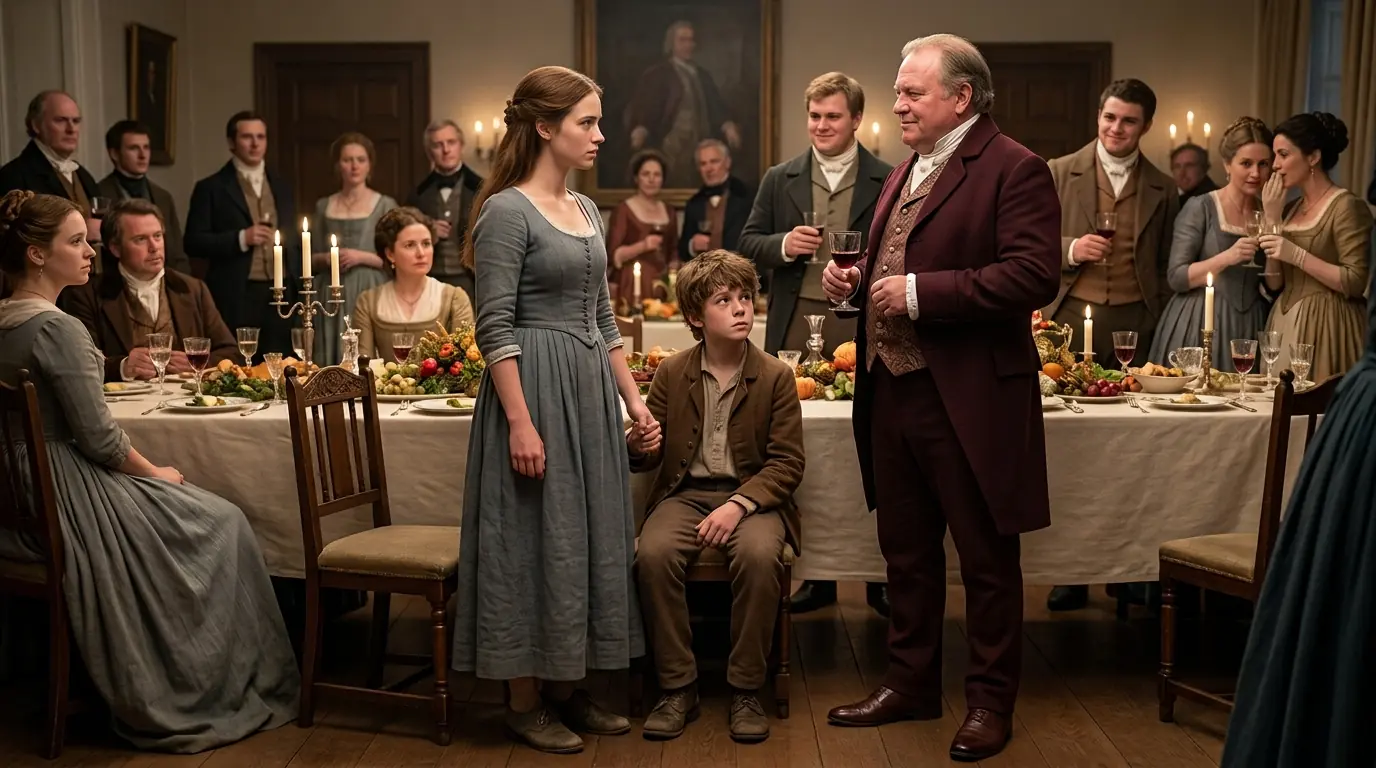
The Aldenmore harvest gathering happened once a year. Everyone came, the merchants, the landowners, the priest, especially the gossips. It was held in the town hall, long tables draped in gold cloth, candles lit even before dark, because the wealthy liked to perform their wealth early. Cecilia came because Edmund asked her to. "It'll be good for Thomas to see it," her father said.
"Let the boy have one nice evening." She pressed her only decent dress and went. The moment she walked in, she felt it. That particular shift in a room when someone who doesn't belong enters it. Heads didn't turn dramatically.
They simply angled a degree or two, just enough. She found a seat near the back and kept Thomas close. For a while it was fine. Then Lord Harwick stood up. Lord Harwick was sixty, red-faced, and owned half the farmland surrounding Aldenmore.
He was also the man her father had borrowed money from. 3 years ago, during the worst of the fever, when there was no other choice, Edmund had been paying it back slowly, faithfully, every month without fail. Harwick cleared his throat and tapped his glass. I want to address something, he said pleasantly. Since we're all gathered, Cecilia felt her stomach drop. He looked directly at her father's empty chair.
Edmund had stayed home, too weak for the cold night air. And then his eyes found Cecilia, the Voss account, he announced, is now 3 months behind. The room went quiet in that horrible interested way rooms do when someone else's suffering becomes entertainment. That's not true, Cecilia said quietly. Harwick tilted his head.
"Excuse me?" She stood up, her chair scraped. Half the room flinched. We paid, she said. Every month I delivered the payments myself. Harwick smiled the smile of a man who has never once been contradicted in public and finds it amusing.
My records disagree. Then your records are wrong. A murmur moved through the tables. Merchant wives leaned toward each other. The priest looked at the ceiling.
Two of Harwick's broad-shouldered sons shifted in their seats and smirked. Perhaps, Harwick said, his voice carrying easily now, enjoying itself. You're confused, girl. It happens. Running a household is complicated when the head of that household is unable to manage.
Unable to manage. Three words, perfectly placed, absolutely deliberate. The entire room now understood he wasn't talking about money anymore. He was talking about her father, his illness, his diminishment. He was using Edmund Voss, a man too sick to be here, too proud to have asked for pity, as a punchline at a party.
Cecilia's hands went cold. My father, she said very carefully, has managed more dignity in one sick day than you've produced in 60 years of good health. The silence after that was different, sharper. Harwick's smile thinned. "You owe me four months now," he said.
"Consider this your public notice. If the debt is not cleared in full within thirty days, I will pursue the cottage." The oven, all of it. She heard Thomas shift beside her. She did not look at him. If she looked at him, she would break.
"I'll see it paid," she said. "See that you do." Harik sat down, reached for his wine, and resumed his conversation as if she had already ceased to exist. No one at the surrounding tables said anything. One woman, Helena Marsh, whose dress cost more than Cecilia's monthly earnings, actually laughed softly at something her husband whispered. Cecilia sat back down.
She picked up her cup, set it down, picked it up again. Thomas slipped his hand under the table and found hers squeezed once, said nothing. He was twelve years old, and he already knew when his sister needed silence instead of comfort. She held his hand tight and stared straight ahead while the party continued around them. Later, walking home in the cold, Thomas spoke first.
"We don't have four months of payments," he said. "No. What are we going to do?" She looked up at the sky. Stars shone above them, frost starting to crust the road beneath them. Somewhere across the village, behind its rusted gates, the Ashcroft estate sat dark and still.
"I don't know yet," she said. It was the most honest thing she had said all evening. She did not sleep that night. She lay in the dark and did the arithmetic over and over, searching for a number that wasn't there. Every arrangement collapsed.
Every calculation came up short. By morning, she had accepted something she had been refusing to accept for months. There was no path out of this alone. She just didn't know yet that a path was already walking toward her. She saw him first at the well, a man she didn't recognize.
And in Aldenmore, everyone recognized everyone. He was drawing water with the focused efficiency of someone who had done hard labor all his life. Plain coat, worn boots, dark hair pushed back carelessly. Not remarkable, not at first. But his hands were wrong for a laborer.
Too steady, too deliberate. The kind of steady that didn't come from work. It came from control, she noticed, filed it away, kept walking. His name, she learned by noon, was Alexander. He had apparently arrived three days ago and taken a position at Edmund Farley's stable on the East Road, mucking stalls, feeding horses, the lowest rung of work available in the village.
People were already talking about him the way villages talk about anyone new with curiosity poorly disguised as indifference. Strange man, the butcher's wife told her at market. Doesn't talk much. Pays for everything in cash. Who carries that much cash to a stable job?
Cecilia bought her flour and said nothing. He came to her bread stall that afternoon. She almost missed him. She was wrapping a loaf for old Mrs. Crane when she looked up and he was simply there standing slightly apart from the small queue watching her work.
Not watching her exactly, but watching her work. There was a difference. She had spent enough years being looked through to recognize when someone was actually paying attention. It unsettled her more than being ignored. When his turn came, he bought a single loaf, paid without haggling, started to leave, then stopped.
"I heard what happened at the harvest gathering," he said. She went still. "Most people did. Harwick's claim is false."
She looked at him properly for the first time. "You weren't there."