At Lumiere, Victoria Sterling, the billionaire CEO known for her ice-cold decisions, sat alone at her usual corner table. She never noticed the four men who walked through the door that Friday night.
They weren’t there for dinner.
Their eyes locked onto her with unmistakable rage, and they moved with the kind of collective tension that preceded violence.
In that moment, the quiet waiter, Darnell Brooks, a single father who’d kept his past buried for three years, had to make a choice.
What he did next surprised everyone, including himself.
The warm glow of chandeliers cast soft shadows across white tablecloths at Lumiere.
Friday nights brought the usual crowd, executives celebrating deals, couples dressed for anniversaries, voices kept low beneath the gentle drift of jazz piano.
The restaurant occupied the ground floor of a glass tower downtown, its floor-to-ceiling windows offering views of the city lights beginning to flicker on as evening settled in.
Darnell Brooks moved between tables with the kind of quiet efficiency that made him nearly invisible.
He’d worked the Friday dinner shift for three years now, 7 until 11:00, and he knew the rhythm by heart.
Refill water glasses before they’re half empty.
Clear plates from the right.
Smile politely, but don’t linger.
The job paid enough to cover rent and his daughter’s school expenses. And it let him pick Lily up from her after-school program every afternoon before his shift started.
He was 35, but looked older when he was tired.
Broad shoulders that he kept slightly hunched.
Dark brown skin that caught the warm light of the chandeliers.
Close-cropped hair with tight curls that needed trimming.
A beard he’d grown to look different from the clean-shaven officer he’d been years ago.
Most customers never really looked at him.
That suited him fine.
Victoria Sterling arrived at exactly 8:00, same as always.
Darnell watched her hand her coat to the hostess and make her way to table 12 in the far corner.
She came twice a week, always alone, always in a dark suit that looked expensive, even from across the room.
Her auburn hair was pulled back tight, and she carried herself like someone who’d learned not to waste energy on unnecessary movements.
Darnell had served her maybe 20 times over the past year.
She ordered efficiently, ate quickly, and left generous tips without making eye contact.
He appreciated that she never tried to make conversation.
Some customers seemed to think waiters existed for therapy sessions or flirting.
Victoria Sterling treated the interaction like a transaction, which was the most respectful thing she could do.
He brought her the usual bottle of sparkling water without being asked.
She glanced up briefly, gave a small nod, and returned her attention to the iPad propped against the table’s small vase of white orchids.
Her fingers moved across the screen with the kind of focused intensity that suggested whatever she was reading wasn’t going well.
Darnell moved back toward the service station near the kitchen doors.
His phone buzzed in his pocket.
He pulled it out carefully, checking that Mr. Harrison wasn’t watching from the host stand.
The text was from his daughter.
“Dad, can you come home early tonight?”
He typed back quickly.
“What’s wrong?”
“Nothing. Just miss you.”
Darnell felt the familiar tug in his chest.
Lily was seven now, old enough to understand that he worked nights, but young enough to still want him home for bedtime stories.
He glanced at the clock above the bar.
Three hours left on his shift.
“I’ll be home by 11:30. Love you.”
“Love you too.”
He slipped the phone back into his pocket and picked up the tray of appetizers waiting under the heat lamp.
Table seven.
A group of lawyers celebrating something, their laughter getting louder with each round of drinks.
He delivered their calamari with the same polite smile he’d perfected, then retreated before they could pull him into their conversation.
The front door opened.
Darnell’s attention shifted automatically.
Part of the job was tracking new arrivals, anticipating who’d need menus, who’d head straight for the bar.
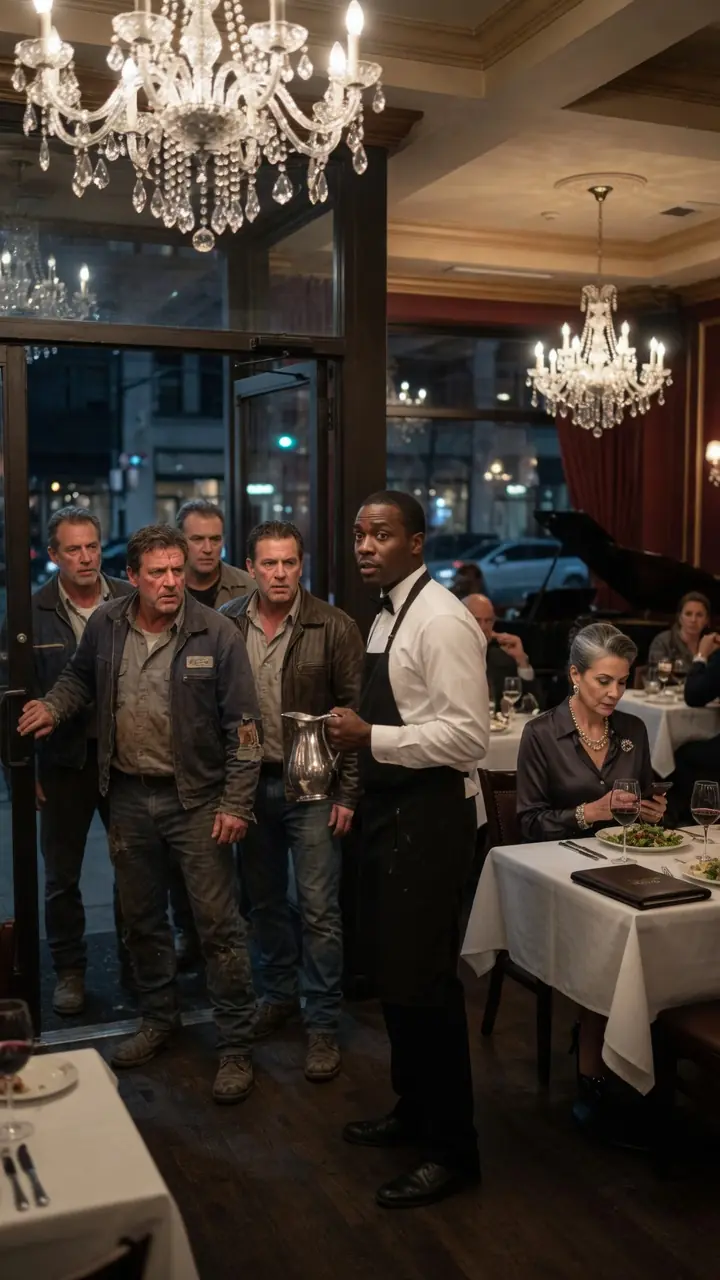
Four men stepped inside.
They weren’t dressed for Lumiere.
Jeans and work jackets. One of them in a faded Carhartt coat with paint stains on the sleeves.
The hostess approached them with her professional smile, but something in their body language made Darnell stop moving.
They weren’t looking at her.
Their eyes scanned the dining room like they were searching for something specific.
One of them, the tallest with graying hair and a hard jaw, spotted Victoria Sterling’s table, and his expression shifted into something sharp and cold.
Darnell felt a familiar sensation crawl up his spine.
It was the same alert he used to get on patrol, the instinct that separated routine calls from situations about to turn dangerous.
He tried to bury that instinct when he left the police department three years ago, but apparently it hadn’t gone anywhere.
The four men moved past the hostess without waiting to be seated.
They took a table near Victoria’s.
Four chairs scraping loudly against the floor.
Other diners glanced over with mild irritation.
The men didn’t open their menus.
They just sat there.
Three of them facing Victoria’s direction, voices low and tense.
Darnell picked up a water pitcher and moved closer, using the excuse of refilling glasses at a nearby table.
He kept his movements casual, but positioned himself where he could hear fragments of their conversation.
“That’s her.”
The tall one with gray hair.
His voice carried an edge of barely controlled anger.
“Sterling Ventures. That’s the CEO.”
“You sure?”
Another man, younger, with nervous energy in his hands.
“I memorized her face from the news. That’s Victoria Sterling.”
The third man leaned forward.
“So what do we do? Just sit here?”
“We let her know. We let her see what her decisions cost.”
Darnell’s grip tightened on the water pitcher.
He looked at Victoria.
She was still focused on her screen, completely unaware.
The soft lighting made her look almost fragile despite the severity of her expression, like someone who’d learned to armor themselves against a world that kept hitting back.
He needed to think.
These men weren’t here for dinner.
Their energy was all wrong.
The kind of collective tension that preceded violence.
Call Mr. Harrison?
Get them kicked out based on a feeling?
They hadn’t done anything yet.
Except Darnell had seen this before.
The stillness before the storm.
The way angry men gathered courage from each other until someone made the first move.
And then the tall one, the leader, looked directly at Darnell.
Their eyes met for two seconds.
Something flickered across the man’s face.
Recognition.
Darnell’s heart rate climbed.
He looked away and moved back toward the kitchen, mind racing.
He remembered them now.
A bar fight at a place called Rosie’s on the south side five years ago.
Darnell had been first on scene as a patrol officer.
Broke it up before anyone got seriously hurt.
They’d all been arrested, spent a night in jail, paid fines.
Nothing major.
But the tall one, Victor, that was his name, had looked at Darnell during booking and said something.
“I don’t forget faces, Officer Brooks.”
Darnell forced himself to breathe normally.
Maybe Victor didn’t recognize him.
Different hair.
The beard.
30 pounds heavier.
But even if Victor did remember, this wasn’t about Darnell.
This was about Victoria Sterling.
One of the four men stood up.
The younger one, nervous energy barely contained.
He walked toward Victoria’s table.
Darnell’s body moved before his mind caught up.
He cut across the dining room, intercepting the man three steps before he reached Victoria.
“Sir, can I help you with something?”
Darnell kept his voice light, professional, but positioned himself directly in the man’s path.
The man stopped.
Up close, Darnell could see the desperation in his eyes, the kind that came from too many sleepless nights.
“I need to talk to her.”
“If you’d like to speak with another guest, I can pass along a message.”
Darnell didn’t move aside.
“Just get out of my way.”
Victoria looked up from her iPad, finally noticing the confrontation.
Her expression shifted from confusion to something more guarded.
Victor stood up from his table.
The other two followed.
Darnell felt the situation crystallizing into something he couldn’t walk away from.
Four against one.
A room full of civilians.
A woman who had no idea she was in danger.
All his training said to de-escalate, create distance.
But there was no backup here.
Just him.
A water pitcher still in his hand.
And three years of rust on skills he’d tried to forget.
Victor walked over, and now Darnell could see the recognition settling fully into place on the man’s face.
“Wait, I know you.”
Darnell met his eyes.
There was no point in lying.
“You should go back to your table.”
“You’re that cop. Brooks. Darnell Brooks.”
Victor’s voice rose slightly.
“You arrested us. Rosie’s Bar. Five years ago.”
The other men looked at Darnell with new attention.
The young one stepped back slightly, suddenly uncertain.
But Victor moved closer.
“Small world,” Victor said.
His tone carried something between surprise and bitterness.
“You’re a waiter now. What happened? They fire you?”
Darnell didn’t respond.
He could feel Victoria’s eyes on him, calculating, trying to understand what was happening.
“I asked you a question.”
Victor’s voice hardened.
“I left the force.”
Darnell kept his tone neutral.
“Now I’m asking you to sit down or leave the restaurant. You’re disturbing other guests.”
“Disturbing?”
One of the other men laughed bitterly.
“That’s rich. You know what’s disturbing? Losing your job because some billionaire pulls their money out of your factory. Two hundred people unemployed. But sure, we’re the problem because we’re a little loud.”
Victoria stood up from her table.
“What is this about?”
Victor turned to face her fully.
“You don’t even know, do you? Sterling Ventures. You pulled your investment from Westbrook Manufacturing eight months ago. You remember that decision?”
Victoria’s expression remained controlled, but Darnell saw the slight tension in her shoulders.
“That’s business. The project wasn’t profitable.”
“Business.”
Victor’s voice dripped with contempt.
“You sit here in your thousand-dollar suit eating meals that cost more than my weekly unemployment check, and you call it business?”
The young man found his courage again.
“My wife left me because I couldn’t pay the mortgage. You want to call that business too?”
Darnell raised his hand slightly, a calming gesture.
“I understand you’re angry, but this isn’t the place.”
Victor looked at him with something like pity.
“You understand? You’re taking orders from people like her now. You really think you understand?”
For a brief moment, Darnell wondered if Victor was right.
Maybe he didn’t understand.
Maybe he’d taken the easy path, hiding in this job instead of facing the world that had broken him.
But then he saw Victoria’s hand trembling slightly as she gripped her iPad, and he remembered why he’d walked away from police work in the first place.
He was tired of watching people get hurt.
Darnell’s voice dropped lower, stripped of the polite server tone.
It came out with the authority he’d carried for eight years in uniform.
“If you want to talk, we can do this the right way. But you need to step back from her table now.”
The words hung in the air between them.
Something in Darnell’s posture had shifted without him meaning it to.
Shoulders squared.
Weight centered.
Hands relaxed, but ready.
The muscle memory of a man who knew how to handle conflict.
Victor studied him for a long moment, then nodded once.
“All right, Brooks. Let’s talk.”
Darnell gestured toward the rear of the restaurant.
“There’s a patio out back. We can talk there without disturbing anyone.”
The dining room had gone quiet.
Other guests watched with the careful stillness of people trying not to get involved.
Victoria remained standing by her table, her expression unreadable.
Darnell caught the eye of Sarah, another server working the floor.
He tilted his head slightly toward the kitchen, their silent signal for trouble.
She gave a barely perceptible nod and moved toward the back to alert the manager.
The patio was technically a service area.
A concrete square enclosed by brick walls where staff came to catch their breath between rushes.
A few metal chairs sat scattered around a table someone had dragged out months ago.
String lights hung overhead.
Half of them burnt out.
The cool night air carried the smell of grease from the kitchen vents.
Darnell held the door open as the four men filed out.
The young one kept glancing back at the dining room like he was already regretting this.
The other two, one built like a linebacker, the other lean with weathered hands, moved with the weary caution of men who’d learned to expect trouble.
Victor was the last to step outside.
He stopped in front of Darnell.
“You really want to help us, or are you just protecting your rich customers?”
Darnell met his gaze.
“I want to stop this from getting worse.”
“Too late for that. It’s already worse. Has been for eight months.”
The door closed behind them, muffling the restaurant noise.
Out here, the city sounds took over.
Distant traffic.
A siren several blocks away.
The hum of air-conditioning units.
Victor leaned against the brick wall and lit a cigarette with shaking hands.
For a second, nobody spoke.
The anger that had carried them into the restaurant suddenly looked heavier out here beneath the weak patio lights.
Darnell stayed near the door, watching all four men carefully.
Not scared.
Just measuring.
The way he used to on night patrols when every bad situation balanced on one wrong sentence.
Victor took a long drag from the cigarette.
“You know what she did to us?”
“I know you said the factory closed.”
Victor laughed bitterly.
“Closed.”
He shook his head.
“Westbrook Manufacturing wasn’t just a factory. That place fed half the south side.”
The lean man with weathered hands finally spoke.
“My dad worked there 31 years.”
The younger one shoved his hands into his jacket pockets hard enough to wrinkle the fabric.
“I was there six.”
Victor pointed toward the restaurant windows where Victoria still stood frozen near her table.
“She pulled the funding. Whole expansion deal collapsed. Two months later, the layoffs started.”
Darnell listened quietly.
Because now that the shouting had stopped, what remained underneath was grief more than rage.
And grief made people dangerous in slower ways.
“What exactly were you planning to do tonight?” Darnell asked.
Nobody answered immediately.
That answer told him enough.
Victor looked away first.
“Didn’t know.”
“You came here angry without a plan.”
Victor exhaled smoke toward the sky.
“We came here because she should have to look at somebody she destroyed.”
Darnell nodded slowly.
“I get that.”
“No you don’t.”
The linebacker-built man stepped forward slightly.
“You still got a paycheck.”
Darnell almost corrected him automatically.
As if a paycheck meant safety.
As if men didn’t drown quietly while still employed.
But he let it go.
Because this wasn’t about him either.
Victor studied Darnell for a long second.
“You really leave the force willingly?”
“Yes.”
“Why?”
The question hit harder than Darnell expected.
He hadn’t answered it honestly in years.
Not to coworkers.
Not to Lily.
Not even fully to himself.
Finally:
“There was a domestic call.”
The men stayed quiet.
Darnell looked past them toward the alley beyond the patio wall.
“Woman named Carla Mendoza. Two kids. Husband drunk, violent.”
His jaw tightened slightly.
“We got there too late.”
The city noise seemed farther away suddenly.
“She died before the ambulance arrived.”
The younger man shifted uncomfortably.
Darnell continued quietly.
“I spent eight years showing up after damage was already done.”
Victor lowered the cigarette slowly.
“One day I realized I couldn’t keep carrying all of it home to my daughter.”
Silence settled over the patio.
Different silence now.
Human silence.
Not confrontation.
Just people standing too close to pain.
Then the lean man asked quietly:
“So waiting tables fixed that?”
Darnell almost smiled.
“No.”
He looked back toward the restaurant.
“But it gave me a chance to be around people without only seeing them on the worst day of their lives.”
Victor stared at him for a long moment.
Then finally:
“She still ruined us.”
Behind the restaurant window, Victoria Sterling suddenly moved.
She was walking toward the patio door.
Darnell straightened immediately.
Victor noticed too.
“She coming out here?”
“Yes.”
“She shouldn’t.”
Darnell’s voice sharpened slightly.
“Then maybe you should leave now.”
But the door already opened.
Victoria stepped onto the patio wearing her coat now, arms folded tightly against the cold.
Up close, she looked older than Darnell expected.
Not weak.
Just tired in the way powerful people sometimes looked when nobody else was around.
Her eyes moved across the four men carefully before landing on Victor.
“You worked at Westbrook.”
Not a question.
Victor laughed once.
“So you do remember.”
“I remember every closure.”
Something about the answer surprised all of them.
Victoria looked toward the city skyline beyond the alley.
“Westbrook was losing eight million dollars a quarter.”
“That factory existed for 42 years!”
“And it was going bankrupt.”
Victor stepped closer.
“You could’ve saved it.”
Victoria’s expression tightened.
“With what? Sentiment?”
The younger man exploded then.
“My son had to leave his school because of you!”
Darnell moved instinctively between them before the distance closed too fast.
But Victoria raised one hand slightly.
Not scared.
Not backing down.
“I understand why you hate me.”
Victor stared at her in disbelief.
“You think this is hate?”
His voice cracked unexpectedly.
“This is what panic looks like when grown men can’t feed their families anymore.”
That landed.
Even Victoria flinched slightly at that one.
The cold wind moved through the patio for a moment.
Then quietly, Victoria asked:
“What were you planning to do tonight?”
Nobody answered.
Because now that she stood in front of them as an actual person instead of a headline, the answer sounded uglier out loud.
Finally Victor muttered:
“I don’t know.”
And that was the truth.
Not murder.
Not really.
Just wounded men carrying humiliation with nowhere to put it.
Victoria studied each of them slowly.
Then something changed in her expression.
Not guilt exactly.
Recognition.
As if she suddenly understood the human scale of a decision she’d only ever viewed through spreadsheets.
She looked at Victor.
“How many employees?”
“What?”
“At Westbrook. How many lost jobs?”
Victor blinked.
“217.”
Victoria nodded once slowly like committing it to memory.
Then:
“And nobody from Sterling Ventures ever came down there afterward, did they?”
No answer needed.
Because of course they didn’t.
Executives vanished after closures.
That was how the world worked now.
Darnell watched something uncomfortable pass across her face.
Not shame.
Worse.
Perspective.
And for the first time all night, Victoria Sterling looked less like a billionaire CEO and more like a woman realizing numbers on a report had names attached to them all along.
Nobody spoke for several seconds.
The city hummed beyond the alley.
Traffic lights changed.
A siren wailed somewhere far downtown.
And under the weak patio lights, five people stood inside the uncomfortable truth that none of this was simple anymore.
Victoria broke the silence first.
“What are your names?”
Victor frowned slightly.
“What?”
“If I’m going to stand here and listen, then I should know who I’m listening to.”
The younger man laughed bitterly.
“Now you care?”
“Yes,” Victoria said quietly.
That answer caught even Darnell off guard.
Victor studied her carefully before finally speaking.
“Victor Hale.”
He pointed toward the others one by one.
“Marcus. Eli. Ben.”
Victoria nodded once after each name like she intended to remember them.
Then she asked:
“How long after the closure before unemployment ran out?”
Marcus answered this time.
“Three months.”
Ben shook his head.
“Mine didn’t even cover rent.”
Victoria looked toward Eli, the youngest.
“You said you have a son.”
Eli swallowed hard.
“Yeah.”
“How old?”
“Five.”
Something flickered briefly across Victoria’s face.
Gone almost instantly.
But Darnell caught it.
Because he’d spent years reading tiny changes in people before situations turned dangerous.
Pain recognized pain.
Victoria folded her arms tighter against the cold.
“When Westbrook closed, I signed 200 documents that week.”
Victor’s jaw hardened.
“Congratulations.”
“No,” she said softly.
“That’s the problem.”
The wind shifted again across the patio.
Victoria stared down at the concrete for a second before continuing.
“I remember the financial reports. I remember the debt projections. I remember the shareholder meeting.”
She looked back up at them.
“But I don’t remember anyone telling me your names.”
Nobody moved.
Darnell watched the anger in Victor’s face struggle against something else now.
Not forgiveness.
Not even understanding.
Just confusion.
Because powerful people weren’t supposed to talk like this.
They were supposed to hide behind lawyers and statements and security teams.
Victoria continued quietly:
“Do you know how many acquisition reports cross my desk every month?”
Victor said nothing.
“Forty-three last quarter alone.”
Her voice stayed even, but something raw edged underneath it now.
“And every single report talks about labor costs. Asset risk. Production efficiency.”
She looked directly at Eli.
“Not one mentioned your son.”
The patio went silent again.
Inside the restaurant, customers still pretended not to watch through the windows.
But everyone was watching.
Darnell could feel it.
Victor finally spoke.
“So what now?”
Victoria met his eyes.
“What do you mean?”
“You heard us. Great. We ruined your dinner, you ruined our lives. What now?”
The bitterness returned there.
Because listening didn’t pay mortgages.
Understanding didn’t reopen factories.
Victoria seemed to know that too.
“I can’t reopen Westbrook.”
Marcus laughed harshly.
“Then what’s the point of this conversation?”
Darnell saw Victoria hesitate for the first time all night.
Not because she feared them.
Because she genuinely didn’t know the answer.
And somehow that honesty mattered more than polished speeches would’ve.
Finally she said:
“The point is that none of you came here tonight because you wanted violence.”
Victor looked away immediately.
“And none of you came because you felt heard either.”
That one landed hard.
Darnell saw it in all four faces at once.
The exhaustion.
The humiliation.
The invisibility.
Men who’d spent months screaming into systems too large to notice them.
Eli rubbed both hands across his face roughly.
“You know what the worst part was?”
Victoria stayed quiet.
“My kid asked why I stopped wearing my work badge.”
His voice cracked slightly.
“I told him the factory closed.”
Eli laughed once bitterly at himself.
“He thought factories only closed in movies.”
Nobody had words for that.
Even Victor stared at the ground now.
And suddenly Darnell understood what this really was.
Not revenge.
Witnesses.
They came because somebody had to finally look at what happened to them and not turn away.
Victoria inhaled slowly through her nose.
Then she asked something unexpected.
“What did Westbrook make before the closure?”
Marcus blinked.
“Industrial refrigeration units.”
“For hospitals?”
“Mostly.”
Victoria nodded slowly.
Her mind clearly moving now.
Executive brain turning again.
But differently this time.
“Did any of the machinery get auctioned?”
Victor frowned.
“Some.”
“And the rest?”
“Storage probably.”
Darnell noticed the shift immediately.
Victoria wasn’t defending herself anymore.
She was thinking.
Calculating.
Searching.
Not for escape.
For possibility.
Victor noticed too.
“What are you doing?”
Victoria looked directly at him.
“Trying to figure out whether I made a decision too quickly.”
Silence again.
Then Ben shook his head slowly like he didn’t trust himself to believe what he was hearing.
“You can’t just say stuff like that.”
“I know.”
Victoria’s voice dropped quieter now.
“That’s why I’m not saying it lightly.”
Darnell leaned slightly against the brick wall watching all of them.
Strange.
An hour ago this patio almost became a crime scene.
Now it felt more like a confession booth.
Then the back door opened suddenly.
Mr. Harrison, the restaurant manager, stepped outside looking pale and panicked.
“Darnell, police are here.”
Everything froze.
Two squad cars had pulled into the alley behind Lumiere.
Blue lights flashing silently against the brick walls.
Someone inside the restaurant must’ve called during the confrontation.
Victor immediately tensed.
Marcus swore under his breath.
Eli looked like he might bolt.
Old instincts.
Bad history with uniforms.
Darnell stepped forward fast.
“Everybody relax.”
Victor laughed sharply.
“Easy for you to say.”
But Darnell already recognized one of the officers stepping out of the cruiser.
Officer Ramirez.
Good cop.
Calm under pressure.
Darnell moved toward the alley entrance before the officers reached the patio.
Ramirez spotted him instantly.
“Brooks?”
Darnell nodded once.
“Situation’s under control.”
Ramirez looked past him toward the four men and Victoria Sterling standing together under the patio lights.
“Restaurant manager said there was a disturbance.”
“There was an argument,” Darnell said carefully.
“No assault. No threats. Nobody wants charges.”
Ramirez studied him closely.
Then quietly:
“You sure?”
Darnell glanced back once at Victor.
At Eli.
At Victoria.
Then answered honestly.
“Yeah.”
Behind him, something unexpected happened.
Victoria Sterling stepped forward beside Darnell and addressed the officers herself.
“These men are leaving peacefully.”
Ramirez recognized her immediately.
His eyebrows lifted slightly.
“Ma’am, if you feel unsafe—”
“I don’t.”
Victor looked genuinely stunned by that.
So did the other men.
Victoria continued calmly:
“They came here angry. Not violent.”
The alley stayed very still after that.
Finally Ramirez nodded once.
“All right.”
Then toward the four men:
“Time to head home.”
Victor hesitated before leaving.
Not because he wanted to fight anymore.
Because suddenly none of them seemed sure how to end this night.
He looked at Victoria one last time.
Then quietly:
“217 people.”
Victoria nodded once.
“I know.”
Victor held her gaze for a long second.
Making sure she really heard him this time.
Then the four men walked past the squad cars and disappeared slowly into the cold city night.
The patrol cars pulled away five minutes later.
Their lights disappeared down the alley, leaving only the soft hum of downtown traffic and the weak yellow glow from the patio string lights.
For a long moment after the officers left, nobody inside Lumiere moved either.
Customers still sat frozen behind the windows pretending to return to their meals.
But the restaurant’s atmosphere had changed completely.
The illusion of distance between people felt thinner somehow.
Victoria looked toward Darnell.
“You stopped that from turning ugly.”
Darnell shrugged lightly.
“They stopped it too.”
Victor and the others were already gone now, swallowed into the city night.
Victoria folded her coat tighter around herself.
“You were a police officer.”
Not a question anymore.
“Yes.”
“How long?”
“Eight years.”
“And now you wait tables.”
Darnell almost smiled.
“That’s usually how jobs work.”
To his surprise, Victoria gave the faintest hint of a real laugh.
Tiny.
Brief.
But human.
Then her expression settled again.
“Why didn’t you tell them who you were immediately?”
Darnell leaned lightly against the brick wall.
“Because men already angry don’t calm down when authority walks in.”
Victoria studied him carefully.
“No,” she said quietly.
“I mean earlier. Before tonight.”
Darnell understood then.
She meant why had he spent three years serving tables silently while people overlooked him.
Why choose invisibility.
He looked toward the alley where the squad cars had vanished.
“After my divorce and after leaving the force… I needed a job where nobody expected me to save them anymore.”
The honesty surprised even him.
Victoria said nothing for a second.
Then softly:
“And did it work?”
Darnell looked back toward the restaurant windows where customers had slowly resumed eating.
“No.”
Because apparently people still found danger wherever they carried pain.
Mr. Harrison stepped onto the patio nervously.
“Everything okay out here?”
Darnell nodded once.
“We’re fine.”
The manager looked relieved enough to nearly collapse.
“Good. Great. Excellent.”
He glanced awkwardly between Victoria and Darnell.
“Well… table 14 wants extra bread.”
Then immediately seemed embarrassed by how absurd that sounded after the last hour.
Darnell almost laughed.
Real life never paused dramatically just because something meaningful happened.
People still wanted bread.
Victoria noticed it too.
A tiny shake of her head.
“Incredible.”
“What?”
“The world keeps moving no matter what breaks inside it.”
Darnell looked at her more carefully then.
Because suddenly she sounded less like a billionaire CEO and more like someone carrying exhaustion too heavy to set down.
“You should head home,” he said quietly.
Victoria nodded slowly.
But she didn’t move immediately.
Instead she asked:
“Do you think they’re wrong to hate me?”
Darnell took his time answering.
“No.”
The honesty landed hard between them.
“But I also don’t think hatred was really why they came tonight.”
Victoria looked toward the alley again.
“Then why?”
“Because people can survive losing money longer than they can survive feeling invisible.”
The patio fell quiet again.
Darnell continued carefully:
“You know what scared them most?”
“What?”
“That nobody important would ever have to look them in the eye afterward.”
Victoria lowered her gaze slightly.
And for the first time all evening, she looked shaken.
Not by threat.
By understanding.
Inside the restaurant, Sarah cracked the patio door slightly.
“Darnell?”
“Yeah?”
“Your daughter’s school called earlier. I wrote the number down.”
Instantly his attention shifted.
Lily.
Always Lily first.
Sarah handed him the note.
“She’s okay,” Sarah added quickly. “They just said it wasn’t an emergency.”
Relief loosened something in his chest immediately.
“Thanks.”
Victoria watched the exchange quietly.
“You have a daughter.”
“Seven.”
“How often do you see her?”
“Every day.”
No hesitation there.
No matter how tired he was.
No matter how many doubles he worked.
Lily got every version of him he still had left.
Victoria nodded slowly like she was trying to imagine what that felt like.
Then quietly:
“I missed my son’s piano recital last month.”
Darnell looked at her sharply.
“You have a son?”
“Ethan. He’s 14.”
The admission sounded strange coming from her.
Like she rarely said it out loud.
“He stopped asking whether I’m coming to things.”
That one hurt.
Darnell could hear it immediately.
Not self-pity.
Regret.
The kind successful people buried beneath schedules until one random moment cracked it open unexpectedly.
Victoria looked down at her watch suddenly.
Almost 10:00 p.m.
Then toward the dining room.
“I should probably leave before your customers start thinking the patio comes with emotional trauma as entertainment.”
Darnell smiled faintly.
“Probably.”
She turned toward the door.
Then stopped halfway.
“Mr. Brooks.”
“Darnell’s fine.”
She nodded once.
“Darnell.”
A pause.
Then:
“Thank you.”
Not for protecting her.
Not specifically.
For seeing the situation before it exploded.
For treating everyone involved like human beings instead of problems to eliminate.
Darnell understood that without either of them saying it aloud.
“You’re welcome.”
Victoria started back inside slowly.
Then stopped one last time without turning around.
“217 people.”
Darnell stayed quiet.
“I’m going to remember that number this time,” she said softly.
Then she disappeared back into the warm restaurant light.
Darnell remained alone on the patio for another minute afterward listening to the city breathe around him.
Three years hiding from the man he used to be.
And somehow tonight, without warning, pieces of that man showed up again anyway.
Not the cop.
Not exactly.
Just someone still trying to stop damage before it spread.
His phone buzzed again in his pocket.
Another text from Lily.
“You still coming home?”
Darnell smiled immediately despite himself.
“Yes baby. I’m coming home.”
Darnell finished the rest of his shift in a strange quiet haze.
The restaurant slowly emptied after 10:00.
Wine glasses cleared.
Checks folded into black leather books.
Chairs reset beneath dimmed lights.
But the energy from the patio still lingered in the air like static after a storm.
Customers looked at him differently now.
Not dramatically.
Just aware.
The construction worker incident had spread table to table while he was outside.
People whispered.
Some recognized Victoria Sterling.
Some recognized the tension.
Most only understood that something important had happened without fully knowing what.
Darnell preferred it that way.
Near closing time, Sarah bumped his shoulder lightly while stacking menus.
“So apparently you used to be Batman.”
Darnell snorted softly.
“Batman had better pay.”
“You never told anybody you were a cop?”
“Didn’t seem relevant.”
Sarah looked toward the front windows.
“Tonight looked pretty relevant.”
Maybe.
Darnell didn’t answer.
Because the truth was more complicated.
He hadn’t hidden his past because he was ashamed.
He hid it because he was tired of carrying expectations.
People saw “former police officer” and immediately wanted something.
Protection.
Authority.
Violence.
Answers.
He just wanted a paycheck and enough peace left in him to be a good father.
At 10:47, Mr. Harrison finally waved him toward the clock-out station.
“Go home, Brooks.”
Darnell grabbed his coat from the employee locker and stepped out into the freezing Denver night.
Snow drifted lightly beneath the street lamps.
His old Honda Civic sat half-covered along the curb.
For a moment he just stood there breathing cold air into tired lungs.
Then a voice behind him said:
“Darnell.”
He turned.
Victoria Sterling stood near the restaurant entrance beside a black town car waiting at the curb.
The driver pretended not to listen.
Victoria held something in her hand.
A business card.
Not hers.
Victor Hale’s.
“When he left,” she said quietly, “he handed this to the hostess.”
Darnell took the card carefully.
On the back, a phone number was written in blue pen beside one sentence.
“People still need jobs.”
Victoria folded her arms against the cold.
“I can’t promise miracles.”
“No one asked for miracles.”
She nodded once.
Then after a pause:
“You really think I forgot they were people?”
Darnell looked at the card.
“No.”
Victoria’s expression tightened slightly.
“Then what happened?”
The city noise softened around them for a second.
Darnell searched for the right answer.
Finally:
“I think success puts distance between decisions and consequences.”
Victoria stayed very still.
“You stop seeing faces after a while.”
That one landed.
Hard.
Because she didn’t argue.
Didn’t defend herself.
She just looked tired.
The driver stepped forward politely.
“Ms. Sterling, we should head out.”
“One minute.”
Victoria looked back toward Lumiere’s glowing windows.
“You know what’s strange?”
“What?”
“I spent twenty years believing efficiency meant removing emotion from business.”
She laughed faintly at herself.
“Tonight four angry men and a waiter taught me more about leadership than half the boardrooms I’ve sat in.”
Darnell shoved his hands into his coat pockets against the cold.
“People usually scream before they break.”
“And if nobody listens?”
He looked down at Victor’s card again.
“Then eventually they stop screaming.”
Neither of them liked that answer.
Victoria exhaled slowly into the winter air.
Then:
“My son plays piano every Thursday night.”
Darnell blinked slightly at the sudden shift.
“What?”
“You said your daughter comes first.”
Her eyes drifted briefly toward the skyline.
“I don’t think my son believes that about me anymore.”
There it was.
Not billionaire regret.
Mother regret.
Much heavier.
Darnell thought about Lily waiting awake at home.
About missed birthdays during his police years.
About promising himself after Carla Mendoza died that he would never again let work convince him family could wait until later.
“Then go to the next recital,” he said simply.
Victoria smiled faintly.
“You make that sound easy.”
“No.”
Darnell opened his car door.
“I make it sound necessary.”
The words hung between them in the cold.
Victoria looked at him for a long second like she was memorizing something.
Then finally she nodded once.
“Goodnight, Darnell.”
“Goodnight.”
Her car pulled away moments later, disappearing into downtown traffic beneath drifting snow.
Darnell drove home through quiet streets with the heater barely working and old jazz playing softly through one damaged speaker.
The apartment lights were still on when he arrived.
Third floor.
Small place.
Nothing impressive.
But warm.
Lily opened the door before he even reached for his keys.
“You’re late.”
Her voice carried fake annoyance and real relief.
Darnell smiled immediately.
“Rough night.”
She wrapped both arms around his waist anyway.
The exhaustion of the evening loosened from his shoulders the second he hugged her back.
“What happened?”
Darnell looked over her head toward the tiny kitchen where unfinished homework sat beside cereal bowls.
How do you explain nights like tonight to a seven-year-old?
You don’t.
So instead:
“Some people forgot how to listen to each other.”
Lily frowned thoughtfully.
“That’s dumb.”
Darnell laughed quietly.
“Yeah.”
She took his hand and pulled him toward the couch.
“I stayed awake because I saved dessert.”
On the coffee table sat two slightly crushed chocolate cupcakes beneath plastic wrap.
One for her.
One for him.
Darnell sat beside her while snow drifted softly beyond the apartment window.
And somewhere across the city, Victor Hale probably sat in a cold apartment still unemployed.
Victoria Sterling probably sat in the back of a town car rethinking the last decade of her life.
And Lumiere probably continued serving expensive dinners beneath warm lights like nothing important had happened there at all.
But Darnell understood something now that he hadn’t fully realized before tonight.
Most lives changed quietly.
One conversation.
One interruption.
One moment where somebody decided to actually see another human being instead of looking past them.
Lily handed him one of the cupcakes.
“Dad?”
“Yeah?”
“You look sad.”
Darnell looked down at her small serious face.
Then toward the snow outside.
“Just thinking.”
“About what?”
He smiled faintly.
“How easy it is for people to hurt each other when nobody slows down long enough to care.”
Lily considered that carefully while peeling the wrapper off her cupcake.
Then she shrugged.
“Well… we can just care harder.”
Darnell stared at her for a second.
Then laughed softly into his hands because somehow a seven-year-old had just solved in one sentence what grown adults in restaurants and boardrooms and city offices spent years failing to understand.
And holding that cupcake in his tiny apartment while his daughter leaned against his shoulder, Darnell Brooks finally realized something else too.
Maybe he hadn’t stopped helping people after all.
Maybe he’d just found a quieter way to do it.