The sun over Black River Canyon scorched the world to silence.
Even the wind seemed afraid to move.
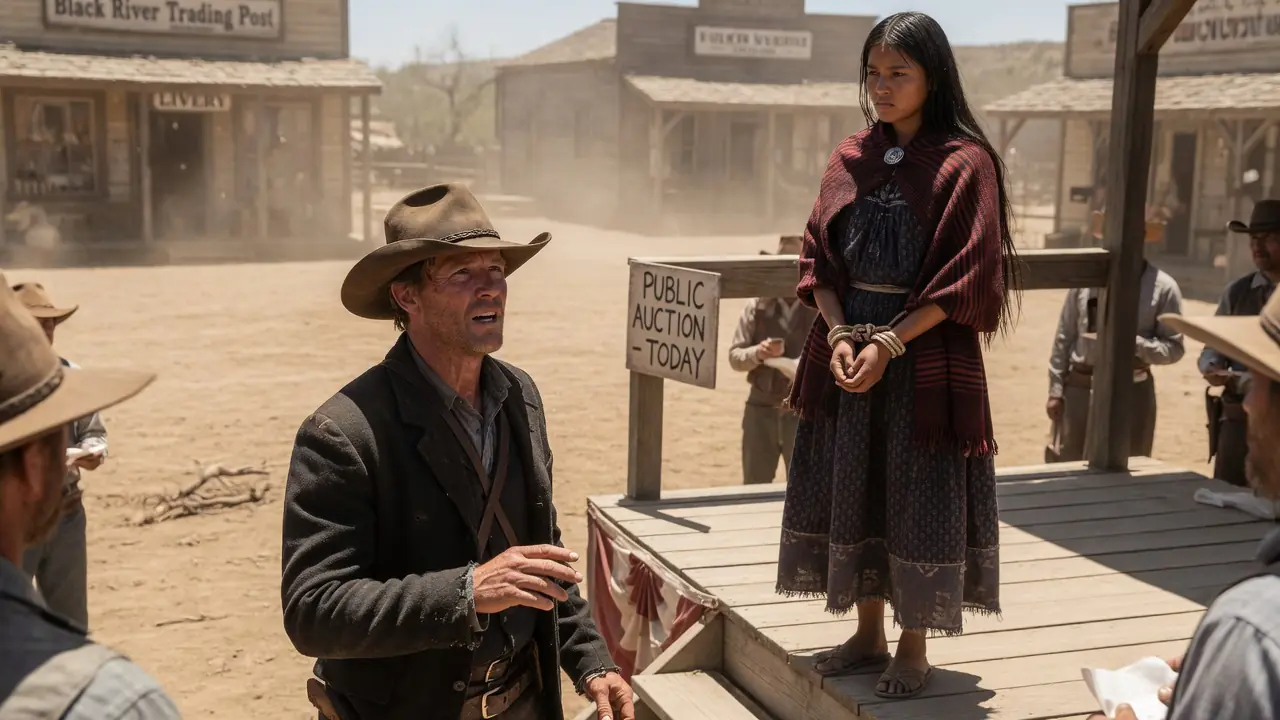
On the cracked wooden platform at the center of the dusty square stood a woman, wrists bound, head high, eyes like polished obsidian.
Her name was Cante, though no one there cared to ask.
The sergeant called her the Apache, shouting prices as if she were livestock.
Her hair caught the light like a black flame.
Her skin bronzed by the same sun that burned the earth, but her gaze calm, unbroken, made the crowd uneasy.
When a drunk ranch hand tossed a coin and laughed, Colt Denham felt something tighten inside his chest.
He had once believed compassion was a mistake that cost lives.
Yet before he could stop himself, his voice cut through the heat.
Forty dollars.
The square fell silent.
The wind stirred again as if startled awake.
The road out of town wound through a world carved by heat and silence.
The Black River Canyon stretched beneath a white sky, its cliffs dark as iron and its water thin as glass.
The river murmured low between stones, a sound half alive like a memory that refused to fade.
Colt Denham rode slowly, reins slack in his hand.
Behind him, the woman he had bought sat straight on the saddle, her hands free now.
Her posture proud as if the ropes had never existed.
Neither spoke.
The only sound was the creak of leather and the weary breath of Colt's bay horse.
He lived a few miles upriver in a one-room cabin patched with old pine and stubborn hope.
The place smelled of dust, horses, and solitude.
Years ago he had been a trail hand, known for his quiet temper and sure aim.
Then came the night he tried to save a woman and her child from a band of raiders and failed.
The child's small hand slipping from his still haunted him when thunder rolled.
Since then, he had spoken little and trusted even less.
When he glanced back, Cante was studying the land with eyes that missed nothing.
The shimmer of heat above the stones.
The flight of a hawk circling the canyon rim.
Her face bore no trace of fear, only an alert stillness, the kind of strength that needed no witness.
Dust clung to her bare shoulders, turning the bronze of her skin into gold.
She looked like someone carved out of the desert itself, a part of the canyon that refused to erode.
They reached the cabin by sundown.
The canyon walls caught the dying light, bleeding copper into the water.
Colt dismounted and held out a hand to help her down.
She ignored it, sliding off the horse with a smooth, effortless motion.
Her eyes met his for a heartbeat, steady, unreadable, then drifted to the cabin, the corral, the stacked firewood.
Inside, the air was cool, shadowed.
Colt poured water into a tin cup and set it on the table between them.
You can drink, he said.
She took it without a word, sipped, then placed it back carefully.
You have a name? he asked.
Her voice was low, melodic.
Cante.
He nodded.
Colt Denham.
Silence filled the small room again, heavy, but not hostile.
This land, she said quietly, was once full of green.
My father told me the river used to sing.
Colt followed her gaze.
It still sings, he murmured, though he wasn't sure why he said it.
Cante turned to him, eyes reflecting the faint firelight.
Then maybe it's waiting for someone to listen.
That night, after she lay down near the hearth, Colt stepped outside.
The canyon breathed around him.
Dry wind.
Distant coyote.
The restless murmur of the river.
He stared into the dark and wondered what kind of man buys a stranger to save her, yet cannot save himself from the ghosts of the past.
Inside, a soft sound reached his ears.
Cante's voice, humming something ancient, a tune that rose and fell like the water below.
The song carried through the cracks of the cabin, blending with the night.
For the first time in years, the silence didn't feel like punishment.
It felt like the beginning of something trying quietly to live again.
Morning came slow, spilling pale light through the cracks of the cabin wall.
The fire had gone out, but it left smoke, pine resin, and faint traces of wild sage.
Colt stepped inside from the porch, carrying a bucket of water from the river.
He stopped when he saw her.
Cante was already awake, kneeling by the hearth, stacking wood with quiet precision.
The ropes that had once marked her wrists were gone, yet the faint bruises remained.
Thin, dark rings that caught his eye before he could look away.
You look at the world like a man who doesn't look at what he's lost, she said.
He didn't ask how she knew.
Some truths didn't need explaining.
As the sun climbed, she began humming again, a tune carried from her father's stories.
The notes rippled through the canyon, soft and defiant.
Colt found himself leaning against the doorframe, listening.
Later that afternoon, when he offered her a plate of beans and bread, she accepted without thanks, but her eyes met his, no longer guarded, just watchful.
That night, as the firelight danced over the cabin walls, Colt sat sharpening his knife while Cante tended the flame.
Neither spoke, yet every flicker of light seemed to narrow the space between them.
When she finally broke the silence, her words were almost a whisper.
The earth here is old, she said.
It remembers everything.
He looked up.
What does it remember about me?
Cante's gaze was steady.
That you still have a heart, even if you've forgotten where you left it.
For the first time in years, Colt smiled.
Faint.
Uncertain.
But real.
Outside, the wind shifted, carrying the scent of rain far off in the canyon.
The days in Black River Canyon fell into a quiet rhythm, slow, sunburned, and honest.
The river thinned to a silver thread, whispering over stones.
The wind carried dust across the porch, settling in every crack of Colt's weathered cabin.
Each morning, Cante rose before him.
She swept the floor, gathered wood, and fed the horses without a word.
When Colt tried to help, she would only glance over her shoulder and say, I know the way of work.
And somehow, she did.
The movements efficient, balanced, unhurried.
At first, Colt found himself uneasy with her silence.
It was not submission.
It was something steadier, like a kind of strength that refused to explain itself.
One afternoon, when she took a small knife to the corral rail to scrape off old splinters, he finally asked, You plan on fixing the whole fence alone?
She looked up, wiping her forehead.
It's not the fence that's broken.
It's the hands that forgot to care for it.
He blinked, then laughed, a sound that startled them both.
You talk like a preacher.
No, she said simply.
I talk like my father.
After that, the silence between them changed.
It was no longer cold.
They began sharing small words about the weather, the land, the stubborn horse that refused to eat dry grass.
One morning, Colt split his palm while mending a gate.
The cut was deep, blood mixing with dust.
Cante came running from the porch, her expression unreadable.
Without asking, she tore a strip from her deerskin dress and pressed it to his hand.
Then she knelt by the water trough, crushing a few green leaves she had gathered earlier.
Yucca, she murmured.
It draws out the hurt.
He watched her bind the wound with practiced care.
Her fingers were steady, warm against his skin.
Where'd you learn all that? he asked.
From the earth, she replied.
It teaches if you listen.
Her touch lingered for a moment longer than needed.
Then she looked up at him.
You keep pain too close, she said softly.
Like it's the only thing that reminds you you're still alive.
Colt tried to answer, but couldn't.
The truth of it lodged somewhere deep where words had long dried out.
That evening, when the air cooled, they sat on the porch as the canyon glowed in shades of amber and gold.
Cante began humming the same tune she sang at night, the one her father had used to call the rain.
The sky above them blushed violet, and a faint breeze stirred through the cottonwoods.
Colt said quietly, It's been months since it rained.
Cante smiled faintly.
Maybe the sky's waiting to be remembered.
The next day, clouds gathered low and gray over the cliffs.
By dusk, the first drops fell.
Light.
Hesitant.
But real.
Colt stood in the doorway, watching her step into the open, face tilted upward as the rain touched her skin.
She laughed, a clear, bright sound that echoed off the rock walls and startled his heart awake.
He stepped down from the porch, letting the rain soak through his shirt.
Guess you were right, he said.
I didn't call it, she replied.
I only reminded it we were here.
The rain lasted an hour, leaving behind the smell of sage and wet dust.
That night, they ate in silence, listening to the dripping eaves.
When she rose to clean the table, he said quietly, You could leave if you wanted.
You're not bound here.
Cante stopped, her hands still.
If I stay, it's because the land lets me.
Colt met her eyes.
Not because of me?
Her gaze softened.
You're part of the land now.
You just don't know it.
Something in him, something long dormant, shifted.
He found himself wanting to protect that calm strength in her, not out of pity, but reverence.
Over the following weeks, they worked side by side.
He showed her how to cut wood evenly, how to use the saw without binding the teeth.
She taught him how to recognize wild mint from poisonous reed, how to read the bend of grass to tell where the river once ran deeper.
One dusk, as they repaired the fence, their hands brushed over the same post.
The contact was brief, but the warmth lingered.
When she drew back, there was a quiet smile on her lips.
Not shy.
Not bold.
Just knowing.
Do you ever miss people? he asked suddenly.
Cante looked toward the darkening ridge.
People forget.
The land doesn't.
He thought about that long after she'd gone inside.
Later that night, when thunder rumbled far away, Colt lay awake, listening to her breathing through the thin cabin wall.
Steady.
Peaceful.
Like the rhythm of a world learning to heal.
He realized then that for the first time in years, he no longer dreaded waking up.
It was late afternoon when the riders came.
Three of them.
Dust-caked.
Cruel-eyed.
With the kind of swagger that only came from cheap whiskey and a loaded gun.
Their horses kicked up red grit as they rode into the yard.
Colt saw the flash of metal, the crooked grin of the man in front.
Hank Crow.
He'd seen that face before, back when Crow rode under Sergeant Amos Roark, chasing Apache camps for bounty.
Well, hell, Crow drawled, swinging down from his saddle.
Didn't think I'd find you keeping company with one of them.
Colt stepped off the porch.
The heat pressed between them like a wall.
What do you want, Crow?
The man spat in the dust.
You bought that Apache wrong.
Roark says she's property of the territory now.
We came to fetch what's ours.
Behind Colt, the cabin door opened.
Cante stepped out, her hair loose, a faint smear of ash on her cheek.
She looked at the men the way a mountain looks at lightning.
Steady.
Ancient.
Unyielding.
I don't belong to any of you, she said.
Crow smirked.
You hear that, boys?
She's got a tongue on her.
The others laughed, a low, mean sound.
Colt felt something in him break loose.
He didn't remember drawing his rifle, only the solid weight of it in his hands.
The barrel leveled square at Crow's chest.
Get off my land, he said.
Crow's grin faltered.
You wouldn't shoot a man for talking.
Colt's voice came like gravel.
Try me.
For a long, dangerous moment, the canyon held its breath.
Then Colt fired one shot, straight into the sky.
The echo crashed through the rocks like thunder.
Horses spooked.
The men cursed, scrambling back to their saddles.
You'll regret that, Crow spat.
Ain't no man hides from Roark.
Maybe, Colt said.
But I ain't hiding.
They rode off, the sound of hooves fading into the dusk.
When silence returned, Colt turned to Cante.
She hadn't flinched once.
Only her hands trembled slightly, hidden in the folds of her skirt.
You just made enemies you can't outrun, she said quietly.
I've been outrunning myself for years, he replied.
They can take a number.
That night, the storm rolled in from the south, black clouds twisting like smoke.
Wind howled through the canyon, dragging sand and leaves in wild circles.
Colt tied down the corral gates, lightning splitting the sky above.
Cante called from the porch, Leave it.
It's not safe.
He shouted something back, but the wind tore the words away.
A gust slammed into him, knocking him sideways against the trough.
His boot slipped, and he went down hard.
The next thing he knew, the world was water and roar, the river swelling from the storm, breaking its banks.
His vision blurred.
Somewhere through the noise, he heard her cry his name.
Colt.
She was running through the rain, skirts bare feet slapping mud.
She caught his arm just as the current dragged him toward the rocks.
The flash of lightning lit her face.
Fierce.
Terrified.
Alive.
With all her strength, she pulled him free, dragging him up the slope toward the cabin.
By the time they reached the porch, he was half conscious, blood streaking his temple.
Cante laid him on the floor, her hands already moving with practiced urgency.
She tore open a pouch of dried herbs, crushed them into a poultice, pressed it against the wound.
Her voice shook as she spoke in Apache, then steadied into song, the same melody he'd heard before.
But now it carried the weight of prayer.
When Colt stirred, the storm had quieted.
Only the drip of rain remained.
He opened his eyes to see her kneeling beside him, hair soaked, hands trembling with exhaustion.
You shouldn't have, he began.
She silenced him with a look.
You saved me with silver, she whispered.
I saved you with breath.
Now we're even.
He managed a weak smile.
That how it works?
Her expression softened.
It's how life remembers balance.
Lightning flashed again beyond the window, but this time it was distant, harmless.
Cante sat back, closing her eyes.
When I was a child, she murmured, my father said, Storms are the earth's way of forgiving itself.
Maybe it forgave you tonight.
Colt watched her.
The curve of her shoulders.
The quiet rise and fall of her breath.
Something deep inside him gave way.
Not in pain, but in peace.
Outside, the river still rushed, but its voice was gentler now.
The cabin smelled of wet cedar and medicine.
He wanted to thank her, but words felt too small.
Instead, he reached out, covering her hand with his.
For a moment, neither moved.
Then she whispered, Sleep, Colt Denham.
The land still needs you.
When he drifted into dreams, he thought he heard the canyon singing low, rhythmic, alive, as if joining her song.
The next morning broke clear and blue, as if the night's fury had been a fever the earth finally sweated out.
Mist rose from the river, softening the black cliffs into a tender gray.
Inside the cabin, Colt woke to the smell of smoke and sage.
Cante was crouched by the hearth, stirring a small pot of broth.
Her hair was still damp, dark against her shoulders.
When she heard him shift, she turned, eyes sharp with relief and fatigue.
You should rest, she said.
I've been resting long enough, Colt murmured, trying to sit up.
His ribs protested.
Cante moved to steady him.
You almost drowned.
He managed a crooked smile.
Would have made a sorry story.
She didn't laugh.
Don't make light of death.
It listens when you do.
For a while, they said nothing more.
She handed him a bowl, and he ate in silence, tasting salt, herbs, and something faintly sweet.
It warmed him all the way down.
When he was done, she gathered the dishes and stepped outside.
Through the open door, he watched her kneel by a patch of damp soil near the porch.
She opened a small pouch, pulling out pale kernels of corn and pressing them gently into the earth.
He rose slowly, walked out to stand behind her.
What's that?
My father's seed, she said.
I kept them since before the soldiers came.
He said if corn will grow, the land still forgives.
Colt looked at the black soil, still soft from rain.
You think this land can forgive me, too?
Cante brushed dirt from her fingers.
You're part of it now.
You bled into it.
That's how the earth remembers who belongs.
He stood there, the weight of her words settling deep.
The canyon was still scarred, still dry in places, but somehow he believed her.
That the world could choose to remember kindness instead of pain.
Over the following days, he healed.
The wound on his head scabbed over.
His strength returned.
Cante moved through the days with quiet assurance, repairing what the storm had scattered.
A broken fence.
Fallen tools.
A washed-out trail.
Colt followed her lead without meaning to, until one afternoon, she caught him watching her tie back her hair with a strip of rawhide.
You stare like a man seeing the sun for the first time, she said without looking up.
Maybe I am, he answered.
She paused, eyes flicking toward him.
And for a heartbeat, the air between them felt fragile, alive.
Then she smiled faintly and went back to work.
A week later, a trader from town came rattling down the canyon path.
Darren Pike.
A man with thin lips and a voice that stank of superiority.
He brought salt and sugar, hoping to trade for hides, but his gaze snagged on Cante the moment he saw her.
Well, now, he said, tipping his hat.
Didn't know you'd started hiring help.
Colt's voice was calm but hard.
She's not help.
Pike's grin soured.
Then what is she?
The one who keeps this place alive.
Cante's head turned sharply, eyes meeting Colt's.
She said nothing, but her breath caught.
Pike muttered something under his breath, took his goods, and left.
When the wagon disappeared beyond the ridge, Cante spoke at last.
You didn't need to say that.
Yes, I did, Colt replied.
She studied him, a long silence stretching between them.
Then she reached into her satchel and pulled out a small braid of horsehair, bound with a strip of cloth.
My people give this to those who listen to the land, she said, to remind them not to forget.
Colt took it gently.
You trust me with that.
Her eyes softened.
I trust what I see in you.
He hesitated.
And what do you see?
Cante smiled slow, knowing, a little sad.
A man who stopped running when the world told him to hide.
He couldn't find words, so he just nodded, slipping the braid around his wrist.
The fibers were coarse, but the gesture felt sacred.
That evening, they sat on the porch together, watching the sun drop behind the ridge.
The corn patch shimmered faintly in the golden light.
Cante leaned forward, elbows on her knees.
Do you hear that? she asked.
The river?
No, she said softly.
The ground.
It's breathing again.
Colt listened.
Maybe it was just wind through the reeds, but for the first time since he'd come to this canyon, he thought he could hear it, too.
A slow, patient heartbeat under the soil.
He looked at her, at the woman who had walked out of his worst memory and turned it into a beginning.
You've done something to this place, he said quietly.
Cante turned toward him, her face lit by the fading sun.
No, she whispered.
I only reminded it.
It's still alive.
Autumn crept into the canyon softly, turning the light honey-colored and the nights cool enough for a blanket.
The corn Cante planted had risen knee-high.
Green blades cutting through the black soil like quiet triumph.
Every morning, Colt would pause at the patch, fingers brushing the leaves, still half amazed that something could grow in a place so stubbornly dead.
But one evening, as the wind shifted colder, Cante stood by the fence looking south.
The horizon burned gold, and in her eyes was a distance he had come to dread.
I have to find them, she said.
Colt set down the saddle he was mending.
Find who?
The ones who survived, she answered.
My father's kin.
Maybe others from the Chiricahua camps.
If they still walk the desert, they should know rain has touched this canyon again.
He stared at her for a long moment.
You'll go alone.
I've walked alone before.
I know, he said, voice low.
And I hated every minute imagining it.
For a heartbeat, she almost smiled, but her gaze softened with something like sorrow.
This isn't leaving you.
It's going toward what’s left of me.
He nodded slowly.
Then I'll take you there.
They rode south at dawn through land that shimmered with the last warmth of summer.
The journey was silent but not heavy.
The silence between them had learned to carry meaning.
After two days, they reached a small settlement of makeshift tents, the remnant of a people scattered and worn thin.
An old woman, her hair silver like moonlight, stepped forward.
Do you seek someone? she asked in Apache.
Cante knelt before her.
I seek memory, she said.
The woman studied her for a long time before shaking her head.
Names have faded.
We remember only songs now.
Cante bowed, the words cutting deeper than she showed.
Colt watched her shoulders tremble once, then still.
When she rose, she turned to him.
No one remembers Cante, she whispered.
So I'll stop searching.
He held her gaze.
Then come home.
They rode back under a sky swollen with starlight.
The canyon greeted them with the sound of running water, stronger now, fuller.
Life had crept back while they were gone.
A week later, a rider from town arrived.
Reverend Alaric Holt.
A thin man with kind eyes who had once baptized miners along the Pecos.
He carried a worn Bible and an easy smile.
Cante watched him dismount, suspicion flickering across her face.
You called a preacher?
Colt scratched the back of his neck.
Didn't reckon we needed much of a crowd.
Just a word to make it right.
Reverend Holt smiled.
Marriage ain't about ownership, miss.
It's a promise that two souls choose to guard each other's freedom.
Cante looked at Colt, something bright trembling behind her calm.
Freedom, she repeated.
That's all I ever wanted.
And that's what I promise, he said.
The ceremony was small, only the wind, the river, and a single candle between them.
When Holt spoke the final blessing, Cante reached for Colt's hands.
His were scarred, hers calloused.
Yet they fit as if the land itself had shaped them to match.
After the preacher left, the two remained on the porch, watching dusk settle.
The air smelled of rain and mesquite smoke.
Cante knelt beside the corn patch, pressing the last few kernels of her father's seed into the soil.
Colt crouched beside her, covering them gently with earth.
When they stood, she began to hum again.
That same song that had once pulled him back from darkness.
It drifted over the water.
Soft as breath.
The canyon answered with its own murmur.
Wind against stone.
Water against rock.
And for the first time, Colt heard no loneliness in it.
Only life.
He turned to her, voice quiet.
So, this is what forgiveness sounds like.
Cante smiled.
No, she said.
This is what home sounds like.