The first thing Clara Bennett noticed was the chandelier.
It hung above the ballroom like a frozen waterfall, throwing white light over crystal glasses, polished silver, black tuxedos, silk gowns, and faces that had never worried about the price of rent. Every piece of glass above her head caught the glow and broke it into glittering fragments, making the whole room sparkle as if wealth itself had a color.
Clara stood beside the service entrance with a tray of champagne glasses balanced carefully on one hand.
Her black waitress uniform was clean but simple. White shirt. Black vest. Black slacks. Flat shoes that had already begun to pinch her feet after only an hour. Her dark brown hair was tied neatly at the back of her neck, and a small silver name tag rested over her heart.
CLARA.
That was all anyone in that room needed to know.
To them, she was not a woman with a past, a family, a mind, or a story. She was a moving hand. A polite smile. Someone who appeared when a glass was empty and disappeared before a conversation became private.
She had worked events like this before. Charity auctions. Political dinners. Corporate launch parties. Weddings where the floral budget could have paid off her mother’s hospital bills three times over. She knew how to walk quietly, speak only when spoken to, and accept the invisible weight of being looked through.
But tonight was different.
Tonight, the gala was being held at the Worthington Grand Hotel in downtown Chicago, and every banner, every printed program, every gold-lettered invitation carried the same name.
The Bennett Foundation Annual Children’s Hospital Gala.
Clara paused when she saw those words printed across the marble entrance earlier that evening.
Bennett.
Her father’s name.
Her name.
But no one here knew that.
And for now, Clara wanted it that way.
She moved into the ballroom, tray steady, eyes calm. At the far end of the room, a jazz quartet played softly beside a wall of white roses. Cameras flashed near a red carpet area. Businessmen shook hands with politicians. Women in diamond necklaces laughed with their heads tilted back, their voices floating like perfume.
The guests had come to donate, to be photographed donating, and to remind one another how generous they were.
Clara passed a group of men discussing real estate investments.
One of them lifted a glass without looking at her.
“Champagne,” he said.
She placed one in his hand.
He did not say thank you.
That was normal.
Near the center of the ballroom stood the man everyone watched.
Preston Vale.
Even from across the room, Clara recognized him.
He was fifty-one, tall, broad-shouldered, with silver-streaked hair combed perfectly back and a smile polished by years of interviews, boardrooms, and courtroom settlements. He wore a black tuxedo that looked custom-made, a watch that flashed every time he lifted his hand, and the relaxed arrogance of a man who believed rooms changed shape when he entered them.
Preston Vale was the CEO of Vale Capital, a private investment firm that owned hotels, restaurants, luxury apartment buildings, and several companies that had once belonged to kinder people.
Clara knew more about him than most people in that room did.
She knew that Preston had once been her father’s trusted business partner.
She knew he had helped push her father out of Bennett Hospitality Group when Clara was nineteen.
She knew that after her father’s stroke, Preston had quietly spread rumors that Daniel Bennett was unstable, weak, and no longer fit to lead the company he had built from nothing.
And she knew something Preston did not know.
Daniel Bennett had spent the last two years preparing to take back everything.
Clara had not come to the gala as a waitress because she needed the money, though she did need money once.
She had come because her father asked her to see the company from the ground floor before taking her place inside it.
“Before you sit at the head of a table,” he had told her, his voice rough from illness but still firm, “you need to understand who clears it after everyone leaves.”
So Clara applied under her mother’s maiden name.
Clara Reid.
Temporary event staff.
No connections.
No special treatment.
No one knew the quiet waitress moving through the ballroom was Clara Bennett, Daniel Bennett’s only daughter, newly appointed chairwoman of the Bennett Foundation, and the woman whose signature would soon decide the future of the entire hotel.
Clara did not want a grand entrance.
She wanted truth.
And truth was always easier to hear when powerful people thought no one important was listening.
By eight-thirty, the ballroom was full.
The auction tables were arranged along the east wall. Signed sports jerseys. Luxury vacation packages. Rare wine collections. A private dinner with a celebrity chef. Everything gleamed under glass cases and soft white spotlights.
Clara moved between tables, offering drinks, collecting empty glasses, and listening.
She heard a woman say the hospital wing was “such a touching little cause.”
She heard a man joke that donating to children’s healthcare made his wife less angry about his new yacht.
She heard laughter from people who could write six-figure checks without changing their weekend plans.
Then she heard Preston Vale’s voice.
“That foundation only exists because Daniel Bennett wanted people to think he had a heart.”
Clara stopped near a tall arrangement of lilies.
Preston stood beside a group of executives, holding champagne like a prop. Around him were three men and one woman, all dressed expensively, all leaning in as if his cruelty was wisdom.
“Daniel was always sentimental,” Preston continued. “That was his weakness. He cared too much about employees, families, sick children, old buildings with history. You cannot run an empire like a church basement.”
One man laughed.
Clara’s fingers tightened slightly around the tray.
Another executive asked, “Have you heard from him recently?”
Preston smirked.
“Barely. He is tucked away somewhere recovering, if that is what you want to call it. Poor man still thinks the Bennett name means something.”
The woman beside him lifted an eyebrow.
“And does it?”
Preston looked around the ballroom as if he owned the chandelier, the marble floor, the air itself.
“Not after tonight.”
Clara felt her heart slow.
Not after tonight.
Those words landed heavily.
She turned away before anyone noticed her listening.
By nine, the speeches began.
The host stepped onto the small stage and welcomed the guests, thanking them for their generosity. A video played on large screens showing smiling children, doctors, nurses, hospital rooms painted in bright colors, and parents holding tiny hands beside medical beds.
Clara watched from the side wall, her tray now empty.
For a moment, the noise in the ballroom softened.
This was why the foundation mattered. Not the photos. Not the social pages. Not the tax benefits. The children. The families who walked into hospitals carrying fear like a second body. The mothers who slept upright in chairs. The fathers who counted coins in cafeteria lines. The nurses who worked double shifts and still smiled.
Her mother had been one of those nurses.
Before she married Daniel Bennett, before the money, before the name, Evelyn Reid had worked nights in pediatric care. She had taught Clara that dignity did not come from being rich. It came from how you treated people when they had nothing to offer you.
Clara swallowed the ache in her throat.
Then Preston Vale walked onto the stage.
The room erupted in applause.
He smiled, placed one hand over his heart, and waited just long enough for the cameras to capture humility.
“Thank you,” he said into the microphone. “Thank you, truly. Tonight is about compassion. It is about responsibility. It is about using privilege to lift those who are less fortunate.”
Clara almost laughed.
Preston spoke beautifully.
Men like him always did.
He praised the doctors. Praised the donors. Praised the hotel. Praised the memory of the Bennett family’s charitable work without once mentioning Daniel by name.
Then he made his announcement.
“It is my honor tonight to pledge, on behalf of Vale Capital and its partners, a donation of five million dollars toward the new pediatric recovery center.”
The applause was immediate.
Cameras flashed.
Guests rose to their feet.
Preston smiled wider.
Clara remained still.
Five million dollars sounded generous, but she knew the number. She had read the documents. Vale Capital had delayed payments to contractors working on hospital housing facilities. Preston owed nearly three times that amount in unresolved obligations connected to foundation-backed properties.
This donation was not generosity.
It was a mask.
When the applause faded, Preston stepped down from the stage, surrounded by praise. A server near Clara whispered, “Must be nice to save the world with pocket change.”
Clara glanced over and saw a young waitress named Maya, maybe twenty-two, with tired eyes and a sharp little smile.
Clara liked her immediately.
“It must be,” Clara said softly.
Maya adjusted her tray. “Careful around Vale. He already made one of the staff cry during setup because the napkins were folded wrong.”
Clara looked toward Preston. “I’ll keep that in mind.”
Maya leaned closer. “No, seriously. He’s mean. Not rude. Mean.”
Before Clara could answer, the catering manager hurried over.
“Clara,” he said, tense. “VIP section needs fresh champagne. Table three. Mr. Vale’s table. And please, no mistakes.”
There it was.
Clara nodded.
She took a full tray from the service station and crossed the ballroom.
Preston’s table sat near the stage, marked by a tall gold number three. Around it were donors, executives, a city councilman, and a woman named Vivian Cross, a luxury magazine editor known for writing flattering profiles about powerful men.
As Clara approached, Preston was telling a story.
“…and the man actually expected me to keep all five hundred employees after the acquisition,” he said. “Can you imagine? Five hundred people doing the work technology could replace in six months.”
The table laughed.
Clara began placing champagne glasses carefully.
Preston did not look at her until she reached his right side.
Then, suddenly, he moved his elbow.
The tray tilted.
Three glasses slid.
Clara caught two.
The third fell.
Champagne spilled across the edge of the table and splashed onto Preston’s sleeve.
The table went silent.
Clara straightened immediately.
“I’m sorry, sir,” she said calmly. “Let me get a cloth.”
Preston slowly looked down at his sleeve, then up at her.
His smile was gone.
“Do you know how much this jacket costs?”
Clara kept her voice steady. “I apologize. I’ll have someone assist with cleaning it right away.”
He stared at her name tag.
“Clara.”
He said her name as if it tasted cheap.
“Tell me, Clara, do they train you people before sending you into rooms like this?”
A few guests shifted uncomfortably.
Vivian Cross gave a small laugh into her glass.
Clara held the tray at her side.
“Yes, sir,” she said.
Preston leaned back in his chair.
“And yet somehow, despite all that training, you managed to pour champagne on me.”
“I understand, sir. I’m sorry.”
“Are you?”
His voice grew louder, just enough for nearby tables to hear.
“Because you people always say you’re sorry after damaging something you could never afford to replace.”
Clara felt heat rise in her face, but she did not lower her eyes.
Maya, standing near the service entrance, froze.
The catering manager looked terrified.
Preston continued, encouraged by the attention.
“You should be careful in rooms like this. One careless move can cost more than a month of your wages.”
Another man at the table chuckled.
Clara set the tray down on a service stand nearby.
“I’ll bring club soda and a cloth,” she said.
Preston held up one hand.
“No. Stay.”
The word cracked across the space.
Clara stopped.
Preston looked around the table, smiling again, performing.
“This is the problem with charity events,” he said. “We raise money for people, and suddenly everyone thinks they belong in the same room.”
The laughter was quieter this time.
Clara looked at him.
“Sir, I’m here to work.”
“Exactly,” Preston said. “You are here to work. Not to hover, not to listen, not to pretend this room is meant for you.”
Clara’s chest tightened.
For one brief second, she saw her father in a hospital bed, one side of his face weaker than the other, struggling to lift his hand. She remembered him telling her that cruelty often wore expensive shoes.
She remembered her mother telling her never to confuse silence with weakness.
Preston pointed toward the spilled champagne.
“Clean it.”
The catering manager rushed forward. “Mr. Vale, I can handle—”
“No,” Preston said, still looking at Clara. “She made the mess. She can clean it.”
The ballroom had begun to notice.
Conversations near them faded.
Clara stood very still.
Then she picked up a white cloth from the service station and stepped toward the table.
She cleaned the champagne from the table edge first. Slowly. Carefully.
Preston watched her with satisfaction.
“Good,” he said. “There are still some jobs people are suited for.”
Something in the room changed.
A few people looked away.
A young doctor near the next table frowned.
Maya’s eyes filled with anger.
Clara finished wiping the table. Then she turned slightly toward Preston’s sleeve.
“I can blot the fabric if you’d like,” she said.
Preston lifted his arm.
“Try not to ruin it further.”
Clara touched the cloth gently to the damp sleeve.
Then Vivian Cross laughed again.
“Preston, you’re terrible.”
He smiled without apology.
“No, Vivian. I am practical. Everyone wants to pretend we are equal at these events. We are not. Some people build hospitals. Some people pass drinks inside them.”
Clara stopped moving.
The cloth remained in her hand.
Preston noticed.
“What is it?” he asked. “Did I offend you?”
Clara looked at him, really looked at him.
At the perfect hair. The custom tuxedo. The watch. The face of a man who had taken her father’s trust and called it weakness.
“No,” she said quietly. “You revealed yourself.”
The table went silent.
Preston blinked.
“Excuse me?”
Clara folded the cloth once and placed it neatly beside his plate.
“I said you revealed yourself.”
A small gasp came from someone nearby.
The catering manager whispered, “Clara…”
Preston stared at her, stunned for half a breath. Then his expression hardened.
“Do you have any idea who you’re speaking to?”
Clara’s voice stayed calm.
“Yes.”
He laughed once, sharply.
“Then perhaps you should remember your place.”
“My place?” Clara asked.
“Yes,” Preston said. “Your place.”
The words hung in the air.
Clara glanced around the ballroom.
People were watching now. Not openly, not all of them, but enough. Phones had lowered. Conversations had stopped. The jazz quartet continued playing softly, unaware that the center of the room had shifted.
Clara looked back at Preston.
“For years, men like you have built entire careers on telling other people their place,” she said. “The kitchen. The back entrance. The service hallway. The bottom of a contract. The wrong side of a locked boardroom door.”
Preston’s eyes narrowed.
“You need to leave.”
“I will,” Clara said. “After the foundation presentation.”
Preston gave the catering manager a cold look.
“Fire her.”
The manager went pale.
“Mr. Vale, she’s temporary staff, but—”
“I said fire her.”
Maya stepped forward. “She apologized. You moved your arm.”
Preston turned his gaze toward Maya.
“And who are you?”
Maya froze.
Clara moved slightly in front of her.
“She has nothing to do with this.”
Preston smiled thinly.
“How noble. One waitress defending another.”
Vivian Cross muttered, “This is getting uncomfortable.”
Preston pushed back his chair and stood.
He was tall, and he knew how to use height. He stepped close enough that Clara could smell the champagne on his breath and the expensive cologne beneath it.
“Let me explain something to you,” he said softly, but the room was quiet enough to hear every word. “People like you survive because people like me allow you to. I can make one call, and you will never work another event in this city.”
Clara did not move.
“People like you,” he continued, “should be grateful when we let you stand near power.”
For the first time all night, Clara smiled.
It was not a large smile.
It was not warm.
It was the smile of someone who had finally heard exactly what she came to hear.
“Thank you,” she said.
Preston frowned. “For what?”
“For saying that clearly.”
Before he could respond, the lights near the stage shifted.
The host returned to the microphone, looking nervous.
“Ladies and gentlemen,” he said, voice slightly shaky, “before we begin the final auction, we have a special presentation from the Bennett Foundation.”
Preston turned sharply.
“What presentation?”
The host glanced toward the side entrance.
A ripple moved through the ballroom as two men entered.
The first was an older Black man in a navy suit, walking with the calm authority of someone used to being obeyed without raising his voice. His name was Samuel Hayes, and he was the Bennett family attorney.
Beside him was a man in his early sixties, moving slowly with the aid of a cane.
The room inhaled.
Daniel Bennett.
Clara’s father.
He looked thinner than the photos displayed in old business magazines. His once-dark hair had gone mostly gray. His left hand rested carefully at his side, still not fully recovered from the stroke. But his eyes were clear. His suit was simple and perfectly fitted. And when he entered the ballroom, the Bennett name suddenly meant something again.
Whispers broke out.
“Is that Daniel Bennett?”
“I thought he was too ill.”
“What is he doing here?”
Preston’s face changed.
For one moment, all color drained from it.
Daniel Bennett walked toward the stage with Samuel Hayes at his side.
Clara stood near table three, still in her waitress uniform, still holding herself with quiet control.
Her father saw her.
Their eyes met.
His expression softened for only a second.
Then he looked at Preston.
The host stepped aside.
Daniel took the microphone.
The ballroom fell silent.
“Good evening,” Daniel said.
His voice was lower than it used to be, slower too, but every word carried.
“It has been some time since I stood in a room like this. Some of you know why. Some of you heard stories. Some of you repeated them.”
Several guests looked down.
Preston stood rigid beside his chair.
Daniel continued.
“Two years ago, I suffered a stroke. During my recovery, I learned a great deal about weakness. I learned how quickly people mistake physical limitation for mental absence. I learned how many friends disappear when there is no longer immediate profit in staying close.”
His eyes moved to Preston.
“And I learned the difference between loyalty and performance.”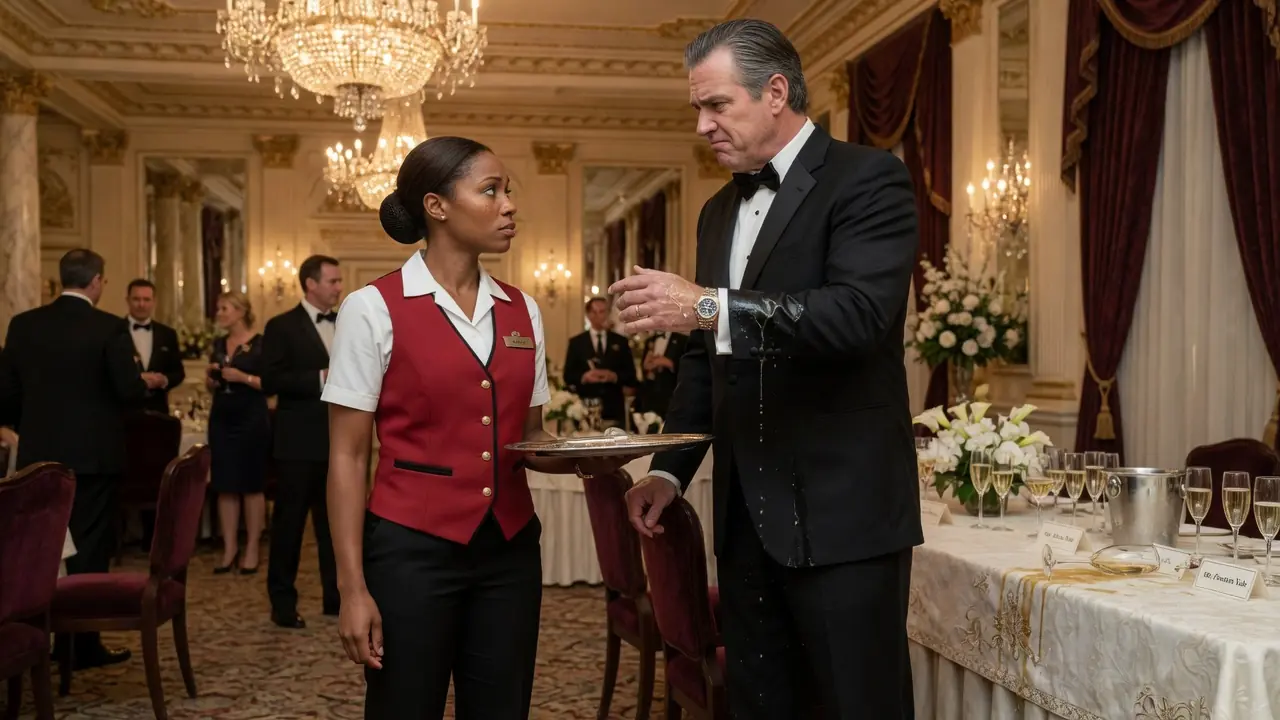
No one spoke.
Daniel rested one hand on the podium.
“This foundation was started by my late wife, Evelyn. She was a pediatric nurse before she was ever Mrs. Bennett. She believed no parent should have to choose between paying rent and staying near a sick child. She believed dignity should not depend on income. This foundation was her heart before it was our family’s name.”
Clara felt her throat tighten.
Daniel looked toward her again.
“For the past several months, the Bennett family has conducted a quiet internal review of every foundation-linked contract, every property agreement, every donor partnership, and every management structure connected to Bennett Hospitality Group.”
Preston’s jaw tightened.
Daniel turned a page.
“What we found was troubling.”
The room stirred.
Samuel Hayes stepped forward with a folder.
Daniel did not open it.
“Several companies tied to Vale Capital delayed payments to workers, inflated management fees, and attempted to redirect funds connected to foundation-supported housing projects. These matters are now in the hands of our legal team.”
Gasps moved through the ballroom.
Preston stepped forward.
“Daniel, this is not the place.”
Daniel looked at him calmly.
“No, Preston. This is exactly the place.”
Preston forced a laugh.
“You’re confused. You’ve been unwell.”
Daniel’s face did not change.
“I was unwell. I was not absent.”
A murmur rose.
Daniel turned slightly.
“Mr. Hayes.”
Samuel Hayes took the microphone.
“As of 4:00 p.m. today, all emergency injunctions requested by Bennett Hospitality Group were granted. Vale Capital’s attempted transfer of operating control over three Bennett properties has been blocked pending investigation. Additionally, the Bennett Foundation board voted unanimously this afternoon to remove Vale Capital and all related entities from donor leadership, advisory authority, and contract preference consideration.”
Preston’s mouth opened.
No words came out.
Then Daniel took the microphone back.
“And one more matter.”
Clara knew it was coming.
Her heartbeat grew louder.
Daniel looked out across the ballroom.
“For too long, people have spoken about the Bennett family as if it ended with me. It did not.”
He lifted his hand toward Clara.
“My daughter has spent the last year studying every part of this organization, from financial records to hospital housing sites to the service staff who carry events like this on their backs while others take credit under chandeliers.”
Every eye turned.
Clara stood in her black uniform beside the table that had mocked her.
Daniel’s voice grew stronger.
“Ladies and gentlemen, I would like to introduce Clara Bennett, incoming chairwoman of the Bennett Foundation and majority voting representative of the Bennett family trust.”
The silence was absolute.
Then the room erupted.
Not in applause at first.
In shock.
Whispers. Gasps. Chairs shifting. People turning toward Preston to see his reaction.
Preston looked at Clara as if she had changed shape before his eyes.
Vivian Cross covered her mouth.
The catering manager nearly dropped the cloth in his hand.
Maya whispered, “Oh my God.”
Clara slowly removed her name tag.
CLARA.
No last name.
She walked toward the stage.
Every step felt longer than the last. Her shoes still hurt. Her uniform still smelled faintly of champagne. Her hands were steady.
When she reached her father, Daniel held out his hand.
She took it gently.
The applause began then.
Soft at first, then stronger. Not from everyone. Some clapped because they were moved. Some because they were afraid not to. Some because they understood power had just shifted and wanted to stand on the right side of it.
Clara stepped to the microphone.
She looked across the ballroom.
Then she looked at Preston.
“Earlier tonight,” she said, “I was told to remember my place.”
No one moved.
Clara continued.
“I was told that people like me survive because people like him allow us to. I was told some people build hospitals, and some people pass drinks inside them.”
A wave of discomfort crossed the room.
Preston’s face turned red.
Clara looked away from him and toward the servers standing near the walls.
Maya. The kitchen runners. The bartenders. The dish staff visible through the service doorway. The people who had carried trays, polished glasses, folded napkins, and been treated as furniture.
“My mother used to say that the true measure of a person is not how they treat someone above them, but how they treat someone who cannot punish them.”
She paused.
“Tonight, I learned a great deal.”
Her voice did not shake.
“I learned which donors speak kindly only when cameras are nearby. I learned which executives confuse cruelty with intelligence. I learned which guests laugh when someone is humiliated because they believe the person being humiliated has no power.”
Vivian Cross lowered her eyes.
Clara turned a page on the podium though she did not need notes.
“I also learned something better. I learned that the staff working this event showed more grace, restraint, and dignity than some of the wealthiest people in this room. They protected one another. They kept working. They remained professional when others were not.”
Maya wiped quickly at her eye.
Clara looked at the catering manager, who looked both ashamed and relieved.
“Effective immediately, the Bennett Foundation will require every partner venue and vendor connected to our events to meet new labor standards: fair wages, written anti-harassment protections, direct reporting channels, and immediate contract review for any guest or donor who abuses staff.”
The room shifted again.
This was no longer just a reveal.
It was policy.
It was consequence.
“Charity,” Clara said, “does not begin on stage. It begins in the hallway, in the kitchen, at the coat check, beside the table where someone thinks no one important is listening.”
Then she turned fully toward Preston.
“As for Mr. Vale, his pledged donation tonight will not be accepted under donor leadership recognition.”
Preston snapped, “You cannot refuse five million dollars.”
Clara looked at him calmly.
“We can refuse money used to purchase silence.”
A low murmur moved through the room.
Preston stepped forward. “This is absurd. You are a waitress playing dress-up with your father’s name.”
Daniel’s eyes hardened.
Clara lifted one hand slightly, stopping her father from speaking.
Then she smiled.
“No, Mr. Vale. Tonight I was a waitress. And you showed me exactly how you treat one.”
Preston looked around, searching for support.
He found none.
The city councilman stared at his plate.
Vivian Cross avoided his eyes.
The executives at his table looked as though they had never met him before.
That was how quickly power worked. One moment, they laughed beside him. The next, they were strangers.
Samuel Hayes stepped closer to Preston.
“Mr. Vale, representatives from our legal team are waiting outside. You are welcome to continue this conversation with counsel present.”
Preston’s voice dropped. “Daniel, after everything I did for you—”
Daniel’s face twisted with something between pain and disgust.
“You did nothing for me, Preston. You did it beside me until you found a way to do it against me.”
Preston’s mouth tightened.
For one second, Clara saw the fury beneath the polished surface. The man who hated being exposed. The man who could not stand that a woman in a server’s uniform had watched him destroy himself with his own words.
Then he turned and walked out.
No one stopped him.
The ballroom doors closed behind him with a soft, final sound.
For a moment, the room remained silent.
Then someone began clapping.
It was the young doctor from the next table.
Then Maya.
Then the kitchen staff near the service entrance.
Then more guests.
The applause grew until it filled the ballroom, echoing against the chandelier, rising above the flowers, the auction tables, the polished floor, and all the fragile masks wealth had worn that evening.
Clara did not smile widely.
She looked at the staff first.
Then at her father.
Daniel’s eyes were wet.
“You did well,” he whispered.
Clara squeezed his hand.
“So did you.”
The gala continued, but it was no longer the same event.
People spoke more softly after that.
Guests who had ignored servers all evening suddenly began saying please and thank you. Some did it awkwardly, as if kindness were a language they had not practiced in years. Others did it sincerely, with embarrassed faces and lowered voices.
Clara returned briefly to the service area.
Maya stared at her.
“So,” Maya said slowly, “you’re telling me I called the new chairwoman of the Bennett Foundation ‘girl’ when I asked you to help me carry dessert plates?”
Clara laughed for the first time all night.
“Yes.”
Maya covered her face. “I am so fired.”
“No,” Clara said. “You’re not.”
Maya peeked between her fingers.
“You sure?”
“I’m very sure.”
The catering manager approached carefully.
“Ms. Bennett, I owe you an apology.”
Clara turned to him.
His face was pale, sincere.
“I should have stepped in sooner,” he said. “I was afraid of losing the contract.”
Clara studied him for a moment.
Fear was not cruelty. It could enable cruelty, yes, but it was not the same thing. She had learned that from watching people survive under powerful men.
“You should have,” she said.
He nodded, ashamed.
“Tomorrow,” Clara continued, “you and I will talk about staff protections.”
“Yes, ma’am.”
“And tonight, make sure everyone working this event receives double pay.”
His eyes widened.
“Double?”
“Triple for anyone Preston Vale insulted directly.”
Maya lifted her hand slightly.
Clara smiled. “Yes, Maya. That includes you emotionally.”
Maya whispered, “I love rich justice.”
Clara laughed again.
Across the room, Daniel watched his daughter from near the stage.
For years after the stroke, people had spoken around him as if he were already gone. They had discussed his company, his foundation, his legacy, his weakness. But looking at Clara now, standing among the staff instead of above them, he knew the Bennett name had not survived because of buildings, contracts, or money.
It had survived because Evelyn’s heart had survived in their daughter.
Near the end of the night, the final auction item was announced.
It was not the private chef dinner.
It was not the vacation package.
It was an unplanned addition.
Clara stepped onto the stage again and announced that the Bennett family trust would match every donation made that evening, not up to five million, but up to ten.
This time, the applause was different.
Cleaner.
Less performative.
Maybe because the room had been shaken. Maybe because people wanted forgiveness. Maybe because some of them, for the first time that night, remembered the children in the hospital video.
By midnight, the gala had raised more money than any previous year.
But that was not the part people talked about the next morning.
They talked about the waitress.
They talked about Preston Vale being escorted from the hotel.
They talked about Clara Bennett standing in a black vest and flat shoes, calmly dismantling a man who thought her uniform made her powerless.
The story spread quickly.
By breakfast, business outlets were calling it “The Bennett Gala Reckoning.”
By lunch, clips had reached millions of views.
But Clara did not watch them.
The next morning, she visited St. Catherine’s Children’s Hospital with her father.
No cameras.
No donors.
No champagne.
Just a quiet pediatric wing with painted murals, tired parents, nurses in soft shoes, and children whose names mattered more than any headline.
A little girl with a purple scarf around her head showed Clara a drawing of a house with a giant sun above it.
“This is where my mom sleeps when I’m here,” the girl said. “But the real room is smaller.”
Clara knelt beside her.
“We’re going to make the real rooms better,” she said.
The girl looked at her seriously.
“Can they have softer chairs?”
Clara smiled.
“Yes. Softer chairs.”
“And snacks?”
“Yes. Snacks too.”
The girl nodded as if approving a major contract.
Daniel stood by the doorway, leaning on his cane.
“You remind me of your mother,” he said when Clara returned to him.
Clara looked down the hallway, where a nurse helped a father carry blankets into a room.
“I hope so.”
“You do.”
They walked slowly toward the elevator.
After a while, Daniel said, “Last night was hard.”
Clara nodded.
“Yes.”
“Did you regret doing it that way?”
She thought about Preston’s face. His words. The silence at the table. Maya’s anger. The staff watching from the walls.
“No,” Clara said. “People like Preston count on private cruelty and public manners. Sometimes the truth needs witnesses.”
Daniel smiled faintly.
“That sounds like your mother too.”
A week later, the Bennett Foundation announced its new labor dignity initiative.
It changed more than gala rules.
Every hotel under Bennett management had to create anonymous reporting systems for staff mistreatment. High-profile guests could be banned for harassment. Vendor contracts required wage transparency. Service workers could report abuse without fear of losing shifts.
Some donors complained quietly.
A few withdrew support.
More took their place.
Then came the final blow to Preston Vale.
The investigation uncovered enough irregularities to trigger lawsuits, audits, and board panic. Vale Capital’s partners began distancing themselves. His magazine profiles disappeared from websites. His speaking invitations were canceled. The people who once laughed at his table stopped answering his calls.
He did not fall in one day.
Men like him rarely did.
But he began falling the moment he told a waitress to remember her place.
Three months later, Clara stood in the renovated family housing wing of St. Catherine’s Children’s Hospital.
The chairs were softer.
The rooms were brighter.
The snack pantry was full.
On the wall near the entrance hung a simple plaque.
Not gold. Not flashy.
Just brushed steel with black lettering.
THE EVELYN BENNETT FAMILY CENTER
For Every Parent Who Needs A Place To Rest, And Every Child Who Needs Them Near.
Underneath, in smaller letters, was a quote.
Dignity is not charity. It is what we owe one another.
At the opening ceremony, reporters asked Clara about the gala.
One asked, “Ms. Bennett, do you think people underestimated you because you were dressed as a waitress?”
Clara looked toward the hospital hallway, where Maya now stood in a navy blazer with a Bennett Foundation staff badge. Clara had hired her two weeks after the gala as part of the foundation’s event worker advocacy team.
Then Clara turned back to the reporter.
“No,” she said. “They underestimated waitresses because they never imagined one could matter to them.”
Another reporter asked, “And what did you learn?”
Clara smiled, not sharply this time, but with the calm of someone who knew exactly where she stood.
“I learned that power reveals people,” she said. “But so does service.”
That evening, after the ceremony ended, Clara and Daniel sat alone in the hospital courtyard.
The city moved around them. Cars passed. Nurses changed shifts. A father carried a sleeping child through the glass doors. Somewhere above them, a mother laughed softly in a family room that had not existed months before.
Daniel looked at Clara.
“You know,” he said, “your mother would have loved that you wore the uniform.”
Clara looked down at her hands.
“I wasn’t sure I could do this.”
“Lead?”
She nodded.
Daniel was quiet for a moment.
Then he said, “Leadership is not knowing you belong above people. It is remembering you are responsible to them.”
Clara leaned back on the bench.
For so long, she had feared the Bennett name would feel too heavy. Too public. Too tied to betrayal, illness, lawsuits, and rooms full of people waiting for her to fail.
But now, sitting beside her father outside a hospital wing built for exhausted families, she felt something different.
Not pride exactly.
Purpose.
The kind her mother had carried in hospital corridors.
The kind her father had almost lost and found again.
The kind that did not need a chandelier to shine.
A month later, Clara returned to the Worthington Grand Hotel.
Not for a gala.
Not for revenge.
For a staff meeting.
Every server, housekeeper, cook, bartender, front desk clerk, and maintenance worker had been invited. The ballroom looked different in daylight. Without gowns and tuxedos, without cameras and champagne, it seemed less intimidating. Just a large room with chairs, coffee stations, and people who had spent years making luxury possible for others.
Clara stood at the front, this time in a cream blazer, dark trousers, and simple black heels.
Maya sat in the front row, grinning.
Clara looked out at the staff.
“The first time I worked in this room,” she said, “I learned that some people believe service makes a person small.”
She paused.
“I am here to tell you that this company will not be run by people who believe that.”
No one clapped at first.
They listened.
That mattered more.
Clara explained the new policies, the wage increases, the reporting system, the guest accountability rules. She answered questions for nearly two hours.
One housekeeper asked if a wealthy guest could still get someone fired by lying.
“No,” Clara said.
A banquet server asked if temporary workers were included.
“Yes,” Clara said.
A cook asked what would happen if managers ignored complaints.
“They will answer to me,” Clara said.
The room grew quiet.
Then the cook nodded slowly.
“Good.”
At the end of the meeting, an older server raised her hand.
She had gray hair pulled into a bun and tired eyes that had seen too many grand events.
“What made you do all this?” she asked. “Really?”
Clara thought about the easy answer.
Her mother.
Her father.
Preston Vale.
The gala.
But the real answer was bigger than one night.
“I did it,” Clara said, “because no one should have to be secretly powerful to be treated with respect.”
This time, the applause came slowly.
Then fully.
Not polished.
Not performative.
Real.
Clara stood there and let it wash over her, not as praise, but as a promise.
Later, as the staff filed out, Maya walked up beside her.
“You know they’re going to tell that story forever, right?”
“What story?”
Maya grinned. “The night a billionaire thought he was humiliating a waitress and accidentally handed her the microphone.”
Clara laughed softly.
“He handed it to himself.”
Maya nodded toward the chandelier.
“You ever going to wear the uniform again?”
Clara looked up at the crystal lights.
Then at the service doors.
Then at the room where everything had changed.
“Maybe,” she said. “Whenever I need to remember what power looks like from the other side.”
That night, Clara stayed after everyone left.
The ballroom became quiet again.
No music.
No champagne.
No laughter from people trying to prove they belonged.
Just the soft hum of lights and the faint movement of workers cleaning up coffee cups from the staff meeting.
Clara picked up an empty paper cup from a chair and carried it to the trash.
One of the janitors saw her and hurried over.
“Ms. Bennett, you don’t need to do that.”
Clara smiled.
“I know.”
She dropped the cup in.
Then she looked around the room one last time.
Months ago, Preston Vale had told her to remember her place.
He had meant below him.
Behind him.
Invisible.
But he had been wrong.
Her place was not at the bottom of the room or the top of it.
Her place was wherever dignity needed defending.
And from that day forward, everyone in the Bennett Foundation knew one thing for certain.
The woman who had once carried champagne through the Worthington Grand ballroom had not come to serve power.
She had come to change it.