At a crowded restaurant in Chicago, Emma, a single mother, is working herself to exhaustion just to earn every dollar she can to pay for treatment for her young daughter who is fighting cancer. Suddenly, a difficult billionaire walks in, someone no one wants to serve because he is famous for being stingy. Only the single mother steps forward and serves him with genuine care. But when he leaves, Emma opens the bill and is immediately crushed to see the tip is only $0. Everyone around her shakes their heads in disbelief. She thinks she has been humiliated until she discovers a mysterious note left behind with a midnight meeting written on it. What she doesn't know is that this single piece of paper is about to change her entire life forever.
 The alarm screamed at 5:50 a.m. Emma Davis slapped it silent and lay there in the darkness, every muscle in her body screaming its own protest. Four hours of sleep. That was all she'd gotten. Again, she forced herself out of bed. The floor was cold against her bare feet. Chicago in November was brutal, and the landlord had turned off the heat two weeks ago because she was late on rent again. Emma tiptoed to the bathroom, careful not to wake Lily. The mirror showed a stranger: dark circles under her eyes, cheekbones too sharp from skipping meals so Lily could eat, hair that desperately needed washing. She was 29 years old. She looked 40. Emma splashed cold water on her face, brushed her teeth with a toothbrush that needed replacing months ago, and pulled her hair into a tight bun. No time for a shower. She'd shower tonight, maybe. She sat on the edge of the bed and examined her black flats. The right one had a separation between the sole and the upper. She'd noticed it yesterday. Felt it getting worse with every step during her twelve-hour shift. She grabbed the duct tape from the nightstand drawer. This was her life now. Duct tape solutions. Temporary fixes, holding everything together with whatever was available. Emma wrapped the tape around the bottom of her shoe, carefully pressing hard to make sure it would last through another shift. The left shoe would probably make it through the week. The right one? She'd be lucky if it lasted until tonight. She stood, tested her weight on the repaired shoe. It held for now.
Emma walked to Lily's room and pushed open the door quietly. Her daughter was curled under a thin blanket decorated with butterflies that had faded from too many washings. Lily's head was wrapped in a soft pink scarf. She'd lost all her hair three months ago from the chemotherapy. Emma sat on the edge of the bed, her heart breaking like it did every morning when she saw how small Lily looked. How fragile. "Baby," Emma whispered, touching Lily's forehead gently. Warm, but not feverish. "Thank God. Mommy's leaving for work." Lily's eyes fluttered open. Brown eyes exactly like Emma's. "Already?" "Yeah, sweetie. But Mrs. Patterson will be here at 7:00 to make you breakfast. She said something about pancakes with chocolate chips." Lily's voice was hopeful, childlike, breaking Emma's heart all over again. "Maybe if you're good and take your medicine." Emma kissed her forehead, breathing in the smell of her daughter's skin. "I love you more than the whole world." "Love you more than the whole universe," Lily whispered back. It was their ritual, their promise to each other. Emma stood to leave, but Lily's small hand grabbed hers. "Mommy, when am I going to get better?" The question punched Emma in the stomach. She forced a smile, forced her voice to stay steady. "Soon, baby, the doctors are going to make you all better. I promise." Lily nodded, but Emma saw the doubt in her eyes. Kids weren't stupid. Lily knew something was very, very wrong. Emma kissed her again, then left before Lily could see the tears.
In the kitchen, Emma opened the refrigerator. The shelves were mostly bare: one egg, a quarter carton of milk that was probably going bad, some leftover rice from three days ago that she'd saved in a plastic container. She cracked the egg into the pan with trembling hands. While it cooked, she pulled out her phone. Three new notifications lit up the screen: electric company final notice. Service will be disconnected in 48 hours. Landlord rent overdue. Pay within five days or vacate premises. And the third one, the one that made Emma's hands shake so badly she almost dropped the phone: Children's Memorial Hospital patient Lily Davis. Bone marrow transplant deposit required. Amount $18,000. Final deadline: 10 days. Ten days. Emma stared at that number. $18,000. It might as well have been ten million. A billion. An impossible, unreachable mountain of money. She made $2.13 an hour base pay as a waitress, plus tips. On a good night, a really good night, she went home with $70. On a bad night, maybe $30. She'd been saving for eight months. She had $3,847 in her account. Even if she saved every single penny for the next ten years, she'd never come close.
The egg burned in the pan, filling the kitchen with smoke. Emma turned off the stove and scraped the blackened egg into the trash. She wasn't hungry anyway. Her stomach was twisted in knots. She grabbed her purse, a worn black thing she'd bought at Goodwill for $5, and headed for the door. On the small table by the entrance where Lily kept her crayons and construction paper, there was a new drawing. Emma picked it up. Two stick figures holding hands: one tall with long hair, that was Emma; one small with a scarf, that was Lily. Above them, written in shaky crayon letters, "Mommy is a superhero." Emma pressed the drawing to her chest and let herself cry for exactly thirty seconds. She counted them. 1, 2, 3. Breathe. 4, 5, 6… At 30, she wiped her face, put the drawing back on the table, and walked out into the cold morning. The bus stop was four blocks away. Emma's feet already hurt by the time she got there.
The Crown was the kind of restaurant where appetizers started at $45 and entrees could run $200. White tablecloths, crystal chandeliers, a wine list thicker than a phone book. Emma had worked there for three years. She knew every table number, every crack in the marble floor, every temperamental quirk of the espresso machine. She clocked in at 6:47 a.m., thirteen minutes early like always. "You're late." Emma looked up. Thompson stood by the time clock, arms crossed over his barrel chest. He was a short man who compensated with meanness and cologne so strong it made Emma's eyes water. "Mr. Thompson, I'm early. My shift starts at 7:00. If you're on time, you're late. That's the rule." He shoved a clipboard at her chest: table assignments, sections three and four today. Emma looked at the paper and felt her heart sink. Sections three and four were the worst in the restaurant, right by the swinging kitchen doors where it was hot and loud, far from the bar, with that one wobbly table that customers always complained about. "Mr. Thompson, I had three and four yesterday. Rachel said she'd switch with me today because I covered her Saturday." "I don't care what Rachel said," Thompson's voice was flat. "You've got three and four. Do your job or I'll find someone who will." Emma bit the inside of her cheek hard enough to taste blood. "Yes, sir." Thompson walked away, trailing that awful cologne. Emma tied her apron around her waist and checked the pocket. Now, the hospital notice was there, folded into a small, thick square. She couldn't leave it at home. She needed to feel it to remember why she was doing this. Why she smiled at people who snapped their fingers at her like she was a dog, why she endured Thompson's cruelty and Rachel's smugness, why she worked until her feet bled and her back screamed. For Lily. Everything was for Lily.
The morning shift was brutal. A businessman sent his eggs back three times because they weren't fluffy enough, even though they looked identical each time. A couple argued for twenty minutes about whether to get the salmon or the sea bass, then blamed Emma when their food took too long. A woman lectured Emma about the importance of education while tipping exactly ten percent on a $100 bill. By noon, Emma's feet were on fire. But Emma stayed. She always stayed. When the lunch rush bled into dinner prep, Thompson didn't ask if she could cover the evening shift. He simply handed her a new section sheet and said, "Don't mess this up." By the time the chandeliers were dimmed and the dinner crowd arrived, Emma had already been on her feet for eleven hours. The duct tape on her right shoe had started to peel. Every step felt like walking on broken glass and hot coals simultaneously. She ducked into the staff bathroom and tried to rewrap the tape. Her hands shook from exhaustion and low blood sugar. She hadn't eaten anything except half a piece of toast sixteen hours ago.
The door swung open. Rachel walked in, already reapplying lipstick in the mirror. She was twenty-two, blonde, pretty in that effortless way that came from never having to worry about money. "Oh, good, you're here," Rachel said without looking at Emma. "I need you to cover table seven for me." Emma frowned. "Table seven? That's in your section." "Yeah, and I'm giving it to you. VIP just walked in. I'm not dealing with it." "Rachel, I already have nine tables. So now you have ten. You should be grateful. VIP's tip big." Rachel finally turned to face Emma, and her smile was sharp, cruel. "Look, I heard about your kid, the cancer thing. So, I'm doing you a favor, okay? A VIP tip could be like a hundred bucks. You need it more than I do." Emma's jaw clenched. "Who's the VIP?" Rachel's smile widened. Marcus Cole. Emma's blood turned to ice. Everyone in Chicago knew that name. Marcus Cole, tech billionaire, self-made fortune, built an empire from nothing and crushed anyone who got in his way. The tabloids called him the Ice King. And he was famous for one other thing. He never tipped ever.
"Rachel, everyone knows he doesn't tip, so maybe you'll be the exception." Rachel walked past Emma toward the door. "But hey, if you don't want it, I'm sure Thompson would love to hear how you're refusing tables during the lunch rush." She left, her laughter echoing down the hallway. Emma stared at her reflection in the bathroom mirror. She looked defeated, exhausted, broken. Then she thought about Lily's drawing. "Mommy is a superhero." Superheroes didn't give up. Emma rewrapped the duct tape tighter, straightened her stained collar, and walked back into the dining room. Time to face the Ice King.
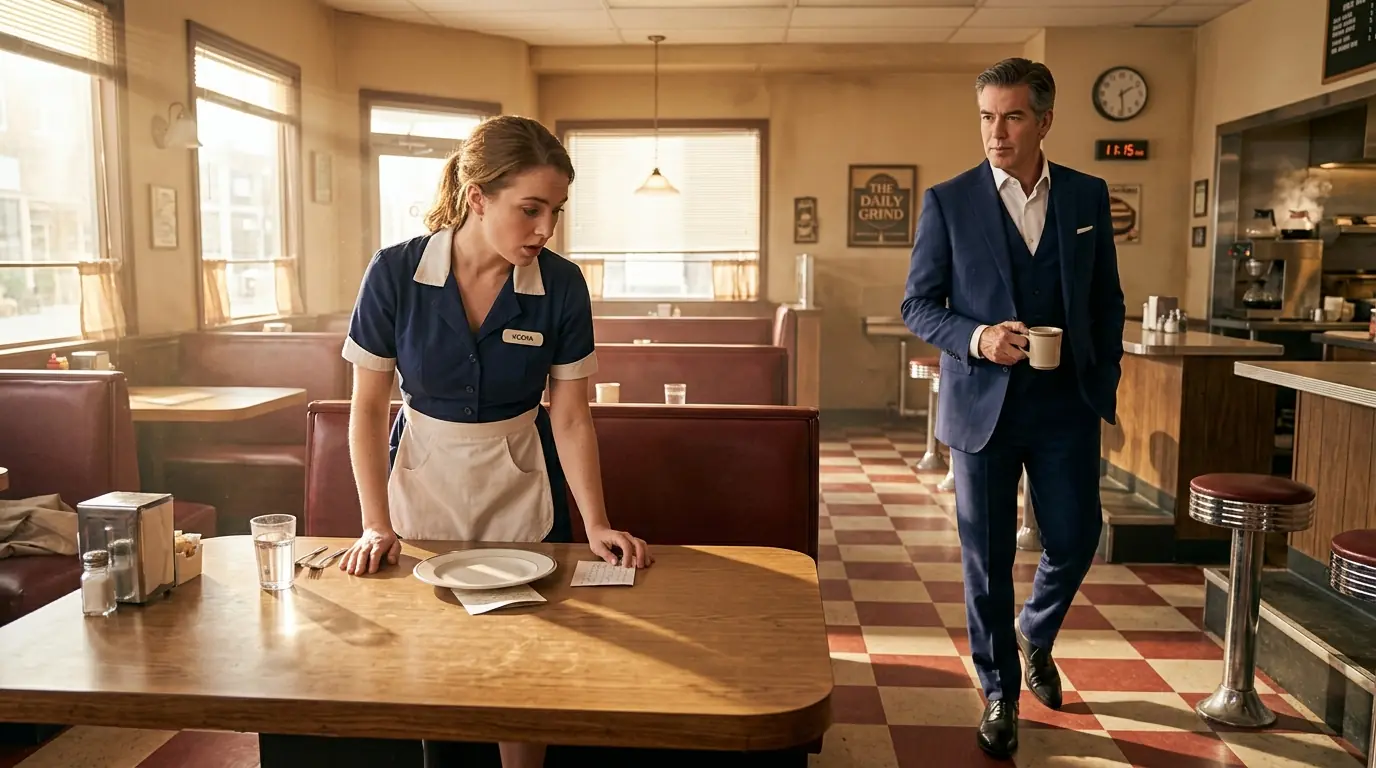
Table seven sat in the VIP section, a corner booth with velvet curtains that could be drawn for complete privacy. The lighting was softer here, more intimate. It was where celebrities came to hide from cameras, where CEOs made deals they didn't want recorded. Emma approached slowly, clutching her order pad like a shield. Marcus Cole sat with his back to the wall, illuminated by the glow of his phone. He was exactly what the photos showed: tall, broad-shouldered with dark brown skin and features that looked carved from stone, sharp cheekbones, strong jaw. He wore a charcoal suit that probably cost more than Emma made in six months, maybe a year. But it was his eyes that made Emma's breath catch when he finally looked up. Cold, calculating, dark brown, almost black. The eyes of someone who saw everything and felt nothing.
"Good evening, sir." Emma's voice came out steadier than she felt. "My name is Emma, and I'll be taking care of you tonight. Can I start you with something to drink?" Marcus didn't look up from his phone. His fingers moved across the screen with practiced precision. "Water. Room temperature. Exactly 70° Fahrenheit, not 68, not 72, 70," his voice was deep, resonant, completely devoid of warmth. "No ice. Slice of lemon, but I want the rind removed completely. I don't want the oils from the peel." Emma blinked. "Yes, sir. Room temperature water at 70° with lemon, no rind. And I want it in three minutes, not four, not five. Three minutes exactly." "Yes, sir." Emma turned and walked as quickly as her damaged shoes would allow. At the bar, she grabbed a thermometer, thankful the Crown had them for the wine service, and filled a glass with filtered water. She held the thermometer in the water, watching the mercury climb: 65, 68, 70. Perfect. She grabbed a lemon and a pairing knife. Her hands worked quickly, carefully removing the bright yellow rind until only the pale flesh remained. She sliced a thin round and placed it in the glass. Two minutes thirty-eight seconds. Emma carried the water back to table seven, setting it down on the coaster with precise alignment. Marcus picked up the glass without looking at her. He examined the lemon slice against the light like he was inspecting a diamond, then took a single sip. He set it down. Still no eye contact. Acceptable. Emma waited, pen poised over her order pad. Was she supposed to take that as approval, dismissal, or a test she’d barely passed? "Are you ready to order, sir?" Now Marcus looked at her. Really looked at her. His eyes traveled from her face down to her scuffed shoes and back up again.
"The ribeye," he said. "But tell Chef Laurent to use Wagyu, not the standard cut. I want it seared for exactly three minutes and twenty seconds per side, not three minutes, not three and a half, exactly three minutes and twenty seconds. Medium rare. If it comes out medium, I'm sending it back." Emma wrote frantically. "Wagyu ribeye, three minutes twenty seconds per side, medium rare. And substitute the pearl onions with shallots. Pearl onions are pedestrian." Emma's pen froze. "Sir, Chef Laurent is very particular about modifications to his dishes." "I don't care what Chef Laurent thinks. This is what I'm paying for." Marcus's voice didn't rise, but the temperature in the booth seemed to drop twenty degrees. "Can you handle that request, or should I speak with your manager?" Emma's stomach twisted into knots. If she bothered Thompson with this, he'd explode and probably dock her pay. If she didn't get the order exactly right, Marcus would complain and she'd be fired anyway. Damned either way. "I'll make sure the kitchen prepares it exactly as you specified, sir." "Good." Marcus returned to his phone, dismissing her like she'd ceased to exist.
Emma walked to the kitchen on legs that felt like rubber. She found Chef Laurent at his station, orchestrating five different dishes simultaneously. "Chef, I need a special order for table seven." Laurent looked up, his face already showing irritation. He was a short French man with a temper that matched his talent. "Table seven, the VIP booth. What does he want?" Emma rattled off the modifications. With each word, Laurent’s face turned a deeper shade of purple.
"Shallots out? Shallots?" His voice rose above the kitchen noise. "He comes into my kitchen and tells me how to cook my ribeye. Please, chef." "He's very specific," Emma said. "He said, ‘If it’s not perfect, fine, fine.’" Laurent slammed a pan onto the stove hard enough to make everyone nearby jump. "But if this pompous ass complains that my food is not to his liking, I will go out there myself and shove the shallots down his throat." "Thank you, chef. I really appreciate—" But Laurent had already turned away, barking orders at his sous-chef in rapid French.
Emma spent the next forty minutes in a state of barely controlled panic. She checked on her other nine tables, refilling waters, clearing plates, smiling until her face muscles ached, but her mind never left table seven. Finally, Laurent called out, "Order up, table seven." The plate looked perfect. The Wagyu was a gorgeous pink, juices pooling slightly on the white porcelain. The shallots glistened. Everything was artfully arranged. Emma carried it like she was transporting a bomb through a minefield.
"Your Wagyu ribeye, sir." She set it down carefully. Shallots instead of pearl onions, seared three minutes and twenty seconds per side, medium rare. Marcus cut into the steak. Pink juice spread across the plate. He lifted a piece to his mouth, chewed slowly, deliberately. Emma held her breath.
"As acceptable," he said finally. Relief flooded through Emma so intensely, she felt dizzy. "Is there anything else I can get for you?" Marcus set down his fork and knife. "Sit down." Emma froze. "I'm sorry." "Sit down," he gestured to the empty seat across from him. "Sir, I can't. I'm working. I have other tables." "I'm paying $312 for this meal. I want conversation." His eyes locked onto hers. "Sit." Emma glanced around desperately. Thompson was in his office. Rachel was busy with a large party. No one was watching. Slowly, like she was approaching a wild animal, Emma slid into the booth. Marcus leaned back, studying her with that unsettling intensity.
"What's your story, Emma?" "My story? You’re different from the other servers here. They’re working this job because it’s close to money and power, because it looks good on an Instagram post. You’re not here for any of that." He tilted his head slightly. "You're desperate. Why?" Every instinct screamed at Emma to stand up and walk away. This was inappropriate. This was none of his business. But she thought about the hospital bill due in ten days. About Lily. "I have a daughter," Emma said quietly. "She's six years old. She has leukemia. She needs a bone marrow transplant, and insurance won’t cover it all. I need to come up with $18,000 in ten days."
Silence. Marcus's expression didn’t change. No sympathy, no warmth, no emotion at all. "So, you're here," he said slowly, "serving people who look through you like you're invisible, hoping that someone will tip enough to save your child’s life." The words stung because they were true. "Yes. That's a terrible strategy." Emma’s hands clenched into fists under the table. "Excuse me? You’re relying on luck, on charity, on the kindness of strangers who have no reason to care whether you live or die." Marcus picked up his wine glass, swirling the deep red liquid. "In business, relying on luck is a guaranteed path to failure."
Tears burned Emma’s eyes. "What else am I supposed to do? I’m a single mother with no college degree, working two jobs. This is the best I could get. Is it? Or is it the job you settled for because you didn’t think you deserve better?" The question hit Emma like a slap. She stood up abruptly. "I need to get back to work." "Sit down. I'm not finished." "Well, I am." Emma's voice shook with anger. "You want to judge my life, fine. You want to tell me I’m a failure. I already know that, Mr. Cole. But I show up every single day. I work until my feet bleed. I smile at people who treat me like garbage. I do whatever it takes to keep my daughter alive. So you can take your opinions and your $300 stake."
And she stopped herself before she said something that would get her fired. Emma walked away before Marcus could respond, her heart pounding so hard she could hear it in her ears. For the next twenty minutes, she avoided table seven like it was radioactive. She served her other tables with a smile plastered on her face, even though inside she was screaming. Finally, she saw Marcus stand and walk to the front. He paid at the register with a black card, probably one of those invitation-only cards with no spending limit, and left without looking back.
Emma waited five full minutes before approaching table seven to clear it. The table was clean, plate scraped clean, wine glass empty, napkin folded neatly, and in the center sat the leather bill folder. Emma's hands trembled as she opened it. The receipt showed $312.75, and in the tip line, someone had drawn a thick red slash, then written in bold red ink, $0. Nothing. After everything, after the perfect water temperature, after battling Chef Laurent for the modifications, after enduring his interrogation, Marcus Cole had left her absolutely nothing.
"Oh my god!" Rachel's voice came from directly behind Emma. "Did the Ice King really give you zero?" Emma couldn’t speak. Her throat had closed up completely. "I told you." Rachel's voice was loud enough to carry across the dining room. Other servers turned to look. Marcus Cole doesn’t tip. He’s famous for it, but you thought you were special, didn’t you? Laughter rippled through the staff.
"Clear that table, Miller," Thompson's voice boomed. "We have a waitlist. Move it." Emma grabbed a bus tub with numb hands and started stacking plates. As she lifted the dinner plate, something white slipped out from underneath the heavy charger plate beneath it. Emma frowned. She set down the plates and picked up the paper. It was thick, expensive stationery, cream-colored, folded once with trembling fingers. Emma unfolded it. The handwriting was precise, angular, written in black fountain pen ink.
"Midnight, Pier 47 warehouse. Come alone. Prove you’re willing to fight. MC." Emma read it three times, her heart hammering. This was insane. This was a setup, a trap. But at the very bottom, in smaller letters, Marcus had added one more line: "Zero dollars because you’re not a servant. You’re a survivor. Now prove it."
Emma stood in the staff bathroom staring at the note for the hundredth time. Pier 47. This was how people disappeared. This was how bodies ended up in Lake Michigan. But then she thought about Lily’s face that morning, the way her daughter had asked, "When am I going to get better?" The hope and doubt mixed together in those brown eyes. Emma pulled out her phone and dialed Mrs. Patterson.
"Hello?" The elderly woman’s voice was groggy with sleep.
"Mrs. Patterson, I’m so sorry to call this late. I need a huge favor. Can you stay with Lily tonight? I have to—I have to work late. A special event."
"Of course, dear. Is everything all right?"
"No. Yes. I just—I might not be back until very early morning."
"Don’t you worry. Lily and I will have a lovely evening. I’ll make her hot chocolate." Emma’s throat tightened. "Thank you. I can’t tell you how much."
"Hush. Now you just do what you need to do. We’ll be fine."
Emma hung up and looked at herself in the mirror. Dark circles under her eyes, clothes wrinkled from a twelve-hour shift, shoes held together with duct tape. This was crazy. But crazy was all she had left. The last bus to the industrial district left at 11:40 p.m. Emma barely made it, running the last two blocks on her damaged shoes. The bus was nearly empty: just Emma, an elderly man who smelled like cigarettes, and a young woman with headphones who never looked up from her phone. Emma sat in the back and watched Chicago pass by outside the window. The glittering downtown gave way to darker neighborhoods, closed shops, abandoned buildings, the kind of area where bad things happened and nobody asked questions.
The bus driver called out, "Pier 47, last stop in this direction." Emma stood on shaking legs. The driver turned to look at her. A heavyset woman with tired eyes. "You sure about this stop, honey? Ain’t nothing out here but warehouses in trouble."
"I’m sure."
The driver shook her head. "Your funeral?" The doors hissed shut behind Emma, and the bus pulled away, leaving her alone in the darkness.
Pier 47 sat on the edge of Lake Michigan, where the city’s industrial zone met the water. Massive warehouses loomed against the night sky. The air smelled like oil, rust, and dead fish. Emma pulled her thin coat tighter and started walking. Her footsteps echoed on the empty street. Every shadow looked like a threat. Every sound made her jump. The distant clang of metal, the screech of a ship’s horn, the skittering of rats in the darkness. Ahead, she saw it: a black SUV with tinted windows, engine idling, parked near a warehouse entrance. Emma’s heart hammered against her ribs.
She could turn around right now, go home, hold Lily close, and pretend this night never happened. But then what? Wait for the hospital to call in ten days and tell her they couldn’t do the surgery? Watch her daughter die? Emma kept walking.
As she approached the SUV, the passenger window rolled down. A man with a thick neck and an earpiece stared at her with flat, professional eyes.
"Name?" he said. It wasn’t a question.
"Emma. Emma Davis."
The man touched his earpiece, speaking quietly. "Package is here." Then he looked at Emma. "Side entrance straight ahead until you see the light."
The heavy metal door groaned open as Emma pushed it. Inside the warehouse was cavernous: shipping containers stacked three high, steel beams crisscrossing overhead. The air was cold enough to see her breath. In the center of the vast space, under a bank of industrial lights, sat a folding table and two metal chairs. Marcus Cole sat in one of them. He’d removed his suit jacket and rolled up his shirt sleeves. No expensive watch on his wrist. No tie. He looked almost ordinary. Almost. He was typing on a laptop, his fingers moving rapidly across the keyboard. He didn’t look up as Emma’s footsteps echoed across the concrete floor.
"You came," Marcus said, still not looking up. "You left me a note. Most people wouldn’t have come. They would have been too afraid or too smart." He finally looked up, his eyes catching hers in that intense gaze again. "Which are you, Emma? Afraid or smart?"
"I’m desperate," Emma said. "You already know that." Something flickered across Marcus’s face. Respect, maybe. "Sit down."
The metal chair was freezing through her thin work pants. Marcus closed his laptop and leaned back, studying her. "Do you know why I left you $0 tonight?" Emma’s jaw clenched.
"Because you’re testing me. You said so in your note, partially. I needed to see how you’d react under pressure, under humiliation, under anger. Most people break. They quit. They give up. They accept that the world is unfair and stop fighting. But you came here at midnight to a warehouse. Even though you’re terrified, even though this could be a trap, that tells me something about who you are."
"What do you want from me?" Marcus pulled a thick folder from a briefcase on the floor and dropped it on the table with a heavy thud. Papers spilled out: spreadsheets, shipping manifests, container numbers, weight records. "Cole Industries. My company. Eight billion in annual revenue. Three divisions: AI development, logistics, and data security. Somewhere in my operations, someone is stealing from me. Four million dollars a year gone. My accountants can’t find it. My auditors can’t find it. My executives—all Harvard and Yale graduates with decades of experience—they can’t find it."
He pushed the folder toward Emma. "You have ninety minutes. If you find the leak, I write you a check for $200,000 tonight. Enough for Lily’s surgery, with money left over for six months of expenses." Emma stared at the papers, then at Marcus. "I’m a waitress. I don’t know anything about—"
"You don’t need to know about corporate logistics. You need to know about patterns, about inconsistencies, about details."
Marcus pulled out his phone and turned it toward her. On the screen was Lily’s complete medical file: diagnosis, treatment history, prognosis, surgery schedule. Emma felt like she’d been punched.
"How did you get that? That’s private."
"I know everything about you, Emma Davis. Lily Davis, six years old, acute lymphoblastic leukemia, complicated by hypoplastic left heart syndrome, needs a bone marrow transplant. Cost after insurance: $18,000. Deposit required in ten days or surgery is canceled."
He leaned forward. "I don’t make offers to strangers. So yes, I investigated you. I know about your husband dying in a construction accident four years ago. I know about your foreclosed house. I know you work two jobs and sleep four hours a night. I know you put duct tape on your shoes because you can’t afford new ones."
Emma’s face burned with humiliation.
"You had no right."
"I had every right. If I’m going to trust someone with my business, I need to know everything about them."
Marcus stood and walked to the edge of the light. "Ninety minutes, Emma. Starting now." He pulled out his phone and made a call, leaving Emma alone with the impossible task.
Emma stared at the folder. Her hands shook as she pulled the first page toward her. Container manifests. Hundreds of them. Endless columns of numbers, weights, dates, container IDs, origin ports, destination ports, contents, values. This was impossible. She was a waitress. She served food and smiled and calculated tips in her head. She wasn’t an analyst. She wasn’t qualified for this.
But then Emma thought about her job: remembering twelve different orders across twelve different tables. Who wanted dressing on the side? Who was allergic to shellfish? Who needed a refill before they asked? Calculating split checks for parties of ten. Observing customers’ body language, anticipating requests, details, patterns, inconsistencies. That was just data in a different form.
Emma grabbed the pen on the table and started reading. Container 847B. Contents: electronics, laptops, tablets. Value: $45,000. Departure weight: 12,000 lbs. Arrival weight: 11,100 lbs. 900 lbs difference. She flipped to the next page. Container 921C. Contents: luxury textiles, designer clothing. Value: $38,000. Departure weight: 8,500 lbs. Arrival weight: 7,800 lbs. 700 lbs difference. Emma kept flipping container after container. Some showed perfect weight matches, but others—high-value electronics, medical equipment, designer goods—showed consistent weight losses.
Emma grabbed a calculator from the table and started punching numbers. Container 847B lost 7.5% of its weight. Container 921C lost 8.2% of its weight. Container 125A lost 8.7% of its weight, always between 7 and 9%. Never more. Never less. That wasn’t random. That wasn’t measurement error. That was deliberate. Emma checked the signatures at the bottom of each manifest. Each shipment required approval from a loading supervisor before the container was sealed.
Container 847B signed by DH. Container 921C signed by DH. Container 125A signed by DH. She grabbed more pages, her heart racing. DH appeared on every single container with a weight discrepancy. But not every container. Some were signed by other supervisors—Jr., KS, Mini—and those containers had perfect weight matches. No discrepancies at all.
Emma cross-referenced the dates. DH worked Mondays and Fridays. On those days, high-value containers consistently lost 7 to 9% of their weight. Tuesday, Wednesday, Thursday, different supervisors, no problems. Then Emma noticed something else. In tiny print, in the corner of each manifest, was an automated crane record. The weight measured when the crane lifted each container onto the ship. The crane weights matched the original departure weights. But DH’s signature logs showed lower numbers. Someone was stealing product after the crane weighed it, but before the container was sealed. Then they were falsifying the paperwork to make it look like the container had weighed less from the start.
Emma looked up. Marcus was standing at the edge of the light, watching her. "Who’s DH?" Emma asked. Marcus’s entire body went rigid.
"What did you find?" Emma turned the papers around her finger, stabbing at the pattern. Every container with a weight discrepancy was signed off by DH. It’s always 7 to 9% of the total weight. Only high-value shipments. The automated crane records show one weight, but DH’s manual logs show a lower number.
She pulled the calculator over. Based on the value of the stolen goods and the frequency of theft, DH is taking approximately $4.1 million per year. But because it’s under 10% per shipment, it looks like acceptable loss or measurement variance. Small enough to hide, consistent enough to profit.
Marcus stared at the papers, his hands slowly curled into fists, knuckles going white. "DH," he said, his voice barely above a whisper. "David Harrison, my chief operations officer." He looked up at Emma. "My brother-in-law."
Emma’s stomach dropped. "I—I’m sorry. Maybe I’m wrong."
"You’re not wrong," Marcus walked back to the table. He pulled out his checkbook, an actual physical checkbook—the kind Emma hadn’t seen in years. He wrote quickly, the pen scratching across the paper. Then he tore the check free with a sharp rip and held it out.
Emma took it with trembling hands. "Pay to the order of Emma Davis. Amount: $200,000." More money than Emma had seen in her entire life.
"You just saved me $4 million a year," Marcus said. His voice was controlled, but Emma could hear the fury underneath. "David’s been stealing for at least eighteen months, maybe longer. My audit team missed it because they were looking at financial transactions, not physical logistics. They were searching for missing money in the accounts. They never thought to check if the actual products were disappearing."
He sat down, suddenly looking exhausted. "I have a proposition for you, Emma." Emma couldn’t take her eyes off the check. This was real. This was actually happening. Lily’s surgery, rent, food, safety—what kind of proposition?
"Work for me. Your official title will be Chief Operations Analyst. Unofficially, you’ll be my eyes and ears. You’ll attend meetings, review operations, identify inefficiencies and fraud." Marcus leaned forward. "I’m surrounded by people who went to the right schools, know the right people, say the right things, and they’re robbing me blind because they think I’m too busy to notice the details. They think their credentials make them invisible. But you? You see what they miss. You’re not part of their world. You’re not blinded by loyalty, old boy networks, or family ties. You notice the lemon rind in the water. You see patterns in the noise. I don’t know anything about business," Emma protested.
"I’ll teach you business. I can’t teach instinct. I can’t teach the ability to see details under pressure." Marcus held out his hand. "Salary: $250,000 per year. Full benefits package. Private healthcare for you and Lily. No co-pays, no deductibles, no limits. You’ll live on my estate in the guest house so you’re available when I need you. But you quit the Crown tonight, and you sign an NDA. If you breach confidentiality, I will destroy you financially, professionally, completely. Do you understand?"
Emma stared at his extended hand. This was insane. People like her didn’t get offers like this. This was a fairy tale. This wasn’t real life. But she thought about Lily’s drawing: "Mommy is a superhero." She thought about Thompson’s cruelty, Rachel’s smugness, the duct tape on her shoes. She thought about having a real chance to give her daughter a real life.
Emma reached out and shook Marcus’s hand. His grip was firm, final, unbreakable.
"Welcome to Cole Industries," Marcus said. "Try not to drown."
Two days later, Emma and Lily stood in front of the Cole estate, and Lily’s jaw was hanging open.
"Mommy," Lily whispered, clutching Emma’s hand. "Is this a castle?"
"It’s Mr. Cole’s house, baby. We’re going to live here."
"Not in the big house. In the guest house behind it," Emma squeezed Lily’s hand, trying to anchor herself to reality.
The estate sprawled across five manicured acres: rolling green lawns, stone pathways, fountains. The main house was ultra-modern, glass and dark stone, three stories of clean lines, and expensive architecture overlooking Lake Michigan in the distance. Marcus met them at the entrance. He was dressed casually, dark jeans, a black sweater, the most normal Emma had ever seen him look.
"Welcome," he said. Then he crouched down to Lily’s eye level.
"You must be Lily." Lily hid behind Emma’s legs, peeking out shyly.
"I heard you like to draw," Marcus continued gently. "I had an art studio set up in the guest house, fully stocked with supplies. And when you’re feeling better, there’s a heated pool out back."
Lily’s eyes went wide. "A pool? A real pool. Real and heated. Year-round swimming."
"Mommy, did you hear that?" Lily tugged on Emma’s sleeve, her shyness forgotten.
Marcus stood and gestured for them to follow. He led them through the main house past a living room with a fireplace that could fit a car, a dining room with a table that seated twenty, and a library with floor-to-ceiling bookshelves that made Emma want to cry from beauty. Out the back door, across a stone pathway lined with flowers, sat the guest house. It was twice the size of their old apartment: two bedrooms, a full gourmet kitchen with appliances Emma didn’t know how to use, a living room with enormous windows overlooking a garden that looked like something from a magazine.
Emma set down their two battered suitcases, everything they owned in the world, and felt completely out of place.
Lily’s surgery was scheduled for next Thursday, Marcus said, pulling out his phone. Dr. Sarah Chen was flying in from Johns Hopkins. She was the top pediatric transplant surgeon in the country. She had performed over 200 successful bone marrow transplants. Emma’s throat tightened.
"Thank you," she whispered.
"Don’t thank me yet. You haven’t survived your first day at work."
Marcus checked his watch. "There’s a charity gala tomorrow night. Museum of Contemporary Art. Every major player in Chicago will be there. You’re coming with me."
"I don’t have anything to wear for an event like that."
"Stylist will be here at noon tomorrow. She’ll handle everything."
Marcus headed for the door, then paused. "Emma, welcome to my world. It’s not as pretty as it looks." The door closed behind him.
Emma stood in the middle of her new home, holding Lily’s hand, feeling like she was standing on the edge of a cliff. That night, after Lily fell asleep in her new bedroom—a room bigger than their entire old apartment, with a bed so soft—Emma sat in the living room and cried. Not from sadness, but from relief, from terror, from the overwhelming feeling that this couldn’t possibly last.
She checked her bank account. The $200,000 check had cleared. It was real money, real safety. Emma transferred $18,000 to the hospital, immediately paying Lily’s surgery deposit in full. Then she sat there staring at the remaining numbers on her screen and cried harder.
The next morning, Emma woke up at 5 a.m. out of habit, her body conditioned to early shifts. For a moment, she panicked, thinking she was late for work at the Crown. Then she remembered she didn’t work there anymore. She worked for Marcus Cole.
Now, Emma got out of bed, the softest bed she’d ever slept in, and walked to the kitchen. She started to make coffee with the fancy machine, then realized she had no idea how to use it. A man in a suit appeared in the doorway, making Emma jump.
"Good morning, Miss Davis. I’m Richard Thompson, head of household staff." Emma frowned. "Thompson, like my old manager? No relation?"
Richard didn’t smile. "Mr. Cole has requested your presence for breakfast at 8:00 sharp. Main house, east dining room."
"Okay. Thank you."
Richard didn’t move. "Miss Davis, a piece of advice. The staff entrance is around the back of the main house. You’re not a guest here. You’re an employee. There’s a difference." He left before Emma could respond.
Emma stood in her beautiful kitchen, feeling the familiar sting of being put in her place. Some things never changed.
Breakfast with Marcus was awkward and tense. He sat at one end of an absurdly long table, reading reports on a tablet. Emma sat at the other end, picking at eggs Benedict she was too nervous to eat.
"You’ll attend meetings with me," Marcus said without looking up. "Take notes. Observe. Listen. Your job is to identify patterns, inefficiencies, potential problems. But you don’t speak unless I ask you a direct question. Understood?"
"Understood."
"Tonight’s gala will be more challenging. You’ll meet the board of directors, major investors, competitors." He finally looked at her. "And my fiancée." Emma’s fork clattered onto her plate.
"Your fiancée?"
"Vanessa Price, corporate attorney. We’ve been engaged for two years." Something twisted in Emma’s chest, a feeling she had no right to feel.
"Oh, I didn’t know you were engaged."
"Most people don’t. Vanessa prefers to keep her personal life private."
Marcus returned to his tablet. "The stylist arrives at noon. Don’t be late."
Clare, the stylist, was a tiny woman with bright red hair and an energy that filled the entire room.
"Okay, honey. Let’s see what we’re working with," she said, circling Emma like a fashion designer, examining a blank canvas.
"I don’t need a transformation," Emma protested.
"Sweetie, you’re attending a gala where dresses cost more than cars. Trust me, you need this." Clare’s smile was kind. "Don’t worry, we’re not changing who you are. We’re just armor-plating you for battle."
Three hours later, Emma didn’t recognize herself in the mirror. The dress was black, simple, elegant, long sleeves, and a high neckline, modest, but the back plunged dramatically low. Her hair was styled in a sleek, sophisticated bun. Makeup flawless, subtle, but polished.
"You look like you belong there," Clare said softly. "Remember that tonight, half the people at that gala are faking it, too. You’re just honest about where you came from."
At 7:00 p.m., a limousine pulled up to the guest house. Emma stepped outside, her hands shaking. Marcus stood by the car, looking devastating in a black tuxedo. But he wasn’t alone. A woman stood beside him, tall, blonde, impossibly beautiful in a red dress that looked like it had been painted onto her body. Her face was angular, sharp, with green eyes that assessed Emma in one sweeping glance.
"Emma," Marcus said, his voice carefully neutral. "This is Vanessa Price, my fiancée." Vanessa’s lips curved into a smile that never reached her eyes.
"So, you’re the charity project Marcus has been so secretive about. How quaint."
Emma forced herself to smile back.
"Nice to meet you, Miss Price. I’m sure." Vanessa turned to Marcus, placing a possessive hand on his chest.
"Darling, are you absolutely certain about bringing her tonight? She’ll be eaten alive."
"Emma can handle herself," Marcus said.
In the limousine, Vanessa sat pressed against Marcus, her hand on his thigh, while Emma sat on the jump seat across from them, feeling like a third wheel.
"So, Emma," Vanessa said, swirling champagne in a crystal flute. "Tell me about your background. Harvard, Yale, perhaps Stanford?"
"I worked at the Crown restaurant," Emma said quietly.
"Oh," Vanessa’s smile sharpened like a blade. "How ambitious of you. From carrying plates to—"
"What exactly? What’s your official title?"
"Chief Operations Analyst."
Vanessa’s laugh was louder this time. "Analyst? Marcus, darling, is that wise? The board will ask questions. What credentials does she have?"
"She identified a $4 million theft in ninety minutes," Marcus said flatly. "That’s her credential."
Something flickered in Vanessa’s eyes: anger, fear. Gone too quickly for Emma to read.
"Well," Vanessa said slowly, taking another sip of champagne, "let’s hope she can handle the pressure of tonight. These events can be so overwhelming for people who aren’t used to them." The message was clear: you don’t belong here.
Emma sat in silence for the rest of the drive, her hands clenched in her lap, wondering what she’d gotten herself into.
The Museum of Contemporary Art had been transformed into something from a fairy tale. Crystal chandeliers sparkled overhead, ice sculptures three feet tall gleamed, and waitstaff in pristine white jackets circulated with trays of champagne and hors d’oeuvres that probably cost fifty dollars per bite. Emma had worked events like this before, but always as the invisible server, carrying trays, cleaning spills, enduring the casual rudeness of people with too much money and not enough empathy.
Now she was walking through the front entrance in a designer dress, and the cognitive dissonance made her dizzy.
"Stay close to me," Marcus murmured as they entered, but Vanessa immediately linked her arm through his.
"Actually, darling, I absolutely must introduce you to Mayor Henderson. He’s been asking about the new data center project, and we really need his support for the zoning variance."
Marcus glanced at Emma. "Will you be all right on your own for a few minutes?"
"No. Absolutely not. Yes, of course."
Marcus and Vanessa disappeared into the crowd, leaving Emma standing alone near a Jackson Pollock that was probably worth more than her childhood home. She grabbed a glass of water—no champagne—she needed to stay sharp and tried to blend into the background. Old habits.
Well, well, well. That voice. Emma’s blood turned to ice. She turned slowly, already knowing what she’d see. Thompson stood there in a tuxedo, holding a tray of champagne glasses—her old manager from the Crown, the man who’d made her life miserable for three years.
"Emma Davis," Thompson said loudly, loud enough that the people nearby turned to look. "What are you doing here? Did you sneak in? Is this some kind of scam?"
Emma’s face burned. "I was invited. I work here now."
"Work here? At the museum doing what? Mopping floors?" Thompson grabbed her arm roughly. "Come on, sweetheart. Let’s get you outside before security spots you and things get ugly."
A small crowd was forming. Emma recognized some of the faces—wealthy patrons from the Crown who’d never looked her in the eye when she served them.
"I’m not crashing," Emma said, trying to keep her voice steady. "I work for Marcus Cole. I’m his Chief Operations Analyst."
"Sure you are… and I’m dating Beyoncé." Thompson’s grip tightened on her arm. "Let’s go."
"Let go of her," Marcus’s voice cut through the murmur of the crowd like a blade through silk. Thompson’s hand dropped from Emma’s arm like she’d suddenly caught fire. Marcus’s face went from smug to pale in an instant.
"Mr. Cole, sir, I was just—" Thompson started.
"This woman is my Chief Operations Analyst, my guest, my colleague," Marcus said, his voice low and lethal. He stepped between Emma and Thompson, and suddenly the temperature in the room seemed to drop twenty degrees.
"And if you ever put your hands on her again, Thompson, I will make it my personal mission to ensure you never work in this city again. I will contact every restaurant, every catering company, every venue manager. Your name will be poison."
"Am I making myself clear?"
Thompson’s face went from pale to bright red. "Yes, sir. I’m sorry, sir. I didn’t know."
"Now you know. Get out of my sight." Thompson practically ran toward the exit. The crowd dispersed. People suddenly very interested in the art on the walls.
Emma’s hands were shaking.
"Thank you."
"Don’t thank me. You shouldn’t have to deal with men like that." Marcus placed a hand on the small of her back, a gesture that felt protective, possessive. "Come. There’s someone you should meet."
He led her to a quiet alcove where an older man stood examining a Rothko.
"Robert," Marcus said, "this is Emma Davis, my new analyst."
Robert turned. He had kind eyes, silver hair, and a gentle smile.
"Analyst? Marcus, you said you were looking for a fresh perspective," he said, then extended his hand to Emma. "No offense intended, my dear, but you look rather young for such a senior position."
Emma identified a major theft in the logistics division that the entire audit team had missed. Marcus said, in ninety minutes, Robert’s eyebrows rose. "Impressive. What’s your background, Miss Davis? MIT? Carnegie Mellon?"
"The restaurant industry," Emma said honestly.
Robert laughed warmly. "Well, that’s certainly a perspective we don’t have on the board. Robert Chen, board director. It’s a pleasure to meet you." They shook hands. Robert’s grip was firm, respectful, treating her like an equal.
"Emma, I need to speak with Robert privately for a moment," Marcus said. "Business. Why don’t you mingle? Listen. Observe. We’ll regroup in twenty minutes."
Emma didn’t want to be left alone again, but she nodded. Okay. She drifted through the gala, keeping to the edges, invisible out of habit. She learned quickly that the best information came from people who thought no one was listening.
Near the bar, a group of men in expensive suits talked loudly over their whiskey.
"Cole’s going to take a hit when the merger news breaks publicly."
"You think the board will approve the Titan deal?"
"Depends entirely on Vanessa. She’s got at least three votes locked in her pocket. Maybe four. If she pushes it hard enough, Marcus is out."
Emma’s pulse quickened. She pretended to admire a nearby sculpture, edging closer. Vanessa wanted the chairmanship that badly. She had been planning this for months, maybe longer. The David Harrison situation—that was just the opening move. She’s building a narrative that Marcus’ judgment is compromised, that he’s becoming erratic.
How? Think about it. He fired his own brother-in-law without a proper investigation. Hired a waitress with zero business credentials for a senior position. Ended his engagement abruptly. Classic signs of someone losing control.
Vanessa was saying this to a nervous-looking man in glasses. "The vote will happen next month. David will testify that Marcus has been vindictive and erratic in his firing decisions."
"He’s my brother," the man interrupted nervously. "He’ll do exactly what I tell him to do."
Emma’s mind reeled. David Harrison wasn’t just Marcus’s brother-in-law. He was Vanessa’s brother, and they were working together to destroy Marcus.
She found Marcus near the main gallery, still talking with Robert Chen. She waited until their conversation ended, then pulled him aside urgently.
"We need to talk right now," she said.
Marcus frowned at her urgency. "What’s wrong, Vanessa?"
"She’s planning to remove you as CEO next month. She’s going to use David’s firing to prove you’re unstable and your judgment is compromised. And Marcus—David Harrison is her brother. They’re working together."
Marcus’s expression didn’t change, but Emma saw his hands slowly curl into fists at his sides.
"How do you know this?"
"I overheard her just now talking to someone named Michael about testimony and board votes and taking over operations after you’re removed."
Marcus’s voice was dangerously quiet. "Go back to the estate. Take the car. I’ll handle this."
"But I can help. This is not your fight. Not yet."
He looked at her and his eyes had gone cold again—the Ice King. "Go home. That’s an order." Emma wanted to argue, but she recognized that look. She’d seen it in the mirror too many times, the look of someone about to do something they couldn’t take back.
She left, but as she walked to the car, she glanced back through the museum’s massive glass windows. Marcus was crossing the room toward Vanessa, cutting through the crowd like a shark through water, and Vanessa was watching him come—a small smile playing at her lips.