In a small country church in America, a young Black orphan wandered in searching for a place to sit when he noticed a lonely woman seated quietly in the last pew. As every family joined hands in prayer, only the boy and the woman had no one beside them. Sensing a silent bond, the boy reached out and took her hand, never realizing that this simple touch would go on to save both their lives forever.
The small country church stood quietly at the edge of town, its wooden frame weathered by years of wind and sun. The bell had rung moments ago, and now the sanctuary was alive with the voices of hymns. Families filled the pews. Fathers pressed their palms against the backs of hymnals. Mothers leaned close to whisper lines to their children, and little ones swung their legs restlessly, shoes tapping against the polished floorboards. The air smelled faintly of pine from the candles mixed with the warm dust of old hymnals.
Near the middle of the church, an entire pew sat empty except for one woman. She looked older than her years, thirty-five, though sorrow had etched lines across her forehead and pulled down the corners of her mouth. Her hair, once thick and golden, was tied back in a knot that had lost its neatness. She clutched a worn Bible to her chest as though it might hold her together, her knuckles pale from the pressure.
Her name had once meant something on this street. People remembered the scent of her bakery, the rolls that filled the air each morning with butter and cinnamon. But an accident had taken her husband and her little boy in a single cruel moment. She had locked the door of that bakery forever. Now she lived alone in a house that smelled of dust rather than yeast, silence instead of laughter. She came to church each Sunday, not because she found peace here, but because she could not bear to lose even this thin thread of community.
Her eyes scanned the congregation as the hymn ended. Families everywhere, husbands bowing their heads beside wives, children leaning against the arms of mothers, whispering questions about heaven in voices too soft to hear. She lowered her gaze quickly, afraid of what envy might spill across her face.
At the back of the church, a boy slipped inside. His clothes were too small for him, the sleeves stretched, the knees worn thin, his skin the color of coffee with no cream. His eyes were alert but cautious, like a stray animal unsure if it was safe to enter. Seventeen years old, though he carried himself with the weight of someone much older, he had no family left, no home, no one waiting for him. On the streets, the world passed him by as if he were invisible. But here, in the crowded hush of the church, he could pretend, if only for an hour, that he was part of something larger.
He kept his head low as he moved through the aisle, searching for a place where no one would ask questions. The boy noticed the woman sitting alone. Her pew looked like a small island in the sea of families, her loneliness as visible as the candlelight flickering against her face. He hesitated. His instinct told him to stay at the back, keep his distance, avoid notice. But something in her stillness mirrored his own emptiness, as if she carried the same hollow weight he felt pressing on his chest.
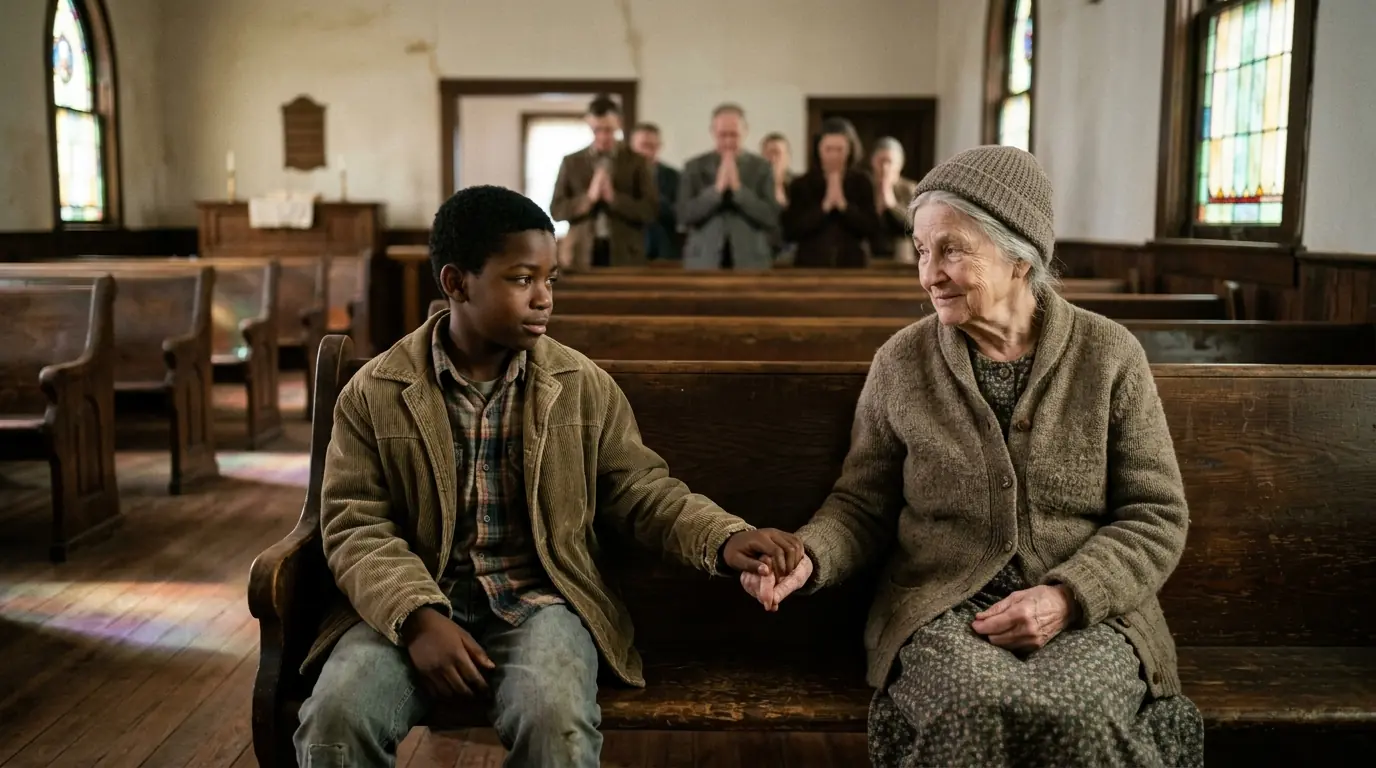 He moved closer, step by step, his sneakers scuffing softly against the wooden floor. The preacher's voice rose at the pulpit, asking the congregation to join hands in prayer. Across the sanctuary, palms touched palms. Fingers laced together. Children tugged on their parents' sleeves and were pulled into the circle of warmth.
But at the center of that empty pew, the woman bowed her head alone. The boy slid into the pew beside her, his heart hammered against his ribs, and for a moment, he nearly turned back. He thought of leaving her in peace, thought of disappearing as he always did, but instead he let his thin, trembling hand reach across the space between them.
Her body stiffened at the sudden contact. She opened her eyes, startled, her breath catching as she looked down at the dark hand gripping her own pale fingers. Her first instinct was to pull away, to reclaim the safety of solitude. Then she saw his face, a boy younger than her lost son, yet carrying the same hunger in his eyes—hunger not for food, but for connection, for belonging, for someone to see him.
Tears rose unbidden to her eyes. She had not expected this. This fragile, desperate trust from a stranger, the pressure of his hand was not strong, but it was steady. She felt the warmth of his skin, the raw sincerity in the gesture. The church continued its prayer, voices weaving together in solemn unison, but for her the sound faded to a low hum. Her heart beat louder. In that single moment, she was no longer a widow clutching an old Bible, no longer the woman who had buried her family and her laughter with them. She was simply human, seen, touched, remembered.
The boy did not look up. His eyes stayed fixed on the floor as if afraid she might push him away. But when he felt her hand relax, when her fingers curved gently to hold his in return, his shoulders loosened. He let out a breath he did not know he was holding. For her, the world shifted. The pew was not empty anymore. The candlelight seemed warmer, the voices of prayer richer. She blinked through the blur of tears, holding on to that small hand as though it anchored her to the present. And for him, the sanctuary stopped being just a building. For the first time since he could remember, he was not on the outside looking in. He was connected.
The prayer ended. The congregation whispered their amends, but the two of them stayed still, hands entwined in silent defiance of their loneliness. It was only a single touch. Yet in that touch, something fragile and profound had begun.
The Sundays that followed carried a new rhythm. The boy no longer lingered at the back of the sanctuary. He walked straight to the pew where she sat, sliding in beside her as though it had always been his place. Their silence grew familiar, no longer awkward, but heavy with a strange kind of comfort. She found herself expecting him, even glancing at the door before each service began, her heart sinking if he was not there on time.
For years, she had walked through life like a ghost. Each morning had been the same. She woke in a silent house, boiled water for tea she hardly drank, and sat at a table that never held another chair. She had told herself this was survival. Endure the days, let time move forward, breathe, and nothing more.
But in truth, she had stopped living when the accident buried her family. Now, watching the boy fold his thin hands in prayer beside her, she felt a stirring she had not allowed herself in years—the thought that perhaps she could begin again.
She watched him measure flour with careful hands and realized he measured himself out of the world too. Always useful, never asking. He should have a desk, a teacher, a bell that told him where to be. He should have more than survival.
On Monday morning, she walked him to the small brick school three blocks away, the one where the maple trees dropped red leaves across the sidewalk. They sat together in the front office, the clock ticking above a faded pennant, while a secretary slid forms across the counter. Her hand trembled when she reached the line that read, “Relationship to student.” She pressed the pen down, the ink catching for a second before it flowed. She wrote, “Guardian,” then dotted the i as if sealing a vow.
The principal, Mr. Carter, with kind eyes and sleeves rolled to his forearms, shook the boy’s hand and said he would do fine. The boy stared at his shoes and nodded once. She answered questions about addresses and meals and emergency contacts, hearing her own voice steady as she claimed him in every field that asked who should be called if anything went wrong.
When they stepped back into the sunlight, she felt lighter, as if the papers had given bones to a hope she had only dared to whisper. They stopped at the thrift store on the corner for a collared shirt and a sweater that still held the shape of the last boy who wore it. She bought notebooks with blue lines, a pencil case that zipped cleanly, and a pack of pencils with bright pink erasers.
That night, she packed a lunch in a brown paper bag: turkey on soft bread, an apple polished on her sleeve, two cookies wrapped in waxed paper, the way she used to wrap sweetness for her son. She placed the bag by the door and stood there longer than she needed, listening to the quiet thrum of the oven and the quieter thrum of her own heart saying, “Begin again.”
On the first day, she walked him to the bus stop. He stood with his shoulders hunched as if trying to disappear into the sweater. She touched his arm lightly. “You belong here,” she said. The words were simple and firm. He did not look at her, but he stood a little straighter when the bus pulled away. She watched until the yellow disappeared around the bend, then turned back toward the bakery with tears she did not wipe away.
When she set her hands to work, the morning felt like a promise rather than a task. He came home that afternoon with a library card and a folded note from a teacher who wrote that he listened closely and worked hard. He spread his notebooks on the bakery counter while dough rose under a towel. She leaned beside him, sounding out words he stumbled on, showing him how to break a problem into pieces the way you cut butter into flour. He read a recipe aloud just to practice, smiling when the words finally caught and held. She looked at him across the counter, the lamp light warm on his face, and thought, “I have been absent from life too long. This is how I return.”
The bakery itself became a second classroom. Together, they scrubbed dust from the shelves, polished the windows until sunlight spilled across the counters, and coaxed the oven back to life. She taught him how to knead dough with the heel of his palm, how to wait patiently for yeast to rise, how to shape rolls that would bake evenly. He listened with hungry concentration. She found herself smiling more often, her chest lighter, her voice steadier. For the first time in years, she was not only surviving—she was beginning again.
But the boy was still thirteen, still restless, still carrying the scars of streets that had not been kind. One afternoon, he did not return after school. She waited, the ticking clock slicing through her patience. When he finally walked in, laughter clinging to him, the smell of smoke on his clothes, anger flared inside her. She demanded to know where he had been. He answered sharply, his eyes flashing with defiance. The kitchen filled with their voices, grief colliding with youthful rebellion. He shouted that she was not his real mother, that she could never understand him. The words cut deep. She turned away, tears burning her eyes. She had let her heart open, had dared to believe she could start over. And in a single outburst, he had ripped the wound raw again.
Another day in the bakery, he burned a batch of rolls. The smell of charred bread hit her chest like a blow. She pulled the blackened tray from the oven and stared at it until her eyes blurred. Memories crashed down: her son’s laughter, the mornings filled with sweetness, the crash of metal on the highway that ended it all. Her body shook. She wept openly, clutching the tray as though it were a coffin.
The boy froze, torn between guilt and pride. Shame twisted in him, but anger rose faster. He accused her of never truly seeing him, of loving ghosts more than him. His voice cracked with fury, but beneath it was fear that he would never belong, that her heart would always be elsewhere.
That night, the house stood in silence. She sat with her Bible open but unread, her eyes unfocused. She asked herself if she had been foolish to invite him in. She thought of the years wasted in mourning, the way she had locked away her life as if punishing herself for surviving. And then she thought of him, the boy with hungry eyes, who reminded her not of her loss, but of her capacity to love again. Perhaps God was giving her one more chance.
The silence stretched until he finally whispered across the room. “I’m sorry,” his voice shook as if afraid she might not forgive. He lifted his head, his eyes glistening. “I don’t want to lose this. I don’t want to lose you.”
Her heart broke open. She crossed the room, pulled him into her arms, feeling his body stiffen and then soften against her. Through her tears, she whispered the words she had been afraid to say. “You have brought warmth back into this house. For years it was cold, but you—” Her arms tightened around him. She lit the fire again. In that embrace, something shifted permanently. She no longer saw herself as a woman buried with her past. She saw herself as someone who had chosen life again, someone who would fight for it. He no longer felt like a guest, but like a son.
The next morning, the bakery glowed with light, the oven burning bright. The smell of bread drifted down the street, neighbors pausing to smile. Inside, she guided his clumsy hands as they shaped loaves together. For the first time in years, she felt not only that she was alive, but that life had begun again.
More than ten years had passed, yet he could still smell cinnamon when he thought about courage. The memory slid in under the noise of the hospital auditorium, the soft thud of seats folding up, the low buzz of colleagues finding places, the metallic click of a microphone springing to life. He stood at the lectern in a slate-gray suit that did not feel like him. A stack of slides ready, a title line glowing on the screen behind him.
He had worked for this morning. He had slept in on-call rooms, studied by flickering vending machines, and told himself that every step carried the warmth of a small bakery he once helped bring back to life. The department chairship would mean influence, programs built the right way, a chance to pull other kids like him through doors that once stayed shut. He wrapped his fingers around the lectern edge and felt his pulse in his knuckles.
At home, she recovered slowly, her color returned, her breath steadied. Her laugh came back in small bursts that warmed the house. One morning, she stood at the kitchen window and said, “It’s time.” He followed her into the bakery at the back of the house. The oven had stood waiting, silent but not forgotten. Together they cleaned, arranged trays, and set the fire roaring. She kneaded dough with practiced hands, her palms pressing memory into flour. He measured, timed, and checked temperatures with the precision of a physician. The loaves rose golden, the air swelled with sweetness, and the house filled with the scent that had once been lost but was now reborn.
He stood in his white coat with flower dust across the sleeves, smiling at the contradiction. She laughed at the sight of him, shaking her head. “You can heal bodies in the morning and shape bread in the evening,” she said. “Both are needed.”
He looked at her at the strength etched into her face and thought of the night she had wept into burned loaves, of the morning she had signed her name on a school form as guardian, of the story she had carried into the auditorium like a banner. Gratitude rose in his chest until it felt like another breath, larger and steadier than all the rest.
The neighbors noticed. Children tugged at their mother’s sleeves, asking for rolls. Old men leaned on canes outside the door, inhaling deeply before stepping in. The bakery became not just a place to eat, but a place to gather. Nurses from the hospital came by, some shy, some tearful, admitting that her words had reminded them of what they had nearly forgotten.
He listened quietly, wiping flour from the counter while she handed out bread with the same tenderness she had once poured into raising him. One Sunday, weeks later, they returned to the church where everything had begun. The sanctuary looked the same, yet nothing was the same. Families filled the pews as always. Voices rose in hymns. Light streamed across the wooden floor. But the pew that had once been empty was no longer hollow.
They sat together, side by side, shoulders touching, hands resting close. The smell of fresh bread clung to their clothes, carried in from the morning’s work, a sweet undercurrent beneath the incense of candles. As the congregation joined hands, they did not hesitate. Their fingers intertwined naturally, without fear, without surprise. She glanced around and saw not isolation, but inclusion, not absence, but abundance.
He closed his eyes and felt no longer the boy on the outside looking in, but a man who had found his place, a son who had chosen and been chosen. The voices rose higher, the hymns swelling. Sunlight poured through the stained glass windows, catching on their joined hands, gilding them in gold. The bakery, the hospital, the streets of the town—all of it seemed to gather in that moment. Family was not blood. Family was not title. Family was the seat beside you, the hand in yours, the courage to begin again after loss.
The bell tolled above the church, deep and resonant. She lifted her head and smiled through tears. He squeezed her hand gently, anchoring them both. The pew that had once been empty was now filled, overflowing with light, with love, with the quiet truth of a promise kept.