At a small diner, an older Black man dressed simply walked in. The staff glanced at him once, then turned away. No one greeted or served him. He watched sadly as they eagerly waited on the wealthier customers. Then one waitress stepped forward, smiling and treating him like any other guest. But that simple act got her yelled at and fired by the manager. Just when she hit her lowest point, the man stood up for her. No one expected that he was actually the owner of the restaurant chain. And the manager was about to learn a lesson he'd never forget.
On Saturday nights, Diner Kingsley never stopped moving. The floor stayed slick with a thin layer of oil that clung to every shoe. The air was dense with the scent of grilled onions and fryer grease, and the hum of overlapping conversations echoed from the booths to the kitchen line. Agnes Seagrid had worked enough double shifts to know that moments of quiet didn’t exist here. Still, she moved with purpose, weaving between servers, dodging open trays, balancing two plates of meatloaf and mashed potatoes while keeping an eye on table nine’s half-empty coffee. Her apron was already wrinkled, and her back had begun to stiffen hours ago, but there was no time to slow down. Not when the place was packed, and the rhythm of survival depended on not missing a beat.
She adjusted the pen tucked behind her ear, set down the plates, and offered a tired but sincere smile to the elderly couple now digging into their dinner. Behind the counter, Paige leaned one elbow against the register, her other hand twirling a strand of hair. She laughed a little too loud at something Spencer said. He wasn’t doing much, just sipping soda and pretending to wipe down a perfectly clean countertop. His apron looked fresh, too fresh for someone supposed to be sweating through dinner rush. Agnes didn’t need to hear the details to know they’d already written this shift off. Paige and Spencer worked like performance artists, appearing helpful when the manager passed, vanishing when it got hard. And Clyde Campbell, their manager, let them. That was the part that really burned. He was stationed just outside the kitchen door, arms folded like a supervisor on patrol. But he wasn’t looking at service. He was looking for tips and status. He’d made it clear early on: serve the ones who look like they’ll spend more. The rest could wait.
Agnes had never been good at waiting. She didn’t complain. She just worked because she had rent due in nine days and because her younger brother, Isaac, had his final law school payment coming up at the end of the semester. He didn’t know she’d picked up extra shifts to cover it. He wouldn’t let her if he did. But this was the deal. They looked out for each other. He had books. She had sore feet. That’s how it went.
It was just after eight when the man walked in. He wasn’t young, maybe mid-sixties, and there was nothing remarkable about him at first glance. His shirt was buttoned to the collar, no tie. The fabric was neat, clean, but faded. Dark slacks, good shoes polished, but scuffed at the toe. He held no phone, wore no watch. His hands were tucked in his pockets as he stepped inside and paused. His posture was upright, calm as though he had walked into a familiar place and expected to be greeted, but no one moved. Paige glanced at him, her expression unreadable, and turned back to the man at the counter, who wore a gold chain and flashed a hundred-dollar bill like it was a passport. Clyde didn’t look up. Spencer walked off to the drink station and began clinking ice like he had something urgent to do. Even the newer hires taking cues from everyone else seemed unsure.
The man stood there waiting, not impatient, not confused, just waiting. From the back corner near the ice cream cooler, Agnes saw it unfold. She saw the pause in the man’s walk, the slight hesitation in his stance. She saw the way no one greeted him, how the air around him grew still, and more than that, she saw herself, not literally, but something deeper. She knew what it felt like to be invisible in a room full of people who chose not to see you. She took a deep breath, slid her notepad into her apron pocket, and walked forward.
"Good evening, sir," she said, her tone respectful but direct. "Welcome to Diner Kingsley. I can take care of you right over here."
The man turned his head slowly. His eyes met hers not sharply but with a kind of focus that made her pause for half a second. There was no judgment in his expression, no irritation, just observation. Then gradually a small smile formed.
"Well," he said, voice smooth, steady, and warm, "it's nice to finally be noticed."
Agnes nodded and motioned toward a booth by the window, one of the few still clean and open. "This one?"
"Okay. It’s perfect." She handed him a menu, though he didn’t open it right away. Instead, he looked around the room once more, then back at her.
"Take your time," she said gently. "I’ll be right back with water." She returned with the glass a minute later, notebook open in hand. "Do you already know what you’d like?"
He tapped the side of the menu once, then pushed it slightly toward her. Double cheeseburger, no onions, fries, extra crispy, black coffee. Agnes smiled, jotted it down, coming right up. As she walked back to the kitchen, she felt the weight of a dozen glances. Paige leaned toward Spencer and whispered something low. Spencer snorted. Clyde’s head had finally lifted, and now his eyes tracked Agnes like she’d broken some rule he never put in writing. She ignored them all.
She handed off the ticket to the cook, checked the fryer herself to make sure it was clean, and poured the coffee with care. No shortcuts, no attitude. She brought it out on a tray within five minutes, made sure the burger was hot and the fries crisp. When she set the tray down, the man looked up.
"That was quick."
"We try our best," Agnes replied simply. He picked up the coffee, turned the mug in his hand once, then looked her in the eye.
"You have a good attitude," he said. "Not everyone takes pride in what they do, but you do. It shows."
Agnes felt a brief flush creep into her chest. She wasn’t used to compliments from customers, especially the kind that weren’t about her looks or her speed.
"I just think everyone deserves to be treated with respect," she said almost automatically.
The man smiled again, deeper this time. "That’s rare." He lifted a fry, took a bite, then glanced back at her. "Thank you, Agnes."
Her hand froze slightly at the side of her apron. She hadn’t told him her name. Her name tag was covered by a folded dish towel. He went back to eating like nothing had happened. Agnes turned and walked away, but her heart was thudding louder than before. Behind her, Clyde was watching.
She returned to the kitchen and stood near the register, not saying anything, just breathing slowly. The man never called for anything else. He ate quietly, sipped his coffee, and when he finished, left cash tucked neatly under the mug. No receipt, no fuss. Before he walked out, he turned one last time. Their eyes met. He nodded once, then he was gone.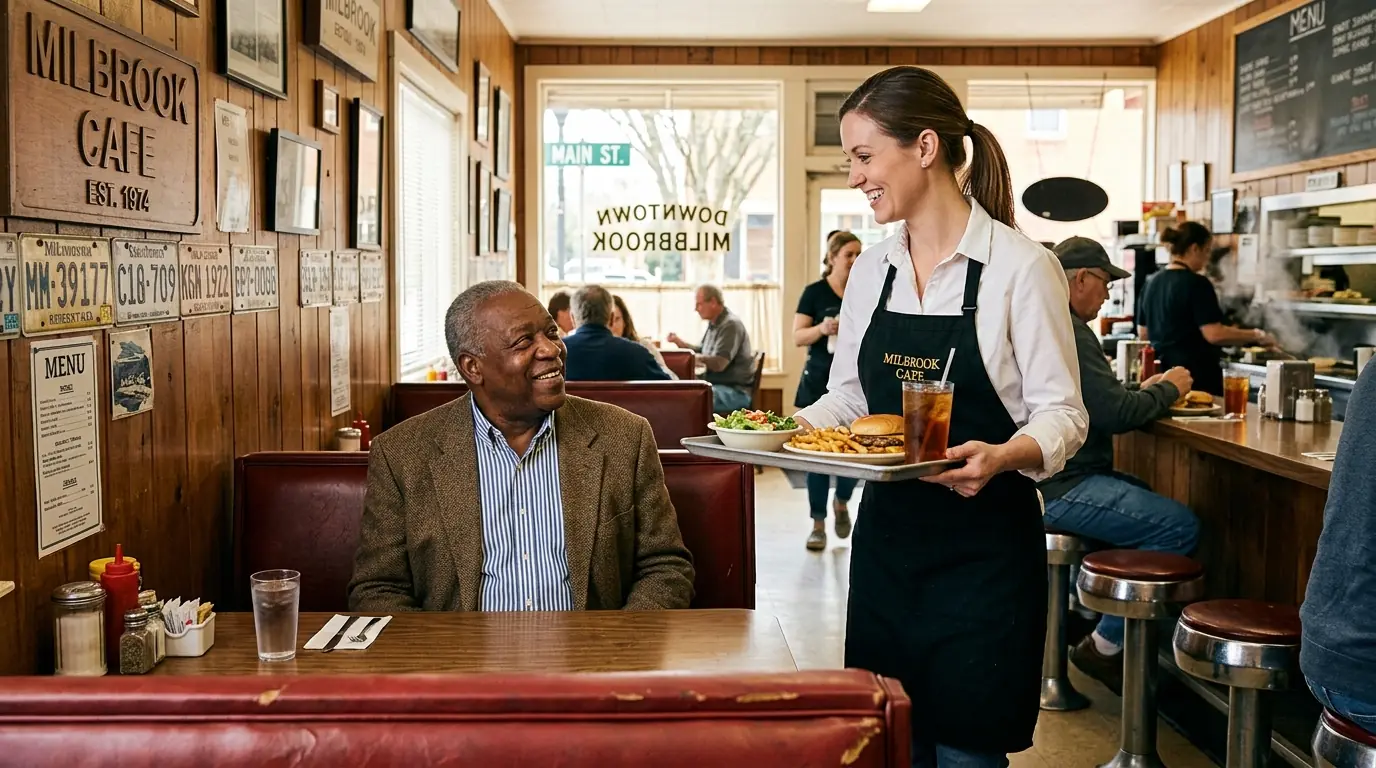
The morning after that strange, heavy Saturday night, Diner Kingsley felt off. Not quiet. The air still buzzed with the usual clatter of early prep pans scraping against burners, the soft sizzle of bacon on the grill, the familiar hiss of the coffee machine warming up for the morning crowd. But beneath all that, something else lingered—a stillness that didn’t belong. It wasn’t the usual morning lag. It was the kind of silence people make when they know something is about to happen, but they’re pretending not to.
Agnes Seagrid walked in through the side door as she always did, her hair pulled back into its usual bun, apron folded neatly under her arm. She gave a quick nod to Dara, the new cashier, who offered her a small smile and quickly returned to stacking creamer cups. The girl didn’t say a word. Neither did anyone else. Spencer stood near the fountain machine, wiping down the counter with circular motions that had no real purpose. Paige was already dressed, her lipstick fresh, but she wasn’t laughing this morning. She was standing still, arms crossed, eyes darting toward the office door. Clyde was waiting. Agnes knew the feeling. Something in her gut tense the way it did when you know the conversation ahead isn’t going to be fair or clear or honest. But she walked past them anyway.
"Agnes," Clyde’s voice came from behind the office door, low and firm. "Can I see you for a second?" She turned and met his gaze. His face was unreadable—tight, measured, with the kind of smile that never reached the eyes. Agnes walked past Paige and Spencer, who both suddenly found something else to look at, and stepped inside. The office was small and stale, like the inside of a lunchbox left too long in the sun. Papers cluttered the desk. A half-eaten breakfast sandwich sat cold beside the monitor. But at the center of the desk, perfectly alone, was a plain white envelope.
Clyde didn’t motion for her to sit. He walked around the desk slowly and took his place in the worn-out swivel chair. Then he leaned back, laced his fingers over his stomach, and exhaled like this conversation was a burden to him. Agnes stood silently. Her arms were at her sides, her posture calm, but her fingers curled slightly under the hem of her apron.
Clyde studied her for a moment longer. Then he began. "We’ve been looking at the numbers," he said. "Staffing mostly. Corporate’s on us to keep things lean." Agnes raised an eyebrow just slightly. "Since when does corporate care about lean on a Sunday morning?" He didn’t answer that. Instead, he leaned forward, sliding the envelope across the table. "I’ll be direct. We’re letting you go, effective today."
She stared at the envelope but didn’t reach for it.
"Why budget cuts? You cut the one person who worked the most tables last night," her voice didn’t rise, but there was steel in it now. Clyde shrugged carefully. "It’s nothing personal."
And that was the moment something inside her shifted because she knew the truth. She’d known it before he even said the words. He was scared, not of her, but of something she represented. He looked down at his desk, but his mind was elsewhere. Inside Clyde’s thoughts, something churned. She shouldn’t have stepped in last night. That old man wasn’t supposed to be served. Not by her. He didn’t fit the profile. Didn’t look like he tipped. Didn’t look like he mattered. Clyde had built a system—one that kept the place running smooth. You give attention to customers who look like they’ll spend. You make room for the regulars who flash cash. You don’t waste time on the quiet types, the ones with scuffed shoes and no phone in hand. That’s how he trained his staff, even if he never put it in writing. And it worked until she went and smiled at the wrong customer.
Clyde clenched his jaw. That old man had eyes too sharp, a voice too calm. And when he looked around the room before leaving, Clyde felt something crawl up his spine. The man had seen everything, and Agnes had stood right there, handing him coffee like he was the mayor. Now Clyde was waiting for the call, the audit, the complaint—the one thing he’d spent years avoiding. So he made his move first. Cut the cord before it burned him.
Back in the room, Agnes was still standing.
"You’re not saying the real reason," she said, her voice low. "You’re trying to get ahead of something."
Clyde gave a short, humorless smile. "I’m doing what’s best for the store."
Agnes stepped forward one pace only. "No, you’re doing what’s best for yourself."
There was a pause. Clyde’s jaw tightened. "You can pick up your check next Friday." That was it. Agnes didn’t answer. She didn’t take the envelope. She turned, opened the door, and walked out. No one said anything when she passed the counter. Paige lowered her eyes. Spencer had disappeared into the back. Agnes walked straight through the diner, past the booths, out the glass door, and into the early morning sun.
Outside, the city was waking up slow. A bus rolled past. A dog barked somewhere in the alley. Agnes stood on the sidewalk for a moment, blinking against the light. Then she walked to her car, opened the door, sat behind the wheel, and didn’t start the engine. She didn’t cry, didn’t shout. She just sat there staring at the steering wheel like it might answer a question no one else would. Her phone buzzed in her pocket. A message lit the screen.
"Isaac, morning, sis. About to head into my contracts class. Everything okay?"
Agnes typed back quickly. "Fine. Just a long shift. Proud of you. Let me know how class goes." She added a heart emoji and pressed send. Then she let the phone slide into the passenger seat.
That night, she stayed home. Isaac had an evening seminar and wouldn’t be back until after nine. The apartment was still and warm, smelling faintly of coffee and cinnamon air freshener. Agnes sat at the small kitchen table, the same envelope from the office lying unopened in front of her. She didn’t touch it. She didn’t want to open anything that didn’t offer a way forward. She had no backup plan. She’d spent everything keeping up with rent, groceries, and Isaac’s tuition. She’d counted on one more paycheck, maybe two, just enough to make it to spring. She rested her head in her hands and breathed slowly. Her shoulders were tight, her chest heavy. It wasn’t just about the job. It was about how easy it had been for Clyde to erase her. No conversation, no defense, just gone.
At 8:13, her phone rang. She didn’t recognize the number, but something about it made her answer.
"Hello."
"Good evening, Miss Seagrid," the voice was familiar, deeper over the phone, but still calm, still even. She sat upright.
"This is Jasper Edith. I believe we met yesterday."
Agnes’s heart skipped, but her voice held steady. "Yes, I remember. I assume you’re no longer at Kingsley."
"No," he said. "I’m not."
There was a pause, not awkward, more like he was letting the truth land. "I’d like to hear why."
Agnes told him slowly, clearly—not to vent, just the facts: the favoritism, the culture of looking the other way, the sudden termination, the silence from everyone else. She expected him to ask questions to challenge parts of the story. But he didn’t. When she finished, he simply said, "I see." Then came the sentence that changed everything.
"I’d like to meet with you tomorrow morning, if you’re available. I have something to discuss with you."
Agnes paused. "What kind of something? A proposal?"
"One that may interest you," Jasper said. And just like that, he ended the call. Agnes sat motionless for a few seconds, phone still in her hand. Then, for the first time since she left the diner, she felt something settle in her chest. Not relief, not yet, but a reason to sit up straighter, to breathe a little deeper.
The morning sun cast a soft light across the storefronts of downtown as Agnes Seagrid stepped off the bus and into a street that somehow felt quieter than it looked. Cars moved steadily through intersections. Distant horns honked without urgency, and the scent of warm pastry mixed with fresh coffee drifted through the crisp air. She followed the direction she’d written by hand, pen and paper her preferred way, and walked a few blocks until she reached the cafe.
It was small, tucked between a bookstore and a flower shop, with white wooden trim and a faded blue awning that gave it a kind of quiet dignity. The bell above the door gave a soft chime as she stepped inside. The sound was strangely comforting. Inside, the atmosphere was different from Diner Kingsley in every possible way. There was no grease in the air, no clatter of silverware being tossed into bins, no sharp shouting from a kitchen line—only calm voices, the soft hum of jazz from overhead speakers, and the warmth of polished wood and morning light falling through tall windows.
She spotted him almost immediately. Jasper Edith sat at a corner table near the window, a steaming mug of coffee in front of him, his posture composed but relaxed. He wore a charcoal gray suit, tailored but not flashy, the top button of his shirt left open. There was a quiet power about him—not forced or performative, just steady. Present. He looked up as she approached and gave a small nod of acknowledgement, the kind that didn’t need words to say, "I’m glad you came."
Agnes hesitated for only a second, then walked to the table. "Mr. Edith," she said softly, unsure of what else to call him.
He gave a gentle wave of his hand, gesturing for her to sit. "Please," he said. "Just Jasper."
She lowered herself into the chair across from him, folding her hands on the table like she had to ground them. She still didn’t know what she was doing here. The last twenty-four hours had left her unsteady. One moment she was standing at a register taking orders and wiping down counters, and the next she was being pushed out like she was a threat to the building. She hadn’t expected justice, but she hadn’t expected punishment for being decent either.
Jasper watched her, not with the scrutiny of a boss, but with the quiet consideration of someone who listened before he spoke. He took a sip from his mug and then set it down with care. "Do you know why I asked you to come?" he asked.
Agnes shook her head slowly. "I don’t," she admitted. "But I figured it wasn’t about another cheeseburger."
That made him smile—not wide, but with genuine warmth.
"No, not this time," he said. He sat back slightly, folding one hand over the other. "Let me start by telling you something I rarely explain in these kinds of meetings. I wasn’t always the owner of anything, let alone Kingsley." His tone stayed calm, but there was weight in his words. "I was born on the south side of Montgomery, Alabama. My mother worked two jobs. My father worked nights when he could get the hours. The first job I ever had was washing dishes in the back of a barbecue joint that wouldn’t let me eat out front."
Agnes felt her chest tighten slightly. Jasper’s eyes were steady, not angry, but full of memory. "I was sixteen. I remember the manager, a white man in his fifties, told me to use the back entrance and not speak unless I was spoken to. I did that job for over a year. I never once sat at a table inside."
Agnes said nothing. She didn’t need to. Her silence was the kind that meant listening with your whole body.
Jasper continued, "I’ve been in this business a long time. I’ve worked from the lowest rung up, not just because I wanted to succeed, but because I wanted to understand how power really works in places like diners and corner restaurants. People think the biggest decisions happen in boardrooms. They don’t. They happen when a server decides whether or not to speak up. When a manager chooses to turn his head, when a customer gets ignored because of how they look." He paused, then leaned forward slightly. "That’s why I built Kingsley—not to make money that came later. I built it because I wanted to create a space where the person with the most basic dignity was the one who got noticed, not the one who spent the most."
He let the words settle. Then he continued, "But somewhere along the way, things shifted. Not every manager follows that idea. Some start seeing patterns, favoring what’s easy, protecting what makes them comfortable. And when that happens, someone like you stands out."
Agnes felt her breath slow. Her throat tightened in a way she hadn’t expected. It wasn’t praise that got her—it was being seen.
"I didn’t do anything special," she said quietly. "He was just standing there. Nobody helped him. It didn’t feel right to pretend I didn’t see him."
Jasper nodded. "That’s the difference. Most people wait until someone tells them what to do. You didn’t." He reached into his jacket pocket and pulled out a small card case. From it, he slid a clean embossed business card across the table toward her. His name, his title, and a direct phone number. Then he spoke with no hesitation: "I want you to come back to Kingsley, the same location."
Agnes’s eyes widened, and she opened her mouth, but he raised a hand gently. Not as a server. As the general manager, she froze. For a few seconds, the noise of the cafe around her faded. Her mind stumbled trying to catch up with what she just heard.
"I’ve never managed anyone," she said. "I’ve never even thought about leading a team."
Jasper nodded. "That’s why I want you. You don’t lead with ego. You lead by doing." He leaned back again, his voice never rising, but carrying all the clarity it needed. "I’ve had eyes on that store for months. The numbers were good. The energy was not. Clyde created a system that served the staff, not the customers. That’s not what I built."
Agnes shook her head more to herself than to him. "If I go back there, they’re not going to make it easy." She pictured Paige’s smirk, Spencer’s smirk, the way Clyde had looked at her like she was a threat to his house of cards.
Jasper gave the slightest nod. "They won’t. But I’m not asking you to fix them. I’m asking you to reset the tone. Set a new standard. The right people will follow it. The others will make their choice."
Agnes looked down at the card, her fingers tracing the edge. It felt heavy in her hand—not because of its weight, but because of what it represented. She wasn’t used to being offered anything. She was used to earning every inch, every hour. But this—this was someone offering her the chance to build something, not just survive it.
Jasper stood. Agnes followed. At the door, he turned to her one last time. "You don’t have to decide today, but if you’re ready to stop taking orders and start giving them, your table is waiting." He left her there, standing in a cafe filled with soft jazz and the scent of roasted beans, holding a card that somehow carried more meaning than any paycheck she’d ever earned. She didn’t know what would happen next, but for the first time, the choice was hers.
Agnes stood in front of the mirror that morning, longer than she meant to, adjusting the collar of her crisp navy-blue manager’s uniform for the third time. The tag still itched at the back of her neck, and the simple silver name badge above the word "Manager" felt heavier than it looked. She had ironed the shirt the night before, not because she wanted to impress anyone, but because she needed to feel grounded. Isaac had left early for class, leaving a note on the counter that said, "You got this." Just three words, but she read them five times before she finally picked up her keys and walked out the door.
As she approached Diner Kingsley, her footsteps slowed. The building looked exactly the same. Same faded red sign, same windows smudged by the fingerprints of dozens of daily regulars, the same front door where she had once stood silently trying not to cry after Clyde fired her without cause. Now, only a few days later, she was walking back in—not to pick up a shift, but to take command of the very place that once discarded her like she didn’t matter.
She pushed the door open just after opening hour. The bell above the entrance gave its usual sharp chime, and for a second, everything inside the restaurant paused—not in chaos, but in recognition. Heads turned. Paige, who had been wiping the counter with her back, froze mid-motion. Spencer, standing at the soda station with a stack of clean cups, lowered them one by one as his eyes locked onto the uniform Agnes wore. The name tag wasn’t flashy, but it may as well have been a spotlight. Dara, the newest hire, glanced up from the register and gave a polite nod. Confused maybe, but polite.
Agnes didn’t smile right away. She walked to the center of the room, set her bag behind the host’s stand, and adjusted her sleeves before speaking. "Good morning, everyone," she said clearly, her tone calm but steady. "Some of you may have already heard. Starting today, I’ll be managing this location full-time."
No one clapped. No one said, "Welcome back." The room didn’t erupt. Instead, there was a quiet that wasn’t quite hostile, but it wasn’t warm either. It was a stillness built on calculation, on hesitation, on people figuring out what this meant for them.
Agnes didn’t take it personally. She had expected this. She turned toward the kitchen, checked the prep sheet posted on the cooler, and began moving through the space like she belonged—because now she did. She greeted the cook, a quiet man named Lorenzo, who had been there longer than all of them. He nodded back with something close to a smile, which was more than she expected.
Paige finally spoke once Agnes passed behind the counter. "That was fast," she muttered just loud enough. From waitress to queen of the castle. Spencer chuckled low but said nothing. Agnes turned her head slightly, eyes still on the inventory list she was reviewing.
"I’m not here to be a queen," she said without looking up. "I’m here to make sure everyone does their job." It wasn’t a threat. It was a reminder.
The day went on. Orders came in. Tables filled slowly, and Agnes worked alongside her staff rather than behind a closed door. She refilled coffee, helped restock straws when the bin ran low, and double-checked the delivery invoice when it arrived. She didn’t bark commands. She didn’t hover. She simply did the work, setting the tone—not by shouting, but by doing.
But that didn’t mean things were smooth. Paige deliberately left one order unclaimed on the counter, letting fries sit too long under the heat lamp. When Agnes asked why, Paige shrugged and said she didn’t hear the ticket go off. Spencer took nearly five minutes to pour a single glass of water, spending most of the time chatting with another employee about a basketball game. These weren’t accidents. They were tests—small, passive ones, but tests nonetheless. Agnes noted each of them, not with anger, but with clarity. She had expected resistance; she just hadn’t expected it to feel so personal.
There were moments she caught herself wondering if they were right. If she was in over her head. If Jasper had made a mistake. If she belonged more on the floor than behind the clipboard. But then she’d remember what Jasper told her in that cafe full of quiet jazz and old wood and soft certainty: "You lead by doing."
So she did.
By midday, she called a brief team meeting near the host stand. She didn’t stand above them. She didn’t call them out. She just spoke. "Starting this week," she said, "we’ll be rotating sections fairly, including lunch and dinner shifts. Tip pooling will be adjusted to reflect actual hours worked, not just seniority. And every customer, no matter what they look like or what they order, gets the same level of service. No exceptions."
No one responded. Paige raised an eyebrow. Spencer folded his arms. Agnes let the silence hold for a moment, then nodded once and returned to her station. She knew they didn’t like it, but she wasn’t there to be liked. She was there to lead.
The first location she would visit was fifteen minutes across town, tucked in a quiet shopping plaza where the foot traffic had slowed and the energy inside had dimmed even more. She drove there in silence. No music, no distractions, only the steady hum of the road beneath her tires and the thoughts pressing against her ribs. When she arrived, the contrast was immediate. The parking lot was mostly empty. Inside, the tables were half clean, the napkin holders half filled, and the staff behind the counter looked more like they were killing time than serving guests.
The current manager, a man in his late thirties named Tom, greeted her with a practiced smile that didn’t touch his eyes. His handshake was dry, polite, detached. He gave her a quick tour of the kitchen, listed the staff names without much context, then excused himself to the back office, and didn’t come out again. Agnes didn’t chase him. She walked the floor instead, stopping briefly to chat with the host, who didn’t make eye contact, and with the dishwasher, a young man who spoke more with his eyes than his mouth. She asked questions, not to pry, but to listen.
She watched how the servers moved flat-footed, slow, with no rhythm. She noticed how no one looked up when a customer entered, how no one smiled unless directly told to. The shift lead answered questions with "yes" or "no," nothing more. There was no hostility, just numbness—like everyone was waiting for something to change, but no one believed it actually would.
Agnes stayed until close, standing near the dish pit at the end of the night, watching as plates clattered and trays were stacked unevenly. Then she slipped into the office and left a single note on the desk: "Team meeting tomorrow, 9:00 a.m., all staff required."
The next morning, the staff gathered slowly. Some stood with arms crossed, others slouched in their chairs or leaned against walls, clearly unsure of what to expect. Tom was absent, claiming a schedule conflict. Agnes didn’t comment. She stood near the front of the dining room, hands clasped loosely in front of her eyes, steady but calm.
"I won’t take much of your time," she began. "But I want to tell you why I’m here. Not because someone complained. Not because I was sent to check boxes or look over your shoulders. I’m here because something in this store is broken. Not the equipment, not the menu, the spirit."
Some of the employees exchanged glances, unsure whether to be offended or relieved that someone had finally said it out loud.
Agnes continued, "I know what it feels like to come to work tired, to feel invisible, to stop caring because it seems like no one else does. I started as a server. I cleaned bathrooms, worked doubles, went home with my back aching, and my tips barely covered rent. I’ve been dismissed, overlooked, and told to be quiet. But I also know what happens when someone refuses to accept that as normal. And I’m here because I think you deserve better."
She let that land. She didn’t smile, didn’t plead. She simply said it, then paused. "I’m not going to fix this place for you. That’s not how this works. But I’m going to work alongside you. I’m going to show up. I’m going to listen. And I’m going to expect more. Not because I want you to suffer, but because I know you can do better than this."
The room was quiet, but no longer dismissive. One of the cooks gave a slow nod. A server near the back uncrossed her arms. It wasn’t applause. It didn’t need to be.
That evening, after the shift, Agnes stayed behind. She organized the supply closet, labeled the dry goods, scrubbed down a grease trap that hadn’t been touched in weeks. She rewrote the schedule to balance out the hours more fairly. She took inventory herself—not because anyone told her to, but because that’s how you build trust: by doing the work no one else wants to do, quietly, consistently.
Near midnight, her phone buzzed. A new message from Jasper: "Day one handled with grace. I chose right." Agnes smiled faintly, tucked the phone into her pocket, and continued folding rags. It was only the beginning, but she had already begun laying the bricks, one shift at a time.
The following weeks, Agnes visited each struggling location in the metro area. Two had management turnover every six months, one was on the brink of being shut down. She observed, listened, and slowly began rebuilding the culture. She coached the staff, not with lectures or authority, but by showing the standard: respect, consistency, and dignity. She rotated sections fairly, balanced tip pooling, and ensured every customer received attention no matter how small their order or how quiet they seemed.
Gradually, changes became visible. Employees who had been passive or disengaged started paying attention. Servers checked in with each other, cooks moved with purpose, and the lines of communication began to open. Mistakes still happened, but now they were corrected with accountability rather than blame. Agnes reinforced the principle that leadership was not about hierarchy, but about action and example.
By the end of three months, every location she oversaw had noticeably improved morale, customer satisfaction, and operational flow. Staff who had once been divided by loyalty to former managers now aligned with the shared standard Agnes established. And through it all, she worked quietly beside them, proving that influence and authority came not from fear or title, but from consistent dedication and respect for the people around you.
Agnes had transformed not just one diner, but the foundation of an entire operation, leaving a legacy built on dignity, perseverance, and the quiet power of leading by example.
In the week following the staff meetings and Agnes’s hands-on training, the atmosphere across all locations began to shift. The tension that once clung to every shift like static had started to fade. Orders flowed with more ease. Service picked up, and even the silence between staff began to fill with conversation again. Not loud or celebratory, but cautious and honest.
Agnes saw it in the little things. Dara moved with more confidence at the register, speaking clearly to customers without needing reassurance. Spencer kept his head down, but his performance was steady and even. Jeremy, who had been hesitant before, now took initiative on his shifts, helping train new hires on the POS system without waiting to be asked.
The rebuilding had begun. But Agnes also knew it was too soon to be comfortable. The past didn’t release its grip just because the present decided to move forward. And in her case, the past still had a name: Clyde Campbell.
It happened on a Thursday just before the dinner rush. Agnes was walking the floor, checking that tables were wiped down and that prep was moving smoothly in the kitchen, when she felt a disturbance—not a sound, not even a shift in energy. It was more primal than that. When she looked up, Clyde was standing near the entrance, one hand casually resting on the host stand, the other in the pocket of his blazer. He wasn’t dressed like a former employee. He looked sharp, intentional, like a man who had chosen his outfit to make a statement.
Behind him, a couple of customers looked on, confused by the way the staff froze. Clyde smiled—not broadly, just enough. Agnes felt her chest tighten, not from fear, but from the sheer audacity of his presence. She glanced at Dara, who stood frozen behind the counter, then at Spencer, who had just stepped out of the kitchen with a tray in his hands. He looked at Clyde and stopped mid-step.
Agnes moved toward the front, her walk calm, but every cell in her body alert. "Good evening," she said when she reached him. "Can I help you?"
Clyde looked her up and down. "Still pretending this place is yours to run, I see." His tone was smooth, laced with the same smug detachment he’d always worn like armor.
Agnes didn’t flinch. "It’s not pretend. It’s my job. And you’re not welcome behind the host stand."
He chuckled softly, glancing around. "You know, I trained half of these kids. They didn’t used to flinch when I walked in."
Agnes didn’t respond to that. She turned slightly, motioning toward the dining room. "If you’re here to eat, you can seat yourself like any customer. But if you’re here to disrupt operations, I’ll have to ask you to leave."
Clyde took a step closer, just one enough that she could see the twitch of annoyance behind his eyes. "You don’t get to tell me where I can or can’t stand, Agnes. You might wear the badge, but we both know who built this place."
Her voice stayed level, but inside she felt her pulse in her throat. "You ran this location. You didn’t build it. You built a culture of fear, favoritism, and silence. And that’s over."
Customers were starting to notice now. A woman near booth four leaned toward her partner, whispering. Two regulars at the counter exchanged glances. Agnes took another small step forward, lowering her voice without softening it. "Clyde, this isn’t about pride. You came back to intimidate people. But that doesn’t work anymore. You can either sit down like a guest or step outside."
He smirked. "You think you’ve won, don’t you?"
Agnes didn’t blink. "I think you lost the second you chose to sabotage your own people."
That landed. For a brief second, Clyde’s expression cracked—not dramatically, but enough for her to see the flash of anger behind the control. He turned slightly, scanning the room, searching for something—a flicker of support maybe—but there was none. Spencer had put down his tray and stepped behind Dara, who now stood straight, eyes focused on the exchange. Even Jeremy had emerged from the kitchen, wiping his hands on his apron, watching.
Clyde straightened his jacket and exhaled. "You know what? Keep it. This place will rot anyway. Too much softness."
Agnes didn’t move.
"Then you won’t mind leaving." He stared at her for one long second, then turned and walked toward the door. No drama, no last word, just the slow, deliberate walk of someone who had finally realized the room no longer belonged to him. When the door closed behind him, Agnes let out the breath she hadn’t realized she’d been holding. The silence that followed wasn’t heavy. It was clean, like the sound that follows a storm finally passing.
She turned to the team, who were still watching, and nodded once. "Back to work," she said simply.
That night, after the last customer had gone and the final chairs were flipped, Agnes sat alone in the office, staring at the empty schedule board. There were still gaps to fill, still systems to improve. But tonight, she had done something bigger than finish a shift. She had drawn a line—not with noise, not with fear, but with clarity, with presence.
The invitation came in the same quiet, deliberate way everything had come from Jasper Edith. No fanfare, no long explanation, just a message sent late in the evening, short and direct. Coffee tomorrow, same place, 10 sharp. Come alone. Agnes read it twice before placing the phone face down on her nightstand. The apartment was silent except for the ticking of the old wall clock and the soft shuffle of Isaac moving around in the kitchen. She didn’t respond to the message. She didn’t have to. Jasper never asked anything unless he already knew the answer.
The next morning, she arrived early. The same cafe, with its warm wood-paneled walls and quiet corners, welcomed her like it always did. She ordered a black coffee, nodded to the barista, who remembered her name now, and settled into the corner booth by the window. Jasper arrived right on time, coat neatly buttoned, expression unreadable but never cold. He took his seat without ceremony, set his phone down, screenside down, and met her eyes directly.
"I won’t draw this out," he began. "You already know why we’re here."
Agnes folded her hands in front of her, steadying herself.
"You’re expanding the offer," she said.
Jasper nodded. "The regional team has reviewed your numbers—not just profits, morale, retention, complaint resolution. Kingsley went from a liability to a model location in under three months. That doesn’t happen unless someone’s doing the work most people avoid. I want you to take on more. We have four locations in the metro area struggling. Two have management turnover every six months. One’s about to be shut down. They don’t need someone to audit their books. They need someone who understands what it means to rebuild from the floor."
He paused, letting the offer settle. "I want you as Regional Operations Manager. You’d have hiring authority, autonomy, a direct line to me."
Agnes felt her pulse rise, not from excitement, but from the sudden weight of it all. She looked down at her coffee, at the slight ripple on the surface. It wasn’t that she didn’t feel honored—she did. But she also felt overwhelmed. Not because she didn’t believe she could do the job. She knew she could. What unsettled her was the idea of stepping away from the space she had just managed to stabilize. The team was just beginning to work together. People were learning to trust. What would happen if she left too soon?
"They still need me," she said softly.
Jasper didn’t interrupt. He watched her carefully. "I know I’ve made progress, but it doesn’t feel finished. I just got them standing again."
He leaned forward slightly. "Then they’ll rebuild it because you already taught them how."
The conversation ended the way it began—with clarity. He slid a folder across the table. Inside were the details, locations, timelines, transition plans. He didn’t push it toward her. He just left it there. "You don’t have to answer today. Read it. Think it through. But if you’re serious about changing the system, this is how you scale it."
Agnes carried the folder home, unopened. She placed it on the kitchen table next to the unpaid gas bill in Isaac’s open textbook. She sat down across from it and stared for a long time. Isaac came out of his room a few minutes later, earbuds and hoodie slouched off one shoulder.
"When he saw her expression, he pulled out one bud and set it aside. 'You okay?'"
She nodded slowly. "Jasper offered me a regional position. Multiple stores."
Isaac raised his eyebrows. "That’s big. That’s… wow."
She gave a quiet laugh that didn’t quite carry joy. "Yeah, it is."
He sat beside her. "So, what’s stopping you?"
Agnes hesitated. Then she answered honestly. "I don’t want to walk away from something I just finished fixing. And part of me wonders if they’re only okay because I’m there."
Isaac leaned forward, resting his elbows on the table. "They’re okay because you showed them how to be. That doesn’t go away just because you change offices. You didn’t do all this to stay in one building forever, Agnes. You did it to prove that someone like you could do it better. Now prove it somewhere else."
She didn’t answer right away, but she listened.
The following week, Agnes began her first day as Regional Operations Manager. She didn’t start in an office. Instead, she visited each struggling location, walking the floor quietly, observing, listening, and taking notes. At each diner, she watched servers move, noticed the subtle body language of disengaged employees, and listened to the tone of conversations. She checked inventory, verified schedules, and observed how the kitchen communicated. At first, the changes she suggested were met with skepticism. Staff had grown accustomed to the old ways, and inertia was strong.
Agnes didn’t push. She demonstrated. She filled drinks when the soda machine overflowed, wiped down tables that had been missed, rearranged a disorganized tray line. She rotated sections fairly and ensured every customer, no matter how small their order, received attention. She spent time coaching employees individually, showing them the standard by example rather than lecture.
Over the next few days, subtle changes began to appear. Dara worked more confidently at the register, greeting customers promptly. Spencer’s movements became deliberate and precise, his eyes focused. Jeremy took initiative, helping train a new hire on the POS system without needing instruction. The culture was slowly shifting. Employees began to realize that consistency and accountability were expected and that shortcuts or passive behavior would not be tolerated.
Agnes held short staff meetings daily, always standing at floor level, never on a platform. She explained the vision: fair rotations, equitable tip distribution, consistent customer service, and respect for colleagues. Mistakes were addressed immediately, not with punishment but with guidance. Employees who previously ignored protocols began to take note. They saw that the standard applied to everyone, including managers, and that leadership meant action and example, not title alone.
By the end of two weeks, the change was visible in both performance and morale. Customers noticed the attention to detail. Complaints decreased. Orders flowed more smoothly. Even the quietest employees started engaging more proactively with both customers and colleagues. Agnes reinforced the principle that culture was built day by day, choice by choice.
When Jasper Edith visited at the end of the third week, he found Agnes walking through a bustling diner floor with a calm but commanding presence. Staff moved with purpose, communication was clear, and the atmosphere had a positive energy that hadn’t existed before. Jasper watched quietly from a corner booth as Agnes demonstrated her standard to a group of new hires. She corrected a misaligned tray, adjusted the rotation of servers, and guided a cook through plating without raising her voice. The staff responded immediately, showing respect not out of fear, but out of understanding and trust.
After the lunch rush, Jasper approached her. "I see what I hoped for," he said. "You’ve transformed more than one location. The staff is responding. The culture is changing."
Agnes nodded, brushing a strand of hair behind her ear. "It’s only the beginning. Some habits are still hard to break. But they’re learning that the standard applies to everyone. That consistency and dignity are expected."
Jasper smiled faintly, a rare moment of genuine warmth. "That’s exactly why I chose you. You lead by doing, not by titles or fear. And that’s how lasting change happens."
Agnes exhaled slowly. For the first time in months, she felt a sense of completion—not just for herself, but for the teams she had rebuilt. She had taken each diner from dysfunction to structure, from tension to collaboration, without relying on authority alone. She had set a standard that would endure beyond her presence.
As she left the last diner that evening, the sun dipping below the skyline, Agnes paused on the sidewalk and looked back at the building. Inside, laughter mixed with the hum of conversation, plates clattered with purpose, and the staff moved as a cohesive unit. She smiled faintly. The work was never truly done, but for now, she had proven that integrity, respect, and consistency could reshape not just a single team, but an entire operation.
Agnes walked to her car, the folder Jasper had given her safely in her bag. For the first time, she felt the weight of responsibility not as a burden, but as an opportunity. She had led by example, she had empowered others, and she had left a lasting legacy across Kingsley’s diners. And for the first time in a long while, she allowed herself to feel a quiet pride in the impact she had made—one decision, one action, one day at a time.
At a small diner, an older Black man dressed simply walked in. The staff glanced at him once, then turned away. No one greeted or served him. He watched sadly as they eagerly waited on the wealthier customers. Then one waitress stepped forward, smiling and treating him like any other guest. But that simple act got her yelled at and fired by the manager. Just when she hit her lowest point, the man stood up for her. No one expected that he was actually the owner of the restaurant chain. And the manager was about to learn a lesson he'd never forget.
On Saturday nights, Diner Kingsley never stopped moving. The floor stayed slick with a thin layer of oil that clung to every shoe. The air was dense with the scent of grilled onions and fryer grease, and the hum of overlapping conversations echoed from the booths to the kitchen line. Agnes Seagrid had worked enough double shifts to know that moments of quiet didn’t exist here. Still, she moved with purpose, weaving between servers, dodging open trays, balancing two plates of meatloaf and mashed potatoes while keeping an eye on table nine’s half-empty coffee. Her apron was already wrinkled, and her back had begun to stiffen hours ago, but there was no time to slow down. Not when the place was packed, and the rhythm of survival depended on not missing a beat.
She adjusted the pen tucked behind her ear, set down the plates, and offered a tired but sincere smile to the elderly couple now digging into their dinner. Behind the counter, Paige leaned one elbow against the register, her other hand twirling a strand of hair. She laughed a little too loud at something Spencer said. He wasn’t doing much, just sipping soda and pretending to wipe down a perfectly clean countertop. His apron looked fresh, too fresh for someone supposed to be sweating through dinner rush. Agnes didn’t need to hear the details to know they’d already written this shift off. Paige and Spencer worked like performance artists, appearing helpful when the manager passed, vanishing when it got hard. And Clyde Campbell, their manager, let them. That was the part that really burned. He was stationed just outside the kitchen door, arms folded like a supervisor on patrol. But he wasn’t looking at service. He was looking for tips and status. He’d made it clear early on: serve the ones who look like they’ll spend more. The rest could wait.
Agnes had never been good at waiting. She didn’t complain. She just worked because she had rent due in nine days and because her younger brother, Isaac, had his final law school payment coming up at the end of the semester. He didn’t know she’d picked up extra shifts to cover it. He wouldn’t let her if he did. But this was the deal. They looked out for each other. He had books. She had sore feet. That’s how it went.
It was just after eight when the man walked in. He wasn’t young, maybe mid-sixties, and there was nothing remarkable about him at first glance. His shirt was buttoned to the collar, no tie. The fabric was neat, clean, but faded. Dark slacks, good shoes polished, but scuffed at the toe. He held no phone, wore no watch. His hands were tucked in his pockets as he stepped inside and paused. His posture was upright, calm as though he had walked into a familiar place and expected to be greeted, but no one moved. Paige glanced at him, her expression unreadable, and turned back to the man at the counter, who wore a gold chain and flashed a hundred-dollar bill like it was a passport. Clyde didn’t look up. Spencer walked off to the drink station and began clinking ice like he had something urgent to do. Even the newer hires taking cues from everyone else seemed unsure.
The man stood there waiting, not impatient, not confused, just waiting. From the back corner near the ice cream cooler, Agnes saw it unfold. She saw the pause in the man’s walk, the slight hesitation in his stance. She saw the way no one greeted him, how the air around him grew still, and more than that, she saw herself, not literally, but something deeper. She knew what it felt like to be invisible in a room full of people who chose not to see you. She took a deep breath, slid her notepad into her apron pocket, and walked forward.
"Good evening, sir," she said, her tone respectful but direct. "Welcome to Diner Kingsley. I can take care of you right over here."
The man turned his head slowly. His eyes met hers not sharply but with a kind of focus that made her pause for half a second. There was no judgment in his expression, no irritation, just observation. Then gradually a small smile formed.
"Well," he said, voice smooth, steady, and warm, "it's nice to finally be noticed."
Agnes nodded and motioned toward a booth by the window, one of the few still clean and open. "This one?"
"Okay. It’s perfect." She handed him a menu, though he didn’t open it right away. Instead, he looked around the room once more, then back at her.
"Take your time," she said gently. "I’ll be right back with water." She returned with the glass a minute later, notebook open in hand. "Do you already know what you’d like?"
He tapped the side of the menu once, then pushed it slightly toward her. Double cheeseburger, no onions, fries, extra crispy, black coffee. Agnes smiled, jotted it down, coming right up. As she walked back to the kitchen, she felt the weight of a dozen glances. Paige leaned toward Spencer and whispered something low. Spencer snorted. Clyde’s head had finally lifted, and now his eyes tracked Agnes like she’d broken some rule he never put in writing. She ignored them all.
She handed off the ticket to the cook, checked the fryer herself to make sure it was clean, and poured the coffee with care. No shortcuts, no attitude. She brought it out on a tray within five minutes, made sure the burger was hot and the fries crisp. When she set the tray down, the man looked up.
"That was quick."
"We try our best," Agnes replied simply. He picked up the coffee, turned the mug in his hand once, then looked her in the eye.
"You have a good attitude," he said. "Not everyone takes pride in what they do, but you do. It shows."
Agnes felt a brief flush creep into her chest. She wasn’t used to compliments from customers, especially the kind that weren’t about her looks or her speed.
"I just think everyone deserves to be treated with respect," she said almost automatically.
The man smiled again, deeper this time. "That’s rare." He lifted a fry, took a bite, then glanced back at her. "Thank you, Agnes."
Her hand froze slightly at the side of her apron. She hadn’t told him her name. Her name tag was covered by a folded dish towel. He went back to eating like nothing had happened. Agnes turned and walked away, but her heart was thudding louder than before. Behind her, Clyde was watching.
She returned to the kitchen and stood near the register, not saying anything, just breathing slowly. The man never called for anything else. He ate quietly, sipped his coffee, and when he finished, left cash tucked neatly under the mug. No receipt, no fuss. Before he walked out, he turned one last time. Their eyes met. He nodded once, then he was gone.
The morning after that heavy Saturday night, Diner Kingsley felt off. Not quiet. The air still buzzed with the usual clatter of prep pans, the soft sizzle of bacon on the grill, the familiar hiss of the coffee machine warming up for the morning crowd. But beneath all that, something else lingered—a stillness that didn’t belong. It wasn’t the usual morning lag. It was the kind of silence people make when they know something is about to happen, but they’re pretending not to.
Agnes walked in through the side door as she always did, her hair pulled back into its usual bun, apron folded neatly under her arm. She gave a quick nod to Dara, the new cashier, who offered her a small smile and quickly returned to stacking creamer cups. The girl didn’t say a word. Neither did anyone else. Spencer stood near the fountain machine, wiping down the counter with circular motions that had no real purpose. Paige was already dressed, her lipstick fresh, but she wasn’t laughing this morning. She was standing still, arms crossed, eyes darting toward the office door. Clyde was waiting. Agnes knew the feeling. Something in her gut tense the way it did when you know the conversation ahead isn’t going to be fair or clear or honest. But she walked past them anyway.
"Agnes," Clyde’s voice came from behind the office door, low and firm. "Can I see you for a second?" She turned and met his gaze. His face was unreadable—tight, measured, with the kind of smile that never reached the eyes. Agnes walked past Paige and Spencer, who both suddenly found something else to look at, and stepped inside. The office was small and stale, like the inside of a lunchbox left too long in the sun. Papers cluttered the desk. A half-eaten breakfast sandwich sat cold beside the monitor. But at the center of the desk, perfectly alone, was a plain white envelope.
At 8:13, her phone rang. She didn’t recognize the number, but something about it made her answer.
"Hello."
"Good evening, Miss Seagrid," the voice was familiar, deeper over the phone, but still calm, still even. She sat upright.
"This is Jasper Edith. I believe we met yesterday."
Agnes’s heart skipped, but her voice held steady. "Yes, I remember. I assume you’re no longer at Kingsley."
"No," he said. "I’m not."
There was a pause, not awkward, more like he was letting the truth land. "I’d like to hear why."
Agnes told him slowly, clearly—not to vent, just the facts: the favoritism, the culture of looking the other way, the sudden termination, the silence from everyone else. She expected him to ask questions to challenge parts of the story. But he didn’t. When she finished, he simply said, "I see." Then came the sentence that changed everything.
"I’d like to meet with you tomorrow morning, if you’re available. I have something to discuss with you."
Agnes paused. "What kind of something? A proposal?"
"One that may interest you," Jasper said. And just like that, he ended the call. Agnes sat motionless for a few seconds, phone still in her hand. Then, for the first time since she left the diner, she felt something settle in her chest. Not relief, not yet, but a reason to sit up straighter, to breathe a little deeper.
The next morning, she arrived early at the cafe with its warm wood-paneled walls and quiet corners. She ordered a black coffee, nodded to the barista who now remembered her name, and settled into a corner booth by the window. Jasper arrived right on time, coat neatly buttoned, expression unreadable but never cold. He took his seat without ceremony, set his phone down, screenside down, and met her eyes directly.
"I won’t draw this out," he began. "You already know why we’re here."
Agnes folded her hands in front of her, steadying herself.
"You’re expanding the offer," she said.
Jasper nodded. "The regional team has reviewed your numbers—not just profits, morale, retention, complaint resolution. Kingsley went from a liability to a model location in under three months. That doesn’t happen unless someone’s doing the work most people avoid. I want you to take on more. We have four locations in the metro area struggling. Two have management turnover every six months. One’s about to be shut down. They don’t need someone to audit their books. They need someone who understands what it means to rebuild from the floor."
He paused, letting the offer settle. "I want you as Regional Operations Manager. You’d have hiring authority, autonomy, a direct line to me."
Agnes felt her pulse rise, not from excitement, but from the sudden weight of it all. She looked down at her coffee, at the slight ripple on the surface. It wasn’t that she didn’t feel honored—she did. But she also felt overwhelmed. Not because she didn’t believe she could do the job. She knew she could. What unsettled her was the idea of stepping away from the space she had just managed to stabilize. The team was just beginning to work together. People were learning to trust. What would happen if she left too soon?
"They still need me," she said softly.
Jasper didn’t interrupt. He watched her carefully. "I know I’ve made progress, but it doesn’t feel finished. I just got them standing again."
He leaned forward slightly. "Then they’ll rebuild it because you already taught them how."
The conversation ended the way it began—with clarity. He slid a folder across the table. Inside were the details, locations, timelines, transition plans. He didn’t push it toward her. He just left it there. "You don’t have to answer today. Read it. Think it through. But if you’re serious about changing the system, this is how you scale it."
Agnes carried the folder home, unopened. She placed it on the kitchen table next to the unpaid gas bill in Isaac’s open textbook. She sat down across from it and stared for a long time. Isaac came out of his room a few minutes later, earbuds and hoodie slouched off one shoulder.
"When he saw her expression, he pulled out one bud and set it aside. 'You okay?'"
She nodded slowly. "Jasper offered me a regional position. Multiple stores."
Isaac raised his eyebrows. "That’s big. That’s… wow."
She gave a quiet laugh that didn’t quite carry joy. "Yeah, it is."
He sat beside her. "So, what’s stopping you?"
Agnes hesitated. Then she answered honestly. "I don’t want to walk away from something I just finished fixing. And part of me wonders if they’re only okay because I’m there."
Isaac leaned forward, resting his elbows on the table. "They’re okay because you showed them how to be. That doesn’t go away just because you change offices. You didn’t do all this to stay in one building forever, Agnes. You did it to prove that someone like you could do it better. Now prove it somewhere else."
She didn’t answer right away, but she listened.
The following week, Agnes began her first day as Regional Operations Manager. She didn’t start in an office. Instead, she visited each struggling location, walking the floor quietly, observing, listening, and taking notes. At each diner, she watched servers move, noticed the subtle body language of disengaged employees, and listened to the tone of conversations. She checked inventory, verified schedules, and observed how the kitchen communicated. At first, the changes she suggested were met with skepticism. Staff had grown accustomed to the old ways, and inertia was strong.
Agnes didn’t push. She demonstrated. She filled drinks when the soda machine overflowed, wiped down tables that had been missed, rearranged a disorganized tray line. She rotated sections fairly and ensured every customer, no matter how small their order, received attention. She spent time coaching employees individually, showing them the standard by example rather than lecture.
Over the next few days, subtle changes began to appear. Dara worked more confidently at the register, greeting customers promptly. Spencer’s movements became deliberate and precise, his eyes focused. Jeremy took initiative, helping train a new hire on the POS system without needing instruction. The culture was slowly shifting. Employees began to realize that consistency and accountability were expected and that shortcuts or passive behavior would not be tolerated.
Agnes held short staff meetings daily, always standing at floor level, never on a platform. She explained the vision: fair rotations, equitable tip distribution, consistent customer service, and respect for colleagues. Mistakes were addressed immediately, not with punishment but with guidance. Employees who previously ignored protocols began to take note. They saw that the standard applied to everyone, including managers, and that leadership meant action and example, not title alone.
By the end of two weeks, the change was visible in both performance and morale. Customers noticed the attention to detail. Complaints decreased. Orders flowed more smoothly. Even the quietest employees started engaging more proactively with both customers and colleagues. Agnes reinforced the principle that culture was built day by day, choice by choice.
When Jasper Edith visited at the end of the third week, he found Agnes walking through a bustling diner floor with a calm but commanding presence. Staff moved with purpose, communication was clear, and the atmosphere had a positive energy that hadn’t existed before. Jasper watched quietly from a corner booth as Agnes demonstrated her standard to a group of new hires. She corrected a misaligned tray, adjusted the rotation of servers, and guided a cook through plating without raising her voice. The staff responded immediately, showing respect not out of fear, but out of understanding and trust.
After the lunch rush, Jasper approached her. "I see what I hoped for," he said. "You’ve transformed more than one location. The staff is responding. The culture is changing."
Agnes nodded, brushing a strand of hair behind her ear. "It’s only the beginning. Some habits are still hard to break. But they’re learning that the standard applies to everyone. That consistency and dignity are expected."
Jasper smiled faintly, a rare moment of genuine warmth. "That’s exactly why I chose you. You lead by doing, not by titles or fear. And that’s how lasting change happens."
Agnes exhaled slowly. For the first time in months, she felt a sense of completion—not just for herself, but for the teams she had rebuilt. She had taken each diner from dysfunction to structure, from tension to collaboration, without relying on authority alone. She had set a standard that would endure beyond her presence.
As she left the last diner that evening, the sun dipping below the skyline, Agnes paused on the sidewalk and looked back at the building. Inside, laughter mixed with the hum of conversation, plates clattered with purpose, and the staff moved as a cohesive unit. She smiled faintly. The work was never truly done, but for now, she had proven that integrity, respect, and consistency could reshape not just a single team, but an entire operation.
Agnes walked to her car, the folder Jasper had given her safely in her bag. For the first time, she felt the weight of responsibility not as a burden, but as an opportunity. She had led by example, she had empowered others, and she had left a lasting legacy across Kingsley’s diners. And for the first time in a long while, she allowed herself to feel a quiet pride in the impact she had made—one decision, one action, one day at a time.