In a small town, a young bakery owner quietly brought food every day to an old homeless man behind her shop. What seemed like a simple act soon drew whispers from her co-workers and strong objections from her mother and fiancé. But she kept doing it, even inviting the old man to her wedding. When he walked into the ceremony, the entire crowd fell silent, their eyes filled with disdain. No one knew that at that very moment members of the National Guard were on their way. And what they were about to reveal would leave everyone speechless.
The town of Hollow Glenn woke slowly each morning like an old man creaking out of bed. The sun never rushed in here. It took its time sliding over the maple-lined streets, brushing gently against faded rooftops and paint-chipped fences. It was the kind of place where you could count on the mail arriving at the same time every day, where neighbors trimmed their lawns with almost competitive precision, and where the bakery opened precisely at 5. That bakery, Marriott and Daughters, had been around for nearly 50 years, passed from mother to daughter, and now mostly run by Meline Marriott, a woman who never raised her voice and never forgot a face.
Meline was 28 years old, fair-skinned, light-haired, and steady in both her manner and her beliefs. She wasn't the sort people gossiped about, at least not at first glance. She dressed plainly, moved with quiet purpose, and never posted selfies or opinions online. She was, in the minds of most in Hollow Glenn, a good girl from a good family. But what people in town didn't say out loud and never would was that Meline had started to make them uncomfortable.
It wasn't her baking, which was consistently excellent, or her temperament, which was unfailingly polite. It was something else, something quieter, something harder to explain. Every morning, long before customers arrived, before Cara clocked in for the early shift, and before the first coffee filter was rinsed, Meline made a second package. It wasn't listed on any order sheet, didn't show up in any inventory.
She made it carefully, methodically: a sandwich wrapped in wax paper, a piece of fruit, usually an apple or banana, whichever was ripe, a bottle of water, and a handwritten note folded into a brown paper napkin, always tucked on top of the meal like a seal. She never reused a message. Some said, "You are not forgotten." Others read, "Someone sees you." They were simple words, but she wrote each one with the same steady hand she used to knead dough.
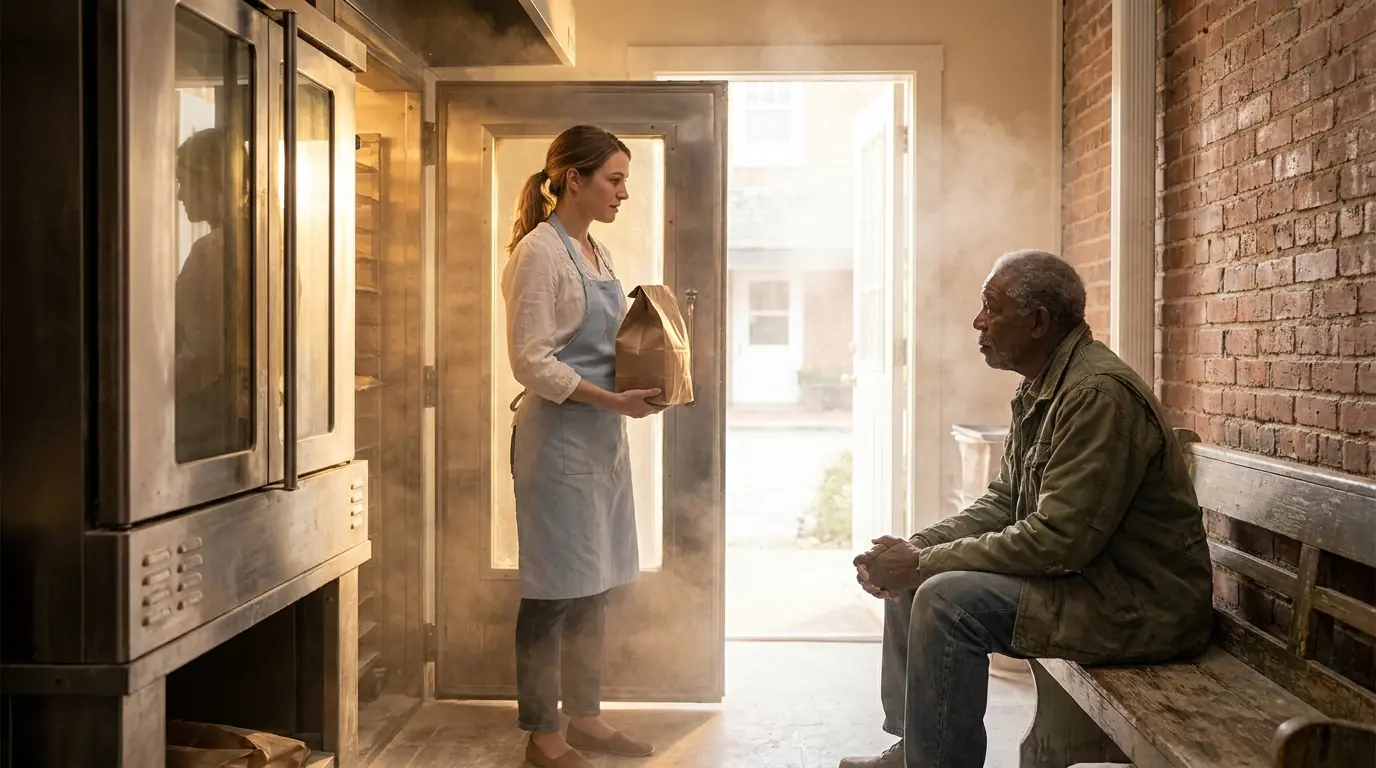
There was no grand mission behind it, no hashtag or campaign, just a routine, a choice she had made. Once the bag was packed, Meline slipped it over her wrist, nodded to whoever had arrived early, and quietly stepped out the back door of the bakery. The alley was clean, not just by town standards, but because she swept it herself every Saturday morning. The dumpsters stood in a neat row against the brick, their lids closed tight, the ground beneath them free of wrappers or crumbs.
And across from them, on an old wooden bench that once sat in the library's reading room, sat the man. He was always there, always early, always silent. He was an older Black man, maybe in his late 60s or early 70s. His skin was dark and weathered. His eyes, though hard to read, never darted around like he was hiding. He sat upright, his back straight, his hands folded or resting on his lap.
His clothes were worn but clean, layered in a way that showed care, not chaos. On cold mornings he wore a heavy jacket that looked like it had once belonged to a soldier, green with faded patches and a collar stiff from age. At his feet sat a canvas duffel bag with frayed straps and a zipper that didn't quite close. He never asked for anything, never spoke, but he was always there like part of the building itself.
Meline never spoke either. She approached slowly, not timid, but respectful, and set the paper bag down on the far end of the bench, never too close. Sometimes their eyes met for just a moment. She never lingered, just a nod, barely perceptible, passed between them. And then she turned and walked back inside. She didn't need to see him eat. She didn't need a thank you. The act wasn't about being noticed.
Inside the bakery came to life. The ovens hummed. The scent of cinnamon and yeast filled the air. And still Meline's mind lingered just a little longer in the alley. She didn't think of herself as generous. She didn't do it to feel good. She simply couldn't stand the idea that someone could be invisible in a town that prided itself on knowing everybody.
That bench, that man, his silence. It unsettled her in a way she couldn't explain. And so she did what she could. The people in Hollow Glenn weren't cruel, not outwardly. They brought casseroles when someone died. They waved from porches. They called the mayor by his first name. But they also knew how to make a person feel unwelcome without ever saying a word.
And Hubert Evans, though no one had spoken his name aloud in months, had become a fixture no one wanted to acknowledge. He made people uncomfortable in a way that had nothing to do with behavior and everything to do with presence. He didn't belong in their picture of a tidy town. That first week, Meline started leaving food. There were murmurs.
Meline didn't respond. She just kept preparing the bag, folding the napkin, placing it beside the man who sat silently through all kinds of weather. Nearly a year had passed since that first morning. It had been winter, then real winter, with icy gutters and scarves pulled high. Now it was late September, and the leaves were starting to turn.
Business was picking up as people returned from summer cabins and children headed back to school. Pumpkin scones replaced lemon bars in the front display. Life moved forward, but some things stayed the same. At precisely 5 each morning, Meline would unlock the bakery's side door, flick on the lights, and begin again. A sandwich, a fruit, a bottle of water, a note, a small act in a small town that somehow carried more weight than anyone wanted to admit.
She never told anyone why she did it. Not her mother, not Brian, not even the pastor when he asked if she wanted to speak during last year's Thanksgiving service. And still the man came, and still she fed him. No one knew where he went at night. No one asked. Meline sometimes wondered, not out of curiosity, but out of a quiet concern she didn't know where to put.
What if one morning he wasn't there? What if he was sick or hurt or worse? The thought would settle behind her ribs like a weight. But she never let it show. If he wanted to disappear, that was his right. But as long as he showed up, she would be there, too. It wasn't about saving him. She didn't believe in rescue stories. People weren't strays to be brought inside and healed with soup. But she did believe in dignity, in routine, in small gestures that said, "You are still here and I see you."
In Hollow Glenn, that was a radical thing. And in Meline's world, it was the only thing that made sense. Meline was rolling out the dough for the second batch of cinnamon rolls when she heard the whisper, just loud enough to register over the hum of the oven fans. "Still feeding your pet ghost out back?" Cara said it lightly, like a joke between friends, but the smile didn't reach her eyes.
She stood at the prep counter slicing apples for turnovers, the knife tapping rhythmically against the cutting board. Mason, who was rinsing a mixing bowl nearby, let out a chuckle, not loud, but sharp enough to sting. "Maybe he's her secret admirer," he added with a crooked grin. "You know, silent type, mysterious, very romantic." He snorted and shook his head, flicking water from his hands onto the sink edge like punctuation.
Meline didn't respond. She kept her eyes on the dough, guiding the rolling pin forward with steady pressure, but her shoulders had gone tense and her jaw had tightened almost imperceptibly. She was used to their comments by now. They'd started out as curiosity, harmless in tone, but as the months dragged on, the remarks had taken on a different texture. They weren't asking anymore. They were watching.
The alley had become an unspoken taboo, a subject that hovered just under the surface of morning conversations. No one dared bring it up with management, not directly. They knew better. But Meline could feel the shift every time she came back through the rear entrance. The silence in the kitchen would pause, stretch a beat too long, then resume just a little colder. No one confronted her. No one told her to stop.
That was the thing about Hollow Glenn: confrontation was considered bad manners, but polite cruelty had plenty of room to thrive. Later that morning, a customer at the register, a woman in her 60s named Mrs. Delaney, who ran the town's consignment boutique, leaned in toward Cara while waiting for her change. Her voice was soft, but deliberately not a whisper. "Is that man still back there? The one who just sits?"
Cara glanced at Meline, then leaned slightly forward, dropping her voice just enough to sound respectful. "He's there most mornings. Miss Marriott brings him something to eat like always." Mrs. Delaney's mouth pursed slightly, her fingers closing around her change. "I don't know," she said. "It just makes people uneasy. Not the kind of image you want near food, you know." She didn't look at Meline when she said it. She didn't have to.
Meline's hand had frozen for just a second, gripping the tongs over a tray of fresh scones. She blinked once, then placed the tray onto the display rack with more force than she meant to. No one reacted. They didn't have to. The message had been delivered. It wasn't personal. Not really. It was about what made people feel comfortable. It was about the kind of image people expected when they walked into a family bakery.
And Hubert Evans, sitting quietly out back in his worn jacket and laced-up boots, didn't fit into that picture. Around 10:30, Mark, the operations manager, asked Meline to step into the office. He was in his late 40s with soft features and a voice that always sounded like he was trying not to wake a sleeping baby. He gestured toward the small wooden chair across from his desk. "Just a quick chat," he said.
The office smelled faintly of old coffee and vanilla extract. He folded his hands on the desk, smiled politely, and leaned forward like he was delivering a gentle reminder, not a reprimand. "First, I want to say you've been doing an incredible job. Everyone appreciates how dedicated you are. The bakery runs smoother with you here." He paused, letting the compliment settle before shifting gears.
"That said, I've received a couple of comments lately. Nothing formal, of course, just observations. Some customers mentioned they've seen someone loitering out back." Meline said nothing. She sat upright, her palms resting on her thighs, eyes fixed on his. Mark continued carefully, choosing each word. "Look, I understand compassion, truly, and I know you're not doing anything wrong, but people are sensitive these days. They like to feel safe, especially when they're buying food."
He paused again as if waiting for her to agree. She didn't. "Maybe," he said slowly, "you could keep things a little more discreet. That's all I'm saying. You don't have to stop. Just make it less visible, less prominent." There was a long silence between them. Meline didn't nod. She didn't argue either. Instead, she stood up quietly, thanked him for his time, and left the office with her spine straight, her steps steady.
She didn't go back to the front counter. Instead, she returned to the prep area and washed her hands with a little more force than necessary. The water was hot, almost scalding, and she didn't flinch. That evening, long after the bakery closed, and the last of the staff had gone home, Meline sat alone at the prep table, the kitchen quiet except for the hum of the refrigeration units. Her hands rested on a clean towel folded in her lap.
She thought about the way Mark had phrased it: make it less visible, as if kindness were something shameful. As if seeing someone like Hubert Evans was what made people uncomfortable. Not the fact that he was out there in the first place. Not the system that had failed him. Not the silence that let it continue. She wasn't angry. Not exactly. But there was something burning low in her chest that she couldn't shake. A kind of quiet indignation. The kind that doesn't demand revenge, only recognition.
Hubert didn't ask to be seen. He didn't ask for help. But neither did he deserve to be hidden like a crack in the sidewalk no one wanted to fix. The next morning, Meline arrived earlier than usual while the sky was still a dull blue, and the town hadn't yet begun to stir. The lights in the bakery were still off. The door clicked open with the same soft sound as always.
Inside, she moved quietly, packing the food with even more care than before: a sandwich, roast turkey and Swiss cheese, no condiments, a ripe pear, a bottle of water, and a napkin that read, "You are worth showing up for." She didn't wait for the oven to heat. She didn't speak to anyone. She walked out the back door with the bag held close to her chest, her breath visible in the cool air.
Poor Waitress Helped an old Man walking in the Rain — The Next Day, He Helped Her
Hubert was already there, as always, seated in silence, his hands folded over his knees, his face partially shadowed by the brim of his old cap. She placed the bag on the bench, just to the side, far enough not to intrude, close enough to matter. Their eyes met. No smile, just that nod, calm, quiet, unmistakable. Then she turned and walked back inside.
The kitchen was quiet when she returned. Cara wasn't due for another 15 minutes, and Mark wouldn't arrive until closer to 7:00. Meline moved through the space with muscle memory, wiping down surfaces, checking the ovens, measuring flour. But her mind was elsewhere. There was something different about the way Hubert had looked at her. It wasn't gratitude, not exactly, and it wasn't recognition in the way most people understood it. It was something quieter, heavier.
She tried to shake the feeling, but it clung to her thoughts like dew on glass. Hours passed. The sun rose higher, but never quite burned through the clouds. Customers came and went, the bell above the bakery door chiming at regular intervals. Conversations rose and fell, mostly about weather, school board meetings, and the upcoming fall festival. No one mentioned the man behind the building. No one ever did.
By the time the lunch rush had faded and the scones were down to crumbs, Meline slipped out back to take out a tray of compost and sweep the alley. It was something she did every other afternoon, part habit, part excuse to check if he was still there. But that day, the bench was empty. Hubert was gone.
She paused for a moment, broom in one hand, tray in the other, scanning the alley like she might have missed him somehow, though she knew she hadn't. The bag she'd left earlier was gone, too. That was normal. What wasn't normal was the napkin. It sat on the edge of the bench, weighted down by a small stone, folded just once. At first, she thought it was one of the extras that had blown loose from the kitchen. Those happened sometimes on windy days.
But then she recognized the color. It was one of hers. Her handwriting was visible along the edge of the fold, but it wasn't her words that made her chest tighten. It was the second line. A different hand, shaky or uneven, but deliberate. She set the tray down, slowly approached the bench, and picked up the napkin with both hands, as if it were something fragile.
The top line read exactly as she had written it that morning: "Still here. Still seen." Beneath it, in ink that bled slightly into the fibers, were six words she hadn't written. "Thank you for seeing me." She stared at it for a long moment. Her fingers trembled, not from the cold. Her breath caught just enough to notice. The words were simple, but they carried weight, the kind of weight that didn't need explanation. It was the first time he had spoken in any way, and he had chosen to use her own canvas to do it.
He hadn't signed it. There was no name, no flourish, just a sentence, a sentence that rewrote the past year and a half in a single breath. Meline didn't cry. She didn't smile. She simply stood there, letting the cold settle around her, holding the napkin like a truth she had been waiting for, but never dared ask to hear. She folded it gently, smoothing the creases with care, and slid it into the back pocket of her apron.
Then she picked up the tray, retrieved the broom, and went back inside. The rest of the day passed in a blur. Orders were filled, receipts printed. The bell above the door rang again and again, but everything felt quieter somehow, even when people spoke, like her ears were tuned to a different frequency now. When Brian called to ask if she wanted to come over later, she said no without explanation. She didn't feel like talking. She needed the silence.
That night, alone in her apartment, she unfolded the napkin again. She sat at the kitchen table, the light overhead soft and golden, the rest of the room cloaked in shadow. Her thumb traced the words over and over as if trying to memorize the shape of the letters. "Thank you for seeing me." It wasn't a grand gesture. It wasn't a story. It was acknowledgment. It was the closest thing to trust she'd been offered by a man the entire town had chosen not to see. And it meant more than any apology or defense she could have asked for from the people who judged her.
She slipped the napkin into her wallet between two faded receipts and a coupon for a store that no longer existed. It fit there perfectly. A small folded thing in a world too loud, too dismissive, too fast to notice the quiet choices. She knew she'd return to it often. Not because she needed proof, but because on the days when the doubt crept in, when the comments stung more than usual, when her mother's voice echoed too sharply, she would need to remember that someone saw her, too.
And somehow, in a world where most people waited to be rescued, Hubert Evans had offered her something better. He had offered her presence, unspoken, unasked for, but unwavering. And that, she realized, was more than enough. The wedding dress had just come back from final alterations. Its lace sleeves folded delicately in a garment bag that hung near the front counter. Sunlight filtered through the bakery windows, catching on the soft shimmer of the fabric.
But while Meline stood admiring the way the light played across the details, the air around her had already begun to shift. It wasn't the dress. It was the looks, the tone of the whispers, the tightening of shoulders whenever her name was spoken just a little too loudly in the wrong conversations. The first comment came from Amanda, the youngest staff member, barely 20, always quick to fill silences with gossip she claimed to overhear, but clearly sought out.
That morning, while slicing lemon loaf, she leaned just close enough to the register where a regular customer, Mrs. Hendris, stood counting her change. "Did you know she still gives food to that man behind the shop?" Amanda said, voice low, but not low enough. "Every single morning, like clockwork." "My sister thinks she's doing some kind of charity project or something. Maybe she thinks she's the next Mother Teresa."
Mrs. Hendris didn't laugh, but her lips tightened as she slipped the change into her purse and murmured, "Well, bless her heart, I guess, but people should know when to stop, especially with folks who you just never know about." By that afternoon, the comment had twisted into something sharper. A different customer asked Cara, another employee, whether the alley behind the shop was safe. "I've seen someone sitting out there lately. Tall man, older. Doesn't look like he's from here. Makes people nervous. Has she ever considered moving the trash bins? Maybe a little more distance could help."
The words were veiled, wrapped in concern, but the message was clear. The man was a problem. Her kindness was a problem. Meline heard it all. She didn't confront anyone. She didn't ask for explanations. But that evening, she noticed that someone had repositioned the donation box near the counter so that the note that read "Helping local families" now faced toward the front window. Someone was making a point.
At home, Brian sat with their wedding planner, flipping through fabric swatches for table runners. When Meline joined them, the planner asked her which hue of ivory she preferred. She barely looked. Brian noticed. After the planner left, he walked to her side and rubbed her shoulder gently. "You seem off." "What happened today?" She hesitated, her throat tightened. She didn't want to sound dramatic, but she didn't want to lie either.
"People are starting to talk," she said quietly. "About me? About Hubert?" Brian frowned, confused. "Why now?" "Amanda said something to a customer, and now it's like everyone thinks I'm either naive or trying to prove something. They don't even see him, Brian. They just see whatever they assume." Brian exhaled slowly, running a hand down his face. "Look, I know it's frustrating, but maybe we should think about boundaries."
She stiffened. "What do you mean?" "I just mean the wedding's close. People are going to be watching everything. If he's always out back, if folks feel uncomfortable, they might think..." "Think what?" she asked, her voice sharper now. He paused, careful. "They might think you're too trusting, or worse, that you're reckless." She stood up then, slowly, the way someone does when they know a conversation won't end kindly.
"He's done nothing to anyone. He doesn't even speak. He just sits there every day. Rain or shine. And I bring him food. That's all." Brian rose, two hands open, calming. "I know. I get it. I'm not saying stop. I'm just saying be careful. Not everyone sees the world the way you do." She looked at him, then really looked, and for the first time, she saw it: the gap between understanding and belief.
Brian loved her. He respected her, but he didn't see what she saw when she looked at Hubert. He couldn't. Not yet. The next morning at the bakery, the staff were unusually quiet. Cara avoided eye contact. Amanda hummed too loudly while cleaning the espresso machine. Meline worked as always, her hands steady, her movements deliberate, but the silence had weight now.
When she stepped out back with Hubert's meal, she paused longer than usual beside him. The bag was heavier today: a bigger sandwich, a thermos of warm tea, two apples. The napkin folded neatly at the top carried no message this time. Her words felt stuck. But when she placed the bag on the bench, she noticed he was already watching her. Not with expectation, not with judgment, but with quiet awareness.
She met his gaze, held it, and for the first time, she asked, "Do you know they talk about you?" He said nothing. His face didn't change, but something in his posture shifted. A stillness became firmer, more rooted. She nodded almost to herself. "They say I shouldn't be doing this, that you're dangerous or that I'm foolish." Still, he didn't speak and she didn't need him to. That wasn't why she came.
Inside, the bell above the front door rang, and Amanda's voice called out, "Another coffee to go, and one almond croissant. No, the other one." Meline lingered only a moment more, then turned and went back in. But the air felt different. He knew. He had always known. And now she had said it aloud. By the end of that week, the pressure was building.
Her mother left a voicemail just long enough to include a question wrapped in concern. "Darling, is it true what I heard about you and that man behind the store? Not that I believe gossip, but honestly, what would people think if they saw him near the cake table at your reception?" Meline didn't respond, not with words. But that night, she opened her wedding journal, turned to a clean page, and stared at it for a long time.
She had waited until the rest of the town was asleep, until Brian had gone home after a dinner punctuated by silence and carefully chosen words. She had not told him what she was doing. She didn't need his permission or anyone else's. The message was brief. It read, "I would be honored if you came. You matter to me." That was all. No mention of suits or ceremony or expectations. No appeal to guilt or sentiment. Just an open door, an acknowledgment, a choice.
She folded it neatly, slipped it into the envelope, and left it on the counter beside her keys. For a moment, she stared at it, unsure if it would ever be read. But it wasn't about the response. It was about the offer. The next morning, she woke before the sun, as she always did. She packed Hubert's meal carefully: egg sandwich with sharp cheddar, a banana, a small thermos of black coffee, and the envelope nestled between the layers of napkins.
She walked through the alley with the same measured pace she had carried for nearly two years: past the chipped paint and the rusted drain pipe, past the back door she had opened and closed thousands of times. The air was crisp, tinged with the scent of earth and the faint burn of wood smoke in the distance. Hubert was already there. He always was, seated on the bench, hands folded, head slightly bowed as if in quiet prayer or thought.
She placed the bag beside him gently. This time she paused. She didn't say anything. She didn't explain. She just offered a small nod. A look that said more than words would. Then she turned and walked back inside. The sound of the door clicking shut behind her seemed louder than usual. Inside the bakery, everything was routine. Amanda arrived late as she often did, with excuses that dissolved in the steam of the coffee machine. Cara was quiet, polite, but distant. Her eyes rarely meeting Meline's.
Customers flowed in and out, some smiling, some not. A few lingered a little longer than necessary, eyes darting toward the back window as if hoping to catch a glimpse of what they dared not ask about. By midafternoon, the dress maker called. The final adjustments had been completed. The veil, custom-stitched with tiny embroidered wheat stalks, a nod to her family's bakery roots, had been steamed and hung beside the gown, ready for pickup.
Meline thanked her softly and hung up, fingers still resting on the receiver long after the call ended. She didn't go to the dress shop that day. She stayed in the kitchen, rolling dough, measuring ingredients, cleaning trays that didn't need cleaning. When Brian stopped by after work, she greeted him with a smile that didn't quite reach her eyes. He noticed but said nothing. "You ready for tomorrow's tasting?" he asked, wrapping an arm around her waist as she stood at the sink.
She nodded. "Almost." He kissed her temple, his touch warm but cautious. "You okay?" She considered lying. Instead, she said, "Just tired." That night, she didn't sleep much. Her mind kept circling back to the envelope, to the weight of it in her hand, to the way Hubert had sat so unmoving, even as she stood before him. She didn't know if he'd open it, didn't know if he'd understand what it meant. But deep down, she believed he would. Not because of the words, but because of the act.
The wedding day arrived with skies that threatened rain but never followed through, the kind of gray that held its breath. The outdoor setup behind the old community hall was already buzzing by mid-morning: folding chairs arranged in perfect rows, mason jars strung from the trellis with sprigs of eucalyptus, and soft jazz humming low from hidden speakers. Meline stood in front of the mirror inside the preparation suite, her wedding dress catching the light like frost on linen.
She smoothed her hands down the bodice, not for the 10th or even 20th time, but because it grounded her. Her heart wasn't racing, but it wasn't calm either. It was steady, waiting, like something was about to knock once, just once, and change everything. She hadn't told anyone what she'd done. Not her mother, not Brian, not even Cara. The invitation she had slipped into Hubert's meal three days ago hadn't come with expectations. It had been like everything else she'd done: an offering with no strings attached.
And yet a small part of her, quiet and cautious, had been listening for that knock ever since. Now, dressed in ivory, hair pinned with delicate gold leaves, makeup soft but precise, she stood still and listened again. Outside, the guests were arriving in slow clusters: Brian's aunt from Vermont, his college roommate from Richmond, neighbors from the next cul-de-sac, and old bakery customers who never came for the bread but always stayed for the stories.
Amanda, assigned to help direct seating, stood in flats for the first time anyone had seen, chewing on her nail, whispering with Cara by the hydrangeas. The air was filled with laughter and faint perfume, with the sound of shoes on gravel and chairs being adjusted, with the faint tension that always precedes a public ceremony. The music shifted. Someone announced the bridal procession would begin in 10 minutes. Meline inhaled.
Her mother came in with a clipboard and a tight smile, smoothing a wrinkle on her own blazer that didn't exist. "Darling, are you ready? You look beautiful. Absolutely stunning. Not too late to rethink that lipstick shade, though." Meline met her mother's eyes in the mirror. "I'm fine." Her mother nodded too quickly and exited. The door clicked shut. And then it happened.
Not a knock, just a hush. A hush so deep it seemed to reach through the windows, through the bustle outside, like something had stepped across an invisible line. Cara was the first to see him. She stopped mid-step, her clipboard slipping slightly in her hands. Amanda followed her gaze, frowned, and muttered something that no one caught because suddenly more people turned to look.
Hubert Evans stood at the entrance to the lawn. He wore a navy blue suit that had clearly seen better decades. The fabric was stiff but clean, the cuffs slightly frayed, and a pressed white shirt beneath it. Around his neck was the soft gray scarf Meline had once tucked into his paper bag on a frigid December morning. It was neatly folded. He had shaved. His posture was upright, shoulders squared back straight.
He carried nothing in his hands, no gift, no bouquet, just presence. People stared, murmured. A few guests shifted uncomfortably. One woman clutched her purse a little tighter. Brian's uncle leaned toward his wife and asked, not quietly, "Isn't that the homeless man from behind the bakery?" No one approached him. No one stopped him. They just watched.
From the preparation suite window, Meline saw it all. The silence, the whispers, him. She turned away from the mirror and walked toward the door. The coordinator tried to stop her gently. "Wait, we're not ready for the aisle." Meline brushed past her. She stepped into the grass, her heels firm on the earth, her gown whispering with every stride. The crowd parted, not out of courtesy but confusion.
Brian, already near the altar with the officiant, took a step forward, brow furrowed. Her mother stood, mouth parted in disbelief. Meline didn't stop. She walked straight to Hubert. They stood face to face in full view of every guest. He didn't speak. Neither did she. But their eyes locked, hers shimmering with purpose, his steady like stone. Then slowly she extended her hand.
For a long moment he didn't move. Then he took it. His hand was large, weathered, strong. He did not grip hers tightly, but his fingers closed over hers with the care of someone who knew what hands were capable of and how often they were used against instead of for. Together they turned and walked down the aisle. The reaction was not loud. It was quieter than any reaction could have been.
Gasps held in throats, heads tilted, eyes wide. No applause, no objections, just the sharp collective inhale of a world watching something it didn't have language for. Brian stood still as they approached. The officiant looked uncertain, his book trembling slightly in his hands. Meline reached the front. She turned to Hubert and gave a small nod. He nodded back, then stepped aside, moving to the first row and taking a seat. Alone.
No one else moved to sit beside him, but he was there. Meline turned to face Brian. He whispered, "Are you okay?" She smiled, not broadly, but with the full weight of her spine straightening. "Now I am." The ceremony began, and though the words were the same — beloved guests, vows, forever — it all sounded different because a man who had once been invisible was now in the front row, and everyone saw him.
There was a stillness after the ceremony that didn't belong to the usual ending of vows. It wasn't awkward, nor was it celebratory. It was something else entirely: a moment suspended in quiet where everyone remained seated, unsure whether to clap or speak or even exhale. The air was too thick with something unspoken, and no one quite knew what would happen next. Meline and Brian stood hand in hand, but the weight of what had just occurred lingered in the space between them like a presence neither of them could name.
Hubert sat in the front row alone, hands clasped in his lap, eyes steady on the horizon beyond the trellis. He had not moved since taking his seat. Then from the far end of the lawn, a deep engine hum broke the silence, not loud, but purposeful. Heads turned as a black SUV with government plates pulled up slowly along the side of the property. Two men stepped out, both in formal dress blues, one older with silver hair and precise posture, the other younger, holding a small velvet box.
They walked in unison down the center aisle, flanked by confusion and curiosity. The elder of the two, a lieutenant colonel judging by his insignia, stopped a few feet from Meline and addressed the crowd with a calm voice that carried effortlessly. "I apologize for the interruption," he began, removing his cap and holding it respectfully at his side, "but this moment calls for recognition that is long overdue."
Whispers rippled through the guests like wind across tall grass. Amanda leaned forward in her seat. Brian's mother frowned and whispered something under her breath. Meline remained still, her eyes on the officer. The man continued, "We are here today not only to witness the union of two people, but to acknowledge the service and sacrifice of someone among us who has for too long gone unrecognized. Mr. Hubert Evans is not only a guest today. He is a decorated war hero."
Gasps, audible ones this time, even from those who had claimed not to care, not to judge. The man standing behind Hubert placed the box on a small table that had been quickly moved beside the arbor. "Mr. Evans served with distinction in the United States Army for over 20 years," the officer said, voice unwavering. "He earned the Silver Star and the Bronze Star for acts of valor under enemy fire. He led rescue missions in conflict zones most of us have only read about. He saved lives, many lives, and after the tragic loss of his wife and son in an accident stateside, he declined all formal commendations and quietly stepped away from public life."
People looked around now, not at Hubert, but at each other, searching for some moral compass they could latch on to, some justification for their earlier silence, their glances, their whispers. None came. The officer turned toward Hubert and nodded deeply. "Colonel Evans, on behalf of a grateful nation, we offer this medal not just as recognition of your heroism, but of your humanity." He opened the velvet box, revealing a gleaming service medal polished to a high shine.
The officer stepped forward, extending it with both hands. Hubert did not rise. He did not speak. For a long moment, he simply looked at the metal, then at the officer, then at Meline. She met his eyes with quiet steadiness. Then Hubert reached out, not for the metal but toward Meline. She stepped forward without a word. He took the medal in one hand and gently, almost reverently, fastened it to the lace at her shoulder, just beneath her collarbone.
The audience watched in breathless silence. It was not showy. It was not theatrical. It was simple. A gesture with centuries of weight. When he was done, he looked at her with a nod so small only she might have noticed it. But she did, and she understood what it meant. "Thank you," he said finally. Just that. His voice was low, but firm, a voice that had not spoken in public in years, a voice some had assumed was long gone.
Meline didn't respond aloud. Her hand found his and squeezed once like a punctuation mark to a sentence only they had written together. The officer saluted. The younger man beside him followed suit. And slowly, one by one, others stood. Not everyone clapped. Not everyone smiled, but they stood. Brian reached for Meline's other hand and held it, less for her now, more to steady himself. His eyes shone with something between apology and awe.
Her mother, seated three rows back, had tears on her cheek, but made no sound. She looked down at her hands folded in her lap and remained still. The ceremony continued, but not as planned. No one remembered the scripted jokes in the officiant's speech. No one noticed the flowers being knocked askew by the breeze. All they remembered was the quiet and what it revealed.
Afterward, while the guests moved toward the reception tent and servers brought out trays of lemonade and small sandwiches, Meline stood near the edge of the lawn where the gravel met the field. Hubert approached slowly. "No rush, just presence as always." "You didn't have to come," she said softly, her voice carrying without effort. "I know," he replied.
They looked out at the guests, at the trellis, at the SUV now pulling away down the drive. "You didn't have to give me this," she said, touching the metal gently. "You gave it first," he answered. She nodded and that was enough. And for the first time since he had arrived, he smiled. Meline never reopened the bakery. The decision surprised almost everyone: from her regulars who had come to rely on her honey cornbread and early morning warmth to her mother, who saw the shop as both legacy and lifeline.
But Meline knew, even before the last guest had left the wedding lawn, that the space behind the bakery no longer held what it once did. Too much had changed. Or rather, too much had finally been seen. In its place, a few months later, came something entirely different. No ribbon cutting, no press release, just a sign, modest and hand-painted, that read, "The Gathering Porch." Beneath it, in smaller letters, "Come in, sit down, eat something."
It opened quietly on a rainy Thursday in October. The first few visitors were not customers. They were, in every way, the opposite. A woman in a patched army jacket, hair cropped short, eyes darting like she expected to be told to leave. An older man with nicotine-stained fingers who asked if there was a price before even crossing the threshold. A teenager who said nothing, just pointed at the pot of soup and held up two fingers.
No one asked questions. Plates were served. Coffee poured. The air inside was warm and no one was asked why they had come. Brian helped with the tables. Meline baked in the back, sleeves rolled to her elbows, face flushed from the oven. She didn't wear an apron anymore. She said it made her feel like she was running a business. This wasn't that.
The porch had no registers, no tipping jar, just a small tin box near the door that read in her handwriting, "Give if you can, take if you need." By November, word had spread in the quiet way good things do: not with noise or ads, but with whispers and nods and a kind of reverent passing of information. A man named Joe, who used to play saxophone at the town's Fourth of July festival before falling on hard times, came by to help sweep the sidewalk.
Mrs. Reigns, who lived alone since her husband passed and didn't like eating at home, started bringing jars of homemade jam to leave on the counter. No one asked for credentials. No one required forms or backstories. They just came. Some spoke, some didn't. All were fed. Meline placed a long oak table in the middle of the main room. It wasn't fancy. The chairs didn't match, but every morning she placed a fresh napkin at each seat. Sometimes a single flower in a mason jar. Other times, just a note card that read, "You belong here."
And every month, like clockwork, a postcard arrived. They came in plain envelopes, no return address. Postmarked from cities and towns Meline had never visited: Des Moines, Tulsa, Greensboro. The handwriting was always the same: neat, unhurried, male. Each card said something different, but always ended the same way. Each breakfast is a greeting. Still grateful. She never showed them to Brian, not because he wouldn't understand, but because they felt like part of a quiet conversation that had started years ago and needed no other voices.
Sometimes she read them twice. Sometimes she just smiled, placed them in a box beneath the counter, and went back to kneading dough. The porch itself started to fill with more than just meals. There was a bulletin board with no rules: handwritten job listings, poetry, missing cat flyers, a single quote scrolled in blue ink that read, "You see more when you stay still."
One Wednesday morning, a man came in wearing a jacket that read "VA Volunteer Corps." He asked if he could speak to whoever ran the place. Meline emerged from the kitchen, wiping her hands on her jeans. "I heard about what you're doing here," he said. "We'd like to help. Maybe bring a nurse in once a week." "Nothing formal, just support." Meline nodded. "That'd be welcome."
No paperwork was signed. The nurse showed up the next Thursday, brought granola bars and a blood pressure cuff, sat by the door, listened more than she spoke. Somewhere along the way, people stopped calling it a soup kitchen. They just called it the porch. And slowly, the town shifted, not in dramatic ways, but in glances that lingered longer, in greetings that reached a little farther, and children who stopped asking why that man with the cane always sat by the front window and started asking if they could sit with him.
Meline's mother came once. She didn't say much, just sat near the back with a cup of tea. Watched. When she left, she kissed Meline on the cheek and said, "I understand now." She never said more. She didn't need to. That winter, as snow settled gently against the glass, Meline added one more thing to the space. A frame hung just above the long table. Inside was a simple napkin, yellowed at the corners, the ink still visible. "Thank you for seeing me." Beneath it, she wrote in her own hand, "Everyone who sits at this table has a story worth knowing."
People asked about the napkin. She didn't always answer. Sometimes she just gestured to the table, to the chairs, to the people sitting without fear, without judgment. And that was enough because now no one had to be seen to be worthy. They were already home. There was no unveiling, no speeches, no scheduled moment with applause. One quiet morning before the doors opened and the kettle began its daily hum, Meline took the frame with the napkin in it and hung it on the wall herself.
She didn't ask Brian's help, though he offered. She wanted to do it with her own hands. The hammer was old, the nails a little dull, but the rhythm of it felt right, like punctuation. The wall it went on wasn't the most obvious one. Not the front entrance, not behind the counter. It was the one across from the long oak table, the place where most eyes naturally landed when they sat down with a plate in front of them and nothing left to pretend.
The napkin looked small against the plaster. Its creases had deepened over time, and the ink had faded slightly, but the words were still there. "Thank you for seeing me." They didn't shout. They whispered. Underneath, in soft gold script, Meline had written something new. "Everyone who sits at this table has a story worth knowing." No plaque explained it. No name attached to either line. Those who knew knew. Those who didn't would in time if they chose to look beyond the surface.
The wall didn't become a monument overnight. But it did become a pause. The kind of space people slowed down in front of. Some read it once and moved on. Others read it twice. A few stood still long enough to let it settle, to wonder. It became something else, too. A place where people began leaving things. Not trash, not clutter. Small tokens. A button from a coat. A folded receipt with a child's drawing on the back. A thank you note, unsigned.
One day, someone pinned up a faded photo of a man in uniform beside a birthday card that read, "I miss you." Meline didn't remove any of it. She dusted around them each morning and straightened the edges when they curled. She let the wall become what it needed to be. Brian once asked her late at night after the last chairs were stacked and the soup kettle scrubbed clean. "Do you ever think about moving that to the front, letting more people see it?"
She considered his question, then shook her head. "It's not for everyone. Just for those who sit still long enough." He didn't push. He knew when her mind was made. Winter passed. Spring came in hesitant bursts with daffodils and thunder and the smell of cut grass. The Gathering Porch didn't change much. More people came, more stories unfolded, but the rhythm held. Meline's hands moved with practiced ease, now from dough to ladle to towel. Each gesture an act of quiet intention.
Hubert never returned, but his presence lingered in the stillness before opening, in the hush that fell when someone stood too long in front of the napkin, in the sound of chair legs dragging across wood as someone sat for the first time without knowing if they were allowed to. The postcard stopped after a year. The last one came from a place called Junction City. It said, "There are people who see the world as it is. There are people who see people as they are. You reminded me I can be both." Still grateful.
She kept it in the same box. She did not cry when it didn't come again. Some stories end not with a door slamming, but with a final exhale. Meline kept going. The wall kept growing. Years passed. One morning, a young man walked in. He looked barely 20, clothes too big, eyes too sharp. He didn't speak at first, just stared at the wall. Then he asked, "Did he really write that?" Meline nodded.
"He was my uncle," the boy said. "My dad never talked about him. Said he disappeared." Meline wiped her hands and came around the counter. "He didn't disappear. He just stopped being seen." The boy looked at the napkin. "He always carried a folded one in his pocket. We thought it was for his glasses." They stood there together for a moment. Then she asked, "You hungry?" He nodded.
She got him a plate, set it in front of him, didn't ask questions. As he ate, he kept glancing at the wall. When he was done, he pulled a crumpled drawing from his backpack, just lines and colors and maybe nothing at all. He walked to the wall, pinned it gently beneath the photo of the man in uniform. Then he left. Meline stood for a long time after, not because she was sad, not because she missed Hubert more than usual, but because she knew, really knew, that the wall was working. Not as tribute, but as invitation. A way of saying, "You are seen. You matter. You don't need to explain."
The Gathering Porch never made headlines. It never franchised. But it outlived more than a few restaurants in Hollow Glenn. People still brought bread, still left notes, still stared too long at a napkin once handed quietly from a man who no one wanted to look at to a woman who looked anyway. And the wall remained. Not because someone planned it, but because someone needed it.
A Kind Waitress Helped a Poor Old Man — Until He Revealed His True Identity