On a rainy day, a female janitor is cleaning windows when she suddenly freezes. Spotting an elderly woman in a wheelchair stranded outside an office building. Ignoring company rules and the risk of losing her job, she rushes over to help, bringing the woman into the lobby to shelter from the rain.
Her actions get her fired on the spot, but she feels no regret. Even though she has no idea that the helpless woman she saved is the mother of a billionaire, a man who is about to change her life forever.
Isabella Moore stood outside the conference room staring at a strip of frosted glass that hid everything happening inside. The door was closed. Not locked, just closed. The kind of closed that reminded you you didn't belong on the other side unless someone decided you did.
Her hands trembled slightly. Not enough for anyone else to notice. Enough for her to feel it. She pressed her palms together, then released them. Her fingers were cold. She hadn't worn gloves this morning. She hadn't thought it would matter.
Inside the room, voices rose and fell in muted tones. Laughter once, a chair scraping back, the soft authority of men who were used to being listened to. Isabella recognized none of the voices, and yet one of them, just one, made her chest tighten. She didn't know why, she just knew.
Her clothes were clean but plain. A dark coat she'd owned for years, shoes that had lost their shine. No matter how often she tried to polish them, she looked like someone who had come to ask for something or to explain herself. She wasn't sure which one scared her more.
Three hours earlier, she'd been officially unemployed. The words had been delivered politely, efficiently, as if they were doing her a favor by not dragging it out. Budget cuts, policy violations, image concerns. She hadn't argued. She hadn't cried. She'd nodded, collected her things, and walked out with her back straight.
Now she was here. Isabella shifted her weight from one foot to the other. The carpet beneath her felt too soft, too expensive. Everything in this building did. The walls, the lighting, even the silence felt curated.
Her phone buzzed in her coat pocket. She didn't need to look to know who it was from. The hospital. She'd memorized the numbers already. The unpaid balance. The next treatment date. The line that said past due in bold unforgiving text.
Her mother had tried to joke about it last night. "I've lived a long life," she'd said. "Don't ruin yours worrying about me." Isabella had smiled and nodded and said nothing. She looked down at her hands again. The skin around her nails was raw, dry from cheap soap and constant washing.
These were not the hands of someone who belonged in a place like this. These were hands that cleaned, wiped, lifted, held. Hands that made choices without thinking through the consequences. A memory pressed at the back of her mind. Rain, loud, sudden. The sound of water hitting glass so hard it felt like it might break through. She pushed it away. Now wasn't the time.
The door in front of her opened slightly. A woman in a tailored suit stepped out, glanced at Isabella, then checked her tablet. "Miss Moore?" she asked. Already knowing the answer, Isabella lifted her chin.
"Yes." "They're ready for you." For a moment, Isabella didn't move. She thought of her mother's face that morning, pale against white sheets. She thought of the envelope on her kitchen table with the hospital logo printed in blue. She thought of the job she no longer had and the one she might never get.
Then she stepped forward. As she crossed the threshold, her gaze lifted just briefly and met the eyes of the man seated at the far end of the table. The same sharp assessing look, calm, controlled, a look that measured people before deciding what they were worth.
He looked at her like he was trying to remember where he'd seen her before. Isabella felt her breath catch. She didn't know it yet, but everything that mattered had already happened. Not in this room. Not today. It had happened days ago under a gray sky in the middle of the rain.
The rain didn't start gently. It never did in that part of the city. It came down all at once, hard and sudden, drumming against the glass of the second floor windows like an accusation. Isabella Moore stood on a narrow ledge inside the building, one hand gripping the frame, the other dragging a squeegee downward in slow practiced strokes.
Soap water ran in thin, uneven lines. She wiped, reset, wiped again. Below her, traffic crawled, horns blared. Impatient and angry. Umbrellas collided on the sidewalk, black and gray shapes bumping into each other without apology.
People moved fast, heads down, shoulders hunched as if speed alone could keep them dry. Isabella glanced at the clock mounted on the far wall. 12:17 p.m. Lunchtime for most people. For her, it was just another hour of work before a short break she might or might not get, depending on how the supervisor felt that day.
She wiped the glass again. Her arms ached. She'd been on windows since early morning. Third building this week. Corporate offices liked their glass clean. It made everything inside look polished, controlled, as if nothing messy ever happened there.
She leaned forward slightly, angling the squeegee to catch a stubborn streak near the corner. That was when she saw the wheelchair. It was directly below her window, half on the curb, half in the street. One wheel was twisted at an awkward angle, caught in a crack between concrete slabs.
Rain soaked the seat, darkening the fabric. The person in it wasn't moving. Isabella froze. At first, she assumed someone would stop. There were dozens of people passing by. Suits, coats, messengers weaving through traffic.
A delivery driver paused near the curb, glanced down, then looked away. She waited. Ten seconds. Twenty. The woman in the wheelchair lifted one hand slightly as if testing whether she still had the strength to signal. Her fingers shook.
White hair clung to her forehead, plastered flat by rain and wind. Her coat was too thin for weather like this. Isabella's grip tightened on the squeegee. She looked around the interior floor. No supervisor in sight. The hallway was empty, quiet, except for the hum of the building's ventilation system.
Her radio crackled softly at her hip, then went silent again. Just a few minutes, she thought. Then another thought followed, uninvited and sharp. What if that were my mother? Her chest tightened.
She remembered the hospital room. The smell of antiseptic. The way her mother's hands trembled when she reached for water. How embarrassed she'd looked, needing help with something so small. Isabella stepped back from the window.
She hesitated only for a moment, long enough to feel fear crawl up her spine, long enough to imagine the consequences, leaving her post, violating policy, getting written up, or worse, then she was already moving. She dropped the squeegee into the bucket, didn't bother hanging it properly.
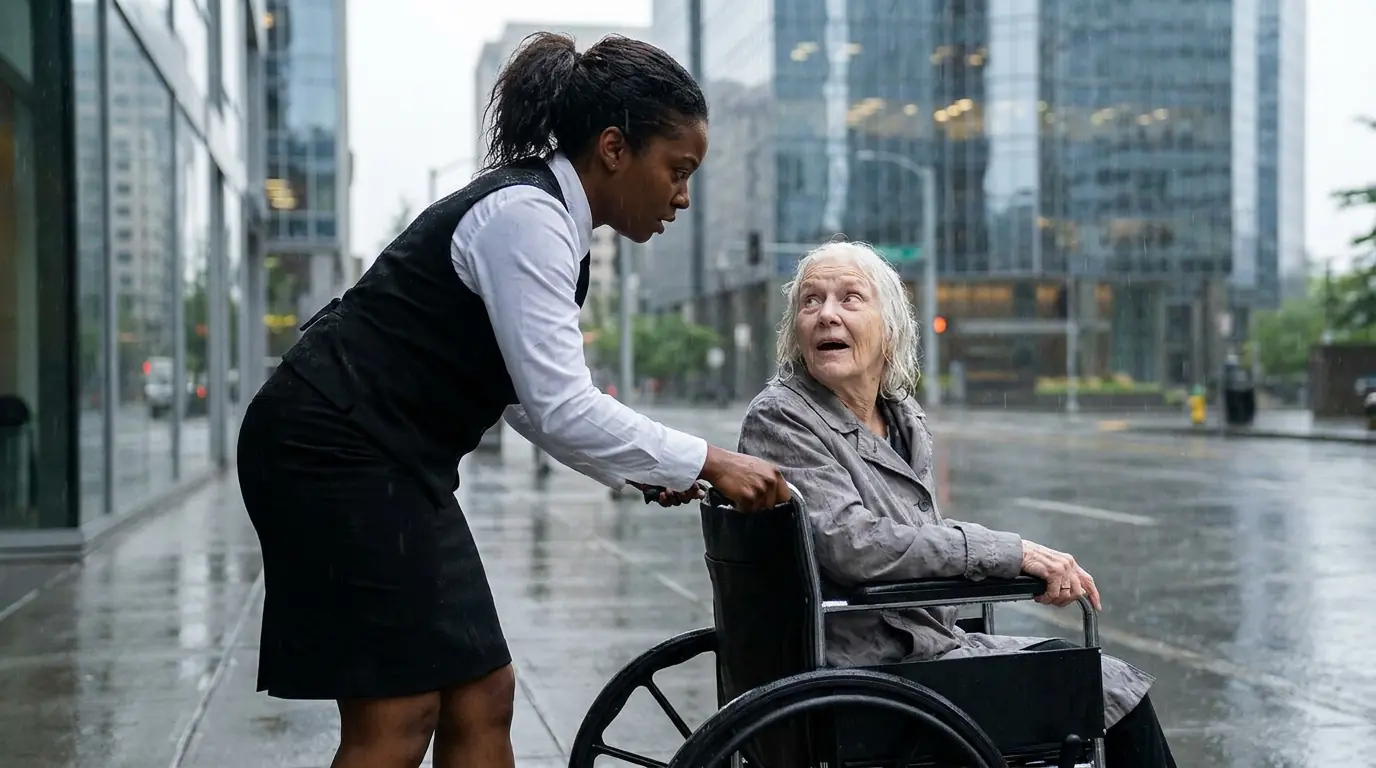
Her boots hit the stairs hard as she took them two at a time. The lobby doors slid open and the sound of rain swallowed her whole. Cold hit her like a wall. She ran across the marble floor, pushed through the revolving door and out onto the sidewalk.
Rain soaked through her jacket instantly. Her hair came loose from its tie. She didn't care. "Ma'am!" Isabella called out, voice raised over the noise. "Ma'am, hold on." The woman turned her head slowly.
Her face was pale, lips tinged faintly blue, but her eyes were alert. Afraid, relieved. "I can't move," the woman said. Her voice was thin, but steady. "The wheels stuck." "I see it," Isabella said, already crouching.
She grabbed the twisted wheel with both hands and pulled. It didn't budge. The rain made everything slick. She repositioned her grip and tried again, bracing her foot against the curb. The wheel jerked free with a sharp scrape.
Isabella exhaled. She stood and moved behind the chair, hands firm on the handles. "I'm going to push you inside. Okay, just for a few minutes out of the rain." The woman nodded, teeth chattering now. "I was waiting for my son. He said he'd be right back."
Isabella didn't ask questions. She didn't need answers to know this couldn't wait. She pushed. The wheelchair rolled unevenly over the sidewalk. Water splashing up onto Isabella's pants. She guided it toward the building entrance, ignoring the stares.
Someone muttered something about blocking the door. Another person sighed loudly as they squeezed past. Inside, the warmth hit them both. The lobby was vast and echoing, polished stone reflecting overhead lights.
Isabella wheeled the chair to the side near a decorative column away from foot traffic. She grabbed a stack of paper towels from a nearby stand and knelt in front of the woman. "Here," she said, blotting gently at the woman's sleeves, her shoulders. "I know it's not much."
The woman looked up at her, startled. "You'll get wet." "I already am." The words came out softer than Isabella expected, almost like a confession. Footsteps echoed sharply across the marble.
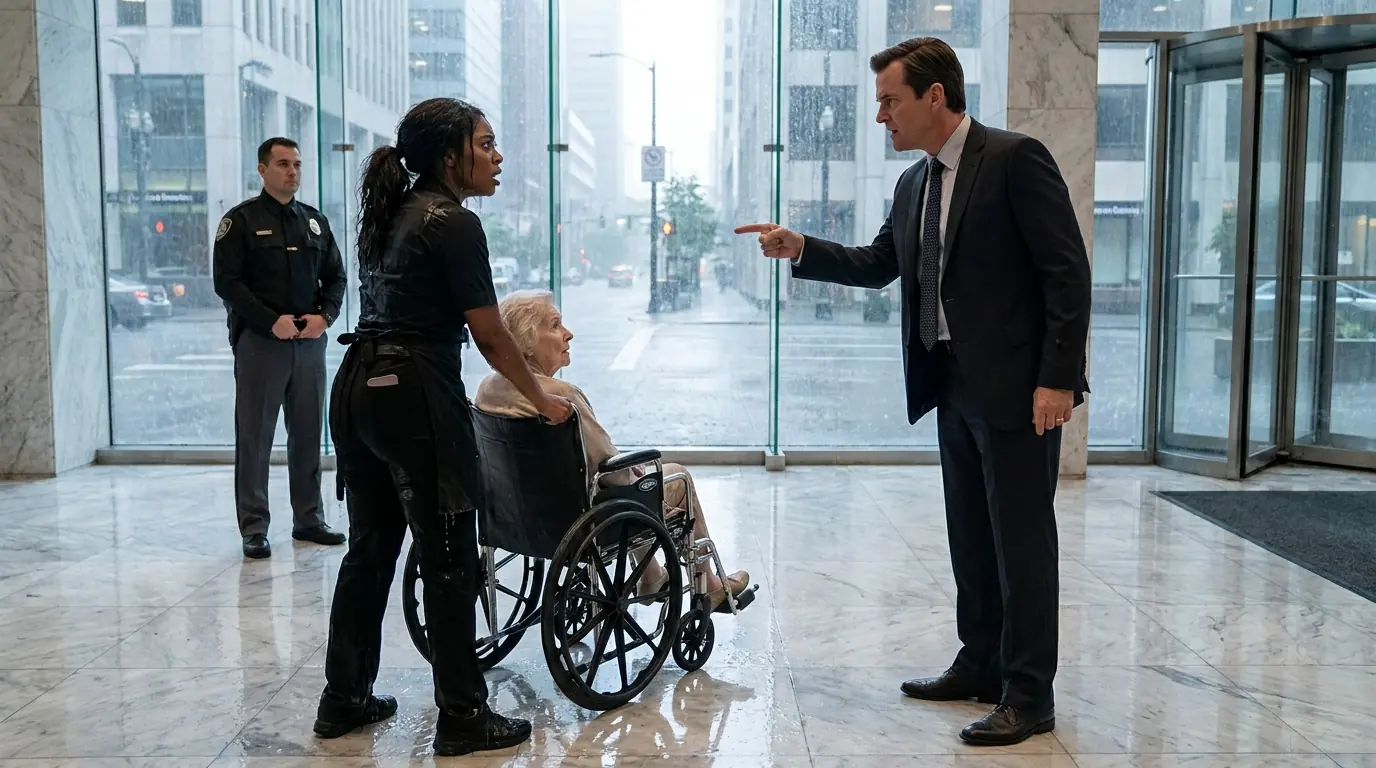
Isabella looked up. Her manager stood several feet away, his expression tight. His suit was immaculate. Dry. He glanced at the wheelchair, then at Isabella, then at the damp jacket on the floor. "What is this?" he said, not bothering to lower his voice.
Isabella stood. "She was stuck outside in the rain. I just needed a few minutes." "This is not our responsibility," he said flatly. "We can't have this in the lobby." "She couldn't move," Isabella said. Her heart was pounding now.
"I'll take her out as soon as the rain eases. Just fifteen minutes." He shook his head. "This is a corporate building. We have policies, liability issues. You're creating a scene." The woman in the chair shrank back slightly, her hands clutching the armrests.
"I'm sorry," she murmured. "I didn't mean to." "Don't," Isabella said, turning back to her manager. "She's not doing anything wrong." "Isabella," he said sharply. "Step away. I'll call security. They'll handle it."
"Handle it how?" Isabella asked. By then, she knew the answer. A guard appeared from the far end of the lobby, already scanning the situation. His gaze lingered on the wheelchair, then flicked to Isabella.
"Sir," the manager said, gesturing. "We need this removed." The guard hesitated. Just a fraction of a second. Then he reached for the handles. Isabella stepped forward.
She stood directly in front of the wheelchair, blocking it with her body. Her hands were shaking now, but she didn't move. "She's not trash," Isabella said. Her voice was low, steady. "You don't just push her back into the rain."
The lobby went quiet. The manager's face hardened. "Get out of the way." "No," Isabella said again, louder this time. "You are." For a moment, no one spoke. Rain streaked down the glass walls behind them, blurring the city outside.
Then the manager straightened. "You're done here," he said. "Effective immediately. Collect your things and leave." Isabella felt the words land heavy and final. She didn't argue. She didn't beg.
She turned to the woman in the chair and picked up her jacket from the floor. She wrapped it tighter around her shoulders. "Come on," Isabella said softly. "Let's go." They moved back out into the rain together.
The building doors slid shut behind them with a quiet, indifferent sound. Outside, the rain hadn't slowed. If anything, it was worse. Isabella pushed the wheelchair down the block, her shoes slipping slightly on wet pavement.
The woman pointed weakly toward a small grocery store on the corner, its awning sagging under the weight of water. They made it inside, breathless. The store was warm and cramped, shelves packed tight with canned goods and cheap bread.
Isabella guided the chair to a small table near the back next to a fogged up window. She checked her pocket, pulled out her wallet, and counted enough for food. Barely. She bought a towel, a cup of hot soup, one sandwich. She split it in half without thinking.
They ate slowly, steam rising between them, rain tapping against the glass. For a while, neither of them spoke. But silence has a way of opening doors. And before Isabella realized it, she was talking about her mother, about the hospital, about how fast things could fall apart when you were already one step from the edge.
The woman listened, really listened, and when she finally spoke, her voice carried a different weight. "I have a son," she said. "He's very busy." Isabella nodded. She understood that kind of busy.
The rain kept falling and somewhere just beyond the window, a future Isabella couldn't yet see, was already beginning to take shape. The grocery store smelled like warm bread and damp coats. Isabella sat across from the woman, hands wrapped around a paper cup of soup she hadn't really tasted yet.
The rain hadn't stopped. It hammered against the glass, relentless, as if the sky itself refused to let the moment pass quietly. For a brief, fragile stretch of time, it almost felt like they were invisible. Two people tucked away in the corner of a small store, sharing heat, sharing silence, no one staring, no one asking questions.
That was when the door swung open again. A man in a dark blazer stepped inside, shaking rain from his umbrella. He scanned the room once, then twice. His eyes landed on the wheelchair, then on Isabella. His jaw tightened.
"Excuse me," he said, already walking toward them. "You can't be here like this." Isabella looked up slowly. "We're just eating. We'll be gone soon." The man crossed his arms. "This store isn't a shelter, and you?" His gaze flicked to the woman. "Can't block the aisle."
The woman shrank slightly, fingers curling into the blanket Isabella had tucked around her legs. "I'm sorry," she said automatically. "I didn't mean to cause trouble." Isabella felt something harden in her chest. She stood.
"She's not blocking anything. We're sitting." The man exhaled sharply, annoyed. "I don't want complaints. That's all. Finish up and go." He turned and walked away. The moment passed, but the air didn't soften again.
Isabella sat back down, pulse loud in her ears. She glanced at the woman who was staring down at her hands now, shoulders slumped. "I hate this," the woman said quietly, "being told where I can and can't exist." Isabella didn't answer right away. She didn't know how. She only knew the feeling.
That sense of being tolerated at best. Managed, moved along. They finished the sandwich in silence. Outside, the rain thinned to a steady drizzle, but the cold remained. Isabella checked the time on her phone.
She should have been home by now. She should have been figuring out how to explain everything to her mother. She should have been panicking. Instead, she stood and pushed the wheelchair back toward the door. "I'll walk you a bit," she said. "At least until you're somewhere dry."
The woman nodded. "Thank you again." They stepped back onto the sidewalk. The city had shifted. The lunch rush was gone, replaced by a dull gray lull. Puddles reflected the tall glass buildings like distorted mirrors.
They hadn't gone far when a familiar voice cut through the noise. "Isabella." She froze. Her manager stood under the building's overhang, dry and rigid, phone pressed to his ear. He lowered it slowly as she approached, eyes narrowing.
"You didn't collect your things," he said. "I will," Isabella replied. "After I help her get somewhere safe." His gaze flicked to the wheelchair. His expression didn't change. "This isn't your problem anymore."
"She was never a problem," Isabella said. "That's not the point." His voice was calm, professional. "You violated policy. You embarrassed the company. Now you're loitering outside with her like you're making some kind of statement."
Isabella felt heat rise in her face. "I'm just making sure she's okay." He sighed as if she were exhausting him. "You're still representing us until you leave the premises. And this," he gestured vaguely, "doesn't look good."
"Since when does helping someone look bad?" Isabella asked. "Since it creates risk," he said flatly. "If she falls, if she claims we refused her services, if someone records this and spins it online, that's how."
The woman looked between them, confused, frightened. "I can go," she said quickly. "Really? I don't want to get you into trouble." Isabella turned to her. "You're not getting me into trouble."
"Yes, she is." The manager cut in. "And so are you." He pulled his phone from his pocket again. "I'm calling security. They'll escort you both away from the building." The word "escort" landed wrong. Heavy. Final.
Isabella's heart pounded. She knew what that meant. They wouldn't help. They wouldn't ask where the woman was going. They would move her along. Out of sight, out of responsibility. She positioned herself behind the wheelchair again, hands firm on the handles.
"No," she said. The manager stared at her. "Excuse me." "No," Isabella repeated. Her voice was steady now, clear. "You're not pushing her anywhere." "Step aside," he said. "Now."
A security guard approached from the entrance, large and silent. His eyes flicked to Isabella, then to the woman, then back to the manager. "Sir?" the guard asked. The manager nodded. "They need to leave."
The guard reached for the wheelchair. Isabella stepped forward. She didn't raise her voice. She didn't shout. She simply stood there, body between the guard and the woman, rain soaking her hair, her jacket, her shoes.
"She's not trash," Isabella said. "She's not something you drag out of the way because she's inconvenient." The guard hesitated. He looked at the woman's trembling hands, at her soaked coat, at Isabella's expression.
The manager's patience snapped. "Enough. You're done. Both of you move." "No," Isabella said again for the last time. For a moment, no one moved. Cars passed. A bus splashed through a puddle, spraying water onto the curb. The city kept going, indifferent.
Then the manager straightened. "You're fired," he said. "Effective immediately. Leave or I'll have security remove you." The words hit hard. Clean, like a door slamming shut.
Isabella felt it then. The fear, sharp and sudden. She thought of her mother, of the hospital bills, of the job she'd already lost. And still, she didn't move. She looked down at the woman in the wheelchair.
"I'm sorry," Isabella said softly. Not for losing her job, for the world, for the fact that kindness always seemed to come with a price. The woman reached up and squeezed Isabella's hand.
"You did the right thing," she whispered. "Even if it hurts." Isabella nodded once. She turned the wheelchair away from the building and pushed forward into the rain, into the cold, into uncertainty.
Behind them, the manager watched for a moment, then turned back inside. The glass doors slid shut, sealing warmth and order and policy behind them. Isabella didn't look back. She focused on the sidewalk ahead, on keeping the wheels straight, on the sound of rain hitting pavement.
She didn't know where she was going. She only knew she wasn't leaving the woman alone again. And somewhere in that choice, quiet, stubborn, costly. The shape of everything that would follow was already forming.
The glass doors closed behind Isabella with a sound that wasn't loud but final. A flat compressed thud. Rubber seals meeting. Inside becoming outside. She didn't turn around. Not because she was proud, not because she was angry, because stopping would mean standing there too long.
And standing too long would invite the kind of thinking she didn't have time for. The rain hit her immediately. Not dramatic, just steady, cold, heavy enough to soak through her coat in seconds. The air smelled like wet concrete and exhaust.
The building lights reflected off the sidewalk, turning puddles into pale mirrors she stepped through without looking down. Her hands started to shake before she noticed the cold, a fine tremor at first, the kind you could ignore if you were busy. She wasn't busy anymore.
She adjusted her grip on the wheelchair handles. The metal was slick. Her palms burned slightly where the skin had rubbed raw earlier. Her shoulders ached, not sharply, dull, deep. The ache of effort already spent and not yet finished.
She rolled the chair forward, the wheels resisting at every uneven seam in the pavement. Each push cost her something. She didn't count it. Her body did. They moved away from the building. One block, then another.
The glass behind them reflected less and less until it disappeared entirely, replaced by brick storefronts and narrow awnings dripping rainwater in uneven lines. Traffic hissed past. No one slowed. No one stared. The city resumed its indifference the moment the doors were out of sight.
Isabella's stomach tightened. Not hunger yet. Something earlier than that. A hollow pressure. She hadn't eaten since morning. She hadn't planned to. She'd planned to work, get through the shift, go home. Plans didn't matter now.
Her phone vibrated in her pocket. She stopped walking, fingers stiff as she pulled it out. The screen lit up with a missed call, then another. Then a voicemail notification. The hospital. She didn't play it right away.
She stood there, rain sliding down her hairline, jacket growing heavier by the second, the wheelchair waiting patiently in front of her like it understood pauses better than people did. When she finally pressed play, the voice was clipped. Professional, familiar in a way she hated.
Her mother's next treatment was scheduled for Friday. The balance on the account was still outstanding. The number was specific, exact, not abstract. $86,240. The date mattered more. Friday, three days away.
She slipped the phone back into her pocket without calling back. There was nothing to say. Apologies didn't reduce balances. Promises didn't move dates. She started walking again. The rain picked up. Not harder, just more insistent. The kind that crept under collars and soaked seams no matter how tightly you zipped.
Isabella felt it settle into her shoes, cold against her toes. She adjusted her stride to keep the wheelchair steady. The woman inside it didn't complain, didn't rush her, didn't apologize for the inconvenience. That silence felt heavier than conversation.
Two blocks down, Isabella saw the grocery store. It was small, narrow front, faded sign, the kind of place that sold bread by the loaf and soup by the cup, and didn't ask questions about why you were there at that hour in that weather. The light inside was warm, yellow. It spilled onto the sidewalk in a way that made the rain look softer than it was.
Isabella slowed without meaning to. Her mind did the math automatically. Cash in her wallet, the bills folded twice, worn at the edges. Enough for groceries for two days if she was careful. Enough for medication if nothing else went wrong. Not enough for both if she made the wrong choice.
Now she stopped in front of the store. The wheels of the chair angled slightly toward the door as if it had already decided. Isabella looked at the handle, then at the glass window fogged from the inside. She could see shelves, a counter, a man behind it wiping his hands on a towel, normal things.
She knew exactly what would happen if she went in. She knew exactly what wouldn't happen if she didn't. This wasn't confusion. It was clarity. "I can wait," the woman said quietly. Isabella shook her head. "You shouldn't."
It wasn't an argument, just a statement. She pushed the door open with her shoulder, guiding the chair inside. Warmth hit her face immediately. Not comfort, relief. Her glasses fogged for a second. She blinked until they cleared.
The man behind the counter looked up, took in the wet coat, the chair, the set of Isabella's jaw, and nodded at once without comment. She parked the wheelchair near the heater, not close enough to be obvious, close enough to matter.
She took off her own jacket, heavier now with water, and draped it carefully over the woman's shoulders. The fabric was thin. It wouldn't do much. It was what she had. "I'll be right back," Isabella said.
She walked to the counter and scanned the prices without picking anything up. Soup, bread, tea. She added numbers in her head. Subtracted, recalculated. Her stomach tightened again, sharper now. She felt it pull against her spine. She knew the feeling. It wasn't panic. It was hunger deciding it had waited long enough.
"I'll take one soup," she said, "and two spoons." The man nodded. No comment. He poured, set the bowl down, slid two spoons next to it, then hesitated. He added a small basket of bread without asking. Isabella noticed. She didn't thank him. Thanking would make it something else.
She paid in cash. Exact change. She felt the loss immediately, like a weight lifted from one side of her body and dropped somewhere she couldn't reach. She carried the bowl carefully back to the heater. Steam curled up, fogging the air between them.
The woman looked at the soup, then up at Isabella. "You don't have to," she said. Isabella set the bowl down. "I know." She didn't explain. She didn't soften it. She sat on the edge of a crate nearby, knees aching when she bent them.
She picked up a spoon and handed it over. Then she picked up the other. They ate slowly, not ceremoniously, practically, spoonful by spoonful, alternating without discussion. The warmth spread unevenly. First the throat, then the chest, then gradually the ache in Isabella's stomach eased just enough to stop shouting.
She felt the fatigue settle in once the urgency passed. The kind that waits politely until you sit down. Her hands still shook, though less now. Her shoulders sagged. She rolled them once, then again, trying to ease the stiffness. It didn't work. She stopped trying.
Her phone vibrated again. She didn't look at it this time. She knew what it would say. Another reminder, another missed call. The future insisting on being noticed. She kept eating. When the bowl was empty, Isabella stood and returned it to the counter.
The man nodded again. No receipt, no questions. She went back, pulled her jacket tighter around the woman, and checked the wheels before moving. One was still damp. She wiped it with her sleeve. The fabric darkened further. She didn't care.
Outside, the rain had eased slightly, not stopped, just loosened its grip. Isabella pushed the chair back toward the street. Her body protested now loudly. Every muscle that had worked earlier now demanded payment. She felt it in her calves, in her lower back, in the base of her neck.
She didn't slow down. She didn't look back at the store. She didn't count what was left in her wallet. She didn't calculate how she'd explain. Friday, those were tomorrow problems. Today had already taken what it would take.
As they moved down the sidewalk, Isabella felt something settle into place. Not resolve, not righteousness, just a line crossed, clear, irreversible. She hadn't chosen it with speeches or declarations. She had chosen it with her feet, with her hands, with money she wouldn't get back.
She knew exactly what she had traded, and she kept walking anyway. They didn't speak as Isabella pushed the wheelchair farther down the street, not because there was nothing to say, but because whatever needed to be said had already happened in action. Words would only soften it. And Isabella didn't want soft. She wanted forward.
The rain followed them. Lighter now, thinner, but still persistent. It clung to the edges of everything, the hems of her pants, the wheels of the chair, the space between breaths. Her shoes made a faint wet sound with every step. She ignored it.
She had learned a long time ago that discomfort only demanded attention if you let it. They passed closed storefronts. A laundromat glowing fluorescent behind fogged glass. A pharmacy with metal shutters halfway down as if even the building was tired. A bus stop with no one waiting.
The city looked like it was holding its breath. Isabella's phone vibrated again. She didn't stop walking this time. She reached into her pocket, glanced at the screen long enough to register the name of the hospital, then slid it back without answering.
The chair rolled steadily in front of her. The woman's posture was still composed, as if she understood exactly what kind of day this had become. "You don't have to take me any farther," the woman said after a while. Isabella tightened her grip on the handles. "I do."
It wasn't stubbornness. It wasn't pride. It was logistics. Leaving her halfway somewhere would mean undoing everything. Isabella had already chosen. That wasn't an option. Not anymore. They reached a small side street where traffic thinned and the buildings leaned closer together.
Brick faces streaked dark by years of rain. Isabella slowed, scanning for an address the woman had mentioned earlier. The numbers were faded, some missing entirely. She checked her phone again, this time for navigation. The screen dimmed, water collecting along its edge. Two blocks more, then a narrow entrance, an older building with a ramp that had been added long after it should have been.
The incline was steeper than regulation. Isabella felt it immediately in her calves. She leaned forward, put her weight into it, and pushed. Her breath shortened, not dangerously, just enough to remind her she had limits. She ignored that, too.
At the top of the ramp, she stopped. Her arms burned. Her hands ached where the skin had softened from dampness. She flexed her fingers once, then again, trying to bring feeling back into them. The woman turned her head slightly. "You're going to get sick," she said.
Isabella exhaled. "Probably." There was no drama in it. Just probability. She guided the chair inside the building, maneuvering carefully through the narrow doorway. The lobby was dim but dry. Old carpet, a faint smell of cleaning solution that didn't quite mask something older underneath.
Isabella parked the chair near the wall and leaned it gently to engage the brake. Her hands lingered there for a moment longer than necessary, as if letting go required confirmation. The woman reached into her bag, fingers searching. "I should give you something," she said. "For the trouble."
Isabella shook her head immediately. "No." The woman paused. "I don't mean money." Isabella met her eyes. "That's exactly what I mean." Silence settled between them. Not uncomfortable, just firm.
"You have your own burdens," the woman said quietly. "Yes," Isabella replied. "I do." She didn't explain. She didn't list them. They were heavy enough without being spoken. The woman nodded slowly.
"Then let me say this," she said. "You didn't have to see me today, but you did. That matters." Isabella absorbed that without reacting. Compliments felt strange right now. Out of place, like being offered shade when you were already soaked.
"I'll be fine from here," the woman said. Isabella hesitated for half a second. Then she stepped back. Not because she believed it fully, because staying longer would turn this into something else, something that required negotiation or permission.
She turned and walked back out into the rain. The moment the door closed behind her, the weight hit. Not emotionally. Physically, her legs felt unsteady. Her shoulders sagged. The adrenaline that had carried her through the last hour drained out all at once, leaving behind soreness and fatigue that had nowhere to go.
She leaned against the wall for a moment, just long enough to steady herself. Then she pushed off and kept moving. She didn't know where she was going yet. Home eventually, but not immediately. The idea of her small apartment felt too tight right now, too quiet. She needed motion, needed distance.
She walked until her feet hurt, then a little farther. The rain thinned to mist. Her hair clung to her face. Her clothes felt heavy, stiff as they dried unevenly. She passed a bus stop and checked the schedule. The next bus was fifteen minutes away. She considered waiting, then shook her head and kept walking.
Her phone buzzed again. This time she stopped. She answered without speaking. "Miss Moore," the voice said. Same clipped tone as before. "We're calling to follow up regarding your mother's account." "I know," Isabella said.
There was a pause, papers rustling. "We need confirmation of payment arrangements by end of day tomorrow." Isabella closed her eyes briefly. "I understand." "Friday is the treatment," the voice continued as if reminding her of something she could forget. "We can't proceed without."
"I understand," Isabella said again. She hung up before the sentence finished. She stood there, phone in hand, rain settling lightly on her shoulders. She didn't scream. She didn't cry. She didn't bargain with herself.
Those things required energy she didn't have. Instead, she pictured the bills, the numbers, the dates. She pictured the grocery store, the soup, the moment she'd handed over cash, knowing exactly what it would cost her later. She didn't regret it. That surprised her.
She started walking again, slower now. Every step deliberate. There was no undoing today, no version of events where she kept her job and still stood in front of that wheelchair. No outcome where she stayed dry and warm and untouched.
She had crossed a line, not dramatically, not loudly, but completely. By the time she reached her block, the rain had stopped entirely. The street lights cast steady pools of light on the pavement. Everything looked ordinary again, as if nothing irreversible had happened.
Isabella climbed the steps to her building, each one heavier than the last. She unlocked her door, stepped inside, and closed it behind her. The apartment was quiet, too quiet. She stood there for a moment, keys still in her hand, shoes damp, body exhausted, mind strangely clear.
There was no going back. And for the first time since the glass doors had closed behind her, Isabella allowed herself to acknowledge it. Not with fear, not with regret, but with acceptance. She had stepped past a boundary she could not uncross, and she had done it on purpose.
The grocery store sat on a corner. Most people didn't notice unless they were already tired. Not trendy, not loud, just a narrow space with fogged windows and a heater that clicked softly every few minutes like it was reminding itself to keep going.
Isabella pushed the wheelchair inside and felt the air change immediately. Warmth, stale coffee, bread toasted too long. The smell of a place that didn't expect to be photographed. No one looked up. That was the first thing she noticed.
A man hunched over a laptop near the window. Two women talking quietly at a small round table, coats still on. Someone asleep in the far corner, head resting on folded arms. The barista glanced over, took in the chair, the damp clothes, the hour, and nodded once. No questions, no looks that lingered, just acceptance, thin and unceremonious.
They took a table near the wall, slightly out of the way. Isabella positioned the chair carefully, making sure the wheels didn't block the narrow aisle. She hung her jacket over the back of her own chair, steam rising faintly from the fabric.
Her hands still shook when she sat down, but less now. Enough warmth had crept in to take the edge off. The grocery store settled around them. Cups clinked. Someone laughed softly, then stopped. The heater clicked again.
Outside, rain streaked down the glass, blurring headlights into pale lines that slid past and disappeared. No one asked what had happened. No one asked where they'd come from. No one asked how long they planned to stay. They were invisible here, and for the moment, that was safety.
Isabella wrapped her hands around the mug. The barista had sat down without comment. She hadn't ordered yet, but it arrived anyway. Black coffee, no saucer. She didn't thank him. He didn't wait. Across from her, Eleanor watched the steam rise from her own cup, eyes following it until it vanished.
She didn't drink right away. She just held it, palms pressed against the ceramic like she was memorizing the heat. "This is nice," Eleanor said eventually. Not brightly, just as an observation. Isabella nodded. "It is."
They sat in silence for a while. Not awkward, not heavy, the kind that happens when there's no immediate task demanding attention. Isabella felt the exhaustion settle deeper now that there was nothing left to push against. Her legs ached, her shoulders burned in a dull, persistent way.
She rolled one shoulder slowly, then stopped when the movement sent a sharp reminder through her back. Eleanor noticed. "You shouldn't carry people," she said quietly. Isabella almost smiled. "I didn't."
Eleanor's eyes flicked briefly to the chair, then back to Isabella. She didn't argue. After another moment, Eleanor spoke again. "They plan my days," she said very efficiently. Isabella looked up, alert but not surprised. "Who?"
"My son, his staff, the people who care for me." Eleanor's fingers tightened slightly around the mug. "They mean well. That's the part that makes it complicated." Isabella waited.
"I eat at the same times every day," Eleanor continued. "I see the same doctors. I'm driven the same routes. Everything is scheduled. Managed." She paused. "Loved." The word landed strangely. "According to availability," Eleanor added.
Isabella didn't interrupt. She didn't nod. She let the silence hold space for the sentence to finish what it had started. "They don't ask what I want," Eleanor said. "They ask what's easiest." The heater clicked again.
Isabella felt something shift in her chest. Not pain, recognition. "My mother's care plan is like that," Isabella said before she meant to. "Appointments stacked back to back. Different doctors every time. No one remembers her name unless it's written down."
Eleanor turned her head slightly. "Does she complain?" Isabella shook her head. "She tries not to." They sat with that. Eleanor took her first sip of coffee, grimaced faintly, then took another.
"Anyway," "It's strange," she said. "To be told you're lucky while everything that made you feel real is slowly removed." Isabella's grip tightened around her mug. Eleanor didn't elaborate. She didn't tell stories. She didn't list grievances. She offered fragments enough to sting, not enough to overwhelm.
"They move me when it's time," Eleanor said. "They stop conversations when they run long. They decide when I'm tired." A pause. "They decide when I'm done." Isabella thought of the building, the manager's voice, the way policy had been spoken like a final authority, not a choice.
She thought of her own life, measured in shifts and balances and dates circled on calendars she didn't control. "There are people who never get pushed out," Isabella said slowly. "They just fade." Eleanor looked at her. "Yes."
The word carried weight, agreement, recognition, not surprise. "They become easy to plan around." Isabella continued. "Easy to move, easy to ignore because they don't demand anything." Eleanor's mouth curved slightly. "Because demanding is inconvenient."
Isabella nodded. She thought of her mother again, of how careful she was not to call too often, not to ask for help unless absolutely necessary. Of how that carefulness had become invisible labor, unnoticed precisely because it was so well-managed.
"They call it care," Isabella said. "But it feels like control." Eleanor didn't respond right away. She watched a drop of condensation slide down her mug, then wiped it away with her thumb. "It is care," she said finally, "just not for the person receiving it."
Isabella leaned back in her chair, exhaustion pressing into her spine. She let her head rest briefly against the wall behind her. The grocery store hummed softly around them, unaware of the shift happening at the table in the corner.
A Kind Waitress Helped a Poor Old Man — Until He Revealed His True Identity
"This isn't about kindness, is it?" Isabella said. It wasn't a question. "No," Eleanor replied. "Kindness is optional. Systems are not." Isabella closed her eyes for a second.
She saw the building again. The glass doors, the way they'd closed without resistance, without ceremony. How easy it had been to remove her once she disrupted the flow. "There are rules for everything," she said. "But no one seems responsible when those rules hurt someone."
Eleanor set her mug down carefully. "That's because responsibility is diffused," she said. "Shared just enough to disappear." Isabella opened her eyes. "So no one has to stop." Eleanor's gaze held hers. "Exactly."
The grocery store door opened briefly, letting in a gust of cold air and rain. Someone stepped inside, shook water from their coat, and moved toward the counter. No one looked up for long. "Tell me something," Eleanor said.
After a moment, Isabella waited. "If you hadn't stopped today," Eleanor asked, "what would have happened?" Isabella pictured it instantly. The sidewalk, the rain, people walking past, the building swallowing its reflection and continuing on.
"She would have stayed there," Isabella said. "Until someone else noticed, or until someone moved her along." "And if no one did," Isabella swallowed. "Then nothing would have changed." Eleanor nodded.
"And if everyone walks past," Isabella didn't answer. "Who is responsible then?" Eleanor asked. Her voice was calm, curious, not accusing. Isabella stared into her coffee. The surface had gone still, reflecting the dim light above them.
She thought of policies, of schedules, of people who did exactly what was expected and still disappeared. "I don't know," she said quietly. Eleanor didn't push. She didn't fill the silence with conclusions or lessons. She simply sat there, hands folded, waiting.
The grocery store remained unchanged, warm, anonymous, safe for now. But something fundamental had shifted at the table in the corner. Isabella had stopped thinking of what happened as a single event. A bad manager, a bad day, a misunderstanding.
She was beginning to see the shape of something larger, and she didn't yet know how to name it. The grocery store didn't change. As the minutes passed, the heater clicked on and off. Cups were refilled. Someone near the window stood, paid, left without ceremony.
Outside, the rain softened into a fine gray veil. Inside, the corner table remained untouched by attention. No one asked how long they'd been there. No one asked what came next. The absence of questions felt intentional, like a quiet agreement between strangers who understood that some people needed to be left alone to think.
Isabella stared into her cup, watching the surface settle after she stirred it. She hadn't meant to say as much as she already had. She hadn't planned to connect anything. But once the shape appeared, it refused to go back to being separate pieces.
"My mother schedules her pain," Isabella said more to the table than to Eleanor. "She times when she takes medication so she won't need help during my shifts. She says it's easier that way for everyone." She paused. "No one asked her to do that. She learned."
Eleanor listened without interrupting, head slightly tilted, eyes steady. No sympathy on her face. No pity, just attention. "She apologizes before asking for anything," Isabella continued. "Before calling, before needing a ride, she says sorry like it's a reflex."
Isabella's fingers tightened around the mug. "She's afraid of becoming a problem." Eleanor nodded once. "Problems are expensive." She said in time, in patience, in paperwork. Isabella let out a breath that sounded almost like a laugh.
"So people learn to disappear instead." "Yes," Eleanor said. "They make themselves smaller, quieter, easier to plan around." The words landed with precision, not as a diagnosis, as a description.
Isabella thought of herself before that afternoon, of how many times she'd stepped aside, lowered her voice, accepted explanations that felt wrong, but were delivered confidently. She told herself it was temporary, practical, necessary.
"I've done that too," she said. "I thought it was survival." Eleanor's gaze softened just slightly. "It is," she said. "At first." Isabella looked up. "And then?"
"And then it becomes habit," Eleanor replied. "And habits become systems." The grocery store door opened again. A gust of damp air rushed in, then out. The bell above the door rang once, then settled.
Isabella followed the sound with her eyes until it stopped. "There are people who never get written up," she said slowly. "Never get fired, never get told no." She thought of the building manager, the policy manual, the way authority moved without resistance.
"And there are people who disappear without anyone having to push." Eleanor folded her hands. "Because pushing leaves marks," she said. "Systems prefer clean exits." Isabella felt the truth of that settle somewhere deep.
Clean exits, quiet ones, ones that didn't require explanation or accountability, ones that could be labeled unfortunate and filed away. "They didn't drag me out today," Isabella said. "They didn't raise their voices. They just said I was out of alignment."
Eleanor smiled faintly. "Alignment is a useful word," she said. "It suggests geometry instead of choice." Isabella nodded. "It makes it sound neutral." "And inevitability feels easier to accept than responsibility," Eleanor said.
Isabella leaned back, the chair creaking softly beneath her. She felt older in that moment, not wiser, just heavier with understanding. The story she told herself about one bad decision, one unfair manager, no longer fit. It was too small, too convenient.
"This isn't about me," Isabella said. "Or you or my mother." "No," Eleanor agreed. "It's about how easily people are sorted." Isabella thought of all the categories she'd moved through without noticing. Employee, liability, disruption, out of scope.
She thought of how quickly those labels had replaced her name. "There are people who are managed until there's nothing left to manage," she said. "And then they're stored somewhere safe, quiet, out of sight."
Eleanor's fingers tapped the table once lightly. "Stored is the right word." Isabella felt something tighten in her chest. "And everyone tells themselves it's care." Eleanor met her eyes. "Because calling it something else would require change."
The heater clicked again. Isabella realized she'd stopped shivering, not because she was warmer, because her attention had shifted fully inward. Eleanor leaned forward slightly. Not to instruct, not to persuade, just to ask.
"If you hadn't stopped today," she said, "what would have happened to me?" Isabella didn't hesitate this time. "You would have waited," she said, "and waited, and eventually someone would have moved you along."
"And if that person had followed procedure," Eleanor asked, "then you'd have been told where you could and couldn't be," Isabella replied. "Without anyone asking where you needed to be." Eleanor nodded.
"And if everyone follows procedure," Isabella's mouth opened, then closed. She looked down at her hands. The skin around her nails was still red. "Evidence of effort, evidence of friction." "I don't know," she said finally.
Eleanor didn't fill the silence. She didn't rephrase the question. She let it remain unanswered, suspended between them. "People think responsibility belongs to the last person in the chain," Eleanor said after a moment. "The one who says no, the one who closes the door."
She paused. "But chains only exist because everyone agrees to hold their link." Isabella felt the weight of that settle. She saw the building again, not as a place, but as a process. Layers of decisions stacked neatly on top of one another, each justified by the one before it.
"What happens if someone lets go?" Isabella asked quietly. Eleanor's expression didn't change. "The chain breaks," she said. "And everyone pretends they didn't hear it." Isabella exhaled slowly.
She hadn't expected answers. She hadn't expected comfort. What she felt instead was exposure. Like standing in a room where the lights had been turned on without warning. She understood now why the afternoon had felt irreversible.
It wasn't just that she'd lost her job. It was that she'd stopped participating in the lie that made everything run smoothly. The grocery store began to empty. Chairs scraped softly. Coats were pulled on. Conversations faded into the rain.
Still no one looked at their table for long. Eleanor gathered her bag. Movements careful, practiced. "My son will come for me soon," she said. Not with certainty, with expectation. Isabella nodded. She felt a quiet dread stir at the thought, though she didn't yet know why.
"Before he does," Eleanor added, "I want you to remember something." Isabella looked up. "You didn't save me today," Eleanor said. "You interrupted a system." Isabella absorbed that. She didn't argue.
"And systems don't like being interrupted," Eleanor continued. "They respond. Sometimes gently, sometimes not." Isabella's shoulders squared almost unconsciously. "I'm not looking for trouble."
Eleanor smiled. "Neither was I," she said. "I just wanted to get home." They stood together near the door. Isabella helped adjust the chair, checked the brakes again. Small practical gestures. Familiar territory.
The bell above the door rang softly as they stepped outside. The rain had stopped completely now. The street shone under the lights, clean and reflective, as if it hadn't been hostile at all an hour earlier. They waited at the curb in silence.
Isabella felt it then. Not fear, anticipation, the sense that something was moving toward her whether she wanted it or not, that the questions Eleanor had asked would not stay contained to a grocery store corner.
Somewhere, decisions were already being made, and she would soon be standing in front of them. The car arrived without announcement. No engine growl, no impatience. It pulled up to the curb and stopped as if it had always planned to be there, as if the street had made space for it long before its tires touched the wet asphalt.
Isabella noticed it only because Eleanor straightened slightly in her chair. A small adjustment that came from habit rather than expectation. The vehicle didn't signal wealth. It didn't need to. Its stillness was enough.
The door opened smoothly, quietly, and a man stepped out. He moved without urgency, without scanning the street, without the reflexive glances of someone unsure of their surroundings. He crossed the distance between the car and the curb at an even pace, coat buttoned, posture upright.
Control, not confidence, was the first thing Isabella registered. "Mother," he said. No rush, no apology for being late, just acknowledgment. Eleanor looked up at him. "You came," she said.
He inclined his head. "I said I would." He turned then, eyes settling on Isabella for the first time. The look wasn't sharp. It wasn't warm either. It was assessing in a way that felt practiced, as if he had learned long ago how to notice without revealing what he noticed.
"You helped her," he said. It wasn't a question. Isabella nodded once. "Yes." He studied her for a moment longer. Not her clothes, not the chair, her face, as if committing something to memory. "What's your name?" he asked.
"Isabella," she replied. He repeated it quietly. "Isabella." He didn't ask what she did. Didn't ask why she was there. Didn't ask what it had cost her. He reached into his coat pocket and withdrew his wallet. Movements unhurried.
He held out a card, then paused, adjusting his grip so she could see it was blank on one side. No title, no company, just a name and a number. "For your trouble," he said. Isabella didn't take it. She shook her head. "I can't."
The man's brow furrowed slightly. Not in offense, in curiosity. "Why not?" "Because if I accept it," Isabella said evenly, "this becomes a transaction." He considered that truly considered it. The card remained suspended between them for a beat longer.
Then he slipped it back into his wallet. "Very well," he said. He helped Eleanor into the car himself. No driver stepping in. No instructions barked, just careful hands and an attention that suggested this, at least, he did not delegate.
Once Eleanor was settled, he closed the door gently and turned back to Isabella. "Good night, Isabella," he said. The use of her name landed with unexpected weight. He hadn't written it down. He hadn't asked her to repeat it. He remembered.
Then he got into the car. The door closed. The engine started softly. The vehicle pulled away, smooth and silent, disappearing down the street without leaving anything behind but a faint impression of order. Isabella stood there for a moment longer.
The sidewalk empty again. The night felt cooler now, quieter. She exhaled and began walking home. Her body ached. Her steps were slow. She replayed nothing. There was no space left for speculation, only movement.
She didn't know who that man was. She didn't know why the encounter lingered in her chest like an unfinished sentence. But as she walked under the street lights, shoes damp, shoulders heavy, one thought followed her all the way home. Someone had seen, and whatever came next. It wouldn't be accidental.
The conference room door closed behind Isabella Moore with a muted click that felt louder than it should have. The room was colder than the hallway. Not in temperature, but in tone. Polished wood table, glass walls, leather chairs arranged with intention.
Every object placed where it belonged. Every person already seated knowing exactly why they were there. Isabella stood for a second too long before moving. No one told her where to sit. She chose the chair closest to the door. Not by accident.
Old habits didn't disappear just because circumstances changed. You always stayed close to an exit when you weren't sure you'd be allowed to stay. Across the table sat six people, men and women in tailored suits, faces neutral, expressions carefully controlled, executives, decision makers, people used to being deferred to.
And at the far end of the table sat him, the man from the rain. He looked different here, sharper, more contained. The fatigue she'd seen that evening was hidden beneath posture and authority. His suit fit perfectly.
His hands rested calmly on the table, fingers loosely interlaced, but his eyes were the same. They met hers without hesitation. Recognition flickered there, brief, controlled, then gone. Isabella's pulse picked up.
She hadn't known what to expect when she'd been told to come back, only that the call had come faster than she'd imagined. Less than forty-eight hours after she'd lost her job, less than forty-eight hours after she'd walked home with an empty wallet and no plan.
She'd almost ignored the call. Almost. A woman to her left cleared her throat. "Miss Moore, thank you for coming in on such short notice." Isabella nodded. "Of course." Her voice sounded steadier than she felt.
"We understand you were recently terminated from your previous position," the woman continued, glancing at a tablet, "under unusual circumstances." Isabella didn't look away. "That's one way to describe it."
A few people shifted in their seats. The man at the end of the table leaned back slightly. "I asked her here," he said. The room went still. The woman paused, then inclined her head. "Of course, Mr. Caldwell."
So that was his name, Caldwell. He turned his attention back to Isabella. "You probably didn't expect to see me again so soon." Isabella met his gaze. "No." "Do you know why you're here?"
She considered lying, considered softening the truth. "I assume you want to talk about what happened," she said. "That," he replied. "And you?" That landed differently.
A man seated two chairs down frowned slightly. "With all due respect, Mr. Caldwell, we're here to discuss the situation at the Midtown building. Liability exposure, reputational concerns." Caldwell didn't look at him.
"We will," he said to Isabella. "But first, I want to hear it from you." The table waited. Isabella took a breath. She didn't rush. She didn't perform.
"There was an elderly woman outside the building," she said. "She was stuck in the rain. People walked past her." She paused. "I helped her." A beat. "My supervisor said it violated company policy, that I made the building look bad."
Another pause. "They tried to remove her. I stood in the way." No embellishment. No defense. "And then you were fired," Caldwell said. "Yes." Someone scoffed softly. Isabella didn't turn to look.
Caldwell studied her. "If you had it to do over again," he asked, "would you make the same choice?" The question hung there. Isabella didn't answer right away.
She thought of her mother, the hospital bed, the unpaid bills, the panic that still lived just under her ribs. "Yes," she said, no hesitation. Caldwell nodded once.
The woman with the tablet spoke again. "Miss Moore, we understand your intentions were compassionate, but you must also understand the risks involved. Buildings like ours operate under strict protocols." Isabella's jaw tightened.
"I understand protocols," she said. "I don't understand pretending people don't exist because they're inconvenient." The room shifted. Caldwell raised a hand slightly. Not a command, a signal. Silence returned.
"You didn't ask for anything that night," he said to Isabella. "Not money, not help, not even my name." Isabella shrugged. "I didn't need it." "And when I offered you cash," he continued. "You refused?" "Yes." "Why?"
She met his eyes. "Because if I'd taken it, it would have turned what I did into a transaction, and it wasn't." A few people exchanged looks. Caldwell leaned forward, elbows resting lightly on the table.
"Do you know how rare that is in rooms like this?" Isabella didn't respond. "You embarrassed the building manager." Someone else said sharper this time. "You created a scene. You put the company at risk."
"I stood still," Isabella replied calmly. "The scene already existed." That earned her a long look from Caldwell. He turned to the others. "You see the problem?" The man frowned. "I see someone who doesn't understand corporate boundaries."
"No," Caldwell said. "You see someone who does better than most." The room went quiet again. "Miss Moore," Caldwell continued. "Your background is not traditional." That was one word for it.
"You don't have an MBA. You don't have corporate experience. You were cleaning windows three days ago." Isabella nodded. "Yes." "And yet," he said, "you recognized a situation every one of us would have avoided. You acted without calculating cost or benefit, and when confronted, you didn't retreat."
He paused. "That tells me something." The woman with the tablet hesitated. "Yes, Mr. Caldwell, are you suggesting?" "I'm suggesting," he interrupted gently, "that we stop pretending competence only comes with credentials."
He looked back at Isabella. "Tell me something. When you stood in front of that wheelchair, what were you thinking about?" Isabella's hands curled slightly in her lap. "My mother," she said, "how scared she'd be if she were alone like that."
Caldwell's expression shifted almost imperceptibly. "My mother," he said quietly, "has been afraid for a long time." No one spoke. He straightened. "Miss Moore, I don't want to offer you money."
Isabella's shoulders eased a fraction. "I want to offer you a job." The words settled slowly. A man near the center of the table laughed once. Incredulous. "You're serious?" "Yes." The woman frowned. "In what capacity?"
Caldwell didn't take his eyes off Isabella. "Senior adviser, community and human impact." Isabella blinked. "I'm not qualified." "You're overqualified," Caldwell said. "Just not on paper." She shook her head. "I don't belong in rooms like this."
Caldwell smiled slightly. "That's exactly why you do." The table erupted. Questions, objections, concerns layered over one another. "This is impulsive. It sets a precedent. We can't base hiring decisions on sentiment."
Caldwell waited them out. When the room quieted again, he spoke evenly. "This company has spent decades optimizing profit. And somewhere along the way, we forgot the cost. I'm not interested in surrounding myself with people who know the rules but never question them."
He turned back to Isabella. "You don't flinch when authority pushes you. You don't barter your values and you see people our systems erase." A pause. "I need that." Isabella swallowed. "And what do you need?" He asked.
She thought for a moment. "My mother's care," she said. "Flexibility, a real contract, and the understanding that if I see something wrong, I'll say it." Caldwell nodded. "Done."
The woman with the tablet hesitated, then slowly nodded as well. Others followed, not convinced, but compliant. Caldwell stood. "We'll draft the paperwork." Isabella remained seated, heart pounding.
"Miss Moore," he added. Softer now. "This won't be easy. People will test you. They'll assume you're here because of me." She met his gaze. "Let them." A corner of his mouth lifted. "Good."
As the meeting adjourned, people filed out in clusters murmuring. Some glanced at Isabella with curiosity, others with thinly veiled resentment. Caldwell lingered. "You didn't read the card I gave you," he said. "No." He nodded. "I hoped you wouldn't."
She stood then, suddenly aware of how tired she was. "Why me?" she asked quietly. Caldwell didn't answer right away. "Because," he said finally, "you didn't save my mother to change your life." He held her gaze. "You did it because it was the right thing to do."
Isabella left the building minutes later, the city spreading out before her, unchanged. She had a job again, a better one. But as she walked toward the subway, she felt the familiar tension settle back into her shoulders because she knew something no one in that room seemed to understand yet.
That choosing not to compromise didn't end with one meeting. It only moved the fight somewhere higher. The first thing Isabella learned was that titles didn't soften rooms, they sharpened them. On her first morning, she stood in the lobby again.
Same building, same polished floors, same quiet confidence in the air, but this time her name was already on the security list. Her badge worked on the first try. The guard nodded instead of looking past her. Nothing else changed.
People still glanced, still measured, still decided what she was worth before she opened her mouth. Her office was smaller than she'd expected. Glass walls, a desk that smelled faintly of lemon cleaner, a chair that looked expensive but felt stiff, no personal items, no signs of life.
She sat down, placed her bag carefully on the floor, and waited for the feeling of arrival. It didn't come. Instead, there was a low, constant awareness, like standing on unfamiliar ground that could shift without warning.
By noon, the emails started. Not hostile, never hostile. That would have been too obvious. They were polite, precise, carefully worded questions that sounded like collaboration and felt like interrogation. Can you clarify your role? Who exactly do you report to? Was this position approved by the full board?
Isabella answered each one simply, directly, no defensiveness, no explanations she hadn't been asked to give. Still, the looks followed her through the halls. She felt them in meetings, in pauses that lasted a fraction too long after she spoke, in the way certain people avoided sitting next to her, as if proximity implied agreement.
On her third day, she was invited to a strategy review. The conference room was larger than the one she'd been in before. Longer table, more screens, more people who had already decided what outcomes they preferred. A man named Douglas Reed led the discussion. Senior, respected, impeccably calm.
They were reviewing a proposed restructuring of a regional service division. On paper, it was clean, efficient, profitable, cut labor costs, centralize operations, outsource support. Isabella listened without interrupting. She waited until the end.
"I have a question," she said. Douglas nodded. "Of course." "What happens to the employees who've been there ten, fifteen years?" she asked. "The ones whose roles are being eliminated." Douglas didn't blink.
"They'll be offered severance packages and after that they'll find other opportunities in the same city. That's not something we can guarantee." "So we're removing the largest employer from three neighborhoods and calling it optimization," Isabella said calmly.
A few people shifted. Douglas smiled politely. "This isn't a social services agency." "No," Isabella agreed. "It's a company that operates within communities." Silence. Douglas leaned back.
"Are you suggesting we abandon a profitable strategy because it makes people uncomfortable?" "I'm suggesting we account for the cost," Isabella said. "Not just the savings." "The cost is already calculated," he replied, gesturing to the spreadsheet.
"Those numbers don't include displacement," she said. "They don't include increased public assistance usage, local business collapse, or reputational damage when people realize we hollowed out their town and moved on." "That's speculative."
"Everything you're projecting is speculative," Isabella said. "The difference is whose lives are treated as variables." The meeting moved on. Afterward, a woman Isabella didn't recognize caught up with her in the hallway.
"You might want to be careful," the woman said quietly. "About what?" "About pushing back so early. People don't like being challenged by someone they didn't choose." Isabella met her eyes. "Neither do I."
The woman studied her, then gave a small smile. "Good luck." By the end of the first week, Isabella understood the rules. Speak, but not too much. Question, but only what was already safe to question. Advocate, but never at the expense of momentum.
She followed none of them. She read reports others skimmed, asked about people when everyone else asked about margins, flagged decisions that looked clean from above and cruel up close. Caldwell backed her publicly. That helped some.
Privately, resistance hardened. Meetings were rescheduled without her. Emails went unanswered until someone else was CC'd. Information arrived late, incomplete, just enough to keep her from fully engaging. On paper, she was part of the process. In practice, she was being starved of oxygen.
At home, her mother's condition stabilized, then wavered again. Isabella took calls from hospital corridors, voice low, careful not to sound distracted during meetings that could decide hundreds of jobs. She slept less, ate when she remembered. Her shoulders ached constantly as if she were bracing for impact that never quite arrived.
One evening, Caldwell stopped by her office. "You're making enemies," he said. "I know." "You don't have to fight every battle." "I'm not," she said. "I'm fighting the ones that matter." "They're going to come for you." "I know."
The next morning, she was copied on an internal memo she wasn't supposed to see. It outlined concerns about her fit, her lack of alignment, her potential liability to long-term strategic goals. The language was clinical, bloodless. What it meant was simple. They wanted her gone.
She forwarded the memo to Caldwell without comment. His response came an hour later. "I'm handling it." She didn't feel reassured. Two days later, the real move came. It started with a missing file.
A report Isabella had submitted flagging discrepancies in a supplier contract had vanished from the shared drive. Not deleted, just gone. It restored a previous version. The discrepancies were no longer there. She resubmitted, documented, saved backups.
The following week, she was called into a compliance review. A man she'd never met slid a folder across the table. "Can you explain these alterations?" Isabella opened it. Her name, her credentials, her signature. The changes benefited a vendor under investigation.
"I didn't make these changes," she said. "That's what you're saying." System logs, access records, timestamps. The edits came from her account, from her workstation. Late at night, hours she hadn't been in the building.
"I was home," she said. "I have records." "The system shows otherwise." By the end of the day, the whispers had started. Fast-tracked higher. Questionable judgment. Now this.
She walked out under a sky threatening rain again. Same street, same city, different weight. Her phone buzzed. Caldwell. "We need to talk tomorrow morning." She stood on the sidewalk watching people pass without recognition, without interest.
Once again, she was standing just outside the glass. This time, the doors were still open. She didn't know yet whether she'd be allowed back in. The meeting the next morning felt different before anyone spoke. Isabella knew it the moment she stepped into the building.
The air was heavier. Conversations stopped a beat too late. Eyes followed her longer than usual, then looked away quickly like they didn't want to be caught staring at someone who was already halfway gone. Her badge still worked. That didn't mean much. Not anymore.
Caldwell was waiting in his office when she arrived. He didn't invite her to sit right away. He stood by the window instead, hands clasped behind his back, looking out at the city like it had personally disappointed him. "They're pushing hard," he said finally.
Isabella nodded. "I assume they would." "They're calling it a compliance issue now. Not values, not alignment." "Compliance," she let out a slow breath. "That's cleaner." "It's more dangerous," Caldwell replied. "Because it sounds objective."
She sat down then carefully. "Do you believe them?" He turned to face her. "No." That was something. Not enough, but something. "They want to suspend you. Pending investigation," he said. "Access revoked. Email frozen. Effective immediately."
"And after that, if they find what they're looking for," Caldwell said quietly. "They'll terminate you with cause." Isabella didn't react. She'd already walked that road once. Losing everything a second time didn't feel dramatic anymore. It felt familiar.
"Do I get to defend myself?" "Yes," Caldwell said. "In theory." By noon, her access was gone. Her inbox locked, her files sealed, her calendar wiped clean as if she'd never existed in it at all.
She packed her bag slowly, not because she was being watched, because rushing felt like panic. And panic was what they expected. As she walked toward the elevators, someone called her name. It was the woman from the hallway, the one who'd warned her weeks ago.
"I'm sorry," the woman said softly. "I tried to push back." Isabella shook her head. "You don't have to apologize." "They're saying you altered procurement documents, that you pushed changes through without authorization." "Do you believe that?"
The woman held her gaze, then shook her head. "No." "That's enough," Isabella said. At home that evening, her mother noticed immediately. "You're too quiet," she said from her hospital bed. "That's never good."
Isabella smiled and brushed her hair back gently. "I'm just tired." "Did they do something to you?" Isabella adjusted the blanket instead. "Everything's fine." Her mother studied her. "You've always said that right before everything fell apart."
That night, Isabella lay awake listening to the city. Sirens, distant voices, the hum of traffic that never fully stopped. She thought about the woman in the rain, about standing in front of that wheelchair, about how simple it had felt at the time.
She hadn't known then what the cost would be. She knew now. The next day, the call came. A formal notice, a scheduled hearing, a list of allegations delivered in a neutral tone by someone who had never met her and didn't need to.
Misconduct, breach of trust, failure to adhere to internal control. The words sat heavy in her chest. Caldwell called later that afternoon. "They found discrepancies linked to your login. Edits made after hours. Vendor approvals routed through your credentials." "I didn't do that." "I know."
"But knowing and proving aren't the same thing." She swallowed. "Someone's using me." "Yes," Caldwell said. "And they're careful." That night, Isabella did something she hadn't done since losing her first job. She asked for help.
Not from lawyers, not from executives, from the one person who had seen systems like this break before. Eleanor. The care facility smelled faintly of antiseptic and lavender. Isabella found Eleanor in the common room, a blanket folded neatly over her lap, a book resting untouched in her hands.
"You look like someone who's been pushed into a corner," Eleanor said gently. "I think I have." They sat together in silence. Then Isabella told her everything. Not the headlines, not the accusations, the details, the missing files, the altered records, the quiet confidence of people who assumed she'd be easy to erase.
Eleanor listened without interrupting, without reacting. "They're not trying to prove you did something wrong," Eleanor said. "They're trying to prove you don't belong." Isabella exhaled. "Can I fix it?"
Eleanor smiled faintly. "You don't fix something like this alone." The next forty-eight hours passed in a blur. Eleanor made calls, old ones, quiet ones, the kind that didn't show up on calendars. Isabella followed trails. Eleanor pointed out patterns others would have dismissed.
Someone had been careful, but not careful enough. The breakthrough came late on the second night. A vendor invoice flagged months earlier resurfaced in a different department's ledger. Same numbers, same structure, different approver. Not Isabella.
A name appeared again and again in the metadata. Someone senior, someone protected. When Isabella brought it to Caldwell, his jaw tightened. "I suspected, but suspicion isn't proof." Eleanor's voice crackled through the speaker phone. "Then let's give them proof."
By the time the hearing convened, the room was full. Board members, legal counsel, compliance officers, faces already practiced in neutrality. Isabella sat at the far end of the table. Calm still. She didn't open with an argument. She opened with a timeline.
Dates, access logs, approval chains, vendor relationships mapped across departments. She didn't accuse. She showed. The room shifted as the pattern became impossible to ignore. "This suggests coordinated activity," someone said.
"It suggests a scapegoat," Eleanor replied. Silence followed. The investigation expanded. Names were added. Questions redirected. Isabella was cleared of immediate wrongdoing. She wasn't celebrated. She wasn't apologized to. She was reinstated with conditions.
The price came quietly. She returned to work changed. She no longer believed the system would correct itself if shown the truth. She stopped trying to be liked. Focused on structure, accountability, building processes that didn't depend on individual kindness to survive.
Weeks later, as rain began to fall again, Isabella paused by the glass doors of the building. She thought of how this had started. One woman, one moment, one choice. The cost had been high, but the story wasn't finished yet. Not even close.
The truth didn't explode. It surfaced quietly, relentlessly, the way facts do when they're allowed to exist long enough without being buried. The investigation expanded beyond Isabella's case. Vendor contracts were reopened. Approval chains re-examined. Internal controls audited with a level of seriousness they hadn't seen in years.
Names that had once been untouchable were suddenly spoken out loud in rooms where silence used to protect them. No dramatic arrests, no shouting matches, just emails that stopped being vague. Meetings that stopped being polite, decisions that stopped pretending nothing was wrong.
The man who had orchestrated the manipulation resigned before he could be removed. His statement cited personal reasons. Everyone knew what that meant. The board accepted it without ceremony. The system corrected itself just enough to survive.
Isabella watched it happen from her office. Hands folded, expression calm. She didn't celebrate. She didn't feel victorious. She felt tired. The kind of tired that comes after holding your ground for too long. Not knowing if the ground would still be there when you finally let go.
Caldwell stopped by one evening after most of the floor had emptied. He didn't sit. He leaned against the doorway, arms crossed loosely. "You could have made this very personal," he said. Isabella didn't look up from the document she was reviewing. "It was never about me."
He nodded. "That's what scares people." She closed the file and finally met his gaze. "What happens now?" "We restructure," Caldwell said. "Not just departments, not just oversight. We change how decisions get made. Who's in the room when they're made?"
"And if that costs money," he smiled faintly. "Then it costs money." That was the part no one had expected. Not retaliation, not revenge, restraint. Isabella declined the public recognition. Declined the press inquiries. Declined the narrative that framed her as an exception, a miracle, a feel-good anomaly the system could point to and move on from.
Instead, she worked. She helped build review boards that included people who lived in the communities affected by acquisitions. She insisted on transparency that couldn't be quietly rewritten. She pushed policies that forced executives to sit with consequences instead of delegating them away.
Progress was slow, uncomfortable, necessary. Her mother's care stabilized. The hospital visits became routine instead of terrifying. Bills were paid on time, not because Isabella had won, but because she was no longer one decision away from losing everything.
Eleanor visited less often now. Her health was fragile, but her presence remained steady in Isabella's life. They talked about small things, weather, books, the quiet relief of being seen. One afternoon, Eleanor reached for Isabella's hand.
"You know," she said softly, "people will remember you for the stand you took in that building." Isabella shook her head. "I hope they don't." Eleanor smiled. "Why?"
"Because if they remember me," Isabella said, "it means they're still waiting for individuals to fix what systems refuse to." Eleanor squeezed her hand. "That's exactly why they'll remember you."
Years later, the building would still stand. The glass would still gleam. The boardrooms would still hum with ambition and urgency and the quiet confidence of people making decisions far from the lives they shaped. But something had shifted.
A pause had been introduced where none existed before. A question asked where silence used to be. A hesitation that forced people to consider who was being left behind. All because one woman hadn't stepped aside.
Isabella walked past the lobby one evening as rain began to fall again. She paused just for a moment, watching people hurry through the doors, umbrellas angled low, eyes focused on anywhere but each other. She remembered that afternoon, the wheelchair, the instinct, the choice that hadn't felt like a choice at all.
She understood now what no one had told her then. That kindness wasn't a detour from power. It was a form of it, and it didn't ask permission. Isabella stepped into the rain. Coat collar turned up, moving forward without spectacle.
The city absorbed her as it always had, but somewhere quietly it was different because she'd been there.
Poor Old Woman Fed Homeless Triplets — Years Later, Three Lamborghinis Stopped at Her Cart