A Waitress Helps an Old Man Every Morning — Days Later, Four Lawyers Arrived at Her Diner

A Waitress Helps an Old Man Every Morning — Days Later, Four Lawyers Arrived at Her Diner

At a small, crowded diner, Maya, a young Black waitress, works tirelessly to earn enough money for her mother's medical treatment. Every day, she endures her boss's scolding and her co-workers’ mockery. Until one day, a poor, shabby old man walks in. Everyone looks down on him and refuses to serve him. Only Maya treats him kindly, even cutting his toast for him when she notices his trembling hands. She has no idea that this small act of kindness will change her life forever. A few days later, she bursts into tears when she learns the old man's true identity.

The alarm screamed at 4:30 a.m. Maya Johnson's hand shot out from under the thin blanket, slapping the clock into silence. Darkness, cold, the same routine for four years straight. She sat up on the mattress. No bed frame. Couldn't afford one, and her feet hit the freezing floor. The radiator hadn't worked in three months. The landlord kept promising. "Keep promising," she thought bitterly.

Maya grabbed her phone. Seventeen missed calls, all from Mercy General Hospital. Her stomach dropped. She called back, fingers shaking. "This is Maya Johnson. My mother is Miss Johnson." The nurse's voice was flat, rehearsed. "Your mother's insulin prescription needs renewal. The current dosage isn't controlling her blood sugar. Dr. Patel wants to switch to a stronger medication, but there's the matter of the outstanding balance."

Maya closed her eyes. How much? "The new medication is $400 per month, and your current balance is $183,642." The number hit like a punch. Maya had heard it before. Every week, actually, but it never got easier. "I'll figure something out, Miss Johnson," she said. Maya's voice cracked. She hung up. Silence filled the tiny studio apartment. Water stains spread across the ceiling like dark continents. Mold crept up the corners. The window wouldn't close all the way, letting in the February wind that cut through Chicago like a knife.
On the wall, a framed certificate: Chicago Institute of Fashion Design, Maya Johnson, class of 2021. Next to it, sketches, dozens of them—evening gowns, wedding dresses, streetwear collections—all gathering dust. Four years ago, she'd been three months away from her dream internship at a design house in New York. Then her mom collapsed at church—diabetic coma, two weeks in ICU, bills that never stopped coming. Maya hadn't touched a sketch pad since.

She pulled on her uniform: black pants worn thin at the knees, white button-up shirt with a coffee stain. She couldn't get her non-slip shoes with the sole separating from the leather. The shoes squeaked when she walked. Sandra loved to make jokes about it. The number 22 bus dropped her at Monroe and Clark at 5:47 a.m. Maya pushed through the door of Sunrise Diner just as the neon sign flickered on. The bell above the door gave its tired jingle.

"Late again, Maya." Harris didn't even look up from the register. He was counting yesterday's cash. Thick fingers moving fast. Harris was 56, balding, with a permanent scowl carved into his face. "I'm three minutes early," Maya said quietly. "Early is on time. On time is late." He finally looked at her. "And what the hell is that stain on your shirt? You look like a homeless person."

Maya's jaw tightened. "I'll keep my apron on." "Damn right you will. We got standards here." Harris jabbed a finger toward the kitchen. "Coffee's not made. Cream's not out. Napkin dispenser's empty. What do I pay you for?" "$9 an hour," Maya thought. Below minimum wage because you claim tips make up the difference. "They don't," she said.

Sandra breezed in at 6:15, fifteen minutes late as always. She was 24, blonde, with the kind of confidence that came from never worrying about money. Her uniform was pressed. Her shoes were new. "Morning, Maya," Sandra said. Her smile didn't reach her eyes. She dropped her purse behind the counter. "Girl, you look exhausted. Rough night?" "Just tired."

Sandra leaned against the counter, examining her nails. "You know, my mama always says if you smile more, life gets easier. You're always so serious. It's depressing." Maya poured coffee into the machine. "I'll work on that. And that accent?" Sandra laughed, shaking her head. "Where you from again?" "Alabama, Mississippi, Georgia. Same difference." "You sound like you’re straight off a plantation. No offense."

Maya's hand froze on the coffee filter. Heat rushed to her face. "That's what I'm just saying." Sandra shrugged. "Don't be so sensitive. I'm trying to help. If you talked more normal, maybe you'd get better tips." Jake poked his head out from the kitchen. He was the cook, 40 years old, tattoos covering both arms. Ex-Marine. "Sandra, shut up and do your job."

Sandra rolled her eyes. "Oh, here we go. Jake the hero." "I mean it. Leave her alone," Jake said. Jake caught Maya's eye. "You good?" Maya nodded. She didn't trust her voice. "Don't listen to her," Jake said. "She's miserable, so she makes everyone else miserable. That's how people like her work." "I know. And for what it's worth, there's nothing wrong with your voice." Maya managed a small smile. "Thanks, Jake."

The morning rush hit at 7:00 a.m.—construction workers, office assistants, lawyers grabbing breakfast before court. Maya moved through the narrow aisles with practiced efficiency, balancing plates, refilling coffee, forcing her face into something resembling friendliness. Table four, two men in business suits. She brought their eggs and toast. "Anything else I can get you?" One of them looked her up and down. "Yeah, a smile. You look miserable."

Maya's face went hot. "I'll bring your check." "Hey, don't get upset," he laughed. "I'm just saying. You want a good tip? Act like you're happy to be here." She walked away. In the bathroom, she locked herself in a stall and counted to ten. Her hands were shaking. Tired of pretending. Tired of smiling when customers talked to her like she was stupid. Tired of laughing at jokes that weren't funny. Tired of acting grateful for $3 on a $30 bill.

Her phone buzzed. Another text from the hospital. Final notice: payment required by March 1st, or services will be discontinued. Maya stared at the message. March 1st was in two months. She didn't have $400. She didn't have $40.

By 2:00 p.m., her feet were screaming. The lunch rush had been brutal—42 tables. Tips were slow. Maya counted the crumpled bills in her apron pocket: $23. Eight hours of work. $23 in tips. $72 total for the day before taxes. She sat in the breakroom, head in her hands. The schedule for next week was posted on the wall. Harris had cut her hours again—28 hours instead of 35. Not enough business, he'd said last week. Got to make cuts somewhere. But Sandra still had 40 hours. So did the other waitress, Jenna.

Maya pulled out her phone and opened her banking app. Checking account $127.43. Rent was due in five days—$850. She was $722 short. Her hands trembled as she opened her email. Three messages from the landlord. Subject lines in all caps: Final warning. Eviction notice. Court date set.

Jake stood in the doorway holding a sandwich wrapped in foil. "Made you lunch," he said. "Turkey and cheese. Figured you didn't eat yet."

Maya's throat tightened. "You didn't have to." "I know, but I did," he said. On the table: "Eat. You look like you're about to pass out."

Her voice cracked. She pressed her palms against her eyes, fighting back tears. "Hey. Hey." Jake pulled up a chair. "What's going on?" "Everything. Nothing. I don't know." Maya took a shaky breath. "I'm drowning, Jake. I can't, I can't keep doing this."

"What do you need?" "Money." "I can loan you." "You already loaned me money last month. I can't pay you back yet." "I'm not worried about it." "Well, I am." Maya wiped her eyes. "I owe you. I owe the hospital. I owe my landlord. I owe everyone, and I can't. I'm working as hard as I can, and it's not enough. It's never enough."

Jake was quiet for a moment. Then he said, "You ever think about asking Harris for a raise?" Maya laughed bitterly. "Are you serious? He'd fire me before he'd give me a raise. Then find another job. I've tried. No one's hiring. Or they are, but they want experience I don't have or degrees I can't afford."

Maya stared at the sandwich. "I'm stuck. Jake, this is it. This is my life." "Don't say that." "Why not?" "It's true." She stood up, grabbing her apron. "I need to get back out there." "Maya, thanks for the sandwich." She walked out before he could say anything else.

At 3:00 p.m., her shift ended. Maya peeled off her apron and counted her tips one more time: $23. She folded the bills carefully and put them in her pocket. Outside, snow had started to fall. Thick, heavy flakes that stuck to everything. Maya pulled her coat tight—a thrift store find with a broken zipper—and started walking toward the bus stop.

Her phone rang. The hospital again. She didn't answer. Two blocks from the diner, she passed a bank. Through the window, she could see people inside, well-dressed, warm, comfortable, living lives she'd never have. Maya stopped walking. She stood there in the snow, watching them. She thought about her sketchbook at home, the designs she'd never finish, the internship she'd never take, the life she'd never live. For the first time in a long time, Maya let herself cry. Not quiet tears, real gut-wrenching sobs that shook her whole body.

She stood on the corner of Monroe as snow fell around her and cried for everything she'd lost and everything she'd never have. A man walking past gave her a strange look and hurried away. Maya wiped her face with her sleeve and kept walking. "Tomorrow, she'd do it all over again."

The next morning, Maya awoke before sunrise. Her body ached, muscles sore from yesterday’s non-stop shift, but she pushed herself out of bed. She brewed instant coffee in her tiny pot, the aroma filling the room. The radiator hadn’t warmed anything, yet she held the cup between her hands, letting the steam warm her fingers. She stared at the sketches on the wall—the dresses, the streetwear concepts, the gowns she’d drawn with care—and felt a pang of loss.

Bus stop at 5:47 a.m. again. Snow had turned to slush. Maya tucked her hands into her coat pockets and shivered. The bus ride was the same as every day: crowded, noisy, people buried in their phones or newspapers, ignoring one another. She kept her head down, listening to the muted hum of conversations and the rhythmic bump of tires over the uneven streets. She tried not to think about the hospital bills, the rent, the looming eviction.

At Sunrise Diner, Harris was already barking orders. "Move it, Johnson!" His voice cut through the air like a whip. "Eggs cold! Coffee slow! What do you pay her for?" Maya swallowed her response. She knew any argument would only earn her a lecture. Sandra arrived late, smirking. She leaned on the counter, whispering to a co-worker about Maya’s tired expression. Maya focused on her tasks, refilling creamers, balancing plates, avoiding any eye contact.

The lunch rush was a torrent. Construction workers, office assistants, and lawyers streamed in. Maya navigated the tables with precision, her movements almost mechanical, forced smiles plastered on her face. Table seven—a pair of men in suits—made thinly veiled comments about her “attitude” while inspecting their breakfast. Maya set down the plates, quietly saying, “Anything else I can get you?” The man smirked. “Yeah. A smile. Maybe you’d get better tips if you smiled.”

Back in the breakroom, Maya leaned against the wall, taking a shaky breath. She counted the bills in her apron pocket: $23. Eight hours of work for a fraction of what she needed. She stared at the sketches on the wall, longing for a life she might never have. The bus ride home brought her back to her tiny apartment. Water dripped from the cracked ceiling. Cold drafts bit at her ankles. Yet, she pulled out the sketchbook from under the bed, fingers tracing the lines she had drawn months ago. Dreams that had once felt tangible now seemed fragile, slipping through her fingers like the melting snow outside.

The phone buzzed again—hospital, bills, warnings. Maya silenced it. She couldn’t let it dictate her morning. She set the sketchbook on the small table, staring at it, imagining herself in New York, working on a collection, bringing her designs to life. A tear fell, but this time, it carried something different: determination. She wouldn’t give up. Not yet. Not until she had tried everything possible.

Jake appeared at her door in the evening, holding a bag with food wrapped carefully. “Figured you didn’t eat,” he said, soft and firm at once. Maya tried to protest, but he waved her off. “Eat first. Then we’ll figure out the rest.” The smell of the sandwich and the warmth in his gesture brought a strange comfort. She sat at the table, biting into the turkey and cheese, feeling energy return, if only a little.

Hours later, she revisited her designs. She sketched a new collection, sharper lines, more detail, her hands moving almost automatically as if the pencil could pull her out of despair. Outside, the snow began to fall again, lighter now, softer, blanketing the city in white. Maya looked out the window, thought about tomorrow, thought about bills, the diner, Harris, Sandra, the bus ride, and the hospital.

She had no solutions yet, but for the first time in weeks, she felt a glimmer of hope. A small, fragile thing, like the first blossom of spring breaking through the ice. Maya closed the sketchbook and placed it carefully on the table, the designs facing the ceiling, like silent witnesses to her promise to keep moving forward.

The next morning, Maya woke before the alarm, her mind still heavy with worry, yet driven by the routine she had carved out over these past months. She pulled on her worn black pants and white shirt, the coffee stain from yesterday still visible, and laced up her shoes that had long since begun to peel. The wind cut through the streets of Chicago as she walked to the diner, her coat pulled tight, and her breath fogging in the cold air. Every step was measured, every motion automatic, honed from years of repeated effort.

Inside Sunrise Diner, the neon sign flickered to life, casting a pale glow over the linoleum floors. Harris barked his usual greetings, a mix of irritation and habit. Sandra was late again, rolling her eyes as she leaned against the counter, whispering to the other staff. Maya ignored her, pouring coffee into the machines, refilling sugar and creamers, setting napkins in neat stacks. Her focus was unwavering; every detail mattered.

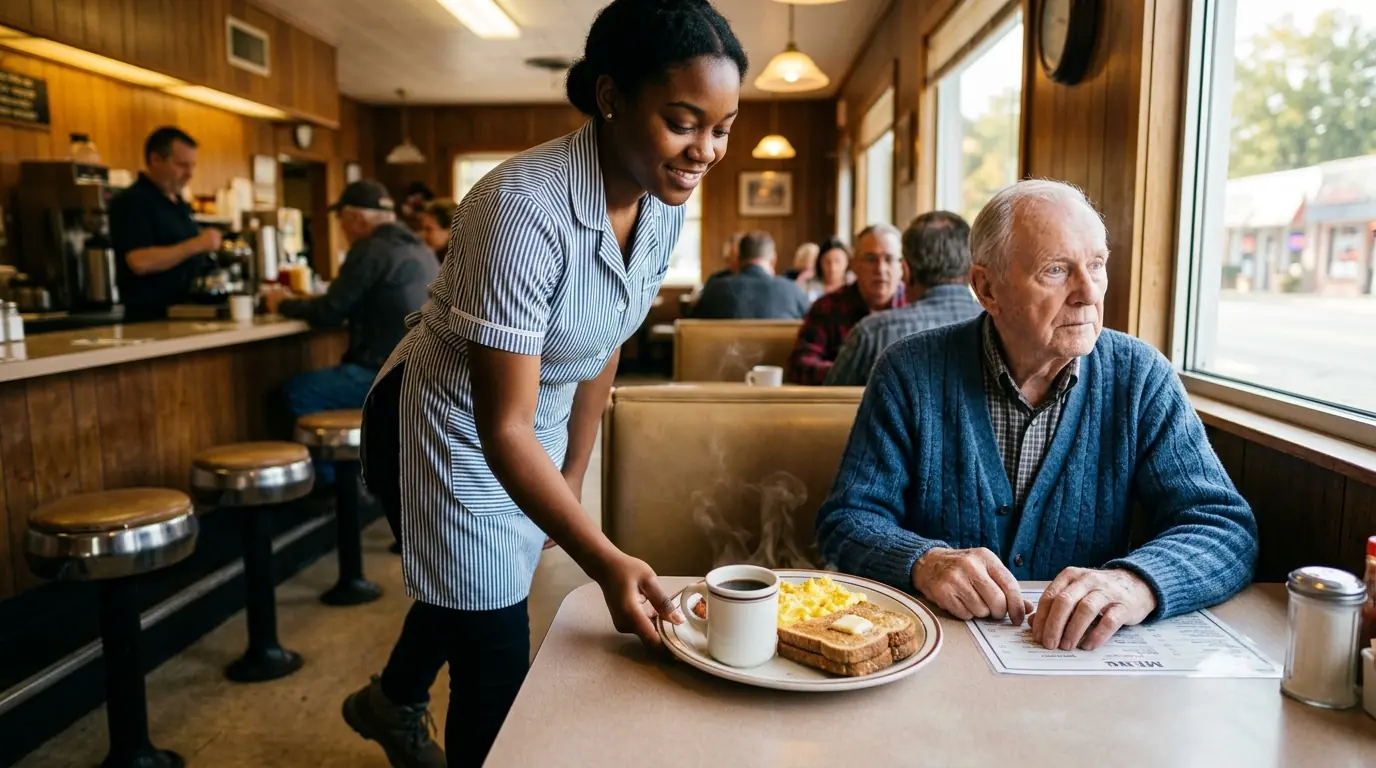
At 7:20 a.m., the bell above the door rang. Maya’s eyes lifted automatically. Mr. Thomas was late. A knot of anxiety tightened in her chest. Three months of exact routines, and now uncertainty. Minutes passed, then a figure finally emerged through the doorway. It was him—stooped slightly, the brown cardigan frayed at the elbows, khaki pants wrinkled, scuffed shoes. He made his way to booth seven, hands trembling slightly as he rested them on the table. Maya approached, her tray in hand, and greeted him softly.

“Good morning, sir,” she said, setting down a cup of black coffee and a small dish of cream. He looked up for a fraction of a second, then nodded. Cream and sugar. Another small nod. Maya returned with eggs and toast, observing his hands, which shook as he attempted to cut the toast. She intervened gently, slicing it into four manageable squares. For a moment, their eyes met—real eyes, full of understanding. A connection that required no words.

Sandra snickered from the counter. “Did you just cut his food for him? What is he, five?” Maya ignored her. Jake caught her eye from the kitchen and gave a small, encouraging thumbs up. The old man ate slowly, methodically, finishing his coffee with care. He placed exact change on the table and left without a word. Maya lingered a moment, reflecting on the effort, the dignity, the humanity in those small interactions. Harris muttered, “He’ll be back.” And indeed, he returned the next morning, and the next, and the next.

Weeks passed. Maya perfected the routine: fresh coffee, clean napkins, carefully prepared breakfast. Eventually, she began speaking to him. “Morning, Mr. Thomas. Cold today, isn’t it?” She would tell him about her mother, her struggles, her dreams. He listened quietly, offering no judgment, only his presence. Maya shared stories of her sketches, her lost opportunities, and slowly, she felt a strange peace in talking to someone who didn’t demand, didn’t critique, didn’t rush her.

Then came the day Marcus Sterling entered her life, delivering news that would shatter the fragile stability she had built: Mr. Thomas had passed in the night. The diner, once a place of small solace, became a doorway to a life she had never imagined. She learned she was named primary beneficiary, inheritor of $7 million, and owner of Sunrise Diner itself. Shock, disbelief, grief—all collided as she struggled to comprehend her sudden fortune, the responsibility, and the expectations that came with it.

Even as the Thomas family tried to contest the will, Brandon and Diana casting accusations of manipulation and deceit, Maya stood resolute. With Marcus guiding her, she learned about estate law, fiduciary responsibilities, and legal strategy. Her purpose sharpened. This was no longer about herself alone. It was about honoring the life of Grace Williams, about respecting William Thomas’s legacy, and about standing for those who had no voice.

The press conference was intense. Brandon painted her as a schemer, but Maya, armed with the truth, the video testimony of William, and Jake’s unwavering support, presented a case not of manipulation but of integrity and kindness. Slowly, public opinion shifted. The diner, her life, and her mission became symbols of what it meant to act with decency in a world that often overlooked it.

Six months later, Maya stood across the street from Sunrise Diner, the new sign freshly painted, windows sparkling, the aroma of cooking welcoming all who entered. She walked inside, greeted the staff, and approached booth seven—the brass plaque above it now reading, Grace and William’s Corner: Kindness Always Welcome. She sat, brewed the first coffee of the day, and placed two cups on the table—one for Grace, one for William. Outside, the city carried on, unaware of the quiet legacy being upheld within. For Maya, the work wasn’t about money or status—it was about ensuring that kindness, dignity, and human connection endured, one cup of coffee at a time.

Maya sat at booth seven, sipping her coffee, letting the warmth seep through her fingers and into her chest. Outside, Chicago was waking slowly, the streets damp from the morning drizzle. She glanced around the diner, taking in the familiar hum of conversation, clinking dishes, and the hiss of the coffee machine. The renovations had made the place brighter, cleaner, more welcoming, but the soul of Sunrise Diner—the small acts of care, the human connections—remained untouched.

She looked at the brass plaque above the booth once more. Grace and William’s Corner: Kindness Always Welcome. It wasn’t just words; it was a mission, a reminder of why she had endured so much hardship and heartache. Maya knew that her life had changed in ways she had never imagined, but this—these quiet mornings, these moments of shared humanity—were the true reward.

Jake emerged from the kitchen carrying a tray of pancakes and eggs. His smile was genuine, unburdened by the past tension. “Morning, Maya. Ready for another day?” he asked. Maya nodded, a small smile tugging at her lips. “I’m ready,” she said softly. She felt a strength inside her, a resilience born from years of struggle and the trust that Mr. Thomas had placed in her.

Customers began to filter in, regulars and newcomers alike, drawn not only by the food but by the story of kindness and perseverance that had become synonymous with Sunrise Diner. Maya moved through the tables with calm precision, offering greetings, refilling drinks, and serving meals. Each interaction, each smile, was a continuation of the legacy she had inherited—a living testament to compassion, dignity, and respect.

She noticed an elderly man sitting alone in the corner, reminiscent of Mr. Thomas. His hands trembled slightly as he fumbled with his menu. Maya approached, her presence gentle, unhurried. “Good morning, sir. Can I get you some coffee while you decide?” She poured a fresh cup, carefully setting it on a clean saucer. The man looked up, startled at first, then nodded, a quiet gratitude in his eyes. Maya cut his toast into four squares, just as she had learned to do, offering the same small, human dignity she had once given Mr. Thomas.

Standing back, she watched him take the first careful bite. In that simple moment, she felt a ripple of connection—a reflection of the countless mornings spent nurturing trust, kindness, and care. She realized that the legacy of Grace and William wasn’t just in the wealth she had inherited or the diner she now owned. It lived in every smile returned, every hand steadied, every life touched.

Maya leaned against the counter, observing the bustle of Sunrise Diner, the warmth of community growing with each passing day. She thought of her mother, finally able to rest without fear of bills and debt, and of the girls she had empowered through scholarships, the small businesses she had helped, the families whose burdens had been eased. Every action, every choice, had built a chain of impact far beyond what she could have imagined.

And in the quiet moments between the rush of breakfast orders, between the laughter and chatter of customers, Maya would sit at booth seven, place two cups of coffee before her, and remember the old man who had changed her life. She would whisper a soft, grateful greeting to Grace and William, honoring the love, the sacrifice, and the second chances that had shaped her path.

Chicago glistened outside, sunlight breaking through the clouds, reflecting off the lake, casting golden hues across the city. Maya took a deep breath, her heart full, her purpose clear. For the first time, she wasn’t afraid of tomorrow. Kindness had guided her through darkness, and it would continue to illuminate her way, one small act at a time. One cup of coffee, one four-square piece of toast, one moment of human connection—this was her legacy, and it was hers to uphold.

The morning continued, but the energy in Sunrise Diner had shifted. Employees moved with renewed purpose, the air lighter despite the lingering winter chill outside. Maya checked the schedule for the day, ensuring every table was attended, every cup of coffee filled, every meal served with care. Her hands moved efficiently, but her mind lingered on the small, profound moments—the smiles she received, the hands she steadied, the quiet gratitude in eyes that were often overlooked by the world.

By mid-morning, the diner was full. Families, office workers, and regulars filled the tables, chatting, laughing, and enjoying the warmth of food and human connection. Maya passed by booth seven, the corner she reserved for the elderly and lonely. A man sat there, an older veteran she had met weeks ago. His eyes, usually distant, followed her as she set down his coffee and plate. “Thank you, Maya,” he said softly. She nodded, understanding the weight behind his words.

Jake leaned against the counter, watching Maya interact with the customers. “You’ve changed this place,” he said quietly. Maya smiled faintly. “It’s not me. It’s what we do together. Every person who walks through this door matters.” Jake nodded, the pride in his eyes unmistakable.

Outside, the city moved on, unaware of the transformations within the diner. But inside, life had shifted. Stories were being written in small acts—shared coffee, gentle words, attentive care. Maya knew that each moment was part of a larger tapestry of kindness, one that she was now responsible for maintaining.

As the afternoon sun filtered through the windows, painting warm patterns across the floor, Maya paused at the counter. She looked out at the bustling tables, at her staff moving with purpose, at the people she had helped and those she would continue to help. The diner had become more than a place to eat—it was a sanctuary, a space where dignity and humanity were preserved, where the legacy of Grace and William lived on in every interaction.

Maya’s phone buzzed gently on the counter. It was a message from Marcus, a reminder of the video testimony that had shifted public perception, a testament to the integrity and vision of William Thomas. Maya read it quietly, letting the weight of those words settle in her mind. She was no longer just a waitress; she was a steward of a legacy, a protector of kindness, a living bridge between the past and the future.

As the day drew to a close, Maya returned to booth seven. She placed two cups of coffee on the table, one for Grace, one for William, a ritual she had maintained for months. Sitting there, she reflected on the journey—the struggles, the losses, the kindness, and the unexpected inheritance that had changed everything. She understood now that her purpose wasn’t simply to manage a diner or a foundation. It was to preserve the humanity that had been entrusted to her, to continue the small acts that had ripple effects far beyond what she could see.

The sun set over Chicago, casting long shadows across the city streets. Inside Sunrise Diner, the lights glowed warmly, illuminating the worn tables, the brass plaques, and the people who had found a place where they were seen and valued. Maya took a final sip of her coffee, breathing deeply, feeling a sense of calm she had never known before. Tomorrow would bring new challenges, new stories, new people who needed care. And she would be ready.

Kindness wasn’t a currency, a favor, or a fleeting gesture. It was a choice, a practice, a way of living. Maya understood that now more than ever. And as she closed the diner for the evening, locking the door behind her, she whispered a quiet promise—to herself, to Grace, to William, to everyone who had been touched by this journey.

“Tomorrow,” she said softly, “we do it all over again. One cup of coffee, one four-square piece of toast, one act of kindness at a time.”

The night embraced the city. Maya walked home, her heart full, her purpose clear, and for the first time, she wasn’t afraid of what tomorrow would bring. The legacy she had inherited was alive, and she was ready to honor it with every step she took.

The following morning, Maya rose before the sun. The city streets were quiet, blanketed in frost, each breath of winter air biting but invigorating. She dressed in her gray suit, now perfectly tailored, but her heart still carried the memories of that worn apron, the squeaky shoes, and the countless mornings of struggle. Stepping into Sunrise Diner, she felt the familiar weight of responsibility, now softened by purpose rather than fear.

Harris had arrived early, unlocking the doors with careful precision. Jake was already in the kitchen, moving with ease and confidence, the new executive chef insignia gleaming on his coat. Maya nodded at him, a small smile passing between them. They had been through so much together, and yet the foundation of trust and respect remained unshaken.

The diner slowly filled. Regulars returned, emboldened by the news of Maya’s victory and the foundation she now led. They brought friends, strangers, anyone who needed to see that kindness and integrity were still valued in the world. Maya moved through the aisles, attentive, present, her hands steady but her heart filled with the quiet joy of making a difference.

Booth seven awaited, the brass plaque catching the morning light. Maya placed the fresh coffee cups carefully, one for Grace, one for William, and sat, letting the ritual ground her. The people who came in knew this was more than a meal; it was a statement that they mattered, that small gestures of care had lasting significance. She greeted each guest warmly, the simple act of acknowledgment rippling through their day in ways she could never fully measure.

By noon, the diner buzzed with life. Laughter, conversation, and the clatter of dishes filled the space. Maya’s eyes swept the room, taking in the sight of her staff moving confidently, customers smiling freely, and the sense of community that had grown over months of dedicated effort. Every plate she served, every cup she poured, was infused with purpose. Each interaction carried the legacy of Grace and William, the testament that kindness and courage could reshape a life, a community, a world.

Even as the afternoon light waned, Maya stayed vigilant, ensuring that the diner remained a haven for those who needed it most. Letters and messages continued to arrive—thank-yous, stories of hope, reports of families helped, dreams enabled. The foundation was thriving, but the heart of the work remained here, in this small diner on Monroe Street, where a simple breakfast could change everything.

As the day ended, Maya cleaned booth seven with the care of someone honoring generations. She replaced the napkins, refilled the salt and pepper, adjusted the flowers in the small vase. Each action, meticulous and intentional, was a tribute to those who had come before and those who would follow. Sitting there, she reflected on the journey—on Grace, William, the lonely elderly, the struggling families, the friends who had stood by her, and the lessons learned through patience, empathy, and unwavering integrity.

The city lights shimmered outside, mirrored in the windows of the diner. Maya finished her coffee, savoring the warmth, the calm, and the knowledge that she had not just inherited a fortune, but a responsibility—a chance to change lives, one simple act at a time. She turned off the lights, locked the doors, and stepped into the quiet night, the weight of the past, the gift of the present, and the promise of tomorrow resting firmly on her shoulders.

Kindness, she realized, was not a fleeting act or a transaction. It was enduring, transformative, and unstoppable. As Maya walked through the Chicago streets, she held her head high, unafraid of what the next day would bring. She was ready to honor the past, shape the future, and continue the legacy she had been entrusted with—one cup of coffee, one four-square piece of toast, one moment of dignity at a time.

The next Monday morning, Maya arrived at Sunrise Diner before dawn. The sky was painted in muted grays and soft purples, the faint glow of the city barely illuminating the streets. She moved through the diner with the calm precision of someone who understood the value of each gesture. The coffee was freshly brewed, the first pot of the day, rich and steaming. Booth seven gleamed with care, the brass plaque catching the early light. Two cups of coffee sat ready, one for Grace, one for William, accompanied by a small vase of fresh flowers, a quiet tribute to the lives and legacy she now carried.

Harris stood behind the counter, watching her with a new respect. He no longer saw her as a frazzled waitress; he saw the woman who had transformed the diner, the woman who had honored kindness and integrity in the face of challenge. “Morning, Maya,” he said, his voice steady, almost warm. She nodded, replying with confidence and calm, her voice reflecting the inner strength she had cultivated over months of struggle and triumph.

Jake emerged from the kitchen, his eyes meeting hers. He had been her constant ally, her silent support, and now his smile was genuine, free of worry or doubt. He moved efficiently, preparing the meals with care, just as he had every day, yet now the weight of fear and uncertainty had lifted. The staff moved in rhythm, the diner alive with energy, conversation, and laughter. The regulars returned, and new faces appeared, drawn by the story of generosity, courage, and integrity that had spread through the city.

Maya walked past the tables, offering a greeting, a smile, a moment of acknowledgment to every guest. Each interaction carried the weight of meaning, the understanding that small acts of kindness, repeated and sincere, could ripple outward to create profound change. Booth seven was no longer just a table; it was a symbol, a sanctuary, a reminder that dignity, respect, and care could transform lives.

Throughout the morning, letters, messages, and stories continued to arrive. Families wrote to thank her, recounting how the Grace and William Foundation had touched their lives, how debts had been paid, dreams had been nurtured, and hope had been restored. Maya absorbed each word, feeling the quiet but powerful impact of her efforts. She had inherited more than wealth—she had inherited responsibility, purpose, and the ability to make a difference.

As the day progressed, Maya maintained her routine with care, pouring coffee, placing dishes, and attending to every detail with precision. The diner was alive, vibrant, and full of energy, yet it remained a place of warmth and welcome. She glanced at the brass plaque above booth seven, at the worn mustard-colored leather, and felt a deep sense of fulfillment. This was what mattered: human connection, compassion, and the ongoing act of honoring those who had come before her.

As evening approached, Maya cleaned the diner meticulously, ensuring that every table was ready for the next day. She placed the fresh coffee cups at booth seven, adjusted the napkins, and refilled the salt and pepper shakers. Each gesture, careful and deliberate, was a tribute to the lives of Grace, William, and the many people whose stories intersected with hers.

Outside, the Chicago skyline glimmered as the sun set, painting the city in shades of gold and pink. Maya locked the doors, the quiet night embracing the diner. She carried the weight of the legacy she had inherited, the responsibility of transforming it into something enduring and meaningful. Her heart was full, her mind clear, and her purpose resolute.

Kindness, she realized, was never a transaction. It was enduring, transformative, and unstoppable. One cup of coffee, one moment of attention, one four-square piece of toast could create ripples of change that extended far beyond the diner’s walls. Maya stepped into the night, the chill of the air brushing her face, unafraid of what tomorrow would bring. She was ready to continue the legacy—her legacy—of compassion, integrity, and the simple, profound power of human kindness.

The following Monday morning, booth seven was ready once again. Maya arrived at 5:45 a.m., carrying her bag and wearing her carefully pressed gray suit. She moved through the diner with quiet confidence, setting the coffee pot on the counter, arranging fresh napkins, and checking the salt and pepper shakers. Every detail mattered, every motion deliberate. The diner now thrummed with energy: regulars who had supported her during the trial arrived early, new customers curious about the story, and even those who had doubted her came to witness what kindness and integrity could create.

Harris greeted her with a tentative smile. He no longer saw her as just a waitress; he saw a woman transformed, carrying the weight of responsibility with dignity. “Morning, Maya,” he said softly. She nodded, her voice steady, “Morning, Harris.” She felt the pride of ownership in every corner of the diner—the polished floors, the restored booths, and the aroma of freshly brewed coffee filling the air.

Jake appeared from the kitchen, his expression bright. His embroidered chef’s coat read “Executive Chef,” yet his eyes retained the warmth and loyalty that had always been there. “Everything ready?” he asked quietly. Maya nodded. She didn’t need words. He understood. Together, they prepared breakfast, maintaining the diner’s soul, honoring the legacy of William and Grace while embracing the new chapter she now commanded.

At booth seven, Maya carefully placed two steaming cups of coffee, one for Grace, one for William, alongside a small vase of fresh flowers. The brass plaque above the booth reflected the soft morning light: “Grace and William’s Corner – Where Kindness is Always Welcome.” Every morning, she reserved this spot for the elderly and lonely, free coffee, free breakfast, ten minutes of genuine attention. The first visitor was Frank, an elderly veteran who had served in Vietnam and hadn’t spoken to his children in twenty years. Maya guided him through a call reconnecting him with his family. Then came Dorothy, grieving her late husband, who just needed someone to listen. Maya listened. She offered not just food, but care, dignity, and attention.

Letters and messages continued arriving from families and individuals touched by the Grace and William Foundation. Medical bills paid, dreams supported, small businesses given a chance, young women enrolled in design programs, inspired by her example. Maya’s heart swelled with purpose. She had inherited more than a diner, more than wealth—she had inherited the ability to continue a legacy of compassion, to honor lives lost, and to create hope for the future.

By evening, Maya moved through the diner methodically, cleaning, organizing, and preparing for the next day. Every cup, every plate, every small gesture carried meaning. Booth seven remained a sanctuary, a symbol of kindness’s enduring power. Outside, Chicago glittered in the last light of day, reflecting a city alive with opportunity, hope, and stories yet to be told.

Maya stepped into the night air, feeling the weight and the strength of the legacy she now carried. The lessons of William and Grace, the echoes of kindness, resilience, and love, filled her with determination. She was ready. She was capable. She was unafraid. Kindness, she realized, was not weakness—it was the strongest force in the world. And as long as she held onto it, it would never fade.

Morning arrived again, and Maya entered Sunrise Diner before the city fully woke. The bell chimed softly as she crossed the threshold, her hands steady, her heart calm. Booth seven awaited, polished, the brass plaque gleaming, the table set with two cups of coffee and a small vase of fresh flowers. The diner smelled of brewed coffee, fresh bread, and warmth. Regulars had already started trickling in, giving nods of recognition, smiles of encouragement.

Jake was at the stove, plating breakfast with precision, his chef’s coat crisp, embroidered title shining. “Morning, Maya,” he said, voice quiet but supportive. She nodded, adjusting her suit, surveying her diner. Every detail mattered. She checked napkins, coffee, silverware. The diner’s soul was intact, preserved, and now strengthened by the legacy she carried.

By 7:20 a.m., the first visitor approached booth seven. An older woman, fragile yet smiling, sat carefully. Maya greeted her softly, placing a cup of coffee in front of her. “Morning, ma’am. Welcome.” The woman’s hands trembled slightly as she accepted the cup, and Maya watched, attentive, ready to assist if needed. Each visitor received more than breakfast; they received attention, dignity, a recognition that their lives mattered.

Throughout the morning, customers came and went, some drawn by the story, some by routine. Maya moved through the diner with quiet confidence, balancing plates, refilling coffee, listening to the brief exchanges, offering warmth in small words, gentle gestures. Every interaction carried meaning, and slowly, the diner hummed with a new energy—a harmony between purpose and service.

At noon, Maya sat briefly in booth seven, surveying the space. The brass plaque reflected sunlight. Memories of William and Grace filled her mind: William’s generosity, Grace’s warmth, and the kindness that had led her to this moment. She knew the responsibility she bore. The diner was no longer just a workplace; it was a living testament to love, compassion, and the human capacity to lift others.

Later that afternoon, Maya received a call from Marcus. “Everything is stabilizing,” he said. “The foundation’s funding, the press coverage, it’s all shifting. People are seeing your integrity.” Maya exhaled slowly, letting the tension drain from her shoulders. She had fought for this not for herself alone, but for everyone who had been overlooked, ignored, or dismissed.

By evening, the diner quieted. Maya cleaned, organized, and prepared for the next day. She sat in booth seven alone for a moment, two cups of coffee before her, reflecting on the journey—the struggles, the grief, the victories, and the promise of hope she now carried forward. Outside, Chicago lights shimmered against the darkening sky. Within, Sunrise Diner pulsed softly with life, filled with laughter, chatter, and the quiet dignity of connection.

Maya stepped out into the crisp night air, pausing to look at the city around her. She felt the weight of responsibility, yes, but also the exhilaration of possibility. She had inherited wealth, property, and opportunity, but more importantly, she had inherited the chance to make a difference, to honor lives lost, and to carry forward the lessons of kindness, courage, and resilience.

With a deep breath, she walked toward her apartment, ready to rest, ready to rise again tomorrow, knowing that every cup of coffee, every kind gesture, every moment of attention and care could change someone’s life. She understood now that legacy was not measured in dollars, buildings, or foundations alone, but in the moments of humanity we give each other—one four-square piece of toast at a time, one cup of coffee at a time, one act of dignity at a time. And that was Maya’s purpose, her mission, and her strength.

The next morning, the diner was alive with anticipation. Maya arrived early, the bell chiming gently as she stepped in, her hands steady, her mind focused. Booth seven waited, the brass plaque gleaming softly in the morning light, flowers fresh, coffee prepared. Each corner of the diner reflected care, order, and the warmth Maya had cultivated. She checked every detail, adjusting napkins, polishing silverware, and ensuring the coffee was brewed just right. Sunrise Diner was no longer just a place to serve food—it was a sanctuary, a space of dignity and respect for anyone who entered.

Customers arrived steadily, drawn not only by the story but by the reputation of kindness that now surrounded the diner. Maya moved gracefully among them, attentive, offering gentle words, listening intently, providing care beyond what was expected. She noticed each person, remembered their preferences, their routines, their needs. The diner hummed with a new rhythm, a balance between service and empathy, business and humanity.

By mid-morning, she paused briefly in booth seven, sitting quietly as sunlight spilled across the worn vinyl. Memories of William and Grace filled her mind: William’s foresight, Grace’s warmth, and the kindness that had shaped Maya’s path. She understood now that the diner was more than a building—it was a living tribute to legacy, love, and the impact of genuine human connection.

A call from Marcus brought reassurance. “The foundation is thriving. People are seeing the truth, Maya,” he said. She exhaled, relief mingling with the weight of responsibility she bore. This wasn’t about money or fame; it was about carrying forward the lives, values, and dreams that William and Grace had embodied. Every action, every interaction mattered.

By evening, the diner quieted, but Maya lingered in booth seven, reflecting on the journey. She had faced adversity, skepticism, and fear, yet emerged with purpose, strength, and clarity. Outside, the Chicago skyline glittered under the night sky. Inside, Sunrise Diner pulsed softly with life, warmth, and hope. Maya stepped out into the crisp air, filled with a sense of possibility. She understood fully that legacy wasn’t measured in dollars, properties, or foundations—it was in kindness, compassion, and human dignity. One cup of coffee, one four-square piece of toast, one moment of attention at a time. This was her mission, her purpose, and her strength.

The following Monday, Maya arrived at Sunrise Diner with the same early morning routine, but a sense of calm had replaced the tension that had haunted her before. Booth seven awaited her, prepared with care, the small vase of flowers still in place, coffee steaming gently in the morning light. She set down the cups with deliberate attention, her hands steady, her heart lighter. It was no longer just about obligation—it was about honoring William, Grace, and the kindness that had shaped her own life.

Customers entered steadily, some familiar, some new, drawn by the stories circulating online, by the reputation of fairness, compassion, and warmth that Maya had built. She served with a gentle smile, listened attentively, remembered preferences, and treated everyone with dignity. Small gestures—a refill of coffee, a carefully folded napkin, a friendly word—wove into an atmosphere of respect and care that was palpable. The diner had transformed from a place of survival to a sanctuary, reflecting Maya’s values and the legacy entrusted to her.

Throughout the day, she thought of the weight she now carried—not just of William’s gift, but of the responsibility to continue a legacy of kindness. Every interaction, every breakfast served, every conversation mattered. Each person who entered Sunrise Diner was seen, heard, and respected. Maya understood that this was what true wealth meant: the ability to lift others while preserving integrity, compassion, and purpose.

By late afternoon, the diner quieted. Maya lingered in booth seven, reflecting on the journey—the long hours, the doubts, the challenges, and the moments of connection that had led to this point. She thought of William, who had entrusted her with more than money; of Grace, whose life had been cut short but whose spirit now lived on through Maya; and of herself, who had learned the strength and power of kindness.

As the sun set over Chicago, casting a golden glow across the streets, Maya stepped outside, taking a deep breath of crisp evening air. She felt grounded, purposeful, and ready for whatever the future held. Sunrise Diner was more than a building; it was a testament to generosity, integrity, and the quiet, transformative power of caring for others. One cup of coffee, one four-square piece of toast, one act of dignity at a time—this was the legacy she would continue, the purpose she would embrace, and the story she would live every day.

In the weeks that followed, Maya’s vision for Sunrise Diner expanded beyond the walls of the restaurant. She began organizing community breakfasts for the elderly and isolated, inviting those who had no one to share their mornings with. Booth seven remained the heart of this effort, a symbol of attention, care, and humanity. Maya remembered every hand she had helped, every smile she had encouraged, and every moment she had offered dignity to someone overlooked.

Her staff adapted to the changes, their attitudes shifting as they saw the impact of their work. Jake’s kitchen hummed with renewed energy, preparing meals not just for profit but for purpose. Harris oversaw operations with a sense of pride rather than mere obligation. Even Sandra, who had once mocked her, had returned, humbled and appreciative, contributing fully to the culture Maya was nurturing. The diner became a hub for connection, support, and hope.

Outside, the world began to take notice. Local newspapers and online stories highlighted the transformation. People spoke of Maya’s courage, integrity, and vision. Families came to Sunrise Diner not only for meals but for inspiration, finding a model of what could be accomplished through kindness and perseverance. Maya personally ensured that every customer felt valued, every act of generosity was meaningful, and every moment was infused with purpose.

Maya also invested time in her own growth. She returned to the Art Institute of Chicago, revisiting her passion for design. Sketches of dresses, evening gowns, and everyday wear filled her portfolio once more, inspired by the stories of those she had helped. She realized that her work at the diner and her artistic pursuits were connected: both were about creating spaces, experiences, and opportunities for people to feel seen and valued.

As months passed, the Grace and William Foundation flourished, providing scholarships, grants, and medical assistance to hundreds of families. Maya watched as lives changed, as young designers pursued dreams, as struggling families gained relief. Booth seven remained the anchor, a constant reminder that even the smallest acts of attention—a cup of coffee, a moment of listening, a four-square piece of toast—could ripple outward and create profound impact.

One quiet Monday morning, Maya sat in booth seven, sipping her coffee and reviewing sketches. She glanced at the plaque above the booth, the brass reflecting the soft morning light. For a moment, she allowed herself to feel the full weight of what had happened: the kindness she had shown, the trust William had placed in her, and the ripple effects that continued to spread. She smiled, not out of relief or triumph, but out of understanding. This was purpose realized.

Outside, the city of Chicago stirred to life. Sunrise Diner glowed warmly among the streets, a beacon of generosity and care. Maya stepped into the morning, confident and steady, ready to greet those who needed her attention, her kindness, and her unwavering humanity. Every cup of coffee, every toast cut with care, every conversation held with respect was a thread in the larger tapestry of her life and the lives she touched. And with each passing day, she carried forward the legacy of Grace, of William, and of the quiet but unbreakable power of human kindness.

Months turned into a year, and Sunrise Diner had become more than a restaurant—it was a community landmark. Locals, once strangers, now knew the story of booth seven, of Maya Johnson, and the extraordinary acts of care that had reshaped the place. People who had been overlooked or forgotten now had a space where their presence mattered, where their stories were heard, and where simple gestures—like a cup of coffee or a friendly smile—were imbued with real significance.

Maya continued to balance her responsibilities carefully. The diner thrived financially under her leadership, yet she never lost sight of the human element that made it special. She still arrived early every morning, brewed the first pot of coffee, and prepared booth seven for those who needed it most. The staff, inspired by her example, treated every customer with attention and empathy, and the atmosphere of respect and warmth became contagious.

Her work with the Grace and William Foundation grew steadily. Scholarships and grants reached young women with dreams like hers, and families burdened by medical debts received life-changing support. Maya personally oversaw many of these programs, taking the time to understand each story and ensure that the foundation’s impact was meaningful and lasting.

Yet even as her influence expanded, she remained grounded. Booth seven served as a daily reminder that true power and wealth were not just measured in money but in compassion and the ability to make someone feel seen and valued. The diner itself, now renovated yet still infused with the spirit of its humble beginnings, symbolized this balance: modernized for efficiency, yet preserving warmth, character, and heart.

On quiet mornings, Maya would pause, looking out the windows at the Chicago skyline, thinking of William, Grace, and all the lives that had intersected with hers. She understood that the kindness she had offered so simply—cutting toast, listening to a story, offering a moment of dignity—had created a legacy far beyond what she could have imagined.

As the sun rose, bathing the diner in soft light, Maya prepared for another day. She set out the coffee, arranged the flowers, and ensured every detail was perfect—not for recognition, not for wealth, but because it mattered to the people she served. Booth seven stood ready, a symbol of hope, kindness, and the enduring impact one person can have on the lives of many. Maya stepped back, taking a deep breath, knowing that she had finally understood the full meaning of the gift she had received: the power to change lives, one act of humanity at a time.

Maya’s evenings often ended quietly in booth seven after the last customers had left. She would sit with a cup of coffee in front of her, reflecting on the lives she had touched and the lives that had touched hers. She thought about William Thomas, whose quiet foresight had changed her world. She thought about Grace, whose memory had guided William’s generosity and had now inspired Maya’s mission. She thought about herself, once struggling, exhausted, and invisible, now empowered, responsible, and determined to honor a legacy of love and dignity.

The diner continued to attract visitors who came not just for the food but for the story, for the chance to witness a place where humanity prevailed over indifference. Local schools and organizations invited Maya to speak about her journey, sharing lessons about empathy, perseverance, and the profound impact of everyday kindness. She spoke to groups of young women about design, entrepreneurship, and resilience, intertwining her personal story with Grace’s and William’s history.

Even with the success and the attention, Maya never lost her humility. She maintained the routines that had once been her lifeline: preparing the diner before sunrise, cutting toast with care, pouring coffee just so. Every small gesture was an anchor to her purpose and a reminder of where she had come from. It was in these quiet moments that she felt the weight of responsibility and the beauty of her inheritance—not only the material wealth but the power to change lives and honor a love that had endured decades.

The Grace and William Foundation thrived, expanding its reach to provide scholarships, grants, and medical relief to hundreds of families. Booth seven became a symbol of hope, a physical manifestation of compassion in action. Maya’s staff worked with renewed dedication, inspired by her vision and example. People who had once doubted her now sought her guidance and celebrated her success. Yet she always remained grounded, knowing that true legacy was measured not in money or fame, but in the humanity one shared with others.

As the sun rose over Chicago each morning, casting warm light over the diner’s freshly painted sign, Maya greeted her first visitors with the same care and attention that had earned her this remarkable journey. Booth seven waited, ready for the next person who needed acknowledgment, warmth, and kindness. Maya moved through the diner with confidence and purpose, understanding that her actions—small and deliberate—had created ripples far beyond what she could see. Each cup of coffee, each four-square piece of toast, each attentive conversation reinforced the message that kindness, once given, never truly dies.

And so, Sunrise Diner stood as a testament: that empathy, generosity, and the courage to act with heart could reshape not just a life, but a community, and that one person’s steadfast humanity could honor the past, transform the present, and inspire the future. Maya finally understood that her journey had never been just about survival—it had been about legacy, about love, about the power to make the world a little more human, one act at a time.

Maya often stayed after closing, alone in the quiet diner, savoring the stillness. Booth seven remained her sanctuary, the symbol of all that had changed—not just for her, but for everyone whose lives had intersected with hers. She would sit, sip coffee, and look around, thinking of the people who had inspired her courage: William, who had trusted her with Grace’s legacy; Grace, whose love story transcended decades; Jake, whose quiet support had bolstered her; and even those who had doubted her, teaching her the weight of resilience.

Each morning brought new faces. Some came for a meal, some for companionship, some for hope. And every morning, Maya treated them with the same care she had offered Mr. Thomas—listening, noticing, and valuing each person as if they were the most important in the world. The diner had become more than a business; it was a place where people could belong, where kindness created ripples far beyond its walls.

Through the Grace and William Foundation, Maya extended this care further—funding education for young women, supporting small businesses, paying medical bills for families who struggled as she once had. The impact was tangible: children learning to dream, families breathing easier, communities strengthened. And yet, she never allowed the wealth or power to change her fundamental purpose. The diner remained the heart of it all, a reminder that legacy was measured not only in money or property but in the human connections nurtured along the way.

On clear mornings, she stood behind the counter, watching sunlight spill across the renovated floors, listening to the hum of conversation and laughter. She remembered every small act that had led her here: cutting toast for a trembling old man, giving a helping hand without expectation, and choosing compassion when it might have been easier to ignore. Booth seven, with its brass plaque and carefully set flowers, waited patiently for anyone in need of acknowledgment, a smile, or a moment of dignity.

Maya finally understood the truth William had been teaching her all along. Kindness was not weakness. It was strength. It created legacy. It healed. It endured. And in that understanding, Maya felt an overwhelming sense of purpose. Each cup of coffee poured, each piece of toast cut, each story listened to, each life touched—it all mattered. She had inherited more than wealth; she had inherited the chance to continue the work of love and compassion that had once been Grace’s. And she would. Always.

News in the same category

News Post