Thunder crashes outside Mama’s Kitchen as Kesha Williams watches a well-dressed stranger stumble through the rain. His expensive suit is soaked, and he clutches a leather briefcase tightly to his chest. He’s clearly lost. Most people would assume he can take care of himself or mind their own business, but Kesha doesn’t hesitate. She unlocks her door and calls out into the storm, “Come in. You’ll catch your death out there.” The man’s grateful eyes meet hers as steam rises from his designer clothes. She hands him towels without asking questions and starts brewing fresh coffee as if he’s family. But what Kesha doesn’t know is that this storm-soaked stranger holds the power to either save her dying restaurant or destroy it completely. The choice he makes will change everything.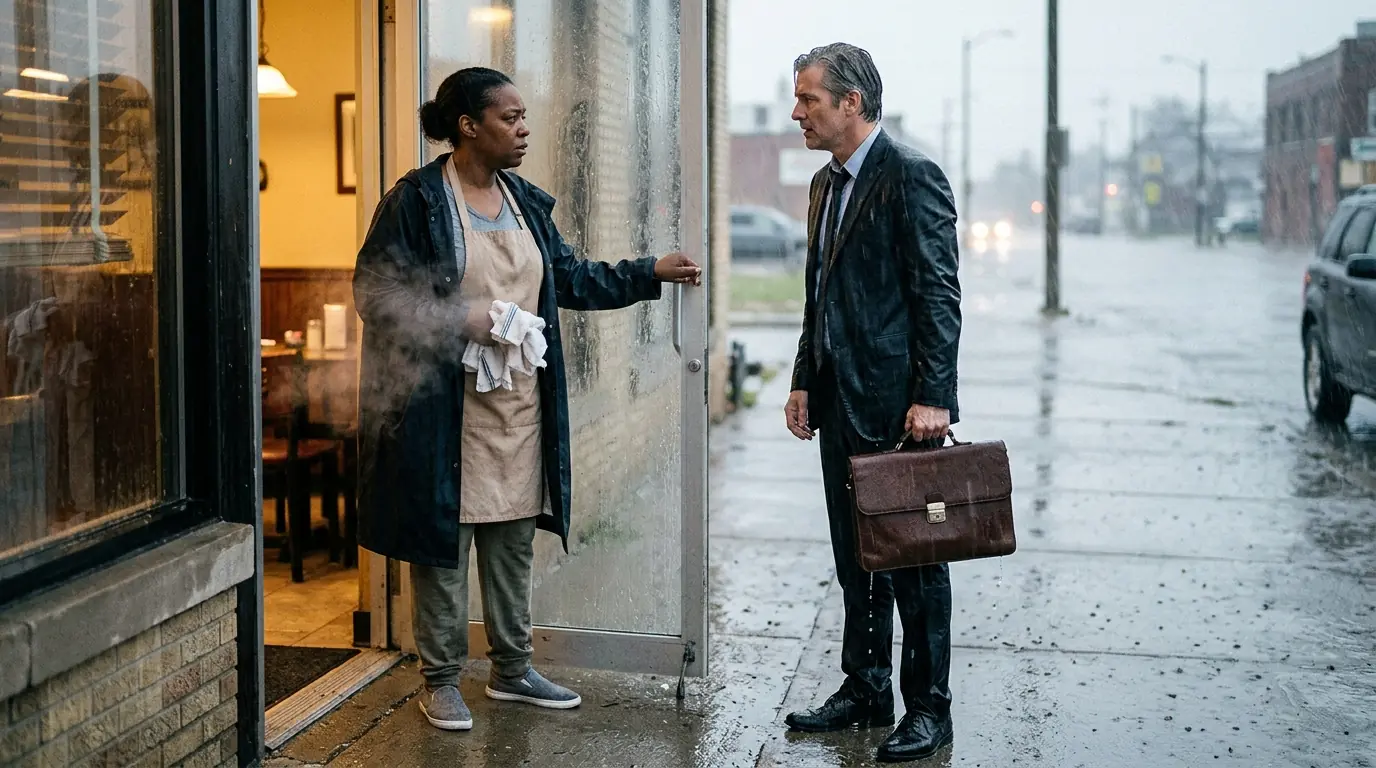 To understand the stakes, we rewind twelve hours. Dawn breaks over Detroit’s Corktown district. Kesha Williams pulls up to Mama’s Kitchen at 5:00 a.m. sharp, the same time she has arrived every morning for the past three years. Ever since her mother, Clara, passed away and left her this restaurant, this has been her life. She sits in her beat-up Honda for a moment, staring at the building that holds everything she has left. The metal security gate bears fresh scratches from last week’s break-in attempt. The blue awning needs replacing, but it costs $800 she doesn’t have. Taped to the front door, impossible to ignore, is a bright yellow foreclosure notice with thirty days remaining. Kesha takes a deep breath, unlocks the gate, and steps inside her mother’s dream.
The restaurant holds forty seats when packed, though today she’ll be lucky to fill ten. Mismatched chairs surround worn wooden tables, each telling a story. The corner booth where the Martinez family celebrated their daughter’s quinceañera, the round table where Mr. Johnson proposed last Christmas, faded photographs lining the walls like a timeline of better days. Her mother Clara flipping golden pancakes, the grand opening twenty-three years ago with lines stretching around the block, holiday gatherings when money wasn’t tight and the future felt bright—all ghosts now. Kesha walks to the register and counts yesterday’s earnings: $47.50. She needs $3,200 for monthly rent. The electricity bill is $340 overdue. Her business savings account shows $23.12. Her personal account isn’t much better. She pulls out her phone, opens the calculator, and adds up the minimum she needs to survive another month: $6,000. Her hands shake.
At 7:00 a.m., her nephew Jerome arrives, looking exhausted. Nineteen years old with dreams of college, he pulls shifts at a warehouse from midnight to 6:00 a.m., then comes straight here for morning prep. “Tia,” he says gently. The morning crowd is thinning. Kesha sees worry in his dark eyes. “This job pays for his community college classes. Losing it means losing his future.” She forces optimism into her voice. Today feels different. She can feel it, but the truth she won’t speak aloud weighs heavily: the landlord, Mr. Patterson, called twice yesterday. Left voicemails. Code words for eviction. The health inspector rescheduled next week’s visit. Usually a bad sign. Probably means someone complained. The local food blogger promised to review them but never showed up. Her commercial insurance premium jumped 40% due to neighborhood risk factors. Too many break-ins, too much crime, too much poverty.
By 9:00 a.m., Kesha flips the sign to open. Through the front window, she watches the neighborhood wake up: kids heading to school with oversized backpacks, commuters rushing toward bus stops, elderly residents walking carefully on uneven sidewalks. Miss Dorothy arrives at 9:30. Seventy-three years old with arthritis, she refuses to slow down. She’s worked here six years, ever since her husband died. “Morning, honey? Are we ready for another day?” Kesha nods, swallowing fear. Dorothy needs this job more than anyone. Santiago arrives last, apologizing in rapid Spanish for being three minutes late. Recent immigrant with three kids and a wife who cleans offices at night, his English improves weekly. Together, they prepare for a day that might bring enough customers to matter—or might not. Kesha prays quietly while adjusting fresh flowers in a mason jar. “I’m not asking for much, just enough to keep going. Just enough to honor Mama’s memory.”
By 2:00 p.m., only two customers had entered Mama’s Kitchen. Total earnings: $12.50. Kesha practices her speech for tomorrow’s bank meeting, rehearsed twenty times on napkin paper. Suddenly, her phone buzzes with a severe thunderstorm warning. Tornado watch. Dangerous winds and flooding expected. The sky darkens unnaturally fast. Wind rattles the old windows. Rain pours. Kesha moves quickly, unplugging electronics and lighting candles. She’s lived in Detroit long enough to recognize a dangerous storm. Cars crawl through rising water. Pedestrians duck into doorways. Then she sees him: a tall, well-dressed man, soaked, silver hair streaming with water, leather briefcase clutched protectively. His shoes slip on wet pavement. Most people assume he can afford a taxi. He doesn’t. Something in his posture triggers Kesha’s protective instincts. She sees vulnerability, reminiscent of her father’s final illness. She opens the door, bracing against the wind. “Sir, sir, come inside.” He looks up, startled, and hurries toward her door, briefcase held high.
Inside, she hands him towels and hot coffee. He’s grateful, his corporate stiffness melting away. “I’m Robert Brooks,” he offers. “Kesha Williams. This is Mama’s Kitchen.” He notices the photographs lining the walls, the handwritten menu, the mismatched chairs, the community bulletin board. His gaze lingers, his curiosity piqued. He sits, sipping coffee. The storm eases outside. Robert calls his driver using Kesha’s phone, his voice commanding yet respectful. Kesha observes his authoritative tone, realizing this is a man of power. His driver arrives, but she senses something unspoken, something beyond money and authority.
Three days later, Kesha receives a call from Sarah Kim at Brooks Development Corporation. Robert Brooks wants to meet regarding Mama’s Kitchen. The revelation hits: Robert Brooks isn’t just a stranger; he’s the CEO of the company systematically buying properties in Corktown, displacing long-time businesses. The man she helped during the storm was scouting her restaurant. Kesha convenes an emergency meeting with her team: Jerome, Dorothy, and Santiago. They learn of the aggressive acquisitions and potential demolition of Mama’s Kitchen. Tension builds.
The next afternoon, Robert Brooks arrives with associates. Professional courtesy replaces casual warmth. He presents a $450,000 acquisition offer, above market value, sufficient to pay off all debts. Kesha questions what will happen to the staff and the community. Robert’s associate explains the property will likely be replaced by a mixed-use retail space. Kesha remains firm: she needs time to consider. Robert’s mask slips momentarily; the professional detachment cannot hide a flicker of guilt. Kesha confronts him: “I thought maybe you understood what this place means, but you’re just another developer who sees dollar signs where others see home.” The words hit Robert like a storm of their own. That night, he sits alone, torn between profit and values, his father’s keychain a reminder of the compassion he had forgotten.
At 8:00 p.m., Robert returns alone to Mama’s Kitchen. He confesses: he wasn’t lost in the storm; he was surveying the property. Kesha realizes the encounter was calculated, yet genuine. Robert treated her with humanity, refusing to exploit her hospitality. Inspired, he presents a handwritten proposal: a $200,000 capital injection for 20% equity, ensuring Mama’s Kitchen remains intact, community-centered, and fully under Kesha’s creative control. The offer includes new community initiatives and protection from gentrification. Kesha accepts. Her team retains their jobs, the menu stays true, and the restaurant name remains. A new model emerges: profit with compassion, development that strengthens communities rather than displacing them.
Six months later, Mama’s Kitchen thrives. Seating is doubled, kitchen equipment upgraded, staff empowered. Dorothy leads a community program, Jerome attends college, Santiago manages a larger team. Neighborhood families gain stability. Robert moves his office nearby, engaging with the community rather than distant profits. Chen Development shifts its model to preserve community anchors. Local news covers the success; national media takes note. Mrs. Patterson, an elderly widow, enjoys weekly meals. Marcus, a teenager, earns his first car. Community meetings flourish. Kesha and Robert share a quiet toast through the kitchen window, reflecting on the storm that brought them together. Kindness, courage, and unexpected connection transformed lives, a reminder that even the smallest acts can ripple into monumental change.
One year later, another storm rolls through Detroit. A young woman and her baby seek shelter. Kesha opens the door as she did for Robert, offering warmth, food, and safety. The circle of community support continues, the legacy of kindness spreading. Mama’s Kitchen remains a cornerstone of neighborhood life, a symbol of hope, compassion, and the transformative power of opening one’s doors to those in need.
In the days that followed, Mama’s Kitchen became a beacon of hope not just for the neighborhood, but for Kesha herself. Word of the storm encounter and Robert Brooks’ unprecedented gesture spread through the community. Locals began visiting more frequently, eager to support the restaurant that had shown compassion even to strangers. Kesha noticed a shift: regular patrons returned, and new faces walked through the door, drawn by the warmth and authenticity of the place.
Robert, meanwhile, began attending the kitchen regularly, not as a developer or executive, but as a mentor and advisor. He helped Kesha streamline operations without compromising the restaurant’s character. Together, they upgraded equipment, introduced minor menu innovations, and ensured staff received fair wages. Dorothy, Jerome, and Santiago flourished under this new management, empowered to bring creative ideas to the table. Each success, small or large, reinforced the sense of community and purpose that Mama’s Kitchen had always represented.
One afternoon, a young culinary student named Maria arrived at the door, soaked from another unexpected storm. Kesha welcomed her in immediately, offering warmth and food as she had done for Robert a year prior. Maria explained her dreams of becoming a chef and her struggles as a single mother. Kesha listened carefully, recognizing the same spark of potential she once saw in Robert. She offered Maria an internship opportunity at the restaurant, mentorship from both Kesha and Robert, and access to resources she had painstakingly secured. The cycle of kindness continued, with the kitchen serving not only meals, but guidance and opportunity.
Meanwhile, Robert Brooks used his influence and network to protect other local businesses from displacement. Mama’s Kitchen became the flagship example of his new development model: blending profitability with community preservation. Reports of revitalized blocks, sustainable local business growth, and empowered residents began appearing in local and national media. Kesha and Robert witnessed firsthand the tangible impact of their collaboration, far beyond any financial metric.
As months passed, Mama’s Kitchen hosted community workshops, cooking classes for youth, and charity events for local families. Kesha found herself fulfilled in ways she hadn’t anticipated: not only sustaining her mother’s legacy but also extending it, touching lives far beyond the restaurant walls. Robert, once focused solely on acquisitions and profit, rediscovered the human side of business and the profound effects of integrity and empathy.
On a quiet evening, Kesha stood at the front window of Mama’s Kitchen, watching the sun set over Corktown. Children played on the sidewalks, neighbors chatted outside, and the hum of the restaurant carried warmth into the fading daylight. She reflected on how a single act of generosity during a storm had transformed the course of so many lives, including her own. Each customer, each staff member, each young culinary aspirant who stepped into her kitchen represented the ripple effect of choosing kindness over indifference.
The story of Mama’s Kitchen, Robert Brooks, and Kesha Williams became a testament to resilience, compassion, and the power of unexpected connections. It was proof that even amidst storms—literal or metaphorical—humanity’s best impulses could create profound change. Kesha now knew that success was measured not by the wealth accumulated, but by the lives touched and the legacy preserved. Each storm that came thereafter reminded her of the day she opened her doors to a stranger, not knowing that the ripples of that choice would continue to reshape her world, the community, and beyond.