At a small bakery, a young Black woman had been working herself to exhaustion for four months, saving every dollar she could just to buy a birthday cake for her sick mother. As she was about to end her shift, an elderly couple, soaked, shivering, and starving, walked in, asking for food, only to be turned away by everyone. Before she could react, the old woman suddenly collapsed from hunger. Without thinking, Aaliyah rushed to help her and offered the very cake she had saved for her mother. What she didn't know was that this single act of kindness would soon lead her into a life she never dared to dream of.
The alarm hadn't gone off yet, but Aaliyah Carter was already awake. She always was. In the gray light filtering through the thin curtains of her basement apartment, she could make out the cracks in the ceiling, the same ones she'd been staring at for the past four years. She'd memorized every line, every split in the plaster. Sometimes on her worst nights, she'd count them like sheep: 47 major cracks, countless smaller ones branching off like veins. Twenty-two years old, and this was her life.
She sat up slowly, careful not to wake the springs in her secondhand mattress. The metal frame groaned anyway, as it always did. The room was barely 10 by 12 ft. Bed pushed against one wall. Small dresser with three drawers that stuck when you pulled them. A plastic chair she'd found on the curb last summer, one leg shorter than the others, propped up with folded cardboard. On the dresser sat a white envelope with college fund written in her careful handwriting. She'd used a blue pen, pressing hard so the letters would stand out, like that would make the dream more real.
Aaliyah pulled on her workclothes: black pants with a small tear near the pocket that she'd sewn up three times now. The thread was starting to fray again. She'd have to fix it this weekend. The gray sweater had seen better days, pilling at the elbows, but it was warm and it was clean, and that was what mattered. She grabbed her wallet from the nightstand and opened it: $12.35, three fives, two ones, a quarter, and a dime. The bus was $3.50 each way, $7 round trip. That left $5.35 for the week. She had ramen at home. She had rice. She could make it work, but $7 was $7. Aaliyah closed the wallet and slipped it into her pocket. The bus could wait. Her legs worked just fine. They'd work for the 43-minute walk to Sweet Haven Bakery. They'd been working for four years now.
Before leaving, she stopped at her mother's door. She stood there for a moment, listening. Through the gap, she could hear the shallow, labored breathing. Some nights it kept her awake, that sound—the rattle in her mother's chest. The pauses between breaths that went on too long. Other nights she was grateful for it. At least it meant her mother was still here, still fighting.
Aaliyah pushed the door open quietly. Linda Carter lay in the narrow bed, her face pale against the pillow. At 53, she looked 70. Kidney failure had a way of stealing more than just health. It took vitality, color, hope. Her mother's hair, once thick and dark, had gone thin and gray. Her skin had that yellowish tint that came from toxins the kidneys couldn't filter anymore. "Mom?" Aaliyah whispered. "You awake?" A slight movement. Her mother's eyes opened halfway, unfocused at first, then finding Aaliyah's face. "A baby?" Linda's voice was barely there, cracked and dry. "What time is it?" "Early. Just after 5:00. I'm heading to work." "So early." "I know."
Aaliyah moved to the bedside. She'd made tea earlier, the cheapest kind from the dollar store—48 bags for $2. And now she placed the cup on the bedside table next to the bottles of medication they could barely afford. "Drink this when you can." "Okay. I'll be back around 6:00." "You work too much, baby." Her mother's hand reached out, trembling slightly. Aaliyah took it, feeling how thin it had become. She could feel every bone. "You're just a child." "I'm 22, Mom, not a child." "You'll always be my child." Linda squeezed her hand weakly. "You don't have to do all this." "We could." "We're not talking about that." Aaliyah kept her voice gentle but firm. They'd had this conversation before. Her mother wanted to stop treatment. Wanted Aaliyah to save the money to go to school, to live her life. But Aaliyah couldn't. Wouldn't. "You're going to get better. You're going to get a kidney. And I'm going to take care of you until then." "Stubborn girl. I learned from the best." Aaliyah smiled and kissed her mother's forehead. The skin was cool and papery. "Rest, Mom. Just rest. I'll call you on my break." She left before the tears could come. She'd learned that trick over the years. Leave fast, cry later. Never let her mother see the fear.
The walk to Sweet Haven Bakery took 43 minutes. Aaliyah knew because she'd timed it the first week back. When she'd started working there two years ago, she'd walked it with her phone out, checking the minutes, trying to figure out if the money saved was worth the blisters, the aching feet, the way her toes went numb in winter. It was. Every dollar counted. The streets of Rochester, New York, were already busy with early morning traffic. Cars rushing past, splashing slush from last night's snow. People in warm coats hurrying to jobs, to lives that didn't involve choosing between bus fare and food. December had arrived with a vengeance this year. The kind of cold that cut through cheap coats and settled in your bones. Aaliyah kept her head down and kept walking, her breath making clouds in the freezing air. She'd learned long ago that feeling sorry for yourself didn't change anything. Didn't pay bills. Didn't cure kidney failure. Didn't turn back time.
Four years. That's how long it had been since everything fell apart. She remembered the day she got her acceptance letter to Monroe Community College. She'd screamed so loud the neighbors complained. Mrs. Patterson upstairs had banged on the floor with her broom. Her mother had cried the good kind of tears, the kind that came from joy so big you couldn't hold it in. They'd celebrated with pizza from Angelo's down the street, splurging on extra cheese and pepperoni, even though they really couldn't afford it. "My daughter's going to college," her mother had said that night, holding the acceptance letter like it was made of gold. She'd read it over and over, touching the school's seal with her fingertips. "My baby's going to have a better life than I did. A real career, a future." That was April.
By June, everything had changed. The diagnosis came fast. Her mother had been tired. That was all. Tired and a little swollen. Probably just working too hard, they'd both said. But when Linda finally went to the emergency room because she couldn't catch her breath, the doctors had delivered the news like a bomb: end-stage renal failure, both kidneys. She needed dialysis immediately. She needed a transplant. She needed things that cost more money than Aaliyah had ever seen in her life. The choice had been simple, impossible, but simple: college or her mother's life. Aaliyah had withdrawn her acceptance in July. By August, she was working two jobs. She'd worked every job she could find over these four years: hotel housekeeper first—$8 an hour cleaning rooms where people left their trash like she was invisible. She'd scrubbed toilets, changed sheets stained with things she didn't want to think about. Found half-eaten room service meals that cost more than she made in a day. The guests never looked at her. She'd been a ghost in a gray uniform. Then waitress at an all-night diner—$7.50 plus tips. Though the tips were usually just loose change left behind, sometimes not even that. Graveyard shifts serving truckers, drunks, and insomniacs. Her feet had ached so bad after those shifts she could barely walk home. But the manager let her take home food sometimes—the stuff that was going to be thrown out anyway—and that saved money. Overnight shifts at the 7-Eleven, where drunk college kids would mock her name tag and leave messes she had to clean. "Aaliyah, what kind of name is that?" they'd slur, laughing. She'd smile and ring up their beer and cigarettes and not say what she was thinking. She'd mop up their spills and restock the shelves they destroyed and go home smelling like hot dogs and disinfectant. Every paycheck, no matter how small, she'd take whatever was left after rent and medicine and food and put it in that white envelope. $5 here, $10 there. Sometimes just coins, quarters, and dimes saved from not buying a soda, from walking instead of taking the bus, from skipping lunch. Her friends from high school had all gone off to college. Their social media was full of dorm rooms decorated with fairy lights, football games with painted faces, late-night study sessions that looked more like parties. Photos with captions like best years of our lives and college squad and making memories. Aaliyah had unfollowed most of them. Not out of bitterness. At least she told herself that she just couldn't bear to watch. Couldn't see their bright futures while hers had been put on hold indefinitely. Some of them had reached out at first: "Hey girl, long time. Want to grab coffee and catch up?" But she'd made excuses. She was working. She was busy. She was tired. Eventually, they stopped asking. It was easier that way. Easier than explaining that she couldn't afford coffee out. Easier than sitting across from them while they talked about classes and professors and campus drama while she had nothing to share but stories about cleaning other people's messes.
By the time she reached Sweet Haven, her fingers were numb despite her gloves. The gloves were cheap, from the dollar store, with holes starting in the fingertips. She pushed through the door, grateful for the warmth, for the smell of sugar, yeast, and coffee. "You're late," said Jessica, the other morning shift worker, without looking up from her phone. Aaliyah glanced at the clock on the wall. "5:58 a.m. Her shift started at 6:00. Sorry," she said anyway. It was easier than arguing, easier than explaining she'd walked 43 minutes in the freezing cold. Jessica wouldn't understand. Jessica drove a car her parents had bought her, lived in an apartment her parents helped pay for. Worked here because she was saving for a trip to Europe. Sweet Haven was a small bakery tucked into a corner of a strip mall between a laundromat and a cell phone repair shop. The owner, Mrs. Chen, was a kind woman in her 60s who'd immigrated from Taiwan 30 years ago. She ran the place with her husband, both of them working 14-hour days, barely making enough to keep the lights on. But Mrs. Chen had hired Aaliyah two years ago when no one else would. Aaliyah had been desperate, then fired from the hotel for missing too many shifts when her mother had been hospitalized. She'd walked into Sweet Haven with no experience, no references, just the honest truth: "I need a job. I'll work hard, please." Mrs. Chen had looked at her for a long moment. Then she'd said, "You start tomorrow, 6:00 a.m. Don't be late." Aaliyah had never been late. Not once in two years.
The morning passed in its usual blur. Aaliyah wiped down tables, refilled the pastry display case with croissants, Danish, and cookies, and made coffee for the early morning crowd—contractors getting breakfast before job sites, office workers grabbing something quick before work, students from the community college, the one Aaliyah should have been attending, studying over lattes they bought with their parents' money. She smiled at everyone, took their orders, made their change, and wished them a good day. Jessica spent most of her time on her phone, occasionally complaining about her boyfriend, her parents, or the weather. "I'm so overwinter," she said around 10, scrolling through Instagram. "My parents said if I save enough, they'll help pay for Cancun in March. I need a beach so bad." Aaliyah nodded, scrubbing at a stubborn coffee stain on the counter. "What about you?" Jessica asked, not really interested. "You doing anything for the holidays?" "Just spending time with my mom." "That's it? God, that's depressing." Aaliyah didn’t respond. She moved to restock the napkin dispensers.
Around noon, during a lull, Aaliyah found herself standing in front of the display case. There, on the second shelf, was a small moose cake, six inches across, maybe. Chocolate and vanilla swirl. The colors marbled together in perfect spirals, topped with a delicate sugar rose that must have taken Mrs. Chen hours to make. The price tag read, "$24.99." Aaliyah stared at it. She’d been staring at it for weeks now. "Still staring at that thing," Jessica said, appearing behind her. "Just buy it already. It’s not that expensive." "I will," Aaliyah said quietly. "Soon." "For what? You got a hot date or something?" Jessica laughed at her own joke. "It's for my mom. Her birthday is coming up. December 20th." Jessica snorted. "Twenty-five bucks for a cake? My mom would kill me. She'd be like, 'That's gas money,' or 'That's half the phone bill. She'd make me take it back.'" Aaliyah didn’t respond. She just kept looking at the cake, at the perfect sugar rose, at the way the chocolate and vanilla swirled together. She’d been saving for four months. Not the same way she saved for college. This was different. This was slower, harder, more deliberate. The college fund envelope had been emptied again three months ago. Her mother had needed an emergency dialysis session, and the hospital wanted payment upfront. Aaliyah had taken every dollar she’d saved—two years of sacrifice—and handed it over. Watch two years of her future disappear in a single transaction.
So this time, she’d been more careful, more secretive: 50 cents from not buying a soda at work, a dollar from skipping lunch and eating the free bread. Mrs. Chen let employees have $2 from walking instead of taking the bus on days when the weather wasn’t too bad. Quarters found in the washing machine at the laundromat. Dimes from the cup holder in the car she sometimes borrowed from her neighbor. She’d hidden the money in different places this time, afraid to keep it all in one spot. A few dollars in her work locker tucked inside an old sweater. Some change in an old shoebox under her bed. Quarters in a Ziploc bag taped to the back of her dresser drawer. Five-dollar bills folded tiny and slipped inside the pages of the one book she owned, a worn copy of To Kill a Mockingbird from high school. $24.99 plus tax made it about $27. Four months of sacrifice for one small cake. But her mother’s birthday was tomorrow, and Aaliyah hadn’t been able to get her a real present in years—not since before the diagnosis. Every year it was the same. "Sorry, Mom. Money's tight this year, but I made you dinner." The dinner was usually pasta with jarred sauce, maybe some frozen vegetables if they were on sale. This year would be different. This year, her mother would have a real birthday cake—the kind with frosting, roses, layers, and everything beautiful.
Earth to Aaliyah. Jessica waved her hand. "Customer." Aaliyah turned. An elderly man stood at the counter, waiting patiently. "Sorry, sir. What can I get you?" The afternoon crawled by. By 3:00, when her shift was supposed to end, Aaliyah was exhausted. Her feet ached, her back hurt from bending over to clean tables. But when Mrs. Chen emerged from the back office, Aaliyah straightened up, ready for whatever came next. "Aaliyah, can you stay for the evening shift? Daniel called in sick." "Of course," Aaliyah said without hesitation. "More hours meant more money. Every extra dollar helped. I’ll pay you time and a half." Aaliyah’s heart jumped. Time and a half. She did the quick math in her head. If she worked until 9:00, that was six extra hours. A time and a half. That was—she’d have enough. Finally, she’d have enough to buy the cake and still have a few dollars left over for the week. "Thank you, Mrs. Chen. Really, thank you so much." The older woman studied her for a moment, her eyes kind but sad. "You work too hard, sweetie. You’re so young. When do you have fun? When do you see friends?" "I have fun," Aaliyah lied with a practiced smile. "I’m fine." "Really?" Mrs. Chen didn’t look convinced, but she patted Aaliyah’s shoulder anyway. "You’re a good girl. Your mother is lucky to have you." "I’m lucky to have her." Mrs. Chen’s eyes grew sadder. She knew about Linda’s condition. Everyone who worked at Sweet Haven knew. Mrs. Chen had even visited once, bringing soup and bread. "How is she doing?" "She’s stable, waiting for a kidney. The doctors say it could be months or years." "I pray for her every day," Mrs. Chen said softly. Aaliyah’s throat was tight. Mrs. Chen squeezed her shoulder once more and disappeared back into the office.
The evening shift was quieter than the morning. Fewer customers, more time to think. Aaliyah restocked shelves, cleaned the coffee machines, wiped down every surface until it gleamed. Jessica had left at 3 without saying goodbye, leaving behind a half-empty cup of coffee and crumbs on the employee table in the back. By 7:00, the bakery was empty except for Aaliyah. She was wiping down the counter when Mrs. Chen came out again, this time wearing her coat. "I’m heading home," she said, putting on her gloves. "You close up at 9:00." "Okay." And Aaliyah, she pulled an envelope from her purse. "Your paycheck. I included the overtime from last week and today’s time and a half." Aaliyah took it with both hands, careful not to crease it. "Thank you, Mrs. Chen, for everything. You’re a good worker. Best I’ve ever had." Mrs. Chen smiled. "Lock up tight, okay, and get home safe." After Mrs. Chen left, Aaliyah stood alone in the quiet bakery. She held the envelope against her chest for a moment, not opening it yet. She already knew what it would say. It always did. After taxes, probably around $230 for two weeks of work, plus today’s time and a half, maybe another $40. $270 total. Rent was $200 a month for their basement apartment. That left $70. Her mother’s medications cost $40 every two weeks. Even with the assistance program, that left $30. Food for two people trying to stretch every dollar. Maybe $40 for two weeks if they were careful. That left $10 short. But that was normal. They were always short. Aaliyah would figure it out. She always did. Maybe she’d pick up another shift. Maybe she’d skip lunch more often. Maybe she’d walk everywhere and save the bus money. The math was always brutal. But tonight, she didn’t want to think about it. Tonight she wanted to think about the cake.
Aaliyah walked over to the display case and looked at the moose cake again. Tomorrow was December 19th. Her mother’s birthday was the day after. Four months of saving. Four months of choosing between a warm meal and a few extra dollars. Four months of walking 43 minutes in the freezing cold. Four months of hiding coins and dollar bills in secret places. All for this one small cake. Tomorrow morning, she’d come in early before her shift started. She’d ask Mrs. Chen to write, "Happy birthday, Mom," in pretty frosting letters on the top. She’d ask for it to be put in one of the nice boxes, the white ones with the clear window, so you could see the cake inside. She’d carry it home, carefully cradling it like a newborn. Maybe even splurging $3.50 on the bus so it wouldn’t get ruined. She’d walk if she had to, but slowly, keeping it level. And when she got home, she’d light a candle, just one, because birthday candles were expensive and unnecessary. She’d wake her mother up gently. She’d say, "Happy birthday, Mom. I got you something special this year." And her mother would cry. She always cried on her birthday now, ever since getting sick. But maybe this year they’d be happy tears. Maybe this year, for just one moment, they could both pretend things were normal. That they were just a mother and daughter celebrating a birthday with cake like millions of other families did every day without thinking about it. Aaliyah smiled to herself, imagining it. Small victories. That’s all she had. That’s all she needed.
At 8:47 p.m., thirteen minutes before closing, the door chimed. Aaliyah looked up from sweeping the floor, already preparing her polite, “We’re about to close” speech. The words died in her throat. An elderly couple stood in the doorway, and everything about them was wrong. The man was tall and thin, maybe in his seventies, wearing a coat that looked like it had survived too many winters. The fabric was worn through in places, patched badly. The color faded from black to gray. His face was weathered, deeply lined. His gray hair was uncombed and wild. His hands, gripping the door, were gnarled and shaking. He held the door open for his wife, who moved like every step hurt. The woman was small and frail, hunched over, clutching her husband's arm with both hands just to stay upright. Her coat was just as bad as his—thin, threadbare, with buttons missing. Her face was so pale it was almost gray. Her eyes were red-rimmed and unfocused. She looked like she might collapse at any moment. They were both soaked. The snow had turned to freezing rain sometime in the evening, and they looked like they’d been walking in it for hours. Water dripped from their coats onto the floor. The woman was shivering so hard Aaliyah could see it from across the room.
“Please,” the man said, his voice rough and desperate. “Please, my wife, she hasn’t eaten in two days. Do you have anything? Anything at all? Even scraps? Even garbage. Please.”
Aaliyah’s grip tightened on the broom. Her heart was suddenly pounding. “Let me see what—We’re closed,” Jessica’s voice cut through the air. She’d been in the back changing out of her workclothes and now she marched out wearing her regular jacket, her purse already slung over her shoulder. “Can’t you people read the sign? We close at 9:00.”
“Please,” the man said again. He looked like begging was killing him, like every word cost him something. “My wife is sick. She needs food. I can—I can work. I can wash dishes. I can sweep. I can do anything you need. Just please give her something to eat.”
“We don’t do charity here,” Jessica said flatly, her voice cold. She looked at Aaliyah. “Tell them we’re closed.”
Aaliyah looked at the couple. The woman’s eyes were half closed now, her breathing shallow and rapid. She swayed slightly even while holding her husband’s arm. “Jessica, maybe we could—” “No. Mrs. Chen doesn’t let us give away food. You know that.” Jessica grabbed her purse and headed for the door. “I’m leaving. Lock up in ten minutes like you’re supposed to.” She pushed past the elderly couple without a second glance, disappearing into the parking lot.
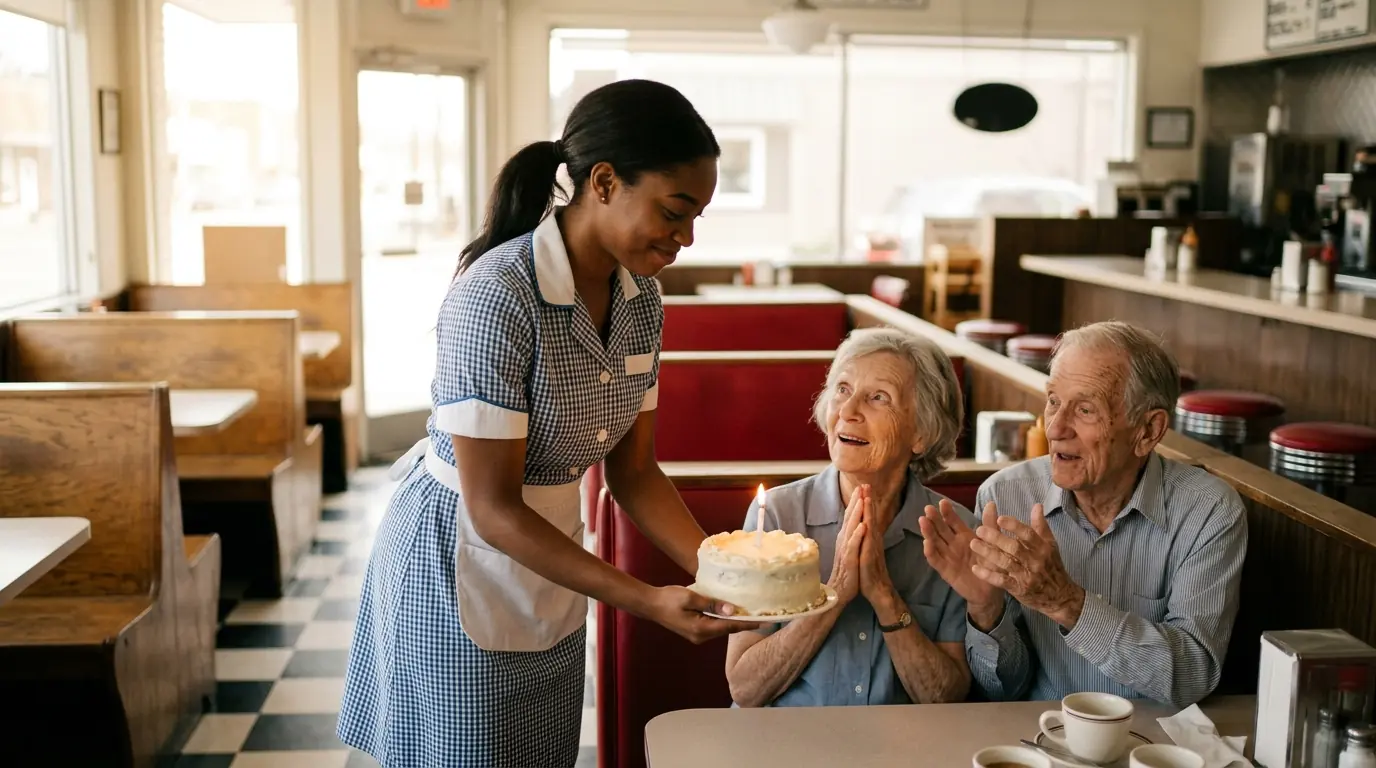 The silence that followed was heavy. The man’s shoulders sagged. His whole body seemed to deflate. “I’m sorry. We shouldn’t have bothered you. We’ll go.”
“Wait,” Aaliyah said. The word came out before she could think about it. They both looked at her—the man with desperate hope, the woman with eyes that barely seemed to see her. Aaliyah’s mind raced. There were day-old pastries in the back. Mrs. Chen usually let her take those home, one of the small perks of the job. But Jessica had already claimed them earlier, saying they were for her boyfriend, even though Aaliyah suspected she’d just throw them away. She did that sometimes. The register had $37 in it. Money that had to be deposited tomorrow morning. Mrs. Chen counted it every day, matched it against the sales receipts. Aaliyah couldn’t touch that. Her own paycheck was in her pocket: $270.
But that was for rent, for medicine, for food, for the cake. The thought hit her like ice water. The cake—her mother’s birthday cake—$24.99 plus tax, $27 and change. She looked at the display case. The moose cake sat there on the second shelf, perfect and beautiful with its delicate sugar rose. Four months of saving. Four months of sacrifice. Then she looked at the woman again. Eleanor, the man had called her. Eleanor’s face was the color of old newspaper. Her lips were cracked and bleeding. Her breathing was getting worse, more labored.
“Ma’am,” Aaliyah said softly. “When was the last time you ate?”
The woman tried to answer, but no sound came out. “Three days,” the man said quietly, his voice cracked. “We… we lost our place. The apartment. Everything happened so fast. The rent went up $300 and we couldn’t afford it. We’ve been staying in my car, but then the car broke down two days ago and we couldn’t fix it. We’ve been walking, looking for shelters, but they’re all full. And Eleanor has diabetes. She needs to eat regularly, or—” His voice broke entirely.
Aaliyah felt something twist in her chest. She thought about her mother lying in that narrow bed, waiting for a kidney, getting weaker every day. She thought about how terrified she was every time she left for work, afraid she’d come home to find her mother had died alone. She thought about what she’d do if someone found her mother on the street, hungry and sick. What she’d hoped they would do.
The woman stumbled; her knees buckled, her husband caught her, but barely. He was too frail himself, and they both nearly went down. “Eleanor,” he said urgently, his voice rising in panic. “Eleanor, stay with me. Please stay with me.”
The woman’s eyes rolled back, her weight went limp in her husband’s arms. “No, no, no,” the man was saying. “Please, Eleanor. Please.”
Aaliyah moved without thinking. She dropped the broom and ran to help, catching the woman’s other arm just as she started to slide to the floor. “Help me get her to a chair,” Aaliyah said. Together she and the man half-carried, half-dragged Eleanor to the nearest table and lowered her into a chair. The woman’s head lulled to the side. Her breathing was fast and shallow, her chest barely moving.
“Eleanor,” the man was saying, patting her face gently. “Come on, honey. Open your eyes, please.”
Aaliyah stared at them. Her heart was pounding so hard she could hear it. This woman was dying right here, right now. This woman was dying. And Aaliyah had a choice. She could call an ambulance. She should call an ambulance. But ambulances cost money. If this couple couldn’t afford rent, they definitely couldn’t afford an ambulance. The hospital would stabilize Eleanor, then discharge her back to the street. Or Aaliyah could do something right now. Something small but immediate.
She looked at the display case again at the moose cake. Her mother’s birthday was tomorrow, but this woman might not have a tomorrow. Aaliyah’s hands were shaking as she walked to the display case. She opened the glass door. It made a soft swoosh sound that seemed too loud in the quiet bakery. And she reached for the cake. Her fingers touched the plate. It was cold. Four months. Her mind screamed. Four months of saving. Your mother’s birthday—the one thing, the only thing you were going to be able to give her. But Eleanor’s breathing was getting worse, ragged, desperate.
Aaliyah picked up the cake. It felt heavier than it should. She carried it to the table like she was carrying something made of glass, something infinitely fragile. Behind her, the man’s voice said, “Miss, we can’t. We don’t have money for—”
“I know,” Aaliyah said. Her voice sounded strange, distant. She set the cake down in front of Eleanor. “It’s okay. We can’t accept this.”
“Yes, you can.” Aaliyah went to the counter and grabbed a fork and a bottle of water. Her eyes were burning, but she wouldn’t cry. “Not yet. Not in front of them.” She set the fork and water on the table. “Please,” she said softly. “Eat.”
The man stared at the cake, then at Aaliyah. His eyes were filling with tears. “I don’t…” He couldn’t finish the sentence. Eleanor’s eyes had opened again. She was looking at the cake with an expression that made Aaliyah want to break. Disbelief, desperate hope, hunger so deep it was painful to see.
“Please,” Aaliyah said again before it was too late. Eleanor reached out with a trembling hand. Her fingers could barely grip the fork. The man had to help her, guiding her hand. She took a bite and then she started to cry. Not loud sobs. These were quiet tears that rolled down her weathered cheeks as she chewed slowly, carefully, like the cake was the most precious thing she’d ever tasted. Like she couldn’t believe it was real.
The man put his arm around his wife, pulling her close. His own face was wet now. He kept whispering, “It’s okay. It’s okay. Hey, you’re okay.” Eleanor took another bite, then another. The color was already starting to come back to her face. Not much, but enough. Enough to matter.
Aaliyah backed away slowly. “I’ll… I’ll get you both some coffee on the house.” She walked to the back room on legs that didn’t feel entirely solid. Once she was out of sight, she leaned against the wall and pressed her palms hard against her eyes. That was her mother’s birthday cake. Four months of saving. Four months of walking in the cold, of skipping lunch, of putting away every spare nickel and dime. Gone. She thought about her mother’s face tomorrow when she would have to say, “I’m sorry, Mom. I couldn’t get you anything this year. I know I said I would, but something came up.” Her mother would smile. She’d hug Aaliyah and say it was fine, that just being together was enough, that she didn’t need anything fancy. She always said that. But Aaliyah had wanted to give her something—this one small thing.
She took a shaky breath and made two cups of coffee. Added sugar and cream to both, even though cream was supposed to be for paying customers only. She didn’t care. When she came back out, Eleanor had eaten about half the cake. She was sitting up straighter now, her eyes more focused. She was sipping water slowly. Thomas, the man, had introduced himself while Aaliyah was gone, was watching his wife like she was the only thing in the world that mattered.
“Thank you,” he said. When Aaliyah sat down the coffee, his voice was thick with emotion. “I don’t know how to… I can never thank you.”
“It’s okay,” Aaliyah said, her own voice unsteady.
“No.” Thomas looked at her directly. His eyes were a pale blue, sharp despite his age. “It’s not just okay. What you did… most people wouldn’t have. Most people would have turned us away, or called the police.” He stopped, swallowing hard. “That cake… it meant something to you, didn’t it?”
Aaliyah hesitated. “It does matter,” she said quietly. “Tell me.” She looked down at her hands. “It’s for my mom’s birthday. Tomorrow.”
Thomas closed his eyes. The pain on his face was real. “Oh, God. It’s fine.”
“Really? My mom will understand.”
“How long?” His voice was quiet now. “How long did you save for it?”
Aaliyah didn’t want to answer. But there was something in his face. Genuine remorse. Genuine pain. It made her tell the truth. “Four months.”
Eleanor made a small sound. She set down her fork carefully, her hands still shaking. She looked at Aaliyah with eyes that were suddenly very clear, very focused.
“Four months,” Eleanor whispered. “You saved for four months and you gave it to us… to strangers.”
“You needed it more,” Aaliyah said simply.
“Why?” Thomas asked. “Why would you do that? You don’t know us. We could be anyone. We could be…”
“Does it matter?” Aaliyah’s voice cracked. “You were hungry. Your wife was dying. I couldn’t just…” She stopped, wiping at her eyes angrily. “I’m sorry. I should finish closing up. You can stay as long as you need.” She turned away before they could see her cry properly.
At the counter, she busied herself with the register, counting the same $37 three times, even though she already knew what it was. Anything to avoid looking at the table where two strangers were eating her mother’s birthday cake. Behind her, she could hear them talking in low voices. Thomas’s deep murmur, reassuring and gentle. Eleanor’s weak responses, getting stronger with each minute. The soft clink of the fork against the plate.
Aaliyah forced herself to focus on closing. Wiping down the espresso machine, checking that all the pastries were put away, making sure the doors to the display cases were locked. Normal things. Routine things. Things that didn’t require thinking.
Finally, footsteps approached.
“Miss,” Thomas said. Aaliyah wiped her eyes quickly and turned. “Yes?”
Thomas held out a napkin. On it, he’d written something in shaky handwriting—a phone number, a name: Thomas and Eleanor Kensington.
“If you ever need anything,” he said, “anything at all, please call this number.”
“I don’t need… please,” she said.
His voice was intense now. “You gave more than you think you did. More than food, more than a cake. You gave dignity. You gave hope. You reminded us that kindness still exists in this world, and those are things most people forget about when they’re helping the homeless.”
Aaliyah took the napkin, not sure what to say. Eleanor had stood up now, leaning heavily on her husband, but she looked so much better than when she’d arrived, color in her cheeks, life in her eyes. She reached out and took Aaliyah’s hand. Her grip was weak, but warm.
“Bless you, child,” she said. Her voice was still rough but stronger. “I don’t believe in coincidences. You were meant to be here tonight. We were meant to find you.”
“I… I don’t understand what you mean,” Aaliyah said.
“You will,” Thomas said. He helped Eleanor into her coat; she’d taken it off while eating. And now Aaliyah could see how thin she was under it, how the clothes hung on her frame.
“What’s your name?”
“Aaliyah. Aaliyah Carter.”
“Aaliyah,” he said it slowly, carefully, like he was memorizing every syllable. “Remember what I said? If you ever need anything, anything at all…” He helped Eleanor to the door. They moved slowly, but Eleanor was walking on her own now, just using Thomas for balance instead of complete support. At the door, Thomas turned back one more time. “The world needs more people like you,” he said quietly. “Don’t let it make you hard. Don’t let it take that away from you.”
Then they were gone, disappearing into the cold December night. Aaliyah stood alone in the empty bakery. The half-eaten cake sat on the table, a witness to what had just happened. The napkin with the phone number was in her hand, the ink already starting to smudge from her sweaty palm. She looked at it for a long moment. Thomas and Eleanor Kensington. The name didn’t mean anything to her—just two more people struggling to survive in a world that didn’t care about them. She folded the napkin carefully and put it in her pocket next to her paycheck.
Then she went back to closing up, washed the plate and fork, threw away the rest of the cake. It couldn’t be sold now, and she couldn’t bear to take it home. Locked the display cases, counted the register one final time: $37, exactly as it should be. At exactly 9:00, Aaliyah turned off the lights, locked the door, and started the long walk home.
The freezing rain had stopped, but the temperature had dropped. The sidewalks were starting to ice over. Aaliyah walked carefully, her hands shoved deep in her pockets, her mind a mess of thoughts she couldn’t quite sort through. Tomorrow was her mother’s birthday, and she had nothing to give her. No cake, no present, nothing but herself, and a half-truth about where the money had gone.
Somewhere in Rochester tonight, an elderly woman named Eleanor was alive because Aaliyah had made a choice, had given up something precious for someone who needed it more. Was that enough? Would that be enough? Aaliyah didn’t know. She just kept walking, one foot in front of the other, toward home.
The apartment was dark when she got back. For a terrifying moment—the same terrifying moment she had every time she came home to silence—Aaliyah thought her mother had been taken to the hospital again. But then she heard it. The familiar labored breathing from the bedroom. The soft wheeze. The pause between inhale and exhale that always lasted a heartbeat too long. Aaliyah exhaled slowly, her whole body sagging with relief. She set down her bag and toed off her shoes, her feet aching from the long day.
She went to check on her mother, moving quietly through the dark apartment. In the bedroom, Linda was asleep. The light from the street lamp outside cast a yellow glow through the thin curtains, enough to see by. Her mother’s chest rose and fell in that shallow way that always made Aaliyah nervous. The medical equipment the hospital had sent home—the portable oxygen tank, the blood pressure monitor, a small box of emergency supplies—sat beside the bed like silent sentinels. Aaliyah pulled the blanket up higher, tucking it around her mother’s thin shoulders. Linda stirred slightly, but didn’t wake.
“Happy early birthday, Mom!” Aaliyah whispered, bending down to kiss her forehead. The skin was cool and papery under her lips. “I love you. I’m sorry I couldn’t. I’m sorry.” She couldn’t finish. What was she even apologizing for?
In her own room, Aaliyah sat on the edge of the bed and pulled out the napkin from her pocket. The phone number stared back at her, written in that shaky handwriting below it. Thomas and Eleanor Kensington. You gave us everything. Let us return the favor. Kensington. She turned the name over in her mind, trying to remember if she’d heard it before. It sounded vaguely familiar, but she couldn’t place it. Probably just a common name.
Aaliyah tucked the napkin into her dresser drawer between two folded t-shirts and changed for bed. She was so tired she could barely think, exhausted down to her bones. Tomorrow was her mother’s birthday, and she’d have to figure out something to make it special. Maybe she could cook a nice dinner with what they had in the pantry. Maybe she could borrow the neighbor’s laptop and find a movie they could watch together. Something. Anything.
Her phone buzzed on the nightstand. A text from Jessica. Did those homeless people leave? Make sure they didn’t steal anything. Mrs. Chen will flip if stuff is missing. Aaliyah stared at the message. Anger flashed through her—hot and unexpected. Those homeless people had names. They had been desperate. They had needed help. But she didn’t respond. She never did. When Jessica said things like that, it wasn’t worth the fight.
She turned off her phone and lay down, staring at the ceiling at the 47 cracks she’d memorized. Four months—all gone in one night. But when she closed her eyes, she didn’t see the cake. She saw Eleanor’s face. The way the color had come back to her cheeks. The way her eyes had focused again, becoming clear, aware, alive. The way Thomas had held her like she was the most precious thing in the world.
Sometimes, Aaliyah thought, the most expensive things in life don’t cost money at all. Sometimes, the most valuable thing you can give is the thing you can least afford to lose. She fell asleep thinking about that, dreaming of sugar roses…
The next morning, Aaliyah woke to her mother calling her name. “Aaliyah, honey, are you awake?” There was something in her mother’s voice—not panic, but surprise. Excitement, maybe. Aaliyah rushed into her mother’s room, her heart already pounding.
“Mom, what’s wrong? Are you okay? Do you need—”
“I’m fine, baby. I’m fine.” Linda was sitting up in bed, actually sitting up, which she hadn’t been able to do easily in months. She was smiling. Actually smiling. Her eyes were bright. “Look,” she pointed to the doorway. There, sitting just inside the room, was a large wicker basket. It was wrapped in cellophane and tied with a silver bow that caught the morning light. Inside were cakes, cookies, fresh bread still in bags, jars of jam with fancy labels, bottles of juice, fresh fruit that looked like it came from somewhere expensive, and a white card tucked into the front.
Aaliyah stared. “What? How did this get here?”
“I don’t know. I heard a knock on the door about an hour ago, loud enough to wake me up. But by the time I could get myself out of bed and to the door…” Linda gestured at the basket. “This was here. No one around. Just the basket.”
Aaliyah picked it up. It was heavy. Really heavy. She carried it to her mother’s bed and set it down carefully. Her hands were shaking as she pulled out the card. The handwriting was the same as on the napkin in her drawer. She’d recognize it anywhere now.
“For Aaliyah and her mother, happy birthday, Linda. Thank you for raising someone who still believes in kindness, even when the world gives her every reason not to. May this birthday be filled with the same sweetness you showed to strangers. Thomas and Eleanor.”
Aaliyah read it three times. Four times. The words blurred.
“Who are Thomas and Eleanor?” her mother asked.
“I… I met them last night at work,” Aaliyah’s voice sounded far away. “They were… they needed help.”
“It wasn’t a question,” Linda said.
“Yeah.”
Linda read the card again, her finger tracing over the words. When she looked up at Aaliyah, her eyes were wet. “You gave them food when we don’t have much ourselves, didn’t you?”
Aaliyah nodded, not trusting her voice.
“What did you give them, baby?”
Aaliyah’s throat was so tight she could barely speak.
“The…the cake. Your birthday cake. I’ve been saving for months. And I—” Her voice broke.
“I’m sorry, Mom. I’m so sorry. I wanted to get you something nice this year, something special, but they were so hungry, and she was sick, and I thought, ‘Come here.’”
Linda held out her arms. Aaliyah collapsed onto the bed, letting her mother hold her while she cried. Linda was so thin now, so weak, but her arms were still strong when they mattered. She stroked Aaliyah’s hair and made soft shushing sounds.
“My beautiful girl,” Linda whispered. “My kind, beautiful, selfless girl. I wanted to give you a real birthday cake—”
“Aaliyah sobbed. “Just once. Just one year.”
“And you did, baby. You did?”
“No, I didn’t. I gave it to strangers.”
“You gave it to people who needed it more than I did. Don’t you see? Every time you choose kindness, every time you help someone, even when it costs you something, that’s a gift to me because it means I raised you right. It means that even though we’ve been through hell, even though we’ve lost so much, you haven’t become hard. You haven’t become bitter. I wanted you to have a real birthday.”
Linda smiled through her tears. “And now I do. Look at all this, Aaliyah. This is more food than we’ve had in months. We can eat like kings for weeks. And more importantly,” she picked up the card again. “Someone saw my daughter’s heart and recognized it for what it is. Someone wanted to honor that. That’s the best birthday present anyone could give me.”
They spent the rest of the morning going through the basket. There was so much—fresh sourdough bread that probably cost $20 a loaf, strawberry jam with real strawberries, chocolate cookies that melted on the tongue, bottles of real orange juice, fresh apples and oranges, a whole pound cake, muffins, scones. This must have cost hundreds of dollars, Aaliyah said, pulling out jar after jar.
“They must be well off,” Linda said.
“Mom, they were homeless. They were wearing rags.”
Linda looked at her. “Are you sure about that?”
Aaliyah thought about it—the way Thomas had spoken, educated, articulate, the way they’d held themselves even in desperation, the careful handwriting on the napkin. “I don’t know,” she admitted. “I don’t know anything anymore.”
They ate fresh bread with strawberry jam for breakfast. Linda cried over how good it tasted. They had real orange juice instead of the powder mix. They split a chocolate cookie.
“This is the best birthday I’ve had in years,” Linda said, smiling through tears. “Maybe the best birthday I’ve ever had.”
But something was nagging at Aaliyah. She couldn’t shake it. The basket was too much, too expensive, too deliberate, and it had been delivered at dawn. Someone had known exactly where they lived and had come here specifically. She thought about Thomas and Eleanor, about their worn coats and desperate faces, but also about the way Thomas had written on that napkin—precise, careful handwriting despite his shaking hands. About the vocabulary he’d used, about Eleanor’s coat—threadbare but well-made, the kind that had been expensive once. Who were they really? The question haunted her all day.
Even as she and her mother shared the food, even as they watched old movies on the tiny TV, even as Linda dozed off in her chair with a small smile on her face, Aaliyah couldn’t stop thinking about it.
That night, after her mother was asleep, Aaliyah pulled out the napkin from her drawer. She stared at the phone number. She should throw it away. Whatever this was—charity, some kind of weird social experiment—she didn’t want it. But she didn’t throw it away. She put it back in the drawer and tried to sleep.
Two days later, Aaliyah was at work, restocking the pastry display case during the morning lull. When the door chimed, she looked up automatically, her customer service smile already in place. The smile died on her face. Thomas and Eleanor stood in the doorway, but they looked completely different.
Thomas wore a charcoal wool coat that looked like it cost more than Aaliyah’s yearly rent. Underneath, she could see a dark suit, perfectly tailored, with a silver tie. His gray hair was neatly combed and styled. His shoes were polished to a mirror shine. Even his posture had changed. He stood straight, confident, commanding.
Eleanor stood beside him in a long camel coat that screamed money. A silk scarf in cream and gold, leather gloves. Her thin frame was draped in quality fabrics chosen to flatter. Her face was made up—subtle, expensive makeup that covered the lines without looking obvious. Diamond earrings caught the light.
Behind them stood a man in a black suit, clearly a driver or bodyguard or assistant of some kind. He had the look of someone paid to be invisible but competent.
The bakery went silent. Mrs. Chen, who had been in the back doing inventory, came out at the sound of the bell. She stopped short, her eyes going wide. Jessica, who was supposed to be wiping tables, just stood there with her mouth hanging open. Two customers at the corner table stopped mid-conversation, staring.
“Holy…” Jessica said under her breath.
Thomas smiled. “Good morning. We’re here to see Aaliyah.”
Every eye in the bakery turned to her. Aaliyah felt her face go hot. Her hands were still holding a tray of croissants. She set it down carefully, like she was moving through a dream.
“I… what? May we speak with you?” Thomas asked. His voice was the same but different. Still gentle, but with an authority she hadn’t heard before.
Privately, Mrs. Chen looked between them and Aaliyah, her expression confused and a little worried.
“Aaliyah, do you know these people?”
“I… I think so.”
“We’ll only take a moment of her time,” Eleanor said. Her voice was stronger now, steady and refined—the voice of someone used to being listened to. “We promise not to keep her long.”
Mrs. Chen hesitated, clearly unsure what was happening. Finally, she nodded. “Use my office.”
Aaliyah followed Thomas and Eleanor into the small back office, her heart pounding so hard she could feel it in her throat. The man in the suit stayed outside along with Mrs. Chen and Jessica, who was openly staring with her phone out like she wanted to take pictures.
When the door closed, Aaliyah finally found her voice. “What’s going on? Who are you people?”
Thomas and Eleanor exchanged a glance. There was something in it—a question and an answer. A whole conversation without words.
“The other night,” Thomas began, “we weren’t entirely honest with you. We weren’t homeless.”
“We weren’t hungry,” Eleanor said softly. “Well, I was hungry. That part was real. Thomas insists on authenticity in these tests, and I can’t fake low blood sugar,” she trailed off, looking almost guilty.
Aaliyah backed up until she hit the desk. “So, you were lying. This was some kind of… what? Test? Scam?”
“A test,” Thomas said firmly. “But not a scam. Please, Aaliyah, let me explain. I don’t want to hear. My wife and I,” Thomas continued, his voice firm but not unkind, “are the founders of the Kensington Foundation. Have you heard of it?”
Aaliyah shook her head, her mind reeling.
“We’re one of the largest charitable organizations on the East Coast,” Eleanor said. “We focus on education, healthcare access, and poverty relief. Over the past thirty years, we’ve distributed more than $200 million in grants and aid.”
Aaliyah stared at them. “You’re… you’re rich?”
“Very,” Thomas said simply. “Quite obscenely rich, actually. I made my fortune in tech back in the ’80s and ’90s before most people even knew what the internet was. Eleanor came from old money. Her family’s been wealthy for generations. Together, we have more money than we could spend in ten lifetimes. We’re also very old,” Eleanor added with a slight smile. “Thomas is seventy-eight. I’m seventy-six. And we don’t have children.”