“Why won’t you just look at me, buddy?”
Edward Crawford, the man behind Pinnacle Atlantic Holdings, was on his knees in a Richmond diner, begging a six-year-old who had not spoken a word in his life.
Oliver was thrashing, screaming, face twisted shut.
Six years. $2.3 million in specialists. Nothing.
Hands.
Then a waitress sat at the next booth and started folding a napkin.
The boy stopped, turned, and went still.
Bellamy’s Corner.
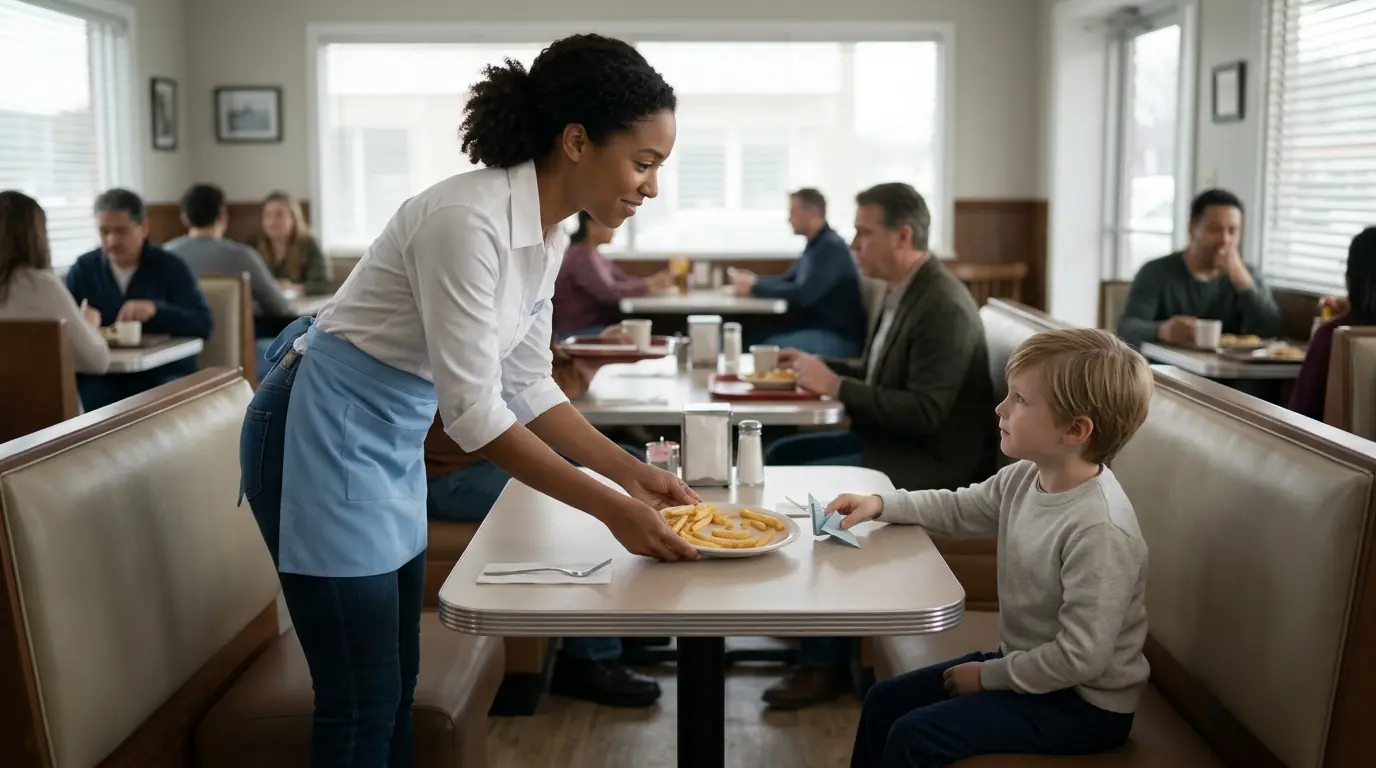
She set a paper bird on the table.
Oliver reached out and smiled.
“Who are you?”
“Nobody you’d remember.”
She walked away, back to clearing plates.
$9.50 an hour.
But that moment was the beginning of the worst mistake Edward Crawford ever made.
Look, that moment in the diner, it was just the beginning. What came next, nobody was ready for.
Before the napkin bird, before the scream, before Edward Crawford walked through that door, Haley Simmons clocked in at 11:47 a.m., thirteen minutes early, same as always. She tied her apron in the kitchen, tucked her phone into the front pocket, and checked the screen one more time.
Three missed calls from Grandma Odell’s home care aide.
She did not call back. Not yet.
Because calling back meant hearing a number. How much was owed. How far behind they were. How many weeks the aide could keep showing up for free before she stopped showing up at all.
Haley put the phone away and pushed through the kitchen door.
“You look like you slept in a mailbox,” Ruth Bellamy said from behind the register.
“Good morning to you, too, Ruth.”
“I’m serious. You eating?”
“I ate.”
“Liar.”
Ruth slid a biscuit wrapped in foil across the counter.
“Eat that before the lunch rush, or I’m docking your pay.”
“You don’t pay me enough to dock.”
“Exactly. So eat.”
That was Ruth.
Sixty-one years old, owner of Bellamy’s Corner Cafe since 1996. She had built the place with insurance money after her husband died, turned a two-room sandwich counter into the only diner on that block that survived three recessions and a pandemic.
Tough mouth, soft hands. The kind of woman who would fire you Monday and pay your rent Tuesday.
Haley bit into the biscuit and got to work.
The lunch crowd was the usual. Mr. Perkins in booth three, grilled cheese, no tomato, extra pickle, same as every Saturday since his wife passed. Two college kids splitting a milkshake and studying for something they would probably fail. A woman in scrubs eating alone, staring at her phone like it owed her money.
Haley moved through them the way she always did. Quiet, quick, noticing things nobody asked her to notice.
She refilled Mr. Perkins’s sweet tea before he finished the first glass. She brought the college kids extra napkins because one of them always spilled. She left the woman in scrubs alone because sometimes that was what people actually needed.
“Order up, table six,” Ruth called.
Haley grabbed the plates. Two burgers, one salad, and a kids’ meal with the fries arranged in a smiley face because she always did that, even though nobody asked.
Table six was a mother with two daughters. The younger one saw the fry smiley and gasped like Haley had performed actual magic.
“Mom! Mom! Look!”
The mother glanced at the plate, then at Haley. She did not say thank you. She did not look up again.
Haley did not flinch. She never did.
She dropped the check at table two, a guy in a polo who had been camping for ninety minutes on a $6.50 order. He left three quarters and a dime on the table.
Eighty-five cents.
Haley pocketed it without expression, wiped the table, and reset the silverware.
Ruth watched from the kitchen window and shook her head. Later, when Haley was not looking, she slipped a five-dollar bill into the tip jar under Haley’s name.
That was the thing about Haley Simmons. She never complained.
Not about the tips. Not about the hours. Not about the fact that she was two semesters away from a degree in early childhood education that she would probably never finish because her grandmother’s medical bills ate every dollar before it landed.
She just worked, showed up, paid attention.
And she had this thing, this thing Ruth called the radar. Haley could walk into a room and know within thirty seconds who was hurting.
Not because they told her. Because she watched.
The way someone held their coffee cup. The way someone’s laugh came a half second too late. The way a child’s eyes darted before a meltdown hit.
She could not explain it. She did not try to. It was just how she was built.
So when the front door opened at 12:15 p.m. and a man in an Oxford shirt walked in holding the hand of a small boy who was already trembling, Haley clocked it before anyone else in the room.
The boy’s fingers were fluttering. His breathing was shallow. His eyes were scanning the ceiling lights like they were hurting him.
Haley reached over and angled the window blinds. Quietly pulled the fluorescent table menu out of the booth before they sat down. Replaced the metal spoon with a wooden stirrer.
She did not say a word. Did not explain.
The man did not notice.
But the boy, just for a second, stopped trembling.
And that was before everything went wrong.
That night, two people sat alone in two very different rooms, carrying the same weight.
Haley’s apartment was above a laundromat on East Broad Street. One bedroom. A kitchen that doubled as a living room. The washing machines downstairs vibrated through the floor from 6:00 a.m. to midnight every single day, until the hum became something she did not hear anymore.
The way you stop hearing your own heartbeat.
She dropped her keys on the counter and pulled out her phone.
Three missed calls from Denise, her grandmother’s home care aide.
She called back.
“Haley, I love Miss Odell. You know I do.”
Denise’s voice was careful, practiced. The voice of someone who had rehearsed what she was about to say.
“But I’m four weeks behind. I got my own bills.”
“You said that last month.”
Silence.
“Just give me till Friday, Denise. Please.”
“Friday. That’s it.”
Haley hung up.
She sat at the kitchen table, the same table where her grandmother used to help her with homework, and opened the laptop.
One new email.
Financial Aid Office.
Subject line, application status update.
She already knew before she clicked.
We regret to inform you.
She closed the laptop. Did not slam it. Did not cry. Just closed it.
Then she pulled the stack of medical bills from under a textbook she had not opened in eight months and counted what she had.
$340.
That was it. That was everything.
Twelve miles west, Edward Crawford walked through the front door of a house worth $4.6 million and heard nothing.
That was the thing about the Crawford estate. It was built for sound to disappear. Marble floors, vaulted ceilings, rooms so large that footsteps dissolved before they reached the walls.
Oliver was already in bed. The monitor on Edward’s phone showed the boy asleep, curled tight, blanket kicked off, the way he always slept.
Greta had filed her nightly report and left it on the kitchen island.
Three pages. Times, meals, behavioral notes, medication log.
She wrote about Oliver the way an engineer writes about a machine.
Edward did not read it. Not tonight.
He walked upstairs, past Oliver’s room, past the guest room, past the bathroom no one used, down the hall to the master bedroom, the one he still shared with a ghost.
Claire’s closet was exactly as she had left it. Dresses still wrapped in dry cleaning bags. Shoes lined up on the rack. A scarf, lavender, cashmere, draped over a hook by the door.
Edward picked it up and held it to his face.
Three years since the accident.
Three years since a truck ran a red light on Route 288 and took her out of the world in four seconds.
Three years, and the scarf still smelled like her perfume.
Or maybe it did not.
Maybe he just needed it to.
He stood there for a long time.
Then he thought about the diner, about the waitress, about the way his son’s mouth had moved, that tiny, impossible curve, and how it was the closest thing to Claire he had seen since she died.
Edward came back the next day, and the day after that.
He did not explain, did not call ahead, just showed up with Oliver at the same booth, same time, and ordered the same thing.
Coffee, scrambled eggs for the boy. Nothing else.
Haley did not ask questions. She just folded.
Napkin birds on Monday, a napkin frog on Tuesday, something that might have been a dog on Wednesday. She laughed at that one, and Oliver’s eyes tracked her face when she did.
By Thursday, Oliver was arranging the animals in a line along the windowsill, sorting them, adjusting their positions, starting over when one was crooked.
Greta watched from the end of the booth, arms crossed, mouth tight.
Ruth watched from behind the register.
“That man’s been here four days straight,” Ruth said, drying a glass. “You know who he is?”
Haley shrugged.
“A dad with a kid who likes napkin birds.”
“Mhm.”
Ruth set the glass down.
“Girl, I Googled him.”
“Ruth.”
“Pinnacle Atlantic Holdings. Look it up.”
“I don’t need to look it up. He tips forty percent, and his kid is sweet.”
Ruth shook her head, but said nothing more.
Some conversations need to wait.
That Friday, Haley came home to a yellow paper taped to her front door.
Thirty-day eviction notice.
She peeled it off, read it once, folded it in half, and put it in her back pocket.
Then she sat on the bottom step of the stairwell, the one with the cracked tile that the landlord never fixed, and pressed both hands over her mouth.
She cried the way people cry when they have trained themselves not to make a sound.
“Nah, hold on. This ain’t right.”
She had $340, an eviction notice, a grandmother about to lose her nurse, and she was out there folding napkin birds for somebody else’s kid?
Not a single complaint.
Put yourself in her shoes. You have nothing left, and you are still giving?
“I can’t.”
The following Monday, Edward walked into Bellamy’s at 9:00 a.m.
No Oliver. No Greta. Just him.
Suit jacket off, sleeves rolled, like he was trying to look less like what he was.
It did not work. The watch alone gave him away.
He sat at the counter. Not a booth. The counter, where Haley could not avoid him.
She poured his coffee without asking.
No sugar.
She had memorized it three visits ago.
“I need to talk to you,” he said.
“You’re talking.”
He reached into his jacket and placed a white envelope on the counter between them, sliding it toward her with two fingers.
Haley looked at it, but did not touch it.
“Open it,” he said. “Please.”
She wiped her hands on her apron, picked it up, and pulled out the contents.
A typed letter on Pinnacle Atlantic letterhead, and a check.
$25,000.
She read the letter slowly. Every line.
Full-time position as Oliver’s personal care companion. Benefits. Flexible schedule. A salary that was more than she made in a year at the diner.
She put the letter down, looked at the check, then looked at Edward.
Then she slid the envelope back across the counter.
“I don’t know you,” she said, “and I don’t take money I haven’t earned.”
Edward blinked.
“I’m sorry. What?”
“I said no.”
“Ms. Simmons, I don’t think you understand what...”
“I understand fine.”
“You want to buy what I did for your son, but that wasn’t a service. That was just Tuesday.”
From the kitchen, Ruth Bellamy’s hand froze mid-reach for a stack of plates. She had been listening to every word.
Edward sat there for a long moment.
He was not used to this.
People did not slide things back to Edward Crawford. They asked for more.
“My son hasn’t smiled in six years,” he said quietly. “He smiled at you. I’m not trying to buy anything. I’m asking for help.”
Haley held his gaze and said nothing.
Then she picked up the coffee pot and walked to the next customer.
Edward left the envelope on the counter.
Haley did not touch it for the rest of her shift.
Ruth locked the front door at 9:15 p.m., flipped the sign to closed, and walked straight to the kitchen, where Haley was scrubbing a grill pan like it owed her rent.
“So,” Ruth said, leaning against the doorframe, “you just turned down $25,000.”
“Ruth.”
“Twenty-five thousand.”
“I heard the number.”
“Girl, I love your pride. Lord knows I do, but pride doesn’t pay for your grandmomma’s nurse.”
That landed.
Haley’s hand stopped moving.
Ruth pulled out her phone, scrolled, and turned the screen toward Haley.
“Pinnacle Atlantic Holdings. Fortune 200. His wife died three years ago, car accident on 288. The boy’s been in and out of specialists ever since. Every article says the same thing. No progress.”
Haley stared at the screen.
The wife’s obituary photo. A blond woman holding toddler Oliver, both of them laughing.
“Why would someone like him come to our diner?” Haley asked.
Ruth put the phone down and looked at her.
“Because his money can’t do what your hands do.”
The kitchen was quiet.
The grill pan dripped into the sink.
“I’m not saying take the check,” Ruth said. “I’m saying hear the man out. One conversation. Here. Not his office, not his house. Right here, where I can see you.”
Haley dried her hands, folded the towel, and set it on the counter.
“One conversation.”
“That’s my girl.”
“And I’m not cashing that check.”
“Baby, nobody asked you to.”
“Yet.”
Tuesday morning, 7:00 a.m.
Bellamy’s was empty except for the smell of fresh coffee and the sound of Ruth humming gospel in the kitchen.
Edward arrived at 7:05.
Haley was already sitting in booth nine with a glass of water and her apron folded on the table beside her.
Off duty.
On purpose.
He sat across from her.
No envelope this time. No lawyer. Just him.
“Thank you for...”
“Let’s skip that part,” Haley said. “You want me to work with your son, so let’s talk about what that looks like.”
Edward nodded and waited.
“I’m not moving into your house. Okay? I want a trial period, four weeks. If it doesn’t work, I walk clean.”
“That’s fair.”
“I keep two shifts here at the diner. This is still my job.”
“Of course.”
“I want to meet Oliver’s therapists before I start. His teachers, too. I need to know what’s been tried and what hasn’t.”
“I’ll arrange it.”
“And you call me Haley. Not Ms. Simmons. Not the caregiver. Haley.”
Edward almost smiled.
“Haley. Got it.”
She paused, looked at her water glass, and turned it once on the table.
“One more thing. If Oliver doesn’t want me there, if he pulls away, if he shuts down, if he’s worse instead of better, I leave after one week. No hard feelings. No check. You don’t owe me anything, and I don’t owe you.”
“And if he does want you there?”
“Then we figure out week two.”
Edward exhaled.
For the first time in this conversation, his shoulders dropped.
“I’ll have my attorney draw something up. Simple. Nothing complicated.”
“Good.”
“Because I don’t do complicated.”
From the kitchen, Ruth’s humming had stopped. She was standing at the window, watching, holding a coffee pot she had forgotten to put down.
Thursday, 8:02 a.m.
Haley pulled her 2009 Honda Civic, cracked windshield, check engine light permanently on, through the iron gates of the Crawford estate.
The driveway alone was longer than her block.
She parked next to a dark Mercedes and a white Range Rover, and sat in her car for thirty seconds, hands on the wheel.
Breathing.
Then she grabbed the canvas bag from the passenger seat, napkin paper, wooden blocks, three jars of finger paint she had bought at a dollar store, and walked to the front door.
Greta opened it before she knocked.
“You must be the new arrangement.”
Not a greeting. A classification.
“Haley.”
“Follow me.”
The house was enormous and silent. White marble, high ceilings, art on the walls that looked expensive and sad at the same time.
No toys on the floor. No drawings on the fridge. No noise.
Oliver’s room was on the second floor. Greta opened the door and stepped aside.
The room was clinical. White walls, organized shelves, a weighted blanket folded in precise thirds on a bed that looked like it belonged in a catalog. A laminated daily schedule taped to the wall, every fifteen-minute block accounted for.
8:00, wake.
8:15, hygiene.
8:30, breakfast.
8:45, sensory exercise A.
Greta handed Haley a binder, three inches thick, tabbed sections, dietary, behavioral, medical, emergency, communication protocols.
“Everything you need is in here,” Greta said. “His routine is non-negotiable. Deviations cause setbacks. I’ve documented every variable.”
Haley flipped through it.
Pages and pages of charts, graphs, notes in small handwriting.
Oliver reduced to data points.
She closed the binder and set it on the desk.
“Where’s Oliver?”
“Downstairs. Breakfast ends at 8:45.”
“Can I see him?”
Greta’s mouth tightened.
“He’s on schedule.”
“I’ll wait, then.”
Haley sat on the floor, right there in the middle of Oliver’s room, cross-legged, canvas bag open. She pulled out a stack of napkin paper and started folding.
She did not look at the binder again.
At 8:51, a small shadow appeared in the doorway.
Oliver stood there, rigid, fingers fluttering, eyes scanning the room like something had changed and he needed to map it.
His gaze landed on Haley’s hands.
She folded.
Slow. Steady.
A bird first. Then a frog. Then something she hoped looked like a rabbit.
Oliver inched forward, one step, two.
He lowered himself to the floor three feet away from her and watched.
By 9:30, he was sitting beside her.
By 10:15, he was touching the animals, lining them up in a row along the baseboard.
By 11:00, he placed one in Haley’s palm.
A gift.
His first.
Greta watched from the hallway, arms folded, jaw set.
The week unfolded fast.
Day two, Oliver followed Haley from room to room. Not close, five feet behind, but following.
Day three, she introduced textures. Velvet scraps, warm water in a shallow bowl, garden soil in a tin cup. Oliver pressed his fingers into each one, again and again, mapping the feeling.
Day four, Haley hummed while she worked. An old hymn, something her grandmother used to sing when Haley was scared of thunderstorms. Low, steady, no words.
Oliver’s head tilted.
By afternoon, he was humming back. Same melody, same rhythm. His version.
Day five, they walked in the garden. Oliver reached up and took Haley’s hand. She did not react, did not gasp, did not squeeze. She just held it, light and easy, and kept walking.
Day six, the grocery store.
Edward had asked Haley to pick up a few things with Oliver. Practice, real-world exposure.
It went fine until aisle nine.
The fluorescent lights buzzed louder there, and a cart crashed behind them. Oliver dropped, hands over ears, rocking.
Haley sat on the floor right next to him. She did not pull him up. She did not shush him.
She hummed the hymn and put her body between him and the stares.
A woman in the next aisle whispered to her friend.
“Is that her kid?”
“Doesn’t look like it.”
Haley heard every word, did not flinch, and kept humming.
Day seven, Edward came home early, 4:15 p.m.
The house was quiet, which usually meant something was wrong.
He found them in the kitchen.
Oliver was sitting at the island, a crayon in his fist, blue, dragging it across paper in long, uneven strokes.
His first drawing.
Haley sat beside him, chin in her hand, watching like it was the most important thing in the world.
Oliver looked up at his father and smiled.
Edward stood there.
He opened his mouth to say something. Nothing came out.
He turned, walked to the hallway, pressed his back against the wall, slid down until he was sitting on the floor, and covered his face with both hands.
He wept.
Not quietly. Not the controlled kind. The kind that comes when you have held something so tight for so long that the moment it loosens, even a little, everything breaks at once.
In the kitchen, Haley heard it.
She did not go to him.
She knew some things you have to feel alone.
She picked up a blue crayon and drew a bird next to Oliver’s scribble.
Oliver looked at it, then back at his paper, and drew a line connecting them.
Three weeks in, and the Crawford house had a heartbeat again.
It was small things, the kind you would not notice unless you had lived in the silence that came before.
Oliver pointed at things now. The window, a bird outside, the jar of peanut butter on the counter. He would extend one finger and look at Haley, and she would say the word.
Window.
Bird.
Peanut butter.
And he would move his lips, trying to catch the shape of it. Some days the sound came out. Some days it did not, but he kept trying.
He slept through the night, every night, for the first time since Claire died.
Greta’s nightly reports got shorter. There was less to document when a child was calm.
Haley arrived at 8:00 a.m., worked with Oliver until 3:00, then drove to the diner for the evening shift.
Two worlds. One woman. Every single day.
She never complained.
She never mixed them.
Edward started coming home earlier, 5:00 p.m. instead of 8:00, then 4:30, then 4:00. He would stand in the kitchen doorway watching Haley and Oliver work, puzzles, textures, sounds, and something in his posture changed.
The rigidity softened. The phone stayed in his pocket longer.
One Thursday evening, Haley cooked. She had not planned to.
Oliver was hungry, Greta had left early, and the fridge had pasta, garlic, and butter. So she made something simple, the same thing her grandmother made when there was not much in the house, but you still needed dinner to feel like home.
Edward came in at 5:15 and found the three of them at the kitchen island. Oliver eating with his hands, Haley wiping sauce off his chin, a pot still warm on the stove.
He sat down.
Haley pushed a plate toward him without a word.
They ate.
Nobody spoke for a while.
The house smelled like garlic and butter and something that had been missing for three years.
“Oliver’s therapist called today,” Edward said. “Asked what changed. I told her we hired someone.”
He paused, pushed a noodle around his plate.
“But that’s not really it, is it?”
Haley looked at him.
“No.”
“You let someone in. That’s what changed.”
Edward held her gaze, nodded once, and looked at his son.
Oliver was arranging three pieces of pasta in a line on the counter. Straight. Even. Perfect.
Some things do not need words.
Diane Ashford noticed it on a Tuesday.
Edward rescheduled the 2:00 p.m. board review, moved it to Thursday. No explanation, just a one-line email from his assistant.
Mr. Crawford has a personal commitment.
Personal commitment.
Edward Crawford did not have personal commitments.
Edward Crawford had quarterly earnings, shareholder calls, and acquisition timelines. That was his life. That had been his life since Claire died.
Then she noticed the pattern. Leaving by 4:30, canceling dinners with investors, smiling, actually smiling during a Monday morning briefing.
Edward Crawford did not smile on Mondays.
Edward Crawford did not smile at all.
Diane made a call.
The private investigator’s name was Glenn, efficient, discreet, expensive. She had used him twice before, once during a hostile takeover, once to vet a whistleblower.
He was good at finding the shape of a person’s life and making it look like whatever you needed it to look like.
Three days later, Glenn delivered a file.
Haley Simmons, age 28. No degree. Dropped out of Virginia Commonwealth two semesters short. Current employer, Bellamy’s Corner Cafe. Annual income, $23,000. Outstanding debt, $12,000. Eviction notice filed March 14th. Grandmother on Medicaid. No professional certifications. No childcare license. No background in behavioral therapy.
And a photograph.
Taken at a grocery store.
Haley sitting on the floor of aisle nine next to Oliver Crawford, who was curled in a ball with his hands over his ears.
Out of context, it looked like a crisis.
Out of context, it looked like negligence.
Diane smiled.
Context was her business.
She drafted a memo. Two paragraphs. Sent it to board members Wallace and Thornton, the two most risk-averse men on the board.
The framing was surgical.
Concerned about the CEO’s judgment. Unvetted individual with financial distress and no qualifications given unsupervised access to a vulnerable minor. Reputational exposure. Liability risk.
She never mentioned Haley’s race.
She did not have to.
Diane arrived at the Crawford estate on a Friday afternoon, unannounced.
She brought a man in a charcoal suit, introduced him as Dr. Nathan Perry, child welfare consultant.
Edward met them in the study.
He had not invited either of them.
“Edward, this isn’t an ambush,” Diane said, sitting down like she owned the chair. “This is a friend looking out for you.”
“Then call first.”
“I would have, but this couldn’t wait.”
She nodded to Perry.
He opened a folder and placed it on the desk.
The private investigator’s file.
Every page a weapon.
Haley’s debts itemized. Her incomplete transcripts. The eviction filing. The grocery store photo, printed full page. Oliver on the floor, Haley beside him, fluorescent lights overhead making everything look worse than it was.
“Who authorized this?”
Edward’s voice was low.
“I did,” Diane said, “because someone had to. Edward, you’re a public figure, the CEO of a Fortune 200 company, and you’ve placed your nonverbal six-year-old son in the care of an unqualified, financially desperate woman with no credentials and no oversight.”
“She’s not...”
“If this gets to the press, or worse, to a courtroom, the board won’t protect you. I’m trying to protect you.”
Perry leaned forward, professional, measured, rehearsed.
“Mr. Crawford, my recommendation is to suspend the arrangement pending a formal review. Standard protocol in cases involving...”
“Cases?”
Edward looked at him.
“My son isn’t a case.”
“Of course not, but the optics...”
“The optics.”
Silence.
Diane let it breathe.
She had done this before.
Plant the doubt, then give it room to grow.
Edward looked at the grocery store photo. Oliver on the floor, Haley beside him.
He knew what had actually happened in that moment. He knew Haley had shielded his son. He knew she had hummed until the panic passed.
He knew.
But the photo did not show that.
The photo showed something else.
And for the first time, just for a second, doubt crept in.
From the doorway, Greta watched, arms crossed.
She nodded once.
Edward called Haley that evening at 7:48 p.m.
She was halfway through her shift at the diner, balancing two plates of meatloaf and a side of coleslaw. She stepped into the kitchen to answer.
“Hey. Everything okay with Oliver?”
His voice was different. Flat. Corporate. The voice he used in boardrooms, not in his kitchen over pasta.
“Haley, I need to pause the arrangement.”
She set the plates down.
“Pause?”
“Just temporarily. There are some concerns about oversight, about...”
“Whose concerns?”
Silence.
“Edward, whose concerns?”
“It’s just for Oliver’s sake, until we sort some things out.”
“For Oliver’s sake.”
Haley knew that phrase. She had heard versions of it her whole life. It was never about the person they named. It was always about the person too afraid to say what they really meant.
“Okay,” she said.
“Haley, I...”
“I said okay.”
She hung up.
She stood in the kitchen for a full minute, both hands flat on the stainless steel counter, breathing.
Ruth looked at her from across the room, but did not ask.
Not yet.
The next morning, Haley drove to the Crawford estate one last time.
She packed her canvas bag, the napkin paper, the finger paints, the wooden blocks, the velvet scraps. She rolled up Oliver’s crayon drawings and tucked them under her arm.
The blue bird. The scribbled lines. The one where he had drawn a brown figure with something yellow in its hand.
Greta stood by the front door, held it open, and did not speak.
Haley stopped at the threshold and turned back toward the house.
“He was starting to say words, Edward.”
Edward stood at the end of the hallway, hands in his pockets.
He did not move.
“He was almost there.”
She walked out.
The door closed behind her.
Upstairs, Oliver stood at his bedroom window. He watched the Honda Civic pull down the long driveway, past the iron gates, and disappear.
His mouth opened.
No sound came out.
Then he screamed.
The kind of scream from the diner, raw, shredded, from somewhere deeper than his lungs.
He did not stop for three hours.
Greta tried the headphones, the blanket, the protocol card.
Nothing worked.
Nothing worked because the one thing that worked had just driven away in a car with a cracked windshield and $340 in the bank.
Haley came back to the diner like nothing happened. Apron on, hair tied, tables wiped, orders up.
The same rhythm, the same routine, the same $9.50 an hour.
She did not talk about the Crawford estate, did not mention Oliver, did not mention Edward.
She just worked.
But Ruth knew.
She knew because Haley stopped humming.
Three weeks at that house and the girl had started humming again. That old hymn, the one from her grandmother.
Now the kitchen was silent, and Haley’s hands moved faster than they needed to, scrubbing things that were already clean.
Ruth gave it two days, then she locked the front door at closing, pulled up a chair across from Haley, and sat down.
“Talk.”
“Ruth, I’m fine.”
“I didn’t ask if you were fine. I said talk.”
Haley’s hands stopped. She stared at the rag in her grip, wrung it once, then told Ruth everything.
The woman in the suit, the file, the fake consultant, Edward’s voice on the phone, flat, rehearsed, not his.
For Oliver’s sake.
Ruth did not interrupt. She sat. She listened.
And when Haley finished, Ruth’s jaw was set so tight the muscle in her cheek twitched.
“So let me understand this,” Ruth said slowly. “They dug up your eviction, your debt, your transcripts, and they used all that, everything you’ve been surviving, to call you a threat to a child you were healing.”
“That’s what happened.”
“And Edward believed it.”
“He didn’t fight it.”
“That’s the same thing.”
Ruth stood up, paced the length of the counter, and stopped.
“No. That’s not the same thing. That man is scared. Scared people fold. But the woman who did this to you, she’s not scared. She’s calculated. And calculated is worse.”
Ruth picked up her phone.
“What are you doing?”
“Calling my nephew, Jerome. He’s a reporter at the Richmond Times-Dispatch.”
“Ruth, no. I don’t want press.”
“I’m not putting you in the press. I’m putting a flashlight on people hiding in the dark.”
She scrolled, tapped, and held the phone to her ear.
“And I’m calling Patrice Coleman. You remember her? Ran the special ed program at Fairfield Elementary. She’ll know what Oliver’s progress actually looks like on paper, in language these people can’t twist.”
“Ruth.”
“Haley. They used your struggle against you. That’s what power does. But power’s got a weakness. It assumes nobody is going to check the math.”
She pointed at Haley with the phone.
“We’re checking the math.”
Eleven miles away, Thomas Whitfield sat in Edward’s study at 10:30 p.m. with a glass of bourbon he had not touched and a folder he had been building for two days.
“Nathan Perry,” Thomas said. “Diane’s child welfare consultant.”
Edward looked up from his desk. He had not slept. Oliver’s screaming had stopped at midnight the night Haley left and had been replaced by something worse.
Silence.
The boy had not hummed, had not pointed, had not looked at anyone since.
“What about him?”
“He’s not a child welfare consultant. He’s not licensed in any state. He’s a corporate fixer. Crisis management, reputation control. Diane used him in the Ashbury acquisition in 2019 and again during the Meridian whistleblower case in 2021. His job isn’t to protect children. His job is to make problems disappear.”
Edward stared at him.
“The memo she sent to Wallace and Thornton,” Thomas continued. “It wasn’t concern. It was a board play. She’s positioning herself, Edward. She’s been positioning herself since Claire died and you started pulling back.”
“And the file on Haley?”
“Cherry-picked. The grocery store photo was taken out of context. The eviction was filed by a landlord who’s under investigation for housing violations. Haley wasn’t the problem. The building was. And her debt? Medical. Her grandmother’s. Every dollar.”
Thomas leaned forward.
“You didn’t protect Oliver, Edward. You abandoned the one person who actually reached him because a woman in a corner office told you to be afraid.”
The room was silent.
The bourbon sat untouched.
Edward turned to his computer, pulled up the home security system, and clicked through the footage from the past three weeks.
Oliver smiling. Oliver taking Haley’s hand in the garden. Oliver humming at the kitchen table. Oliver sitting on the floor beside her, lining up napkin birds along the baseboard.
Then, a clip from day six.
Oliver standing in the kitchen doorway, mouth moving, trying to form a word. His lips shaping something.
Again.
Again.
Hay...
Haley.
Edward’s hand covered his mouth.
“What have I done?”
Thomas did not answer.
Some questions are not meant to be answered by someone else.
Monday morning, 9:00 a.m.
Pinnacle Atlantic Holdings, 44th floor.
Diane Ashford walked into the main conference room five minutes early, the way she always did.
Power sits first.
She chose the chair to the right of the head, Edward’s chair, and set her portfolio down. Leather-bound, monogrammed. She had prepared a succession timeline.
Subtle. Nothing aggressive.
Just a gentle nudge toward the board.
Edward’s performance was slipping. His focus was compromised. The company needed stability.
She would plant it during new business. Let it breathe. Let it grow.
The board filed in. Wallace, Thornton, five others. Thomas Whitfield took a seat in the corner.
Unusual.
He was not a board member.
Then Edward walked in.
He looked different. Not tired. Not broken. Something else. The kind of calm that comes after you have already made the hardest decision.
He did not sit down.
“Thank you all for coming on short notice. This won’t take long.”
Diane smiled and opened her portfolio.
“Six weeks ago,” Edward said, “I hired a woman to care for my son. She had no degree, no certifications, no connections. She was a waitress making $9.50 an hour at a diner in Richmond.”
Diane’s pen stopped.
“In three weeks, she did something no specialist, no therapist, no program had managed in six years. My son smiled. My son hummed. My son picked up a crayon and drew for the first time in his life. My son started trying to speak.”
He clicked a remote.
The wall screen lit up.
Security footage, timestamp, date, location.
All visible.
The board watched Oliver take Haley’s hand in the garden. Watched him line up napkin birds on the baseboard. Watched him sit at the kitchen table drawing, calm, present. Watched him smile.
The room was silent.
“Then,” Edward continued, “someone in this company decided that woman was a threat.”
He clicked again.
Diane’s memo appeared on screen.
Every word.
“This memo was sent to two board members by our senior vice president, Diane Ashford. It describes the caregiver as...”
He read directly.
“An unvetted individual with financial distress and no qualifications.”
He looked up.
“It recommends immediate removal.”
Diane’s face did not change.
Not yet.
“The memo was supported by a report from a man named Nathan Perry, introduced to me as a child welfare consultant.”
Another click.
Perry’s file. His real file.
“Nathan Perry is not a child welfare consultant. He holds no license in any state. He is a corporate fixer specializing in crisis management and reputation control. Ms. Ashford retained him during the Ashbury acquisition in 2019 and the Meridian whistleblower case in 2021. His job has never been to protect children. His job is to make people disappear.”
Wallace shifted in his seat. Thornton removed his glasses.
“The evidence used against this caregiver, her debt, her eviction, a photograph from a grocery store, was gathered by a private investigator hired with corporate resources. The photograph was taken out of context. The eviction was filed by a landlord under investigation for housing code violations. The debt is medical. Her grandmother’s.”
Edward turned to Diane.
“You took everything this woman has been surviving, her poverty, her struggle, her lack of a piece of paper, and you weaponized it. Not to protect my son. To protect your position.”
Diane’s composure cracked just a millimeter. She straightened her portfolio.
“Edward, this is emotional. You’re not thinking clearly. I was protecting the company’s...”
“This is about a waitress?”
She looked at the board.
“We’re derailing a Fortune 200 company over a waitress?”
The room did not move.
Edward let the silence hold.
Then he said, “Kindness isn’t a skill you hire. It’s a truth you recognize.”
He turned to the board.
“I’m recommending immediate termination for cause. Misuse of corporate resources, fraudulent representation of a consultant, manipulation of board communications for personal advancement.”
Wallace looked at Thornton. Thornton looked at the screen.
Oliver smiling.
The vote was unanimous.
Diane stood, gathered her portfolio, walked to the door, and stopped. She looked at Edward one last time.
He did not look back.
The door closed behind her.
The next morning, Edward walked into Bellamy’s Corner Cafe at 7:15 a.m.
No suit jacket. No envelope. No lawyer.
Haley was wiping down booth four.
She saw him come in.
She did not stop wiping.
He sat in booth nine.
Their booth.
Folded his hands on the table and waited.
She finished booth four, then five, then six. Took her time. Refilled Mr. Perkins’s sweet tea. Cleared a stack of plates from the counter. Rang up a to-go order.
Then she walked to booth nine, order pad in hand, pen ready.
“What can I get you?”
Edward looked up at her.
“I failed you. I failed my son. I don’t have a check. I don’t have a contract. I don’t have a plan.”
He paused.
“I just have an apology and one question.”
Haley waited.
“Will you let me earn your trust back?”
She did not answer right away.
She looked at him. Really looked. The way she looked at people when she was reading what they were not saying.
“You don’t earn my trust,” she said. “Oliver does. If he still wants me there, I’ll come back.”
“He does. He hasn’t stopped...”
“I’m not finished.”
Her voice was steady. Not angry, not cold, just clear.
“This time I set the terms. All of them. Not your lawyer, not your board. Me.”
“Okay.”
“And if anyone, anyone, comes at me with a file or a photo or a memo again, I’m gone. And I don’t come back.”
“That won’t happen.”
“You said that last time. You said for Oliver’s sake.”
That landed.
Edward’s eyes dropped to the table.
“You’re right. I did.”
Silence.
“One chance,” Haley said. “That’s what this is. One chance.”
From the kitchen, Ruth Bellamy stood at the window, coffee pot in hand, a tear running down her cheek that she would deny until the day she died.
“That’s my girl,” she whispered.
Haley drove through the iron gates the next afternoon.
Same Honda Civic. Same cracked windshield. Same canvas bag on the passenger seat.
She walked into the house, up the stairs, down the hall to Oliver’s room.
The napkin birds were still on the windowsill.
Every single one.
Untouched.
Exactly where they had been the day she left.
She sat on the floor, pulled out folding paper, and started folding.
She did not call for him. Did not announce herself.
A shadow appeared in the doorway.
Oliver stood there.
Still.
Fingers fluttering. Eyes locked on her hands.
He did not move for a long time.
Then he walked forward slowly.
Sat down beside her.
Close.
Closer than before.
He reached behind him and pulled out a piece of paper. A crayon drawing. Wrinkled like he had been holding it for days.
A brown figure. A yellow bird in its hand.
He placed it in Haley’s lap.
Her eyes filled. She pressed her lips together and held it.
Oliver looked at her face.
Then he opened his mouth.
The sound was rough. Unpracticed. Like a door that had not been opened in years, grinding against its frame.
“Hay... ley.”
Haley’s hand went to her mouth.
“Hay... ley.”
In the hallway, Edward Crawford gripped the doorframe with both hands. His knuckles white. His breath gone.
His son had just spoken a name.
His first word.
And it was hers.
Haley set the drawing down and opened her arms. Slowly. Gently. No pressure.
Oliver leaned in.
Pressed his forehead against her shoulder.
He did not pull away.
She held him. Light. Easy.
The way you hold something that finally, after everything, chose to stay.
Six months later, Haley Simmons walked across a stage at Virginia Commonwealth University in a cap and gown that Ruth Bellamy had ironed three times because, “You’re not graduating with wrinkles, baby.”
Early childhood education.
Two semesters she thought she would never finish.
Funded by a scholarship from the Crawford Foundation. Not a personal check from Edward. Not charity. An application. An essay. A review board that did not know her name until they read her work.
She earned it.
Oliver sat in the third row of the auditorium between Edward and Ruth.
When Haley’s name was called, Oliver stood up.
He did not clap. Too loud. Too much.
But he raised both hands and fluttered his fingers in the air.
His version of applause.
The only version that mattered.
The ripple kept moving.
Haley worked with Oliver three days a week at the Crawford estate. The other two days, she drove across Richmond to Fairfield Elementary, where Patrice Coleman had built a special education program that was underfunded, understaffed, and doing miracles anyway.
Haley consulted. Trained aides. Taught them what no textbook covered.
How to read a room. How to slow down. How to meet a child where they are instead of dragging them to where you think they should be.
Oliver was in a mainstream classroom now. With support. With a plan.
He spoke in short phrases. Three, four words at a time.
Enough to ask for water. Enough to say, “No, thank you.” Enough to say, “Haley, come back,” every Wednesday morning when she left for Fairfield.
He still folded napkin birds. Every day.
His teacher kept a shelf for them in the classroom. The other kids started asking him to teach them.
He could not explain the steps with words yet, so he showed them.
Slowly. Patiently.
The way Haley had shown him.
Edward restructured his schedule. Stepped back from daily operations. Came home by 4:00 p.m.
He and Haley had a professional respect that lived somewhere near the border of family.
Never crossing it. Never needing to.
What they shared was not a relationship. It was a debt repaid in presence.
Ruth Bellamy got new booths, a new kitchen hood, and a sign out front that still read Bellamy’s Corner Cafe in the same hand-painted letters from 1996.
Edward funded the renovation. Ruth approved every detail.
“You can fix my kitchen,” she told him. “But you touch that sign, and I’ll end you.”
Sunday morning.
Bellamy’s. 9:00 a.m.
Haley sat in booth nine. Oliver beside her.
He pulled a napkin from the dispenser and folded it. Slowly. Carefully. Tongue between his teeth.
The bird was lopsided. One wing too long. Beak slightly crushed.
He placed it on the windowsill next to a row of others.
Then he looked up at Haley and grinned.
She grinned back.
At the counter, Edward Crawford held a coffee cup. He watched them.
His son and the woman who saw him first.
His hands were steady.
So where are they now?
Haley Simmons runs a nonprofit called Ground Level. It trains caregivers in underserved communities. Sensory-friendly techniques. Early intervention. The kind of care that does not require a six-figure budget. Just patience. Just presence.
Last year, the program reached two hundred families across Virginia.
Oliver Crawford is eight years old. He reads at grade level. He has a best friend named Wyatt, who also likes folding things, mostly paper airplanes, which Oliver considers structurally inferior to birds.
He is still quiet. Still particular. Still Oliver.
But he is there.
Present.
Connected.
Edward Crawford stepped down as CEO of Pinnacle Atlantic Holdings. He is chairman now. Three days a week. The other four belong to his son.
He told a reporter once that the smartest business decision he ever made had nothing to do with business.
Diane Ashford was last seen consulting for a firm currently under federal investigation for securities fraud.
No one was surprised.
Ruth Bellamy retired. The diner is run by her niece, Angela.
Booth nine has a small brass plaque on the wall.
It reads:
Where It Started.
Man. Six years. Six years. No smile. No words. Nothing. You spend millions. Nothing works. Then a waitress with a napkin does what nobody could.
Imagine that is your kid.
Just imagine.