At twenty-three, Emma Whitaker had learned how to make tired feet keep moving.
Every morning before sunrise, she tied her faded sneakers, pulled her brown hair into a loose ponytail, and walked six blocks through the quiet streets of Maple Falls, Pennsylvania, to Rosie’s Diner. The town was small enough that everyone knew which houses had peeling paint, which porches had lonely rocking chairs, and which families were one missed paycheck away from trouble.
Emma’s family was one of them.
Her mother had passed away three years earlier after a long illness that drained their savings and left behind a silence no one knew how to fill. Her father, Daniel Whitaker, worked odd construction jobs whenever his knees allowed it, but most weeks, Emma’s waitress tips paid the electric bill, bought groceries, and kept the little blue house on Cedar Lane from slipping away.
She did not complain.
There was no time for complaining when the rent was due, the car needed repairs, and her younger brother, Noah, still had two years of high school left. Emma wanted him to have choices. She wanted him to leave Maple Falls if he wished, go to college if he could, and never feel the heavy shame of counting coins at a grocery checkout.
So she worked double shifts.
Rosie’s Diner sat on the corner of Main and Bell, with red vinyl booths, silver-rimmed stools, and a hand-painted sign that had survived more winters than anyone expected. The place smelled of coffee, buttered toast, fried potatoes, and old stories. Truck drivers came in before dawn. Retired men gathered near the window by seven. Office workers hurried in for sandwiches at noon, and lonely people came by in the evening because the lights inside made the world feel less empty.
Emma knew them all.
She knew Mr. Callahan liked his coffee black and bitter. She knew Mrs. Bennett wanted extra napkins but never used them. She knew which customers tipped kindly and which ones left nothing but complaints. She smiled anyway, because smiling was part of the uniform, even when her heart felt worn thin.
One rainy Thursday in October, the lunch rush hit harder than usual.
The sky outside was the color of wet cement. Rainwater ran along the curb in restless streams, and customers crowded inside, shaking umbrellas and stamping mud from their shoes. Emma moved between tables with coffee in one hand and a plate of pancakes in the other, her apron pocket stuffed with order slips.
“Emma, table four needs refills.” Rosie called from behind the counter.
“Got it.”
“Emma, the kitchen says the meatloaf is out.”
“I’ll tell them.”
“Emma, phone order on line two.”
“I’m coming.”
She did not stop moving for nearly three hours.
By two in the afternoon, the crowd thinned. The diner settled into that strange quiet between lunch and dinner, when the coffee grew stronger and the fluorescent lights hummed louder. Emma leaned against the counter for ten seconds, just long enough to breathe.
Then the bell above the door rang.
An elderly man stepped inside.
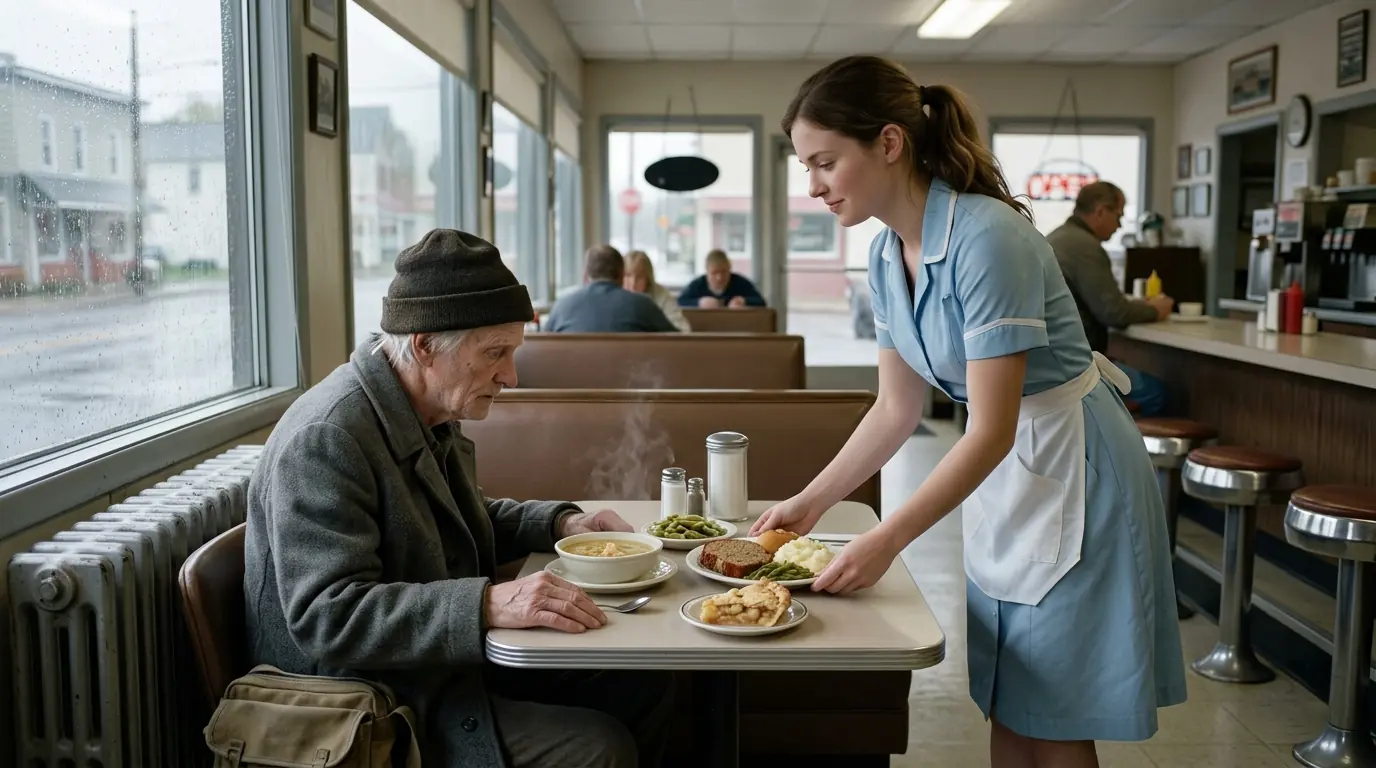
He was thin, with a stooped back and rain clinging to his gray coat. His hair, white and uneven, stuck out from beneath a worn wool cap. His shoes were polished once, maybe years ago, but now the leather was cracked and darkened from the storm. He carried no umbrella, only a small canvas bag pressed against his chest as if it held everything he owned.
For a moment, no one greeted him.
A couple near the window glanced up, then looked away. Two men at the counter lowered their voices. The old man stood near the entrance, blinking against the light, uncertain whether he was welcome.
Emma straightened.
“Hi there.” she said gently. “Come on in. You must be freezing.”
The old man looked at her with pale blue eyes that seemed both tired and alert.
“I don’t want to be trouble.” he said.
“No trouble at all.” Emma picked up a menu and walked toward a booth near the radiator. “This spot is warm.”
He hesitated before following her. Water dripped from the hem of his coat onto the floor, and he looked down as if ashamed of each drop.
“I can clean that up.” he murmured.
Emma smiled. “That’s my job, not yours.”
He sat slowly, wincing as his knees bent. Up close, Emma noticed his hands. They were large, rough, and trembling slightly, with scars across the knuckles and dark half-moons beneath the nails. Hands that had worked hard for many years.
She set the menu before him.
“What can I get you to drink?”
“Just water, please.”
“Coffee is fresh.”
He shook his head. “Water is fine.”
Emma had heard that tone before. It was not dislike. It was calculation. The voice of someone measuring every penny before allowing himself even a small comfort.
She nodded. “Water it is.”
When she returned with the glass, the old man had not opened the menu. He sat with both hands folded on the table, staring at the prices.
Emma waited.
Finally, he cleared his throat. “What’s the cheapest thing you have?”
“The soup is five dollars.” Emma said.
The old man’s face tightened.
“Is there anything smaller?”
Emma looked at him more carefully. His cheeks were hollow. His lips had a faint bluish tint from the cold. He was trying to remain dignified, but hunger was written plainly across him.
She lowered her voice. “Are you very hungry?”
He looked away.
That was answer enough.
Emma took the menu from the table. “We have a special today.”
He frowned. “I don’t see it listed.”
“It’s not on the menu.”
“What is it?”
“Chicken soup, meatloaf, mashed potatoes, green beans, and pie.”
His eyes widened slightly. “I can’t afford that.”
“You can today.”
“No, miss, I don’t take charity.”
Emma nodded slowly, respecting the pride in his voice. “Then don’t. I messed up an order earlier. Kitchen already made it. If nobody eats it, we throw it out.”
That was not true.
The old man studied her, and for a second Emma wondered if he knew.
“What’s your name?” he asked.
“Emma.”
“I’m Arthur.”
“Nice to meet you, Arthur.”
He looked at the table. “I can pay two dollars.”
Emma smiled softly. “Then today’s special costs two dollars.”
Arthur’s throat moved as he swallowed.
“All right.” he whispered.
Emma went to the kitchen, where the cook, Miguel, was scraping the grill.
“Miguel, I need a meatloaf plate, chicken soup, green beans, mashed potatoes, and a slice of apple pie.”
He raised an eyebrow. “For who?”
“Table six.”
“The old guy?”
“Yeah.”
“Rosie approved?”
Emma pulled five dollars from her apron pocket and set it near the register. It was part of her tips from the lunch rush, money she needed for gas.
“I’m paying.”
Miguel looked at her with quiet understanding.
“You sure?”
“No.” Emma said. “But do it anyway.”
When she carried the food out, Arthur stared as if he had forgotten what a full plate looked like. Steam rose from the soup. Butter melted into the potatoes. The meatloaf was thick and covered in gravy.
Emma set everything before him.
Arthur did not touch the fork right away.
“Miss Emma.” he said, voice low. “I know what you did.”
She opened her mouth to deny it, but his expression stopped her.
“I won’t embarrass you by arguing.” he continued. “But I will say thank you properly.”
“You already did.”
“No.” He looked at the food, then back at her. “You looked at me like I was still a man. That is different.”
Emma felt something twist in her chest.
She had no grand answer for that. So she only said, “Eat before it gets cold.”
Arthur ate slowly at first, as if his body had to remember how to receive kindness. Then his hunger won. He finished the soup, half the meatloaf, all the potatoes, and the pie last, with careful small bites. Emma refilled his water and brought him coffee anyway, placing it beside him without comment.
When he reached for his coat after the meal, the rain had eased but had not stopped.
“Where are you headed?” Emma asked.
Arthur paused.
“South end of town.”
“That’s a long walk.”
“I’ve walked farther.”
“You’ll get soaked again.”
He gave a faint smile. “I’ve been soaked before.”
Emma should have let him go. She had tables to clean, floors to sweep, and another shift starting at four. But something about the old man’s careful dignity made it impossible to look away.
“Wait here.” she said.
She went to the back room, opened her locker, and pulled out her old navy rain jacket. It had a small tear near the sleeve, but it was warm.
When she handed it to him, Arthur immediately shook his head.
“No.”
“It’s just a jacket.”
“You need it.”
“I have another one at home.”
That was also not true.
Arthur’s eyes narrowed, but he took the jacket with both hands, gently, as if it were a fragile thing.
“I’ll bring it back.” he said.
“No rush.”
He reached into his coat pocket and placed two damp dollar bills on the table. Then he searched again, found three pennies, and added them carefully.
Emma wanted to push them back, but she understood by then that refusing would hurt him more than accepting.
“Thank you.” she said.
Arthur nodded, put on the jacket, lifted his canvas bag, and walked toward the door.
Before leaving, he turned.
“Emma Whitaker.” he said, reading her name tag. “You have your mother’s kindness.”
Emma froze.
“My mother?”
Arthur seemed to realize he had said too much. His face shifted, closing slightly.
“Kindness has a familiar shape.” he said.
Then he stepped out into the rain.
For the rest of the day, Emma could not stop thinking about that sentence.
You have your mother’s kindness.
Her mother, Clara Whitaker, had been known for kindness. She was the kind of woman who brought casseroles to grieving neighbors, gave rides to strangers, and slipped grocery money into church envelopes without signing her name. But Arthur had spoken as if he knew her.
When Emma got home that night, exhausted and damp from walking without her rain jacket, she found her father sitting at the kitchen table, sorting bills beneath the yellow light.
“You’re late.” Daniel said.
“Double shift.”
“You eat?”
“At work.”
He knew better than to believe her, but he did not press.
Emma dropped her bag onto a chair. “Dad, did Mom know an old man named Arthur?”
Daniel looked up slowly.
“Arthur who?”
“I don’t know. White hair. Blue eyes. Maybe in his seventies. He came into the diner today.”
Daniel leaned back, searching his memory.
“Your mother knew half the town.”
“He said I had her kindness.”
Her father’s face softened with sadness. “A lot of people would say that.”
“Did she ever help someone named Arthur?”
Daniel rubbed his jaw. “There was an Arthur Langley years ago. Owned the old furniture workshop by the river before it closed. Quiet man. His wife died young. Your mom used to bring food to him when he got sick one winter.”
“Arthur Langley.” Emma repeated.
“Haven’t heard that name in years. People said he moved away.”
Emma thought of the canvas bag, the soaked coat, the cracked shoes.
“I don’t think he moved far.”
Daniel looked at her carefully. “Is he all right?”
“I don’t know.”
That night, Emma lay awake in the small room she had never gotten around to repainting after high school. Rain tapped the window. Her mother’s old quilt covered her legs. She thought about Arthur walking alone toward the south end of town, wearing her jacket, carrying his little bag.
The next morning, she arrived at Rosie’s before sunrise and found the jacket folded neatly on the bench outside the diner door.
On top of it sat a small wooden bird.
It had been carved by hand, no larger than her palm, smooth and delicate, with tiny lines etched into the wings. A note was tucked beneath it.
Miss Emma,
I returned the jacket as promised. Thank you for remembering that old men get cold too.
Arthur
Emma held the wooden bird for a long time.
After that, Arthur began coming to the diner every Thursday at two.
At first, he ordered only soup. Emma made sure the bowl was always full. Sometimes she paid the difference. Sometimes Miguel added extra bread without saying anything. Rosie pretended not to notice.
Arthur never asked for help, and Emma never called it that.
They developed small rituals. He sat at table six near the radiator. Emma brought coffee before he requested it. He paid whatever coins he had and always left something behind. A carved leaf. A tiny wooden heart. A little chair no bigger than a matchbox. Each piece was beautifully made, shaped by hands that still remembered skill even when life had taken so much else.
One Thursday, snow fell early.
Arthur arrived shivering badly, his lips pale, his breathing uneven. Emma rushed over.
“Arthur, sit down.”
“I’m fine.”
“You’re not fine.”
“I just need a minute.”
His knees buckled before he reached the booth.
Emma caught his arm and called for help. Miguel came running. Rosie dialed 911. Arthur tried to protest, but his voice was weak.
At the hospital, Emma stayed in the waiting room long after her shift ended. She had no reason to be there, not officially. She was not family. She was not his emergency contact. But leaving felt wrong.
Near midnight, a doctor finally came out.
“Are you Emma Whitaker?”
She stood quickly. “Yes.”
“He’s asking for you.”
Arthur lay in a hospital bed, smaller than she remembered, with an oxygen tube beneath his nose. His wool cap was gone, revealing thin white hair. His canvas bag sat on a chair nearby.
“You should be home.” he said.
“You collapsed in my diner.”
“Your diner?”
“Rosie’s diner. But emotionally, mine.”
He smiled weakly.
The room grew quiet.
“Arthur, do you have family I should call?”
His smile faded.
“No one who would come.”
Emma sat in the chair beside him. “I’m sorry.”
“I had a daughter once.”
The words hung in the air.
Emma did not speak.
Arthur stared at the ceiling. “Her name was Helen. She had your stubborn chin. Her mother died when Helen was fourteen, and I did not know how to be soft after that. I loved my daughter, but love trapped inside pride can become a cruel thing.”
His voice trembled.
“She wanted to study art. I wanted her to run the workshop. We fought. Terrible words. Mine were worse. She left at nineteen. I told myself she would come back when she needed money. She never did.”
Emma’s heart tightened.
“Did you look for her?”
“Too late.” Arthur closed his eyes. “By the time I swallowed my pride, I found out she had died in a car accident in Ohio. She had a little girl I never met, adopted by her father’s relatives. I was too ashamed to find the child.”
Emma whispered, “Arthur.”
“I spent years building furniture for people who had homes while losing my own. Bad investments. Medical bills from my wife’s illness. Taxes I ignored. Then the workshop closed, and shame became easier than asking anyone for help.”
He turned his head toward her.
“Your mother brought me soup once when I was sick. She sat in my workshop and told me grief could either lock a door or teach a hand to open one. I did not understand her then.”
Emma’s eyes filled.
“That sounds like Mom.”
“She was a good woman.”
“The best.”
Arthur reached toward the canvas bag with effort. Emma picked it up and placed it beside him.
He pulled out a small bundle wrapped in cloth.
“I made something for you.”
“Arthur, you didn’t have to.”
“I know.”
Inside the cloth was a wooden music box. The lid was carved with tiny branches, birds, and a little diner sign. Emma opened it carefully. A soft melody began to play, faint and trembling but beautiful.
“My wife loved that song.” Arthur said. “I could not remember all of it, but I remembered enough.”
Emma held the box as tears blurred her vision.
“It’s beautiful.”
“Young people always say that when old people give them strange things.”
“No.” She laughed through tears. “It really is.”
Arthur watched her with an expression Emma could not read.
“Why are you so kind to me?” he asked.
Emma wiped her cheek. “Because someone should be.”
For a long moment, Arthur said nothing.
Then he whispered, “That answer could save a life.”
Arthur remained in the hospital for four days. Emma visited every evening after work. She brought crossword puzzles, clean socks, and soup from Rosie’s. Daniel drove her twice when snow made walking dangerous. Noah came once and awkwardly handed Arthur a drawing from his art class, which Arthur praised so sincerely that Noah stood taller for the rest of the night.
When Arthur was discharged, Emma learned the truth of his living situation.
He had been sleeping in the back room of the abandoned furniture workshop by the river.
The building had no proper heat. One window was cracked. The roof leaked in two places. He had hidden it well, but not well enough.
Emma stood inside the old workshop, staring at dusty workbenches, stacked lumber, broken tools, and tarps spread across corners where rain had seeped through.
“You can’t stay here.” she said.
Arthur looked embarrassed. “It’s mine.”
“It’s freezing.”
“I manage.”
“No, you survive. That’s different.”
He sighed. “And where would I go?”
Emma did not have a good answer. Her house was too small, money too tight, and her father too proud to accept another mouth to feed without worrying himself sick.
But she could not leave Arthur there.
So she started with what she could do.
She asked Rosie if Arthur could sit in the diner during slow hours. Rosie agreed with a grumble that fooled no one. Miguel gave him leftovers after closing. Daniel came with a toolbox and repaired the cracked window. Noah helped sweep the workshop and carried out rotten boards. A church group donated blankets. Someone from town, hearing whispers of the situation, dropped off a space heater.
Emma organized all of it quietly.
Arthur resisted at first.
“I don’t want to be a project.” he snapped one afternoon.
Emma stood in the doorway of the workshop, holding a bag of groceries.
“You’re not a project.”
“Then stop fixing me.”
“I’m not fixing you.”
“What do you call this?”
She set the groceries down.
“I call it not letting someone freeze.”
His face hardened. “I was fine before you came along.”
Emma looked around the cold, leaking workshop.
“No, Arthur. You were alone. That’s not the same as fine.”
The words landed harder than she expected.
Arthur turned away, his shoulders shaking. For a moment, Emma thought he was angry. Then she realized he was crying.
She stepped closer but did not touch him.
“I’m sorry.” she said softly.
“No.” His voice broke. “You’re right.”
From then on, something changed.
Arthur began accepting help, but more than that, he began giving what he still had.
He taught Noah how to sand wood with the grain, not against it. He repaired three broken chairs from Rosie’s diner. He made a new sign for the front window, carved from oak and painted by hand. Customers noticed. Compliments followed. Then requests.
Could he fix a rocking chair?
Could he restore an old table?
Could he build a small bookshelf?
Arthur tried to refuse payment, but Emma insisted.
“You are working. You get paid.”
“I’m old.”
“You’re skilled.”
“That doesn’t matter much anymore.”
“It matters to me.”
With each small job, Arthur seemed to return to himself. His back remained bent, his hands still trembled, but his eyes sharpened. He began arriving at the diner not as a man seeking shelter but as a craftsman carrying purpose in a canvas bag.
Emma watched him come alive piece by piece.
At the same time, her own life remained heavy.
Bills did not care about kindness. Her father’s knee worsened. Noah needed money for college applications. The landlord hinted that rent might rise after the new year. Emma picked up extra shifts at night, cleaning offices in the next town after finishing at Rosie’s.
She told no one how tired she was.
One evening in March, Arthur found her sitting behind the diner after closing, elbows on knees, face buried in her hands.
He stood quietly beside the back steps.
“Bad day?” he asked.
Emma straightened quickly. “I’m fine.”
Arthur gave her a look.
She sighed. “I hate that word now.”
He sat beside her with careful effort.
For a while, neither spoke.
Then Emma said, “I got accepted.”
“To what?”
“Community college. Nursing program.”
Arthur turned to her. “Emma, that’s wonderful.”
She nodded, but tears slipped down her face.
“I can’t go.”
“Why not?”
“Because tuition costs money. Books cost money. Gas costs money. Time costs money. My family needs me working, not sitting in classrooms.”
Arthur was quiet.
Emma wiped her tears angrily. “I shouldn’t have applied. It was stupid.”
“No.” Arthur said firmly. “Hope is never stupid.”
“It is when it makes reality hurt worse.”
Arthur looked at the alley behind the diner, where rainwater glistened under a streetlamp.
“My daughter once told me the same thing.”
Emma turned to him.
“She said art school was stupid because dreams were for people with money. I told her she was right.” His face tightened with regret. “I thought I was protecting her from disappointment. Really, I was teaching her to expect nothing from life.”
He looked at Emma.
“I won’t make that mistake twice.”
Emma shook her head. “Arthur, you can’t fix this.”
“No. But I can remind you of something. A closed door is not always locked. Sometimes people are just too tired to push.”
She gave a sad laugh. “That sounds like something my mom would say.”
“She was smarter than I ever was.”
Spring came slowly to Maple Falls.
The river thawed. The trees along Main Street began to bud. Rosie’s Diner filled with people talking about gardens, baseball, and road repairs. Arthur’s small repair work grew into a quiet little business. He made shelves, fixed cabinets, restored old trunks, and carved custom signs.
Emma helped him keep track of orders in a notebook. Noah made flyers. Daniel built a sturdy ramp for the workshop entrance.
For the first time in years, Arthur had visitors not because he was pitied, but because people needed him.
One Saturday, Emma arrived at the workshop and found Arthur dressed in his best shirt, the one with pearl buttons and a collar pressed flat. His hands shook as he swept sawdust from the floor.
“What’s going on?” she asked.
Arthur avoided her eyes. “Someone is coming.”
“A customer?”
“Not exactly.”
Before Emma could ask more, a car pulled up outside.
A woman in her forties stepped out. She had auburn hair, a cautious expression, and a young teenage boy beside her. Arthur gripped the broom so tightly his knuckles whitened.
The woman walked inside.
“Arthur Langley?” she asked.
Arthur nodded.
“I’m Rebecca Hale.” Her voice trembled. “My mother was Helen Langley.”
Emma’s breath caught.
Arthur seemed to shrink and stand taller at the same time.
Rebecca reached into her purse and pulled out a folded photograph. “I wasn’t adopted by relatives. My father raised me. He told me about you when I was older, but I was angry for a long time. Then I saw a flyer online. Langley Woodwork. Maple Falls. I wondered if it was you.”
Arthur stared at the photograph but did not take it.
“I don’t deserve to ask forgiveness.” he said.
Rebecca’s eyes filled. “Maybe not. But I came anyway.”
The teenage boy looked around the workshop. “Did you really make all this?”
Arthur looked at him, startled.
“Some of it.”
“It’s cool.”
The boy’s simple words broke something open.
Arthur covered his face with one hand. Rebecca stepped forward, unsure at first, then embraced him. Arthur sobbed like a man who had been holding his breath for thirty years.
Emma quietly stepped outside.
She stood near the river, letting them have their moment. Her own tears came, not from sadness exactly, but from witnessing a door finally open after decades of regret.
Later, Arthur found her by the water.
“You did this.” he said.
Emma shook her head. “No. The flyer did.”
“You made the flyer happen. You made the work happen. You made me believe I was allowed to be found.”
Emma looked at him softly. “I’m glad she came.”
Arthur nodded, eyes wet. “So am I.”
After that, Rebecca and her son, Miles, visited twice a month. The first visits were awkward. There were long silences, careful questions, and grief too old to untangle quickly. But Arthur tried. He listened more than he spoke. He apologized without defending himself. He showed Miles how to carve simple shapes. He told Rebecca stories about Helen as a little girl, how she used to draw birds on scraps of wood and hide them in his toolbox.
Emma watched from a distance, grateful.
She thought that might be the gift Arthur received for all the kindness stirred back into his life.
She did not know her own was still coming.
In early June, Rosie’s Diner received notice that the building had been sold.
The new owner planned to renovate the block, raise rent, and replace the diner with a modern café. Rosie cried in the kitchen for the first time Emma had ever seen. Miguel cursed in Spanish while chopping onions with unnecessary force. Customers were furious, but fury did not pay commercial rent.
Emma felt the news like a physical blow.
Rosie’s was not just her job. It was the place where she had held herself together after her mother died. It was where Noah came after school, where Daniel met friends for coffee, where Arthur had walked in from the rain and changed all their lives.
“What will you do?” Arthur asked her that evening.
“I don’t know.”
“What about nursing school?”
Emma laughed bitterly. “Now? I need another job.”
Arthur studied her, but said nothing.
Two weeks later, he asked Emma to come to the workshop before her shift.
When she arrived, Rosie, Miguel, Daniel, Noah, Rebecca, Miles, and several regular customers were already there. Emma stopped in the doorway, confused.
“What is this?”
Arthur stood beside a workbench with a folder in his hand. He looked nervous but determined.
“Emma Whitaker.” he said. “Three years ago, you lost your mother. Since then, you have carried more than most people twice your age. You have fed people, comforted people, defended people, and worked until your own dreams nearly disappeared.”
Emma glanced around, embarrassed. “Arthur, what are you doing?”
He continued.
“When I came into Rosie’s Diner, I was hungry, cold, ashamed, and nearly finished with this world. You gave me a meal, a jacket, and dignity. Because of you, I found my granddaughter. Because of you, this old workshop breathes again. Because of you, I remembered I was not done living.”
Emma pressed her lips together as tears gathered.
Arthur opened the folder.
“Years ago, before I lost everything, I owned more than this workshop. I owned the empty storefront next door to Rosie’s Diner. I thought the bank had taken it, but Rebecca helped me find the paperwork. It was tied up in old tax confusion, but it is still mine.”
Emma stared at him.
Arthur’s voice shook.
“I have sold it.”
“Arthur.”
“Don’t interrupt an old man during his speech.”
A few people laughed softly.
“With the sale, I paid my debts. I set aside money for repairs here. And I created a scholarship fund at Maple Falls Community College.”
Emma’s heart began pounding.
Arthur looked directly at her.
“The first recipient is you.”
The room went still.
Emma shook her head. “No.”
“Yes.”
“Arthur, I can’t accept that.”
“You can.”
“It’s too much.”
“So was a full meal when I had two dollars.”
She covered her mouth.
Arthur stepped closer and placed the folder in her hands.
“Tuition. Books. Transportation. Enough to reduce your shifts while you study. It is not charity. It is an investment in the kind of person this world needs more of.”
Emma could barely see through tears.
Rosie sniffed loudly. Miguel wiped his eyes with a towel and pretended he was not crying. Daniel stood frozen, pride and grief moving across his face. Noah grinned like the world had finally done something right.
Emma looked at Arthur.
“Why would you do this for me?”
Arthur smiled, old and gentle.
“Because someone should.”
The words returned to her from that hospital room, and she broke.
She hugged him carefully, mindful of his thin frame, and Arthur held her like a grandfather who had found another piece of family he did not know he was missing.
That fall, Emma started nursing school.
She still worked at Rosie’s, though fewer shifts. The diner did not close after all. The community fought harder than anyone expected, and the new owner, facing public pressure and a better offer from a local investor, sold the building to a cooperative formed by Rosie, Miguel, and several townspeople. Arthur carved the new sign himself.
Rosie’s Diner and Community Table.
Underneath, in smaller letters, he carved: Everyone deserves a place to sit.
Emma studied late into the night, often exhausted but no longer hopeless. Arthur helped Noah build a desk for her from reclaimed oak. Daniel repaired an old car so she could drive to campus. Rebecca sent care packages with notebooks, pens, and tea. Miles made her a crooked wooden bookmark that read Future Nurse Emma.
Some days were still hard.
There were exams she feared failing, bills that still came, and moments when grief for her mother returned suddenly, sharp as winter wind. But Emma had learned something from Arthur, and maybe from her mother too.
A life could be rebuilt quietly.
A family could form unexpectedly.
A single act of kindness could travel farther than anyone imagined.
Two years later, on a bright May morning, Emma graduated from nursing school.
She wore a white dress beneath her gown and carried a photo of her mother tucked inside her program. Daniel sat in the front row with Noah, who had grown taller and was heading to college himself in the fall. Rosie and Miguel cheered too loudly. Rebecca took pictures. Miles waved a handmade sign.
Arthur sat between them all, wearing a navy suit that Rebecca had bought him and a carved wooden bird pinned carefully to his lapel.
When Emma’s name was called, she crossed the stage with tears in her eyes.
The applause rose around her, but she heard Arthur’s voice above it all.
“That’s our girl.”
After the ceremony, Emma found him waiting beneath a maple tree outside the auditorium. He looked older now, more fragile, but peaceful in a way he had not been when she first met him.
“You did it.” he said.
“We did it.”
He shook his head. “No. You walked the road.”
“You helped me find it.”
Arthur reached into his pocket and pulled out a small key on a ribbon.
Emma smiled through confusion. “What’s this?”
“The key to the workshop.”
“Arthur.”
“I’m not giving it away today.” he said. “Don’t look so frightened. I’m not done annoying people yet.”
She laughed.
“But one day, it will be yours and Noah’s, if you want it. Not as a burden. As a place. A place where people can learn, repair, build, gather. Your mother believed broken things deserved patience. You believed broken people did too. Seems fitting.”
Emma closed her fingers around the key.
“I don’t know what to say.”
Arthur looked at the campus lawn, where families were taking photographs and graduates were embracing.
“Say you’ll keep opening doors.”
Emma leaned her head against his shoulder.
“I will.”
Years later, people in Maple Falls would tell the story many different ways.
Some said it began when a hungry old man walked into a diner during a storm. Others said it began long before, when Clara Whitaker brought soup to a grieving widower who had forgotten how to accept kindness. Noah believed it began with a wooden bird left on a bench. Rosie insisted it began with meatloaf, because most important things in life were improved by gravy.
Emma had her own answer.
It began the moment she looked at a man everyone else had looked past and decided his dignity mattered.
Arthur Langley did not make her rich in the way people usually meant. He did not hand her a mansion, a fortune, or a perfect life. What he gave her was better. He gave her a future she had almost surrendered, a family she never expected, and proof that kindness, when given without calculation, often returns in forms too deep to measure.
And every Thursday afternoon, even after Emma became Nurse Whitaker at Maple Falls Medical Center, she still stopped by Rosie’s Diner.
At table six, near the radiator, she would sit with Arthur, drink coffee, and listen to him complain that the pie crust was better in the old days.
Then he would smile, slide a new carving across the table, and pretend not to notice when she cried.