The first time Evelyn Parker saw the homeless boy, he was sitting behind her bakery with his knees pulled to his chest, staring at a torn paper bag like it might turn into dinner if he waited long enough.
It was a cold November evening in Burlington, Vermont. The streets were slick from earlier rain, and the wind carried the sharp smell of winter coming early. Evelyn’s bakery, Parker’s Hearth, had just closed for the night. The display case was empty except for a few leftover rolls, two blueberry muffins, and a small loaf of bread that had cracked unevenly while baking.
Evelyn was seventy-six years old, small and thin, with silver hair pinned neatly at the back of her head and soft gray eyes that had watched too many seasons pass through the front window. She wore a flour-dusted apron over a faded blue dress, sensible black shoes, and a cardigan with one loose button she kept meaning to fix.
For forty years, she had opened the bakery before sunrise.
Her late husband, Thomas, had built the wooden counter himself. Their daughter, Claire, had once done homework beside the oven while cinnamon rolls cooled on trays. But Thomas had passed away twelve years earlier, and Claire now lived across the country with a family of her own. She called every Sunday, always asking Evelyn to retire and move closer.
Evelyn always said, “Soon.”
But she never meant it.
The bakery was not just a business. It was the last place where her life still sounded familiar.
That evening, she stepped into the alley with a bag of trash in one hand and a tray of leftover bread in the other. She planned to leave the bread near the back door for Mr. Alvarez, the night janitor from the bank, who sometimes stopped by after his shift.
Then she saw the boy.
He could not have been more than ten. His brown hair was messy, his coat too thin, and his sneakers so worn that one toe showed through the fabric. A faded backpack sat beside him. His cheeks were hollow, and his hands were red from the cold.
The boy looked up sharply when he heard her.
“I’m leaving,” he said quickly.
Evelyn stopped. “I didn’t ask you to leave.”
“I wasn’t stealing.”
“I didn’t say you were.”
His eyes moved to the tray in her hand.
Then away.
That small movement told Evelyn everything.
She had seen hungry people before. Pride had a particular posture. It looked down before asking for anything.
“What’s your name?” she asked.
The boy hugged his backpack closer. “Noah.”
“Noah what?”
He hesitated. “Noah Miller.”
“I’m Evelyn Parker.”
He nodded toward the sign above the back door. “I know. It says Parker’s Hearth.”
“So it does.”
For a moment, the wind moved between them.
Evelyn looked at the paper bag in his lap. Inside were two bruised apples and half a pack of crackers.
“Have you eaten dinner?” she asked.
Noah lifted his chin. “I’m fine.”
His stomach answered with a loud growl.
His face turned red.
Evelyn pretended not to hear it.
“I made too much soup,” she said.
He stared at her. “In a bakery?”
“I am capable of owning more than one pot.”
He almost smiled, then caught himself.
“I don’t have money.”
“I didn’t ask for money.”
“I can’t take charity.”
Evelyn looked at him gently. “Then don’t call it charity. Call it dinner.”
Noah did not move.
Evelyn opened the back door and held it wide. Warm air drifted into the alley, carrying the smell of yeast, butter, and vegetable soup.
“You can sit near the oven,” she said. “You can leave whenever you want. But I won’t let a child eat crackers in an alley while I have soup on the stove.”
His eyes narrowed. “Why?”
“Because I still know right from wrong.”
Noah looked at the dark end of the alley, then at the warm light behind her.
At last, he stood.
Inside, the bakery was quiet. The ovens had been turned off, but warmth still clung to the brick walls. Evelyn led him to a small table in the back kitchen and set down a bowl of soup, two buttered rolls, one muffin, and a mug of hot chocolate.
Noah stared at the food.
“That’s too much,” he whispered.
“No,” Evelyn said. “Too much would be cake before soup.”
He looked up quickly. “There’s cake?”
She smiled. “Eat first. Negotiate later.”
He picked up the spoon with careful fingers. At first, he took small bites, as though afraid the bowl might be taken away. Then hunger overtook caution. He ate quickly, silently, stopping only to breathe. Evelyn turned toward the sink and washed dishes so he would not feel watched.
When he finished, he looked embarrassed.
“I’m sorry.”
“For what?”
“For eating fast.”
Evelyn placed another roll on his plate. “Bread doesn’t mind.”
Noah touched the roll but did not eat it.
“For later?” she asked.
He nodded.
Evelyn wrapped two more rolls and a muffin in paper and placed them beside him.
“Where are your parents, Noah?”
His hand tightened around the mug.
“My mom died.”
Evelyn’s heart sank. “I’m sorry.”
He looked at the table. “My dad left before that.”
“Who takes care of you?”
He shrugged.
That shrug was too heavy for a child.
“Noah.”
“I was staying with my uncle,” he said quietly. “He said I could stay until he found work. But then he got mad. He said I ate too much. He told me to go find somewhere else.”
Evelyn closed her eyes briefly.
“How long ago?”
“Three days.”
She sat across from him slowly.
“You’ve been outside for three days?”
“I found places.”
“That is not the same as being safe.”
He looked away. “People don’t like homeless kids. They think you did something wrong.”
Evelyn reached across the table but did not touch him.
“Listen to me. Being hungry is not wrongdoing. Being abandoned is not wrongdoing. Being a child who needs help is not wrongdoing.”
His eyes filled, but he blinked hard.
“I’m not crying,” he said.
“I didn’t say you were.”
The words were familiar now, and this time he almost smiled.
Evelyn called the local family shelter that night. They were full. She called the church. No immediate placement. She called a social worker whose number she still had from a winter food drive. A proper emergency process would begin in the morning, but for that night, the answer was complicated.
Evelyn hated complicated answers when a child needed a simple bed.
So she made one upstairs.
Above the bakery was a small apartment where she sometimes rested between early morning baking and afternoon customers. It had a couch, a narrow bed, a bathroom, and old quilts folded in a cedar chest.
Noah stood in the doorway of the apartment, clutching his backpack.
“I can’t stay here.”
“You can.”
“What if I steal something?”
Evelyn looked at him. “Are you planning to?”
“No.”
“Then we’ll both take the risk.”
He looked startled by her trust.
That night, Noah slept on the couch beneath a quilt Thomas’s mother had sewn fifty years earlier. Evelyn slept lightly in the bedroom, waking twice to check on him. Each time, he was curled tightly beneath the blanket, one hand gripping the wrapped roll he had saved.
In the morning, she found him washing his bowl at the sink.
“You don’t have to do that,” she said.
“I know.”
He kept washing.
Evelyn let him.
Some children needed chores the way others needed comfort. Chores made kindness feel less dangerous.
The next few weeks were difficult. The social worker, Denise Harper, helped locate temporary housing, but every placement seemed fragile. Noah’s uncle refused to take him back. Records were incomplete. Relatives were distant or unwilling. The system moved slowly, and winter moved fast.
Evelyn kept feeding him.
At first, he stayed only one night. Then another during a storm. Then he began coming by after school, though he was not officially enrolled anywhere yet. Evelyn helped Denise with paperwork. She found Noah clean clothes through the church donation closet. She packed lunches in brown paper bags and wrote his name on them in careful blue ink.
Noah resisted every gift.
“I’ll pay you back,” he said again and again.
Evelyn always answered, “Eat first.”
Eventually, he stopped arguing before meals.
But he never stopped helping.
He swept the bakery floor. He stacked napkins. He carried flour bags too small for his pride and too large for his arms. He learned to wash mixing bowls properly and how to scrape dough from the wooden table without wasting any.
One morning, Evelyn found him watching her knead bread.
“You have to feel when it’s ready,” she told him.
“How?”
She placed his hands on the dough.
“At first, it fights back. Then it softens. But if you give up too early, it never becomes what it should.”
Noah looked at the dough beneath his hands.
“People are like that?” he asked.
Evelyn smiled softly. “Sometimes.”
He did not answer, but he remembered.
By spring, Denise had arranged for Noah to enter a stable foster home with a couple named Paul and Miriam Bennett. They lived twenty minutes away, had raised three children, and wanted to give Noah a safe place without making him feel like a project.
The day he left, he stood in the bakery kitchen with his backpack on his shoulders.
“You won’t forget me?” he asked.
Evelyn’s eyes stung.
“Noah Miller, I have forgotten where I put my glasses twice this week, but I will not forget you.”
He gave a small laugh.
Then he hugged her.
It was quick and awkward, but real.
After that, Noah came every Saturday.
Paul and Miriam understood that the bakery mattered to him. They brought him after breakfast and picked him up before dinner. Evelyn taught him to bake bread, muffins, pies, and rolls. He learned how to measure by weight, how to proof dough, how to fold butter into pastry, how to tell when sugar had caramelized just enough.
But more than baking, he learned steadiness.
Every Saturday, the bell rang.
Every Saturday, Evelyn looked up and smiled.
Every Saturday, he had a place where he belonged.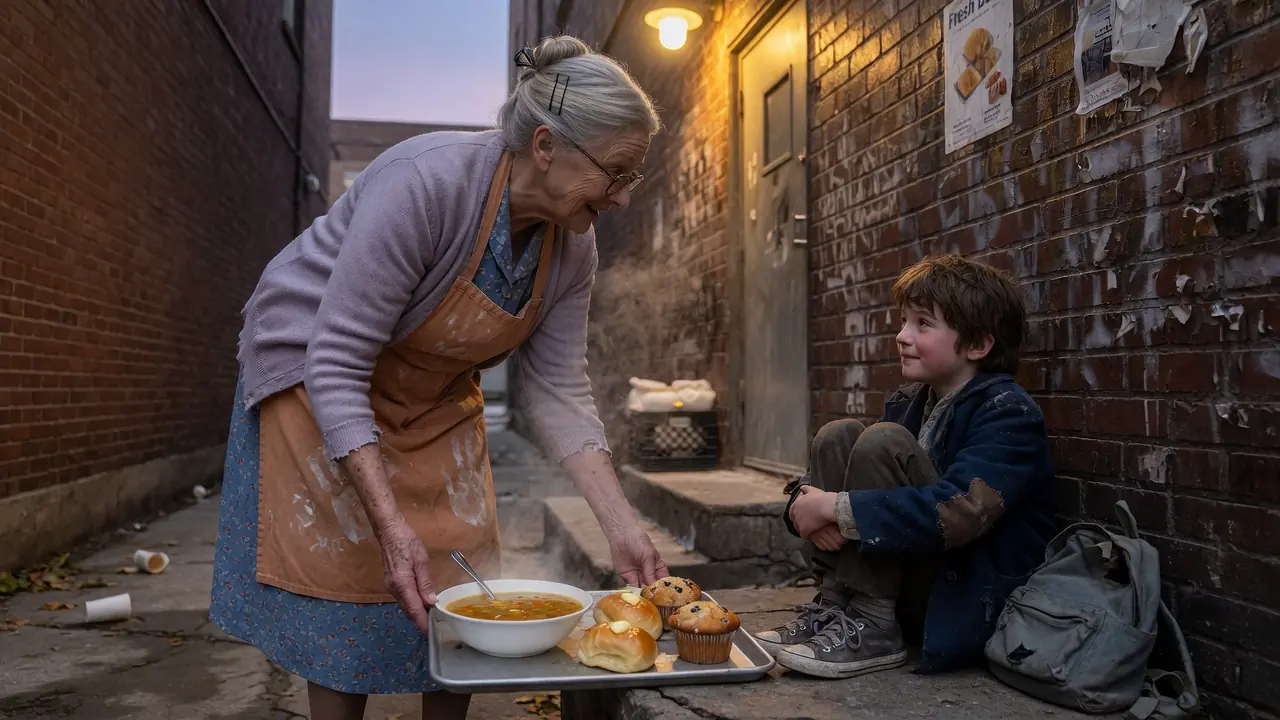
Years passed.
Noah grew taller. His shoulders broadened. His face lost the sharp hunger that had haunted it when they met. He did well in school, especially in math and business classes. By sixteen, he was helping Evelyn track bakery costs and suggesting changes she pretended not to appreciate.
“You underprice your rolls,” he told her one afternoon.
“I price them with love.”
“Love won’t pay the gas bill.”
“You sound like an accountant.”
“You need one.”
She flicked flour at him.
He laughed, and the sound filled the kitchen.
At eighteen, Noah graduated high school. Evelyn sat in the front row with Paul, Miriam, and Denise. When his name was called, he looked directly at her.
After the ceremony, he handed her a small box.
Inside was a keychain shaped like a loaf of bread.
“I know it’s not much,” he said.
Evelyn held it like it was gold. “It’s perfect.”
“I got into culinary school,” he added.
“I know.”
“And business school after that, maybe.”
“I know that too.”
He looked surprised. “How?”
“Because I’ve watched you turn hunger into plans.”
His eyes filled.
“I’m going to pay you back one day,” he said.
Evelyn smiled. “You already did.”
“No,” he said. “Not yet.”
Noah left for culinary school in New York. He called every Sunday evening. He sent pictures of pastries, kitchens, menus, and the first loaf of bread he made that he said “almost tasted like yours.”
Evelyn wrote back on bakery stationery.
Bread knows when your hands are impatient. Slow down.
Butter must stay cold, but your heart should not.
Never serve food without dignity.
Noah kept every note.
While Noah’s world expanded, Evelyn’s began to shrink.
Parker’s Hearth struggled.
The town changed. Rent increased. A chain bakery opened near the shopping center. Younger customers wanted online ordering, delivery apps, card readers, social media photos. Evelyn still wrote daily specials on a chalkboard and took cash from an old register that stuck in cold weather.
The bakery’s roof leaked. The ovens needed repair. Her hands ached in the mornings. Some days, lifting a tray felt harder than it should.
She did not tell Noah.
He was building his life. She refused to pull him backward.
By the time Evelyn turned eighty-four, she was three months behind on the building loan Thomas had once taken to expand the kitchen. A developer offered to buy the property. The price was not generous, but it would clear her debts.
The letter sat on the counter for two weeks.
She read it every night.
Then folded it again.
One cold evening, she stood in the kitchen after closing, looking at the empty ovens. For the first time in forty years, she whispered, “Maybe it’s time.”
The bell above the front door rang.
Evelyn frowned. She had locked the door.
She walked out front and froze.
Noah stood inside the bakery.
He was twenty-nine now, tall, clean-shaven, wearing a dark coat over a chef’s jacket. His eyes were the same, but steadier. In one hand, he held a leather folder. In the other, a small gold key.
Evelyn stared. “Noah?”
He smiled. “Hi, Mrs. Parker.”
“You’re supposed to be in New York.”
“I was.”
“How did you get in?”
He held up the keychain shaped like bread. “You gave me a spare when I was seventeen.”
“I gave that for emergencies.”
He looked around the empty bakery. “This counts.”
She tried to smile, but her face trembled.
He saw everything.
The tired ovens. The patched ceiling. The unpaid bills near the register. The way her hands curled slightly from pain.
His smile faded.
“You should have told me.”
“I didn’t want to worry you.”
“You fed me when I had nothing.”
“That was different.”
“How?”
“You were a child.”
“And you are family.”
The word broke her.
She turned away, but Noah came around the counter and hugged her gently. For a long moment, she let herself lean against him.
“I can’t keep it anymore,” she whispered. “I tried.”
“I know.”
“No, you don’t. I failed.”
He pulled back and looked at her firmly.
“You saved my life in this kitchen. Don’t you dare call this failure.”
She covered her mouth.
Noah opened the leather folder and placed papers on the counter.
“I came home because I’m opening something.”
“A restaurant?”
“Partly.”
He turned the first page. It showed drawings of the bakery, restored and expanded, with a community kitchen attached to the back.
“I bought the building note,” he said.
Evelyn stared at him. “You what?”
“I bought the debt from the bank through my company.”
“Noah…”
“And I paid off the remaining balance.”
She stepped back. “You cannot do that.”
“I already did.”
“That is too much.”
“No,” he said softly. “Too much was a ten-year-old eating crackers in an alley because no one cared whether he survived. This is just money.”
Evelyn shook her head, crying now.
Noah continued, “Parker’s Hearth is going to stay open. But we’re adding a community meal program for homeless children and families. Fresh bread every morning. Soup in the afternoon. Training classes for young people aging out of foster care. Paid apprenticeships. No shame. No questions at the door.”
He placed the small gold key in her hand.
“This is the first key.”
She looked down at it.
On one side, it was engraved:
PARKER’S HEARTH
On the other:
EAT FIRST.
Evelyn laughed through tears.
“You remembered.”
“I remember everything.”
The renovation took four months.
Evelyn complained constantly.
The new ovens were too shiny.
The ordering system was too complicated.
The young staff played music too loudly.
The restored sign looked “too proud.”
Noah listened and smiled because every complaint meant she was still there.
He preserved what mattered. Thomas’s wooden counter stayed. Evelyn’s chalkboard stayed. The back table where Noah first learned to knead bread stayed. The old bell above the door stayed. The upstairs apartment was repaired and turned into temporary emergency lodging managed properly through local family services.
On reopening day, the bakery was full before sunrise.
The new sign read:
PARKER’S HEARTH BAKERY & COMMUNITY KITCHEN
Fresh Bread. Warm Meals. Open Doors.
Inside, a framed photograph hung near the counter. It showed Evelyn and Noah from years earlier, both covered in flour, laughing beside a tray of uneven rolls.
Beneath it were the words:
Some Things Rise Because Someone Believed They Could.
During the opening ceremony, Noah stood in front of the ovens and spoke to the crowd.
“When I was ten,” he said, “I sat behind this bakery with crackers in my hands and nowhere safe to sleep. Evelyn Parker opened her back door. She gave me soup, bread, a blanket, and a place where I was not treated like a problem.”
Evelyn sat in the front row, holding a tissue.
“She taught me that food is not just food. It is dignity. It is safety. It is someone saying, ‘You are still worth feeding.’ Everything I have built began with the night she told me to eat first.”
The room blurred through Evelyn’s tears.
Noah turned toward her.
“This kitchen is for every child who needs what I needed. And it is named for the woman who gave it before anyone was watching.”
From that day on, Parker’s Hearth became more than a bakery.
Children came after school for soup and bread. Families received meals during hard weeks. Teenagers from shelters learned baking skills and earned real wages. Elderly neighbors came for coffee and conversation. No one was made to feel ashamed for being hungry.
Evelyn no longer woke at three every morning, but she still came in daily. She sat near the front window, greeted customers, corrected Noah’s recipes, and taught apprentices that bread dough could sense fear.
One winter evening, years after the reopening, a small girl stood hesitantly near the back door with a backpack and no coat.
Evelyn saw her from the kitchen.
Slowly, with her cane in hand, she walked over and opened the door.
The girl looked up. “I don’t have money.”
Evelyn smiled gently.
“I didn’t ask for money.”
The girl’s stomach growled.
Evelyn looked back at Noah, now standing by the ovens. Their eyes met.
He nodded, tears shining in his eyes.
Evelyn opened the door wider.
“Come inside, sweetheart,” she said. “Eat first.”
Years later, people in Burlington would say Noah Miller had saved Parker’s Hearth.
But Noah always corrected them.
“No,” he would say. “Mrs. Parker saved it years before I ever had the money. I only gave her kindness a larger kitchen.”
And Evelyn, who had once believed her bakery would close with her, lived long enough to see its lights stay on late into the evening, feeding children who came in from the cold.
She had given one homeless boy soup and bread.
In return, he gave her bakery a future.
More than that, he gave her the joy of knowing that the door she opened once would never close again.