“Get out. Trash like you is defiling my town.”
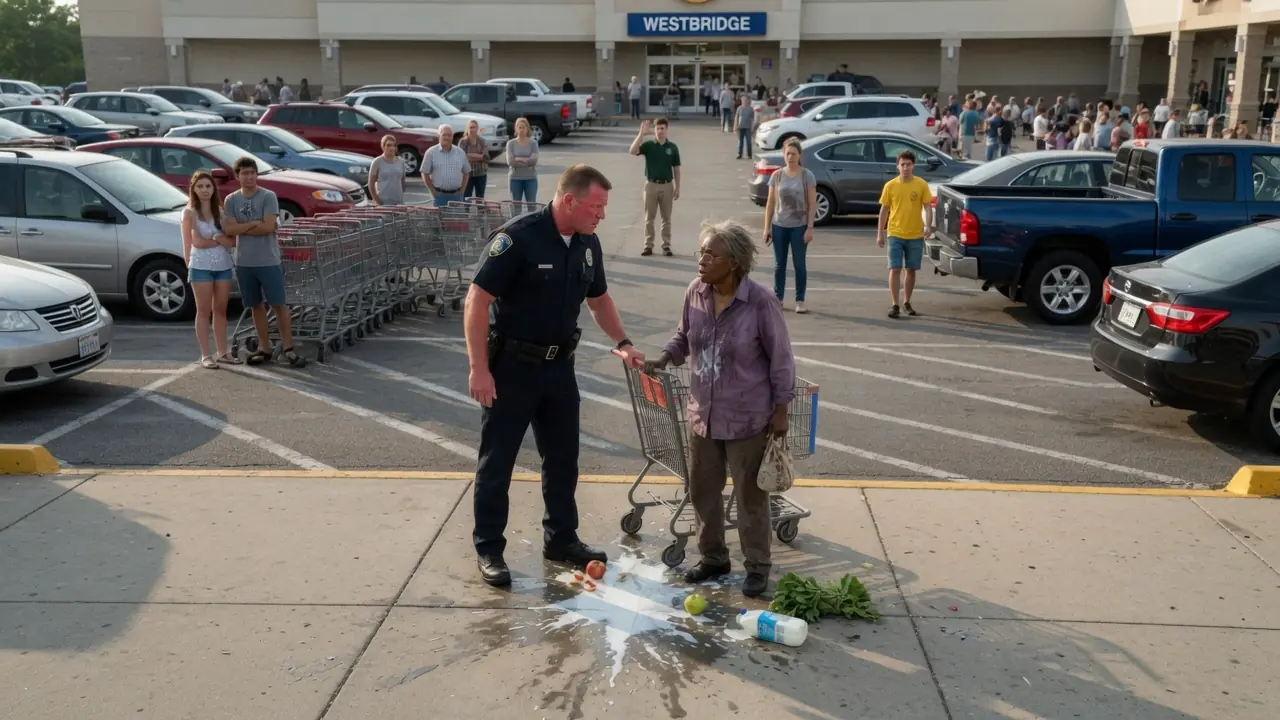
The roar of Officer Brent Marlow tore through the muggy air, followed by the sickening thud of his combat boot against the ribs of a seventy-year-old Black woman. Lucinda stumbled, her grocery bag scattering its contents, apples rolling under parked cars like the dignity of the town’s residents trampled daily. He sneered, adjusted his gun belt, and prepared to deliver another kick to the woman who was writhing in pain to teach her a lesson.
But that kick never landed. A hand, hard as cold steel, locked onto his ankle, yanking him backward and sending the bulky officer sprawling onto the scorching concrete. Brent scrambled to his feet, hand immediately fumbling for the grip of his pistol, curses spilling from his mouth as he intended to intimidate the death-wish fool. But he froze.
Standing before him wasn’t a fearful civilian, but Admiral Jonathan Reed in a crisp SEAL uniform, his eyes blazing with killing intent, and the rank insignia on his shoulders powerful enough to strip Brent of his badge on the spot. No warning. With a single brutal CQC maneuver, Reed twisted the officer’s arm behind his back. The sharp crack of bone was audible even over the distant wail of a siren.
As the officer screamed in pain and humiliation, Lucinda, the former undercover operative he dismissed as trash, slowly lifted her head, wiping a streak of blood from her lip. She showed no fear, her eyes meeting Reed steadily as her hand silently slid a USB drive containing the Blue Meridian Organization’s blacklist into his palm.
“Time to take out the trash, Admiral.”
Brent’s arrest in the parking lot was merely the opening shot. From that USB drive, stained with blood and tears, a legal storm swept through Westbridge, exposing the true faces of corrupt officials and judges hiding behind Blue Meridian. But when one snake is decapitated, other, more venomous heads will rise. An envelope stamped with a crimson phoenix, Project Rise, already lay on Reed’s desk, inviting him into the true war in the shadows.
Westbridge looked bright and harmless on the surface. White wooden houses, porches with flags, spotless parking lots, and wealthy white folks sipping morning coffee, as if nothing had ever cracked here. But that illusion vanished the moment a Black person stepped onto Main Street. Eyes on both sides of the road changed.
Glances turned sharp and fast like knife cuts. Car doors locked with a dry click that made the invisible line Westbridge had drawn long ago feel solid and loud. The older folks whispered with caution. A white woman in a cardigan leaned toward her friend and quietly said how odd it was to see a dark-skinned person out during the day, as if she didn’t know where they came from.
Her voice was soft, but heavy enough to thicken the air with unease. The town’s surface stayed calm, but underneath, everyone knew Westbridge sorted people the way it sorted trash. In that unspoken order, the police played the biggest role and enjoyed it. Especially Brent Marlow, an officer just under forty with a face that was always too confident to be pleasant.
He walked the sidewalk like he owned the land with his own money, hand on his belt like a reminder that he had the power to stop anyone just because. No one in town ever asked why Brent had never faced a successful complaint. Everyone already knew his record was spotless, not because he was kind, but because the entire police force believed the town needed someone with a hard hand like his. Black folks avoided eye contact.
Wells, a mechanic, would quietly say that seeing Brent was like meeting a toxic wind. You just hoped it passed without tipping you over. Brent understood that fear and fed off it. He liked the way people held their breath when he showed up, like he was a blade and they were something soft beneath it.
Mornings at the cafe next to City Hall were always Brent’s stage. He sat by the window, watching the street, sipping his coffee, scanning everyone who passed. If someone didn’t look the way he thought they should, he’d put his cup down and say his favorite line.
“In this town, skin color speaks before the mouth does.”
The old white men laughed loudly and said he was right. Then the conversation went on as if nothing had happened. The young server kept her head down, tray in hand, trying not to hear. Black folks chose a different route instead of walking past the glass because they knew all it took was for Brent to see them, and that alone could start trouble.
That line of his spread across town like an unwritten law. It didn’t hang on a bulletin board, but everyone in Westbridge knew it was real and that it shaped how life moved here. People could deny it out loud, but the way they dropped their gaze or changed direction said it all. In the middle of all that imbalance was Evelyn May Sutton, seventy-two years old, small in frame, wearing a faded lavender sweater frayed at the cuffs.
She lived alone in the last house on Holly Street, where a willow tree nearly covered the entrance. She was the type who bothered no one, watering her flower pots in the morning, buying chicken and vegetables from the small market in the afternoon, sitting on her porch in the evening, listening to the soft hiss of an old radio. But to Westbridge, she was a bright stain on the picture they’d tried to keep the same for decades. She was the only Black person who had lived that long without leaving, without bowing her head, without avoiding Main Street, even though everyone quietly understood that place wasn’t meant for her.
People said Evelyn was kind, but didn’t match. That nothing she did was wrong, but her presence in the middle of town looked like a crooked line in the drawing they wanted to keep uniform. She knew those eyes. She heard the murmurs behind her.
But she just wanted to live a normal life in the town where her parents and grandparents once lived, where every corner of her home held memories, where even the wind on the porch reminded her of something. What she didn’t know was that this town, which had never been kind to someone like her, was about to get much worse just because one man in a uniform believed her skin didn’t deserve respect. The message came to Brent on a sweltering afternoon, his favorite time to stir up trouble on the streets. His phone buzzed softly in his pocket.
Brent glanced at the screen and smiled the way someone does when they believe the whole town fits neatly in the palm of their hand. It came from an unknown number, but he recognized the sender immediately because in Westbridge, only one group kept up the habit of speaking in code. Blue Wolf, the internal alias for the Blue Meridian intermediary, the organization whose name alone made people here feel a chill in their spine. Brent opened the message.
The words were short, clear, cold.
Purple shirt. Follow. If there’s material, collect. Just a reminder.
He read it twice, then sneered like it was a weekend treat. Orders like this didn’t need questioning. He knew they watched him closely enough to make sure he’d follow through. Reminder?
The word Blue Wolf used never meant anything as soft as it sounded. In Westbridge, people had learned what reminder really meant. Pulling someone behind a parking lot, cornering them on a dark road, slamming them against a warehouse wall, and saying a few words that made sure they’d never step out of line again. Some had their noses broken, but no one investigated.
Some were threatened with having their families’ health insurance cut off if they ever opened their mouths again. Some were hit with charges so fast, they didn’t even know what was happening. These stories spread in whispers and lowered eyes because anyone who’d ever tried to speak up disappeared from town life in ways others would explain as they moved, even though no one ever saw a moving truck. Brent treated orders like this as part of the job.
He knew Blue Meridian relied on him to keep order in this part of town, to make sure anyone who tried to look too deep into the dirt backed off. Messages from Blue Wolf were brief, but enough for him to judge how serious things were. They mentioned material, which meant someone was holding something Blue Meridian didn’t want getting out. And the target was the woman in the purple shirt, which made Brent frown for a second before he chuckled.
He pictured Evelyn Sutton slowly walking through the grocery store with her old cloth bag. He’d seen her a few times, frail, quiet, the kind of person he believed would topple over with just a shove. The fact that they’d picked her struck him as odd. But that doubt slid away the moment he remembered the kind of power this group held.
If they wanted her reminded, it meant she had stepped into a forbidden zone they’d spent years building to hide their business. In this town, people understood the word reminder better than any dictionary ever could. A carpenter once said that after he dared to complain about the police holding his grandson’s car too long, he was hit with back-to-back tax audits for a month and fined for a violation he never knew existed. A young waitress told her friend that Brent had once threatened to have her father’s driver’s license revoked if she kept serving tables to Black customers.
These things never made the paper. No one filed complaints, but they became part of the town’s nervous system, training people to live smaller and speak less. Those who had dared to speak out ended up in situations outsiders would call coincidences. A man lost his job even though he’d performed well just because he said Brent had beaten a Black teenager.
A teacher was hit with a false policy violation after trying to report an assault behind the school. These scattered stories pieced together into a picture everyone recognized. Going up against the police, especially Brent, led to nothing but trouble. So when Brent read the message, he felt light, like he’d just been handed a chance to prove he was still Blue Meridian’s most reliable enforcer in Westbridge.
He had no hesitation about going after an elderly woman because to him, people weren’t something to consider. He thought in simple, cruel terms. Her skin, her age, her silence, all of it made her perfect for the role of victim. The kind no one would step up to protect.
He slipped the phone into his pocket, pulled his hat low, and felt that familiar excitement spreading across his chest like he was about to restore order to this town the way he liked it. He looked around the parking lot where people walked quickly to avoid his gaze. And he believed he had the lives of everyone here wrapped tight in his grip. With that message, he was sure.
This afternoon, Westbridge would remember him again. And Evelyn Sutton would become another example he created to remind people where they stood. Brent was not the kind of person to miss an opportunity when a target stepped into his line of sight, especially after the message from the Blue Wolf. He was leaning against his patrol car, his hand still brushing the edge of his phone as if feeling the aftertaste of that order, when he saw Evelyn Sutton approaching the supermarket entrance from a distance.
Her pace was slow, one hand holding a cloth bag, the other adjusting her thin glasses. Just an elderly woman going to buy a few things, but to Brent, the sight triggered something in his head like the opening blast of a siren. He tracked every step she took, his eyes narrowing like an animal catching the scent of the weakest prey in the herd. Evelyn nodded politely to an employee pushing carts while Brent stood several dozen steps away.
He hated people like her, quiet yet upright, as if her very existence was a small reminder that not everyone feared him. Even though the truth was that most people did. Brent scanned the parking lot, quickly taking in the cars parked on both sides, then stepped back a few paces and shifted his position to get a clear look at the cameras mounted on the poles. The space between the two rows of SUVs was the biggest blind spot where the cameras were partially blocked and usually recorded the pavement more than people.
That was the spot he often chose, a place where he could shove someone and there would be no footage pointing back at him. He walked toward that area, acting as if he were just on a routine patrol, and closed in at the exact moment Evelyn pushed a thin shopping cart out of the line. Brent grabbed the handle of the cart, taking control of it. Evelyn looked up, startled.
Her expression wavered as she recognized him. She had seen him on the street before, and that memory alone was enough to make her shoulders tense. Brent pulled the cart back slightly, then yanked it hard to the side. She lost her balance, her hand clawing at the air before she could grab the edge of the cart again.
“What are you doing?”
Her voice trembled both from the pain and from the fear of facing someone the whole town said was better left alone. That question, instead of giving Brent pause, made him laugh. The kind of laugh that kicked straight at another person’s dignity. He leaned in closer than necessary and spoke in a low voice, the one he used with people he considered beneath him.
“Don’t play dumb, old woman.”
His expression made it clear he had been waiting for this moment all morning. In Brent’s mind, this was not a spontaneous act, but the opening move of a lesson he intended to teach in the name of town order. He glanced around again, certain that for the next several dozen seconds there would be no one brave enough or foolish enough to intervene. A man who had just stepped out of his car saw the two of them standing close and turned away, pretending to be busy with his keys.
A woman pushing a stroller passed by faster than normal, keeping her eyes on the ground as if her footsteps were the most urgent matter in the world. That silence fed Brent’s confidence. He felt like he was the gravity of the parking lot, pulling all attention toward himself while no one had the strength to escape. Evelyn focused on her breathing, trying to calm herself.
She was used to Westbridge’s coldness, but that sudden yank made something else clear to her. Brent did not intend to stop at mere harassment. His eyes were not those of someone checking papers or asking questions. They were the eyes of someone who knew he was backed by a force ordinary people could never touch.
She wanted to step back, but her leg hurt. Her palm gripped the cart because she was afraid she might collapse onto the pavement. She glanced toward the lane on the left where there was a gap between the rows of cars and realized he had deliberately maneuvered her into this corner, a place where no one could see clearly. Brent reached up and adjusted the brim of his cap, an action far too calm, as if he were doing something perfectly ordinary in the middle of a sunny day.
He looked up toward the open space above where the camera pointed but did not fully sweep, then turned back to her with a slanted smile, the kind that made her pulse rush toward her heart. She looked at him, trying to gather what little composure she had left. But at that moment, Brent took another step forward, not a big one, just enough to make her understand that his intention was becoming more concrete. In Brent’s eyes, this was the perfect moment to begin the task the Blue Wolf had given him.
He did not need to say it out loud or issue threats in advance. He believed that his smile and the position he was standing in were warning enough. He had chosen the blind spot, isolated her, and secured his excuse to continue. To him, that order did not stop at surveillance.
It was an invitation to impose his power on someone he believed to be the weakest. And as he looked at Evelyn standing there, bracing herself against the pain in her leg, he knew the storm he wanted to create was ready. Brent stepped in close to Mrs. Evelyn as if trying to take over the space she was standing in. His breath, thick with cigarette smoke, blew straight into her face, making her instinctively pull her head back.
He looked her over from head to toe, his eyes filled with open contempt, the kind of look she’d seen from many people in this town, but never this close. Never so close that she could actually smell the violence coming off someone. Her hands gripped the edge of the shopping cart tightly. Her legs still hurt, but what unsettled her more was the nearness Brent forced between them.
He moved in another step, small, but enough to make her feel pinned in a corner with no way out. She tilted her head up to say something, a plea, a soft protest, but Brent struck before she could even get a word out. He shoved her hard in the shoulder. His motion was quick but forceful, slamming her back against the cart with a loud crack that rang out sharply across the parking lot.
She gasped in pain, both hands clinging to the cart to keep from falling. At that exact moment, a carton of milk inside the cart got crushed, popping open and splattering across her purple shirt. The white liquid splashed all over her chest and arms, soaking into the fabric ice cold, but the humiliation stung far worse. She stood there trembling, partly from the blow, mostly from the shame of being treated like an object in front of so many people.
Brent looked at her like he’d just broken a toy, no regret in his face at all. A young grocery store employee, a few yards away, had seen Mrs. Evelyn stumble. He took a step forward, hand halfway raised to help her, but before he could say anything, Brent spun around. His voice boomed loud enough for both rows of parked cars to hear, sharp and cold enough to make the kid freeze like he’d been punched in the chest.
Brent barked, “Touch her, and you’re fired. Got it?”
The words hit like a sentence. The employee flinched, backed away, blinking fast, one hand up to his cheek, more in shock than fear. He gave Mrs. Evelyn a look full of guilt, then dropped his eyes and turned away from Brent out of pure survival instinct. No one else dared step in.
A couple standing near their pickup truck saw what happened and quickly turned to load bags into the back. Their movements were rushed and clumsy, like they just wanted to disappear. An older white woman caught part of the scene, but pulled her handbag close, lips pressed tight, eyes down, as if the best thing she could do was pretend she hadn’t seen anything. In Westbridge, seeing a Black person mistreated wasn’t unusual.
It was like a long shadow everyone recognized, but no one wanted to stand in. The silence and avoidance from the people around the lot made one thing clear to Mrs. Evelyn. She was standing in a vacuum of justice, where no one planned to reach out, not even those with every reason to. Brent glanced around, quietly pleased that no one objected.
He liked this silence, the kind that made whatever he wanted to do seem acceptable. He turned back to Mrs. Evelyn. Her purple shirt, now stained with milk, looked like a mark he had left behind. And something about that made him feel satisfied in the worst way.
In his mind, she wasn’t a person. She was a symbol of everything he’d hated for years. Black people who didn’t stay in their place. People who weren’t afraid enough of him to get out of his way.
Mrs. Evelyn slowly raised a shaky hand to wipe the milk from her face. The motion was unsteady and slow, like she was clinging to the last piece of dignity she had. She looked down at her shirt, then up into Brent’s eyes. He was waiting, watching, ready to pounce if she gave him the reaction he wanted.
But she didn’t shout. She didn’t curse. She didn’t cry. She just let out a heavy breath, not from pain, but from the weight of a lifetime lived in a town that didn’t want to see her stand tall.
Brent saw that quiet endurance and gave a half smile, the kind that made it clear he took her silence as confirmation that he could keep going. All around, people kept their distance like it was the safe thing to do. They glanced over, then looked away, their eyes sliding off the truth like a habit learned to avoid trouble. A young woman stood by her car, holding her phone, but too scared to raise it.
To record, she only dared to peek sideways, hiding the device when Brent’s gaze swept her direction. The familiarity of seeing a Black person put in their place froze the whole lot in a silent compromise. No one helped. No one spoke.
And Mrs. Evelyn knew, with full clarity, that the worst part was still coming. The way Brent looked at her now was just the first twist before the real storm hit. Brent watched Evelyn as she struggled to keep her balance beside the shopping cart, her face full of confusion and pain. The sight irritated him in a strange way, as if her weakness itself were a challenge to the authority he was displaying in the middle of the parking lot.
He stepped in another half step, his hand shooting up so fast she had no time to react, and grabbed a fistful of her gray hair, yanking it backward. Her head snapped back, her neck letting out a dry, deep crack like old wood being split. The pain made her knees buckle, her vision blurring with shock. Her breath broke into ragged bursts, her hands trembling with each hard pull.
Brent held the force steady, not much, but enough to make the back of her neck burn. He wanted her to know this was not an accident, but a deliberate act. Evelyn tried to raise her hands to her hair to lessen the pull, but Brent shoved them away roughly, forcing her to bend even lower. The grocery bag from the supermarket was still hanging on the cart handle, and she instinctively reached for it as if clinging to a small piece of normalcy from her day.
Brent saw that and, impatient, yanked the bag out of her hand as though her attempt to hold onto it were a personal insult. The bag hit the ground. Several apples rolled away, lodging under a nearby car. A bundle of greens fell onto the dry, cracked pavement, smeared with dust.
Brent looked at the scattered groceries, then planted his foot on one apple and crushed it. The wet, heavy sound burst under his shoe. He shifted his weight and stepped on the greens, grinding them into flattened streaks of torn green. Each stomp pressed deeper into Evelyn’s dignity, as if he were proving to her that she and anything belonging to her were worth nothing.
A short distance away, a woman standing beside a small gray car had witnessed everything, from Brent yanking Evelyn’s hair to sending her groceries spilling onto the ground. She did not come closer. Her eyes were wide with fear. One hand covered her mouth to stifle her breathing.
She pulled her phone from her pocket, her fingers shaking as she dialed, her mouth pressed close to the device, her voice so low it was almost swallowed by the air. She said, “There’s a police officer assaulting an elderly woman. I’m in the supermarket parking lot, but I’m afraid he’ll hear me.”
Her voice caught at the end, her breathing uneven, knowing that what she was doing was no different from stepping into the town’s quicksand. She did not dare look up toward Brent, keeping the phone tight to her ear, her eyes darting around, hoping no one noticed. In this town, making a call like that was already an act of recklessness.
Brent seemed to sense a slight shift in the air, the presence of someone watching from afar, but he did not turn around. Instead, he bent down low, almost whispering directly into Evelyn’s ear. His tone sliced like a blade against flesh.
He said, “In this town, just breathing is already too much for you.”
The words struck her like an invisible kick, so blunt and cruel that she did not know what reaction was even possible. Her ears rang for a moment, whether from the insult or from his hand still clamped tight against her scalp. The parking lot seemed to stretch wider in a cold way. People stepped farther back, close enough to see, but not close enough to be pulled in.
A man standing by an open trunk held a case of bottled water and did not dare close it. Another person passed by, pushing a cart, walking quickly, but not so fast that it looked like fleeing. Eyes fixed on the asphalt, as if the ground had suddenly become the only thing worth noticing. That avoidance was not simple cowardice.
It was a survival reflex, shaped by years of witnessing scenes like this. They knew who carried power and who carried the wrong skin color by the town’s standards. They knew that siding with Evelyn could invite retaliation in many forms, from tickets left on doors to tax inspections to a poisonous rumor capable of ruining a life. Evelyn managed to keep just enough awareness not to collapse completely.
She forced herself to stay upright, both hands gripping the edge of the cart, the only support left in the space Brent had taken over. Her eyes were blurred, her neck burned from the hair pull, but the worst feeling was not the pain. It was the realization that everyone around her was avoiding her gaze. No one looked her in the eye.
No one offered a look of sympathy or encouragement. She stood there like a wrong-colored stain in the bright parking lot, like an error everyone wanted to pass by as fast as possible. And Brent, with the cruelty of someone who knew he was playing a role no one dared interrupt, felt even more clearly that the boundary between him and her was being erased in exactly the way he wanted. She drew in a trembling breath, trying to make herself smaller so as not to provoke him.
But that very smallness only excited Brent more. He enjoyed the feeling of someone backed into a corner, gasping with fear. He felt his irritation mix with a particular kind of pleasure, and he knew he was not ready to stop. In that moment, Evelyn understood that the space around her was closing in.
Like a pit slowly sealing shut. And Brent was the one filling it in with his casual brutality. Brent tightened the space between himself and Mrs. Evelyn one more step, then suddenly shoved hard, knocking her completely off balance. Her body slammed down onto the cold, hard concrete.
The impact sounded dry, heavy, and bitter, like a rock hitting an old sheet of tin. The noise made a few people nearby shudder. But no one moved. They only stole quick glances, then pretended to busy themselves with shopping carts or car doors, as if the cruelty unfolding just a few yards away had nothing to do with them.
Mrs. Evelyn lay on her side, one hand braced against the ground. Her breath came out in strained bursts. Gray hair tangled across her face, making her look so small it seemed fear could be packed into her without a single word. Brent stood over her, his shadow falling across her body like a sentence being handed down.
He tilted his head, his gaze sharpening into the look of someone who knew his victim had no one to defend her. Then he spat out the words that made people nearby instantly stare at the tips of their shoes.
“Get out of my town, you old purple trash.”
His voice was flat and cold without a hint of hesitation, as if he were tossing away something broken rather than insulting a human being. The words hit her no differently than a blow, her shoulders sagging a little more. And in that moment, she understood clearly that he did not see her as a person. In his eyes, she was a nuisance wrapped in the color he hated most.
A soft thud as an apple rolled across the ground, pushed by the wind, made her lift her head on instinct. But that small movement became the excuse Brent needed to step closer. He raised his foot and drove it straight into her ribs. The force was so strong her body curled inward by reflex.
Her breath burst out in a short, painful sound. The air seemed to leave her all at once. Her throat tightened. Her eyes filled with tears from both pain and humiliation.
An older woman near her own car clapped a hand over her mouth to keep from crying out, while a man several rows away turned his back, as if forced to flee from a truth everyone knew but no one dared face. Brent watched her recoil. The corner of his mouth stretched into a twisted smile. He liked the surge of power running through him.
The enforced silence around him. The image of a Black woman lying on concrete with no hand reaching down to pull her up. The feeling made him draw a deeper breath, as if the parking lot were a stage and he was playing the lead role before an unwilling audience that had to watch but could not speak. He took a small circle around her, then bent low.
His hand clenched into a fist, veins standing out clearly. In his eyes, there was no anger. Only a sick pleasure. A thrill in seeing another person’s pain reflected on the pavement.
Mrs. Evelyn tried to turn away from him, but her legs hurt too much to push herself up. She lifted one hand to shield the ribs he had kicked, forcing herself to breathe deeply to stay conscious. But the sound of Brent’s steps closing in made her shudder, as if each footfall were landing straight on her chest. In front of her was the rough gray asphalt blurred by tears.
Behind her was the invisible wall the entire town had built over the years. The parking lot was wide, yet she felt cornered. Trapped with no escape meant for someone like her. Someone whose skin color had made life heavier since she was a child walking across a school yard.
Brent lifted his fist higher, his shoulder rotating slightly like someone preparing to deliver a final blow. He looked as though he was savoring the moment. Savoring the filthy power he believed belonged to him alone. His eyes burned with a cold light.
The light of someone who believed the suffering of Black people was proof of his standing in this town. Her fingernails scraped against the ground as she tried to drag herself away on pure survival instinct. But Brent stepped in again, positioning himself so there was nowhere left for her to retreat. A heavy silence settled over the parking lot.
No one spoke. No one breathed loudly, afraid that any sound might make him turn and redirect his rage at them. Mrs. Evelyn looked up and saw his fist looming as if it filled the entire sky above her. A shiver ran down her spine as she clutched one last breath before everything might go dark.
In that moment, she felt clearly the brutality Westbridge had nurtured in the shadows for years. Brent leaned closer. His eyes were no longer those of someone carrying out a task, but of someone ready to destroy anything that displeased him. And then his fist tightened, seeming just one heartbeat away from crashing down onto her face.
No eyes dared meet the scene. No cry rang out. Everyone waited for what no one wanted to see. Everyone except Brent, who stood there with naked aggression and a warped sense of pleasure at seeing Mrs. Evelyn in so much pain she could not stand.
The sound of something falling just outside the supermarket doors rang out at the exact moment Brent’s fist was about to come down. A bottle of water slipped from someone’s hand, rolling across the tiled floor and coming to a stop with a soft clink. But in the thick, heavy air of the parking lot, that small noise hit like an alarm. Mrs. Evelyn let out a faint groan as she tried to twist away from the blow.
The sound was barely audible, but enough to ride the wave of hot wind and reach the ears of the man who had just stepped out of the store. He stopped, still holding his grocery bag, head tilting slightly at the strange sound. His expression, calm like someone who had just finished a few errands, changed instantly the moment he looked toward the row of cars and saw the disturbance. That man was Jonathan Reddick.
Around sixty years old, medium build, his shoulders tight with the kind of strength shaped by years in a strict, disciplined environment. He straightened up, set his bag aside onto a nearby shopping cart, and his eyes went sharp and cold the moment he saw a scene he knew required no second guessing. An elderly woman was on the ground, her body curled, hand clutching her ribs, while a white police officer stood over her with a fist ready to strike. That image made Jonathan’s face tense.
A different kind of silence rose in his throat. Not fear, but the quiet fury of someone who had seen too many forms of injustice. Jonathan reached for the small radio clipped to his hip. The movement was crisp and precise, like someone who had done this his whole life.
He pressed the button, voice low but firm, the words cutting through clear enough that a few nearby people turned to look, startled by the unfamiliar tone.
“Code red. Possible civilian assault in progress. Requesting immediate backup.”
He didn’t yell. He didn’t repeat himself. His voice carried the situation plainly with no need for added explanation. In a town where cops acted like self-made kings, a stranger calling for backup on a police officer was so rare that no one reacted right away.
Brent heard Jonathan’s voice. His clenched hand froze in midair. He turned, frowning, thrown by the unfamiliar voice and the alert itself.
“Code red?”
He had never heard a local use that term. For a split second, Brent looked confused, like someone whose script had just been ripped apart. Then he saw Jonathan, a Black man, standing tall, hand still on the radio, eyes locked with a cold, focused intensity that made Brent’s chest tighten. In that brief moment, as Brent looked into Jonathan’s eyes, he felt something strange.
Not fear, but a creeping unease sliding down his spine, as if someone had just pulled him out of the role he thought no one could ever challenge. Jonathan began walking forward. His shoes hit the ground in heavy, deliberate steps. The sound echoed, each footfall landing like a drumbeat in the air already packed with shallow breaths.
The parking lot fell completely silent. People scattered nearby could all hear it. They looked at Jonathan, then at Brent, then down at Mrs. Evelyn, still lying on the cement. With every step Jonathan took, the tension thickened.
The rhythm, boom, boom, boom, was steady. Not loud, but deep enough to thrum in the chests of everyone around, holding their attention in complete, wordless suspense. Brent stood frozen for half a second, something rare for him. His hand was still raised, but the force had loosened.
He did not understand why his palm had begun to sweat, a sensation he was not used to. He took a very small step back to reclaim a bit of breathing room, then adjusted his expression as if trying to hide that brief loss of rhythm. He barked out a short, angry line as if to steady both the onlookers and himself.
“My business. Stay out of it.”
But his voice lacked its usual solidity, sounding more like wood striking metal than iron crashing down on stone. Jonathan did not answer and did not change his pace. His eyes remained fixed on the scene ahead. And what unsettled people most was his silence.
There were no threats, no accusations, only the gaze of someone who had seen enough pain to refuse to accept another act of violence happening right in front of him. In that look was something Brent could not explain. Something that made him feel, for the first time, a sense of danger sliding toward him. The woman who had called 911 earlier raised a hand to her chest, her heart pounding as she saw someone dare to step into a space no one else would enter.
A middle-aged man standing near a pickup truck muttered something under his breath, still unable to believe that anyone might actually stop Brent. The air in the parking lot seemed to be squeezed down into a narrow tunnel, with Jonathan moving straight toward its center. Evelyn tried to lift her head to follow the sound of footsteps. The sight of an older Black man approaching with a cold, steady expression stirred something in her between despair and hope.
Just for a moment, she realized this man was not like the rest of the town, not like the people who turned away, and not like the police officers she had always learned to avoid. Brent clenched his fist again, trying to recover his threatening posture. But the sound of footsteps striking the ground grew clearer, closer. And with each step, he lost more of his advantage.
The rhythm, boom, boom, boom, sounded like a warning being drawn in a straight line across the parking lot, pulling every gaze toward the unknown man whose name no one knew. And in the exact moment Jonathan took another long step forward, Brent felt, for the first time that day, that the heat rising in his body was not violent excitement, but something very close to fear. Something he had believed he had buried at the soles of his boots for many years.
Mrs. Evelyn lay curled on the cement, her body drawn inward by the instinctive self-protection of someone who had lived through far more danger than her appearance suggested. Her eyes were blurred with pain, her glasses slipping down her nose, her vision shaking with each ragged breath. Her hands trembled as they searched for something to grip on the ground. Anything that might help her keep a bit of balance so she would not fall further.
But the concrete was cold and slick, and her fingers brushed only dust and broken bits of plastic. She felt sharp pain in her ribs, in her neck, in the part of her hair that had been yanked hard. Pain pulsed with her heartbeat, as if someone were squeezing her from the inside. In that moment, she felt her age weigh down on her more than ever before.
Her body was no longer agile enough to spring up like it once could, no longer strong enough to withstand a brutal kick. A fragment of old memory stirred in her mind, a memory she had always kept buried in the quietest corner of her life after leaving the service. She had once been an undercover operative in a time when Black women were dismissed more than anyone else in a conference room. She had gone into places where one wrong step meant never coming back out.
She had faced men with guns and men with power, had listened to death threats over the phone at two in the morning, and had learned to stay calm under the gaze of those who wanted to destroy what she protected. Back then, fear did not control her. It stood beside her like a long shadow that she learned to leave behind whenever she went on a mission. She knew how to steady her breathing, how to anticipate danger, how to look straight into risk without trembling.
But today, her body was different. It was no longer the body of a resilient woman in her thirties, nor that of a woman in her forties who still had the strength to endure long, grinding days. Seventy-two years was a heavy weight, and each passing year had left marks she could not deny. Her knees ached when the weather turned cold.
Her hands shook slightly when lifting something heavy, and her breath shortened when she had to move fast. What she once ignored had come back, clear and unforgiving. She knew she was no longer at a point where calm alone could save her. And that awareness sent a chill down her spine colder than the cutting afternoon wind.
She tried to lift her head to see what Brent was doing, and the first thing she saw was the shadow of his fist blocking part of the light ahead of her. He stood close, legs spread, shoulders tense. His fist was raised so high she could no longer tell whether it belonged to a man or to something darker. Between broken breaths, she thought, briefly and clearly, “Today is the day I go.”
No plea escaped her lips. No cry followed. Only the quiet acceptance of someone who had lived long enough to know that sometimes evil needs no reason to end a life. On the cement, the sound of Jonathan’s footsteps was still drawing closer.
But to Mrs. Evelyn then, all sound faded before the pounding of her own heart beating hard, uneven, as if it wanted to burst free of her chest. She tried to turn her face away from the fist closing in, but her strength was gone, and the movement stopped at a slight tilt. Her gray hair fell across one side of her face, and through the strands, she saw Brent’s twisted smile spreading, the kind that told her he was savoring every second of hurting her. Humiliation rose in her throat, choking her breath even more.
She feared pain less than she feared his eyes, eyes that told her he saw her as nothing more than a meaningless obstacle to be swept aside. Brent rolled his wrist, his fist tightening again, his upper arm tensing. He drew a long breath through his teeth, as if the act itself filled him with a thrill he could not name. Around them, several witnesses lowered their eyes, unable to keep watching.
A young man behind the trunk of a car trembled, his fingers digging into the metal edge until his knuckles turned white. A mother pulled her child closer, covering the child’s eyes with a quick but shaking hand. Just as Brent’s fist was about to come down, a shout cut through the air, sharp and forceful like a blade. The command split the sky in two, shattering the suffocating stillness that had wrapped the parking lot.
“Stop. Put your hand down.”
The words rang out solid enough to thump against the chests of those nearby. Jonathan Reddick did not scream, but his voice struck like a blow against the cord that had been pulled tight for minutes. Brent flinched, his shoulders jerking for a brief instant as his eyes snapped toward the sound. The hand clenched in a fist loosened halfway before tightening again out of wounded pride.
Mrs. Evelyn heard the command, the force of it cutting through her pain and despair. She could not lift her head yet, but she knew someone had stepped into the place the entire town was afraid to touch. Balanced on the edge between life and death, that voice felt like a new breath, one she had believed lost forever just seconds earlier.
Jonathan advanced at a pace that was not fast, but solid enough that everyone watching could feel the resolve packed into each step. Brent had just managed to turn his head when Jonathan’s hand seized his collar. It was not the kind of grip meant to restrain, but a deep, forceful, precise grab like that of someone who had practiced this motion for a lifetime. Brent was yanked out of position like a wooden stake pulled from the ground, his feet stuttering, his body pitching forward before being flung sideways.
His breath caught in his throat. The confidence he always wore on his face vanished in an instant. What remained was the collision of shock and rage as he realized this force did not come from an ordinary town resident. Jonathan pivoted, using the momentum Brent himself had created to slam him onto the concrete.
The throw was clean, like a move honed through years of training, not an inch wasted. Brent hit the ground spinning, letting out a short groan as his back and shoulders struck hard. He planted a hand to push himself up, but the confusion in his eyes made it clear he had never been treated like this by anyone in the town. Living in Westbridge for so long had convinced him he was untouchable.
That no one dared lay a hand on him. That his badge was a shield that forced heads to bow. And yet now, he had been put on the ground by a stranger as easily as a misbehaving child in a schoolyard. The people standing nearby began to step closer, not to help Brent, but to get a clearer look at the man who had just thrown a police officer to the ground.
All eyes turned to Jonathan, then settled on the olive-green uniform he was wearing. The late afternoon sun reflected off his chest, making the eagle emblem stand out sharply, silver, catching the light in crisp lines. The neatly embroidered words beneath came into view as Jonathan shifted slightly to step in front of Evelyn.
Naval Special Command.
And just below that, the title that made several people instinctively step back half a pace.
Admiral.
An elderly man nearby frowned, his mouth parting slightly in disbelief. A young woman lifted a hand to cover her mouth, her breath tightening as she understood that the man standing in the middle of the parking lot was no passerby. Brent lifted his head and stared at the lettering. His breathing skipped, his throat drying as if he had swallowed hot sand.
In that moment, everything he had believed about his place in the town, about how others feared him, about the power he thought he held securely, began to wobble like a house with its foundation dug out. He stammered, the sound broken and warped.
“A-ad-admiral?”
His voice no longer held firmness, trembling like a string pulled too tight. Jonathan did not answer right away. He stood between Brent and Evelyn, tilting his head slightly as he looked down at him. His gaze was not explosive with anger, but belonged to someone who had witnessed brutality so many times that he had run out of patience for it.
Evelyn looked up past the arm shielding her side and saw Jonathan’s broad shoulder blocking her from Brent. And for the first time since the attack began, her breathing was no longer broken. The parking lot fell silent. No reversing engines, no slamming doors, no rolling carts.
Everyone stood still, even those who had pretended to be busy before. They looked at Jonathan’s uniform, at the silver eagle glowing in the afternoon light, at the embroidered words that forced them to rethink the man who had just shouted at Brent. A few people realized they were standing in front of a rank that no one in the town police department would dare touch. A rank that made people remove their hats the moment they heard it, without needing to ask why.
Brent pushed against the ground to stand up, but the movement no longer carried the aggression he once had. His face flushed, unclear whether from anger or shame. He tried to reclaim his familiar threatening air, but Jonathan’s gaze remained unchanged, calm and cold enough to keep Brent from taking even a single step forward. A heavy breath passed, and in that moment, the people of Westbridge saw something they had never witnessed before.
A police officer lowering his head before someone out of fear, not because of the law. A light wind swept through the lot, stirring a few scraps of plastic on the ground. And everything seemed frozen in the moment when Brent’s false power was stripped bare in front of everyone. Brent held Jonathan’s gaze for another second, then lowered his eyes, his lips pressing into a trembling curve as he tried to hide his confusion.
The question he had just uttered still hung in the air, a question that drained all arrogance from him.
“Admiral?”
It echoed in his mind like the first crack that made the entire mask of power he had worn for years begin to fall apart. Jonathan bent down to check that Evelyn was breathing evenly, his hand resting on her shoulder with a gentleness that was startling compared to the rough moments before. He reassured her with a small nod, then straightened and looked back at Brent. His face was set like stone, weathered by years of wind and frost.
In that moment, the people of Westbridge understood they were witnessing something rare in their town. The first time an abuser of authority had been lifted from the position he believed was permanent. Brent still stood there, not daring to raise a hand. And in his eyes, a new fear had taken shape, clearer than any words he had ever used on others.
Brent was still reeling from the earlier takedown, but the mix of shame and bruised ego pushed him into a state of blind aggression. He sprang up faster than anyone expected, reaching behind his back and drawing his baton with the practiced speed of someone who had used it far more than necessary during his years as a cop. He let out a guttural yell of rage and swung the baton straight at Jonathan’s head, trying to reclaim the authority that had just been ripped from him. But Jonathan didn’t flinch.
His hand moved so fast that nearby onlookers could barely track it. With a crisp SEAL hand-to-hand maneuver, he twisted Brent’s wrist at exactly the right point. A jolt of pain shot through the tendon in Brent’s arm, and the baton flew from his grip, clattering to the ground and rolling into a pile of bruised apples from Mrs. Evelyn’s grocery bag. The baton spun a few times on the cement before coming to a stop, lying there useless like proof that, for the first time in this town, Brent’s favorite weapon no longer carried any weight.
Embarrassment flushed Brent’s face red. He lunged again, no longer with any tactics, just a charge fueled by wounded pride and the need for revenge. But Jonathan sidestepped with a slight pivot, smooth and exact like someone who had done this a thousand times. He grabbed Brent’s collar, used the momentum against him, and slammed him straight down onto the concrete.
Brent hit face-first with a heavy grunt, arms flung out like a puppet with cut strings, his cheek scraping across the rough ground. Before he could push himself up, Jonathan had his arms locked behind his back with a precise joint hold, forcing Brent’s entire weight down under his control. Brent thrashed, trying to turn over, but every move failed. His wrists were locked tight, his shoulder burned, and his face was pressed to the pavement, making it hard to breathe.
In those few seconds, he felt something he had never imagined: what it was like to be on the other end of this. A strange fear crept up his spine, hot and humiliating. Jonathan held Brent down with one arm and raised the other to his radio. His voice wasn’t loud, but it was firm and clear.
Each word landed across the parking lot like an order no one could ignore.
“Code black. Officer assaulting a civilian. Request immediate federal support.”
When he finished, he stayed in position, scanning the area with calculating eyes as if assessing the approach routes and the risk of anyone else stepping in. The people who had been watching flinched at those words. Federal support had never been spoken in this town’s parking lot like that before. One woman placed a hand on her chest and drew a long, stunned breath.
A few young men stepped back further, eyes wide as if witnessing something they never thought could happen. On the ground, Brent began to panic. He writhed, trying to yank his arm free from Jonathan’s grip, but the hold was solid as steel.
Brent shouted, voice a mix of pain and fury, “Let go! You don’t have the authority!”
But the sentence caught in his throat when Jonathan added a bit more pressure to the joint, making Brent gasp from the sharp pain in his upper arm. There was no trace of the usual aggression in his voice anymore, only the choked sounds of someone watching their confidence drain away. The sound of a police siren wailed from a distance and quickly grew closer. Within seconds, two town patrol cars sped into the parking lot, screeching to a halt with tires grinding against the pavement in a long, harsh drag.
Familiar officers jumped out, hands instinctively on their holsters. They saw Brent on the ground, restrained by another man, and immediately drew their weapons. One officer shouted, “Let him go!” His voice was taut like a pulled wire.
His face flushed with fear at the sight in front of him. In this town, a cop had never been taken down like that, and it shook the entire team as if they had lost their compass. Jonathan did not stand up, did not release his hold, did not change his demeanor. He raised his head and looked straight into the line of guns pointed at him, his expression calm, without a hint of panic.
It was that very calm that made the two younger officers glance at each other, unsure of who or what they were facing. The tension in the air stretched so tight that even the townspeople watching held their breath. One wrong move and everything could explode. Then came the roar of large engines from the main road.
Two sleek black SUVs tore into the lot as if they had driven through a wall of fire. The doors flew open before the vehicles fully stopped, and federal agents stepped out, lightly equipped, faces stern, movements fast. One of them pointed and ordered the town police to step back, his voice cold and sharp.
“Federal agents taking over. Drop your weapons now!”
The town officers looked at each other, stunned. In less than forty seconds since Jonathan had called for support, the parking lot, once ruled by Brent and his fellow officers, had become a federally controlled scene. The townspeople watched in disbelief. A man whispered to his wife, gripping the handle of his shopping cart tightly.
“I’ve lived here forty years, and I’ve never seen anything like this.”
Jonathan finally released his hold, leaving Brent lying on the ground, gasping and trembling, stripped of any trace of the man who once believed himself the king of Westbridge. The people watched in a silence hard to name, the silence of those who had waited years to see justice but had never dared to hope. And that day, for the first time in Westbridge, justice did not come from a town badge. It came from the hands of a man they had not even had time to ask the name of.
News of the incident in the parking lot didn’t need the press or loudspeakers to spread. It exploded through a few shaky cell phones held by people who had been just meters away, but were too afraid to get close. A young man had filmed Brent raising his fist, then Jonathan slamming him to the ground. He didn’t post it right away.
He was scared. But when he saw federal cars pull in, his hands trembled as he hit post. Ten minutes later, the video had moved beyond Westbridge. Thirty minutes later, it hit the biggest state news page.
Within an hour, Black residents from nearby towns started commenting, tagging each other to watch one of the South’s worst cops finally get stopped by someone. Longtime Westbridge locals watched the video with mixed emotions: horror at the brutality, but also a strange sense of clarity. Like a fog that had hung for decades had finally torn open. Outrage swelled as people slowed the video down to the part where Brent kicked Mrs. Evelyn.
They heard the impact, heard her short gasp of pain, then saw his raised fist, a sentence handed down without reason. Many comments asked the same question, “How can this happen in broad daylight?” One mother living near the elementary school wrote, “I used to tell my husband, ‘Brent scared me every time I walked past his patrol car.’ Now people see why.”
Social media turned its spotlight to Westbridge, a town that had always lived sealed like a metal box, now pried open by a two-minute video. When reporters showed up at the police department, they got the usual line, “The matter is under investigation.” But the townspeople knew better. Everyone remembered the stories that had been buried for years.
The quiet talk at coffee shops. The bruises on Black boys whose parents stayed silent. Once the video surfaced, people began to dig into Brent’s past, like unlocking a dusty, long-sealed room. Internal records revealed questionable incidents.
Three Black teens beaten while in handcuffs, though the reports called it aggressive resistance. A single mother had once accused Brent of forcing her to take the blame for her son, but the complaint vanished after it was filed. A Black man over sixty had his collarbone broken in a collision with a patrol car door, though neighbors swore they heard him scream right before the police took him away. These stories had been buried under Westbridge’s silence, but now they came rising up with shame.
People started texting each other, sharing old videos they’d once recorded but never dared to post, even sending out drafts of status updates they never found the courage to publish. The silence of years began to break into a flood of guilt. An older woman went to her daughter’s house in tears after watching the video, saying she’d once seen Brent shove a boy into the street, but turned away to avoid trouble. Her voice shook as she said, “I should have spoken up long ago.”
One by one, witnesses came forward. A mechanic told how Brent had jabbed a finger in his face, demanding he say his nephew had a gun, when all the boy had was a torn leather wallet. A retired teacher recounted the day Brent attacked a student right on school grounds, and how the whole thing was adjusted to fit local policy. Their stories didn’t need embellishment.
The truth was plain and rough, and enough to chill even those who’d never lived in Westbridge. The mood in town changed by the hour. Eyes that once looked down began to look up. People who used to stay quiet when Brent walked past started talking to each other in the grocery store, saying, “This should have happened long ago.”
A middle-aged man at the gas station said to his friend, “Remember that fourteen-year-old boy two years ago? I always thought Brent did it, but no one dared ask.”
When his friend asked why, he answered with a catch in his throat, “Because we stayed silent too long.”
That question spread through all of Westbridge. It was in the eyes of those watching the video, in the voices of those recounting long-buried events, in the hearts of people who had seen cruelty up close and stepped back to protect themselves. Now, seeing a stranger stand up to it, they finally started asking why they had never done the same. In a corner of the parking lot that day, a small group gathered around Mrs. Evelyn as medics arrived.
A young woman placed a hand on her shoulder, her eyes full of pain and guilt. She didn’t say she had turned away when Brent approached, but the way she held Mrs. Evelyn’s hand said it clearly. An older man stepped forward and said quietly, “We’re sorry.” Mrs. Evelyn didn’t speak.
Her breath was still thin and pained, but the look in her eyes made it clear she understood exactly why it had taken so long for this to happen. Westbridge had begun to shake, not because a punch had been stopped, but because the town, for the first time, had looked at itself in the mirror and seen a stain that had been there for years. They asked themselves, “How long have we been silent?” No one had an answer.
But the question echoed loud enough for everyone to know that silence had just lost its power. While the federal vehicles were still parked at the edge of the lot, the FBI agents had already stepped out and quickly divided the area into three clear sections using yellow tape. One agent signaled for the town police to step back, while another told the supermarket staff to temporarily shut the store. The whole scene unfolded so fast that the local officers stood frozen, as if caught in a gust of wind.
They weren’t used to taking orders from others, especially when the man they were trying to protect was now handcuffed and groaning on the ground. An agent walked over and requested that Brent be moved to the federal vehicle to avoid further disturbance, a comment that made a few town officers flush red, but none dared respond. This was no longer a local matter, and the FBI’s presence meant they were now operating above the authority of anyone wearing a town badge. A female agent opened her tablet at the scene, entered a code, and pulled up a contact monitoring list.
Onlookers nearby caught a glimpse of Brent’s name already appearing under a watch category, not for major criminal activity, but for domestic organization of interest. A few people sighed. One man muttered, “So, they’ve had eyes on him for a while. Today’s clash was simply the tipping point that triggered the file to be expanded immediately.”
After just a few minutes of reviewing the data, the agents found a pattern of brief but regular calls between Brent and an unknown number in the neighboring state, a number previously linked to a shadowy group called Blue Meridian. The townspeople had never heard the name, but the agents knew it all too well. It was the kind of organization that operated quietly across small towns, relying on local police to maintain influence. Another agent pulled Jonathan aside from the crowd to take an initial statement.
Jonathan stood with complete composure, his voice steady and precise, not a word wasted. The agent listened and kept writing, page after page. Jonathan described Brent’s every move, the hair grab, the kick, the punch, with such clarity and sharpness that the agent looked up several times, as if he were listening to someone trained in observation, not a civilian out shopping. Jonathan’s breathing was steady, his shoulders squared, and his gaze firm, as if he had just done something that fell squarely within his duty, not something impulsive.
A paramedic walking by paused and glanced at him, silently wondering who this man was who spoke to federal agents as if he were one of their own. The agents checked Jonathan’s radio, then exchanged a quick, knowing glance. They recognized the codes he’d used. These weren’t ones the average person would ever hear.
Code red, code black, terms used in special response levels within the military and national security. One agent turned and asked him, “Are you active or retired?”
Jonathan answered simply, “I’m still in a strategic advisory role.”
That statement made the people nearby tilt their heads. They didn’t fully grasp what it meant, but it was clear enough. This man wasn’t just another supermarket customer. Meanwhile, the town police were kept away from the scene by a mobile barricade.
A young officer tried to step forward to say something, but the agent in front of him raised a hand to stop him and told him to return to the staging area. Another team began collecting batons, documenting the points of impact, and photographing the injuries on Mrs. Evelyn’s body. They worked coldly and quickly, as if they were handling a serious crime rather than the minor scuffle the town police had labeled most similar cases in the past. As the video kept spreading, a big question started hanging over everyone’s heads.
Why was an admiral there at just the right moment? A man standing by his truck scratched his head. “I’ve been coming to this market for twenty years and never seen a Navy officer here.”
The woman who had called 911 whispered, “He didn’t seem like someone who just happened to be there. He reacted too fast.”
A college student muttered, “Something huge must be going on for the feds to show up that fast.”
These questions followed one another, spreading through the parking lot, down the supermarket hallways, and across the town’s private group chats. One agent walked over and spoke quietly to a teammate.
“Eyes on Jonathan. He called the code perfectly. Not even half a beat off. That’s not a regular person.”
The teammate gave a slight nod, still watching Jonathan as he stood beside the ambulance. The olive-green shirt caught the sunlight so clearly that the words “U.S. Naval Special Command” stood out unmistakably. People nearby stared at the uniform, then turned to watch Brent being taken away, and not one of them gave a nod of respect like they usually would. The town police looked on, too, but didn’t dare approach.
A new feeling crept into Westbridge, one they hadn’t realized they’d lost: the presence of real authority. Authority not built on threats or connections, but on legitimate command. The ones who had stayed silent were now asking themselves why that man had shown up at the exact moment Brent was about to take a life. They looked at each other, whispered, and that quiet curiosity turned into a shared question that the whole town found hard to ignore.
“If he’s an admiral, what else is he here for?”
The question spread like ripples, bringing doubt, hope, and a quiet fear that what they had seen today was just the tip of something much larger. The FBI kept working, and Jonathan stood by the ambulance, watching the federal vehicle drive Brent away. He didn’t say anything, but his eyes made it clear that today didn’t end in that parking lot. And everyone who had been there, from the elderly to the young, understood one thing hanging in the air.
Power had just arrived in Westbridge, and it hadn’t come without a reason. When the FBI began interviewing people around the supermarket area, something strange happened in the town. Those who had once stayed silent stepped forward without being asked. They stood in a spontaneous line, some holding old records, others carrying only memories.
They waited their turn to speak about the things that had kept them up at night, but had never been said out loud. The silence of Westbridge over so many years didn’t disappear on its own. It was pulled up by Brent’s fall and by Jonathan’s arrival, as if the wall of fear had just been drilled open wide enough for light to break through. A young woman holding her baby stood in front.
Her hands trembled, but her eyes were steady. When an agent asked her a question, she took a deep breath and began telling a story she had kept hidden for two years. She said Brent once stopped her outside a convenience store at night, checked her ID, and then accused her of suspicious behavior. When she pushed back, Brent leaned in close to her ear and said the words that had haunted her ever since.
“You say one more word, and I’ll leave your body in the ditch behind the ridge.”
She was shaking so badly she dropped her wallet, but she remembered his voice cold as steel. When the agent asked why she hadn’t reported it, she gave a bitter smile through tears.
“Report to who? The people working with him?”
Right behind her was an elderly man, nearly eighty years old, walking slowly with a cane, but full of purpose. He stood at the table, placing his hand on it to keep his voice from shaking. He talked about the day his son, a gentle young man, was stopped by Brent during a traffic check with no reason. His son came home with a swollen face and pain in his ribs so bad he couldn’t breathe.
At the hospital, the doctor said two ribs were broken from severe impact. But when he asked what the doctor wrote in the report, the man looked around and whispered, “I was told to write it differently.”
The old man recalled that moment with reddened eyes, frustration building into words.
“I knew who hit him. Everyone knew, but no one dared speak.”
The FBI listened and took notes, but as they began to piece the statements together, they saw that many details matched almost exactly. Descriptions of Brent, his patrol schedule, the locations, even the exact words he used to threaten people. They were so consistent, it made the agents uneasy. This wasn’t just a bad cop.
It was a pattern of abuse, repeated and protected for years by the silence of the town and the shielding within the system. When they requested hospital records of cases labeled accidents or self-inflicted injuries from the past two years, what they found made them stop to double-check. Many victims had the same conditions: broken ribs, deep bruising, mild head trauma. The records had strange edits, words changed with different ink or altered in subtle ways that were hard to spot unless someone was looking closely.
One older nurse, after receiving legal protection, finally admitted someone from the police department had called to request she rewrite the descriptions to fit a template and to leave out any mention of external force. People gathered in cafes and small shops to talk not about the video anymore, but about stories they had once heard. A man told how his grandson was chased by Brent in the high school parking lot just for wearing a hoodie. A shop owner said she once saw Brent grab a Black man by the shirt outside her store and slap him before forcing him into a patrol car.
When she wanted to speak up, her mother held her hand and said, “Don’t ruin your life.”
That line had echoed in her mind for years, but this time she sat down at the table with an agent and told everything. As these truths came out, the people of Westbridge looked at each other as if seeing the town through a different lens. An elderly woman whispered, “I thought he was just aggressive. I didn’t know it was like this.”
A middle-aged man said, “It’s not just him. Someone had to be backing him for him to go this far.”
That comment made those nearby go quiet for a few seconds, then nod like hearing something they’d always known, but had never admitted. The FBI kept asking questions, and the answers kept lining up in disturbing ways, all pointing back to Blue Meridian, a hidden network operating through small towns using local police to maintain control. Brent wasn’t the mastermind. He was a tool, a violent, easily controlled tool who valued power more than integrity.
When one agent asked the old man from earlier, “Why do you think this went on for so long?”
He looked out the window, his voice dry. “Because we were afraid. And because there are people who want us to stay afraid.”
That afternoon, Westbridge slowly came to understand that what happened to Mrs. Evelyn wasn’t an accident. It wasn’t a bad day for a cop. It wasn’t a mistake. It was the inevitable result of a deeper disease, one that rotted from the inside, spreading silently through every nod, every missing complaint, every turned-away glance at something wrong.
Brent was just a symptom, not the cause. And once that truth was spoken, the town could no longer return to the silence it had always known. Mrs. Evelyn was taken to the hospital with pain in her ribs and difficulty breathing, but she remained alert enough to surprise the nurse. When Jonathan entered the room, she was lying on her side, her eyes tired but focused in the way only someone who had worked in the shadows could manage.
Her arm trembled slightly as she waved him closer. Jonathan stepped forward, intending to ask her a few calming questions, but she reached under the blanket, searching for something small she had kept close to her body as if she’d planned for this. She pulled out an old silver USB drive, slightly scratched, and placed it in his hand, gripping it tighter than most injured people could. She looked him straight in the eye, breathing heavily but speaking clearly.
“Take it. I don’t have much time. It’s for you.”
Jonathan froze, the weight of those words sinking into him. He looked at the USB sitting in his palm, so small that if it fell under the bed, no one might ever find it. But her eyes told him it wasn’t meaningless. He asked, “How did you get this?”
She closed her eyes for a second as if gathering strength, then whispered, “Thirty years. I’ve been watching them.”
Jonathan didn’t need to ask who them meant. With everything that had happened, the name Blue Meridian hit his mind faster than his heartbeat. Mrs. Evelyn tried to sit up, but the pain forced her back down. Jonathan moved to support her, but she raised a hand to stop him and kept speaking, though her breathing was uneven.
“I used to be deep cover. You know that kind of work. I thought I left it all behind, but I found something in 1993, then something else in 2000, and from then on, I collected every piece.”
She looked at the USB as if it held her entire life. “Blue Meridian’s been around longer than we think. They’ve changed their names, swapped out company fronts, moved assets through different hands, but the foundation has never changed.”
Jonathan gripped the USB tightly. Her words didn’t sound like someone who had been randomly attacked, but like someone passing on an unfinished mission. He asked, “You tracked them alone?”
She gave a tired laugh, dry and short. “Who else? I was quieter than they assumed an old woman could be, which made it easier to move. But the more I followed, the clearer it got. Do you know they use small-town cops like the ones in Westbridge to build the outer ring?”
Jonathan nodded slightly. He knew that model too well. Underground networks often used small towns as links, dropping minor power into local hands in exchange for loyalty. Brent was the perfect fit: easy to control, hungry for power, and fueled by resentment.
When Jonathan plugged the USB into the FBI laptop a few hours later, the screen filled with folders labeled in abbreviations. Many files dated back nearly three decades, but the contents were far from outdated. A report on a bribed officer in Louisiana, photos of ledger books from a tire shop in Mississippi used as a money laundering station, and a list of code names linked to a group of Alabama businessmen with ties to local officials. The data wasn’t complete, but it was thick enough to make the agent beside him go quiet.
A map appeared on the screen, stretching across three states, red dots connected by thin dashed lines showing active links. That map made the room quieter than Mrs. Evelyn’s hospital room. One agent asked in disbelief, “She did all this on her own?”
Jonathan answered simply, “If she said thirty years, she meant thirty years.”
The way he said it made everyone understand that behind the gentle smile of an elderly woman was a willpower most younger people couldn’t imagine. Jonathan looked again at the map, then down at the notebook file she had attached to the USB. Some lines were shaky with age, others sharp and firm from when she was still strong. The content came together to form a clear picture.
Blue Meridian wasn’t just a hidden branch in a single town. It was a network woven into police departments, officials, and businesses in multiple places. Westbridge was just an outer ring. Jonathan felt a heaviness settle on his back as he inherited a mission that would never have an official name.
The image of Brent attacking Mrs. Evelyn in the parking lot made everything even clearer. This wasn’t the impulsive act of a bad cop. It was a reflex from a link in the chain reacting to the threat of exposure. If Brent had received an instructional warning, it meant the organization believed Mrs. Evelyn had gotten too close.
That attack wasn’t random. It was a block, an attempt to protect the entire network behind it. Jonathan stood up and walked out of the room, but before leaving, he turned to look back at Mrs. Evelyn. She was asleep, her breathing steady but weak, her shoulders curled beneath a thin blanket.
He knew she hadn’t been exaggerating when she said she didn’t have much time left. Her entire life seemed to have been compressed into that small USB, and she had chosen him to carry it forward. As Jonathan stepped into the hospital hallway, he looked down at the USB in his hand and understood that from now on, he wasn’t just someone responding to an assault. He’d been placed at the center of something much bigger, something that Brent’s punch never landed, but had already opened the door to.
And that door led straight into the darkness where Blue Meridian had operated for decades, waiting for someone strong enough to peel back the layers it had spent years trying to hide. When the data on Mrs. Evelyn’s USB was analyzed more thoroughly, the communication lines, transaction histories, and code names began to match pieces the FBI had been tracking for years but never had enough evidence to act on. Now, everything pointed to Westbridge. And once the Feds were involved, pieces of Blue Meridian’s silent power structure began falling away like old plaster, no longer clinging to the wall.
Within two days, seven town police officers were immediately suspended. No warnings, no internal meetings, just official orders handed out, badges collected on the spot. Some were taken straight to the parking lot behind the station and interrogated on-site to prevent the destruction of evidence. People who had once been threatened by them stood at a distance, watching, some shaking their heads, others turning away in disbelief that this was really happening.
Among the seven suspended, three were handcuffed that same afternoon after evidence showed they had altered reports, deleted camera footage, and manipulated witness statements in cases involving Brent. One older officer even broke down crying as he was taken to a vehicle, not out of remorse, but out of fear. For decades, he had believed he was safe. Now, it had all collapsed at once.
A younger officer nearby turned pale watching him go, as if realizing that blind loyalty to a rotten system no longer protected anyone. Not long after that first layer of police was peeled back, two county judges were also removed from the bench. The news spread so fast that people were talking about it outside banks and gas stations. Everyone knew these judges had stood behind questionable rulings.
One had dismissed Brent’s assault case citing insufficient evidence, a reason everyone recognized as a cover. The other had a pattern of reducing sentences for individuals linked to certain local businesses. Businesses which, when audited by the FBI, showed money transfers to an account matching a code found on Mrs. Evelyn’s USB. When one of the judges was led out of the courthouse through a side door, he told reporters, “I don’t know what’s going on.”
But the way his eyes looked down betrayed his words. Watching this, people began to realize the system had never just been broken in one place. Around the same time, news broke that a key figure in the business community had disappeared overnight. He owned three small companies across two neighboring states and had always appeared polite and friendly to the public.
But on Mrs. Evelyn’s USB, he appeared as the financial controller of Blue Meridian in the eastern Mississippi region. When agents arrived at his house for questioning, he had already left hours earlier. Neighbors reported seeing a strange car parked outside around two in the morning, after which he came out with a small bag, got in the car, and vanished. His trail ended at a gas station near the state border, then nothing.
His escape shocked those who once saw him as a good man in the community, unable to understand that kindness can sometimes just be a thin coat of paint over hidden claws. As the external links were pulled apart, Blue Meridian began unraveling from within. A flood of encrypted messages appeared on communication channels the FBI had been monitoring for months. The people behind the organization were asking how Brent had let things in Westbridge get out of control.
Some blamed him for being too aggressive and drawing federal attention. Others said he was stupid for not giving a quiet warning, as the original order had said. But the truth was, Brent wasn’t just reckless. He was the final product of a system built on violence and fear, the exact kind of system Blue Meridian depended on.
Now that he was in custody, the organization no longer had its shield in Westbridge. Another batch of internal messages showed members arguing about whether to delete files, burn documents, or leave the region entirely. One final message, intercepted too late, read, “We can’t afford to lose any more links.”
Inside a temporary office in the hospital, Jonathan reviewed the FBI’s notes and documents on the unfolding chaos. He wasn’t surprised. Organizations built on corruption always collapse from the inside before they fall from the outside. When the weakest brick is pulled, the entire structure starts to tilt.
Brent was that brick. He thought he was the center, but in truth, he had been part of the foundation rotted long ago. As Jonathan stood to leave for a closed-door meeting with federal agents, he overheard someone in the hospital hallway say, “They’re eating themselves now.” That comment, though simple, captured exactly what was happening.
Blue Meridian hadn’t yet been dismantled, but it was choking on its own exposed and fragile parts. And in the middle of the chaos, Jonathan knew the next storm wouldn’t hit Westbridge. It would sweep across three states, the very areas marked in red on Mrs. Evelyn’s USB, highlighted on the power map she had tracked for thirty years. The hearing was held in a large room of the federal courthouse, where the old wooden benches were packed to the brim.
The air was heavy, as if Westbridge had brought thirty years of silence and placed it squarely on the shoulders of everyone present. On the witness bench, townspeople sat in rows, waiting to be called one by one. As the agent read the list of names, each sounded so familiar that people in the room looked at each other, wondering why it had taken this long for them to appear here. The first witness was the young mother who had once come forward to the FBI with her baby in her arms.
She stepped up, her hands still trembling, but this time, there was no Brent blocking her path. No threatening glare behind a patrol car window, no warning that her body would end up in a ditch if she said another word. She spoke into the microphone, her voice breaking but steady.
“He said my child would disappear if I didn’t sign the confession in his place.”
The room stirred quietly, not because they didn’t know, but because it was the first time such a thing had been said aloud without fear of retaliation. Next was the elderly man with the cane, who had spoken about his son being beaten by Brent, ending up with two broken ribs. He sat down slowly, his wrinkled hand gripping the edge of the table for balance. His voice had aged, but each word landed with clarity.
“I took my son to the hospital. He couldn’t breathe from the pain. The doctor said the ribs were broken, but was told to write that it was from a fall.”
He paused, looked around the room, then added a sentence that made many lower their heads. “I kept quiet about it. Today, I want to say sorry to my son.”
The next witnesses spoke of nights being pulled over for no reason, of punches thrown the moment they objected. Black residents of Westbridge weren’t surprised to hear it. They had lived it, avoided it, built their lives around dodging it. But when those words rang out inside the hearing room under official lighting, some choked up at finally being seen.
When the prosecutor played the large video screen, the footage slowed as Mrs. Evelyn was shoved onto the concrete. The impact echoed through the courtroom speakers, making some instinctively cover their mouths. When the screen showed Brent kicking her in the ribs, a sharp hiss, like a gust of fury, rippled through the benches. And when the part came where Jonathan grabbed Brent by the collar, the hearing room went completely silent.
No one said a word. Some wiped their eyes. Others held the hand of the person next to them. And those who had once bowed their heads in front of the town’s police now watched the video with guilt rising like floodwater.
When it was Jonathan’s turn to testify, the room seemed to hold its breath. He didn’t adjust his shirt or take a long breath. His steadiness showed in every step he took toward the microphone. He didn’t glance around for reactions.
He focused, as if standing in the middle of a mission where there was no time for distraction. The prosecutor asked him to describe what had happened. Jonathan recounted every detail: the hair grab, the kick, how Brent tried to move Mrs. Evelyn into a camera blind spot. He spoke evenly, his voice cutting clean through the facts without any dramatics.
And when the prosecutor asked why he had chosen to intervene, Jonathan looked directly at the hearing panel and said the sentence that froze the entire room.
“Justice doesn’t see color, but those who abuse power know exactly what it looks like.”
That sentence wasn’t a shout, but it rang in everyone’s head like a hammer striking wood. A woman wiped away tears. An older man nodded slowly, as if someone had finally said aloud what he had kept in his chest for many years. Even those who had never faced direct discrimination felt those words hit them like an unavoidable truth.
Jonathan continued testifying with the precise observations he had committed to memory in the few seconds before stepping in. He described Brent’s expression, not the face of a man performing his duty, but of someone enjoying another person’s pain. When he stopped speaking, the room went so quiet you could hear a chair shift slightly. But what changed the tone of the hearing wasn’t Jonathan’s words.
It was the image of Mrs. Evelyn lying in her hospital bed, her face covered in bruises, yet her eyes still so strong that the cameraman had to look away for a moment. People looked at her and understood that she wasn’t just the victim of an assault. She was the face of countless generations who had been forced to bow their heads, stepped on, and treated as unworthy of protection. That evening, Mrs. Evelyn’s image appeared on national news.
On social media, people began calling her the woman in purple from Westbridge. A young artist painted the moment she lay on the concrete with Jonathan’s shadow rushing in behind her and posted it online. The image was shared tens of thousands of times overnight. No one called her a hero, but the entire country looked at her and saw the truth.
The ones pushed down the hardest are often the ones who remind society that silence is never neutral. They looked at her and saw a symbol, not because she wanted to be one, but because life had forced her into that role when Brent raised his fist in the middle of the parking lot. The hearing ended in silence. Not because people had nothing to say, but because they knew the words spoken in that room had gone beyond Westbridge.
They had become a turning point, forcing everyone to face the big question the town had avoided for years. When justice is distorted, who will stand up and say it needs to be made right? The federal report was released on Monday morning. No fanfare, no major press conference, just a document of over thirty pages distributed to media outlets and sent directly to the county court.
But in Westbridge, it sounded like thunder on a clear day. In that report, the name Brent Marlow appeared more than forty times, alongside charges so serious that even those he had harmed never imagined they would one day be written down in black and white. The report confirmed that Brent had committed intentional assault, gross abuse of power, deliberate harm to non-resisting civilians, systematic racial discrimination, falsification of official records, and maintained contact with an underground criminal organization. At the end of each section was the signature of a federal investigator.
No one called it an incident anymore. The news spread so quickly that many in Westbridge read it while still sipping their first cup of coffee. An older man stepped onto his front porch, holding the paper, reading and rereading the line, “intentional racial discrimination,” as if to make sure he wasn’t seeing it wrong. A young mother on her way to drop off her child at school texted her friends, “This day finally came.”
Black residents around town gave each other quiet nods, not in celebration, but as a long exhale. The feeling of finally being seen after years of being ignored. That very morning, the Blue Meridian base in Westbridge was completely shut down. Federal agents swarmed the group’s front office, disguised under the name of a small brokerage company, yellow tape stretched from the front door to the parking lot.
Townspeople watched from a distance like they were witnessing the peeling away of a false front. Everyone had known that place existed, but no one had dared say it operated as a center of power in the town. Now they watched as the FBI carried out boxes of documents, removed hard drives, sealed ledgers, and understood that Westbridge was being dug up to its roots. An elderly woman murmured at the sight, “It’s been right in front of us all these years. We didn’t dare look.”
That lockdown wasn’t just a legal action. It was a statement that the rot in this town would be unearthed down to the very bottom. Meanwhile, a list of officials summoned for expanded investigation was circulated across the state. Soon after, the media got hold of the number.
Eighteen people had been listed as required to provide testimony. Among them were two county council members, one local prosecutor, three business owners who had funded town projects, and a former police chief who retired six years ago. People who were once seen as community builders now had their names printed under an investigation headline. A grocery store owner gave a dry laugh when she heard the prosecutor’s name and told a customer, “I once saw him shaking hands with Brent in the parking lot. Now it makes sense.”
The evidence from Mrs. Evelyn’s USB, combined with a flood of witness statements, allowed the FBI to reconstruct the network Blue Meridian had used to control Westbridge for years. One agent stated, “There was no longer any doubt. This town was a small, but critically important, link in the chain of three states the group aimed to dominate.”
Through every line of the report, a pungent truth came into focus. Those in power had bowed their heads for too long, and it was that very bowing that allowed people like Brent to believe they were the law. That same afternoon, official arrest warrants were signed and issued for fourteen individuals. The number alone shook the entire town.
Federal vehicles rolled through Main Street, stopping at various locations. Residents stood on their porches, watching agents knock on doors, read charges, and handcuff people they used to greet with respect. A businessman who once donated to the local school was taken away in silence, no longer carrying the image of the generous man who’d smiled at ribbon-cutting ceremonies the town used to celebrate. A young police officer slumped when he saw his superior handcuffed in the precinct’s backyard.
A county council member wiped sweat from his brow as agents read his list of violations in front of his family. Jonathan followed every development from a temporary desk inside the FBI’s field office set up right in Westbridge. He sat upright, eyes on the photos and arrest orders spread before him. Mrs. Evelyn’s small USB sat beside them like another presence in the meeting.
Everyone understood that without the thirty years of data she had collected, and the blow Brent almost struck, none of these arrests might have happened. Jonathan looked at the long list of names, feeling no satisfaction, only weight. These weren’t strangers to the town. They were people who had once laughed at county fairs, patted others on the back like they carried kindness, but false kindness couldn’t cover the trails of money and influence the FBI had just uncovered.
As the sun went down, Westbridge was no longer the peaceful town it had pretended to be. People opened their doors, whispered to each other, and made phone calls. Some sat in silence on their steps, knowing history was shifting right in front of them. But there was fear, too.
The fear that if part of the network had been arrested, the rest might try to strike back. Jonathan understood that as well, which was why he left the office after hours with a face that hadn’t lightened at all. Brent’s case was only the beginning of a much larger indictment that the federal government had just set in motion. In the last yellow light of the day, Westbridge felt a new kind of fear, not fear of brutal police or loose laws, but fear of facing the truth that their town had rotted so deeply it took the federal government to pull it into the light.
And even though fourteen warrants had been issued, everyone knew this wasn’t the end, just the first chapter of a reckoning unlike anything they had seen in their lifetimes. Brent’s trial took place in courtroom number two, a room that had mostly handled minor offenses and civil disputes in the past. That day, every seat was taken, with many people standing pressed against the walls and a long line forming out in the hallway. Westbridge had never seen a day this crowded because everyone understood this wasn’t just the trial of a single police officer.
It was the trial of an entire habit of power he had come to represent. Brent walked into the room flanked by two federal agents. No badge, no gun, no posture of a man used to stopping others in the street without reason. He stood there in a plain prison uniform, hair disheveled, eyes scanning the courtroom and meeting only cold stares.
He swallowed hard, never before having felt so small in the town he once thought he owned. As the proceedings began, the prosecutor read a list of charges so long that a few people in the room looked up in surprise. Brent closed his eyes for a moment, then opened them again, but the familiar arrogance was gone. He listened as each charge was read aloud.
Intentional assault, abuse of power, threats against civilians, systematic racial discrimination, unlawful interference with medical records, and contact with a criminal organization. Each item was a blow to the years he had lived under the illusion of being untouchable. When it came time for witnesses, the first to stand was the young mother he had once threatened to kill. When she looked at Brent, the fear she once carried was nowhere to be seen.
She told her story in a calm voice so steady that Brent lowered his head as if trying to avoid her gaze. “I believed he would really kill me,” she said, “because he knew no one would stop him.”
She used to tremble when she said that. Today, she stood straight, speaking every word clearly. After her testimony, several in the room fell silent as if seeing themselves in her story.
The second witness was the elderly man with the worn cane. He looked at Brent for a long moment before speaking. “I stayed silent to protect my family, but silence made him stronger. I apologize to my son for not speaking up sooner.”
His voice trembled from age, not fear. The entire courtroom listened to him as if hearing a collective confession on behalf of the town. Brent stared at the floor. He couldn’t meet the eyes that were old, but filled with accountability.
Then came the third, the fourth, the fifth witness. One after another stood up. Each was a story Brent had thought buried forever. A young man spoke of being cornered and beaten by Brent in a parking lot before he even knew what he was being accused of.
A woman told of being forced to sign a confession to cover up Brent’s misconduct. Another man recalled watching Brent kick away a Black boy’s ID card and laugh, proud of the act. No one was afraid of him anymore. They spoke like they were clearing out a past they had long carried in silence.
Brent’s lawyer, hired by Blue Meridian before the group was dismantled, tried to argue that his actions were poor decisions made under pressure. But that defense collapsed the moment the prosecutor presented the USB drive Mrs. Evelyn had handed to Jonathan. The small silver stick was placed into evidence like a blade that severed any hope Brent had left. Inside were contact lists, transaction histories, and Mrs. Evelyn’s notes spanning thirty years.
Each file revealed a layer of thick dust now exposed to light. The lawyer fumbled. His voice lost its certainty. And minutes later, all he could say was, “No further comment.”
Jonathan was called last. When he stepped up to the witness stand, the courtroom was so quiet you could hear the sound of his shoes on the floor. He described what he had seen that day, the kick, the raised fist Brent had aimed. He added nothing, left nothing out.
And when the prosecutor asked why he had chosen to intervene, Jonathan looked directly at the bench, his calm eyes holding a deeper anger he couldn’t hide. He said, “I’ve seen many forms of power, and I know real power never needs to stand on the necks of the weak. Justice doesn’t see color, but those who abuse power know exactly what it looks like.”
That line made the courtroom hold its breath. Seconds later, the sound of reporters scribbling notes filled the room. Someone leaned back and exhaled as if they had just heard something they had waited years to hear. Brent looked at Jonathan, his eyes narrowing as if finally realizing that the man standing in front of him wasn’t just a witness.
He was the one who had shattered the illusion of power Brent had lived in for so long. When the judge read the verdict, the courtroom fell into absolute silence. Twenty-seven years in federal prison. Brent stood frozen.
No one in the room celebrated, but a quiet sense settled over the benches, a knot loosened, a long-delayed moment of accountability finally arrived. Brent was escorted out immediately, his face pale, saying nothing, offering no apology, no excuse. He walked out like a man with no ground left to stand on. And that was the truth.
When the courtroom door closed behind him, the rest did not leave right away. They stood still for a moment, as if to close a chapter in the town’s history. The day Brent was sentenced was not a day of celebration. It was the day Westbridge finally looked straight at its past and accepted that too many had been hurt by a man who thought he was God.
And finally, justice had touched him in a way he never saw coming. Mrs. Evelyn’s USB, once thought to be just a small item she kept close in case of danger, had now become the key that unlocked the largest investigation into underground power structures in the South in decades. As federal analysts combed through the data, each link she had quietly gathered over thirty years began to emerge like a power map hidden just beneath the false calm of countless small towns. One agent said during an internal meeting, “Without this USB, we’d need another ten years to connect the dots.”
Jonathan heard that and only tilted his head slightly because he knew Mrs. Evelyn had sacrificed more than anyone to obtain every single piece of that information. When the federal report was submitted to Congress, it set off a chain reaction. Several states immediately opened their own hearings and called for a full review of all county-level police operations. Citizens started showing up at community meetings in numbers larger than usual, and they no longer stayed silent or sidestepped the issue of racial discrimination.
Some southern states, Alabama, Louisiana, Mississippi, moved quickly to draft new legislation requiring independent oversight boards for every local police agency. It was something human rights groups had long proposed, but never managed to push through. This time, the data on the USB and the video of Brent assaulting Mrs. Evelyn left no room for retreat. Just a few months later, all three states passed the new legislation establishing clear accountability rules, mandating video recording for every interaction with civilians, and removing officers with repeated complaint histories.
A representative stood before Congress and said, “If a seventy-two-year-old Black woman can expose an entire network of corruption, it would be shameful if we, the ones in power, failed to do our part.”
That speech was broadcast nationwide and became the most quoted line of the week. Mrs. Evelyn’s name was no longer just the name of an elderly resident in a small town. It had become a symbol of the courage shown by those who don’t sit in conference rooms, hold no official title, but dare to face what many in power choose to avoid. People called her the woman in purple, not because of the color of her clothes, but because of her persistence, like a streak of color that refuses to fade, no matter how many times it’s been stepped on.
A women’s club in Georgia launched the Evelyn May Sutton Scholarship to support Black students studying law. A social justice group in Alabama used her image on posters calling for police reform. Her name was mentioned so often that Jonathan paused the first time he heard it come through the national radio while driving to the hospital. In the hospital room where she lay, sunlight poured in through the window and lit up her face, weak but still carrying the firmness he’d seen that day in the parking lot.
Her eyes were closed, her breathing light and steady, but the way she moved her lips made it feel like she still wanted to say something more. Jonathan sat beside her bed, elbows resting on his knees, hands clasped together. He rarely stayed still that long, but today, no one pulled him away from that chair. Mrs. Evelyn lay in silence, and he stayed quiet, too.
As if even a whisper might drag her back into the long chase she’d spent her life running. He leaned in close and spoke just loud enough for her to hear.
“You didn’t fight for nothing.”
His voice was low, carrying the weight he never let show to anyone else. “This whole region is changing because of what you collected, because of what you endured.”
He looked at her hand resting on the blanket, thin but still holding the strength of someone who had spent a lifetime standing up to the dark, unseen forces.
“I promise, I’ll handle the rest. I won’t let anyone bury what you found.”
She didn’t open her eyes, but the corner of her mouth shifted slightly as if she’d heard him. A nurse came in to check her vitals, but Jonathan kept watching her, not looking away for a second. He knew she didn’t need applause or thanks. What she needed had already come.
The world was finally facing what she had been pointing to all along. That same day, as the media reported on newly opened hearings in the southern states preparing to pass oversight laws, Mrs. Evelyn’s image appeared across broadcasts like the spirit behind the reform. Jonathan turned on the TV in her room just so she could hear her name spoken with respect.
“You did it,” he said softly. “And the South will never be the same again.”
Outside the hospital, the wind began to shift, bringing the first warmth of the season. Some people called it normal weather. But for Jonathan and those who had witnessed the day she was attacked, it felt like a sign. What she had planted was beginning to take root in the soil of three states Blue Meridian once thought belonged to them.
And even though Mrs. Evelyn never asked for her name to be remembered, the entire South was now saying it louder than ever. The envelope hadn’t come through the mail. It sat on the waiting room chair just outside Mrs. Evelyn’s hospital room, no postmark, no return address, nothing but a sharp fold, as if the person who placed it had measured every millimeter.
Jonathan stepped out after checking the monitor one more time and was about to call an agent when his eyes stopped on the envelope. It lay exactly in the center of the row of chairs, too precisely placed to be an accident. He looked down the hallway, only the white lights and a few passersby. No one paid him or the envelope any attention.
Jonathan picked it up. The paper was thick, not the kind sold in regular stores. When he opened it, something dropped gently into his palm, a small metal badge, heavier than it looked, a phoenix, wings spread wide, but the head turned backward, as if staring into its own shadow. The symbol was too familiar to need explaining.
It marked a secret group that had once operated in the shadows of military and intelligence campaigns, a group the press had never been allowed to name. The reversed phoenix, a sign that the mission ahead would follow no procedure, no paperwork, no cover, only action. Jonathan turned the badge over. Laser-etched on the back was a short line.
Louisiana.
But what made him go silent wasn’t the badge. It was the folded sheet of paper inside the envelope. The handwriting was plain, slightly slanted, but the words were sharp and unmistakable.
Blue Meridian was just the gate. Louisiana needs you.
No signature, no code, no clue, just a mission call, simple as that. But it was strong enough to pull Jonathan’s spine straight with a reflex long buried since his battlefield years. He stood still for a moment. The hospital was so quiet he could hear the ventilator from the room next door.
He looked out the window, where the late afternoon sky was fading into gold. He knew this wasn’t a threat. It was a statement. What he had uncovered in Westbridge was only the edge of the map.
Mrs. Evelyn’s USB hadn’t ended anything. It had opened a door into a new chapter, wider, darker, older, and more deeply rooted in the South. Jonathan held the badge in his hand, but before he could slip it into his pocket, he heard the light sound of running footsteps. He turned.
Nadia stood at the end of the hallway, hands clenched at the hem of her coat. The white light above her made the worry in her eyes even clearer. She looked at the envelope, at the badge, then straight at him.
“You’re leaving again?”
Her voice wasn’t harsh, but the old fear in it made Jonathan take a half step back. He had missed years of her life because of missions. He had disappeared without explanation, called from places she could never trace. She had grown up with a father always near and far, like a shadow that faded as soon as it appeared.
Jonathan stepped closer. “It’s not what you think.”
But as soon as he said it, she shook her head. “You always say that.”
That moment pulled him back to the years when she was little, standing on the front porch asking if he’d make it to her school performance. He had missed it, and many other things.
“If you go,” Nadia said, her voice tilting as she tried to stay composed.
That wasn’t a request for him to stay. It was a plea for him to come back, to let her know he was alive, to keep her from waking up each morning wondering, “Will he come back this time?” Jonathan nodded slowly.
“I promise.”
Nadia looked at him for so long that Jonathan had to look away first, knowing that the promise would not be easy to keep. Everyone who received the Reversed Phoenix knew the road ahead came with no guarantee of safety. As they stepped outside the hospital, a black SUV was already parked under the trees. No plates, no driver waiting, just the back door slightly open, as if it had been expecting Jonathan for days.
He stood still for a few seconds, the badge still in his hand. Nadia stood beside him, silent, but he could feel her breath tighten, afraid he might walk away without looking back. Jonathan turned to her.
“I won’t disappear again, but there are things I have to finish.”
She didn’t agree. She didn’t object. She simply stepped forward and buttoned his coat, as if that small act might protect him somehow. When she stepped back, their eyes met once more, long enough to say what neither of them could say out loud.
Jonathan turned, walked down the steps, and approached the black SUV. As he sat in the back seat, the door closed automatically. The sound echoed through the cabin like the final period of a long chapter. The man in the front didn’t turn around.
He just spoke a single sentence, low and firm.
“Welcome to Project Rise, Admiral.”
The SUV started, pulled away from the hospital entrance, and headed down the long road ahead into a South where deeper shadows waited, and where Blue Meridian had only been the beginning. Jonathan leaned back and closed his eyes for a moment. In his hand, the Reversed Phoenix badge was cold as steel, but the feeling inside him was clear, like fire just lit. Behind him, Westbridge was beginning to heal.
Ahead, Project Rise had just turned its first page. The story in Westbridge wasn’t just about a police officer abusing his power being exposed. It was a mirror held up to towns, communities, and even individual families across America. Places where silence lasted long enough for wrongdoing to take root like an old tree.
What happened to Mrs. Evelyn, a seventy-two-year-old Black woman who only wanted to buy a few groceries, opened a conversation this country has avoided too many times. Unchecked power always looks for ways to crush the vulnerable, and racism doesn’t need to scream to survive. It just needs enough people to keep walking past like they didn’t see anything. The first lesson came from Westbridge’s own silence over the decades.
When a community chooses safety over justice, evil doesn’t disappear, it grows stronger. People used to believe that staying out of trouble was the best way to live in peace. But that silence gave Brent and others like him the space to become the law on the street. The most painful part wasn’t that he hit someone, it was that he knew no one would dare stop him.
Westbridge didn’t lose because he was powerful, but because they stayed quiet. The second lesson came from Mrs. Evelyn. She wasn’t strong anymore. She held no position of power.
She didn’t have a loud voice, but thirty years of gathering data and observing was enough to crack open an entire network. She proved that change doesn’t always come from the ones in charge. It can begin with someone ordinary, persistent, and unwilling to let injustice erase their dignity. If she had stopped five years ago or ten, Blue Meridian would still exist, but she didn’t stop.
She chose to do what was right, even knowing it might cost her. The third lesson came from Jonathan. He proved that when someone with real power uses it to protect the right people, one decisive move can shift the course of a town’s history. Justice doesn’t exist on its own.
It has to be built, held, and defended by those willing to take responsibility. Jonathan didn’t step in for titles or attention. He did it because he saw an elderly woman being slammed to the pavement. He acted even knowing it might drag him into a much longer fight.
And the final lesson came from the community itself. When they decided to stop being silent, when the young mother stood up, the man with a cane walked into the hearing, when neighbors reopened conversations long buried, the whole town changed. No one waited for a hero to fix it. They became part of the pressure that forced the truth out.
In that moment, Westbridge finally began to heal. This story reminds us that injustice doesn’t begin with violence, it begins with permission, with the nod, with looking the other way, with saying, “It’s not my business.” And justice doesn’t begin with courts or federal agents. It begins the moment someone says, “Enough.”
Mrs. Evelyn said it with the data she kept for thirty years. Jonathan said it with his actions, and the people of Westbridge said it with their testimony.