Somewhere in England, in a season when money whispered and reputation roared, there lived a man who had everything the world said a man should want. He had a name that opened doors. He had land that stretched beyond what the eye could follow. He had silver on his table, fire in his hearth, and more suits of fine wool than he could wear in a year.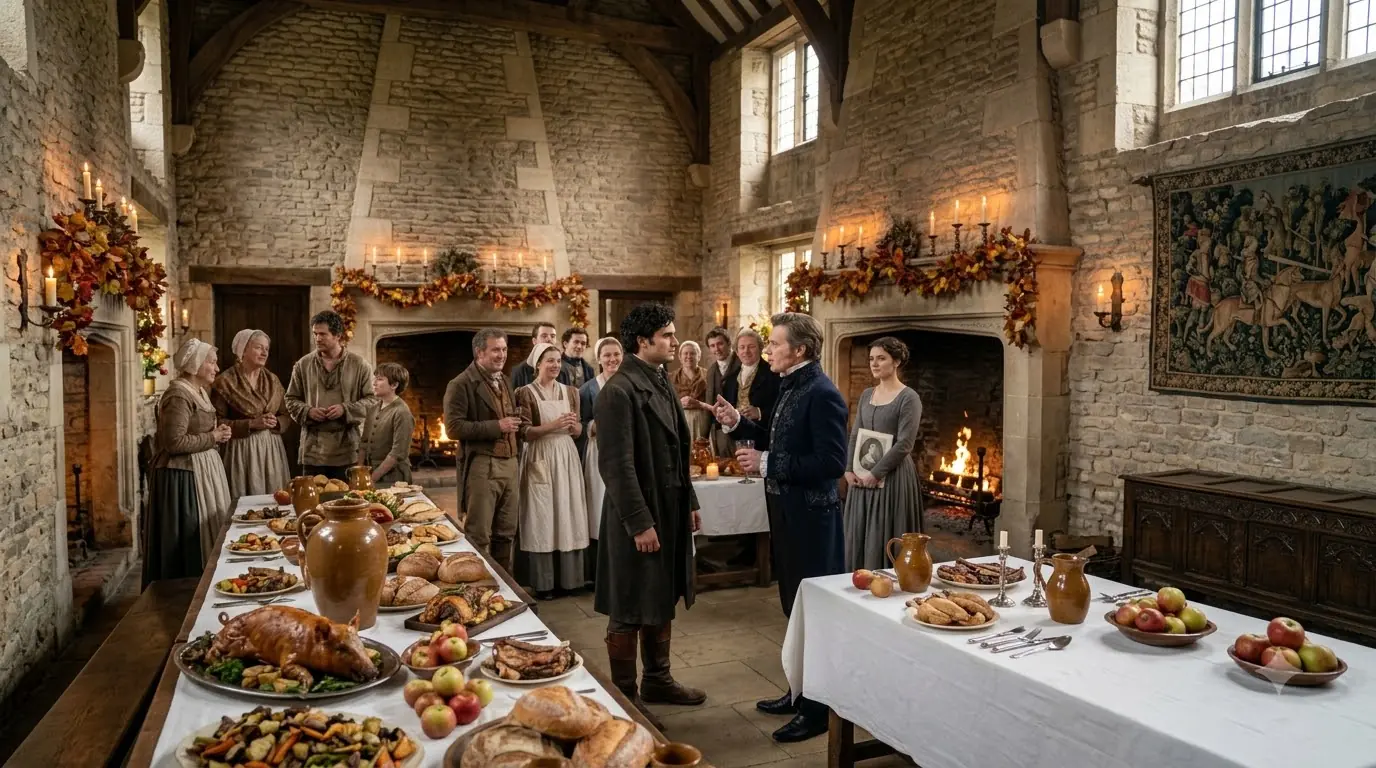
And he was completely, utterly, quietly miserable. Not the loud kind of miserable that asks for attention. Not the dramatic kind that weeps in public. No, his was the kind that hides behind a perfectly straight cravat and a perfectly measured bow.
The kind that smiles at dinner parties and then stares at the ceiling at three in the morning, wondering if any of it is real. His name was Julian Ashford, Duke of Ashberry, the most eligible man in all of England and the loneliest. Most men in his position would have done what was expected: married one of the polished young women their mothers dangled before them like prizes, smiled for the portraits, produced an heir, and carried on. Julian almost did exactly that.
But something stopped him. Not pride. Not arrogance. Something far simpler and far more dangerous.
Hope. He hoped in that stubborn inconvenient way that refuses to be educated out of a man that somewhere in this world there existed a woman who would look at him and not see the title, not see the estate, not see the fortune. A woman who would simply see him. What he did next was either the bravest thing a duke had ever done or the most foolish, depending on who you asked.
He disappeared. And in his place, a man named Julian Ash arrived at a crumbling northern estate, wearing plain clothes, carrying worn boots, and asking for work. This is the story of what happened when the mask came on, and what happened when it came off.
In which we meet a duke who has everything and wants none of it.
London, 1842. The Ashford townhouse sat at the corner of Grosvenor Square like a monument to itself. Five stories of pale stone, iron railings polished to a mirror shine, windows tall enough to let in half the sky. Inside the candles burned all evening, and the rooms hummed with the particular kind of noise that comes when wealthy people gather to remind each other they are wealthy.
Julian stood at the edge of the drawing room and watched. He was thirty-one years old, broad-shouldered with dark curling hair that his valet fought with every morning and dark eyes that missed nothing. His face was the kind that women noticed, and men measured themselves against without meaning to. He wore his evening clothes with ease, but his posture carried something heavier than the fabric, a stillness, weariness.
He was watching the room the way a man watches a theater he has seen too many times. Across the room, Lady Gwendolyn Hartwell held court in pale yellow silk. She was beautiful in the way a china vase is beautiful, flawless to look at, cold to touch, dangerous to drop. Three young men hovered at her edges, laughing at whatever she said, which was always precisely calibrated to entertain without revealing anything true about herself.
Julian's mother appeared at his elbow. Eleanor, the Dowager, Duchess of Ashberry, was a small woman with a spine like Sheffield steel, and opinions she delivered with the confidence of royal decree.
Eleanor: You have been standing here for twenty minutes. Lady Gwendolyn has glanced your way four times.
Julian: Has she? I hadn't noticed.
Eleanor: You notice everything. That is your problem. You notice too much and feel too much and say too little about either. Go and speak to her, Julian.
Julian: To what end, mother?
Eleanor: To the end of securing your future and the future of this family. You are 31. The estate requires an heir. These are facts, not opinions.
Julian said nothing. He lifted his glass and took a slow sip, and something in his expression closed off, the way a window shuts against rain. He had heard this speech, or some version of it, for four consecutive seasons. He could recite it from memory.
He had even once rehearsed a rebuttal. He never delivered it because arguing with his mother was like arguing with the tide. What he could not tell her that he had not told anyone was that it was not Lady Gwendolyn herself he objected to. She was perfectly adequate.
She would run his household with precision, appear beautifully at his side, and never once embarrass him. She would also never once make him feel like anything other than a title with a heartbeat. He had tried three seasons ago to feel something genuine during a dance with a viscount's daughter who quoted Keats with genuine love in her voice. He had felt a flicker of something then, a small warmth, like the beginning of a fire.
Then her father had arrived, beaming, calculating, already imagining the wedding announcement in The Times, and the warmth had extinguished itself completely. They did not see Julian. They saw the Duke of Ashberry. They saw the estate, the name, the income, the position.
He had become without meaning to a prize to be claimed. He crossed the room. He spoke to Lady Gwendolyn. She smiled, and her smile was a performance, practiced and precise.
She asked him about the opera season. He answered. She laughed at the right moments. He bowed correctly.
The whole exchange lasted eight minutes and left him feeling as though he had swallowed something hollow. He made his excuses at ten o'clock, stepped into his private study, and locked the door. On his desk was a letter from his steward, Arthur Finch, at Ashberry Hall, the estate's northern property, three days' ride from London. The roof of the east wing was leaking.
The tenant accounts were in disorder. The archives hadn't been properly cataloged in two decades. The place was, in Arthur's careful understatement, in need of considerable attention. Julian read the letter twice.
Then he sat very still, and a thought came to him. Not a sensible thought, not the kind of thought a reasonable man entertains, but the kind that arrives fully formed and refuses to leave. What if I went there not as the Duke? What if I went as nobody?
What if just once I learned what it was like to be seen without the title? He told himself it was madness. He told himself it was irresponsible, undignified, and possibly illegal in some way he couldn't immediately identify. Then he picked up his pen and wrote Arthur a letter.
He wrote, "Tell the staff the Duke is sending a clerk to assist with the estate accounts. His name is Julian Ash. Make room for him in the staff quarters. Do not, under any circumstances, tell anyone who he really is." He sealed the letter.
He sat back and for the first time in four years, Julian Ashford, Duke of Ashberry, smiled.
In which a duke arrives in plain clothes and learns he knows nothing.
Ashberry Hall sat in the North Yorkshire moors like a great old sleeping thing that had given up on elegance, but not on dignity. Its stone was the color of storm clouds. Its chimneys numerous and crooked. Its gardens overgrown in the cheerful, unconcerned way of gardens that have outlasted several gardeners.
Julian arrived on horseback in the early morning three days after leaving London, wearing a coat that had belonged to one of his footmen and boots he had broken in deliberately by walking the garden path for two hours the night before his departure. His trunk, when it came on the cart behind him, contained plain shirts, a leather-bound notebook, two novels, and a tin of biscuits. He had not brought his valet. He had not brought his secretary.
He had brought himself, and that felt, for the first time in years, like enough. Arthur Finch met him at the side gate. Arthur was sixty-three, compact and weathered, with the sort of face that had seen too much to be surprised by anything, and too much good to be soured by it. He was the only person on the estate who knew the truth.
Julian: That is precisely the impression I intend to give. And you will call me Mr. Ash.
Arthur: Yes, Mr. Ash. Forgive me. A moment of adjustment.
Julian: How many staff are currently in residence?
Arthur: Fourteen, sir. Mrs. Dawson, the housekeeper; Mrs. Bevan, the cook, and her two girls; three groundsmen; two footmen; the understeward, young Perkins; and the archivist, Mr. Hartley, who comes three days a week from the village. His daughter assists him and has been cataloging the library.
Julian nodded. His cover story was simple. He was a clerk sent by the Duke's solicitors to assist Arthur with the estate accounts, which were in genuine disarray.
The story was close enough to the truth that it would hold. Arthur led him through the side entrance, past the kitchen gardens, and into the servants quarters. Julian's room was small, cold, and perfectly honest. A single iron bed, a wash stand, a window that looked out onto the stable yard.
No fire had yet been lit. “It is smaller than my dressing room in London,” Julian noted, “and somehow more restful.” He put his trunk down and took a long breath of air that smelled of horses and damp stone and October, and he felt something uncoil somewhere in the middle of his chest. He changed into a fresh shirt.
He picked up his notebook. He went to find the archive. The Ashberry archive was housed in a room off the library, a large, drafty chamber lined from floor to ceiling with shelves and cabinets containing a century and a half of estate documents, correspondence, ledgers, maps, and miscellaneous papers that had been added to with enthusiasm and organized with none of the same enthusiasm. Julian stood in the doorway and absorbed the scale of the chaos.
Someone else was already there. She was seated at the large central table with her back to him, a ledger open in front of her, a pencil moving steadily. She had dark brown hair pinned up simply, a few strands escaping at the nape of her neck. She wore a plain gray dress, practical and neat.
Beside her were three neat stacks of papers, a pot of ink, and a cup of tea that had clearly gone cold an hour ago. She did not look up. Without turning, she spoke.
Clara: If you are Perkins, the 1798 rent rolls you asked about are in the third cabinet, second shelf, marked with a red ribbon. If you are anyone else, I ask that you not touch anything until I finish this column.
Julian blinked.
Julian: I am neither Perkins nor anyone in particular. I am Julian Ash, sent to assist with the accounts.
The pencil stopped. She turned. Her face was not what he expected, though he could not have said afterward what he had expected. She was perhaps twenty-five, with a direct gaze and a frank expression that held no trace of the careful social arrangements he was used to seeing on women's faces in drawing rooms.
Her eyes were a clear, steady gray-green, the color of the moors in certain kinds of light. She was not performing anything. She was simply looking at him.
Clara: The solicitor's clerk. Arthur mentioned you might be coming. I am Clara Hartley. My father is the archivist here, but he is unwell this week, so I have taken over the cataloging.
Julian: Are you a trained archivist yourself?
Something in her expression shifted, not offended, but precise.
Clara: I have been assisting my father since I was 12. I have cataloged archives in three counties. I can read estate Latin, and I know the difference between a quit rent and a fee farm. If that constitutes training, then yes.
Julian felt a small, unfamiliar sting. He had asked a patronizing question without meaning to, and she had answered it without condescension. He was already behind.
Julian: I apologize.
The question was poorly framed. I should have asked what you were currently working on. A pause. She considered him with those clear eyes.
Clara: The 1830 to 1842 tenant ledgers. Someone and I strongly suspect it was an underclerk who no longer works here. Filed 14 years of rent payments under the wrong property names. I am rebuilding the records from the original receipts.
Julian: That sounds like an enormous amount of work.
Clara: It is. You may assist me if you can read a column of figures without adding them wrong three times before getting them right.
Julian sat down at the opposite end of the table.
Julian: I will do my best. She slid a stack of receipts across the table and returned to her ledger. For 2 hours, they worked in silence that was neither uncomfortable nor empty. It was the kind of silence that happens between two people who are both genuinely engaged with what they are doing and do not feel the need to fill the air with noise to prove they are there.
Julian, who had not done actual clerical work in his life, made three errors in his first column and corrected them carefully before she could notice. He made one error in his second column, noticed it himself, and crossed it out neatly. He was better by the third. The work was oddly absorbing.
He had signed his name to documents like these for a decade without ever having understood what they actually represented. What a column of numbers felt like when you traced it back receipt by receipt to a real family paying their rent on a cold morning. He did not share this thought. He kept his head down and worked.
At noon, Clara stood and stretched her back.
Clara: I take lunch at the kitchen table. The cook, Mrs. Bevan, serves soup at 12. You are welcome to join.
Julian: Thank you. And so the Duke of Ashberry ate his first lunch at the kitchen table of his own estate, seated between a girl named Clara and the understeward named Perkins with a bowl of potato soup and a heel of bread, and felt absurdly, inexplicably at home, In which two people clash, debate, and begin, without meaning to, notice each other.
The first week at Ashberry Hall was a lesson in humility administered without mercy. Julian had known abstractly that running an estate involved work. He had signed off on budgets for such work for a decade. What he had not known what no amount of signing paperwork prepares a man for was what that work actually felt like in the hands.
On his second day, he was asked to help the groundsman repair a section of fence along the north pasture. He had assumed this would take 2 hours. It took five because he held the post driver incorrectly. and the groundsman, a man named Tom who was kind about it, had to show him three times. On his third day, Mrs. Dawson assigned him to carry the coal scuttles to the upper rooms because one of the footmen had taken ill.
He learned that a full coal scuttle weighs more than it looks, and that a house with 14 fireplaces generates an extraordinary amount of ash. On his fourth day, he returned to the archive. He was getting better at the records and Clara had noticed though she had not said so directly. What she had said when she found his third column of figures and ran her finger down it checking his arithmetic was Clara you did not make any errors today.
Julian I know Clara yesterday you made one. Julian I know that too. She had almost smiled. He was fairly certain of it.
The work brought them into proximity every morning. And proximity, when the people involved are both curious and capable, has a way of generating conversation. It began with a small argument. Julian had been reorganizing a section of the pre-1800 correspondence by date, which seemed to him the logical system.
Clara arrived, looked at what he had done, and immediately began moving the folders back.
Julian: What are you doing? I spent an hour on that.
Clara: I know and your instinct was logical, but it will not work for this collection. The Ashberry correspondence between 1775 and 1800 is referenced by topic in the estate index, not by date. If you file by date, we lose the cross references. The old system, maddening as it is, needs to be maintained.
Julian: The old system is a disaster. I could not find the 1789 timber contracts anywhere in it.
Clara: That is because the 1789 timber contracts are not in the correspondence section. They are in the property agreements cabinet understanding timber because they were part of a larger land settlement. If you had asked me, I would have told you. He had not asked. That was the difficulty. He was used to being the most informed person in any room about any subject. He was finding at Ashberry Hall that this was not remotely true.
Julian: You are right. I should have asked.
Another almost smile. He was learning to watch for them. They fell into a rhythm after that. He would encounter a problem in the records.
She would provide context. She would encounter something beyond her immediate reach, a filing cabinet with a stiff lock, a ledger too heavy for the shelf, and he would help without being asked. They did not talk about personal things. They talked about the estate.
But the estate, as it turned out, was a way of talking about everything. Late on a Thursday afternoon, with rain beginning against the high windows and the lamp turned up against the early dark, Clara came across a letter in the correspondence file that made her stop. She read it twice. Then she set it down with a deliberate quietness.
Julian: What is it, Clara? A letter from the second Duke to his estate manager. 1783. He is instructing the manager to reduce the tenant cottages on the east farm by four. The families are to be, he says, relocated to improve the prospect from the house.
The way she said it was careful and even, but there was something beneath the evenness.
Julian: That was common practice in the period. Enclosures, landscape improvements.
Clara: I know it was common. That does not mean it was right.
Julian looked at her. She was not speaking abstractly. Her expression had the quality of someone whose family had very possibly been on the receiving end of decisions made by men like the second Duke. in letters exactly like this one. She was holding the document carefully.
The way you hold something you are simultaneously obligated to preserve and personally wish did not exist.
Julian: No. It doesn't mean it was right.
She looked up. He was watching her with something that was not the detached professional interest she had assumed was his entire personality.
Clara: You are not going to argue.
Julian: I was considering it, but I think you are correct. And I find I respect being correct more than I enjoy a comfortable argument. A genuine pause. Then Clara, that is a very unusual quality in a man.
Julian: Possibly. I will take it as a compliment.
She returned the letter to the file. She made a small note in the catalog, and then she reached for the next document with a steady hand, and neither of them said anything more about it. But something had shifted in the particular way that things shift when two people discover they share a value, not just a task. The rain kept on, the lamp burned steadily, and Julian Ash, who was not Julian Ash, sat across from Clara Hartley, and thought, in which a duke develops blisters, and something like Understanding.
By the second week, Julian had stopped thinking about London. This surprised him. He had expected to miss the coffee houses, the clubs, the particular hum of city life that tells a man he is at the center of things. Instead, what he felt most mornings was a quiet satisfaction in getting up and having specific physical uncomplicated work to do.
He had blisters on his right hand from the fence mending. He had a bruise on his left shin from an encounter with a wheelbarrow that he declined to discuss in detail. His back ached from stooping over the archive table for hours at a stretch. He had not in his adult life ever had blisters.
He found he did not entirely mind them. There was something honest about a blister. It was proof that a thing had actually been done. On a gray Tuesday morning, he came out to the stable yard and found a scene developing.
A section of the kitchen garden wall had partially collapsed overnight, and Mrs. Dawson, the housekeeper, was surveying the damage with the expression of a woman calculating how many additional problems this would create by the end of the day. Julian looked at the wall. He looked at the pile of fallen stones. He looked at the two groundsmen who were standing nearby in the manner of men who were waiting to be told what to do.
Arthur appeared at his elbow.
Arthur: Mr. Ash, a word. He drew Julian slightly aside.
Arthur: This wall needs attention before the winter rains. I would normally write to the Duke's office for authorization of the repair funds, but that process takes 6 weeks, and we do not have 6 weeks. I know who you actually are, and I know you have the power to release the funds immediately, but if you do, people will wonder why a clerk has that authority.
Julian: What do we have in the emergency maintenance account?
Arthur: 40. The repair will cost closer to 70.
Julian thought for exactly 4 seconds.
Julian: Begin the work. I will find a way to cover the difference without creating questions. He spent that afternoon helping to clear the fallen stone, loading rubble into a wheelbarrow, passing fresh mortar to the mason who had been brought in from the village. It was hot, even in October. Real work. His hands ached, his shoulders burned.
He kept his head down and worked. At one point, Tom, the groundsman, paused and offered him a water flask.
Tom: You're doing good work, Mr. Ash. Honest work. Not many clerks would pitch in like this. Julian drank from the flask. It tasted like cold water and mud and something that in London he would have called unpleasant. Here it tasted like the end of a productive hour.
Julian: The wall needed fixing. I was here.
Tom, still some men would have stood aside and watched. You got your hands dirty. He had never thought about that, the choice of whether to stand aside. In his life as the Duke, standing aside was simply the expected arrangement.
The men did the work. He signed the authorization. He had not realized how much of life that meant you missed. Clara came by late in the afternoon with tea and bread, which was apparently her habit on days when work ran long.
She stopped when she saw him. His coat was off, his shirt sleeves rolled to the elbow, his forearms gray with mortar. He was helping the mason hold a large section of stone steady while it was set. He did not see her watching.
She told herself she was simply noting that the repair was progressing well. She told herself she was not noticing the set of his shoulders or the quiet focus in his expression or the fact that he had been working for 5 hours without complaint. She left the tea and bread on the garden wall and went back to the archive. When Julian came in for supper that evening, Arthur met him in the corridor with a very particular expression on his face.
The expression of a man who is enjoying something he knows he should not enjoy.
Arthur: Miss Hartley left tea for you specifically.
Julian: She left it for the workers.
Arthur: She called you by name when she set it down. I was watching.
Julian said nothing. He went to supper. The days continued to arrange themselves in a pattern he had not anticipated. mornings in the archive, afternoons doing whatever the estate required, evenings quiet, the kind of quiet he had not known in London. He began to see Ashberry Hall not as a property with a maintenance budget, but as a living thing, a community of people who depended on each other, in ways that the annual accounts could not fully capture.
He began to understand, with a clarity that embarrassed him, how little he had understood about his own estate. He wrote nothing about this to anyone. He simply kept going, and the blisters on his right hand slowly healed into calluses, and he was obscurely proud of them, in which the archive becomes something more than a room, and books become a language. There is a particular quality to autumn evenings in old houses, the way the light thickens and turns amber, the way the cold at the windows makes the warmth inside more real by comparison, the way the silence becomes less an absence and more a presence.
Julian discovered this in the fourth week of his time at Ashberry Hall during an evening that began as nothing and became something that he would think about for a long time afterward. He had taken to staying late in the archive after Clara had gone for the day, reviewing the tenant accounts by lamplight and making notes for the financial restructuring he was beginning to plan. He had also, without quite admitting it to himself, taken to leaving the archive door open so that he could hear if anyone was still moving in the library. On a Friday evening, he heard her.
Clara had not left. She was in the library proper at the far end standing on a step stool and attempting to retrieve a volume from a high shelf. As Julian came through the doorway, he saw the stool wobble. He moved quickly, catching the edge of the stool without thinking.
She caught the bookshelf. Neither of them fell. She looked down at him. He looked up.
The distance between them was approximately 10 in.
Clara: I had it.
Julian: You did not have it.
Clara: I was adjusting my weight. You were falling.
A beat of silence. She was still holding the bookshelf. He was still holding the stool.
Clara: Perhaps a little. Thank you.
She descended the stool, and he stepped back to a reasonable distance, and they were both very deliberately looking at the book she had retrieved rather than at each other. It was a first edition copy of Milton's Paradise Lost, which turned out to be relevant because Milton was the first truly safe thing either of them could find to say.
Julian: You were retrieving Milton on a Friday evening.
Clara: I was checking whether this copy was the 1667 first edition or the 1674 revision. The spine is damaged and I could not read the date from below.
Julian: And which is it?
She opened the frontispiece and read.
Clara: 1667—the first.
Julian: That is quite valuable.
Clara: Yes, it should be cataloged separately and properly stored. I will make a note tonight.
She sat at the library table. He, for reasons he did not examine, sat across from her. She made her note. He looked at the shelves.
Julian: Have you read it? Milton. Clara. Several times. Though I find Satan the most interesting character in it, which people always find unsettling.
Julian: Satan is the most interesting character in it. Milton all but admits it. He gives him all the best lines.
Clara looked up.
Clara: Most men, when I say that, tell me it reflects poorly on my moral character.
Julian: Most men who say that have not actually read it. She was quiet for a moment. Then Clara, what did you read growing up?
Julian: Whatever I could find. My family's library was large. I had access to more books than a boy has any right to. I read without a system or plan, which my tutors despised, and I consider one of the better decisions of my early life.
Clara: Our library was smaller. My father believed in reading deeply rather than widely. He had perhaps 200 books, but he had read each of them at least four times. He used to say that the second reading is where you begin to understand, and the fourth reading is where you begin to argue. He sounds like a remarkable man. Something soft moved through her face.
Clara: He is. He is not well at the moment, but his mind is still entirely itself. He reads 3 hours every day. He simply does it in bed now. Julian noted that she spoke of her father with a love that was precise and unembellished. She did not perform warmth. She simply had it. They talked about books for 2 hours. Not politely, not carefully. the way two people who read genuinely talk about books, arguing about characters, disagreeing about endings, confessing to rereading childhood favorites when they were tired. At one point, Julian went to the shelves and pulled out a copy of Sense and Sensibility and read her a passage that he claimed proved his point about Eleanor Dashwood's emotional intelligence. And Clara listened and then took the book from his hands and read him a different passage that proved the opposite. And they were both laughing by the end of it. At 9:00, Clara stood and said she must go.
Julian stood too because instinct was instinct. At the door, she paused.
Clara: You are a very strange person, Mr. Ash.
Julian: I am frequently told so.
Clara: I mean it as something close to a compliment.
She left. Julian stood in the empty library for a long moment with the lamplight golden around him and felt with a clarity that was almost frightening something he had not expected to find here. He had come to Ashberry Hall to see if he could be seen. And he was beginning to think with something that sat between wonder and terror that she was looking at him, the actual him.
Not the title, not the estate, not the Duke of Ashberry, just Julian. And she seemed improbably and entirely without permission from his plans to find Julian worth looking at. He blew out the lamps. He went to his plain room.
He lay on his iron bed and stared at the ceiling. And the thought came to him, late and quiet and impossible to ignore. in which a threat arrives in fine clothes and Clara shows what she is made of. He arrived on a Wednesday in a carriage so polished that it caught the pale November sun and threw it back in angry flashes. Lord Edmund Vain, Earl of Creston, stepped out onto the gravel drive of Ashberry Hall with the particular ease of a man who enters all spaces as though he owns them, even the ones he doesn't. He was 44 years old, silver at the temples, elegantly lean, with eyes the color of old coins, and an expression of permanent, refined amusement that did not quite reach those eyes.
He was the sort of man who was described as charming by people who did not know him well, and as dangerous by people who did. Julian, working in the stable yard when the carriage arrived, saw him from 20 ft away, and felt every muscle in his body go very still. Vain and Julian had a history, a long complicated one, in which Julian had three years earlier blocked Vain's attempt to absorb a small estate belonging to a widowed neighbor by presenting evidence in court that Vain's claim was fraudulent. Vain had lost the case.
He had not lost the grudge. Arthur appeared at Julian's side within moments.
Arthur: Lord Vain, he says he was passing through the county and wished to pay his respects to the estate. He has not been to Ashberry Hall in 6 years.
Julian: He was not passing through. Yorkshire is not on the way to anywhere from his Derbyshire estate. He is here because he has heard something.
Arthur: What do you wish to do?
Julian thought for a moment. The answer was clear.
Julian: Nothing different. I am Julian Ash, clerk. Show him the hospitality appropriate for a guest of Lord Vain's rank and see him to the south drawing room. I will remain out of his sight as much as possible. If he asks about the Duke's whereabouts, you will say the Duke is in Edinburgh on legal business.
Arthur nodded and went to greet the guest. Julian went back to work and kept working and tried not to think about the fact that Vain was somewhere inside his house. The difficulty was Clara. Vain had been shown to the drawing room, but he did not stay in it.
He was the kind of man who took tours of houses that weren't his, fingering things and asking pointed questions in a pleasant voice. By the afternoon, he had made his way to the library. Julian knew this because Mrs. Dawson came to find him looking uncomfortable.
Mrs. Dawson: The guest—my lord, Mr. Ash, I mean—is in the library. Miss Hartley is there. He has been asking her questions for half an hour.
Julian put down his tools. When he entered the library, he found Vain leaning against a bookshelf in an attitude of elegant relaxation and Clara seated at her usual table with a ledger open in front of her, looking as composed as a woman who has decided that rudeness requires no reaction. Vain. Ah, and who is this?
He said it with a slight pleasant smile, looking at Julian the way a man looks at a piece of furniture he is considering having removed. Julian Ash, my lord, estate clerk sent by the solicitors.
Vain: How diligent. And you are assisting Miss Hartley, was it?
Clara: I am assisting the estate accounts, my lord. Mr. Ash is assisting me. Between the two of us and the 15 ledgers on that table, we are sufficiently occupied.
Vain looked at her with something sharp behind the pleasant eyes.
Vain: Of course. I was merely curious about the current state of the estate. In the Duke's continued absence, it seems a little unattended.
Clara: The estate is perfectly attended, my lord. The accounts are being thoroughly reviewed and organized, which is often a sign of a well-managed property rather than a neglected one. If you have specific questions about the estate's operations, Mr. Finch, the steward, would be the correct person to consult.
A pause. Vain looked at her for a moment with an expression that was not quite a smile.
Vain: You are quite well informed for an archivist's assistant.
Clara: My father has been archiving this estate for twenty years. I have been helping since I was 12. I am probably the most well-informed person in this room about its history, which is a statement, not a boast.
Vain smiled. He was recalculating. Julian could see it. Vain.
Delightful. I shall consult Mr. Finch as you suggest. He left. Julian did not look at Clara immediately.
He went to the window and watched Vain cross the courtyard below. Then he turned.
Julian: Thank you.
Clara had returned to her ledger.
Clara: There is nothing to thank me for. He was wasting our time.
Julian stood there, and what he felt was not gratitude alone. It was something more complicated. She had defended the estate with more precision and less fuss than he could have managed himself in the moment, and she had done it without knowing she was doing it for him. That evening, Arthur found Julian in the corridor and spoke quietly.
"Arthur, Vain has sent a letter. I intercepted it before it reached the post. He wrote to his solicitor in London. He is asking for confirmation of the Duke's current whereabouts and whether there are any reports of the Duke being indisposed or otherwise unable to manage his affairs.
Julian: He is testing the ground. He wants to know if there is a power vacuum he can exploit.
Arthur: What do we do?
Julian looked at the wall for a moment. Then Julian, we let him look. He will find nothing. And in the meantime, we fix whatever needs fixing so that when I resume my identity, there is nothing vulnerable for him to touch.
Arthur nodded. But Julian was aware as he walked back to his room that the countdown had changed. Vain's arrival was a clock now, ticking against the fiction of Julian Ash. It was only a matter of time before someone with access to a London directory or a portrait gallery connected the name Ashford with the face in the archive.
He needed more time. And he was increasingly painfully aware that the reason he wanted more time had less to do with the estate accounts and more to do with a woman who was not impressed by anything except honesty in which a roof falls, a secret strains, and two people work through the night. It happened on a Sunday at three in the morning. Julian was asleep when he heard it.
Not an explosion, but a deep prolonged groan. the sound of old timber giving way, followed by a crash that shook the floor beneath his bed and sent dust sifting down from the ceiling. He was on his feet before he was fully awake. The east-wing roof had collapsed. Not entirely—the structural beams held, which was the only reason no one was hurt, but a 40ft section of the upper gallery roofing had come down, taking the plaster ceiling below it and a significant portion of the library's rare book section with it.
By the time Julian reached the library, Arthur was already there with three of the staff pulling books out of the debris by lamplight. Julian grabbed the nearest lamp and went in beside them. Clara arrived 12 minutes later. She was wearing a heavy coat over her night gown, her hair loose down her back, and she did not say anything when she came in.
She looked at the destruction for exactly 3 seconds, then went to the archive doorway, assessed what had been protected and what hadn't, and began directing the salvage operation with a clarity that Julian thought absurdly was one of the most impressive things he had ever seen. Clara Milton is in the archive. It will be fine. The bound collection near the east window is at risk if someone gets to that shelf.
Don't stack the wet volumes. Lay them flat on any dry surface you can find.
Clara: Tom, is there tarpaulin in the groundsman's store?
Tom: Yes, miss.
Clara: Get it. All of it. They worked until 6:00 in the morning. Julian worked beside her the entire time, hauling debris, sorting documents, spreading tarpaulins, making decisions about what was worth saving and what was not. At some point, the cold became something they simply ignored. At some point, the lamp oil ran low, and they lit candles. At 6:00, they sat on the floor of the undamaged part of the library. among stacks of salvaged books and looked at each other. They were both filthy, plaster dust, damp and exhaustion.
Clara: The structural damage.
Julian: I know.
Clara: The repairs will cost a great deal. The estate's reserve.
Julian: I know.
She looked at him steadily. He met her gaze. He was so tired that some of his guard was down. He could feel it.
The way you lose the ability to maintain a careful expression after 20 hours without sleep. The way things start to show through that you have been deliberately not showing.
Clara: You are going to find a way to fix this without asking the Duke's office for authorization, aren't you?
The way you found a way to fix the garden wall. Julian was quiet for a moment.
Julian: Yes.
Clara: How does a clerk have access to that kind of money?
Julian: He has particular authority.
She held his gaze for a long moment. Her expression was not suspicious. It was something more careful and more searching than that.
Clara: I see.
She looked away. She started arranging the stack of books beside her into neater order. She sees, he thought. She has seen or begun to see something that she has not yet named out loud.
And she is choosing right now whether to name it.
Clara: Will the estate be all right? Yes, I will make sure of it.
She nodded. She looked at the salvaged pile of books and her expression softened just a little. Clara Milton is safe.
Julian: That matters to you.
Clara: It matters to the estate. And it was 1667, so yes, it matters to me.
They sat in companionable, exhausted, quiet for a few more minutes. Then Clara stood and said she would go change and returned to help organize the salvage properly. Julian watched her go. He made his decision in that moment, quiet and complete.
He was going to fix the estate. He was going to deal with Vain. He was going to tell her the truth. Not because he had a plan for it, but because the alternative of continuing to be Julian Ash, to the woman who had just worked through the night beside him, for reasons that had nothing to do with money or status, was something he could no longer stomach.
He went to Arthur that morning and laid out a financial plan that involved quietly releasing funds from his personal accounts through the solicitor's office. the kind of arrangement that could be explained if anyone asked as an advance from the Duke against the estate accounts. The roof repairs began within the week. Vain, who was still in the vicinity, heard about the collapse and wrote another letter. Julian intercepted this one himself.
It was to his own solicitor, asking whether a structural failure of this scale might constitute evidence of gross mismanagement, and whether such evidence could be presented to the courts as grounds for a guardianship petition over the estate. Julian read it twice. Then he burned it. Then he sat at his small desk in his small room and wrote a letter of his own, not as Julian Ash, but as the Duke of Ashberry, with his full authority and his full signature to his London solicitors, instructing them to begin researching every financial transaction connected to his uncle's trusteeship of the Ashberry estate funds for the past 15 years.
It was time to start pulling on that thread. He addressed the letter, sealed it, and handed it to Arthur in the corridor.
Julian: See that this reaches London by the fastest possible route.
Arthur: Yes, your grace.
Julian looked at him.
Julian: Mr. Ash, still Arthur. Of course, Mr. Ash. But there was something in Arthur's expression, a quiet knowing warmth that said more than the words in which the mask is named, and two people stand in the full light of the truth.
It was a Tuesday, 3 weeks after the roof collapse, and the repair work was progressing steadily. The east wing smelled of new timber and plaster. The library was being carefully restored, book by book, shelf by shelf. Julian arrived in the archive in the morning to find it empty.
Clara's notebook was on the table. So were her pencils and her ink. But Clara was not there. He did not think much of it.
He sat down and opened his accounts. An hour later, she still had not arrived. Another hour passed. Julian had started to feel the first small brush of unease when the door opened and Clara came in.
She was carrying a document. She set it on the table between them and sat down. It was a portrait engraving, the kind that appeared in society publications and was sometimes pasted into almanacs of the English peerage. It showed a man in formal dress, dark-haired, dark-eyed, with a slight controlled expression that was composed but not warm.
The caption beneath the engraving read, "Julian Ashford, fourth Duke of Ashberry." It was unmistakably him. Julian looked at the portrait. He looked at Clara. She was watching him with an expression that was entirely still and entirely readable because she had stopped somewhere in the past few seconds performing stillness and was simply feeling it.
Clara: I found this in the bottom of a storage box in the archive 6 days after you arrived. 6 days.
Julian: Clara, I want to tell you what I did with it before you say anything else. I put it back in the box. I covered the box with three other boxes and then I went back to work.
Julian was very still, Clara, because I needed to know something that a piece of paper could not tell me. I needed to know whether you were a good man who happened to be doing something strange or something else entirely. And the only way to know that was to watch you without you knowing I was watching. Julian sat with that.
Julian. And what did you conclude? She was quiet for a long moment.
Clara: I concluded that you worked alongside Tom in the mud fixing a fence and never once implied it was beneath you. That you stayed up all night saving these books when you had absolutely no obligation to do so. That you listen when people speak to you as though what they say matters. And it is not performed listening. It is actual listening. That you have been fixing this estate's problems quietly and at personal cost with no audience.
She looked at the portrait.
Clara: I concluded that you did not come here to deceive the people of this estate. You came here to know them and possibly to know yourself. Julian let out a slow breath.
Julian: I came here because I was tired of being seen as a title. I wanted to know whether anyone would choose to know me as the actual me without the name, without the position.
Clara: And did you find out?
He looked at her.
Julian: I think I am still finding out. She did not look away. There was something in her face that was open in a way he had not seen before. Not without guard, but without performance.
Clara: I need to tell you that I am angry with you. Not for coming here in disguise. I think I understand that. However impractical it was. I am angry that you let me sit with your secret for weeks while I was sitting with mine. We were both keeping accounts of each other and neither of us said so.
Julian: That is fair.
Clara: It is another silence different from all the working silences they had shared before. Bigger.
Julian: Clara, I have to tell you something that will perhaps change the nature of this conversation, and I am going to say it regardless of how it changes things.
She waited.
Julian: What I feel for you is not a complication of the situation. It is the only thing in this situation that I am entirely certain about. Everything else, the title, the estate, the question of what happens next, I can manage. What I feel is not something I can manage and I have stopped trying.
Clara was very quiet. Then Clara, you understand that everything between us is now different.
Julian: Yes, Clara. And that I need time to think about what different means.
Julian: Yes. Take all the time you need.
She picked up the portrait. She studied it for a moment.
Clara: You look more like yourself when you are carrying coal scuttles. It was not the softest thing anyone had ever said to him. It was the most honest.
He stood. He bowed a habit too ingrained to entirely set aside. And she looked at him as he did with an expression he couldn't fully read but couldn't stop looking at. He left the archive.
He walked out into the cold air of the stable yard, where the repair work was still ongoing, where Tom was mixing mortar with the easy precision of long practice, where the estate that was his, that was also somehow, in a way he had never felt before, actually his, was going about its honest morning business. And he thought, whatever comes next, I would not undo any of this. Not one morning of coal scuttles and fence posts. Not one evening of Milton by lamplight.
Not one night of cold stone and salvaged books.
The Harvest Gala: the exposure and the choice that defines a man.
The Harvest Gala at Ashberry Hall had been an annual tradition for 120 years. Every tenant farmer, every village family connected to the estate. Every person whose livelihood touched the estate's land was invited. Torches were lit along the drive.
Music was played in the great hall. Tables were laid with autumn food bread and cider and roasted meats and apples from the estate's orchard. It was Julian had been told growing up the one day a year when the Duke of Ashberry was expected to be not a duke but a host, present, human, and available. He had attended the gala three times, always from behind the formal distance that his position required.
He had never until this year actually spoken to more than four of his own tenants. This year was different. This year, Lord Vain had written a letter to every significant social figure within traveling distance of Ashberry Hall, inviting them to attend what he described as a rather remarkable autumn gathering at the Duke's estate, for which the Duke himself is not precisely in attendance, though his clerk is. He had included just enough implication and just enough ambiguity to guarantee that the curious would come.
Julian found out about the letters on the morning of the gala when Arthur came to him with one that had been intercepted from the post. He read it. He put it down. He was quiet for a long time.
Arthur: We could close the estate. Call it off. Send everyone home.
Julian: We will not call it off. The tenants have been preparing for this gala for a month. The families from the village have been looking forward to it. We will not cancel it because of him.
Arthur: Then what do we do?
Julian looked at the letter in his hand. Then he looked out the window at the drive, where the morning light was beginning to catch the frost on the grass, and where, far down the lane, a cart was already coming with goods for the evening's tables.
Julian: We have the gala, and I will stop hiding.
He dressed that afternoon in his own clothes, which had arrived in a trunk from London at his quiet request three days earlier. Dark coat, properly fitted, white linen. The clothes of Julian Ashford, Duke of Ashberry, were worn correctly.
He looked at himself in the small mirror on the wash stand in his plain room. He did not feel, as he had feared he would, relieved to be back in them. He felt, instead something more complicated, aware that the man looking back at him was the same man who had fixed fences and carried coal and read Paradise Lost by lamplight, and that the clothes did not determine that man. He knocked on Arthur's door.
Julian: Where is Clara?
Arthur: She arrived an hour ago. She's in the archive.
Julian: In the archive on the night of the gala?
Arthur: She said there was a document she wanted to finish.
He went to the archive. She was at the central table. She had a ledger open in front of her and was making notes. She heard his footsteps and looked up.
She saw the coat. She looked at him for a moment without speaking. Then she looked back at her ledger.
Clara: You are going to step forward tonight.
Julian: Yes.
Clara: Vain will try to make it look like a performance, as though you were playing at being humble for entertainment.
Julian: He will try.
She closed the ledger.
Clara: What will you say to them?
Julian looked at the walls of the archive, the rows of ledgers and documents and letters, the record of 150 years of this estate's life.
Julian: The truth is that I came here because I had forgotten what this estate actually was—not an income and an address, but people, history, and work done carefully by those who deserved better than a landlord who only ever saw numbers. Spending two months here as the least qualified clerk in Yorkshire was the best and most honest education of my life.
Clara was quiet.
Clara: They will believe you. The tenants know you. They know Julian Ash. And Julian Ash is a man worth believing.
Julian: He is also you, a little—the person I tried to become while watching how you did things.
She looked at him then with an expression that had stopped being careful.
Clara: Go. I'll come in a moment.
The great hall was full by the time the music began. Tom was there with his wife and their three children. Mrs. Dawson was there in her good dress which she wore twice a year. The mason who had repaired the wall was there, the cook and her daughters, every tenant farmer whose figures had passed through Julian's hands in the past two months, every name he had learned, every face he had come to know, and among the guests who had received Vain's letters, a scattering of expensively dressed people from London and from the county houses who were looking around with the curious, slightly uncomfortable expression of people who have arrived somewhere they expected to find a scandal and found instead a genuine celebration.
Vain was there too. Near the fireplace with a glass of wine and an expression of contained anticipation. Julian stepped into the great hall. The room changed.
Not loudly, not dramatically. The way a room changes when the person everyone has been waiting for without quite saying so appears. Mrs. Dawson saw him first. Her hand went to her mouth.
Then she curtsied. And her expression was not the curtsy expression of formal respect. It was something far more complicated and far more genuine. Tom and his wife exchanged a look. Tom nodded slowly as though something had been confirmed.
Vain straightened. He set his glass down. He stepped forward.
Vain: Ladies and gentlemen, it seems our host has finally decided to honor us with his presence. Though I confess I am struggling to distinguish the Duke from the estate clerk he has been impersonating for the past two months.
The room was very quiet. Julian looked at Vain. He had known this man for fifteen years. He knew exactly what Vain wanted.
Confusion, shame, a public stumbling of a man caught in a lie. He did not give him any of those things. He said in a clear voice that carried the length of the hall.
Julian: Yes. I disguised myself as an estate clerk. I did it because I had been signing papers about this estate for nine years without understanding what this estate actually was. And the only way I could think of to understand it was to come and do the work myself.
He continued.
Julian: I fixed fences. I carried coal. I cataloged ledgers. I helped save a library from a roof collapse at three in the morning. I learned the names of the people who work here and the names of the people who depend on this land. And it is the most useful and humbling thing I have done in my life as Duke of Ashberry.
He looked around the room.
Julian: The people in this hall deserve a landowner who understands what he owns. Not land and buildings, people, work, and trust. I came here to find that. I am embarrassed that it took me this long to look.
Another silence longer. Then Mrs. Dawson began to applaud. Not the careful drawing room applause of polite society. the actual genuine kind that started in the hands and came from somewhere deeper. Tom followed, then the mason, then the cook, then one by one the tenants who had shared tables with Julian Ash, and who recognized now the man in front of them as the same person they had eaten soup beside and worked alongside.
The London guests joined because the room demanded it, because there is a kind of truth that people recognize, even when it inconveniences them. Vain said nothing more. He stood at the edge of the applause and the thing he had intended to be a humiliation had become something entirely different and he had no mechanism for that. Julian looked for Clara.
She was at the back of the hall. She had come in quietly. She was watching him with an expression that he recognized now, the one she wore when she was deciding whether to let herself feel something. He crossed the room.
People moved aside, not with the difference of rank, but with the instinct of people who can see that two people need a moment. He stopped in front of her.
Julian: I told them the truth.
Clara: I heard.
Julian: I want to tell you something else. Something that is not about the estate or the title or any of it.
She waited.
Julian: I came here to find out if a woman could love me without the name. I found out something different and better. I found out that being worth loving has nothing to do with what you are called. It has to do with what you actually do. And you taught me that without meaning to, one morning at a time.
Clara's expression had shifted into something open and unhurried.
Clara: You are aware that what comes next is very complicated.
Julian: I am, Clara. Different worlds, different expectations, people who will have strong opinions.
Julian: I know. I am also aware that I have spent my entire adult life inside other people's expectations. And the only two months in which I lived as though I were a real person were these last two. I would rather be complicated and real than simple and hollow.
She looked at him for a long full moment.
Clara: Then we'll start there. It is complicated and real.
She offered her hand. Not as a social gesture, not as a performance, simply as a person offering a hand to another person. He took it. Across the hall, Vain slipped out through the side door.
Julian would deal with him tomorrow with the evidence that had arrived from the solicitors that morning, confirming what they had suspected about Julian's uncle's long manipulation of the estate funds. The courts would attend to that. Tonight, the music was playing and the hall was full, and Tom was dancing with his wife, and Mrs. Dawson was pretending not to cry, and Milton was safe on its shelf in the archive. Julian Ashford, Duke of Ashberry, stood in his own great hall with the hand of a woman who had known exactly who he was for weeks and had chosen quietly and deliberately to wait and see who he chose to be.
And he thought with the simple, clear certainty of a man who has finally stopped running from something and started running toward it. The courts examined Lord Vain's conduct. His attempt to maneuver against the estate was documented and dismissed. He retreated to Derbyshire and was not heard from in Ashberry again.
Julian's uncle faced a reckoning. The fifteen years of financial manipulation that Julian's solicitors uncovered was a slow and careful crime, the kind built on small decisions compounded over time. It was resolved through the law without drama and without forgiveness. The east-wing roof was fully repaired before Christmas.
The library was restored. The 1667 Milton was given its own proper case. Arthur Finch retired the following spring on a pension that Julian calculated was the most honest debt the estate had ever paid. Mr. Hartley, the archivist, recovered enough to resume working three days a week.
He never asked Julian directly about his time as Julian Ash. He was a man who understood records, and he understood that some things deserve to be filed under a person's private history. Clara did not become the Duchess of Ashberry in a whirl of romantic ceremony. What happened was slower and truer than that.
She and Julian spent six months in honest conversation about what their different worlds meant, about what they each needed, about the ways in which two people from very different circumstances could build something that honored both. The conversations were not always easy. Some of them were hard in the honest way that necessary things are hard. But they had both learned, in a cold archive by lamplight, how to work through difficult things without giving up on them.
They were married in the spring in the small chapel at the edge of the estate with fourteen people present, most of them tenants. Mrs. Dawson cried again. She had decided this was acceptable for a second occasion. Tom shook Julian's hand at the end of the service with both of his.
The way he had shaken it the very first time on the day of the fence repair. Julian gripped back. Some things don't change between a man and a man who has worked beside him. That is one of the finer things in the world.
This is a story about masks. But the mask in it is not the one Julian wore to the estate. The mask he wore was the one he had been wearing for years in London. The mask of a man who has everything and therefore must appear to want for nothing.
The mask of status. The mask of sufficiency. The mask that says, "I am fine. I have my title. I have my position. I need nothing from any of you." The lessons that Ashberry Hall taught him are the same lessons that life teaches all of us eventually if we are willing to learn them. First knowing about something and understanding it are not the same. Julian had known about his estate for a decade.
He understood it in two months. The difference was physical presence, actual participation, and the willingness to be the least qualified person in the room. That willingness is not weakness. It is the beginning of wisdom.
Second, people will show you who they are if you stop trying to manage the impression you give them. Clara showed Julian who she was because he stopped performing. And because he stopped performing, she felt safe not performing either. Two people who are both being real, even imperfectly, have a chance of something genuine.
Two people who are both performing have only a chance of a very convincing duet. Third, trust is built in ordinary moments, not grand gestures, not declarations, the fence mending, the late evening in the archive, the night of the roof collapse when two people worked side by side without needing to explain to each other why it mattered. Trust is the compound interest of small, consistent, honest choices. Fourth, and perhaps most important, the thing you are looking for is almost never where you are looking for it.
Julian went to Ashberry Hall looking for a woman who would see him without his title. What he found was a version of himself he had been hiding since he was old enough to understand what a title meant. She did not give him that version of himself. She created conditions in which he could recover it.
The people who matter most to your growth are rarely the people who tell you what you want to hear. They are the ones who hand you a stack of tenant receipts and say, "Add these up without making errors and we'll see how you do. See how you do." That is always the question. And the only way to answer it is to show up in whatever plain coat you have and begin.