He'd given up on 12 lost horses, then a woman rode up with all of them. The last thing I expected to see coming down the switchback that morning was my own horses.
I'd been sitting on the porch step with a cold cup of coffee, watching the trail because there was nothing else to watch and I hadn't slept.
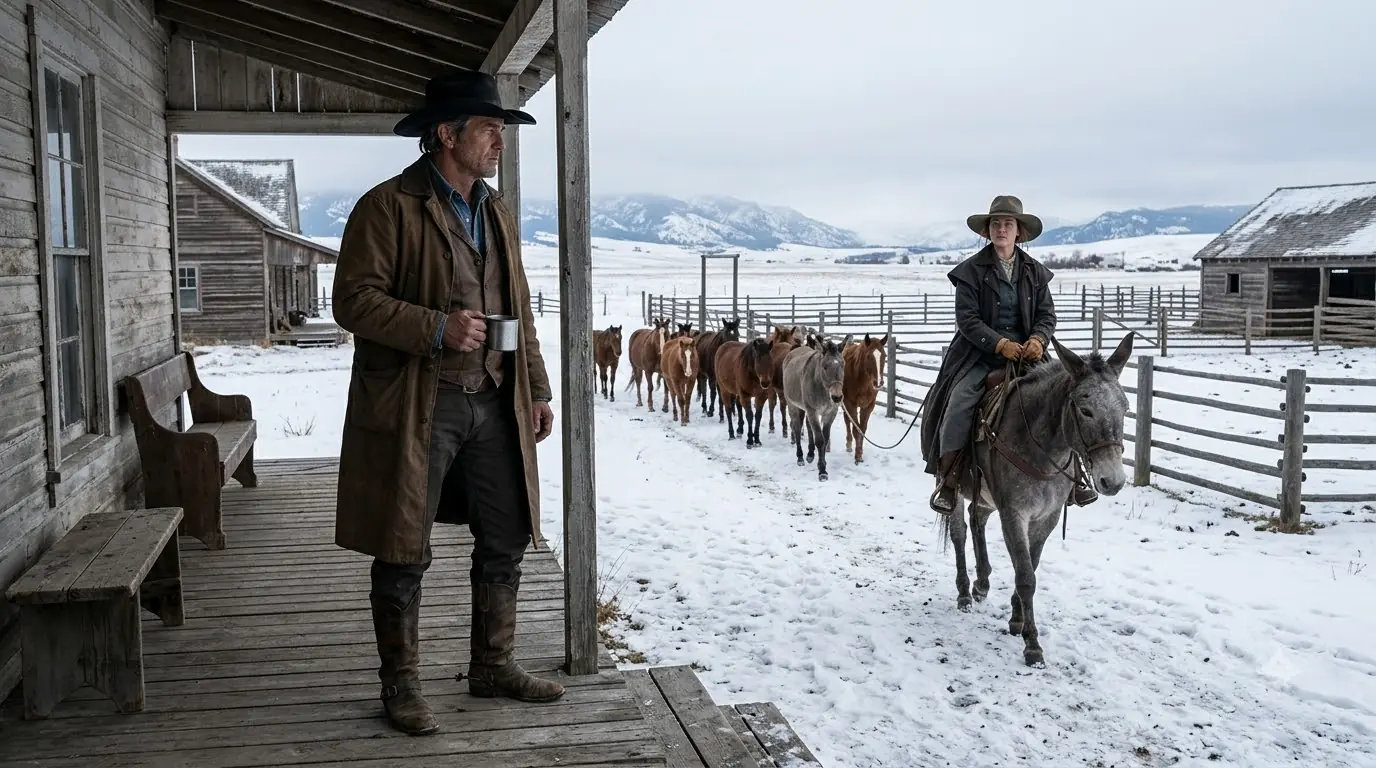
Three days since the storm hit the upper pasture. Three days since I'd ridden every draw and gully from here to the Sulfur Creek fork and come back empty each time, saddle sore and stupider for the effort. The horses were gone.
12 of them, the whole breeding string I'd spent 11 years building, the only thing on this ranch worth the word valuable. Gone into that white wall of snow and wind, and not one of them had the sense or the luck to come down on their own. I'd stopped looking the evening before, just stopped. Pulled off my boots and set them by the door and decided that was the end of it.
I don't say that to make myself sound beaten, though I was. I say it because a man gets to a certain point where the arithmetic just stops working. 53 years old, both knees shot, a ranch that barely cleared enough in a good year to keep the roof sound, and now no horses. The arithmetic doesn't work. You set your boots by the door and you let it be.
There's a particular quiet that comes over a place when you stop fighting it. I'd felt it once before, years ago, during the bad stretch when I'd had to sell down to the studs. Same feeling. Like the land itself goes still because it's waiting to see what you'll do, except you've already decided and there's nothing to do.
You just sit. The cold comes in under the door. The coffee goes cold in the cup.
I sat there for a long time before the light came up. I watched the gray grow in the east and I thought about practical things. What the horses would have been worth at spring sale, whether there was a neighbor I could approach about buying breeding rights to their stallion for one season to get anything from the mares I still had in the small pasture, whether the ranch was a going concern at all without the string. I ran the numbers in my head and they ran badly.
My wife Margaret had sat in the same kitchen 20 years ago and run numbers with me during the first bad stretch before she got sick. She'd been better at numbers than I was, steadier. She didn't panic and she didn't pretend either. She'd look at the thing straight and tell you what was actually there. I'd learned more about my own ranch from how she read a ledger than I ever learned on my own.
She was gone 15 years now and I still miss the way she read a ledger. That was the kind of morning it was, sitting on the step with the cold cup, thinking about numbers and about Margaret and about whether 53 is too old to start over a second time and fairly sure the answer was yes.
Then I heard them. You know the sound.
If you've worked horses your whole life, you know it without thinking, hooves on rock, but spread out, not one animal, not two, a whole string moving together. The particular scatter of it. I heard it before I saw anything and my body went ahead of my mind. I was standing before I decided to stand, the cold cup still in my hand.
They came around the bend in the trail single file, bunched a little at the front where the path narrows, and I counted them as they cleared the rock face. One, two, three. I got to eight before I stopped counting and started trying to understand what I was seeing behind them. A woman on a gray mule, the kind of ugly, hard-headed mule that makes the best sense in mountain country and the worst impression anywhere else.
She was riding easy, not working hard, like she'd been doing this all morning and expected to do it all afternoon. A duster coat that had seen weather. Hair pulled back and mostly covered by a hat that wasn't hers, too large, sitting low on her ears. One hand loose on the reins, the other resting on her thigh, holding a coiled rope the way someone holds it who's used one before and will probably need it again.
She drove those horses right into my front yard and stopped them there like she'd been to this place before, though she hadn't. I could tell by the way she looked at the house, quick, measuring, taking it in. I finished counting, 12. She looked at me, "These yours?"
I said they were. "Found them in a box canyon up past the second ridge. The big sorrel mare had herself wedged between two rock faces, hind leg caught in a crack. Had to work her out slow. That's what took the morning."
I didn't say anything. I was still counting, which was foolish because I'd already counted, but I kept doing it. "They're sound," she said. "The mare will need watching for a day or two. That leg isn't broke, but she was pulling against it a while before I got there."
I finally got my mouth working. "How'd you know they were mine?" She nodded toward the south pasture gate. "There was a brand plate nailed to the post, the same mark on every animal in that string. Wasn't hard to figure," she said.
Her name was Nora Voss, and she was 29 days out of St. Louis. That's the piece of information that took me longest to make sense of. 29 days. She'd come west with a party of women heading for the valley settlements, bride seekers mostly, organized by a land company that had promised them rancher husbands and fresh starts.
The party had broken up at the Bitterroot Crossing. One wagon lost a wheel beyond fixing. Two women decided to turn back when the pass showed snow, and the rest scattered to different routes depending on who they'd agreed to meet and where. Nora wasn't meeting anyone.
She told me this matter-of-factly, like it was a practical detail and not the kind of thing that would make most people look at her differently. She'd signed on with the party for the company and the safety of numbers, but she wasn't promised to anyone in particular. She had the name of a woman in Caldwell Wells who ran a dry goods store and had written that she needed a partner who could keep books and wasn't afraid of long hours. That was where Nora was headed. Another four days' ride, she figured, maybe five if the weather turned again.
I brought the horses into the south pasture while she watered the mule. She did it without asking where the water was, just found the trough, led the mule to it, let him drink, checked his feet while he drank looking for stone bruising. She was practical with animals the way a person gets from growing up with them, not the way they get from reading about them. I got the sorrel mare into the small paddock by herself and checked the leg.
She'd been right. There was swelling from the knee down, but nothing broken. The mare was putting weight on it, which was the thing to watch. I stood in the paddock for a while just looking at her, at all 12 of them, at the fact of them being here when an hour ago I decided they were gone.
She stayed for supper because I asked her to and because the light was already going, and there was no good reason to push a mule for more hours in the cold when there was a barn and a warm stove available. That's the practical version. The true version includes the fact that I asked her twice before she agreed. And the way she looked at the barn before she looked at the house told me she was making sure the animals would be all right before she thought about herself.
I made what I had, which wasn't much, salt pork and cornbread, and the last of a jar of pickled beets that I'd been saving for no particular reason. She ate everything and didn't comment on it one way or the other, which I respected. Some people make a performance of eating plain food, especially women who didn't expect plain food. She didn't.
We sat at the table after and she drank coffee and I drank coffee and we talked about the horses mostly. The condition of the upper pasture, whether I'd had horses scatter before in a storm and how long they'd stayed out. I told her about the breeding program, what I was working toward with the bloodlines, the mare I'd paid too much for four years ago because I knew what she'd throw and I'd been right about it. Nora listened the way people listen when they actually want to know something, not the way they listen when they're being polite.